




Abstract
Executive Summary
Word-of-mouth (WOM) communication is widely accepted as a critical factor in building marketing strategies and communications. Invention of the Internet and proliferation of social media have added a new electronic dimension to traditional WOM, thereby converting it into electronicWOM (eWOM). The extant literature has focused on various aspects of eWOM such as its effect on consumer’s purchase decision process, utilization of eWOM to build brand strength and consumer loyalty, information diffusion, and creating buzz among potential consumers.
The purpose of this study is to do a systematic review and meet the two objectives:
(1) summarize the extant literature in eWOM domain and (2) identify a few areas for future research.
This article has been organized as follows.
It starts with the definition and interrelationship between three keywords used in literature, which are traditional word-of-mouth (WOM), electronic word-of-mouth (eWOM, also referred as online word-of-mouth [OWOM]), and viral marketing. The article focuses on theoretical foundations and frameworks which form the basis of eWOM in the literature. eWOM borrows its foundation from different disciplines based on the research perspective. It highlights theories based on social perspective (sociology literature), information perspective (IS literature), and marketing perspective (specific theories from marketing literature). It identifies the motivational factors for consumer involvement in eWOM creation and diffusion process and summarizes the findings of literature on what drives consumer to spread eWOM on various channels. It discusses the findings from literature review on importance and effects of eWOM for marketing communications and marketing strategies. It provides actionable strategies for practitioners and marketers to suggest how they can utilize eWOM to improve performance, generate more sales and to communicate with consumers? It also looks at how to deal with negative eWOM and how a firm should respond to it. Finally, it analyses the current status of research and suggests a few areas for future researchers.
Keywords
Bright Local, a search engine optimization (SEO) firm, does regular market research and explores the consumer consumption of online reviews, and how these reviews influence consumers’ opinions and purchases from local businesses (Local Consumer Review Survey, 2014 ). The 2014 report shows that 88 per cent of the consumers trust online reviews as much as personal recommendations. This is further supported by another study by Dimensional Research in 2013, which shows that an overwhelming 90 per cent of the customers say that their buying decisions are influenced by online reviews (Marketing Land, 2013). Online reviews are one type of electronic word-of-mouth (eWOM) communication. A few examples from the real world exemplify the importance of eWOM communication for marketers:
In 2005, disappointed with Dell’s customer service, blogger Jarvis coined the term ‘Dell Hell’ in his blogs, which brought Dell national embarrassment (Xia, 2013). In 2012, McDonald launched a campaign on twitter with hash tag #McDStories about the heritage of company’s food, which turned into a chaos when the hashtag was being used to share negative or funny stories about the company (Pfeffer, Zorbach, & Carley, 2014). In 2014, Zomato, an online restaurant review site in India (similar to yelp.com), had to take back its hiring advertisement and issue an apology. It has created a controversial recruitment ad, comparing two cities—New Delhi and Bengaluru—on different parameters and lifestyles, which did not go down well, especially with people working in Bengaluru, known as the ‘Silicon Valley of India’ (Lighthouse Insights, 2014).
PURPOSE OF THE STUDY
The topic of eWOM has attracted the attention of researchers across areas and a mixture of many theoretical foundations and frameworks from different streams including consumer behaviour, information systems, and sociology literature. The objective of this study is twofold: (a) to summarize the extant literature in eWOM domain, and (b) to identify areas for future research. This article provides an overview of research and important findings on the following topics:
Traditional WOM and eWOM, also referred to as online WOM (OWOM) in literature Theoretical foundations and frameworks, which have been used in the eWOM literature. Motivations for consumer to generate and spread eWOM on various eWOM channels. Importance and effects of eWOM in marketing strategies. Learnings for marketers on how to deal with eWOM (positive and negative) and how to utilize it for their benefits.
There is an impressive body of research available on the topic of eWOM. So, we have used a few basic criteria to limit the number of research articles to a manageable set. We have referred to the version 4 of the Academic Journal Quality Guide published by the Association of Business School (Harvey et al., 2010), for ranking of the academic journals. We have included journals that are listed in either under Grade 4 or Grade 3 from the Marketing and Information Management areas. We have also included some unranked (unlisted) journals for a better coverage of the topic. We have made a conscious effort to focus our literature review in the eWOM domain in the last 10 years of publication.
WOM, eWOM, AND VIRAL MARKETING
Dichter (1966) defines traditional WOM communication as passing of information between a non-commercial communicator (i.e., someone who is not rewarded) and a receiver concerning a brand, a product, or a service. The invention of the Internet has added a technological dimension to it by introducing electronic channel (medium).
eWOM communication refers to any positive or negative statement made by potential, actual, or former customers about a product or a company, which is made available to a multitude of people and institutions via the Internet (Hennig-Thurau et al., 2004). eWOM can be expressed in different forms such as opinions, online ratings, online feedback, reviews, comments, and experience sharing on the Internet. It utilizes online communication channels, for example, blogs (blogger.com, worldpress.com), review sites (yelp.com, epinions.com), discussion forums (chan4, gaia online), online e-retailers (Amazon.com, bestbuy.com), firm’s own brand and product sites (Microsoft, Apple), and social networking sites (Facebook, Twitter). Technological flexibility makes it possible to express eWOM content not only by using textual information but also by using rich multimedia such as images, videos, and animations. In most cases, eWOM is not confined to geographical boundaries and does not disappear with the passing of time. The life of eWOM content is infinite. It stays almost forever and is not deleted or removed at regular time intervals, unless there are legal issues attached to it.
Viral marketing and eWOM are generally used interchangeably. However, the researcher community is divided on the usage and meaning of these words. Phelps et al. (2004) have used both terms with an ‘or’ in the title of their research paper making them interchangeable. On the other side, Modzelewski and Wong 2000, p. 1) argue that
...true viral marketing differs from word-of-mouth in that the value of the virus to the original consumer is directly related to the number of other users it attracts. That is, the originator of each branch of the virus has a unique and vested interest in recruiting people to the network.
Shirky (2000) suggests that soon viral marketing will mean WOM advertising to most people. More importantly, he adds that the concept describes a way of acquiring new customers by encouraging honest communication among consumers. Therefore, it is very difficult to clearly distinguish between these two terms due to considerable overlap. However, the motive for both is to acquire customers, to create buzz and positivity about the brands and products, and add to revenue generation.
THEORETICAL FOUNDATIONS AND FRAMEWORKS
The concept of eWOM is an extension of the theories and knowledge on which the traditional WOM foundation is grounded. It borrows the building blocks for its foundation from many areas and theories such as information adoption model, elaboration likelihood model (ELM), cognitive fit theory, social exchange theory, social contagion, multistep flow model,and expectation confirmation theory. We provide a brief discussion of the important theories that appear in literature. A complete listing and discussion is beyond the scope of this article.
Information Adoption Model
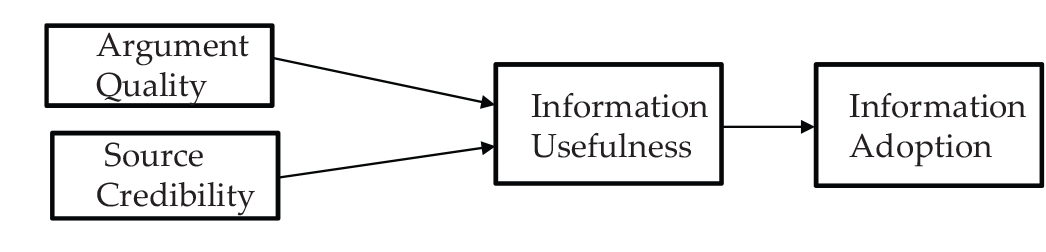
An information adoption-based view of information transfer assumes that just as people form intentions towards adopting a behaviour or a technology, they similarly form intentions towards adopting particular advocated ideas and behaviours. As such, factors that influence the adoption of behaviours or technologies can be used to understand the adoption of advice as well (Sussman & Siegal, 2003). This model helps in understanding how intentions towards a message (eWOM) are formed. The messages may have different effect on people depending on contexts and settings. The usefulness of eWOM information to a person will also depend on the quality of content and credibility of source. This model is conceptualized in Figure 1.
Elaboration Likelihood Model (ELM)
Extending from the information adoption model, consumers judge the usefulness of information based on the quality and credibility of the person who is sharing it. This is why mostly eWOM generated by a person in close network has a greater influence compared to marketer generated information (Bickart & Schindler, 2001). Sussman and Siegal (2003) use ELM of informational influence to understand the process by which individuals will be influenced by messages which they receive. ELM states that there are two routes to persuade a person—central or direct cues and peripheral or indirect cues (Petty & Cacioppo, 1986). In the eWOM context, when consumers are involved in low-involvement process of online consumer reviews, they engage in peripheral processing by focusing on non-content cues such as a signal showing the product popularity. On the contrary, consumers in high-involvement process are more likely to process persuasion attempts via the central route so that review content is important for them (Park & Lee, 2008).
Cognitive Fit Theory
Researchers (e.g., Park & Kim, 2008) have used the cognitive fit theory along with the ELM model in their research. According to this theory, if individuals have high motivation and ability to process a message, they can engage in effortful cognitive activity through the central route. However, when individuals lack either motivation or ability to process detailed information, persuasion comes from the peripheral route. So, they tend to rely on peripheral cues or mental heuristics rather than focal messages. Therefore, a message with many arguments can be accepted if one thinks that ‘more is better’, without a need to carefully evaluate those arguments. This explains the volume of eWOM message generated and its influence on the consumer who believes that more is better. Gopinath, Thomas, and Krishnamurthi (2014) use the three dimensions of eWOM valence, namely attribute, emotion, and recommendation in investigating the relationship between eWOM, advertising, and brand performance based on cognitive processing of information.
Social Exchange Theory
In the social environment, there is an exchange of tangible or intangible activities between at least two people including rewards or punishments. This theory, proposed by Homans (1958), explains the reasons behind social interaction. It is widely used to explain why individuals share information and opinions and involve in discussions to generate eWOM. It is used in the eWOM literature to find out the types of contributors and the underlying motives for generating and leveraging social capital using online reviews (Munzel & Kunz, 2014). Cheung and Lee (2012) make use of it in investigating the factors that drive consumers to spread eWOM in online consumer-opinion platforms.
Social Contagion
The social contagion theory provides foundation for the spread and diffusion of eWOM among consumers. Trusov, Bucklin, and Pauwels (2009) use it to explain the formation and growth of online communities using Facebook. They explain that eWOM referrals have substantially longer carryover effects than traditional marketing actions and produce substantially higher response elasticities. Libai, Muller, and Peres (2013) use contagion theory to discuss the role of acceleration and expansion in the context of seeding programmes, which are used by marketers to spread information about a new product or idea.
Multistep Flow Model
The two-step flow of communication or multistep flow model states that most people form their opinions under the influence of opinion leaders, who are perceived as experts or more knowledgeable (Katz & Lazarsfeld, 1970). Opinion leaders are the people, who receive the message first and then decode or interpret messages for other users. Hence, they form a critical role due to their influencing power on other persons. This concept of opinion leadership in the eWOM literature is used to explain the propagation of messages and who should be targeted first to generate and expand the messages (Phelps et al., 2004). Myers and Robertson (1972, p. 41) propose that ‘opinion leadership is two-way: people who influence others are themselves influenced by others in the same topic area’. Sridhar and Srinivasan (2012) extend it and suggest that online product reviewers, who are opinion leaders for future consumers, are influenced by information provided by other opinion leaders.
Expectation Confirmation Theory
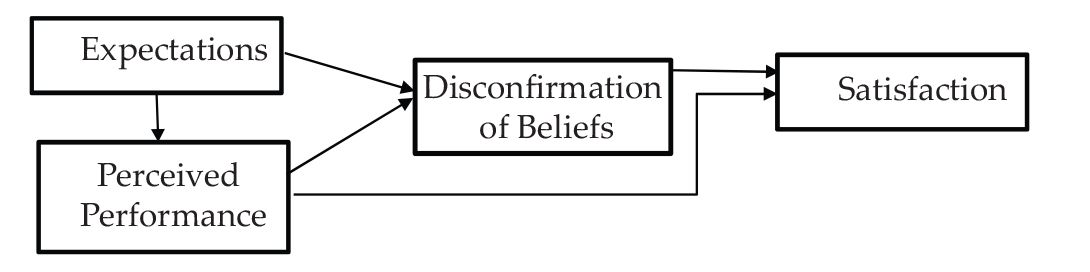
Oliver (1977) proposes the expectation confirmation theory (ECT) which states that expectations, coupled with perceived performance, lead to post-purchase satisfaction. This effect is mediated through positive or negative disconfirmation between expectations and performance. If a product outperforms expectations (positive disconfirmation), then post-purchase satisfaction will result. If a product falls short of expectations (negative disconfirmation), then the consumer is likely to be dissatisfied (Oliver, 1980). This theory acts as the base for valence (positive and negative) and volume of eWOM created in the form of online reviews and ratings (Cheung & Lee, 2012; Hennig-Thurau et al., 2004). The theoretical model is presented in Figure 2.
Thus, we find that conceptualization and theoretical background of eWOM is embedded in theories spanning various areas. In the context of marketing domain, consumers are using it (knowingly or unknowingly) in their purchase decisions. The next section deals with the role played by eWOM in a purchase process.
ROLE OF eWOM IN CONSUMER PURCHASE DECISION
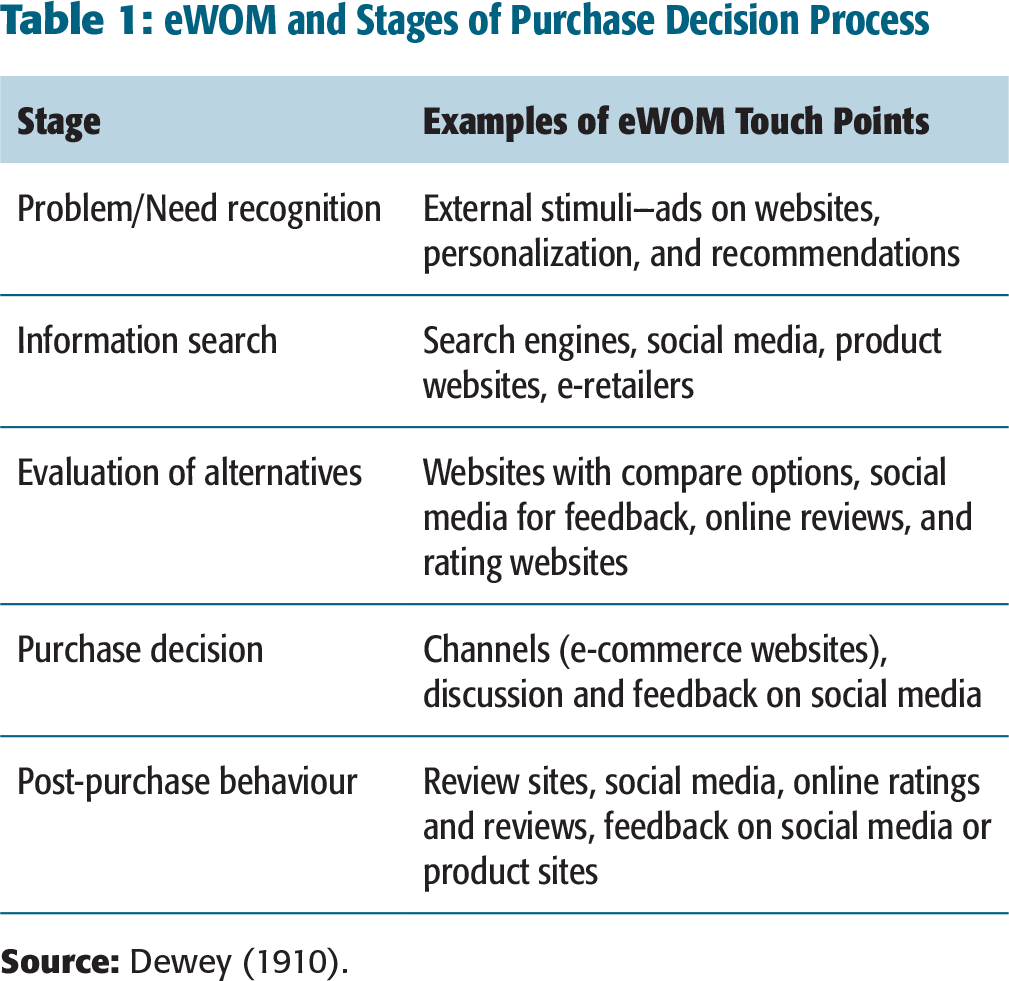
eWOM and Stages of Purchase Decision Process
IMPACT OF eWOM
Majority of consumers are influenced by online reviews and recommendations while making their purchase decisions. As per the Internet Telecommunication Union (ITU), 39 per cent of the global population uses the Internet which translates to 2.8 billion people with access to the Internet (International Telecommunication Union, 2013). With technological flexibility and accessibility options (smartphones/desktops/notebooks/tablets, etc.), consumers have many choices and a powerful medium to voice their opinions in the form of eWOM on different channels and communication platforms. Any consumer with access to Internet can play the role of a critic (Piller, 1999). The line of distinction between real experts and normal users disappears when it comes to influencing the consumer’s choice. Consumers on online channels get influenced more by the reviews of people close to them as compared to reviews by experts. User generated eWOM is considered highly credible and influential in comparison to the efforts created by a company (Bickart & Schindler, 2001). eWOM not only influences consumer decision but also impacts firm profits as it can generate value through market expansion and market acceleration (Libai et al., 2013). It can also help in acquiring customers who would not have bought the product in the first place.
However, online reviews may be subjected to self-selection biases that impact customer purchase behaviour. The idiosyncratic preferences of early buyers can affect long-term consumer purchase behaviour as well as social welfare created by the review systems (Li & Hitt, 2008). Early adopters of the products have a self-bias, thus, influencing the ratings and reviews online. This early positive (or negative) trend has an impact on potential consumers. In contrast, Moe and Trusov (2011) show that although ratings behaviour is significantly influenced by previously posted ratings and can directly improve sales, the effects are relatively short-lived once indirect effects of social dynamic and idiosyncratic errors are considered.
The technological characteristics of the Internet and social media enable eWOM to spread like wildfire within a very short span of time. In reaction to any questionable statement or activity, the social media users can create waves of outrage within just a few hours referred to as online firestorms (Pfeffer et al., 2014). These firestorms pose new challenges for marketers to control the damage and rebuild reputation. Researchers have also made a clear distinction between volume (quantity) and content (quality) of eWOM. Gopinath et al. (2014) state that what people say is more important than how much people say. Time also plays a role in the effects of wear-in and wear-out of eWOM. The emotion-oriented eWOM takes time to wear in before it is impactful and attribute-oriented eWOM wears out over time.
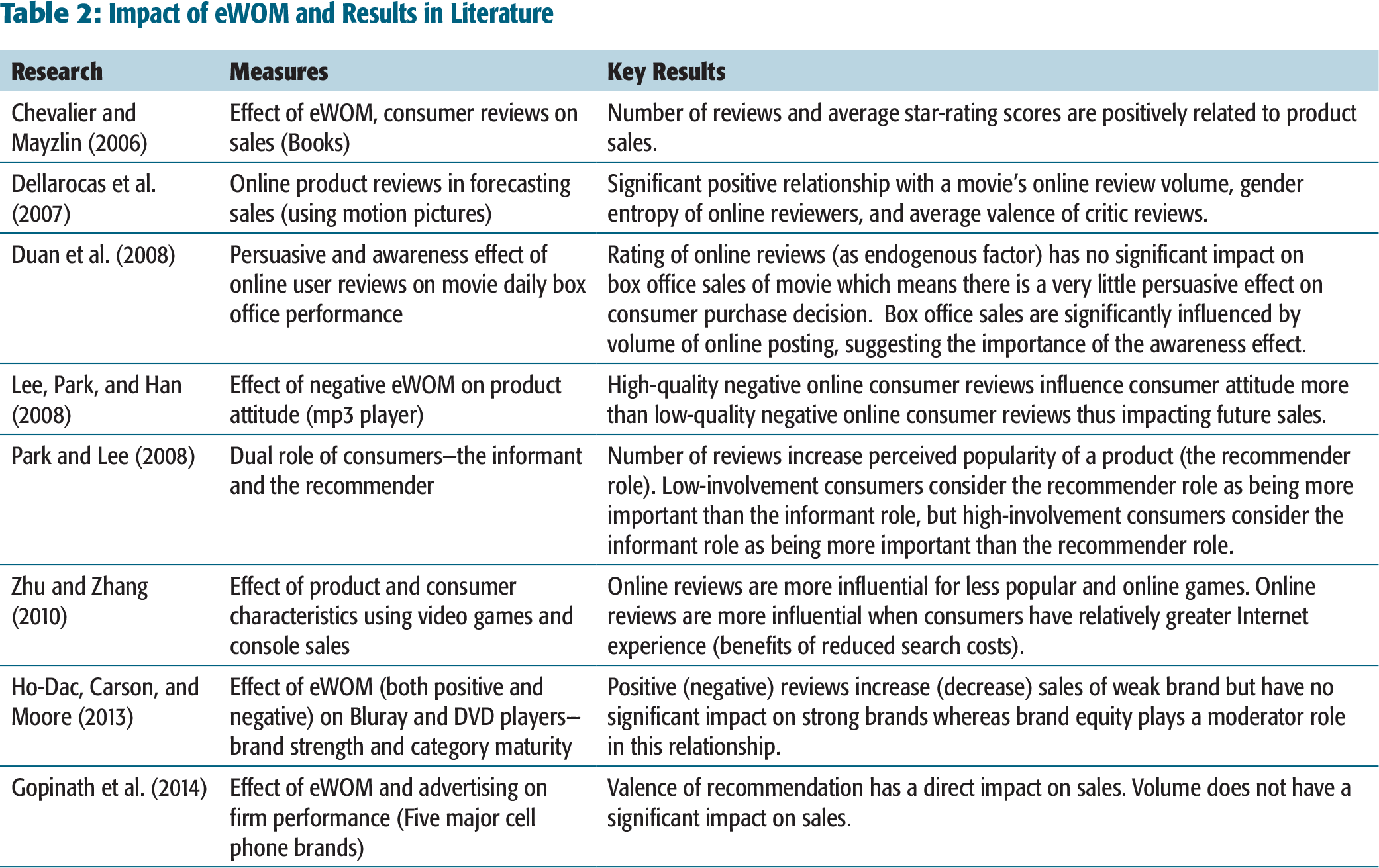
Researchers have taken different measures such as online reviews and ratings to measure the impact of eWOM on different performance measures such as sales. The interesting part is that few studies contradict each other, even though they have used the same industry and data. For example, Chevalier and Mayzlin (2006) examine book sales at Amazon.com and find that online reviews influence book sales; however, using data from the same Amazon.com, Chen, Wu, and Yoon (2004) find that more consumer recommendations improve the sales, but consumer ratings are not found to be related to sales. In the movie industry, while Dellarocas, Zhang, and Awad (2007) find online reviews influencing box office sales, Duan, Gu, and Whinston (2008) suggest that the rating of online user reviews has no significant impact on movies’ box office revenues after accounting for the endogeneity, but they find box office sales to be significantly influenced by the volume of online posting, suggesting the importance of awareness effect.
We present a brief summary of research on the impact of eWOM in Table 2. The next section explains the factors and drivers which motivate consumers to participate in the process of eWOM creation.
MOTIVATIONAL FACTORS FOR GENERATION AND EXPANSION OF EWOM
The review of eWOM literature sheds light on some interesting consumer characteristics and traits that explain the motivation behind the generation and expansion of eWOM. There are broadly two aspects for motivation: the first deals with consumer psychology or behaviour and the second deals with product-specific antecedents which prompt consumers to express themselves. A consumer plays two roles of an informant and a recommender when she engages in creating online consumer reviews which involve experience, evaluation, and opinion on products (Park & Lee, 2008). Based on psychology literature, Cheung and Lee (2012) identify four perspectives, which explain why consumers spread eWOM in online opinion platforms:
Egoism—It refers to serving the public good to benefit oneself. Collectivism—It refers to serving the public good to benefit a group. Altruism—It refers to serving the public good to benefit one or more others. Principlism—It refers to serving the public good to uphold a principle.
Impact of eWOM and Results in Literature
MEASUREMENT OF eWOM VALUE
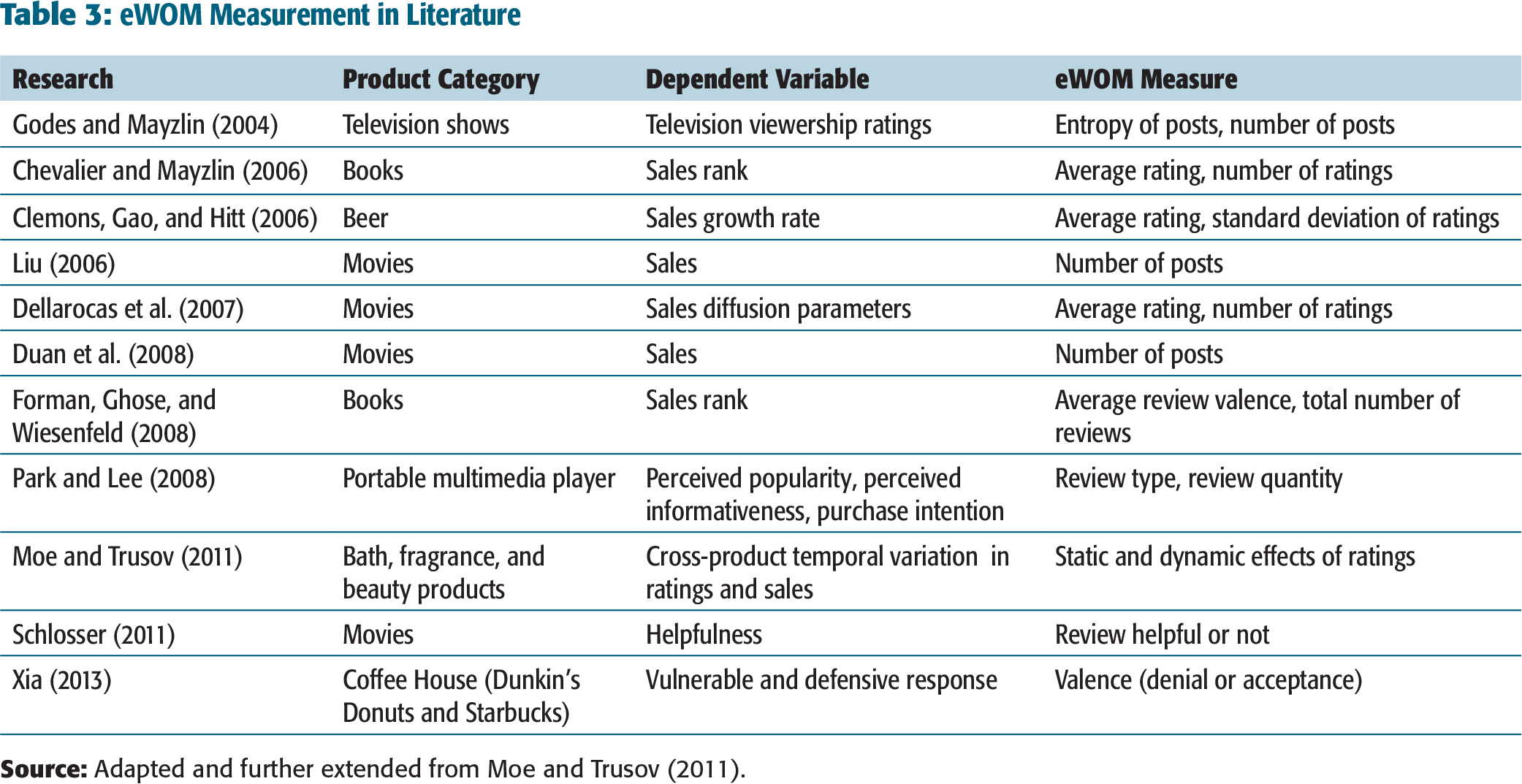
The value of eWOM has been measured using two approaches in literature. The first approach focuses on how many persons are affected and it ignores the time dimension at which they are influenced (Hinz et al., 2011). The second approach assumes that profit results from the eventual adopters and acceleration of adoption (Hogan, Lemon, & Libai, 2003; Ho et al., 2012; Jain, Mahajan, & Muller, 1995).
Researchers have used three parameters to measure eWOM and its effect on product performance:
Valence—average ratings; it includes positive and negative aspects. Gopinath et al. (2014) have added three dimensions of valence: (a) attribute oriented, (b) emotion oriented, and (c) recommendation oriented. Variance—statistical variances Volume—number of postings, number of reviews
eWOM Measurement in Literature
LEARNINGS FOR MARKETERS
Researchers have demonstrated that brand characteristics and consumer characteristics have a complex and interrelated relationship with eWOM. These characteristics can be used to utilize eWOM for better marketing communications and ultimately influence the consumers. Consumers spread WOM (online and offline) as a result of social, emotional, and functional drivers and different brand characteristics such as excitement, differentiation, and complexity (Lovett, Peres, & Shachar, 2013). However, the order of drivers differs in online (social, functional, and emotional) versus offline (emotional, functional, and social) channels. A firm can use the right order depending on the channel it is planning to use for communicating with consumers.
Brand equity plays a moderating role between the relationship of online consumer reviews and sales. Positive consumer reviews have a stronger positive effect on the products of weak brands compared to strong brands. Similarly, negative consumer reviews affect the weak brands more compared to strong brands. Contrary to the speculation that brands will matter less with eWOM, it is proved that in fact eWOM matters less for strong brands (Ho-Dac et al., 2013). The stronger and well-established brands are relatively less affected by a negative eWOM. So, marketers can utilize eWOM valence depending on the strength of their brands. Additionally, marketers can utilize online communities to build stronger brands (McWilliam, 2000).
Social media has changed the balance of power and dynamics of communication between manufacturers and retailers, their brands, and consumers. Consumers are using eWOM in their purchase decision process and as a medium to share their experiences with products and services. Access to this shared information is not confined to geographical boundaries and is available to potential consumers. Firms can acquire, retain, and engage customers (Mayzlin, 2006) and make them happy by utilizing eWOM effectively. These satisfied consumers can expand the positivity as a diffusion process using their social networks to potential customers. Firms can use eWOM channels to post favourable sponsored reviews by experts, or anonymous positive posts, or may decide to post negative information about competing brands. However, there is a risk of such strategies backfire if consumers come to know about sponsored reviews due to credibility issues. Firms may manipulate online ratings to shift consumer beliefs in their favour. If all firms start doing it and consumers anticipate such behaviour, then they may not be influenced by inflated ratings and reviews (Dellarocas, 2003). Firms can utilize the bi-directional nature of online eWOM to match the expected payoff of consumers (Dellarocas, 2006). In case of product failures, they can proactively utilize online channel to reach consumers and address their problems, thereby turning them into satisfied consumers and strengthen their reputation for long-term relations and benefits.
The Internet websites use a variety of summary information strategies to display ratings given by consumers in consumer reviews. The final rating (in the form of stars or numerical numbers) acts as the first impression for a website visitor. Consumers put varying efforts to access and assimilate online information depending on product type—high-involvement or low-involvement product and hedonic or utilitarian product (Moe & Trusov, 2011). For search products, consumers deem online reviews to be more credible when reviews contain detailed information about the product. However, for experience products, consumers determine the credibility of a review by assessing the level of reviewer agreement with a review (Jimenez & Mendoza, 2013). So, a firm can build different strategies based on the type of product to connect and influence consumers with filtered online reviews. Websites can filter the extremely negative reviews or place them deeper (hidden) so that consumers need to put more efforts in the form of more clicks to reach them. Firms should always place a positive review first to its consumers because it acts as an anchor for subsequent evaluations (Lee et al., 2008).
Positive eWOM increases the sales of weaker brands and by increasing sales it generates more positive eWOM. This helps the transition from weak to strong brands and creates a positive loop which not only increases sales but also increases the overall brand equity. The reverse is true in the case of negative eWOM (Ho-Dac et al., 2013). So, firms can utilize the opportunities for their advantage by focusing on generating more positive eWOM and reducing negative eWOM. In case of negative eWOM, a firm should be open to taking criticisms. This may show that the firm is vulnerable. However, this vulnerability is critical for relationship building (Xia, 2013). By accepting the faults and resolving problems, the firm can show a sincere attitude towards consumers and earn their trust and convert them into positive brand ambassadors especially on the social media platform. However, if a firm uses a defensive response, then consumers perceive it as disrespectful towards them which has a negative effect on firm performance in the long run.
Lee and Bradlow (2011) present a very interesting possibility in their research. They propose to use online customer reviews for the analysis of market structure by automatically eliciting product attributes and brand’s relative position. The complete automatic process based on semantic analysis can be run on online reviews to get the voice of customers. The results can be used for further managerial analysis to support the management decision-making process.
In practice, how eWOM can be used in innovative ways without going through the established process can be explained with the help of a very interesting phenomenon that has been observed recently in the Indian mobile smartphone industry. The traditional marketing thinking focuses on building brand awareness and stronger brand equity to connect to consumers and generate sales. However, the success of Moto G, Moto E, and Xiomi smartphones in India provides a contrasting theory. These smartphones were exclusively sold in India by online retailer, Flipkart. All of these phones have experienced stock-outs within minutes of availability due to huge demand. Motorola was able to beat its rival like Nokia in just five months with such a high demand (Dhamija, 2014). The interesting part about this whole story is that there has been rarely any advertisement on any traditional media (TV, newspapers, and radio). The information about these products was available only on online platform such as Flipkart website and few online review websites. Since the phones were distributed using exclusive online retail, consumers did not get a chance to touch and feel the products. It was only positive eWOM that created a buzz among potential buyers and was the main influential driver to generate huge sales.
The power and critical importance of eWOM is widely accepted and many firms are using innovative ways to harness the power of eWOM, to create buzz and awareness among consumers. They have opened eWOM channels to directly connect to consumers (for example, having a dedicated Facebook page, providing options for feedback and communication features on websites).
eWOM has been able to attract marketers and researchers both due to its importance and vast effect on marketing strategies and communications. It has been researched extensively in the last decade along with the growth of the Internet and social networking sites. The ever expanding nature of technological breakthroughs and inter-relationship with consumer behaviour, human psychology, and social behaviour provide ample opportunities for further research.
DIRECTIONS FOR FUTURE RESEARCH
There is already an enormous amount of research available that covers various dimensions and aspects of eWOM. We believe it has further potential for future research due to the emergence of new technological breakthroughs, arrival of smart devices, and increasing access to the Internet across the global population.
eWOM can be created using various sources such as company sponsorship (seeding), expert reviews, or directly by consumers. Till now, researchers have used eWOM sources together to predict sales and other performance parameters of interest (Chevalier and Mayzlin (2006); Clemons et al., 2006; Dellarocas et al., 2007; Duan et al., 2008; Liu, 2006). It will be interesting to investigate the inter-relationships and influence between distinct sources of eWOM. For example, a firm may start with seeding programme about a new product on online platform, followed by expert reviews. The effect of these two as antecedents can be investigated on the potential of future eWOM created by end consumers and performance parameters.
eWOM has the effect of varying magnitude depending on the maturity of product category (mature or emerging) and strength of the brands—weak or strong (Ho-Dac et al., 2013). The effect of eWOM can be measured in different stages of product life cycle (PLC), such as introduction, growth, maturity, and decline stage. For example, the role of eWOM can be studied in the context of expansion and acceleration of product awareness and product adoption in the early introductory stage of PLC. Libai et al. (2013) investigate the value of eWOM seeding programmes and compare the acceleration and expansion effect. The relationship between eWOM and its usage in manipulating or extending the various stages of PLC can be another interesting area. Researchers can focus on finding the nature of relationship between usage of eWOM and duration of PLC stages that can have immense managerial implications and practical utility for marketers. The concept of long tail can also be part of such studies.
Most of the studies have used consumer reviews from websites such as Amazon.com to gather data for analysis. Researchers may look for other sources of eWOM content in online communities and discussion forums. The Internet has devoted forums for Harry Potter and Lord of the Ring fans and many similar other online communities that discuss about books, movies and many other products. Users of these websites create content in multiple forms such as views, opinions, images, and videos, which is different from the content created in standard rating format. These forums may have more insights on consumers’ opinion, as they provide an open discussion environment. It would be interesting to utilize data from such forums for understating the online eWOM generation in future research.
Another area that holds the potential for interesting future research is the social media platform. Theories from sociology such as Hofstede’s (2001) cultural dimension theory and concepts of social capital can be used to study the relationship between a society structure and its virtual equivalent on the Internet. The effect of eWOM can be studied and compared across cultures with different dimensions based on Hofstede’s cultural dimension theory. There is a relationship between consumer’s eWOM intention and social, emotional, and functional drivers (Lovett et al., 2013). This can be further extended to the psychographic characteristics such as lifestyle or life stage of consumers who are involved in the eWOM creation or expansion process. The personality and other psychological characteristics of consumers (cf. introvert versus extrovert) may also affect quality and quantity of the eWOM content.
eWOM has been assumed as a valid and truthful content in research studies. However, hoax and spam, two undesired content of the Internet, have also become an integral part of the eWOM content. A huge amount of content with malicious intentions is generated and spread on the Internet including social sites, which has not been clearly differentiated or mentioned in various studies. Generally, such undesired content has an impulsive theme to persuade users to spread and share it further. For example, false news of death of a celebrity, sighting of aliens, false product contamination rumours, and many more similar examples have been used on social media to spread rumours. Unfortunately, most of the consumers do not invest efforts to check the validity of such information. This opens an interesting area for research on the diffusion of such false information and its impact on the product attitude and purchase intentions of the consumers. The findings from such research will definitely help marketers to deal with unwanted spam and hoaxes effectively.
CONCLUSION
In our review of eWOM literature, we have seen that eWOM is an extension of the well-established concept of WOM on the Internet platform. The conceptual and theoretical foundation is built on theories that span different academic disciplines. The traditional marketing approach is being revised and modified to utilize the power of the Internet. Consumers have more power with them due to proliferation of social media and the Internet forums and communities.
Many consumers directly or indirectly make use of eWOM before making the final purchase. Consumers use eWOM in the post-purchase process to share product experiences and to voice their opinions. Consumers have different motivations when they participate in eWOM creation. They participate to provide first-hand reviews, to help other consumers, to discuss pros and cons of a product and for information sharing. Brand loyalties are fought hard in social communities and forums.
Marketers can utilize eWOM for building product awareness, improving sales and other related performance parameters, strengthening brand value, and building customer loyalty. eWOM also acts as a direct feedback to marketers. They can use positive and negative eWOM to improve their product and service deliveries and to offer recoveries and address consumer grievances.
Technological breakthroughs and inventions and innovations of smart devices, smartphones and tablets, and new ways of communication, such as instant messaging apps on smartphones, are the new trends and events that will have an impact on how consumers and marketers will deal with eWOM. These new avenues will provide the playground for future research in this area. Seth Godin, a famous American marketer and author, sums the importance of eWOM aptly in his blog (Godin, 2010):
The experience I have with you as a customer or a friend is far more important than a few random bits flying by on the screen. The incredible surplus of digital data means that human actions, generosity and sacrifice are more important than they ever were before.