




Abstract
Executive Summary
In the years to come, India will be highly vulnerable to the impacts of rising sea level, floods and droughts, water pollution, and the associated health hazards. In addition to the severe effect of water-related concerns on health and heat stress, water scarcity problems would also impact generation of electricity, both in hydel and thermal power sectors, industrial production, which often requires large volumes of water, and irrigation, which again is highly water-based. To address such severe concerns in the realm of unavailability of water in desired quantity and quality, many industry initiatives have been implemented. However, the challenge is huge and full industry participation in this endeavour is still awaited in India. Private sector participation would be a relevant and much-needed initiative to the cause of water management in the country. However, the inclination of private sector in taking up such initiatives has not been ascertained yet.
Therefore, an empirical academic research was undertaken to determine (a) if there is an awareness in private sector in India with regard to existence and impacts of water crisis and (b) if such awareness would lead to voluntary participation on the part of private sector. A research instrument in the form of survey questionnaire was administered on a population of practising managers across the country. Thereafter, structural equation modelling was carried out to analyse the data, thus, obtained.
The research concludes that there is significant awareness that (a) water crisis does exist in India, (b) there is a possibility of spread of disease due to water stress, and that (c) private sector could help in recycling, treatment of wastewater, and conservation initiatives.
Further, the research also shows a significant link between awareness about disease impacts due to water stress and propensity to support individual initiatives. The awareness that private sector could help in recycling and treatment of wastewater and in conservation initiatives would lead to voluntary participation of private sector both in the organizational capacity as well as in managers taking up individual initiatives.
Keywords
Freshwater is indispensable to most life forms and is needed, in large quantities, in almost all human activities. Climate, freshwater, biophysical and socio-economic systems are interconnected in complex ways, and so, a change in any one of these induces a change in another. Anthropogenic climate change adds a major pressure to nations that are already confronting the issue of sustainable freshwater use. The challenges related to freshwater are: having too much water, having too little water, and having too much pollution. (Bates, Kundzewicz, Wu, & Palutikof, 2008)
Today, freshwater ecosystems and the water resources for human consumption are under severe threat because of the continuous increase in water demand on the one hand and decline in the water quality on the other (Millennium Ecosystem Assessment, 2005). The increase in the demand for water is partly due to the increasing population, urbanization, industrialization, energy demand, and various developmental activities, and partly due to climate change (Pittock, 2011).
It is anticipated that climate change would directly impact water resources in the form of floods and droughts, decline in water quality, and generally affect the availability of water in many different ways (Jain, 2012). Thanks to research, conferences, media, and international agencies, the general awareness about climate change, its causes, and adverse effects are widely known. All the same, the fact that water will be the primary medium through which climate change will influence the earth’s ecosystems and therefore people’s livelihoods and well-being is perhaps not as well known. Availability and quality of water will be the main concerns for the world in the future and these would be the major issues that the societies and the environment would need to address under climate change (Bates et al., 2008).
Both water-related and climate change-related issues, which are often interrelated, are likely to have severe impact on communities and societies across the world. They may even have far-reaching health implications encompassing increase of (a) water-borne diseases because of contaminated water during floods and natural disasters, (b) water-washed diseases resulting from lack of personal hygiene as a result of inaccessibility and scarcity of water, (c) water-based diseases, (d) water-related diseases, and (e) water-dispersed diseases caused by water-borne parasites, insect vectors, and other infections which abound and proliferate in scarce and polluted water (Jain, 2012).
In addition to these health concerns, water scarcity problems would also impact generation of electricity, both in hydel and thermal power sectors; industrial production, which often requires large volumes of water; and irrigation (Jain, 2012). According to the United Nations, about 70 per cent of the water consumption is by the agricultural sector, 22 per cent by industries, and 8 per cent by domestic households (UN Water, 2014). Thus, if water becomes a scarce and substandard resource, the effects will be felt not only by the human population but also in the agricultural, industrial, and energy sectors.
To address such severe concerns in the realm of unavailability of water in desired quantity and quality, countries need to take integrated actions for sustainable water management.
CHALLENGES IN SUSTAINABLE WATER MANAGEMENT IN INDIA
Water management requires addressing the effects of water-related problems and the causes which bring about these problems (Rao & Thamizhvanan, 2014; Sharma & Tomar, 2010).
The process of water resources planning and decision-making should be shared with the four main stakeholders: civil society, relevant government entities, non-governmental organizations (NGOs), and the private sector. Their active involvement in the planning and implementation process can help in efficiently addressing the challenges in water resources management (United Nations Framework Convention on Climate Change, 2008).
Water Situation in India
India is endowed with large freshwater reserves; however, increasing population and overexploitation of surface and groundwater over the past few decades has resulted in water scarcity in some regions.
Growth of the Indian economy has driven increased water usage across sectors, resulting in significant increase in volumes of waste water. In the absence of proper measures for its treatment, the existing freshwater reserves are getting polluted.
Rapid urbanization has resulted in an increase in per capita water consumption in towns and cities. It is also driving a change in consumption patterns and increased demand for water-intensive agricultural crops and industrial products (Grail Research, 2009).
Higher average temperatures that will occur as the result of climate change and changes in precipitation and temperature extremes are projected to affect the availability of water resources through changes in rainfall distribution, soil moisture, glacier and melting of ice/snow, and river and groundwater flows; these factors are expected to lead to further deterioration of water quality as well.
Thus a combined impact of population rise, socio-economic growth, urbanization, and climate change pose challenges towards sustainable water management in India (Jain, 2012). A balanced demand and supply in domestic water use, and adequate availability of water for agriculture, industry, and energy production would be required to overcome these challenges. (Halady & Rao, 2010)
In the coming years, India will be highly vulnerable to the impacts of the rising sea level, rising global temperature, floods and droughts, water pollution, and the associated health hazards. Sea level along the Indian coastline has been steadily rising at the rate of 1.06–1.25 mm/year (MOEF, 2010). By 2100, there may be about 50 cm rise in the sea level, causing a displacement threat to the large number of people living along the 7,517 km coastline.
The rising global temperature is likely to
reduce the size of glaciers in the Himalayan range, severely affecting water flow in the northern river basins in India; increase evapo-transpiration from crops/vegetation and land surfaces; increase water demand from population; and accelerate the occurrence of extreme events such as floods, droughts, and rain storms (IPCC, 2008).
The major Indian rivers get their water from the melting of snow and glacier during the summer season. If the trend of rising temperature continues, the river flow in the Himalayan basins may initially increase. However, with the depletion of snow reservoir, the variability of downstream run-off will increase, subsequently reducing the water flow. This will seriously affect the livelihood of people engaged in fisheries and agriculture in the river basin (Wilk & Wittgren, 2009). To address such water-related threats, coping mechanisms in the form of mitigation as well as adaptation strategies are urgently needed. The mitigation aspects of water-related strategies would refer to reducing the generation of greenhouse gases so as not to increase the global warming (which is one of the main causes of water-related calamities), facilitate judicious use of fresh water, control water demand and improve efficiency, work against contamination of ground water and fresh water bodies, so as to prevent disease and so on. All the same, in view of many water-related calamities which have already destroyed communities, such as Chennai floods in November 2016, we focus here on adaptation strategies (Potarazu, 2015)
Adaptation Initiatives to Water Challenges in India
The human race has to often cope with various kinds of natural hazards such as floods, droughts, forest fires, earthquakes, and spread of diseases. This coping with nature is looked upon as adaptation of the entire society to the natural phenomena. Adaptation to water-related problems refers to changes in the ways society uses water (Jain, 2012). Adaptation strategies have taken different forms: such as seasonal migration of communities in search of water in the face of drought, agricultural population inventing techniques for storing water, relocation of agriculture and irrigation facilities, constructing embankments and dikes, and even lowering lakes to protect cities, agricultural land, and populations from flooding (Wilk & Wittgren, 2009).
Adaptation in the context of water-related concerns should be able to primarily improve resilience of people to the unavoidable variability of water availability in the country. Adaptation strategies should, therefore, include:
Increasing the water supply and improving the ecosystems: This would involve (a) expansion of rainwater harvesting and improvement of rain-fed cultivation and ground water recharge, (b) adoption of water transfer schemes, (c) restoration of aquatic habitats and ecosystems, (d) building of reservoirs to increase storage capacity, (e) encouraging the use of traditional water harvesting systems to supplement household water supply and irrigation practices. Restoring the poorly maintained irrigation infrastructure to improve water efficiency Establishing systems to trap nutrients and provide food and fodder for communities and livestock Protecting the water sources during flooding and conserving water during drought. Controlling water demand and increasing water use efficiency. Encouraging water recycling Growing drought-resistant crops Managing the irrigated agriculture by changing cropping calendar, crop mix, irrigation method, and repairing and maintaining the irrigation infrastructure Improving urban and sanitation infrastructure. Improving flood protection by constructing flood protection infrastructure, increasing upstream storage, and improving flood forecasting Reusing waste water after recycling
In addition to the above, there are many other freshwater adaptation measures such as conjunctive management of groundwater, tank restoration, etc. (Amarasinghe, Shah, & McCornick, 2008; Gupta & Deshpande, 2004; Pittock, 2011). Since private sector has provided leadership for implementing certain well-defined projects, they may be roped in to take up this challenge and achieve the identified targets.
Global Initiatives for Shared Water Management
Most business operations either depend on water resources or have significant impacts on them. Some businesses use water for cooling and cleaning; others use water as a central ingredient in the production or for consumption of the product sold by them (World Business Council on Sustainable Development, 2005). Therefore, the future of business depends on the sustainability of water resources which are increasingly coming under pressure. Globally, per capita availability of water is steadily decreasing. This trend is going to continue with the growth in world population, increased water consumption levels of the emerging economies, and climate change becoming a reality (World Business Council on Sustainable Development, 2005).
In recent years, many business initiatives have been developed across the world to support sustainable water management. In fact, the public–private initiative ‘CEO Water Mandate’ was launched at the 2007 UN Global Leadership Forum (CEO Water Mandate, 2007). Some of the world’s largest corporations urged their business peers to take immediate action to address the emerging global water crisis. The project is designed to help companies better manage water use in their direct operations and through their supply chains. More specifically, the endorsers of the initiative pledge to set water-use targets, assist suppliers with water-efficiency practices, and partner with governments, policy makers and community groups to address water shortages and sanitation, and to share experiences with the ultimate aim of advancing best practices in the field (UN Global Compact, 2008). These initiatives are to be taken up totally on a voluntary basis.
Another initiative called the ‘Water Initiative’ has been launched in 2003 by the World Economic Forum (2008). This programme is intended to promote public–private partnerships on water projects and responsible management of watersheds. The aim is to create multi-stakeholder networks, comprising businesses, NGOs, international organizations, and governments that facilitate cooperation on water projects that are well developed, bankable, with appropriate leadership and financing plans. The initiative has focused on creating water partnerships in India and South Africa (Morrison, Morikawa, Murphy, & Schulte, 2009).
Besides these initiatives, the World Business Council on Sustainable Development (WBCSD) has also encouraged corporations to be concerned about water issues (Moss, Wolff, Gladden, & Guttieriez, 2003; World Business Council on Sustainable Development, 2005). It has introduced the ‘Global Water Tool’ with an emphasis on reporting and risk assessment in the context of water issues (Lambooy, 2011). Guidelines on voluntary environmental reporting are, amongst others, offered by the Global Reporting Initiative (GRI), which has pioneered the development of the world’s most widely used sustainability reporting framework. This framework sets out the principles and performance indicators that organizations can use to measure and report on their economic, environmental, and social performance (GRI, 2008).
Private sector participation in water management has been explored in China’s water market (Choi, Chung, & Lee, 2010), Portuguese water sector (Silvestre, 2012), in Malaysia (Tan, 2012), and Indonesia (Bakker, 2007). In all these studies, the authors have established the tremendous contribution of the private sector towards water management.
Voluntary Participation of Indian Industry in Sustainable Water Management
In India, the industry initiatives in the context of water management have been in the areas of (a) policy formulation, (b) information dissemination, water audits, and water awareness, and (c) water projects which involve promoting private sector participation and watershed management. In this context, the initiatives carried out by many Indian companies in the realm of water efficiency are broadly in the following areas (India Water Portal, n.d.):
Improving cooling tower operations Efficient effluent treatment and usage of waste Corporate Social Responsibility (CSR) activities in water harvesting and watershed interventions Attitudinal and awareness drives like water audits.
The Confederation of Indian Industries (CII) partnered with the Global Water for Sustainability (GLOWS) to build local capacity for Indian industry/corporate through Public–Private Community Partnership (PPCP) projects in water management (PPCP Guidebook on Water, n.d.). Indian Business Alliance on Water (IBAW), formed by the World Economic Forum (WEF) & CII-Godrej GBC in 2006, has facilitated PPCP projects in water for information dissemination through seminars and other awareness programmes in schools and other organizations. The Green Building Movement has also been started to optimize the water use in various buildings across the country (CII, 2009; Iyer & Dasgupta, 2011).
Thus, there are many initiatives that have been successfully implemented in India in the context of water management. However, the challenge is huge and full industry participation in this endeavour is still awaited. Also, the awareness of water concerns is still not widespread in this country. It is expected that as the awareness level grows, especially amongst the private sector, their propensity to commit and encourage their organizations towards sustainable water management will become a reality.
To determine if such propensity exists in the private sector and also to determine if awareness of water concerns exists, an empirical academic research was undertaken.
CONCEPTUAL FRAMEWORK FOR EMPIRICAL RESEARCH
Objectives
The objectives of the empirical research were to:
(1) assess the awareness levels of Indian private sector about the water-related concerns; (2) assess the propensity to take up initiatives to assess water concerns; and (3) evaluate if an awareness would lead to initiatives to address the water-related concerns.
Constructs and Associated Indicator Variables
Prior to empirical research, it was necessary to specify the constructs and associated indicators which could be used to measure the level of awareness of the private sector on the existence and impact of water crisis and assess how it can help in addressing this situation. Based on published research on sustainable water management in India (Grail Research, 2009; Iyer & Dasgupta 2011; Jain, 2012; Thakkar, 2012;) and related literature on water-related issues across the world (Kabat & Schaik, 2003; Pittock, 2011; Wilk & Wittgren, 2009), the following constructs and indicators were identified:
Awareness of Water-related Concerns
The level of awareness on water concerns in India can be determined from the understanding of the different impacts which can be broadly classified in terms of the following constructs:
Construct 1: Awareness of the existence of water shortage situation in India, that is,
Sustainable water management in India poses numerous challenges. There is increasing gap between demand and supply to provide enough water. There is huge challenge in meeting the growing water demands of big cities. There will be higher water demand from the population due to rising temperature as a result of climate change.
Construct 2: Awareness of stress and other impacts due to water shortage in India, that is,
More areas and hence more population will fall under water stress. Crop production will suffer due to water shortage and increasing temperature. Shortage in water supply will affect power generation which needs large volumes of water. Mass migration in search of water will become commonplace.
Construct 3: Awareness of the spread of disease due to water stress in India, i.e.
Water-related diseases will increase. Water-washed diseases will increase.
Awareness of what Industry/Private Sector Can Do to Address Water-related Challenges
Construct 4: Awareness that private sector can start in recycling and treatment of waste, for example,
Private sector can go for investment in recycling and treatment of industrial wastewater. Private sector can invest in waste water treatment plants. Private sector can recycle industrial waste water discharge. Private sector can use already used water for cleaning and recirculation systems.
Construct 5: Awareness that private sector can start water conservation and watershed development, for example,
Private sector can incorporate efficient water usage practices. Private sector can invest in rainwater harvesting facilities.
Construct 6: Awareness that private sector can help build/spread awareness amongst companies
By holding awareness seminars for water conservation for suppliers. By holding awareness seminars for water conservation for distributors. By holding awareness seminars on water conservation for employees.
Construct 7: Awareness that private sector can organize initiatives to enable communities cope with water shortage, for example,
Organize initiatives enabling community water management. Set up drinking water and purification systems. Incorporate community-based watershed management programme. Improve sanitation and availability of drinking water in communities.
Construct 8: Awareness that private sector can organize initiatives to help in improving agriculture and irrigation infrastructure, for example,
Provide irrigation water and increase agricultural production. Help farmers halt watershed erosion and grow more food.
Construct 9: Awareness that private sector can organize initiatives to build waste water treatment plants and sanitation facilities, for example,
Help in improving infrastructure and sanitation facilities in neighbouring residential areas Help promoting waste water treatment plants for groups of small companies.
Construct 10: Extent of keenness or propensity on the part of private sector to:
Encourage organizations to take up voluntary initiatives addressing water-related issues Encourage organization to involve in providing clean water to communities Encourage organization to invest in waste water treatment plants Encourage organization to promote water conservation for suppliers, distributors, and other business partners, etc.
Construct 11: Extent of keenness or propensity on the part of private sector to:
Take up voluntary initiative individually to spread awareness Become a change leader to promote water conservation in organization Start movement to increase awareness of water conservation amongst colleagues.
Conceptual Framework
To meet the research objectives, the following hypotheses were developed:
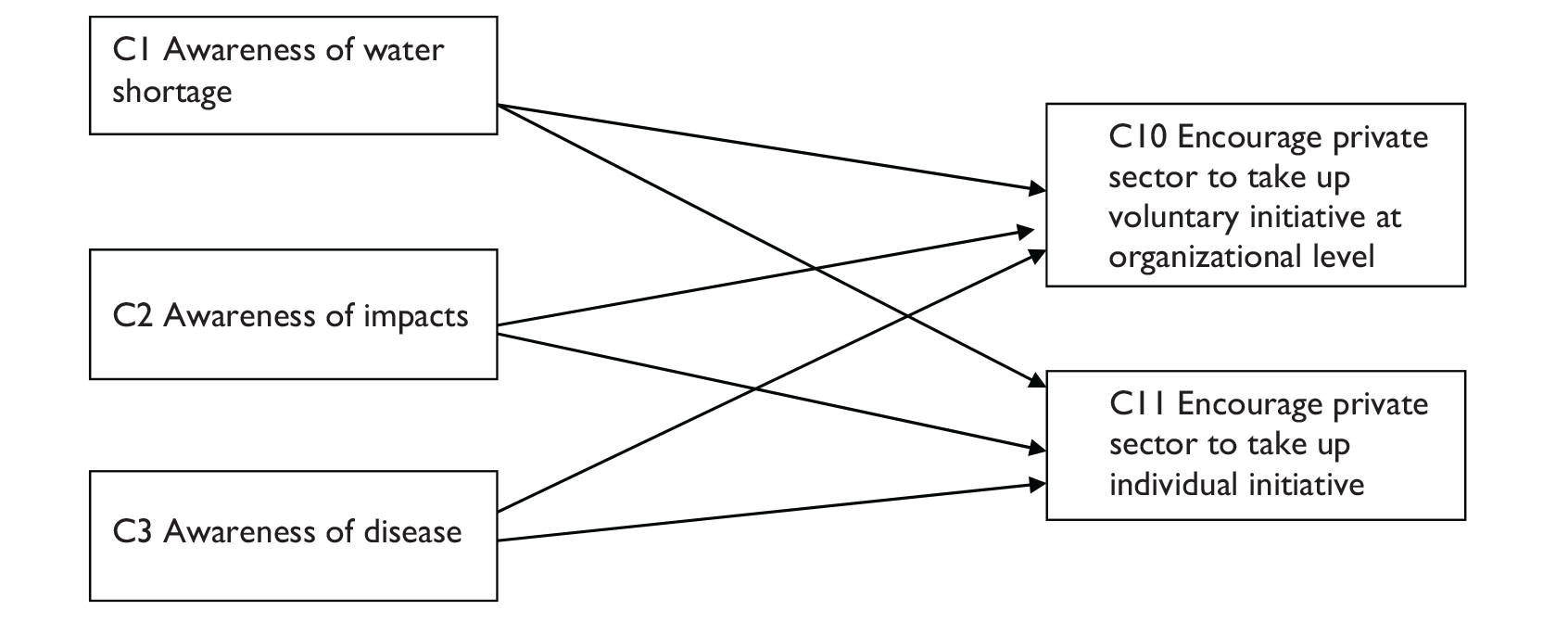
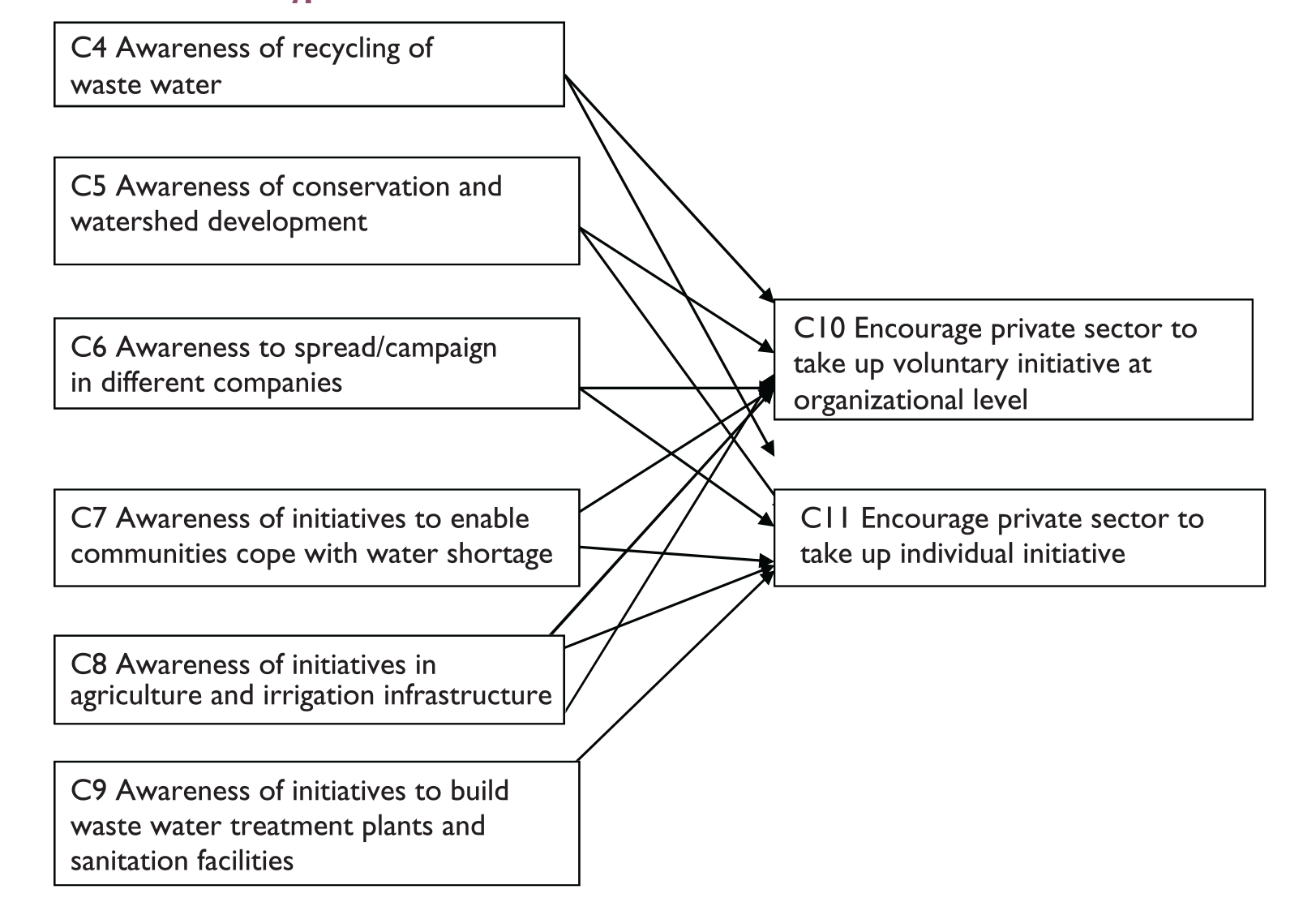
Hypothesis 1: Awareness of the existence of water-related challenges would encourage private sector to take up voluntary initiatives, both individual and organizational, towards enabling communities to adapt to water challenges. Hypothesis 2: Awareness of the potential of the private sector to address water-related challenges in India would lead private sector to take voluntary initiatives, both individual and organizational, to enable communities to adapt to water challenges.
Using the constructs as defined above, the conceptual framework for the two hypotheses can be presented as shown in Figures 1 and 2.
RESEARCH METHODOLOGY
The proposed research consisted of two parts:
Exploratory research, where the basic statistics such as mean standard errors and associated t-values were computed from the database created on the responses. Confirmatory research, where structural equation modelling was applied to determine the factors driving the private sector to take up initiatives for addressing the water challenge in India.
In this section, both the hypotheses are considered and linkages between the awareness constructs and initiatives, both at organizational as well as individual levels, are determined.
Exploratory Analysis
For analysing the data, first, the mean, standard errors, and associated t-values were determined for each construct. These measures were used to test the significance of each construct corresponding to one-tailed t-test with null hypotheses and alternative hypotheses such as:
H0: Mean < = 2.5 (median of the 4-point scale used in the survey questionnaire)
H1: Mean > 2.5 (median of the 4-point scale)
If the t-value associated with the test is greater than 1.645, the construct is considered significant.
Thus, if Construct 1 has t-value greater than 1.645, it can be inferred that awareness of the existence of water shortage is significant among managers in India.
Confirmatory Analysis
The linkages between the constructs were determined by structural equation modelling (SEM), where a series of separate but interdependent multiple regression equations measured the causal relationships amongst the constructs. In SEM, there is a unique feature of being able to include variables that are not directly measurable and are thus called unobserved or latent constructs (Joreskog & Sorbom, 1993). The observed variables, gathered from field surveys, are referred to as manifest or indicator variables and are used to measure the latent constructs.
The significance of the overall model was given by the Chi-square value, associated degrees of freedom, and overall model p-value which must be greater than 0.05 for accepting the model. The individual links were determined in terms of individual critical ratios that should be more than 1.96 or less than −1.96. The critical ratios have individual p-values which must be less than 0.05 to be considered significant at 5 per cent level of significance.
In addition to the Chi-square tests and the associated p-values, various other descriptive measures were considered in assessing the overall model performance: Comparative Fit Index (CFI), Goodness-of-fit Index (GFI), Adjusted Fit Index (AGFI), and Normed Fit Index (NFI), etc. All these indicators should be close to 1 for better model fit.
Research Instrument: The Survey Questionnaire
For empirical research, a survey questionnaire was used to measure 11 constructs presented earlier. The individual variables or manifest variables formed the different items in the questionnaire (Jain, 2012). The items under awareness constructs C1–C9 were measured on a 4-point Likert scale:
1= not aware 2 = little aware 3 = aware 4 = very aware.
The items under the constructs measuring propensity of private sector to take up individual as well as organizational initiatives, C10 and C11, were also measured on a 4-point Likert scale:
1= not keen 2= little keen 3= keen 4= very keen.
In addition, demographic features of the respondents, years of operation of the company the respondent was working for, and the size of the company (in terms of the total number of employees) were obtained.
Sampling Frame and Data Collection
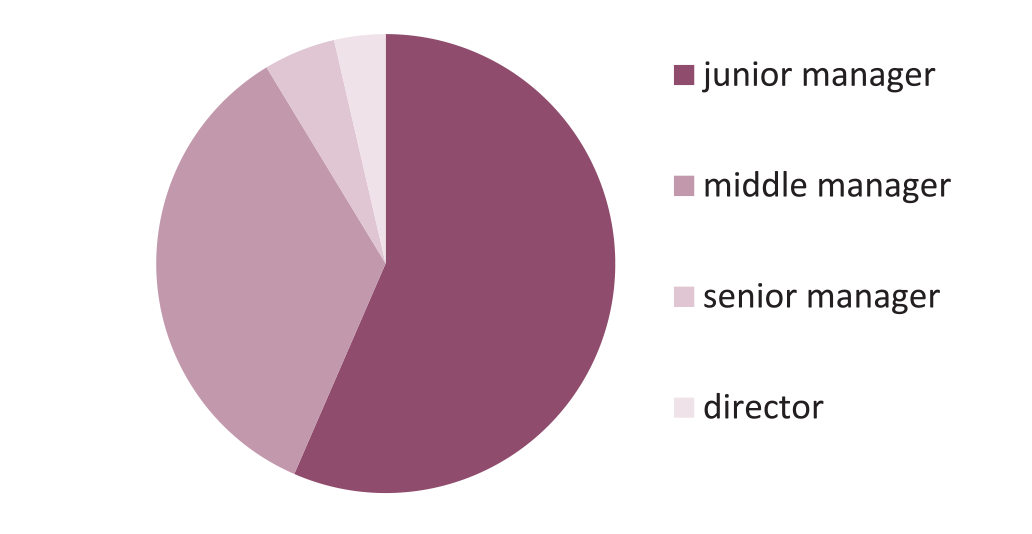
The sampling frame comprised Indian managers working in different organizations in the private sector—professional managers who were Indian alumni of the Asian Institute of Management, Philippines, the Great Lakes Institute of Management, Chennai, and the Indian Institute of Management, Ahmedabad. Data were collected through non-probability purposive sampling. The questionnaire was digitalized and the link sent to a population of junior to middle managers to directors at different organizations in the country.
The final sample size was 166, the associated margin of error being less than 8 per cent. The data collection was carried out during the second half of 2013. Based on the responses obtained, a database was set up and analysed using the methodology explained above.
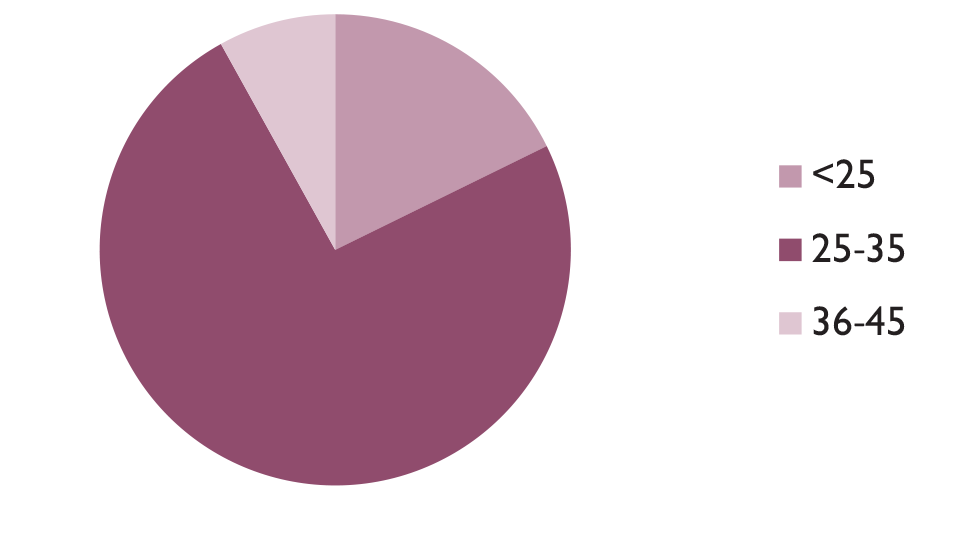
Some indices of sample profile are given in Figures 3(a) and 3(b):
Sample Profile by Age Group
RESULTS
Exploratory Analysis
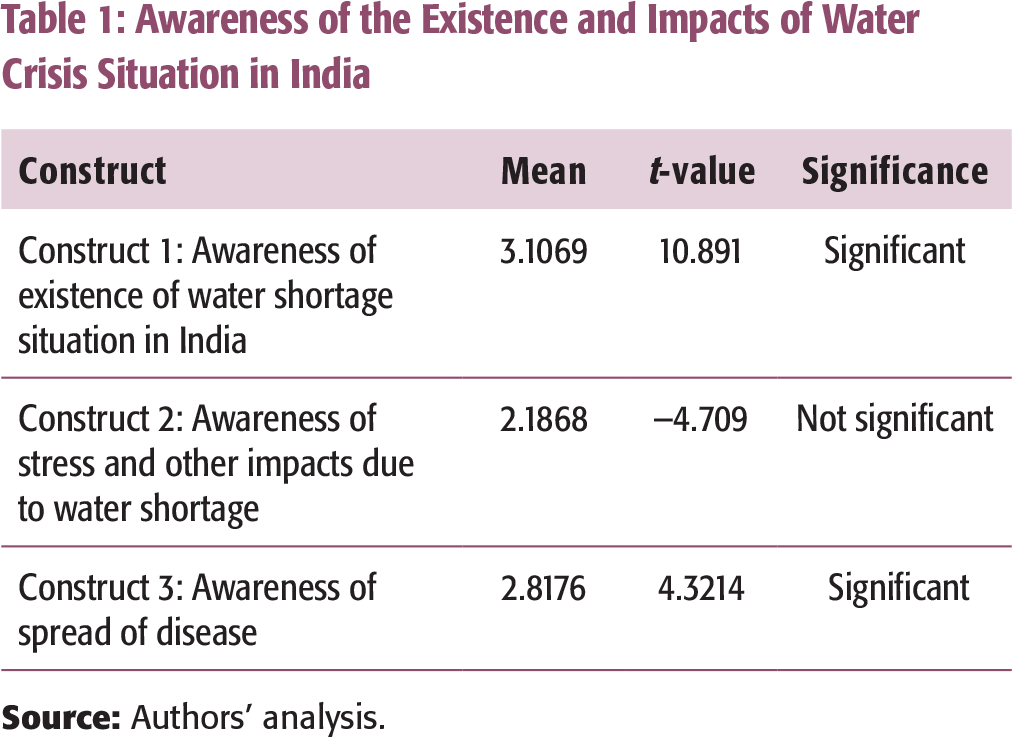
An analysis of the database reveals significant awareness on the part of practising managers about the existence of impending water shortage situation in the country and also about the spread of disease due to water crisis. However, awareness about spread of disease due to water crisis was not significant (Table 1).
Awareness of the Existence and Impacts of Water Crisis Situation in India
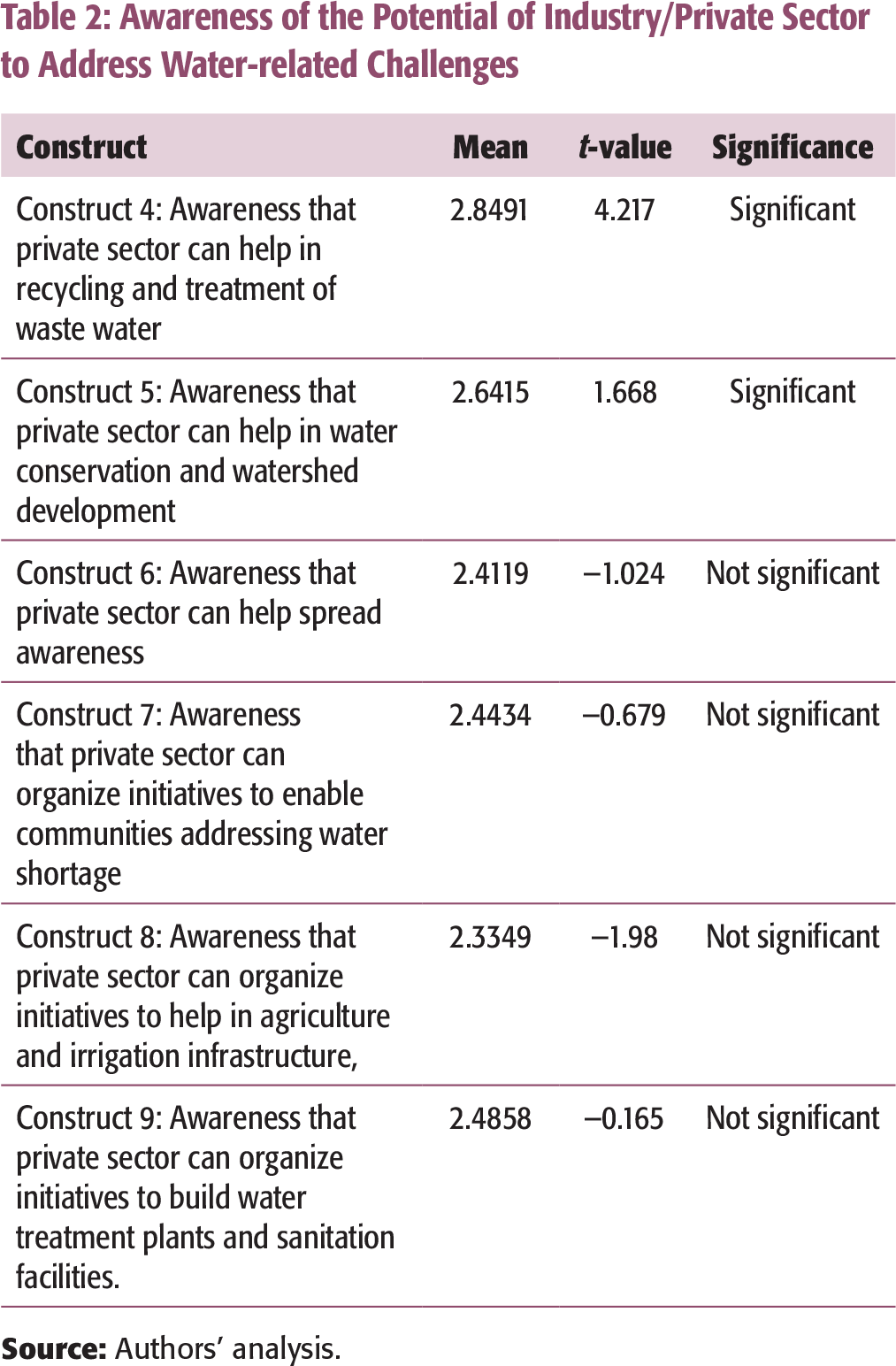
Awareness of the Potential of Industry/Private Sector to Address Water-related Challenges
Propensity of the Private Sector to Take Up Initiatives
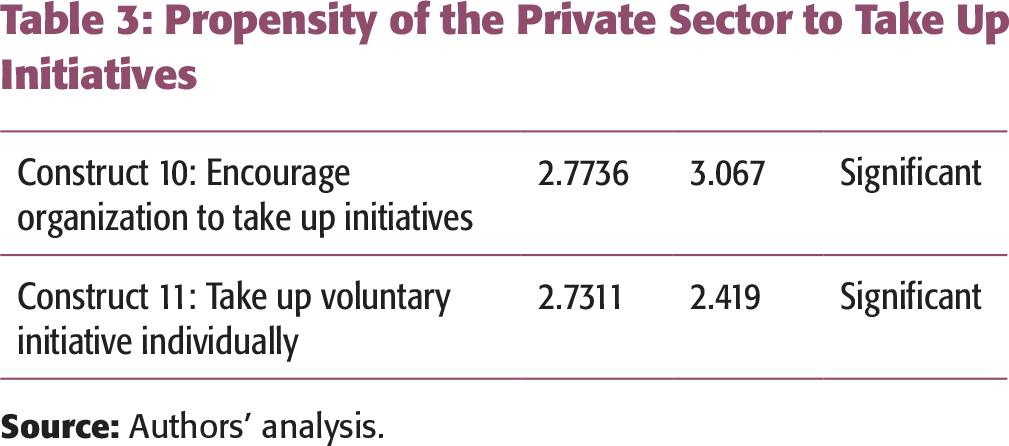
Thus, the private sector has significant propensity to take up voluntary individual initiatives and also to encourage organizations to take up initiatives on water related issues (Table 3).
Out of 11 constructs considered, only 6 constructs, C1, C3, C4, C5, C10, and C11 are found to be significant.
Confirmatory Research with Structural Equation Modelling
Having formulated the two hypotheses, structural equation modelling was applied to check if the data supported the proposed models.
Structural Equation Modelling (SEM)
This is an analytical approach to study the linkages between unobserved variables or latent variables/constructs and observed variables or manifest/indicator variables which constitute the unobserved variables. The measurement model connects the unobserved variable to the observed variable. The structural model connects the unobserved variables to the unobserved variables.
SEM estimates a series of separate but interdependent multiple regression equations simultaneously. Linear SEM approach is used to validate the causal relationships between the different latent constructs (Joreskog & Sorbom, 1993). Generally, the fit criteria of a structural equation model indicate to what extent the specified model fits the empirical data. Only one GFI measure, that is, the c2 test statistic, has an associated significance test, while all other measures, such as GFI, CFI, AGFI, and NFI, are descriptive.
For the chi-square GFI test of the model as a whole, the chi-square value should not be significant if there is a good model fit: the higher the chi-square, the more the difference between model-estimated and actual covariance matrices, and hence the worse would be the model fit. If the p-value associated with the c2 value is larger than 0.05, the null hypothesis is accepted and the model is regarded as compatible with the population covariance matrix S. In this case, the test states that the model fits the data. For a good model fit, the ratio c2/df should be as small as possible.
As there exist no absolute standards, Chi square/ degrees of freedom is less than 2.
Critical ratio: After the model is run, each arrow has a regression coefficient. This coefficient divided by its standard error is called critical ratio. This ratio is very much like the t-value but applies even when the normality assumption does not hold.
Consider any arrow/link from one variable to another. For any regression coefficient b, the null hypothesis is H0: β =0, H1: β =\= 0.
Under 5 per cent level of significance, if critical ratio is more than 1.96, the link is considered significant.
Results for SEM on Hypothesis 1
In this model, the significant constructs, C1, C2, and C3 were considered and their impacts investigated on C10 and C11. The overall measure of the model fit, Chi-square/degrees of freedom, overall p-value, GFI, CFI, AGFI, and NFI are given below.
Chi-square/ degrees of freedom = 1.304 ( good fit comprises < 2)
Overall p-value = 0.071 ( good fit comprises p-value > 0.05)
GFI = 0.919 ( acceptable fit > 0.90)
CFI = 0.982 ( good fit > 0.97)
NFI = 0.927 ( acceptable fit > 0.90)
AGFI = 0.855 ( acceptable fit > 0.85)
Regression Estimates
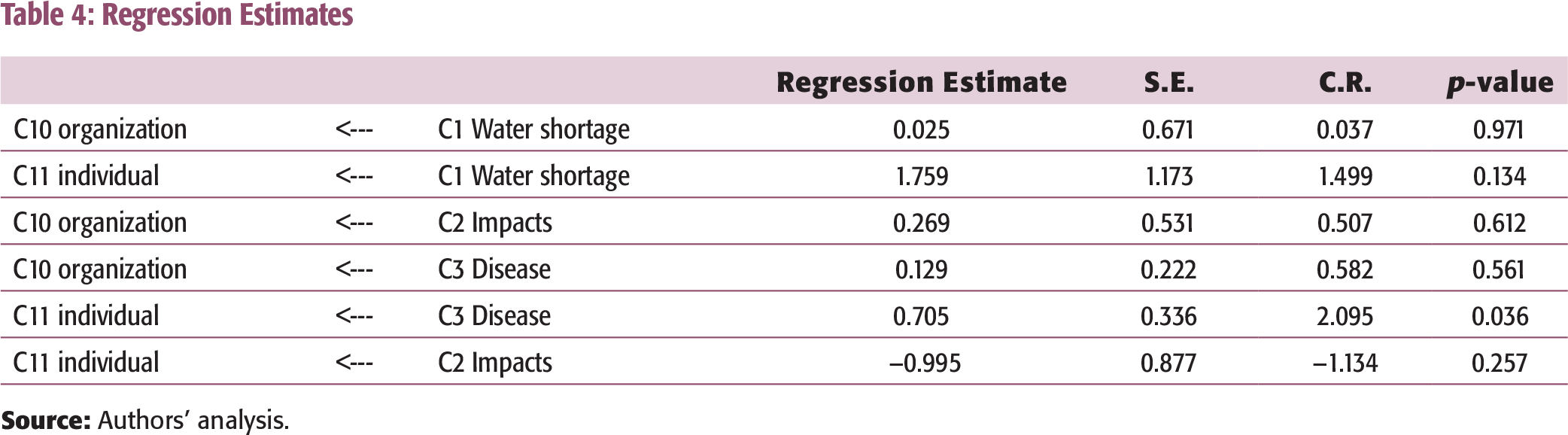
From the regression estimates on the individual links, one observes that most of the links considered are not significant though the overall model fit is significant and acceptable (Arbuckle, 1997). Awareness of spread of disease was the only construct which led to individual initiatives. Thus, the current analysis confirms that as awareness about spread of disease increases, the propensity to individual initiative will increase.
Next a model for Hypothesis 2 was run, using C4, C5, C6, C7, C8 and C9 as independent variables and C10 and C11 as dependent variables (Figure 2).
However, this model did not converge perhaps because C6, C7, C8, and C9 had not emerged as significant in the exploratory analysis.
SEM Combined Results for Hypotheses 1 and 2
In this analysis, first, a model was proposed considering all the constructs C1–C9 and their causal impacts evaluated on C10 and C11. Using the conceptual framework as given above, with Hypothesis 1 and Hypothesis 2 combined, several runs for structural equation models were taken. The final model did not converge under this scenario.
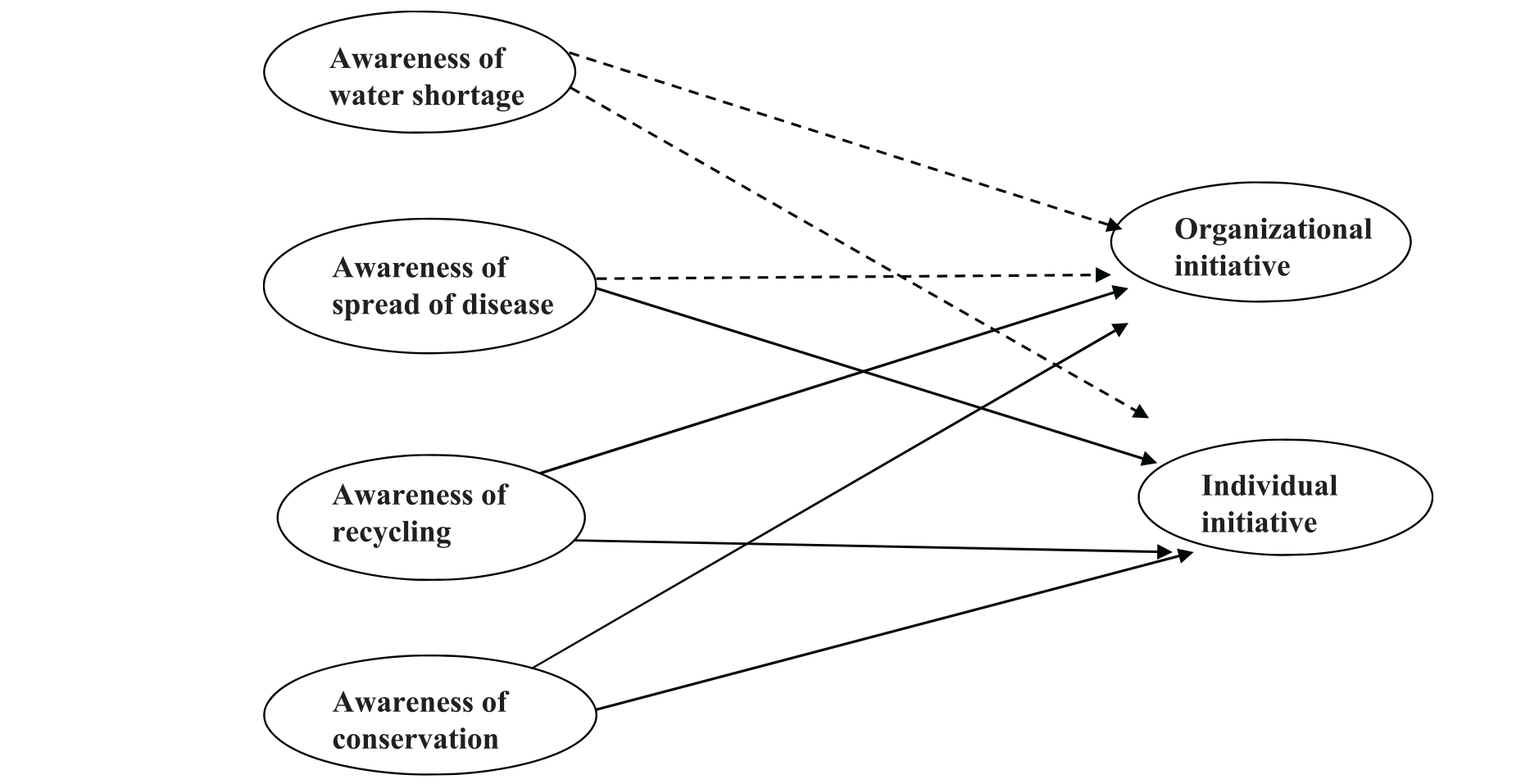
Thereafter, only the significant constructs as obtained from the exploratory analysis were considered. This time the final model converged with C1, C3, C4, C5, C10, and C11 remaining in the model. The following indicators give the measures of GFI:
Chi-square/ degrees of freedom = 1.152 < 2 implying significant model fit
Overall p-value indicating goodness of fit for the final model = 0.113 (good fit > 0.05).
GFI = 0.885 (acceptable fit > 0.90)
NFI= 0.931 ( acceptable fit > 0.90)
CFI = 0.990 ( good fit > 0.97)
AGFI = 0.885 (acceptable fit > 0.85)
From the results on regression estimates of the different links, considering only the significant constructs, the final combined model for Hypotheses1 and 2, emerged (Figure 4).
DISCUSSION AND RECOMMENDATIONS
From the exploratory analysis, it emerges that there is significant awareness about the existence and impact of water crisis in India. There is also significant awareness that private sector can help in recycling and treatment of wastewater and conservation and watershed development initiatives.
The confirmatory analysis shows significant link between awareness of spread of disease and propensity to individual initiatives. The awareness that private sector can help in recycling and treatment of wastewater and in conservation initiatives would lead to voluntary participation of private sector both in the organizational capacity as well as in managers taking up individual initiatives.
Government organizations, NGOs, and industry confederations should actively and jointly set up think tanks to facilitate open debate and dialogue on water management issues. They should engage experts and chalk out road maps for effective private sector participation. The industry confederations need to formulate work programmes through seminars, round-tables, and conferences and adopt a mission to open the closed mindsets, build capacity for rigorous policy analysis and innovative thinking, and stimulate creative problem solving (Vaidyanathan, 2007).
Several well thought out adaptation initiatives for efficient water management have been implemented successfully in many locations (Grail Research, 2009; Iyer & Dasgupta, 2011, etc.). Awareness about the success of these initiatives should be created across the country so that the managers in different industries get motivated to take up effective measures to help the country address the water crisis.
There are various industry bodies in India like Confederation of Indian Industries (CII) and Water Institute at Jaipur, which encourage companies to implement sustainable water management programmes. For instance, Visakhapatnam Steel plant invested $0.47 MM for water conservation and $4.6 MM for ongoing projects in 2006–2007. It also installed 9 check dams and 18 recharge wells for water harvesting (Grail Research, 2009).
Tata Chemicals Limited invested $21,000 in 2006–2007 for water conservation and recycling projects saving 50 MM litres of water per year. Similarly, Wipro and Hindalco have successfully implemented many innovative and efficient initiatives to help in recycling, rainwater harvesting, water conservation, and watershed development at different levels (Grail Research, 2009). Coca Cola India has implemented a water sustainability strategy and engaged the community to overcome water scarcity challenges at their plant locations. In fact, the tipping point was reached with the awareness of the existence and feasibility of private sector initiatives, as significantly confirmed by this empirical research (CII, 2009).
Not only have these strategies been extremely useful to the communities, they have also inspired them to work towards overcoming the water challenge (Chaklader & Gautam, 2013). However, the magnitude of the crisis demands involvement of many more companies on a much larger scale.