



Abstract

Case Analysis
True cultural connection is the holy grail for brands if they want to create an enduring emotional relationship with people.
—Adam Chmielowski, Flamingo 1
Cited in McEwen, W. J. (2005). Married to the brand: Why consumers bond with some brands for life. Princeton, NY: Gallup Press.
Havells India Limited has successfully transformed itself from a family run business to a public limited company. With a turnover of US$ 1.3 billion, Havells is a leading player in the fast moving electrical goods (FMEG) industry. It was undergoing a transition from a predominantly industrial brand to becoming a leading consumer brand in all four categories, namely, switchgears, cables, lighting, and electrical consumer durables. These four categories, comprising 17 business verticals, were managed by their respective business heads and product heads in the organization. The business was now directly handled by a second generation leader, Anil Rai Gupta—the son of the founder of Havells, Qimat Rai Gupta. Havells faced strong competition in different categories from players such as Philips, Osram, Legrand, Schneider, and Anchor, besides the economic slowdown which had reduced the sales of industrial brands. On the other hand, there was an enormous growth potential for Havells as 50 per cent of the market was yet to be adequately covered.
FMEG Industry Environment
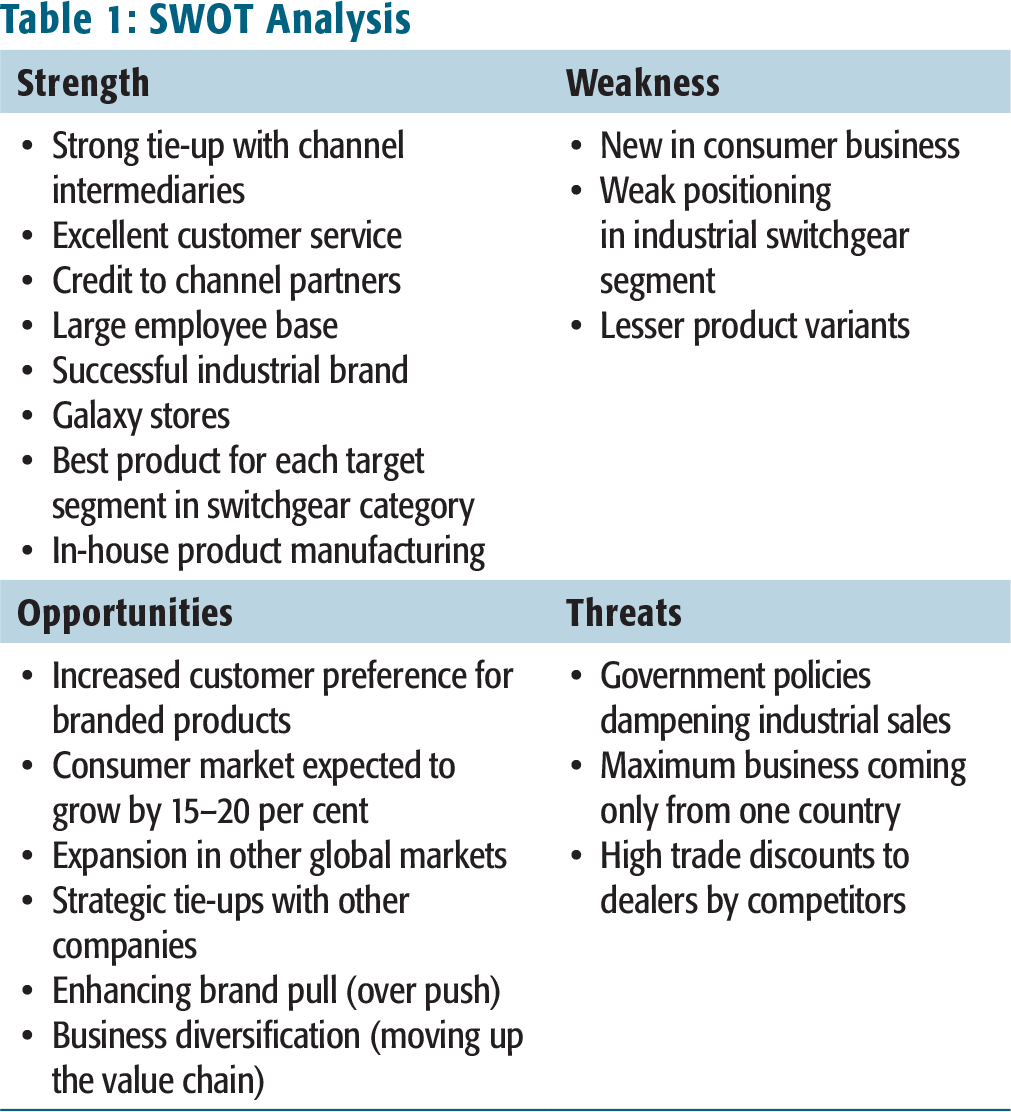
The FMEG industry, especially consumer products, had seen an improved growth in the last few years and many customers now preferred branded products. As a result, more and more consumers had moved to the organized sector for their electrical product requirements. There were bigger players such as Philips and Osram who had created a strong foothold in the consumer market through consistent branding and a wide distribution network. However, the growth in the industrial market of this industry was heavily dependent on government policies. Due to this derived demand trend on government policies, there was a slowdown in the sales of industrial products for the past few years. The index of industrial production (IIP) recorded a negative trend. This prompted companies like Havells to hedge their risk by entering into the consumer market which was expected to grow at a rate of 15–20 per cent in the coming years.
Havells started focusing on the consumer market in 2004. It entered the consumer market with the strength of having a deep understanding of the Indian market and consumer requirements, a strong network of the existing industrial dealers and buyers, large in-house manufacturing capacities, and a large professional strength of over 5,000 employees. The merger and acquisition of companies such as Standard Electricals Limited, Crabtree India, and SLI Sylvania (its lighting business) increased the penetration of Havells in both domestic and global consumer markets. Havells undertook branding efforts in products like MCB and RCCB for the first time in the industry. The idea was to educate the customer about the criticality of the product in terms of its safety and usage. This provided first mover’s advantage to Havells in terms of visibility and building these products as prominent consumer brands in the respective categories.
Consumer Brand versus Industrial Brand
Industrial marketing required personal interaction and an understanding of the product/service requirement of the customer. Relationship building with the target customer and providing timely service are important for building an industrial brand. It is a high involvement process from both sides, and price negotiation plays an important role in it. In the case of consumer brands, the branding is done using mass media including social networking platforms. Sales promotion campaigns and promotional offers help in ramping up the sales of consumer brands. Thus, the process of the transformation of Havells into a consumer brand required sustained media advertisement, which had been undertaken by Havells. There had to be adequate variety in each product line and the variants needed to be launched at regular intervals. Havells seems to be fully aware of this and had R&D centres to meet this requirement. The other challenge with the consumer brands is getting volumes which will help in getting the desired revenue and profits. The industrial brand, being a big ticket item, has either each product costing high or a larger order size (volume), or both, thus leading to larger revenue per customer order. Therefore, sustaining consumer brand requires large threshold volume. A higher unit sales would result in deep market penetration and wide acceptance of product among the masses.
TOWS Matrix for Havells
SWOT Analysis
Suggested Future Move (TOWS Matrix)

Managerial Issues
Anil Rai Gupta was concerned with the strong competition in certain product categories from both multinationals and Chinese companies. Besides industrial slowdown, there was the challenge to sustain and increase the market share. Havells was mulling diversification so as to further grow the business.
The Havells management needed to look into specific managerial issues in its four product categories:
Switchgears: It provided the highest profit margin for Havells. In FY 2013, it contributed to 42 per cent in profits, though in revenue terms (25 per cent), it was second after cable products (the switchgear market was expected to grow by 10 per cent in the coming years). Crabtree, Standard, and Reo targeted different segments of the market. There was high brand preference in this category and hence a lot of opportunity for Havells, as many customers who were buying from unorganized markets were shifting towards the organized market due to its safety and aesthetic appeal features. Havells had the opportunity to grab these new customers through superior branding efforts including customer education using the traditional channels and social media platform. Cables: There was high growth (15 per cent) in demand in this category. Cables and Wires constituted 40 per cent of the entire electrical industry. In industrial purchase, it was mostly transactional relationship with buyers, with pricing being the major differentiating factor. Due to heavy investment on quality and branding, Havells could not afford to offer deep discounts. Therefore, it had to increase its focus on consumer market especially the wires market, where customers are more safety and brand conscious. Lighting: This category has seen transition from lamps to tubes to compact fluorescent lamp (CFL) and now to light emitting diode (LED). The government sector was the major buyer and LED was the future for lighting industry in India. In the CFL business, Havells ranked second (12 per cent of the market share), whereas in Luminaires, it ranked fourth (13 per cent of the market share) in the industry. The LED market was quite fragmented with multiple major players. Superior service offered by Havells was a differentiator in this category. Electrical consumer durables: Havells was a pioneer in decorative fans. It faced stiff competition from Crompton Greaves, Orient, and Khaitan. It also manufactured and marketed motors, home pumps, and domestic appliances dealing such as electric iron, brewing machine, blender, cooking machine, juicer, mixer, water heaters, etc. Havells was a late entrant in the electric consumer durables which was already entrenched by bigger players such as Bajaj, Philips, and TTK Prestige.
Suggested Approach for Havells
Havells is poised for an all-round growth and a transition from a predominantly industrial brand to a consumer brand. In view of this aspiration and taking into consideration the facts given in the case study, the following approach would help it to achieve the desired goal:
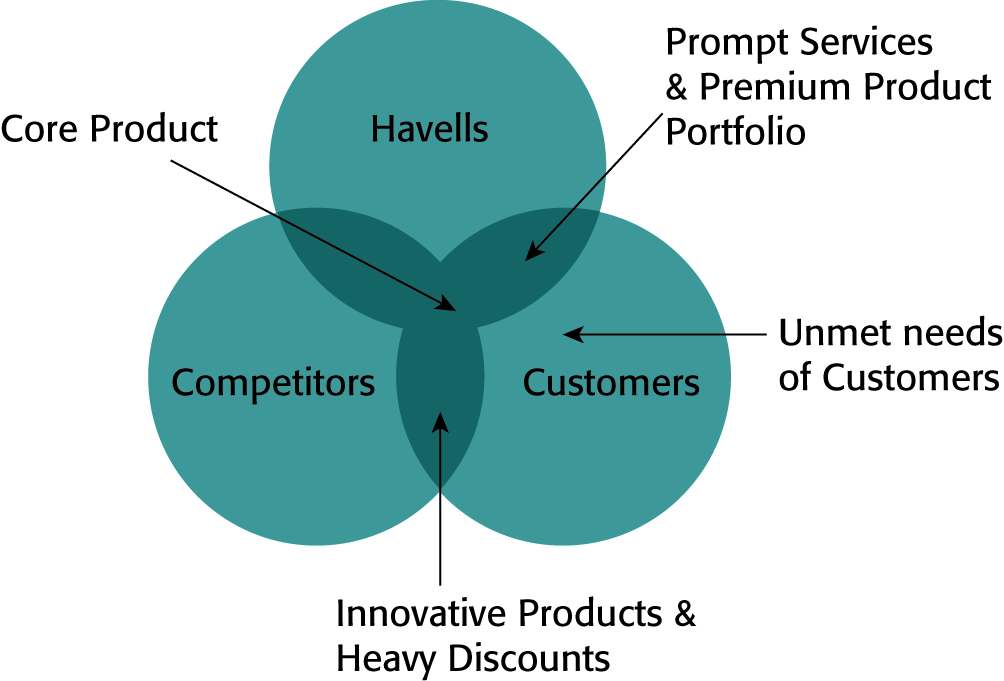
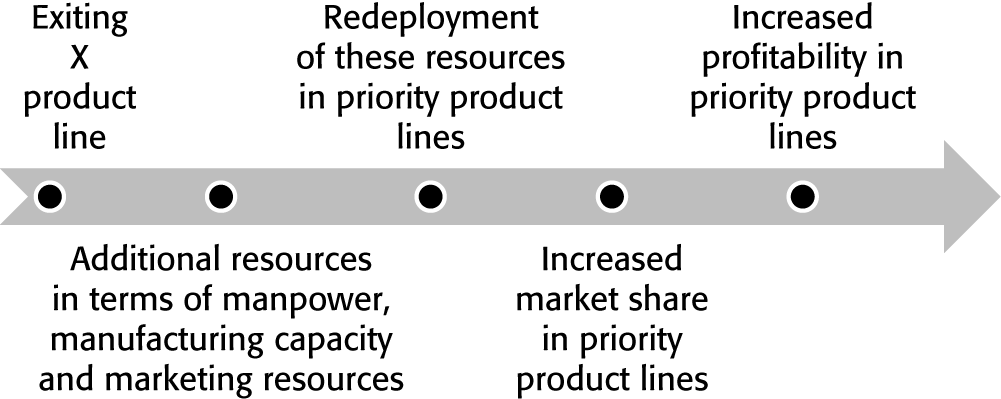
Managing competition through consolidation: Havells has expanded itself too thinly, especially in the electrical consumer durables category. Weak brands demoralize the sales force which has a cascading effect on the other brands of the company. It is recommended that Havells revisits its portfolio and thinks of exiting certain consumer product lines in select categories. This will provide additional resources which may be used to strengthen the focus in promising consumer brands and also cover the rest of the unexplored Indian market. A three-circle exercise for respective categories highlights the points of action. For example, in the case of domestic appliances business of electric consumer durables, Havells is facing a stiff competition from Philips, Bajaj, and TTK Prestige. It has premium products and good services as compared to its competitors who have occupied the majority of the market share with innovative products and dealer’s support due to higher discounts/commissions (Figure 1). Although the market size of domestic appliances is `50,000 million, there are other businesses like cables (`165,000 million), where it ranked third in terms of market share, and lighting (`52,000 million), where it ranked around second (CFL) in terms of market share. So, Havells should exit a few consumer product lines in domestic appliances where it is not even a fourth or a fifth player even after 2–3 years of business (Figure 2). Any diversification initiative by Havells management before undertaking this consolidation exercise may further put pressure on the already stretched organizational resources.
Three Circle Analysis of Domestic Appliances Business (electric consumer durables)
Impact on Electric Consumer Durable Value Chain
Innovation for new consumer brands: In the FMEG industry, like in other consumer product businesses, new products should come at regular intervals. New products are mostly based on incremental innovation initiated on the basis of market feedback or competitive pressure. Successful electrical consumer product companies such as Philips, Osram, and Bajaj are following this trend. Havells initially sourced technology from small and medium enterprises (SMEs) in Germany. Later, many of these German SMEs closed due to Chinese mass manufacturing onslaught. Then Havells decided to have its own in-house innovation centre and thus opened four R&D centres. India now follows the product patent 2
Product patent means that the `process of manufacturing a product' and `the final product' both have to be new/novel.
Process patent means that only the process of manufacturing a product has to be different and it may result in same/similar or a new product.
Focus on Tier II and Tier III cities: In order to successfully transition to a consumer brand, Havells requires a large volume of sale of its products in all four categories. Apart from metro cities and Tier I cities where it may find it easy to make inroads, leveraging its experience and relationship with industrial consumers, a major hope lies with Tier II and Tier III cities. The number of consumers as the target market is much larger in these cities than that in metros and Tier I cities. However, Havells will have to innovate to come up with ‘no-frills’ models and other customized products which are ‘value-for-money’ for Tier II and Tier III customers. The launch of low-priced electric switches ‘Reo’ in small towns and rural areas, and its success in winning customer and retailer confidence, is an important pointer towards this trend. Furthermore, creating a ‘pull’ for the brand will require consistent branding efforts by the company. Barring exceptions in few states such as Punjab and Haryana, the super-premium product offering of Havells such as decorative fans, cables, and brewing machine, may become part of the niche category of products.
Outsourcing: Havells should consider outsourcing some of the product manufacturing besides sourcing a few finished products, specifically for product lines where it does not have technology or it is not competitive (cost-wise) for it to manufacture in-house. There are many consumer products on which the competitors are able to provide higher channel discount than Havells. Undertaking a cost–benefit analysis would result in drastic cost-cutting and help Havells launch new consumer products at a lower cost and enter into different consumer markets faster.
Thus, Havells is on the right path of increasing its market share in the consumer brand as heavy reliance on industrial brands may be risky. However, the consumer brand requires high volumes to break-even, new product launches at regular intervals, and consistent branding to aid recall. Havells needs to emphasize on consolidation and innovation, focus on Tier II and Tier III cities, and explore outsourcing options to reduce product costs on its path to become a leading consumer brand in the FMEG industry.