



Abstract

Keywords
INTRODUCTION
Formerly IAS
Management Consultant, Hyderabad
e-mail: subh_25@yahoo.com
Globally, India is often perceived as an emerging global economic power because of the strong economic growth that the country has achieved for a sustained period during the early twenty-first century, including the global financial crisis period in the late 2000s. The recent slowing down of the economy has not changed that perception significantly. While the growth rate of the gross domestic product (GDP) might justify the tag of an emerging economic power, we cannot escape the fact that India faces several challenges, both in the economic and the social sectors. Various reports published by the government, academic institutions, non-governmental organizations, and multilateral funding agencies, such as the World Bank, highlight many of these challenges, for example, the slow pace of economic reforms, poverty, inequality, dismal educational performance, and poor indicators of health, and prescribe policy solutions. In this colloquium, we focus on a few specific issues that require serious attention of the government and the public but are relatively less discussed in public discourse and policy debates: banking sector reforms, road safety, sanitation reform, and ethics in the medical profession.
The first three contributions are related to banking sector reforms. Two of these contributions, by V K Sharma and R K Dubey, deal with challenges posed by the economic and financial meltdown in the United States (US), which lasted for many years, drying up credit for individuals and businesses and causing huge job losses. Sharma discusses the risk of aggressive lending practices adopted by the commercial banks in the Western developed countries that led to the crisis and the importance of India anticipating such problems to meet the challenges from foreign economies in a globalized world. While the US economic and financial meltdown turned into a global economic meltdown, Indian banks, regulated effectively by the Reserve Bank of India (RBI), avoided the downsides that took the world by surprise. Dubey emphasizes good corporate governance in banks and offers suggestions to avoid such catastrophic consequences in India. The third contribution by T M Bhasin analyses the steps that the banks can take to keep pace with the technocentrism of the next generation. With banks playing a very important role in the Indian economy in agriculture, industry services and entrepreneurship, the challenges they face are intertwined with the challenges that India faces.
The focus of the colloquium shifts to infrastructure with the fourth contribution by Durga Bhattacharya that deals with the severe traffic challenges bedevilling the roads in the Indian metros, the big cities, and also the highways. The situation is worsening each year. The article attributes the choking of traffic in the metros and in the cities in India to the sudden explosion of number of vehicles inadequate breadth and limited infrastructure on the roads. The rapid rise in the number of vehicles is partly due to relatively cheap and easy access to consumer loans from the banks. The loan sanction targets imposed on the officers by the banks are only making things worse. The traffic chaos, in addition to increasing the pollution and making travel less safe, can also cause decline in the economic productivity of urban population.
Subhrendu Bhattacharya dwells on the problem of sanitation—an issue that is as neglected as road safety. While there have been considerable political rhetoric and some policy initiatives in this area, very little has been achieved in terms of outcomes. Urban roads have increasingly become sites for dumping garbage. There is a near absence of sensitization on the issue of sanitation and cleanliness in Indian cities and utter callousness about the maintenance of public goods. The blame has to be also placed at the doors of the administration, including the urban development ministry. While some areas received government attention and achieved remarkable results, sanitation and cleanliness continued to be a matter of high rhetoric and low action for the government as well as corporate India. If the Swachh Bharat Abhiyan of the present Prime Minister has to succeed, then the bureaucrats, ministers and the political parties will have to be seriously trained so that they develop a passion for sanitation in public places, at least now, after a century of initial concern shown by Mahatma Gandhi and Swami Vivekananda for pubic cleanliness.
The twin challenges of traffic and sanitation chaos have become an embarrassment for India worldwide, especially with the advent of electronic media.
Another big challenge that India faces arises from the ethical downsides of medical marketing, which divert considerable resources towards private health care, straining allocation of limited capital to alternative sectors. The last contribution in the colloquium by Raghava Dutt Mulukutla, Soumya Mulukutla, and Uma Aysola stresses the point that it is due to illiteracy in general and medical illiteracy in particular that a lot of expenditure has to be diverted towards offering health care education to the masses. In a literate nation, these funds would have found a better use in other areas of development. More importantly, the article rakes up the ethical and legal issues in medical marketing. It is very important to have structured ethical guidelines in place and to ensure that the stakeholders operate within those guidelines.
India has made remarkable progress in several areas while running the largest democracy in the world. The time has come, however, to pay more attention to some of the hitherto less-discussed issues in public policy—good corporate governance in the banking sector, the state of our roads, our poor sanitation record, and medical ethics.
The Challenge of Financial Leverage in Banking
Former Executive Director
Reserve Bank of India
e-mail: vksvs2009@gmail.com
The article discusses the challenge of financial leverage in modern banking in the aftermath of the global financial crisis and shows how to effectively, and credibly, manage this challenge in the overall interest of the real economy. Given no less significant role of the global credit rating agencies in the global financial crisis, alongside global regulatory and supervisory inertia, the article suggests credit default swaps (CDSs) as effective, credible, and real-time substitutes for the inertial credit ratings. It also throws light on how investors, financial analysts, bank regulators and supervisors like the RBI should analyse the banks' financial performance in the overall interest of systemic financial stability.
THE CHALLENGE OF FINANCIAL LEVERAGE: ‘RISK—REWARD' TRADE-OFF IN BANKING
A bank typically has high financial leverage, which is measured by equity multiplier (EM), which is the total assets of a bank divided by its common equity. Multiplying this leverage (EM) by return on assets (ROA) gives return on equity (ROE) for a bank. Typically, competitive, safe and sound banks have had historically an average ROA of about 1 per cent and an EM of about 15, implying an average market-competitive equilibrium ROE of about 15 per cent. In the recent period, the Indian banking system has had a leverage of about 13–14 times. Significantly, and hearteningly, to the credit of the RBI and the Indian banking sector, this corresponds to an average leverage ratio (inverse of EM) of 7 per cent and more which, at about 2.5 times, is way higher than 3 per cent mandated by the new Basel III capital rules to be complied with only in 2018. Incidentally, but significantly, Indian banks being already 2.5 times Basel III compliant with a leverage ratio of 7 per cent and more will need to increase equity capital only to maintain their existing leverage ratio, that is, to remain compliant with themselves and not at all to comply with Basel III as is widely, but erroneously, made out in many quarters. This conclusion will be very much valid even if the denominator of the leverage ratio is inflated to include all off-balance-sheet liabilities that in the case of Indian banks are about 100 per cent of the aggregate assets because this will only reduce the leverage ratio from 7 per cent and more to 3.5 per cent and more that is still higher than the Basel III requirement of 3 per cent.
In this context, another key financial parameter is net income margin (NIM) that is the difference between interest plus non-interest income earned and interest expended as a percentage of a bank's assets. Collectively, for Indian banks, in the recent period, NIM has varied between 2.5 and 3 per cent. If non-interest income is insignificant and negligible as a percentage of assets, the parameter reduces to what is termed as net interest margin. But as NIM subsumes non-interest income also, it is value adding and better to work with the generic NIM. If we deduct ROA from NIM, we get non-interest cost of intermediation. In fact, it is this critical metric/objective function, namely NIM–ROA that must be the mantra of a role model bank management for maximizing returns to depositors and/or minimizing costs to borrowers. Thus, either way, constrained minimization of the objective function (NIM–ROA) maximizes value to all stakeholders, namely shareholders, insured and uninsured depositors, borrowers, taxpayers, in particular, and the real economy, in general.
And as to why banks must typically be allowed relatively high, but not excessive, financial leverage by public policy, the answer is that banks are special because of their intermediation role in the real economy for efficient and effective monetary policy transmission to happen at all in the first place. To have an incontrovertible sense of this proposition, one only needs to consider the extreme hypothetical case of banks, like some non-financial corporates, having an EM of 1. This, as one will readily see, will mean ROE ≅ ROA × 1, and if this is, say, 14 per cent, the borrowing costs to the real economy will be 14 per cent and more, even if the applicable policy rate is 1 per cent as banks' lending will be entirely funded by interest-insensitive equity. In other words, monetary transmission will be completely clogged. But since higher financial leverage is a double-edged sword, it multiplies through EM, both profits and losses and, therefore, needs to be handled with care. This challenge is addressed by effective regulation and supervision of banks for uninsured depositors and deposit insurance for small depositors.
Incidentally, but significantly, those who swear by Modigliani Miller Theorem 1
Modigliani, F., & Miller, M. (1958). The cost of capital, corporation finance, and the theory of investment. American Economic Review, 48(3), 261–297.
Deposit Insurance and Credit Guarantee Corporation (DICGC) (2012-13). Annual Report. Reserve Bank of India, Mumbai, India.
To complete the story of the inevitability of the challenge of financial leverage in modern banking and central banking, it would only be appropriate to put it in a historical perspective. Specifically, in mid-1800s, Danish banks had a leverage ratio of 75 per cent, Americans had 55 per cent, and Europeans had 25 per cent in the early 1900s. 3
The Economist (November 12, 2012). Strength in numbers: How much capital banks had when they had choice?
In the above infamous somersault in financial leverage in global banking, inflated ratings by global rating agencies played a significant role. Given the serious question mark over the credibility of rating agencies, the Basel Committee needs to revisit the primacy of the role assigned to ratings of such agencies. In fact, credit appraisal and measurement are the most basic functions of intermediation performed by banks traditionally. In the light of this, ratings, if at all, may be meant for and be relied upon by the unsophisticated and uninitiated retail and small investors, but not banks. Besides, given the fact that rating agencies generated almost 40 per cent of their revenues from assigning the so-called inflated ratings to collateralized debt obligation (CDOs) tranches, backed by subprime mortgages and the obvious inherent conflict of interest involved, the US Congress and regulators investigated the role and function of rating agencies. In view of this, Basel Committee needs to de-emphasize rating for assigning capital charge for credit risk by banks. Indeed, if anything, given the tremendous volumes and liquidity of credit derivatives in general and of CDSs, both single names and indices based, it would be more market-price discovery-driven for banks and supervisors alike to rely on prices backed out from these. Indeed, CDSs price credit risks almost on real-time basis as much as the US treasury, foreign exchange, stock and commodities and markets do.
Credit rating agencies, in comparison, are much more inertial and lagged. Significantly, as if to redeem their lost credibility and reputation, all the three rating agencies, namely, Fitch, Standard & Poor's and Moody's started a new service that provided implied credit ratings backed out/derived from CDS spreads. There is, thus, a very strong case for kick-starting a full-fledged CDS market in India. The popular refrain that the recent global financial crisis was caused, or exacerbated, by CDSs is again a myth in that CDSs, which are simple plain-vanilla off-balance-sheet/non-fund-based derivatives, were confused with the CDOs that are on-balance-sheet and funded securitized structured credit products. It was securitization/re-securitization, involving CDOs that played a seminal role in the crisis and in no way the CDSs. In fact, it is also a myth that securitization through CDOs was an originate-to-distribute model; rather, really speaking, it was an originate-to-distribute-back-to-originators model! This is because almost all CDOs originated came back to sit on the structured investment vehicles (SIVs)/conduits sponsored by originating banks themselves. Besides, for all the overdone fears about systemic risks from the so-called unregulated over the counter (OTC) CDS markets, remarkably orderly and non-disruptive auction-based settlement of CDS claims in respect of CDSs written on Lehman Bros., Icelandic Banks, Fannie Mae and Freddie Mac incontrovertibly attested to the resilience of CDS markets. Indeed, if anything, CDSs can be an effective answer and substitute for CDOs/securitization, as it is less messy, more transparent, and easily monitorable.
Interestingly, the New York Fed-led initiative to improve the OTC CDS markets seeks to replicate India's Clearing Corporation of India Ltd (CCIL) model, where although OTC foreign exchange transactions are bilaterally negotiated, they are cleared and settled through RBI sponsored CCIL. Today CDS prices/spreads are by far the most closely monitored early warning signals for real-time changes in credit risk of an entity, whether private or sovereign. This is because CDSs make it possible to back out an implied credit price, even when one is not being discovered in the underlying cash market instruments like bonds or loans. Thus, CDS market has a tremendous practical application as a reliable diagnostic tool in stress testing for supervisors and regulators. Besides, a CDS market will also enable efficient hedging and trading of credit risk and synergize the development of active and liquid corporate bond and repo markets. Like equity, credit risk subsumes all other risks, as it is a function of Forex risk, interest rate risk, leverage risk, liquidity risk, human resources and governance risk, and that is why CDSs and equity prices are, in equilibrium, almost perfectly negatively correlated, that is, as CDSs spreads widen, equity prices fall almost one for one.
CDS, like interest rate swap (IRS), or for that matter any other derivative, is no exception to cash market replication principle of derivatives pricing. 4
Sharma, V. K. (2012). The financial innovations that never were. Keynote Address delivered by V. K. Sharma, Executive Director, Reserve Bank of India, at Finnoviti 2012 organized by Banking Frontiers, Mumbai, India, on 8 November 2012, Bank for International Settlements, Basel, Switzerland, Central Bankers‘ Speeches.
Significantly, if actual CDS premium/price/spread is higher than the above theoretical/model price, then an arbitrageur will sell a CDS (which is equivalent to going along the reference corporate bond) and receive this actual spread and short the reference bond and invest the proceeds of short sale at the going corporate bond repo rate and receive fixed, and pay overnight, in an IRS, and do the opposite arbitrage if the actual CDS spread is lower than the theoretical/model spread/price until the arbitrage opportunity disappears and theoretical/model and actual market prices align again. But sadly, like in a classical catch-22, this arbitrage is just not possible simply because of its complete absence, as I said before, in the IRS market and, therefore, alas, much as we would all wish, a happening corporate bond market cannot happen, inter alia, to supplement huge infrastructure funding needs of the Indian economy!
In particular, pre-crisis, luxuriant supply of liquidity in an exceptionally low interest rate environment, led global banks any which way to expand credit, and inflate, in the process, the now infamous credit bubble with all its cataclysmic and apocalyptic consequences. All through the inflating of this bubble, banks actively engaged in excessively leveraging their balance sheets with no questions asked by regulators and supervisors ostensibly because banks were all this while fully Basel II-compliant based on their risk-weighted assets. In particular, in the case of the five biggest broker dealers in the US, their combined gross leverage exceeded 30 times (incidentally those of Fannie and Freddie exceeded 60 times), although they were very well capitalized on a risk-weighted basis as per the Basel II-inspired rule change by Securities and Exchange Commission (SEC) in 2004, permitting them to compute capital on a risk-weighted basis. Indeed, because of this excessive leverage, risk perception of these prime brokerages deteriorated to a point that their hedge fund clients, a byword for excessive financial leverage, came to eclectically decide which not-so-prime brokerages they will deal with rather than the other way round. This was because hedge funds' leverage was much lower at about 10–15 times in comparison. Also, according to a report in The Economist, 5
Sharma, V. K. (2009). Genesis, diagnosis, and prognosis of the current global financial crisis. Address at the Senior Management Conference, Mumbai, 21 November 2008. BIS Review, 34, Bank for International Settlements, Basel, Switzerland, Central Bankers‘ Speeches.
Specifically, even if global imbalances and accommodative monetary policy provided an enabling environment for excessive leverage and risk-taking, it was still the responsibility of regulators and supervisors to have taken appropriate macro-prudential measures, pre-emptively and proactively, rather than, reactively. But, unfortunately, this broad spectrum and generic failure of an inertial regulatory and supervisory system worldwide, alongside that of global credit rating agencies, especially in the West, precipitated the unprecedented global financial crisis and the resulting great recession. Significantly, Alan Greenspan, in a congressional hearing in October 2008, admitted that he had found a flaw in his free market philosophy that shunned financial regulation and expressed ‘shocked disbelief' that financial firms failed to self-regulate and exercise sufficient surveillance over their trading counterparties to prevent losses. 6
Lanman, S., & Matthews, S. (2008). Greenspan concedes to flaw in his market ideology. Retrieved from http://www.bloomberg.com/apps/news?pid=newsarchive&sid=ah5qh9Up4rIg
Unearned and unearned prosperity are unsustainable. Keynote Address delivered by Mr V. K. Sharma, Executive Director, Reserve Bank of India, on 30 November 2012, at International Leadership Symposium on ‘Rethinking Capitalism and Globalization‘ organized by World Forum for Ethics in Business in partnership with World Bank Institute at European Parliament, Brussels, Belgium. (Bank for International Settlements, Basel, Switzerland, Central Bankers‘ Speeches).
In a refreshing contrast, RBI effectively addressed the challenge of potential financial leverage in Indian banks by pre-emptively and proactively delivering counter-cyclical prudential measures like increasing risk weights for exposure to commercial real estate, capital market and systemically important non-deposit accepting NBFCs as also higher provisions against certain riskier categories of standard assets that were rolled back, again counter-cyclically, to cushion the impact of tighter liquidity and slowing economic growth in the aftermath of the crisis. Not for nothing, therefore, RBI came across as a Quintessential Model of Excellence, a veritable paragon of central banking, standing and walking tall! It is, therefore, no surprise that Jim Walker, Global Head of Research at Credit Lyonnais, eulogized RBI saying that ‘India has the best central bank in Asia.' 8
Op. cit. Sharma, V. K. (2008).
Ibid.
Transitioning to Basel III
It is interesting to consider what impact a quicker transition from the pre-crisis excessive financial leverage to the Basel III-mandated maximum leverage of 33 times will have on the global real economy. Given that even this Basel III-mandated minimum leverage ratio of 3 per cent is rather low, one can imagine where global banks were on this metric before the cataclysm. In sharp contrast, Indian banks being already 2.5 times Basel III compliant with a leverage ratio of 7 per cent and more will need to increase equity capital only to maintain their existing leverage ratio, that is, to remain compliant with themselves and not at all to comply with Basel III as is widely, but erroneously, made out in many quarters. This conclusion will very much be valid even if the denominator of the leverage ratio is inflated to include all off-balance-sheet liabilities that in the case of Indian banks are about 100 per cent of the aggregate assets because this will only reduce the leverage ratio from 7 per cent and more to 3.5 per cent and more that is still higher than Basel III requirement of 3 per cent due only in 2018. But even this rather modest number seems very ambitious if one reckons with the fact that this has to be complied with only by March 2018. But significantly, this is a redeeming feature because any quicker transition would be counterproductive for the global real economy given the state in which it currently is.
To have a sense of what a quicker transition could mean for the real economy, it is instructive, intuitively appealing and insightful to model changes in output/growth in the real economy through an analogy of incremental capital to output ratio by conceptualizing incremental assets to output ratio (IAOR). Any quicker increase in regulatory capital will, as it already has, result in deleveraging or shrinking of, or no growth in, bank balance sheets hurting global output and jobs. Specifically, the IAOR for India is empirically estimated at 2.5, which means that for 1 per cent shrinkage in bank assets, output will decline by 0.4 per cent! This then is the powerful and intuitively compelling way to model the impact of an increase in the regulatory capital or leverage ratio for banks on the real economy and explains the caution on the part of regulators in calibrating the phasing in of higher regulatory capital and leverage ratio.
The other way higher regulatory capital and leverage ratio will hurt growth/output/jobs is through the Taylor rule. In this formulation, higher regulatory capital or leverage ratio would mean involuntary monetary tightening as it were. This would happen because all else being equal, which means NIM–ROA also remaining unchanged, ROA would need to rise for banks to be able to continue to deliver market-competitive equilibrium ROE to attract equity capital. With no further cost cutting and efficiency gains immediately possible, this, in turn, will, through corresponding increase in NIM, increase borrowing costs for the real economy, the effect of which would be the same as that of involuntary monetary tightening. It is precisely to mitigate this adverse impact on growth/output/jobs that calibrated transition to higher regulatory capital/leverage ratio has been envisaged, although 3 per cent leverage ratio itself is rather low. Of course, the upside of longer transition would be that in spite of increasing ROA, banks may even succeed over time in reducing, or even minimizing NIM–ROA via endogenous business process reengineering and technology upgradation, covered later in the article, resulting in reduced borrowing costs for the real economy.
Come quarterly/annual bank financial results, investors and readers of business and financial newspapers are all agog over some analyst gushing, ‘Bank A's net profit rises 35 per cent,' and some other analyst emoting, ‘Bank B's NIM is highest at 5 or 6 per cent.' And all these are taken by readers and investors as a holy grail, suggesting that banks concerned have been exceptionally efficient and profitable. This need not and may not at all be so. But before seeing why, it would only be instructive and value adding to consider the business model of a typical competitive, efficient, safe and sound bank. As we have seen above, a bank is typically characterized by relatively high financial leverage and is measured by EM, which is nothing but total assets of a bank divided by its common equity/shareholder funds. Multiplying this leverage (EM) by what is called ROA gives ROE for a bank.
UNCLUTTERING THE CLUTTER
We are now ready to unclutter the clutter in bank financial performance analysis and evaluation. As regards the myth of NIM being a key measure of profitability, let it be said that NIM, by and in itself, conveys nothing more than what it apparently does. As we have seen before, it is just the difference between interest plus non-interest income earned and interest expended as a percentage of a bank's assets. It is just a means to an end and not an end in itself. For it to make any sense, therefore, it needs to be analysed further beyond what it is by considering NIM–ROA. For if NIM be 6 per cent, and ROA be zero, then automatically ROE will also be zero, and it is no brainer to see that this nominally very high NIM only establishes that the bank is neither competitive, efficient, safe nor sound. Even if ROA be, say, 2 per cent, then NIM–ROA will be 4 per cent. And this bank will be far less efficient and competitive than a bank whose NIM is, say, 3 per cent, and ROA, say, 1 per cent, and therefore NIM–ROA 2 per cent. This is because non-interest cost of intermediation of the higher NIM bank is twice that of the lower NIM bank, and it is precisely twice as large NIM–ROA and its reasons through its granular analysis and dissection that should engage the attention of bank analysts and investors and, no less, RBI, for it is this NIM–ROA that subsumes all non-interest expenses such as taxes, salaries /wages/compensation, operational expenses, loan loss provisions, marked-to-market provisions, write-offs, etc. And this NIM–ROA becomes even more significant, if the reported gross non-performing assets (NPAs) are unusually low. Therefore, in the above example, the bank with a lower NIM–ROA will be twice as efficient and competitive as the one with a higher NIM–ROA because the former maximizes value for all stakeholders, namely, depositors by way of higher deposit interest rates, borrowers by way of lower borrowing costs and shareholders by way of given ROA and market-competitive equilibrium ROE. Significantly, as stated before, in combination with the unusually low gross NPAs for such banks, the unusually wide NIM–ROA would look, if anything, even more questionable in the sense that what is absent in the unusually low gross NPAs is very likely present in the unusually wide NIM–ROA. The RBI must pay particular attention to this feature during their on-site examination and supervision.
Finally, coming to too much being made of, say 25–35 per cent growth in net profits, this too needs to be regarded with circumspection, for these numbers need to be adjusted for the growth in balance sheet/assets and not just considered in isolation and on a stand-alone basis. For if net profit grows at 35 per cent on a year-on-year, or a compound annual growth rate basis and assets/balance sheet also grow by, say, 35 per cent, then there is really nothing to write home about, for the bank in question has been no more, and no less, efficient and profitable than before. Another equally insightful way to see this is in terms of change in ROA. For example, if previous ROA be, say, 1 per cent, then there is no change in ROA, as the ROA also remains unchanged at 1 per cent for 35 per cent growth both in net profits and assets/balance sheet. On the contrary, if for a 35 per cent growth in net profit, balance sheet/assets grow by, say, 25 per cent, then the bank has been more efficient and profitable only to the extent of (1.35/1.25?1)*100, that is, + 8 per cent and not 35 per cent, as bank analysts would unwittingly have readers and investors believe. In this case, ROA increases from 1 per cent to 1*1.08, that is, 1.08 per cent only. Also, significantly, and equally, if balance sheet/assets grow by 40 per cent, then the so-called nominal profit growth of 35 per cent will translate into a less efficient and less profitable performance of (1.35/1.40?1)*100, that is, ? 3.5 per cent and not 35 per cent, as ROA will decline to 0.96 per cent from 1 per cent previously, although absolute net profit increased by 35 per cent. This then is the conceptually robust and technically rigorous nuts-and-bolts way of how bank analysts and investors must dissect bank financial performance and judge the true and fair value of banking stocks for value investing/buying and equally how RBI must evaluate the financial performance of banks it regulates and supervises.
CONCLUSION
The challenge of higher financial leverage in modern banking is inevitable, given the imperative of efficient and effective monetary policy transmission in the real economy so that borrowing costs in the real economy are higher not because of lower financial leverage/higher leverage ratio, but largely, if not only, because of higher monetary policy rates and vice versa. This is precisely here that the synergies between monetary policy, credible and effective banking supervision and, no less, the lender of last resort function come in and which is why banking supervision was taken away from the now defunct Financial Services Authority and given back to the Bank of England after the crisis. In decisively and deftly managing the inevitable challenge of leverage in modern banking, effective and credible supervision makes for efficient and effective monetary policy transmission and, in the process, makes for a globally competitive and efficient real economy. In other words, there is a trade-off between leverage and effective, credible, proactive, pre-emptive and even intrusive, supervision of banks. In other words, the more effective and credible the supervision, the higher the leverage threshold can be and vice versa. The higher regulatory capital, or lower leverage, is the cost of supervisory inaction and failure imposed on banks but borne by the real economy. To make this seemingly heretical statement realistic, one can make the leverage subject to a ceiling, as Basel III has done; only this ceiling is limited by the fallibility of those in charge of banking supervision. So, to conclude, to prevent a repeat of the worst global financial crisis, what we need more than, and beyond, Basel I, II, III, IV...is supervisory temper, culture, and attitude.
Corporate Governance in Banks: Issues and Implications
Former Chairman & Managing Director
Canara Bank
e-mail: rkdubey54@gmail.com
Corporate governance refers to the way in which a corporation is directed, administered and controlled. 10
Baker, H. K., & Anderson, R. (2010). Corporate governance: A synthesis of theory, research, and practice. Kolb Series in Finance, United States: Wiley.
The World Bank User Guide (2005) identified and isolated the following factors for the corporate mess and disarray—‘ineffective boards, weak internal controls, poor audits, lack of adequate disclosure, and lax enforcement have led to financial crises and major corporate scandals around the world in recent years'. 11
World Bank (2005). User guide. Global Corporate Governance Forum Toolkit, No. 2. Washington, DC: World Bank Group. Retrieved from http://documents.worldbank.org/curated/en/2005/01/6477468/developing-corporate-governance-codes-best-practice-toolkit-vol-1-3-user-guide
Cited in Nayak, S. K. (2003). Corporate Social responsibility: An Indian perspective. Executive Education. Retrieved from http://www.iupindia.in/503/EE_Corporate_Social_Responsibility_17.html
In a report for the OECD, Kirkpatrick justifiably maintained
The financial crisis can be, to an important extent, attributed to failures and weaknesses in corporate governance arrangements, which did not serve their purpose to safeguard against excessive risk-taking, in a number of financial services companies. Accounting standards and regulatory requirements have also proved insufficient, in some areas. Last but not the least, remuneration systems have, in a number of cases, not been closely related to the strategy, risk appetite of the company and its longer term interests.
13
Kirkpatrick, G. (2009). The corporate governance lessons from the financial crisis. Financial Market Trends. Paris: OECD Publication.
In a consultative paper on Review of Corporate Governance Norms in India, SEBI defined corporate governance as
[T]he acceptance by management of the inalienable rights of shareholders, as the true owners of the corporation and of their own role, as trustees on behalf of the shareholders. It is about commitment to values, about ethical business conduct and about making a distinction between personal and corporate funds in the management of a company.
14
Securities and Exchange Board of India. Consultative paper on review of corporate governance norms in India. Retrieved from http://www.sebi.gov.in/cms/sebi_data/attachdocs/1357290354602.pdf
In other words, good corporate governance implies a judicious mix of various segments, namely, regulatory governance, market governance, stakeholder governance, and internal governance.
In India, the Kumar Mangalam Birla Report recognized that the ‘fundamental objective of corporate is the enhancement of long-term shareholder value, while at the same time, protecting the interests of other stakeholders'. 15
Report of the Kumar Mangalam Birla Committee on Corporate Governance. SEBI, Government of India. Retrieved from http://www.sebi.gov.in/commreport/corpgov.html
Three basic issues arise here:
Understanding the positioning of the organization and its competitive advantage.
Interpreting and positioning governance in order to develop business, while maintaining an ethical and moral position in the marketplace and community.
Paying fair remuneration to executives, but without damaging the reputation of the organization.
CAUSES OF GOVERNANCE FAILURE
The health of the economy is both a function and reflection of the financial and professional ethics of corporate entities. This necessitates implementation and maintenance of high standards of corporate governance norms. Basic elements of good corporate governance are honesty, trust, integrity, openness, performance orientation, responsibility, accountability, mutual respect and organizational commitment.
The corporate governance philosophy must be based on sound business ethics and strong professional acumen that aligns the interests of all stakeholders and the society at large. Hence, corporate governance transcends the conduct of business in accordance with shareholders' desires. A recent report of the Economist Intelligence Unit 16
Economic Intelligence Unit (2013). A crisis of culture: Valuing ethics and knowledge in financial services. The Economist. Retrieved from http://www.economistinsights.com/sites/default/files/LON%20–%20SM%20–%20CFA%20WEB.pdf
The global financial meltdown of 2008 was caused, inter alia, by the inherent fault lines in corporate governance, including regulatory, market, stakeholder and internal governance. Internal governance failures included ineffective boards, weak internal controls, poor audits, lack of adequate disclosure and lax enforcement; grossly inadequate accounting standards and regulatory requirements; remuneration systems unrelated to the strategy and risk appetite of the company and its longer term interests; proliferation of complex products and inadequate emphasis on financial literacy and consumer protection.
CORPORATE GOVERNANCE PRINCIPLES FOR BANKS—CONSULTATIVE DOCUMENT—OCTOBER 2014
The Basel Committee's revised principles on corporate governance in banks were built on the Committee's 2010 document. Specifically, the revised principles include:
Strengthening the guidance on risk governance, including the risk management roles played by business units, risk management teams and internal audit and control functions, and shaping a sound risk culture to drive risk management within a bank. Expanding the guidance on the role of the board of directors in overseeing the implementation of effective risk management systems. Emphasizing the importance of the board's collective competence, as well as the obligation on individual board members to dedicate sufficient time to their mandates and to remain updated on developments in banking. Providing guidance for bank supervisors in evaluating the processes used by banks to select board members and senior management. Recognizing the fact that compensation systems form a key component of the governance and incentive structure through which the board and senior management of a bank convey acceptable risk-taking behaviour and reinforce the bank's operating and risk culture.
There is no single approach to good corporate governance. But the Committee's revised principles provide a framework of robust and transparent risk management and decision-making, and thus promote public confidence and uphold the safety and soundness of the banking system.
INITIATIVES OF THE RBI
In conformity with the recommendations of the Consultative Group of Directors of Banks and Financial Institutions, headed by Dr A. S. Ganguly, banks were advised in June 2002 to implement appropriate governance practices to preserve shareholder trust, while maximizing long-term shareholder value. The RBI has focused on ensuring ‘fit and proper' owners and directors of the bank, diversified ownership and screening of the nominated and elected directors to satisfy the ‘fit and proper' criteria. Measures initiated by RBI and the central government ensure greater transparency and better governance in banks. Changes have also been made in Sick Industries Companies Act (SICA).
Corporate governance relates not merely to the individual firms or banks, but to the stability of the entire financial structure. Corporate governance in banks requires establishment of policies and procedures for monitoring of credit risk, liquidity and capital and market risks.
CLAUSE 49
On the basis of the Kumar Mangalam Committee, a new Clause 49 was incorporated in the Stock Exchange Listing Agreements. Clause 49 stressed on the following. (a) Board of Directors were accountable to shareholders. (b) Board controls laid down code of conduct and the board was made accountable to shareholders for creating, protecting and enhancing wealth and resources of the company reporting promptly in a transparent manner, while not involving in day-to-day management. (c) The classification of non-executive directors into those who are independent and those who are not. (d) Independent directors were not to have material or pecuniary relations with the company/subsidiaries and if they had, they had to disclose it in the annual report. (e) Emphasis laid on the calibre of non-executive directors, especially of the independent directors. (f) Optimum combination of not less than 50 per cent of the non-executive directors was made, of which companies with non-executive chairman, to have at least one-third of the independent directors and under the executive chairman, at least half of the independent directors. (g) Nominee directors were to be treated on par with other directors. (h) Qualified independent audit committee to have a minimum of three, all being non-executive directors, with one having financial and accounting knowledge. (i) Corporate governance report to be a part of the annual report and disclosure on director's remuneration, etc., was to be included.
These corporate governance norms have been well documented. But there has to be a greater realization that good corporate governance could significantly add value to the company. The success of the provision of independent directors in stopping any potential breaches in the equitable accounting and transmission of created wealth in their companies to the shareholders hinges on the complete independence and objectivity of the chosen directors and the availability of enabling processes for the successful implementation of the scheme.
Rapid growth, post-reforms and the paradigm shift in economic policy made India ideal for exploring the issue. While prior to the adoption of Clause 49, India was considered a laggard in corporate governance. Subsequently, the process of promoting and raising the standards of corporate governance in India has, despite occasional hiccups, indeed made some headway. Contrary to popular perception, Indian investors and businessmen welcomed governance mechanism, becoming an integral part of regulatory prescriptions, such as, Clause 49 of the Listing Agreement and various provisions of the Companies Act. Americans were, however, not at all enthusiastic about the 2002 Sarbanes–Oxley law (SOX), whose provisions were strikingly similar to the Indian law.
The amended Clause 49 of the SEBI guidelines on corporate governance, which came into effect from December 31, 2005, significantly enhanced the original intent of protecting the interests of investors through wider responsibilities of audit committees and streamlined governance practices and disclosures, including those relating to related party transactions and proceeds from public/ rights/preferential issues requiring Board of Directors to adopt a formal code of conduct, widened definition of independent director, periodical review by independent director, whistle blower policy, quarterly compliance report, in the prescribed format, and issue of certificate of compliance. Viewed thus, the revised Clause 49 is of considerable contextual significance.
The revised Clause 49 is applicable to the listed companies in accordance with the defined schedule of implementation. However, for other listed entities, which are not companies, but body corporate (e.g., private and public sector banks, financial institutions, insurance companies, etc.) incorporated under other statutes, the revised clause applies to the extent that it does not violate their respective statutes and guidelines or directives issued by the relevant regulatory authorities. This clause covers various areas, such as, Board of Directors, Audit Committee, Remuneration of Directors, Board Procedure, Management, Shareholders, Report on Corporate Governance and Compliance. But special mention may here be made of the independence criteria for directors, enhanced roles and responsibilities of the board, improved quality and quantity of disclosures, consolidated roles and responsibilities of the Audit Committee in all matters relating to internal controls and financial reporting and enhanced accountability of top management, particularly the chief executive officer (CEO) and the chief financial officer. What is particularly welcomed is that in several of these areas, the revised Clause 49 adopts global best practices and in some cases, even goes beyond the global best practices.
In Clause 49, the listed entities as a part of the mechanism of corporate governance are required to prescribe an inviolable code of conduct for directors on the board of directors of an entity and the senior management. In most cases, however, the code of conduct extends to all employees in the executive grade. In accordance with Clause 49, all banks in India have formulated a code of conduct for directors. This code of conduct, which is posted on the website, clearly enunciates the guiding principles, which govern the operation and conduct of the daily business of banks with their multitudinous stakeholders, government and regulatory agencies, media and other participants. Board members/senior management are required to affirm compliance of the code and the annual report should contain such a declaration signed by the chairman.
All banks have prohibited insider trading and SEBI guidelines are strictly adhered to. All designated employees intending to deal in the shares of the bank exceeding the threshold limit have to seek prior clearance of the compliance officer. No designated employee can pass on any price-sensitive information to any person directly or indirectly by way of making a recommendation for the purchase or sale of the shares of the bank.
All directors are expected to exercise good judgement to ensure the interests, safety and welfare of customers, employees and other stakeholders, and to maintain a cooperative, efficient, positive, harmonious and productive work environment and business organization. The directors while discharging their official duties must act honestly and with due diligence to preserve, protect and strengthen the bond of trust between them and the institutions. In view of the multi-layered issues at stake and the onerous responsibility of adequately discharging fiduciary responsibilities, the directors are expected to exercise the kind of care and prudence, which an ordinary person is expected to take in his/her own business.
EMERGING CONTOURS—NAYAK COMMITTEE AND GOPALKRISHNA COMMITTEE REPORTS
The Report of the Committee to Review Governance of Boards of Banks in India (P J Nayak Committee) (May 2014) recommended major changes in the governance of public sector banks (PSBs), where the government owns more than 50 per cent of the shares, and thus has majority voting power. Hence, the report recommended transfer of government shares to Bank Investment Company (BIC) with functional autonomy, leading to improved governance of PSBs. The committee also suggested incremental changes in the governance of private banks.
The committee termed the boards as ‘non-independent', except for the shareholder directors. ‘Independent' directors are elected by shareholders, excluding the government. But the non-government shareholding in many banks is substantially held by institutions, indirectly controlled by the government, insurance companies, financial institutions, etc. These institutions largely select the ‘independent' directors.
The committee identified three significant issues:
Factors that stymie the performance of PSBs; the perverse incentives in the current structure because of state ownership and operational controls by the state. The committee suggested that the state should continue as an investor; intervene on issues of larger public good through policies, in consultation with RBI and ensure that these policies affect the private banks and PSBs equally and keep completely off-operational control. It also suggested that the government should reduce its stake in the banks to just about less than 50 per cent that takes the banks out of vigilance (right to information), while keeping the state as the dominant shareholder and not losing ownership-based control. Examining ineffective leadership, the committee criticized the process of appointing the chairman and whole-time directors and their tenures. The committee suggested a radical model of moving all the government shareholding in PSBs to a special vehicle, similar to a holding company. This structure would have the basic function of protecting the commercial interests of the state. This committee will also have the power to make appointments of whole-time directors and directors that represent the state, while the rest of the independent directors would be inducted through the process of identification of skill gaps and through a nomination process of the board.
On governance of private banks, the committee identified the nature of investors and suggested a ‘fit and proper' criterion, even for institutional investors (authorized bank investors) eligible to appoint their representatives on the board.
The committee recommended repeal of Bank Nationalization Act (1970; 1980), SBI Act and SBI Subsidiaries Act because these acts require government shareholding to be more than 50 per cent and it is the government that appoints chairman and managing directors (CMDs) and board directors. Once these acts are repealed, the government should set up a BIC under the Companies Act, 2013, as a ‘core investment company'. The government should transfer its shares of PSBs to BIC and register all PSBs as ‘subsidiary companies' of BIC, under the Companies Act. Thus
With BIC owning more than 50 per cent shares in those PSBs, it would have the power of appointing board of directors and through them the CMD. But this requires repealing some acts. Hence, the Nayak Committee recommended that till BIC is formed, the government should set up a Bank Boards Bureau (BBB) at Mumbai. This BBB will comprise senior bankers—three members and one chairman for a three-year tenure. They will advise on all board appointments, including that of the bank chairman/CMD and the executive directors. Once BIC is set up, BBB will be dissolved.
The government rejected the recommendation of lowering government holding in banks below 50 per cent but is open to other suggestions, for example, raising the tenure of CMDs of banks, separation of chairman and managing directors (already implemented) and better quality of independent directors with domain knowledge.
CONCLUDING OBSERVATIONS
In view of diverse challenges, boards must perform their identified roles in contributing, counselling, and controlling dimensions. Monitoring, implementing and enforcing to achieve the desired outcomes in terms of responsibility, transparency, and equitable treatment must be founded on principles-based guidance. These strategies necessitate synchronized measures to consolidate strengths of both the individual constituents and the system as a whole. The effectiveness of industry-led, empirical research-based strong value-added practices depends on the greater accountability of directors, managers and professionals working for companies. Such ‘rules of the game' must eliminate ineffective policies, make unwillingness to change absolutely unacceptable and lift the ‘corporate veil' to minimize regulatory norms and adopt voluntary codes.
Value-added practices do not only matter but they are also here to stay. In the ultimate analysis, value-added practices must be institutionalized so that they transcend the regulatory framework in an attempt to align corporate structure, business and disclosure practices. As M Damodaran, former Chairman, SEBI, stressed, ‘Don't wait for a prescriptive approach, from a regulator, in order to set standards for corporate governance. The best companies are the ones that raise the bar so high that even regulators wonder whether this can ever be followed by other companies.' While regulation and compliance issues are necessary to build a superior performing board, the board has to formulate a vision and ensure complete implementation to provide the key differentiator.
In the imperfect world, beyond compliance with guidelines, boards now matter more than ever. There is a greater thrust on increased transparency and accountability because of compliance mandates, regulation and shareholder activism. Boards require a sharper focus on greater strategic engagement and value addition by the directors, concentration on assumptions and scenario analysis. Accordingly, boards must carefully straddle the risk–reward matrix and ensure the determination of the extent of acceptable risk and implement controls to meet expectations of managers, customers, investors and employees through cultural realization, internalization, and adjustment. It is important not simply to avoid all dangers, but to navigate all risks with intelligence and foresight for ‘prudent risk'. Boards must look beyond revenue and margin and look at brand and the present and future quality of people for sustained improvement.
While better risk management, regulation of pay, and enhanced market discipline are necessary, they do not obviate the need for a strong supervision of banks. Effective regulation promotes corporate governance and effective corporate governance ensures that the objectives of the regulation are met with minimal regulatory intervention.
Professor Mervin E. King, Chairman, King Committee on Corporate governance, South Africa, stressed, ‘It is quality governance and not quantity that is important.' 17
King, M. E. (2010). Foreword. A corporate governance model: Building responsible boards and sustainable businesses. Private Sector Opinion, Issue 17. Global Corporate Governance Forum Publication, International Finance Corporation , World Bank Group, Washington D C.
Banking with Next Generation in a Digital Age
Managing Director & CEO
Indian Bank
e-mail: tmbhasin@gmail.com
The Internet of everything changes everything
—John Chambers, CEO of Cisco.
Rapid advancements in technology are changing the way we interact with each other. Working with the customer-friendly technologies changed the users' mindset to go in for customer-friendly conveniences in business. For banks, this would be a great challenge, as the future customers will represent generations X and Y, and digital babies will have to reach out to the population that loves spending, prefers credit and loans and are projected to be at the peak of their earnings in 10 years from now. Today, about 3.54 billion of the world population is under the age of 30. 18
Oracle Financial Services (2010). Are banks ready for the next generation customer? Retrieved from http://www.oracle.com/us/industries/financial-services/gen-y-survey-report-165297.pdf
BANKING WITH NEXT GENERATION—WHY ARE THEY IMPORTANT AND WHAT DO THEY LOOK FOR?
The banking industry has dealt with generational changes before, but the digital natives of generations X and Y have brought about a unique set of challenges. Their profiles indicate their expectations. They are financial novices who have no long-term investment plans and their most popular banking products are credit and debit cards; a credit-friendly generation that needs flexible financial assistance in managing their financial affairs; mobile banking is their preferred channel for banking; internet is an integral part of their lives and wireless marketing is their preferred choice. Quality customer service is a critical component of generation Y strategy—independently dependent, practically motivated, tech-savvy, socially mindful and financial freshmen. Unlike their brand-loyal predecessors and their choices, they are informed and motivated by their own experience and those of their peers, they are highly educated, skilled and far more entrepreneurial than the earlier generations and they also value their careers more. They want to be well paid to maintain a work–life balance; maintaining their lifestyle is their objective; saving is not a high priority for generation Y, as they believe in ‘living for the day'. In essence, they are the clients who do not care about the labour pains; they want to see the baby.
Digitalization of the Banking World
The Indian banking system is on an upward growth trajectory and is expected to become the third largest banking industry worldwide by 2020. 19
Frost & Sullivan (2013). Indian banking industry to emerge as the third largest in the world by 2020. ANI News. Retrieved from http://www.frost.com/prod/servlet/press-release.pag?docid=288758588
Lito, C. (2011). Challenges and opportunities for Chinese and Indian banks to emerge as global players. Conference of the Asian Bankers Association, Colombo, Sri Lanka, October, 2011. Retrieved from http://www.aba.org.tw/images/upload/files/pp1-14.pdfn
RBI Bulletin (May 2014). Table No. 43—Payment System Indicators. Reserve Bank of India. Retrieved from https://www.rbi.org.in/scripts/BS_ViewBulletin.aspx?Id=14945
According to Economic Survey, 2012–2013, by 2020, the average age of Indians will be 29 years. This new age consumer base is tech-savvy, always connected with real-time online information. The noteworthy milestone in the multi-channel usage has been mobile banking through short message service (SMS). The launch of smart phones has created a revolution in the techno-driven Indian banking system. Cell phone penetration has reached almost 85 per cent and the rise of the middle class has increased the number of households with internet connectivity. ‘The Indian IT industry is projecting towards $300 billion USD per annum in revenue by 2020,' said Som Mittal, President of the National Association of Software and Services Companies (NASSCOM) in India. 22
Mittal, S. (2009). India IT at $300 billion in revenue by 2020. Retrieved from http://webdevnews.net/2009/05/som-mittal-nasscom-india-300-billion-revenue-2020/
Mishra, S. K., & Sahoo, D. P. (2013). Mobile banking adoption and benefits towards customers‘ service. International Journal on Advanced Computer Theory and Engineering, 2(1), 78–83.
Innovative Digital Banking for the Future
Big data, cloud computing, social media, and mobility are the four ‘transformative megatrends' that will shape global technology adoption over the next decade. The concept of ‘virtual banking' is gaining ground in which the banks offer financial transactions directly through electronic delivery channels only without the intervention of branch banking. The power of technology makes it happen seamlessly and virtually. The banking technology, using cloud computing and analytics, based on big data will be the differentiating factor. Big data assumes special significance for a country like India, where the need of the multitude of customers to correspond with different economic strata, languages and social profiles presents an interesting opportunity for business. As per NASSCOM, the big data market in India will grow at 83 per cent annually to reach US$1 billion by 2015. 25
Dataquest (2013). Big Data and enterprise mobility: Growing relevance of emerging technology themes: The India perspective. Retrieved in January 2013, from www.dqindia.com/dataquest/ column/173768/big-data-a-india-perspective
‘Virtual Banker', one of the digital tools, which is a physical extension of the Web, will bring in banker–customer interface through video conferencing services and digital documentation will provide the customers with a true omni-channel seamless consumer experience, where physical branches and online facilities are used interchangeably. The ‘Poalim Connect' model of Israel's Bank Hapoalim 26
Bank Hapoalim (2012). Annual Report 2011. Retrieved from http://globenewswire.com/news-release/2012/03/29/471833/250455/en/Bank-Hapoalim-Reports-2011-Financial-Results.html
An asset-light branch is a ‘Shop' that involves low levels of digitization offerings, retail-like displays and provides customers with the opportunity to browse in self-serve aisles, acting as both, service and sales centres. This bank branch focuses on basic standardized products and services. The intent of the ‘Shop' is to make financial services more tangible by packaging them in boxes and selling them on shelves in branches. It is ideally suited for students, first-time banking customers or existing customers with standardized banking needs. Using a Facebook presence to launch new product ideas and source user opinions is yet another route of digitalization. Creation of ‘Click to Chat' tool, with other features like savings tips, discussions and links to instructional videos on YouTube should be made available on the social network sites. Japan's Jibun Bank uses the mobile channel as its primary means of contact with the consumer, allowing customers to open accounts using just their phone and its camera. 27
Narter, B. (2010). Advanced mobile banking defined: A mobile-centric financial institution (Jibun Bank) case study. Retrieved from http://www.celent.com/reports/advanced-mobile-banking-defined-mobile-centric-financial-institution-jibun-bank-case-study
Challenges Ahead
An ongoing adoption of digital technologies and applications, however, will not be without potential pitfalls, and a number of important challenges need to be addressed to ensure a continued growth:
Ensuring easy usability is one critical challenge area for the manufacturers, as it creates a dilemma between identifying a middle ground between jobs being performed and creation of user-friendly technologies. The challenge for the regulators and policy makers will be manifold. The changed telecommunication definitions will have an impact on marketing and pricing of services and examining the level of market competition in a particular sector. For the regulators and policy makers, identifying the key players across the sectors will be a big challenge. With a host of new wireless technologies poised to enter the marketplace, regulators will need to consider the level of substitutability between cellular mobile and other advanced wireless services such as WLAN or WiMax. The issue of spectrum and how different wireless technologies should coexist alongside one another is another major concern, as the availability of adequate spectrum is critical to support future services. In the process of complete digitalization of the banking world, the branch network rationalization and differentiation of branch types to optimize their service levels, keeping costs under control will be the other concern. Automation of HR functions will have to be evaluated and redefined to provide desired levels of service to the next generation. Maintenance of individualized data of the existing Baby Boomers, generations X and Y and the digital baby customers online for a cradle to grave banking will be a Herculean task. Strategic acquisitions or partnerships with digital innovators to secure their long-term position and market share should be the greatest concerns for the banking industry. Incumbents in developing markets, where there is a larger share of unbanked consumers, will experience the greatest threat from new players if they do not improve their digital offerings. Engaging younger employees more actively to connect with younger customers occupies the critical seat of importance and any mismatch will ruin the process of digitalizing the banking world.
The age of digitization offers the banking industry new opportunities and challenges to growing profits, from improving customer experience to gaining access to a new wealth of data. Together, technology and customer demand are driving a complete transformation of how banking is done. There is a growing global tribe of consumers who want anytime access to services and banking is no exception. A personalized experience sits at the heart of these expectations: Generation Y wants to be treated as individuals. Banks have a tremendous opportunity to provide generations X and Y consumers and digital babies with personalized advice and value propositions. In fact, retail banks that execute correctly will become financial service providers of choice for these consumer categories. The three key elements for banks to meet the needs of generation Y customers are: a mobile-enabled online interface for personal finance management, a video-centric advisory model to interact with bank staff and a bank-moderated community or social networking venue that provides virtualized advice on demand.
The future digital features need to be focused on innovations in user experience, mobile devices and networks, social media and collaboration, customers' analytics and channel integration. The transition towards a digital world has been nothing short of a revolution. In the future, banks will have to become serial innovators, moving with the urgency of start-ups and looking for ideas everywhere. If banks embrace the digital world, banking will become a true enabler in people's lives, helping to change the industry for good. To conclude, banking in a digitalized world is adding value to customers' lives and is not about what products we can offer.
Road Safety and Transportation Challenges in India
Ph.D Scholar
Department of Sociology, Osmania University, Hyderabad
e-mail: bhttya@yahoo.com
The threat perception that beleaguers the Indian roads and transportation system is a daunting challenge that India faces today. With increasing travel demand, on one hand, and limited road capacity, on the other, traffic miseries continue to exacerbate the crisis.
An industrialized society cannot exist without an efficient transportation system. Products need to be moved from where they are produced to where they are consumed with minimum difficulty, in terms of both time and cost. In most industrialized countries, transportation is so pervasive that we often fail to comprehend the magnitude of its impact in the society. In 1999, transportation costs in the US amounted to $554 billion, constituting approximately 6 per cent of the GDP. 28
Stock, J. R., & Lambert, D. M. (2001). Strategic logistics management. New York: McGraw-Hill, p. 312.
Figure 1 illustrates how freight transportation has grown in the US relative to its GDP. Efficient transportation system is an index of development and is possible through expansive road network in India.

Delaney, R. V. (2000, June 5). 10th annual state of logistics report. Press conference remarks to the National Press Club, Washington, DC, Figure 12.
An efficient transportation system is not only critical to industrial development but to the overall growth of the country, and the government's focus on constructing multi-lane expressways network to boost logistics seems very relevant in the context. According to the Planning Commission (2012–2017), 30
Planning Commission (2012–2017). 12th Five Year Plan (2012–2017) Report. Working Group on Central Road Sector, Ministry of Road Transport & Highways, Government of India.
India's NH network covers 1.7 per cent of the total length of roads, which bears the brunt of 40 per cent of the traffic across the length and breadth of the country. Considering the expectant growth rate of 9 per cent, it is estimated by the ministry that a target NH network of 85,000 km has to be achieved. An estimated ₹483,323 crore has been allocated for the expansion and development of NH and expressway. In addition to the National Highways Development Project (NHDP), in the 12th Plan, National Expressways Network, covering an additional 17,637 km will be undertaken, with public–private participation. Similarly, for state highways (SH), major district roads and urban road developments, the ministry has ambitious development plans on building elevated skyways and corridors, and multi-level grade separators at busy crossroads.

INDIAN ROAD SAFETY RECORDS
As per the National Crime Records Bureau 2011 31
Ministry of Home Affairs (2011). National Crime Records Bureau. Retrieved from http://ncrb.gov.in/
According to WHO (2009), 32
WHO (2009). Global status report on road safety 2009. Retrieved from http://www.who.int/violence_injury_prevention/road_safety_status/2009/en/
Number of Accidents and Number of Persons Involved (2002–2011)
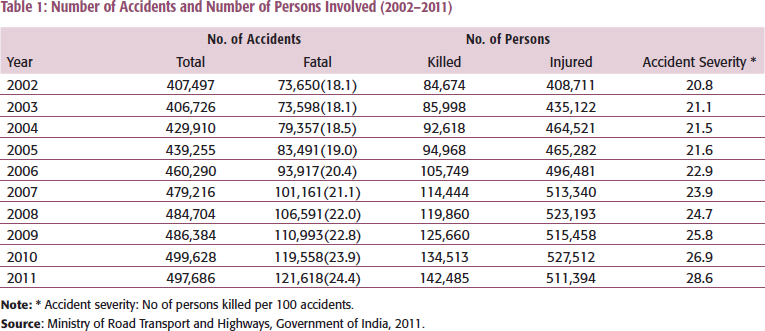
As per the Ministry of Road Transport and Highways 2006 Report, out of the total road-related deaths, 27 per cent are by motorized two-wheelers. Rationally speaking, enforcement of helmet law should be most stringent but is found extremely lacking. The report states that India does not have any road law in place for vulnerable road users like a child or the disabled. It also indicates that Indian highways do not have any speed limit restriction nationally and the local data on speed limit enforcement are unavailable. This only confirms that a grave violation such as speeding is treated with such triviality by the government. The official facts and data validate the serious road safety issues, which need as much attention as road infrastructure development. Figure 3 shows the share of various factors responsible for road fatalities in India.

VULNERABLE ROAD USERS' CHALLENGES
In India, there are no rules of the road; people follow their own unwritten traffic rules. Vehicles change lanes illegally, violate traffic signals; overcrowded autos carry school children posing great risk; ambulances do not get the right of way because of inadequate space on the roads. Moreover, most of the roads in India are poorly lit, increasing the risk of accidents at night. In the developed world, passing a school bus is illegal and punishment involves heavy penalties and suspension of license. In India, there are no laws for school bus, which puts the lives of small children on high risk.
The Global Status Report on Road Safety (World Health Organization [WHO]), 2013, states that more than 231,000 people died in road accidents in India. Approximately half of those are vulnerable road users, motor cyclists, pedestrians, and bikers.
In India, millions walk to their workplace; children walk to their schools. Ironically, few Indian roads have proper sidewalks; some are ill-maintained or occupied by encroachers. Most cities in India do not have a foot overbridge or an underground pedway at major busy cross-roads. The pedestrians are forced to walk on the roads and that significantly increases the possibility of getting hit by a vehicle. A recent Hyderabad High Court order has directed the city authorities to warn the hawkers and shopkeepers against wrongful use of pavements. The court judgment reads that despite the court warning, if pavements are still encroached upon by the businesses for unauthorized display of their merchandize, the authorities can confiscate and auction or destroy the articles. Storm drain covers are often found missing and no warning signs are put up, causing serious threat to the pedestrians.
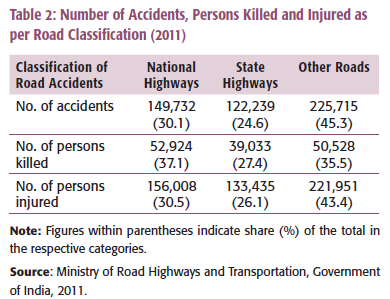
Table 2 classifies the accidents and injuries in national highways, SH and other roads.
Number of Accidents, Persons Killed and Injured as per Road Classification (2011)
EXPANSIVE CAR POPULATION COMPOUNDING ROAD CHALLENGES
With the onset of globalization, in June 1993, a new automobile policy was announced. Foreign automakers began to flood the Indian roads with different varieties of car models. Indian banks exploited the opportunity and began to extend auto loans to euphoric consumers, whose choice of cars and models till then was very limited. But the automakers and the bankers failed to realize that with such aggressive marketing policy, they were adding to the traffic chaos in India. According to State Bank of India (SBI) Director's report 2014, the bank's ‘auto loan portfolio has grown by 35.4 per cent, during FY 2012–2013'. As per the report, SBI car finance offered many concessions, such as no advance EMI, and longest repayment period of seven years to boost sale of cars. The automakers and bankers, through aggressive marketing strategies, flooded the Indian city roads with myriad brands of cars. The city roads overpopulated with cars leave a carbon footprint from vehicular emission and cause serious respiratory health hazards.
As per the data provided by the Office of State Transport Commissioners/UT administration, Indian car ownership per 1,000 person is only 117 as against USA's 828, Japan's 617, France's 654, Germany's 610 and UK's 544 (International Road Federation, Geneva, 2011). 33
Retrieved from https://data.gov.in/catalog/stateut-wise-registered-motor-vehicles-1000-population#web_catalog_tabs_block_10
India should emulate Singapore's vehicle ownership policy. Singapore auctions certificate of entitlements of vehicles, at a very high premium, to keep a check on vehicle ownership. According to Bloomberg, ‘at S$86,889 ($67,000), just for a permit, the total price of a Volkswagen Passat vehicle in Singapore is about the same as the median US metropolitan home'. 36
Goodman, W. (2012). Singapore family sedan matches cost of a U S home. Bloomberg Business. Retrieved from http://www.bloomberg.com/news/articles/2012-06-04/singapore-family-sedan-matches-cost-of-a-u-s-home

International comparison of light duty vehicle fuel economy and related characteristics. International Energy Agency Working Paper Series (2010).
There is a reason for Europeans leaning towards compact cars. Europe is essentially urban in character and Europeans consider small cars easier to manoeuvre on city roads. Indians should emulate the practical and smart approach of the Europeans and continue to patronize smaller vehicles and limit deployment of number of cars and two-wheelers on Indian roads.
ROAD USERS' CONCERNS OVERRIDDEN
The WHO 38
WHO. (2013). Global literacy report on road safety 2013. Retrieved from http://www.who.int/violence_injury_prevention/road_safety_status/2013/en/
On January 1, 2015, the Home Minister of India launched a mobile road safety application ‘Himmat' to help women users, which could send distress calls to the police control room. The application runs on smart phone devices alone. In India, smart phone ownership is very limited and with a huge digital divide, only a small segment of society could benefit from this application. The government initiative comes with a good intent but does not address all the safety issues and is highly non-inclusive.
In this context, it is relevant to raise certain pertinent questions:
Is it enough to create extra additional road space and world-class road infrastructure without creating awareness among public about road safety measures and rules of the road? Did the transportation department in conjunction with local administration reach out to the communities and organize road safety awareness campaigns through sustained media blitz? Is law enforcement comparable to world standards?
There is only one answer to each of these questions—‘No'—We have failed immeasurably to create awareness, and sensitize the public on road safety measures.
ACTION PLAN TO REDRESS TRAFFIC CHALLENGES: CERTAIN RECOMMENDATIONS
The Indian government has embarked on an ambitious, expansive road network programme. There is an all-out effort to improve road infrastructure and bring it at par with the world standards. The intent of the government is to attract big investments from abroad and provide quick and unrestricted freight movement to the businesses.
As part of the action plan, certain recommendations are proposed to address the challenges that the vulnerable and vehicular road users face on Indian roads.
1. Awareness information and traffic education
Public awareness and dissemination of traffic law information are critical to alleviate traffic snags. It could be made possible through:
Introducing traffic safety education at the school level. Setting up a road safety agency that would work as the nodal agency, under which, government certified privately held, non-profit traffic safety education associations would operate. Instituting a safe driver award as an incentive to promote safe driving. Constructing road safety community parks for children by city corporations with private participation. Carrying out aggressive social marketing campaign to generate public awareness about road safety.
2. Decongestion of the roads
Car population should be proportionate with the road space available. The following measures may help in maintaining this balance:
The transportation department must put a cap on number of vehicles within a metropolitan area through legislation. Substantial increase in vehicle registration cost, motor vehicle tax and other fees should be imposed as a disincentive. For the second car ownership, the registration and other taxes should be hiked. The consumers should be encouraged to buy small- and mid-sized compact cars, and incentives in the form of significant tax refund on auto loan should be given to such buyers. The sale of two wheelers should also be cut down and the use of public transportation should be promoted. The city administrations should use the tax revenue generated from the additional registration fees and vehicle tax to build multi-level parking lots in areas where there is inadequate parking facility and heavy flow of traffic. The parking fees should be competitive and at par with privately maintained parking lots. The city administration must assign more ‘one-way streets' to ease the flow of traffic. During morning and evening rush hours, more lanes should be opened on the side of the road that carries higher volume of traffic. Roadside parking should be banned on streets that record heavy flow of traffic, especially during rush hours. Banks should devise a revised auto loan policy wherein a family of four would not qualify for the second car loan, despite the individual having credit worthiness. Small car aspirants should be extended loans at lower interest rates and applications of customers seeking the second large passenger car or SUV auto loan should be declined.
3. Traffic law enforcement and technology
The traffic violations that are typical to Indian roads should be identified and strict vigil should be kept on repeat violators charging heavy penalties.
To reduce speeding violation, photo radar enforced automatic traffic-control system should be made available to Indian police force. Indian police patrol vehicles should be equipped with automatic license plate reader, for effective monitoring of traffic and booking violators. Flashing red light, radar-enforced speed detector should be installed as a traffic-calming technique, ahead of unsafe zones and work zones to forewarn approaching vehicles. Child restraint law and school bus stop law should be brought in and strictly enforced as the children are in a high-risk category. The punishment under the currently applicable Prevention of Corruption Act, 1988 for traffic offenders should be amended and stricter punishment incorporated. Any person attempting to bribe or influence licence issuing authority must be denied driver's licence.
5. Technology and road safety
A dynamic traffic model system (DTMS), appropriate to adapt to unique Indian traffic conditions, should be developed to forewarn the drivers and law enforcement officers of the imminent bad road conditions, traffic congestion, work zone delays, etc. (Figure 5).

5. Emergency road service
Post-crash care is critical; the emergency service call number 100 available in India does not measure up to the world standards. The numbers 9-1-1, operational since 1968, are synonymous with public safety in the US, and it is the backbone of emergency reporting and response. The 9-1-1 system routes distress calls through telephone, wireless cellular, satellite phones, Voice over Internet Protocol IP (VoIP) and automatic crash notification systems. 9-1-1 is an extremely efficient robust and fast emergency service. India's emergency number 100 has a poor response time. It should be overhauled and made robust and efficient. The call handlers should be properly trained to deal with all kinds of emergencies. According to American Police Beat, typically, the response time for 9-1-1 is under 10 minutes. The same standard must be maintained in the Indian emergency call services.
CONCLUSION
The above recommendations are an attempt to address the challenges on Indian roads. The suggested mechanisms, if implemented, should bring in road safety awareness among the public, improve traffic rule compliance, ensure strict enforcement of traffic laws, and reduce road fatalities.
Multi-dimensional Neglect of Sanitation: Indian Brand Equity Took a Heavy Beating Globally
India has been very slow in improving sanitation in cities and villages despite domestic and global talent and capital available. However, India is not the only country, which faces an urban blight due to lack of sanitation. Even developed countries, such as Switzerland, USA, Germany, France, and the UK, not very long ago, faced the same problem. By early 1800s, very few homes in the US had plumbing piped facilities. Water supply systems were also crude as a result of which the community baths provided by the city council could probably be cleaned once a month.
The current apathy towards sanitation in India can be traced back to the British indifference to poor neighbourhoods, creating a semblance of divide between the educated Indians of the cities, working as administrators and professionals, and the rest of rural India. Further, politicians bringing droves of migrants from rural areas and encouraging them to encroach on the vacant land in the cities, apathy of civic officials towards sanitation and lack of initiatives by the public institutions contributed substantially to the problem.
BRITISH RULE INITIATED SANITATION DIVIDES
The British, during their rule, lived in clean social environments and took care of the private as well as public goods. They did not want the average Indians to live well, and hence never insisted that public goods are maintained well. Punishments were included in laws for many misdemeanours and crimes, but not for lack of cleanliness of public goods. They, thus, developed a level of comfort with most average Indians living with little civic facilities. While moving around, they sometimes had to pass through neighbourhoods, which were alien to their living environment, but it did not affect them. Neither did it generate any antipathy to move around in such areas!
The rich Indians, whom the British pampered, had also developed an indifference towards their brethren living in such poorly maintained neighbourhoods. Habits die hard and this comfort continued even after India received independence and that explains why there have been highly hierarchical living conditions in the cities of India. While a few areas are of world standards, few others could be comparable to the poorest countries of Africa. Administrators rarely felt that they were being unethical by allowing such pathetic living environment.
It is the hierarchical thinking of caste-centric India of those times that probably precluded the national officials to design policies that would give better quality of life and facilitate enhancement of hygienic conditions on the roads. Another major reason could be the meagre sanction of funds for the sanitary development even in big cities in pre-Independent India. It is, thus, evident that sanitation got little attention during the British rule from 1857 to 1947.
POST-INDEPENDENCE SCENARIO
After Independence, the administration took steps to improve the rural scenario—developing the education system, constructing fair weather roads, opening commercial bank branches, extending financial assistance for modernization of agriculture and starting health sub-centres and small rural enterprises besides promoting rural electrification, alternative energy sources, use of fertilizers, pesticides in agriculture and lift irrigation projects. But a sustainable sanitary system has eluded the Indian villages for over half a century.
Strangely, despite a very engaged democracy, where people come to the streets representing different public issues, they never agitated and appealed to the government to improve the sanitation system. They appeared to be in comfort, with not so clean environment, probably an age-old habit. Public goods were always the least priority and now with advertisements arriving for private goods through bill boards and 24/7 TV channels, the demand for public goods has further gone down.
The denial of positive moves by the management of the institutions and those dealing with public policies left most village roads without a public toilet. With private toilets unavailable due to general lack of awareness and the absence of any regulation imposed by the village and town administration, people went in the open to defecate for which no fines were imposed by the administration. In comparison, development of roads, street lights, umpteen entertainment places in the bigger cities and the metros with no laws to stem migration from smaller towns and villages generated a ceaseless stream of migration from villages and small towns to the metros and bigger cities. Slums became a haven for all of these droves of migrants. The dirty unhygienic practices travelled along with the migrants to the cleaner cities. Councillors, who had encouraged them to arrive to the metros to increase their comfort in the city first and then to swell their vote bank, came in the way of regulating these migrants. The city administration in the metros and big cities looked the other way when the migrants in large numbers dirtied the city without fear of any retribution from the administration.
Apathy of City Officials
While the Revenue Department takes credit for being the coordinating department for all the other departments, why did it fail to protect the government land? In fact, the Government of India corporations, be it steel plants or shipyards, have never allowed government land to be passed on to the slum dwellers. Even educational centres like Lucknow University, Allahabad University, Osmania University, IITs, IIMs and other national institutes could keep their land safe from encroachment by raising boundary walls. One sees a serious failure on the part of the municipal administration to protect the government land and enclose them with boundary walls. The Municipal Commissioner and the officials have indirectly allowed the politicians to see that the cities are blighted. In fact, there may not be a single city where slums do not exist and concurrent lack of cleanliness and lack of hygiene do not persist.
DEVELOPED WORLD TOOK A CENTURY TO CLEAN UP THE SANITATION MESS
Globally, people do not realize that even in 1700s and 1800s, most of the developed world had lived a far less physically hygienic life. It was a common sight for the European and even the Americans to go around the streets barefoot. As late as in 1943, during the Second World War, former Prime Minister Mrs Indira Gandhi had to once stay in Lisbon on a transit air journey from Switzerland to London. In a letter to her father, Pandit Jawaharlal Nehru, who was in jail, due to participation in freedom movement of India, she wrote how barefeet Portuguese people spitting on the road reminded her of an average city in India. 39
Frank, K. (2007). Indira: The life of Indira Nehru Gandhi. New Delhi: Harper Collins Publishers.
When Abraham Lincoln became the President of USA, he proposed a bathroom in the White House, where there was none before. The issue had to be debated in the Congress and after several deliberations, the proposal was rejected.
In the Victorian era, the hygiene in London, except in palaces and around, was awful. Florence Nightingale 40
Vallee, G. (2006). Collected works of Florence Nightingale, Volume 9. Waterloo, O N: Wilfred Laurier University Press.
VISIONARY LEADERS FAILED TO IMPROVE SANITATION IN INDIA
In 1880s, Swami Vivekananda through his literary works and speeches urged the neighbourhoods of the cities and villages to maintain hygiene and cleanliness. 41
The Complete Works of Swami Vivekananda. Retrieved from http://belurmath.org/complete_works_of_swami_vivekananda/complete_works.htm
The lack of people's initiatives to take care of their public goods was faulted and an appeal made to improve the situation fell on deaf ears. Although on far tougher and bigger issues, the leaders could pull them, for instance, to fight for country's freedom. India's freedom struggle and sanitation were the twin goals of Mahatma Gandhi. He succeeded in getting people's cooperation for freedom movement, but there was apathy to improve sanitation. Plague broke out in the Black and Indian localities in South Africa during Gandhiji's stay there. He undertook a cleanliness campaign, involving the Indian volunteers and cleaned the homes and the streets with community participation. In his autobiography, 42
Gandhi, M. K. (1927). A story of my experiments with truth (1st ed.). Ahmedabad: Navajivan Mudranalaya.
In the mid-1970s, Sanjay Gandhi, the youth Congress leader emphasized that the cities needed cleansing. He identified a big slum in Delhi, where cleanliness was at its lowest ebb. On trying to get the place vacated for carrying on cleaning operations, he received a lot of resistance. The recalcitrant slum leaders refused to move out. In the US, if the city administration takes a decision to raze a project housing the poor to the ground and develop that area for commercial purposes, they are offered alternative accommodation.
Synchronization of concern for maintenance of private and public goods needs to be India's first priority. This value is astonishingly missing in the Indian socio-political system, although Indians abound in pursuit of values. Even in the Victorian or Elizabethan times, no encroachments were allowed to come up with slums, to be regularized later. The government could allot land and also houses to live, but the proprietary rights never got transferred to the slum dwellers nor did the politicians get political loyalty of the slum dwellers, as they get in India. It is worthwhile learning, from other countries, how they run their nations, states and cities. Cities have to be run, for civility, as icons of education and culture, to be followed, by people from villages. Jawaharlal Nehru started his political career as the Chairman of Allahabad Municipality and Vallabhai Patel as the Chairman of Ahmadabad Municipality. Despite these two stalwarts, being former municipal chairmen, they took no dynamic initiatives to prevent slums from coming up in cities or to beautify the cities.
LEARNING FROM LIVE EXAMPLES
A lot of learning can take place for government corporations and citizens from the nation itself, looking around and identifying the plusses of the other cities and states and popularizing the concepts. The public sector has done a marvellous job of constructing townships around plants and maintaining them. S K Rao, an IAS officer of the Gujarat cadre, created a spectacular example by cleaning up Surat after plague broke out in the city about a decade ago. Probably, only a few state chief secretaries and chief ministers would be aware of this successful experiment. Should not have the other state governments invited him, to share his professional experiences, before at least the civic officials duly honouring him at the highest level?
The national research institutes and even the rural training institutes in India keep their premises immaculate, worth emulating, by the district administration. Why should the state governments not arrange, at least a visit to these places, to learn the systematic and professional approach of some of these institutions? Other officers and staff dealing with public health, sanitation and cleanliness and aesthetics remain unaware of the sources of learning of your work. In fact, the trained officials should address the gardeners, the garden supervisors, the maintenance officers of housekeeping in phases from all over India from different districts about the techniques of clean living.
GLOBAL LEARNING
Politicians, technocrats, bureaucrats, businessmen and corporate executives have been taking trips abroad, but it is astonishing to note that the most visually beautiful aspect of the West, its cleanliness, is not catching their attention. They do not simply observe the ubiquity of garbage bins and dumpsters and the practice of garbage bags being left out, twice a week outside the homes, in the neighbourhoods, to be collected in big garbage outsourced trucks, belonging to waste management entrepreneurs.
In India, citizens have to take the blame for eating in the public places and throwing the left over packages on the streets. The eatery owners, paying no taxes and developing no infrastructure, boisterously prevent the pedestrians from using the sidewalks. They do not ordinarily maintain any garbage bin. The municipal officials do not think that a garbage disposal system is necessary and the municipal squads do not work to contain this public nuisance. No reviews at the superior officers' level in the police department are ever made to ascertain how many public nuisance cases have been booked, how many persons have been chargesheeted and how many offenders have been sentenced to jail.
Once the sanitation of Indian cities, towns and villages start improving, one would notice a difference in the overall development. Non-resident Indians (NRIs) would try to contribute voluntarily to the development initiatives of India's economy. It would then be easy to leverage the NRI investment in knowledge and capital. FDIs would increase substantially and so would the foreign institutional investors. Slavish exodus of bright young men and women to the developed world for higher studies and then taking up foreign jobs would probably abate. Quality of lives of the average Indian would improve remarkably helping the Indian professionals and scholars to compete much better globally.
Could Chicago's Intrusive Commissioner of Sanitation be a Model for India?
There is neither a commissioner of sanitation in any state in India nor is there an all India commissioner of sanitation. In the US, there are commissioners of sanitation with an onerous responsibility. In fact, for every few suburbs, with an aggregated population of about 500,000, there are commissioners of parks. They oversee the overall maintenance of the parks, their walking trails, and cleaning of the lakes in the parks. During the British rule in India, there were senior officers of the Indian Civil Service, who worked as Commissioners of Sanitation in Calcutta, Madras and Bombay presidencies, besides an All India Commissioner of Sanitation, stationed in British capital of Calcutta.
TOUGH CALL AND ADEQUATE DEDICATED CAPITAL FOR IMPROVED SANITATION—THE NEED OF THE HOUR
With tough moves, cities in India would certainly look like cities in the West in about 25 years. An attempt should be made to make the sanitation of the cities like that of Singapore, Hong Kong, Chicago and Paris, based on 50:50 cost-sharing between the government and the private. If corporate India could build world-class airports, based on the public–private partnership (PPP) programme, there is no reason why they will not succeed in improving the urban sanitary conditions by shouldering the responsibility equally with the government.
Could the Indian government learn from this precedence to shape the profile of the much talked about cleanliness and swachhata programme? Right from the times, I had the experience of witnessing the functioning of the government from close quarters, since the late 1970s, there had never been even a 10-minute discussion on cleanliness of public goods and sanitation by any district collector, district magistrate or a commissioner/secretary to the government from the state capitals or the Government of India. Further, in no big government office buildings, including that of the states and the national headquarters, there is a cleaner's room, where he/she could relax after the tough day's work. As long as sanitation in India gets such lukewarm attention and the cleaner's woes are not thought about, leave aside solving them, it is hard to achieve the cleanliness that the Prime Minister is striving for. Even the corporate India has never paid attention to improve the quality of their lives.
Following the practices of the Commissioner of Sanitation in Chicago, who sent teams to inspect homes in the slums, India can try the same first as a pilot project, particularly in the slum areas. On a caste and linguistic origin basis, too many people live in tiny slum accommodations in metros and big cities, which are not only highly unhygienic, but unsafe too. In the developed world, the size of residential accommodation is decided by the city administration to allow only a certain number of people; this also applies to restaurants and community halls and the like. The institutions and individuals could be booked and made to pay heavy fines for violating the guidelines of safety and hygiene.
Cities in India would need strong regulations, till awareness comes, which could take at least 25 years. No great achievements can be effected, with complacency and regulatory authorities, looking the other way. Another way of achieving the goal could be through motivation of the sanitation workers by duly introducing annual awards, by high personages, including cash awards for cleanliness, zone wise, in every municipality in India.
India's economic and health future heavily depends on bringing a sanitation revolution, and certainly incremental efforts in the realm of sanitation would not only require capital but more importantly, the involvement of the government, the corporate India and the general public if the cleanliness and sanitation drive has to take shape as a revolution in the Indian cities and villages.
Marketing the Medical Profession; Ethical–Moral–Legal and Social Obligations
Director and Chief, Spine SurgeryUdai Omni and Apollo Health City
Hyderabad
e-mail: rdmuluk@gmail.com
Consultant: Digital Marketing and Social Media
Hyderabad
e-mail: soumya.mulukutla@gmail.com
Head - Health and CSR
Athena Energy Ventures
New Delhi
e-mail: uma.aysola@gmail.com
The business of healthcare gets harder every year, and competition has become a huge factor for thousands of organizations and practices. 43
Stewart Gandolf (2013). How to avoid the 7 deadly sins of healthcare marketing. Healthcare Success Strategies. Retrieved from http://www.healthcaresuccess.com/pdfs/whitepaper.pdf
Students of secondary education, when asked why they want to take up medicine as their career, would promptly reply, ‘I want to serve the poor of our country.' Thoughts like these, as innocent that they are, would result in thousands of students embarking on the toughest grind of medical education—specialization, sub-specialization and apprenticeship. A decade after stepping into medical school, the young doctor is confused, somewhat depressed, and apprehensive in a busy metropolis having no patients coming to him. Doctors in their middle ages with established practices are not comfortable either. The youngsters armed with new technologies are posing a serious threat to their seniors. Minimal access technologies, robotic surgeries, use of navigation and intervention techniques are beyond the comprehension of most senior doctors the world over. With marketing gurus entering the field, everything is changing. Practising the art and science of modern medicine is easier for doctors than understanding medical marketing, advertising, branding, hub and spoke models, spaghetti marketing, etc. 44
Ibid.
MARKETING THE MEDICAL PROFESSION
The medical community never felt the need for marketing over the decades. With rapid growth of metros and cities, the health industry has moved on from small nursing homes and clinics to medium-sized hospitals and corporate chains. With ever-increasing competition and rising health care costs, there is pressure on the doctors to treat more patients, order more investigations and perform more procedures. The industry, much to the resentment of doctors, has completely moved away from their control and is now managed by professionals, whose job is to balance the books and generate profits. Those doctors who have maintained a conservative approach and are averse to advertising are made to rethink their practice strategies. It is surprising but true that the medical community in general hardly knows the difference between marketing and advertising. 45
Linwright, K. (2013). 5 tips for getting started with content marketing in healthcare. Quaintise. Retrieved from http://www.quaintise.com/5-tips-for-getting-started-with-content-marketing-in-healthcare/
According to Attorney David Harlow, 46
Harlow, D. (2012). 7 dangerous legal issues to avoid in doctor advertising. Healthcare Success. Retrieved from http://www.healthcaresuccess.com/blog/doctor-marketing/dangerous-legal-issues.html
Marketing—The Dilemma for the Medical Practitioner

THE DIGITAL ERA
Linwright, 47
Op. cit., Linwright, K. (2013).
The compliance norms that need to be followed in the area of digital marketing are well laid out and can actively support doctors who are located in remote areas. The social media also puts indirect pressure on the doctors to improve their quality of care, as their ratings are available for public viewing. Sixty per cent of the doctors in the US feel that social media improves the quality of care delivered to patients. 48
Honigman, B. (2013). 24 outstanding statistics and figures on how social media has impacted the healthcare industry. Retrieved from https://getreferralmd.com/2013/09/healthcare-social-media-statistics/
IMPACT OF MEDICAL MARKETING
The best marketing for health care industry is through the word of mouth. Although the exposure is small, it is still the most effective. Able and affable doctors, nurses and other health care providers are the best marketing tools. Advertising campaigns in print, television, and social media played a huge role in the ongoing polio eradication programme as well as in the use of seat belts, smoking, obesity-related health disorders, etc. The role of icons, sports and film personalities in health campaigns cannot be overemphasized.

Pulizi, J. (2012). Research finds health care content marketing lags two years behind. Retrieved from http://contentmarketinginstitutecom/2012/11/health-care-content-marketing-lags-two-years-behind/
The realization has dawned on the medical community that the best way to advertise oneself and attract patients is to establish direct contact with the masses via content marketing through webcasts, blogs, social media, electronic newsletters, etc. To start a medical marketing campaign and make it successful, the doctors need to understand their practice, including specialization and target patients, and allocate sufficient funds for the same.
MORAL ISSUES
Although morality refers to what is good and bad in the society, the truth remains that it is an individual's conscience that dictates what is moral and what is unethical. Shaw and Barry 50
Shaw, W. H., & Barry, V. (2013). Moral issues in Business (12th ed). Australia: Cengage Learning.
What is ethical for one business may not stand the test of scrutiny in other businesses; for example, the referral fee paid by a hospital to doctors who refer patients: Is this correct? Should patients be fleeced for just being referred to a particular hospital or a doctor? If this is all morally wrong, what about the word ‘finder's fee' that we hear in other professions? Why is this wrong in medical profession?
FEAR MARKETING
Amongst the two emotions that are most used as marketing tools are fear and hope; the former can induce patients to take immediate action faster than that of the latter. According to experts at Loyalty Square, 51
Retrieved from http://loyaltysquare.com/fear_marketing.php
Brain tumours in adults. Patient. Retrieved from http://patient.info/print/9163
ETHICS AND MEDICINAL MARKETING
William H. Shaw 53
Shaw, W. H. (1994). Moral issues in business (6th ed.). Belmont, California: Wadsworth Pub Co.
Lee, S. T. (2013). Doing good, doing right: Health communication and media ethics. In Rukhsana Ahmed & Benjamin R. Bates (Eds), Health communication and mass media: An integrated approach to policy and practice. Surrey, England: Gower Publishing Ltd.
Let us take the example of marketing the human organs. How do you market the trade of organ buying and selling? 55
Erin, C. A., & Harris, J. (1994). A monopsonistic market—or how to buy and sell human organs, tissues and cells ethically. In I Robinson (Ed.),Life and death under high technology medicine (pp. 134–153). Manchester: Manchester University Press in association with the Fulbright Commission, London.
Be it kidney, heart or liver, there are long waiting lists all over the world and many die before they get help. According to Cooper and Lanza (2000), in India alone, about 100,000 new patients are diagnosed with kidney-related disorders 56
Cooper, D. K. C., & Lanza, R. P.(2000). Xeno: The promise of transplanting animal organs into humans.New York: Oxford University Press,pp. 7–17.
Erin, C. A., & Harris, J. (2003). An ethical market in human organs. Journal of Medical Ethics, 29(3), 137–138.
The government can intervene and appoint well-meaning individuals from the medical profession as well as from the public to form committees that would in turn prioritize the waiting list, perform background checks of the sellers, and fix a price. This is perhaps one way to address the serious issue of shortfall of human organs.
This then raises an even more serious issue: What if a particular patient cannot afford the price? Why should the price of an organ be decided by a committee? Does not the donor have a right to charge whatever he/she thinks is the right price for the organ that he/she is donating? When airlines can hike their fares during peak hours and for last minute bookings and if that is approved by the regulatory authorities and found to be ethical, the sellers of organs should also have the right to part with their body parts for a price dictated by the market forces. Why should an organ donor sell one's organs at the same price to a poor man and to a billionaire?
THE LEGAL ISSUES
Attorney Harlow says, ‘Observing the basic rules of the road keeps most professionals in safe advertising territory.' 58
Op. cit., Harlow, D. (2012).
MARKETING AND MEDICAL ILLITERACY
For any marketing model to be successful, it should reach all sections of the society and be appealing and affordable. Modern medicine being technology driven, the cost of health care is escalating each year and is beyond the reach of most of our population. Till recently, health insurance was almost non-existing in India. The percentage of population covered by the insurance schemes has accelerated from about 75 million people, covered (roughly about 16 million family beneficiaries) in 2007, to an estimated 302 million people in 2010, that is, about one-fourth of the population. 59
The Planning Commission of India (2011). A critical assessment of the existing health insurance models in India. Sponsored under the Scheme of Socio-economic Research, New Delhi: A Research Study Submitted by Public Health Foundation of India.
Medical illiteracy is a major problem in both educated and uneducated communities. Armed with material downloaded from the net, the educated people confront the doctor with what they think is wealth of medical knowledge. They forget that most information posted on the net is not peer reviewed and never gets published in indexed journals.
A lot of communicable diseases and infections in India stand testimony to illiteracy and apathy. Let us take the example of Polio. 60
Jacob, J. T., & Vashishtha, V. M. (2013). Eradicating poliomyelitis: India‘s journey from hyperendemic to polio-free status: Indian Journal of Medical Research, 137(5), 881–894.
Sood, O. P., & Rattan, A. (2003). India and the global eradication of polio. Gurgaon: Ranbaxy Science Foundation.
Arlappa, N. Epidemiological overview of preventable blindness in India—A focus on Vitamin A deficiency among pre-school children in India. Retrieved from http://www.iapb.org/sites/iapb.org/files/Epidemiological%20Overview%20of%20Preventable%20Blindness%20in%20India.pdf
If the above marketing campaigns are examples of great marketing strategies that made a huge impact on the health of the nation, take the example of dishonesty of marketing stem cell treatments. Stem cell marketing is big business in a poor country like India. The true potential of stem cell in restoring function in patients with spinal cord injuries is uncertain. 63
Tiwarie, N. R. S., Hurtado, A., Bartels, R. H., Grotenhuis, A., & Oudega, M. (2009). Stem cell-based therapies for spinal cord injury. Journal of Spinal Cord Medicine, 32(2), 105–114.
Position statement of Association of Spine Surgeons of India 2014. Retrieved from www.assi.in
The problems of medical marketing are not unique to India alone and affect the so-called educated population of the West as well. Fusing adjacent segments of spine in patients with chronic back pain is a standard surgical practice. However, medical device companies competed with each other and manufactured the so-called lumbar disc device. The idea was to preserve movement between the vertebrae that was not possible in fusion. The device was Food and Drug Administration (FDA) approved and surgeons lectured the world glorifying this device. Soon the problems surfaced; deaths and great number of complications were reported and FDA was forced to withdraw the device and multimillion dollar lawsuits followed. 65
Thomas, J. (2009). Ethical and legal issues in medical practice. Indian Journal of Urology. 25(3), 335–336.
CONCLUSION
Medical marketing is here to stay. It certainly is the responsibility of marketing gurus to educate the doctor and the public about health issues. The doctor community needs to be appraised about marketing, which should be ethical, moral, and legal. The marketing firms should make honest assessment about the costs, the requirements of the medical profession and help them achieve their goals. Those who want to specialize in health care marketing must first familiarize themselves about the laws governing health care marketing and advertising and act accordingly. Issues of confidentiality, justice, beneficence and non-maleficence are key factors that should guide the physician. The marketing professionals must remember that they are not marketing a commodity but the health of human beings whose defences are at their lowest when they are sick; they must strive to know the difference between the two.