




Abstract

Executive Summary
The Indian Military is currently suffering from a serious shortage of officers. Lucrative offers from outside the military as well as job-related factors in the service serve as prime detractors forcing the servicemen to leave the military prematurely. This shortage of officers affects the military leadership on ground and is therefore a matter of grave concern for the defence of the country.
In an endeavour to address it, this article reviews the past literature and proposes a model for the antecedents of attrition in Indian Military services. Drawing on job satisfaction (JS) and employee retention in organizational behaviour, a comprehensive causal model is developed regarding the influence of various generic and military-specific causes on officers' propensity to leave the military.
The study proposes 12 job-related organizational and personal factors that may affect the personnel's satisfaction with the military job, namely person–organization fit, job stress, job autonomy, internal security duties, pay, promotion, retirement concerns, resettlement concerns, family satisfaction, family involvement, work–home conflict and recreational facilities. In addition to these, external factors like the perceived government and military support have also been proposed as an antecedent to JS. Not all of these causes are universal, as service terms for Indian officers differ from most of other militaries. In the next step, the effect of satisfaction with the military job has been examined for its effect on the commitment of the personnel to the Indian Military, and thus their intention to continue in the job. Research propositions have been made, taking into account most of the relevant theories of the discipline as well as an exhaustive literature review, supported by voices of some of the military personnel interviewed for this study.
The study is an effort to develop a conceptual theoretical model, which warrants an empirical investigation. Consequently, the study also proposes and develops scale items to measure the constructs in the model as a guideline for future researchers.
The Indian Military is facing a critical shortage of officers, to the tune of about 24 per cent(Thaindian News, 2008). The situation is similar for the Indian Air Force and the Indian Navy, although to a lesser extent. The shortages are mainly in the ranks of Lieutenant Colonel and below (Kanwal, 2008)—that is, the officers who lead the troops on ground—which has serious repercussions for the state of military preparedness. The armed forces are, in fact, facing a bleeding battle on two fronts: First, they are failing to attract bright youngsters to join the forces, and second, the serving officers are seeking premature retirement in ever-mounting numbers (Pandit, 2008). The problem takes a serious turn with the resignation of officers who were in line for promotion to the rank of Brigadier and Major General (Pandit, 2008). Therefore, the following questions arise: (a) Which factors are responsible for this tendency towards resignation? (b) If this trend continues, then who will soldier for the country.
Turnover, or the voluntary or involuntary act of leaving an organization, has been a focus of research by several disciplines—including psychology, sociology, and economics—for a number of years. Researchers have applied and studied these results in a wide variety of professions. To some extent, turnover is a natural phenomenon for any organization. In fact, a certain amount of turnover may even be taken as desirable, as the new incumbent may come with new ideas to give renewed vibrancy to the organization. In addition, as the Human Capital Theory suggests, resignations deprive organizations of the skills and abilities necessary for high performance among the workforce, and hence negatively impact organizational effectiveness (La Rocco, Pugh, & Gunderson, 1977) and organizational success (Mehay, 1990). While the literature is replete with work on the topic in the civil domain, there is a noticeable dearth of similar efforts in the military field, especially in the Indian context. Thus, the present study addresses issues related to officer retention in the Indian Military, and thereby evolves a conceptual model for officers' propensity to leave.
Turnover of qualified and trained military officers is a huge problem, not only for the Indian Military but for most of the defence forces in the world. Turnover propensities are observed in officers at both the early and later stages of their career. The triggers for the two types may not be totally disjointed, yet the decisive push invariably has different origins.
EARLY TURNOVER
Early turnover pertains to resignation tendencies that develop in officers, right after they join the military or in their first few years of service. This is often based on the introduction of additional information, including that which was not available during the initial decision to join, or information that causes the initial decision to be ‘overturned' (Ramdass, 2005). Research has generally attributed turnover to unmet expectations, that is, where initial expectations concerning readily observable aspects of the work/job are not fulfilled (Griffeth & Hom, 2001) and disappointments related to compensation (Van de Ven, 2003).
Mental health factors also appear to play a significant role in the process of early turnover. As operating conditions in the military are very tough, there is a need for military personnel to have not only good physical endurance, but also a high order of psychological stamina (Krueger, 2001). According to research in the area, mental health-related problems or depression scores play a critical role in a significant portion of cases of turnover/discharge within the first six months of enlistment (Sɒmer, 2004b).
LATE TURNOVER
Late turnover in the Indian Military stems from a wide variety of factors, such as, perceived slow or poor career progression, family-related issues, early retirement or resettlement concerns, etc. The disillusionment may be accentuated by factors such as a lack of self-fulfilment or a perceived futility of the job in hand. Attrition may also have an entirely different origin—a corporate pull. As the economy improves, more and more military men are tempted out of barracks to cross over to the corporate world (Abdi, 2007). For example, the cases of combat pilots switching over to commercial airlines, naval officers eyeing merchant navy jobs, and so on, are not unheard of.
Regardless of whether turnover is early or late, the physical separation of an officer from the military is very deleterious to both—the military and the individual officer. High attrition within the military impacts group cohesion and effectiveness (Ramdass, 2005), and therefore affects unit performance (Shaw, Gupta, & Delery, 2005) and, most importantly, even the combat potential of the military to some extent (Rajya Sabha, 2001). The impact of turnover for the officers themselves is very specific: When they separate from the military, they leave behind not only the organization but also the profession of arms (Greenhaus, Collins, Singh, & Parasuraman, 1997). Although individuals may find work in jobs similar to the ones they performed in the military, their active affiliation with the military is often lost (Diana, 1998; Heilmann, Bell, & McDonald, 2009). Thus, for military officers, turnover is not merely a change of career, but is a change of profession.
THE CONCEPTUAL FRAMEWORK
A considerable amount of work on employee turnover has been conducted in the past. Almost all of these models have suggested that job dissatisfaction influences actual turnover through its effects on intentions to leave (Sɒmer, 2004b). Initially, turnover was linked only to satisfaction, and it was not until much later that commitment was also realized as another vital player in the process. Some of the important models developed with respect to the evolutionary process are discussed in the succeeding paragraphs.
One of the earliest turnover models, conceived by March and Simon (1958), was the Theory of Organizational Equilibrium. This theory postulated that an employee stayed with an organization as long as the benefits of his effort and time matched rewards from the organization. When the two fell out of equilibrium, the employee would look for job alternatives. This theory related the idea of job satisfaction (JS) with a desire to move. Although not tested empirically, the model laid the ground for further research. Guided by this, Price (1977) suggested a structural model that related satisfaction to turnover. In this, satisfaction was hypothesized as being affected by many factors, including pay, integration, formal and instrumental communication, etc. However, turnover is said to take place only when other suitable opportunities exist. The model is valuable as an early attempt to relate individual, organizational and external variables into a single model.
The conceptual turnover model that has received the most attention in the psychological literature was provided by Mobley (1977), which proposed several intermediate linkages between JS and turnover. Within that model, once dissatisfaction occurred, a sequential process began with thoughts of quitting; after completing several other steps, the employee compared the opportunity with the present job, based on which turnover could take place. This model is particularly valuable, as it regards turnover as a sequential process that can potentially be arrested in time.
Mobley, Griffeth, Hand, and Maglino (1979) offered a more comprehensive, expanded model of turnover that reflected the importance of economic, organizational and individual variables in the turnover decision process. They theorized that JS was inadequate to predict turnover behaviour. Their model catered for the need to consider present work attitudes, future expectations, and both work and non-work domains of employees' lives in order to truly understand turnover. Muchinsky and Morrow (1980) proposed a multidisciplinary model of JS related to voluntary employee turnover. They hypothesized three major sets of turnover determinants: economic opportunity factors, individual factors, and work-related factors. The model indicated that economic factors are the most important determinants of turnover: When jobs are plentiful, JS may become more salient in turnover decisions, whereas when jobs are scarce, other factors come into play, such as, pay, security, and future prospects.
The above models are based on the relationship between satisfaction and turnover. Later, commitment and its role in turnover came to be included. For example, Michaels and Spector (1982) found that (i) intention to leave was the immediate predictor of leaving; (ii) JS and organizational commitment (OC) were the immediate antecedents of intention to leave; (iii) JS was predicted by pre-employment expectations, perceived job characteristics and leader considerations; and (iv) OC was predicted by leader consideration (Lee & Mowday, 1987). Williams and Hazer (1986), after reviewing some of the important turnover models, provided evidence that personal and organizational characteristics only directly influenced satisfaction, while commitment was influenced indirectly through the impact of the above characteristics on satisfaction and the subsequent effect on commitment.
Although satisfaction and retention are distinct concepts, they are closely related in that higher satisfaction with characteristics of work life is associated with stronger OC (Mathieu, 1991; Ting, 1997). Griffeth, Hom, and Gaertner (2000) further reported that the predictive power of commitment for turnover was stronger than that of satisfaction, and even more so for military samples. Griffeth and Hom (2001) proposed a comprehensive model of turnover that incorporated both satisfaction and commitment as major mediators in the turnover process. Within this, satisfaction was assumed to be influenced by job-related factors, individual-related factors, and labour-market conditions.
While earlier turnover models have established a number of antecedents of satisfaction, such as, pay, promotion, autonomy and family factors, their significance may vary in the Indian context. At the same time, several factors are unique to the Indian Military, such as, early retirement, resettlement concerns and internal security (IS) duties, which assume great importance in the turnover decisions of Indian Military officers.
Taking into account past research and Indian contextual inputs, the factors that are expected to play a vital role in turnover in the Indian Military have been grouped under four categories: job-related factors, career-related factors, family-related factors and attitude-related factors. The work and family factors are proposed to impact turnover intention (TI) through satisfaction and commitment. Satisfaction impacts all three components of OC positively, whereas all three components of OC are negatively related to TI (Gade, 2003). In light of the above, a proposed framework is presented, as shown in Figure 1.
The Conceptual Turnover Model

Qualitative in-depth interviews and group discussions were conducted with Indian Military officers to identify items that could be used to measure the constructs, since no relevant measurement scales were found in the past literature relating to a military context. Table I in the Appendix provides details of the constructs and items, which can be used by future researchers in measuring similar contexts. However, tests of reliability and validity for these scale items are advised.
The following sections provide a number of research propositions that link the antecedents and outcomes of the variables outlined above in the conceptual framework.
Job-related Factors
Person–Organization Fit and Job Satisfaction
Anderson, Flynn, and Spataro (2008) expressed person–organization (P–O) fit as the degree of confluence between a person and his/her organization. In earlier research, the antecedents of P–O fit were largely restricted to the selection and socialization of newcomers (Caldwell, Herold, & Fedor, 2004). However, later work has shown that the fit may change with tenure on two counts: first, in relation to changes in people's perceptions, and second, in terms of changes in the organization. With increased tenure, the individuals' goals and values get closer to those of their organization, which influences the fit. It has been observed that newcomers who receive social support from insiders display higher perceived fit compared to newcomers who receive lesser social support (Cooper-Thomas, van Vianen, & Anderson, 2004). Research has also highlighted the role of mentoring, coaching, training and development in further helping new entrants and organizations to achieve higher levels of P–O fit (Lee, Reiche, & Song, 2010). Schneider's attraction–selection–attrition (ASA) model lends support to the criticality of person–environment fit in the turnover process. The model states that individuals are attracted to, selected by, and stay with organizations that suit their personality characteristics. Individuals who prove to be a poor fit after entry will inevitably leave the organization, either by choice or by force (Schneider, 1987). The major assumption of the model is that both the attraction and retention processes are based on some kind of person–environment fit (Sɒmer, 2004a), which is based on the personality characteristics of the two. There is an abundance of research that supports the existence of relationships between JS and P–O fit (Caldwell et al., 2004; Kristof-Brown, Zimmerman, & Johnson, 2005; Rice, 2008). From the perspective of organizations, P–O fit is expected to lead to higher performance, stronger OC, and lower TI among the workforce. From an employee's perspective, achieving fit may elicit higher JS, lower stress, greater well-being and superior opportunities for career advancement (Kristof-Brown et al., 2005; Lee et al., 2010). The relation between P–O fit and JS was also highlighted in our study in the responses of army officers interviewed. Responses like:
[What] other organization on earth [...] will pay you to look after your own health? Who else will pay you to play games as part of your job? The ‘yes boss’ culture is not for everybody.
lead us to propose:
Job Stress and Job Satisfaction
Job stress is defined in terms of its physical and physiological effects on a person, and can include mental, physical or emotional strain. This can occur when there is a discrepancy between the demands of the environment/workplace and an individual’s ability to carry out and complete these demands (Henry & Evans, 2008; NIOSH, 1999). Most jobs are stressful to some degree, either because of a competitive workplace or competition in the marketplace. However, this stress is likely to be of a higher order in military organizations, as they are based on higher levels of formalization, strict procedures and routines that frequently consist of a negative-based reward system and a need to increase coordination among units to the highest possible level in order to perform effectively when needed. More US soldiers have killed themselves than have died in the Afghan war due to stress arising from war, frequent deployments, often-brutal conditions, loss of comrades, family separation or battle injuries (Thompson & Gibbs, 2012). The Indian story is similar and has forced the Union Cabinet to order de-stressing measures for the military (Thapar, 2007).
Beehr and Bhagat (1985) proposed that stress is a function of the perceived uncertainty in obtaining outcomes and the perceived importance of these outcomes. Thus, stress is often experienced due to a loss of control over obtaining desired outcomes on the job, such as career advancement (Heilmann et al., 2009). Greenhaus et al.’s (1997) model of voluntary turnover, as modified by Heilmann et al. (2009), relates family and work factors to stress and in turn to TI. Often, deployment of an officer to remote and distant areas gets in the way of their fulfilling basic social/family obligations towards aged parents, spouse, children, relatives and friends. Thus, the key problem may be a loss of control over their personal life. In the later years of service, worries about early retirement considerably add to officers’ stress. The loss of job occurs at a time when he needs it most for the care of aged parents, higher education/marriage of children and his own old age settlement.
As one officer said:
We retire earlier than our civilian counterparts for the national consideration of keeping the military young. The state should therefore be responsible for our resettlement, more so, as our military skills have no relevance in [the] civil job market.
In addition, the work itself can be stressful in terms of work overload (Fairbrother & Warn, 2003; Sparks & Cooper, 1999). Stress in the military is thus a cumulative effect of work, work culture, and work environment. Fairbrother & Warn (2003) noted that stress has a negative influence on the JS of naval officers. Conflict between the demands of navy life and the expectations of personal relationships contribute to lower JS. Given the family-centric nature of Indian society, the enhanced work–home conflict (WHC) only adds to the stress. Increased stress leads to higher levels of dissatisfaction and a tendency to leave the military. On the other hand, lower levels of stress will have a favourable effect on satisfaction. Thus, we may propose:
Job Autonomy and Job Satisfaction
Autonomy refers to the degree to which a job provides freedom, independence, and discretion to the individual in scheduling the work and determining the procedures used to carry it out (Griffeth & Hom, 2001). Restrictions of various kinds are an inherent feature of military functioning. While this is inescapable from the organizational perspective, it gives rise to irritation and dissatisfaction in terms of individual considerations. Many officers feel that the moment they join the military, they lose their freedom granted by the Constitution of India. They have neither freedom of expression nor that of action, as everything in the military is guided by standard drills and procedures that leave no room for individual initiative or imagination. Some officers of the Indian army also feel that their enthusiasm is dulled by a hierarchical culture, which limits their professional initiative (Thapar, 2008).
There is also frustration, particularly amongst more intelligent officers, arising from the stifling professional environment of unquestioning obedience (Shukla, 2008). Life under such a restrictive regimen impacts personal growth, which particularly impacts post-military civil employment, which finds ex-officers too rigid or inflexible in their day-to-day approach. There is also rather a limited scope for academic and intellectual advancement, which again tends to stifle the growth of officers (Hira, 1977). However, some officers feel that although the military is not as democratic as the national civilian system may be, one is not too restricted either to tread unique paths covering overall responsibilities. To some extent, this may be related to individuals’ own attitudes to work or to their work style. As one battle casualty and gallantry-award winner pointed out:
It is an orderly and structured life. You have all the freedom to speak up your mind, provided you have the moral courage to do so.
In view of the above, we propose:
Internal Security Duties and Job Satisfaction
Aid to civil authorities is an assigned secondary role for the armed forces. The forces always willingly provide humanitarian support to the civil population during natural or manmade disasters such as floods. However, officers resent the role of the military as a constabulary for IS duties, such as, maintaining law and order in the face of insurgency, terrorism, and so on. As pointed out by Awasthy (1986), the military is stated to be unsuitable for this purpose, as (i) it calls for operating methods that differ from those employed in the performance of the military’s main or primary task; (ii) it interferes with training schedules and (iii) it blunts the combat edge of the military. What is most resented is the perception that these assignments are based on convenience, rather than the criticality of the need (Ramaswami, 2010).
This resentment increases as the frequency of deployment on such duties rises, and this results in increased levels of resignation. As one 32-year-old ex-major stated:
I did not join the army to become a policeman. I signed up as a soldier to guard the country’s borders. And, I left because I got tired of assisting the civilian administration.
The literature supports the prediction that workplace factors will have direct effects on stress and JS, as well as stress influencing JS (Kirkcaldy, Cooper, & Furnham, 1999; Lyne, Barrett, Williams & Coaley, 2000). Fairbrother and Warn (2003) noted that although these findings were important, they were not based on sound theory. This non-theoretical approach, therefore, creates difficulties in predicting which factors in a specific workplace will contribute to stress and which to JS. IS, which is one of the most important workplace factors for the Indian Military, may, therefore, be viewed to impact, to varying degrees, both stress and JS. Alternatively, IS duties may cause stress, which in turn may influence JS. Our discussions with Indian Military officers revealed that while no military assignment is totally stress-free, the IS duties are not so much of an issue related with stress. The prime stressors in their context are different, as discussed earlier in this article; and IS duty is primarily seen to be more of an irritant and interruption to their own tasks, hence influencing JS. Increased deployments imply a higher level of dissatisfaction for the officers. In view of the above, we propose:
Career-related Factors
Military Pay and Job Satisfaction
Pay has been consistently linked to a greater satisfaction with military service (Lal, 1986) and has often been perceived to be linked to status (Mahajan, 2000). Military members compare their pay with income for comparable positions in the civilian sector: When military pay is significantly lower than civilian opportunities, it is cited as one of the principal reasons for the loss of attractiveness of the military as a career (Wilcove, Burch, Conroy, & Bruce , 1991).
On the adequacy of pay, Lord Islington had postulated, in his report submitted to the Crown in 1912, that:
The only safe criterion is that the government should pay so much, and so much only, as is necessary to obtain recruits of the right stamp, and to maintain them in such degree of comfort and dignity as will shield them from temptation, and keep them efficient for their term of engagement (Singh, 2010).
This dictum has three elements: attraction, retention, and motivation, which the compensation package must meet (Singh, 2010). In addition, the compensation package must compare with the market standards (Bhalla, 2006).
The social and industrial–organizational psychology literature suggests that pay satisfaction could be influenced by three major considerations: (i) the economic benefits received on the job; (ii) the extent to which earnings are regarded as fair or deserved and (iii) non-economic JS (Berkowitz, Fraser, Treasure, & Cochran, 1987). Thus, satisfaction is influenced by both pecuniary and non-pecuniary aspects of military compensation.
Pay satisfaction is a function of what one receives relative to what one thinks one should receive (Diaz-Serrano & Cabral, 2005). Most models of pay satisfaction stipulate a positive relationship between the pay level and pay satisfaction, and the pay satisfaction as one of the core components of overall JS (Smith, Kendall, & Hulin, 1969). Therefore, higher pay may have a higher influence on JS. We thus propose:
Promotional Prospects and Job Satisfaction
One of the strongest motivating factors in any organization is the urge of an individual to reach his/her full potential (Pinto, 1975). Higher ranks relate to individual achievement, increased pay, and greater prestige in the organization (Ramdass, 2005). Officers may also value promotions because they carry an acknowledgement of the work well done, as well as an increase in authority and job amenities, and the ego boost that comes with a promotion. Promotions are, thus, very vital for an officer’s career (Kosteas, 2011). The ability to achieve a higher rank is influenced by a number of factors, such as, length of service, performance appraisals and, most importantly, vacancies. However, the career-progression pyramid in the military is too sharp to accommodate all of the positively evaluated and deserving officers at higher ranks. Therefore, only a small fraction of officers can hope to reach the ranks of Colonel and above (Mahajan, 2000; Pinto, 1975; Rao, 2008; Singh, 2005), and at a very slow pace (Awasthy, 1986; Hira, 1977), which is an operational constraint.
Promotion in the armed forces is fraught with uncertainty (Mahajan, 2000), including a benign fear of getting superseded at each rank after the first, say, 20 years of service (Singh, 2008). Since, in the forces, rank determines all other personnel parameters, including retirement ages, the failure to make a promotion becomes a traumatic experience and results in demotivating and de-energizing the majority of otherwise excellent men (Koithara, 1989). As one officer, who missed a promotion for the rank of colonel mentioned:
The world is never the same after supersession. It shatters the officer, impacts the spouse and even the children feel the difference.
Pay and promotion have been consistently linked to a greater satisfaction with military service (Ramdass, 2005). Kosteas (2011), noting the importance of promotions as a determinant of JS, highlighted that past promotions had a lingering, but fading, impact on JS. This finding is in line with previous research, which found that income changes have a temporary effect on job and life satisfaction. However, the receipt of a promotion in the recent past and the expectation that a promotion is possible in the near future result in a higher JS. These results are consistent with findings in the empirical literature that expectations play an important role in determining a worker’s JS. Thus, a satisfactory growth in career enhances satisfaction with the service, while a lack of career advancement seriously impacts the JS of an officer. In view of the above, we make the following proposition:
Early-retirement Concerns and Job Satisfaction
The loss of a job in the form of early retirement is perceived to come at a time when the job is needed most, due to a peak in officers’ social commitments such as care of aged parents, children’s higher studies, marriage, etc. (Singh, 2008). In addition, some feel that with advancement in age, the emoluments, status and earning power should correspondingly increase, whereas in reality, in the prime of life, earning capacity gradually decreases and suddenly stops (Pinto, 1975).
This fear of early retirement creates a syndrome of anxiety psychosis, which has a detrimental effect on efficiency and productivity (Pinto, 1975). Right from the beginning, all career decisions of an officer tend to be burdened with the worry of a second career after the military. The age of superannuation is the core issue, since at this point, the subject is too young to finally retire in life and too old for a second career in the civil field. Thus, compared to civil service or industry, the military does not give a lifelong career to its officers nor is the present age of retirement conducive to their getting a job after leaving the service. In reality, officers are forced to change their entire career midstream, without having a fighting chance to succeed in either (Pinto, 1975).
The truncation aspect of the military career is, therefore, perceived by many officers as unfair and as overshadowing all other disadvantages of the services. This has been identified by numerous serving and retired officers as one of the most negative features of military service, thus, making the military a very unattractive career option (Mahajan, 2000; Pinto, 1975; Rao, 2008; Singh, 2005; 2011). While premature severance from service will depend on the overall impact of service/personal considerations and prevailing employment opportunities in the market, the retirement concerns strongly impact officers’ satisfaction with services. The extent of concerns varies with officers’ self-assessments of ease of settlement in a second career, which depends on their relevant skill set within the civil job market. Higher possibilities and confidence of a smooth transition to the civil job market mitigates early retirement concerns and in turn reduces officers’ dissatisfaction with military service. We thus propose:
Resettlement Concerns and Job Satisfaction
Dissatisfaction with the other side of resettlement, that is, re-employment is an even more serious issue. As the state does not provide any guarantee of officers’ rehabilitation in civil life, they must fend for themselves (Pinto, 1975). Military sociologists have referred to the military as an ‘elite’; however, in the Indian context, officers feel neglected by the society in terms of finding second careers (Awasthy, 1986). Their age upon discharge is considered to be on the higher side for the corporate world, and the non-market ability of combat-related skills is another major hurdle. It is, therefore, hardly surprising that soldiers who have been taught to take pride in themselves, their jobs and their units find it highly difficult to swallow all their pride and accept whatever jobs come their way as a second career or that they feel resigned, frustrated and let down (Pinto, 1975). Military leaders often suffer from post-retirement psychosis, leading to associated problems (Awasthy, 1986). As one naval commander stated:
[There is a] lack of system/effort by the government to integrate retired military personnel in civil life including Public Sector Undertakings (PSUs). [The] outside world looks for specialized services. Our service learning and knowledge do not get transported fully [to] civil jobs by virtue of [the jobs’] nature. We have potential that needs to be integrated with civil requirements.
In this regard, one view is that military officers should be allowed to use their careers as a stepping stone towards civilian life, after having acquired the requisite skills to opt for a second career (Bagga, 2008). Another view is that military officers themselves must make extensive efforts, during their service, to become professionally competent, sound and resilient, instead of looking for opportunities only post-retirement, to the detriment of their professional efficiency (Thapan, 1991). In either case, there is a need for a sound resettlement of veterans by the state. Thus, better resettlement packages would improve the satisfaction level of officers, while lower resettlement assurances may lead to a higher dissatisfaction. We therefore propose:
Family-related Factors
Family’s Satisfaction with Military Life
The hardships and turbulence of military life impact service members and their dependents alike. While the former are physically and mentally conditioned to take such difficulties in their stride, spouses and children find it increasingly harsh and out of tune with the present-day socio-economic environment of the country. A military lifestyle makes the pursuit of a worthwhile career nearly untenable for military spouses, a large number of whom may be professionals pre-marriage. Due to frequent postings, including many to remote areas, highly qualified spouses often have to sacrifice their careers to be with their families. This implies a loss of self-esteem, in addition to a loss of family income and independence of the spouse, as well as difficulties with future unemployment due to a lack of continuity. To sum up, the military structure is not built to accommodate a two-income family (Dempsey, 2008; Raghavan, 2008; Randhawa, 2004; Segal, 1988), which thus affects family’s satisfaction with the military way of life (Lal, 1986).
The military also exercises direct constraints on families through normative pressures on the behaviour of spouses and children. Spouses are integrated into a military social network and are expected to initiate and take part in panoply of social functions and volunteer activities under specific social obligations (Raghavan, 2008; Segal, 1988).
In addition, erosion of facilities such as hospitals and canteens due to the population pressure of current and ex-servicemen is also a cause of deep concern and dissatisfaction for families (Randhawa, 2004; Shukla, 2008; Singh, 2005, 2011). These factors weigh heavily on the psyche of the family and may result in families harbouring long-term feelings of resentment and abandonment. Hence, we propose:
WorkHome Conflicts and Job Satisfaction
Greenhaus and Beutell (1985) defined the work–family conflict (WFC) as a form of inter-role conflict in which pressures from the work and family domains were mutually incompatible in several respects. That is, participation in the work (family) role is made more difficult by virtue of participation in the family (work) role.
Greenhaus and Beutell (1985) further noted that the work and family domains were interdependent, and that the nature of conflict was bidirectional: work can interfere with family and vice versa; thus, the term WHC was suggested by Greenhaus et al. (1997).
The conflict of work–family demands is essentially based on the scarcity principle in economics, which assumes that personal resources such as time and energy are limited, and therefore the allocation of greater resources to one role necessarily implies a reduction of those for the other. Military institutions challenge families in ways that would be unimaginable in most civilian occupations (Adams, Jex, & Cunningham, 2006). For instance, they entail unusually high levels of commitment and dedication from both the service members and family members in terms of hazardous duty assignments, the possibility of capture or death, frequent relocations and extended family separations (Bowen, 1989). While the military demands must be continuously accommodated by families, military spouses are becoming less willing to adapt to the demands of the ‘greedy’ military institution (Segal, 1988), and hence the conflict. However, the other direction of the clash–that is, the family–work conflict–has been found to be a lot less prominent, especially in the Indian environment. As the wife of a Group captain stated:
In [the] military, the debate on workhome conflicts is not so relevant. It’s always the military first.
In both military and civilian contexts, WFC has been associated with a negative relationship in terms of job–life satisfaction(Kossek & Ozeki, 1998). Soldiers who are dissatisfied with their life and military roles are unlikely to perform well. As WHC has been found to be related with decreased JS, and since job dissatisfaction has been linked to turnover (Carsten & Specter, 1987), reducing WHC may be a way to enhance retention–which is a very important issue in today’s voluntary force (Adams et al., 2006). This leads to the following proposition:
Family Involvement
Family involvement (FI) is the perceived level of personal involvement of professionals with their family responsibilities. It implies an increased allocation of time to family and home activities, such as, child care and family or household activities (Heilmann et al., 2009). This may lead to a higher level of WFC due to greater interference of work with family life. In addition, FI has been found to be significantly related to family interfering with work (Frone, Russel, & Cooper, 1992). Whatever the direction of the conflict, professionals who are deeply involved with their family may respond by seeking to leave the profession, which is the source of the conflict (Thoits, 1991).
For people with high FI, family is a major source of satisfaction in life. As a result, such people are expected to have a positive relationship with family social support, which thereby increases the families’ chances and motivation to provide higher levels of emotional and instrumental support, thus lowering the levels of WFC (Adams, King, & King, 1996).
Emotional and instrumental support from family is hypothesized to be positively associated with life satisfaction (La Rocco, House, & French, 1980). Higher levels of FI are, therefore, thought to be associated with higher levels of emotional sustenance from family members, which, in turn, has a positive relationship with life satisfaction, and thus to JS. We therefore propose:
Recreational Means and Job Satisfaction
Sports, adventure, recreational and social activities have always been promoted in the military. The facilities generally meant for service members are liberally extended to families as well. Social gatherings, which are an integral part of military life, are extremely common, while regimental functions are a deeply entrenched part of a unit’s life. The benefits of these practices go far beyond those of the physical fitness and overall wellness of a service member and their family. Such activities are traditionally seen as effective ‘stress busters’, while increasing the cohesiveness of the military fraternity and significantly improving the quality of life (QoL) in an environment of heavy commitments to work, which in turn enhances the satisfaction and commitment of officers and their families to the military. In Dowden’s (2000) Quality of Life (QoL) model, leisure and recreation are among the critical QoL domains. The availability of adequate leisure time and leisure activities at a military station impacts the satisfaction of service members with the military way of life (Lal, 1986). Balancing work and non-work domains, therefore, implies positive perceptions concerning these QoL domains. Further, the greater the number of such facilities available, the better the perception of QoL and the greater the satisfaction level of officers with their military job/way of life and commitment (Sɒmer, 2004b). This, in turn, may influence employee turnover (Ramdass, 2005). In light of this, we propose:
Research has further revealed that while variables, such as, those discussed above in relation to work environment, do impact JS, they have no direct impact on TI (Williams & Hazer, 1986). Rather, these work characteristics are assumed to influence TI (and hence turnover) of military personnel indirectly, as proposed in Figure 1, through their effects on JS (Griffeth & Hom, 2001). This is consistent with the findings of Heilmann et al. (2009), which indicated that work-related variables have insignificant effects on TI.
Attitudinal Factors
Organizational Commitment
The most widely accepted definition of OC is comprised of three parts: (i) a strong belief in, and acceptance of, the organization’s goals and values; (ii) a willingness to exert considerable efforts on behalf of the organization; and (iii) a definite desire to maintain organizational membership (Porter, Steers, Mowday, & Boulian, 1974). OC is a useful construct for understanding employee behaviour. That the servicemen and women remain in the military despite all these hardships may be largely explained by the concept of OC (Karrasch, 2003). Meyer and Allen (1997) defined OC as a combination of three component processes: affective commitment (AC), continuance commitment (CC), and normative commitment (NC). In the military context, AC refers to a soldier’s emotional attachment to, or identification with, the military service or the unit; it is the ‘want to’ part of the construct of commitment. CC refers to perceptions of the costs associated with leaving the military, and it is related with ‘need to’ aspect of commitment. CC taps into perceptions of both available job alternatives and the personal sacrifices to be made by leaving the organization. Finally, NC refers to a soldier’s moral obligation or ‘ought to’ stay with the military aspect of the commitment (Gade, 2003).
An often-debated issue relates to whether military service is a ‘career’ or a ‘calling’. This assumes further importance, as the concept of a ‘calling’ is closely related to NC. Mahajan (2000) suggested that military service was a career, but one that was nurtured and activated by the military value system, so that it became a calling for many over a period of time.
Turnover Intention
The subject of employees’ intentions to leave an organization is among the most studied in organizational behaviour. Intention to leave means that employees are willing to give up their existing job voluntarily for an alternative organization or work that, for some reason, is more appealing. Over the years, such intentions have been systematically analysed and discussed from the economic, psychological, sociological, and managerial perspectives.
Commitment and Turnover Intention
OC, which refers to a relatively stable and global attitude towards the employing organization, has been consistently shown to be related to variables associated with employee withdrawal and has been found to be one of the best predictors of turnover (Smith, 1988; Wilcove et al., 1991). Research has indicated that all three commitment dimensions are negatively correlated with TI, but AC and CC are important for predicting and understanding outcomes that are vital to military organizations, such as, attrition, morale, and performance (Gade, 2003). The empirical evidence further suggests that AC is a better predictor of variables associated with military withdrawal compared to the other two dimensions of commitment (Smer, 2004b).
Empirical evidence also indicates that CC, which is related to both job-market conditions and the perceived availability of alternative jobs, has an effect on turnover tendencies (Richardson, 2003; Wilcove et al., 1991). The probability of finding a satisfactory alternative has been shown to influence TI, both directly and indirectly (Griffeth & Hom, 2001) through work attitudes, the most prominent of which is JS.
In addition, NC, which can be thought of as the ‘serving my country’ factor (that is, doing work that is important to the nation, accepting the risks to life in the defence of the country, fulfilling obligations to the country, etc.), also impacts TI (Lal, 1986). Officers consider the army as having a mission of great significance, and the opportunity to serve one’s country in such a capacity is the most important reward of an army career. They also feel that the magnitude of this reward is sufficient to overcome some of the disadvantages inherent in a service career (Johnson & Marcrum, 1968); thus, the deeper the feeling of service to a nation, the higher the NC and the lower the propensity to leave. From the above, following propositions are made:
Emotional Bond and Affective Commitment
The uniform, service customs, traditions, and disciplined and orderly lifestyle give military personnel a kind of exclusivity. The unique culture of integrating the spouse and children within the larger uniformed fraternity, while providing a decent QoL in cantonments, as well as the respect of society, further cements this bond to make the military service a family tradition for many. Over a period of time, the military profession becomes a way of life and this mitigates the many negatives of the career. As one retired infantry officer stated:
I [would] always like to be a soldier, in my own regiment, in all my future births.
Such emotional bonding persists even after the end of the active military service and proliferates beyond national boundaries. There is a spontaneous and instantaneous rapport between the soldiers, no matter whether they are serving or retired, regardless of their home country. This traditional and unique membership to a huge fraternity contributes to his AC to the military. The more deeply entrenched the bonding among the officers is, the higher their AC. We hence propose:
Job Satisfaction and Turnover Intentions
Frederick Herzberg’s two-factor theory, or motivatorhygiene theory, states that there are certain factors in the workplace that cause JS (motivation factors), while a separate set of factors causes dissatisfaction (hygiene factors) (Herzberg, Mausner, & Snyderman, 1959). It has been theorized that JS and job dissatisfaction act independently of each other, and are not on a continuum, with one increasing as the other diminishes, but are independent phenomena. In order to improve the satisfaction, both sets of needs must be attended to, and it should not be assumed that an increase in satisfaction leads to a decrease in dissatisfaction (Mahajan, 2000).
The idea of desirability of movement has become commonly associated with the concept of JS. Research has suggested that satisfaction with military life is one of the most important factors affecting the intentions of officers to serve in the army (Lal, 1986), and that higher JS is associated with lower turnover rates (Wilcove et al., 1991). Thus, JS and intention to leave are very closely and negatively related. We thus propose that:
Empirically, the satisfactionactual turnover relationship has been found to be weak (Sɒmer, 2004b). This weakness may, to some extent, be attributable to contractual obligations of the officers in some militaries to stay for the complete contracted period.
Perceived Support–Job SatisfactionAffective Commitment
Military roles are fraught with risk. Service personnel are trained to give their best to accomplish missions, even if this involves supreme sacrifice for the nation. In return, they expect general support from the society, the government and the military itself to conduct their work and non-work responsibilities.
Societal support is often perceived by officers as lacking. An entrenched feeling in the armed forces is that the commitment expected of them is not matched by society’s commitment to them (Mahajan, 2000), and that respect is given only at the time of trouble. The government support on the instrumental side is generally provided to officers in the form of state provisioning of military hardware and training, but on the emotional side, it is again seen to be lacking. Officers feel that the prestige of a military career is on decline (Abdi, 2007; Awasthy, 1986; Hira, 1977), while the neglect of the military by the state is on the rise. Within the military, support of any kind is rarely a question: Officers perceive the military as a well-knit and fairly cohesive organization. Therefore, ranks and seniority notwithstanding, the military has a very high level of bonding and camaraderie. This bonding provides various types of support to officers in a range of situations.
Theorists have commonly adopted tenets of the exchange theory to describe the underlying mechanism by which perceived support influences work attitudes and behaviours (Diana, 1998). The exchange theory suggests that the commitment of a soldier increases ‘in exchange for’ socio-emotional and task-focused support from the organization. The ‘organizational support–organizational commitment’ relationship has also been adequately supported empirically (Eisenberger, Huntington, Hutchison, & Sowa, 1986; Williams & Hazer, 1986). The support of an officer from society or the government is perceived as acknowledgement of the services and sacrifices made, received from the grateful nation. As support increases, motivation, satisfaction, and AC for the military also go up. The above leads to the following propositions:
Satisfaction–Commitment–Turnover
As an attitude, commitment is distinguished from JS in that the former is an affective response to the whole organization, whereas the latter represents an affective response to specific aspects of the job (Williams & Hazer, 1986). Soldiers’ degree of OC and satisfaction with military life have invariably been related to retention (Etheridge, 1989; Lappin, Klein, Howell, & Lipari, 2003; Smith, 1988). Although these both exhibit a negative impact on turnover (Griffeth et al., 2000), the relationship between the two seems to be more than a simple unidirectional relationship. Porter et al. (1974) suggested that satisfaction is associated with various aspects of the work environment, and that it, therefore, develops more quickly compared to commitment. Commitment, on the contrary, takes much longer to form as many more aspects between the worker and the organization now come into consideration. The process, therefore, suggests that satisfaction is an outcome of commitment and that commitment mediates the relationship between satisfaction and TI (Heffner & Gade, 2003; Williams & Hazer, 1986).
This cyclic relationship between satisfaction and commitment still needs to be empirically established, and therefore the first view happens to be the most supported. Thus, JS is the cause of commitment, which in turn mediates the relation between JS and intention to leave. In view of the above, we propose:
DISCUSSION
The extant literature reaffirms the relationship between satisfaction, commitment, TI, and actual turnover. However, as the social, geopolitical, and attitudinal conditions of the Indian Military differ from those of other armed forces, the strength of some of the interrelationships might vary. More importantly, some of the antecedents of satisfaction and commitment are likely to be different in the Indian context. In addition, for a given antecedent, the real concern may be different. For example, family satisfaction is a well-established antecedent in the prior models, but in the Indian context, it essentially implies, more than anything else, the availability and quality of family accommodation, quality education for children and the viability of professional pursuits on the part of the spouse as part of the military way of life (Mahajan, 2000). Similarly, pay, promotion, stress, family satisfaction, and so on are all well-established antecedents of satisfaction, but some additional antecedents, such as, IS duty, resettlement concerns and early retirement, also appear to influence satisfaction very significantly in the case of Indian Military officers, and therefore deserve consideration in the proposed model. These constructs have been defined in Table I of the Appendix, and the items to measure these have also been suggested for further exploration.
LIMITATIONS AND FUTURE RESEARCH DIRECTIONS
While the summary of the past literature and the integration of several theories derived from these works and incorporated into our model are interesting and useful, the limitations of our conceptual contribution are notable in the absence of empirical findings. We encourage further theorizing, empirical testing, replication and extensions of our work so that greater confidence can be placed in its implications.
One limitation of our work relates to the coverage of the relevant literature in the Indian context. While the retention of officers is of great relevance to the Indian Military, not much background literature could be located in the public domain. This may be due to the prevailing security-related practices or restrictions in the military. Therefore, the present work is, to a large extent, based on research conducted outside of India. While many such findings do apply to the Indian settings as well, there may be a certain amount of variation in outcomes due to cultural, geographical and other differences. Thus, the study could have captured these distinctive features much better if past indigenous efforts could also be amalgamated with the present work; this should also be a focus of future research.
A second limitation pertained to the inaccessibility of serving officers for discussions and in-depth interviews. The prevailing security culture does not encourage or facilitate such investigations in the civilian domain, even when scholarly in nature. It was vital, for example, to target officers for the study who were most susceptible to leave prematurely—that is, for instance, in the service bracket of 16–22 years. Furthermore, as the perceptions of officers may vary with their service, age, length of service and operational sector profile, consideration of these variables would also have provided more realistic outcomes. However, fulfilling this requirement was not feasible, and therefore the research need was met, to some extent, by interacting with a number of officers from different service brackets and from different branches of the military while on resettlement courses at the Indian Institute of Management. A more extensive and precise sample frame is, thus, suggested for future studies on similar topics.
A third limitation lies in the sweeping conclusions drawn for all branches of the Indian Military. The three services (army, air force, and navy) have a lot in common and are viewed as one entity—the Indian Military. However, despite the similarities, the functional environment of the three branches is quite different, meaning that one study for all three may be too generic. Separate studies on turnover in the army, air force or navy may, therefore, be taken up, with a focus on the peculiarity of the particular service.
CONCLUSION
This study provides a novel effort to theorize factors that cause servicemen to leave the Indian Military prematurely. This topic is of great importance, as today officers have more occupational choices than before and may tend to cross over to civil jobs if not satisfied with the military. As no prior work appears to have been undertaken on the subject, this article is a small step in the right direction.
Being an early effort, this study raises more questions than it answers. All of the issues discussed in the article need to be further addressed in order to answer the questions more effectively. The outcomes, once obtained, may help the Indian Military to overcome the problem of attrition and attain a higher level of operational preparedness.
Footnotes
APPENDIX
Operationalization and Measurement of Study Constructs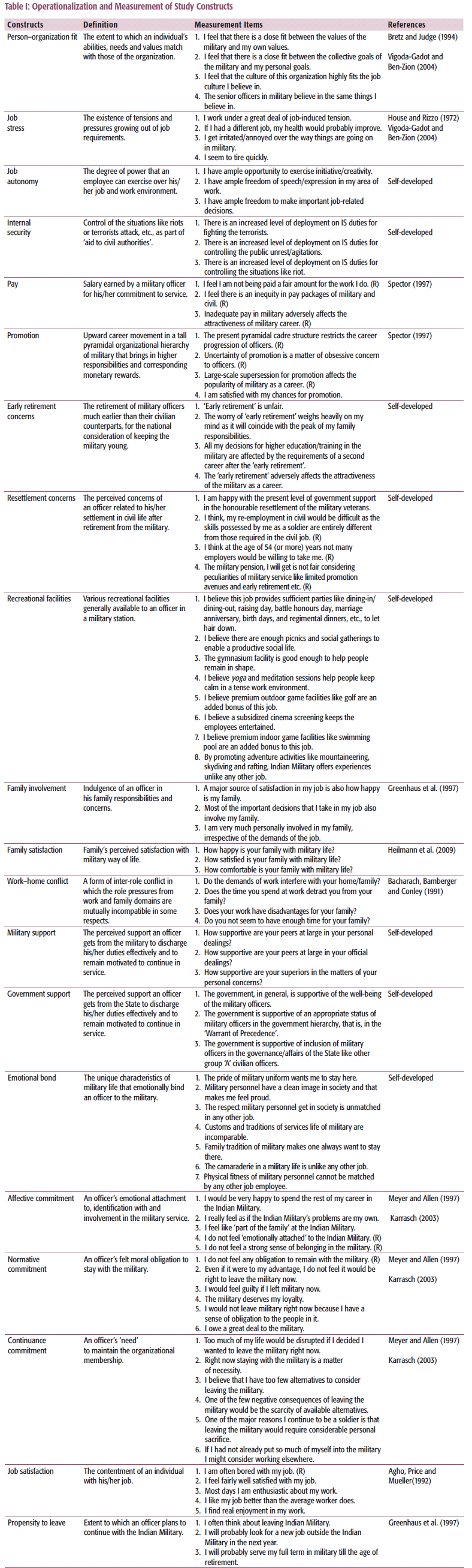
Constructs
Definition
Measurement Items
References
Personorganization fit
The extent to which an individual’s abilities, needs and values match with those of the organization.
1. I feel that there is a close fit between the values of the military and my own values.
Bretz and Judge (1994)
2. I feel that there is a close fit between the collective goals of the military and my personal goals.
Vigoda-Gadot and Ben-Zion (2004)
3. I feel that the culture of this organization highly fits the job culture I believe in.
4. The senior officers in military believe in the same things I believe in.
Job stress
The existence of tensions and pressures growing out of job requirements.
1. I work under a great deal of job-induced tension.
House and Rizzo (1972)
2. If I had a different job, my health would probably improve.
Vigoda-Gadot and Ben-Zion (2004)
3. I get irritated/annoyed over the way things are going on in military.
4. I seem to tire quickly.
Job autonomy
The degree of power that an employee can exercise over his/her job and work environment.
1. I have ample opportunity to exercise initiative/creativity.
2. I have ample freedom of speech/expression in my area of work.
Self-developed
3. I have ample freedom to make important job-related decisions.
Internal security
Control of the situations like riots or terrorists attack, etc., as part of ‘aid to civil authorities’.
1. There is an increased level of deployment on IS duties for fighting the terrorists.
Self-developed
2. There is an increased level of deployment on IS duties for controlling the public unrest/agitations.
3. There is an increased level of deployment on IS duties for controlling the situations like riot.
Pay
Salaryearned by a military officer for his/her commitment to service.
1. I feel I am not being paid a fair amount for the work I do. (R)
Spector (1997)
2. I feel there is an inequity in pay packages of military and civil. (R)
3. Inadequate pay in military adversely affects the attractiveness of military career. (R)
Promotion
Upward career movement in a tall pyramidal organizational hierarchy of military that brings in higher responsibilities and corresponding monetary rewards.
1. The present pyramidal cadre structure restricts the career progression of officers. (R)
Spector (1997)
2. Uncertainty of promotion is a matter of obsessive concern to officers. (R)
3. Large-scale supersession for promotion affects the popularity of military as a career. (R)
4. I am satisfied with my chances for promotion.
Early retirement
The retirement of military officers much earlier than their civilian counterparts, for the national consideration of keeping the military young.
1. ‘Early retirement’ is unfair.
Self-developed
2. The worry of ‘early retirement’ weighs heavily on my mind as it will coincide with the peak of my family responsibilities.
3. All my decisions for higher education/training in the military are affected by the requirements of a second career after the ‘early retirement’.
4. The ‘early retirement’ adversely affects the attractiveness of the military as a career.
Resettlement concerns
The perceived concerns of an officer related to his/her settlement in civil life after retirement from the military.
1. I am happy with the present level of government support in the honourable resettlement of the military veterans.
Self-developed
2. I think, my re-employment in civil would be difficult as the skills possessed by me as a soldier are entirely different from those required in the civil job. (R)
3. I think at the age of 54 (or more) years not many employers would be willing to take me. (R)
4. The military pension, I will get is not fair considering peculiarities of military service like limited promotion avenues and early retirement etc. (R)
Recreational facilities
Various recreational facilities generally available to an officer in a military station.
1. I believe this job provides sufficient parties like dining-in/dining-out, raising day, battle honours day, marriage anniversary, birth days, and regimental dinners, etc., to let hair down.
Self-developed
2. I believe there are enough picnics and social gatherings to enable a productive social life.
3. The gymnasium facility is good enough to help people remain in shape.
4. I believe yoga and meditation sessions help people keep calm in a tense work environment.
5. I believe premium outdoor game facilities like golf are an added bonus of this job.
6. I believe a subsidized cinema screening keeps the employees entertained.
7. I believe premium indoor game facilities like swimming pool are an added bonus to this job.
8. By promoting adventure activities like mountaineering, skydiving and rafting, Indian Military offers experiences unlike any other job.
Family involvement
Indulgence of an officer in his family responsibilities and concerns.
1. A major source of satisfaction in my job is also how happy is my family.
Greenhaus et al. (1997)
2. Most of the important decisions that I take in my job also involve my family.
3. I am very much personally involved in my family, irrespective of the demands of the job.
Family satisfaction
Family’s perceived satisfaction with military way of life.
1. How happy is your family with military life?
Heilmann et al. (2009)
2. How satisfied is your family with military life?
3. How comfortable is your family with military life?
Workhome conflict
A form of inter-role conflict in which the role pressures from work and family domains are mutually incompatible in some respects.
1. Do the demands of work interfere with your home/family?
Bacharach, Bamberger and Conley (1991)
2. Does the time you spend at work detract you from your family?
3. Does your work have disadvantages for your family?
4. Do you not seem to have enough time for your family?
Military support
The perceived support an officer gets from the military to discharge his/her duties effectively and to remain motivated to continue in service.
1. How supportive are your peers at large in your personal dealings?
Self-developed
2. How supportive are your peers at large in your official dealings?
3. How supportive are your superiors in the matters of your personal concerns?
Government support
The perceived support an officer gets from the State to discharge his/her duties effectively and to remain motivated to continue in service.
1. The government, in general, is supportive of the well-being of the military officers.
Self-developed
2. The government is supportive of an appropriate status of military officers in the government hierarchy, that is, in the ‘Warrant of Precedence’.
3. The government is supportive of inclusion of military officers in the governance/affairs of the State like other group ‘A’ civilian officers.
Emotional bond
The unique characteristics of military life that emotionally bind an officer to the military.
1. The pride of military uniform wants me to stay here.
Self-developed
2. Military personnel have a clean image in society and that makes me feel proud.
3. The respect military personnel get in society is unmatched in any other job.
4. Customs and traditions of services life of military are incomparable.
5. Family tradition of military makes one always want to stay there.
6. The camaraderie in a military life is unlike any other job.
7. Physical fitness of military personnel cannot be matched by any other job employee.
Affective commitment
An officer’s emotional attachment to, identification with and involvement in the military service.
1. I would be very happy to spend the rest of my career in the Indian Military.
Meyer and Allen (1997)
2. I really feel as if the Indian Military’s problems are my own.
Karrasch (2003)
3. I feel like ‘part of the family’ at the Indian Military.
4. I do not feel ‘emotionally attached’ to the Indian Military. (R)
5. I do not feel a strong sense of belonging in the military. (R)
Normative commitment
An officer’s felt moral obligation to stay with the military.
1. I do not feel any obligation to remain with the military. (R)
Meyer and Allen (1997)
2. Even if it were to my advantage, I do not feel it would be right to leave the military now.
Karrasch (2003)
3. I would feel guilty if I left military now.
4. The military deserves my loyalty.
5. I would not leave military right now because I have a sense of obligation to the people in it.
6. I owe a great deal to the military.
Continuance commitment
An officer’s ‘need’ to maintain the organizational membership.
1. Too much of my life would be disrupted if I decided I wanted to leave the military right now.
Meyer and Allen (1997)
2. Right now staying with the military is a matter of necessity.
Karrasch (2003)
3. I believe that I have too few alternatives to consider leaving the military.
4. One of the few negative consequences of leaving the military would be the scarcity of available alternatives.
5. One of the major reasons I continue to be a soldier is that leaving the military would require considerable personal sacrifice.
6. If I had not already put so much of myself into the military I might consider working elsewhere.
Job satisfaction
The contentment of an individual with his/her job.
1. I am often bored with my job. (R)
Agho, Price and Mueller(1992)
2. I feel fairly well satisfied with my job.
3. Most days I am enthusiastic about my work.
4. I like my job better than the average worker does.
5. I find real enjoyment in my work.
Propensity to leave
Extent to which an officer plans to continue with the Indian Military.
1. I often think about leaving Indian Military.
Greenhaus et al. (1997)
2. I will probably look for a new job outside the Indian Military in the next year.
3. I will probably serve my full term in military till the age of retirement.