




Abstract
Keywords
According to the United Nations, more than 500 million people in the world suffer from some form of disability (Despouy, 1988). India also reports high prevalence of disability. The Census data of 2001 revealed that in India there were about 21.9 million (2.13% of the total population) people with disability (PwD), whereas the National Sample Survey Organization (NSSO) data of 2002 estimated these figures to be 49-90 million. The difference in estimates of Census (2001) and NSSO (2002) for different types of disabilities can be explained by the lack of universal definitions and criteria of disability used during the surveys (Walia, n.d.). As per the latest Census data of 2011, there is a substantial increase of 22.4per cent in the disabled population of India during the decade, with over 26.8 million (2.21% of the total population) people in the country suffering from one or the other kind of disability (Sivakumar, 2013). These figures at the national level can be considered as mere estimates and the actual disabled population can be much higher than the one mentioned above. One of the reasons for low reported figures can be the stigma attached to disability that prevents many people, especially women and rural disabled, from declaring their disability (Hiranandani & Sonpal, 2010; Jeffery & Singal, 2008). This fear or stigma can be attributed to the way people perceive disability. A disability refers to a physical, sensory or mental limitation that interferes with a person's ability to move, see, hear or learn (Ministry of Social Affairs National Committee for the Disabled, 2003-2004). A person may be either born disabled or may become so later in life due to an illness or an accident. According to Census 2011, 20.3 per cent of the disabled are locomotor impaired, followed by hearing impaired (18.9 per cent) and visually impaired (18.8 per cent). Nearly, 5.6 per cent of the disabled population suffers from mental impairment, a classification introduced in the 2011 Census (Sivakumar, 2013).
Previously, disability was largely understood in terms of individual impairment (Goodley, 1998). By placing disability in the realm of personal tragedy, it perpetuated a culture of dependency. However, history is full of people who have done exceedingly well in life in spite of their limitation due to any physical or mental disability. One of the best examples is Professor Stephen Hawkins who, despite suffering from incurable motor neuron disease, has been recognized as the world's foremost theoretical physicist. A number of other examples from recent history (Helen Keller, Beethoven, etc.) suggest that people with different types of disabilities have been able to break free from their impairment with facilitation and support from the proximal environment, including society.
One of the ways of facilitating disabled people and mitigating the effects of disability is by removing the obstacles that cause such impairment. This can be done by increasing the accessibility of the products and services to PwDs so that they feel part of the mainstream. In this article, after providing some background about the concept of disability, we have highlighted some initiatives taken by organizations in various parts of the world including India. These initiatives have attempted to include the large pool of customers with disability (CwD) in the mainstream, either by developing new products and services or by fine-tuning the existing products and services to cater to their specific requirements. In the later part of the article, we have presented arguments and counter-arguments on why some organizations take such initiatives and what pulls others away from doing that. We have also discussed why such initiatives should be a part of the overall business strategy of every product-oriented/service-oriented organization and what factors can facilitate their step forward.
In this article, we have taken a slightly different perspective from the existing literature on disability that either takes a charitable view on disability or looks at it as a market for profit generation. We try to present an alternate view by amalgamating the social approach with a business approach. We are proposing that organizations should amend their existing business strategies so that they also cater to CwD. By doing so, organizations would be able to serve a larger segment of society by making them a part of their business strategy. This view is also different from diversity inclusion initiatives mentioned in the existing literature that either focus on employees or on other stakeholders like vendors. Our focus is on CwD which is less explored in general and virtually unexplored in the Indian context.
EXISTING PERSPECTIVES ON DISABILITY
Previous work has looked into the aspect of disability through different dimensions and disability policy scholars have described various historical models of disability. The most commonly referred paradigm among them is known as the social model of disability (Borsay, 1986). This model acknowledges the role of society in causing and perpetuating disability, besides shaping economic and social strategies. In this model, disability is not an attribute of an individual, but rather a complex collection of conditions. Many of these conditions are created by the social environment that excludes, discriminates, and stigmatizes people with impairments (Goodley, 1998). Accepting disability as a socially created problem, it calls for individual and collective responsibility of all societal members to redress disabling environments (Oliver, 1996) and demands full integration of disabled individuals into society by making social adjustments. Thus, the issue of disability is the collective responsibility of the society at large to make the environmental modifications necessary for full participation of PwD in all areas of social life (Langtree, 2010), which also includes providing economic benefits in a sustainable manner to such people. This has been known as the economic model of disability where disability is defined as a person's inability to participate in work (Michigan Disability Rights Coalition, n.d.). This view, along with the social model of disability, has been the reason for many organizations providing employment to PwD as part of their diversity inclusion strategy after making suitable organizational policy changes. It also goes beyond recruitment and employment to include suppliers with disabilities and providing technology interface that is also accessible to PwD. Sometimes, such initiatives are organized as part of the corporate social responsibility of the organizations.
There is another way of looking at the inclusion of PwDs, which is provided by the market model of disability (Donovon, 2012). This view proposes that PwD constitutes a sizeable group of customers which can be catered by the organizations. The idea is that even the for-profit organizations, by providing products and services catering to this group, can help them to chart their own destiny in everyday life. It is also said that there is an additional reference group of stakeholders that consists of relatives, friends and co-workers of the CwD. The combined group of CwD and related stakeholders form a big market that can be explored by the organizations. We build upon the market model of disability and look into different aspects like rationale, hindrances, facilitators and concerns for commercial organizations to realign their business strategy for CwD.
Although the market model of disability highlights CwD as an important segment, there are not many organizations that consider this as a priority. In this landscape, we find primarily two types of organizations. One engaged in catering to the market for disabled by producing specially designed and developed products exclusively needed by this group. For example, the producers of hearing aids that are useful for people with hearing impairment or the producers of wheelchairs/crutches for the mobility-impaired people. There is another set that majorly focuses on mainstream customers but also makes efforts to cater to specific requirements of disabled customers. For example, there are some service providers like airlines that make special provisions for physically challenged passengers by providing facilities and assistance to those with limited mobility to ensure that everybody has a safe and pleasant journey. However, to the best of our knowledge, there are limited examples of such organizations that, while catering to mainstream customers, with slight modification also make their products and services accessible to CwD. These organizations realize that CwD is a group where their regular operations may not be able to serve them adequately. Simultaneously, they do not want to exclude this segment. With this realization, they modify their products and services for the benefit of CwD while continuing to serve their large group of customers with regular products and services. We take a look at some such initiatives by organizations across the globe including India.
INITIATIVES BY ORGANIZATIONS IN DEVELOPED COUNTRIES
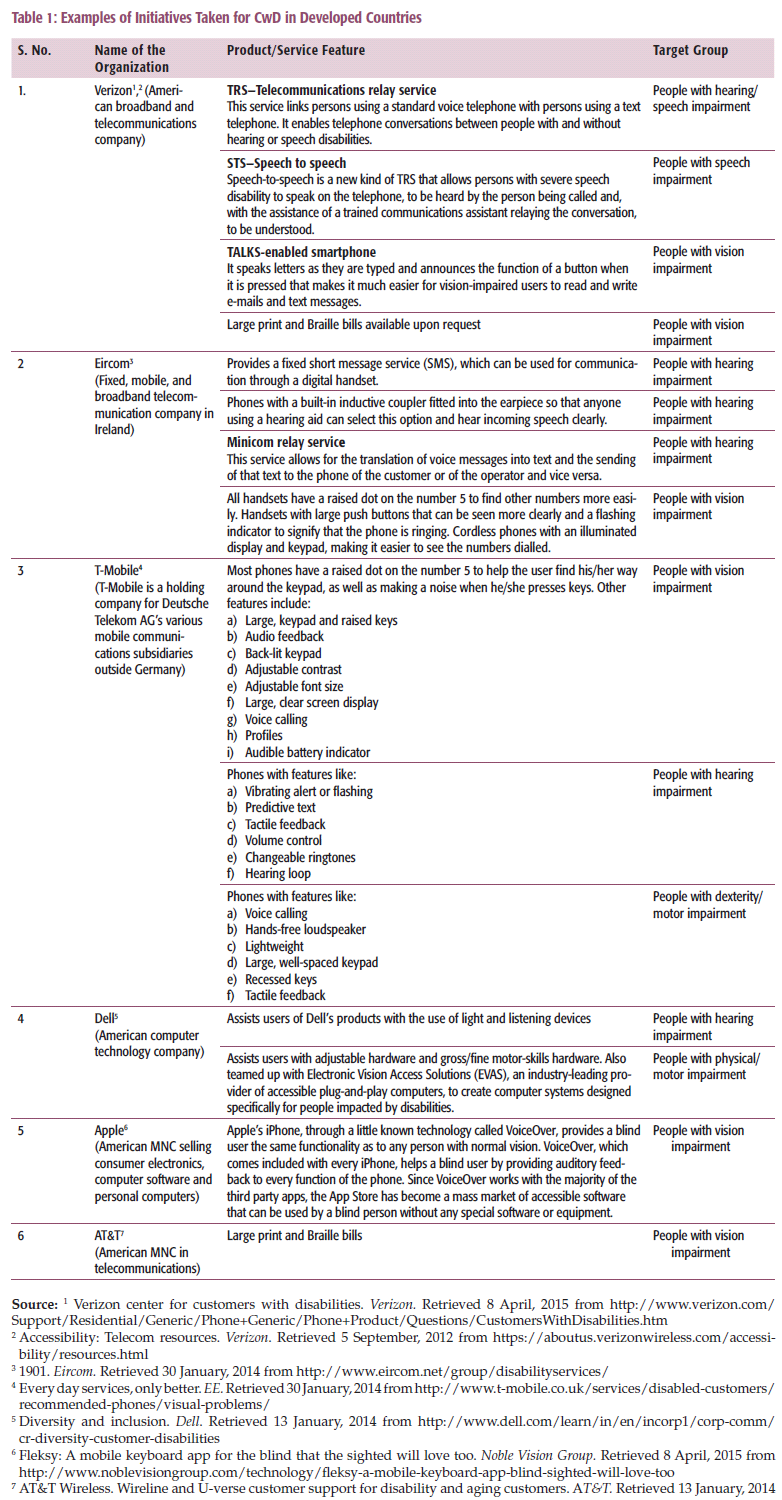
Most of the examples of business initiatives for CwD are from developed countries where there are strict nationwide laws to avoid racial, gender as well as disability discrimination. This facilitates and drives the organizations to modify their products and services, suitable for CwD. Organizations dealing with technology products and services have been on forefront of such initiatives by providing assistive technology to the impaired. The International Business Machines Corporation (IBM) has been actively developing products and delivering services to CwD by identifying technology solutions for people who have visual, cognitive, and motor impairment. The Big Blue has integrated accessibility into its product development process as complete accessibility checklists are required at key phases of the development process and accessibility verification is integrated into testing and validation procedures. 1
Product accessibility information. IBM. Retrieved 5 September, 2012 from: http://www-03.ibm.com/able/product_accessibility/index.html.
Accessibility at AOL is about extending the power of the Internet to all users. AOL. Retrieved 8 April, 2015 from: https://help.aol.com/articles/about-accessibility.
These examples are not only limited to organizations involved in technology products and services. The Bank of America (BoA), a banking and financial services corporation from the United States, has services for people with vision and hearing impairment (Leibs, n.d.). BoA has specially designed its bank website for people with vision impairment that can be accessed by a specially designed screen reader. Also, it has talking automated teller machines (ATMs) (with headphones) and ATMs with tactile markings on the keypad for making it user-friendly for CwD. For people with hearing impairment, the Bank provides sign language interpreters at its banking centres, free of charge. In another example, AMC Entertainment (AMC) in the United States has a programme that gives an opportunity to families affected by autism and other developmental disabilities to enjoy their favourite films. Realizing that autism, a complex neurodevelopmental impairment, often comes with sensory challenges such as hypersensitivity to light or sound, and individuals affected by autism may not understand the social boundaries of movie theatre etiquette such as not talking during the film, AMC organizes special shows for such people on a monthly basis. To provide a comfortable setting for this unique audience, the auditoriums have their lights turned up and the sound turned down. Also, audience members are welcomed to get up and dance, walk or sing in these shows (US Business Leadership Network, n.d.).
Examples of Initiatives Taken for CwD in Developed Countries
1Verizon center for customers with disabilities. Verizon.
2Accessibility: Telecom resources. Verizon. Retrieved 5 September, 2012 from https://aboutus.verizonwireless.com/accessibility/resources.html
31901. Eircom. Retrieved 30 January, 2014 from http://www.eircom.net/group/disabilityservices/
4Every day services, only better. EE. Retrieved 30 January, 2014 from http://www.t-mobile.co.uk/services/disabled-customers/recommended-phones/visual-problems/
5Diversity and inclusion. Dell. Retrieved 13 January, 2014 from http://www.dell.com/learn/in/en/incorp1/corp-comm/cr-diversity-customer-disabilities
6Fleksy: A mobile keyboard app for the blind that the sighted will love too. Noble Vision Group. Retrieved 8 April, 2015 from http://www.noblevisiongroup.com/technology/fleksy-a-mobile-keyboard-app-blind-sighted-will-love-too
7AT&T Wireless. Wireline and U-verse customer support for disability and aging customers. AT&T. Retrieved 13 January, 2014 from http://www.wireless.att.com/learn/articles-resources/disability-resources/nccd.jsp.
SOME INITIATIVES BY INDIAN ORGANIZATIONS
Some Indian organizations have also taken lead in doing business with CwD. Reliance Energy, one of the licensees to distribute electricity in Mumbai, has initiated a number of steps for CwD. Being a utility with universal service obligation, it identified ‘inclusiveness’ as the first step in responding to its clientele that showed diversity. Under this, it also focused on people with physical disabilities. One of the steps in this direction was designing its customer care centres with a ramp for the wheelchair-bound customers. It also decided to provide its monthly electricity bill in Braille to the visually challenged customers (Rediff.com., 2005; Web Bureau, 2005).
In another example, with ATMs fast turning out to be the primary channel for cash withdrawals, the Union Bank of India (UBI) has opened a talking ATM for CwD in 2012. With the idea that even the customers with any impairment should have access to these machines, UBI designed this ATM that enabled the visually challenged persons to do transactions on voice guidance. Also, the ATM site is designed in a way that even physically challenged persons—on wheelchair—can access it. This ATM also supports transactions of other bank's ATM cards for visually challenged customers (Union Bank of India, 2012).
While Reliance Energy and UBI have already demonstrated their willingness to align their strategy for doing business with CwD, other organizations in India are also gearing up for the same. Indian Railways, a state-owned enterprise of the Government of India, is one such example. It issues concessional tickets to CwD on producing documentary evidence that is verified at the ticket counter. However, this facility is not available for online booking, despite CwD needing it more than the other passengers. Realizing that physical verification of disability document has to be done away with, Indian Railways has come out with a plan wherein identity cards with specific numbers will be issued to each CwD, which will be built into the computerized passenger reservation system across the country. This will ensure that even differently abled persons can avail fare concession while booking tickets online (Singh, 2012).
As the above examples suggest, a small number of Indian organizations have taken initiatives to reach out to PwDs by making special provisions in product and service delivery. Gradually, more organizations are making efforts to reach out to the set of physically disabled people. This gravitation may be due to a number of factors.
WHY SOME ORGANIZATIONS DO IT?
In the given pretext, the most obvious question that can be raised is: Why, at the first place,
organizations need to make diversity an integral part of their organizational strategy? As the
economic environment is getting more and more competitive, organizations are identifying ways to
stay ahead. Including diversity as an integral part of the mainstream organizational initiatives is
the strategic innovation that demarcates the leading organizations from others. As per Hamel (1998), strategic innovation is a result
of: 1. bringing a diverse set of voices into the strategy dialogue; 2. creating opportunities for conversations about opportunities in unserved markets; 3. focusing on passions that lie outside of the normal firm repertoire; 4. developing new perspectives on both capabilities and customer needs; and 5. launching low-risk marketing experiments.
In their study, Slater, Weigand, and Zwirlein (2008) found evidence that organizations with a strong commitment to diversity outperformed their peers on an average. For example, in organizations like IBM and Microsoft, diversity is a strategic goal. Diversity can bring new voices and perspectives into the strategy of any organization, helping its managers to understand and cater to the needs of a demographically diverse customer base (Slater et al., 2008). Now, organizations in virtually all sectors of the economy are beginning to recognize that diverse employee backgrounds enhance competitiveness in the global economy (Ramirez, 2000). Ninety-two of the 100 most economically prosperous companies in the United States, the Fortune 100, have policies that express a commitment to promoting diversity in the workplace (Ball, Monaco, Schmeling, Schartz, & Blanck, 2005). For promoting diversity, organizations focus on various communities like people from diverse ethnicity, culture, age, gender, physical orientation, and PwDs to name a few. Ball et al. (2005) stated that the organizations that focused on diversity made efforts to develop products and services that appealed to and benefited the communities they served. This provides an explanation for organizations to pursue strategy of diversity inclusion for CwD.
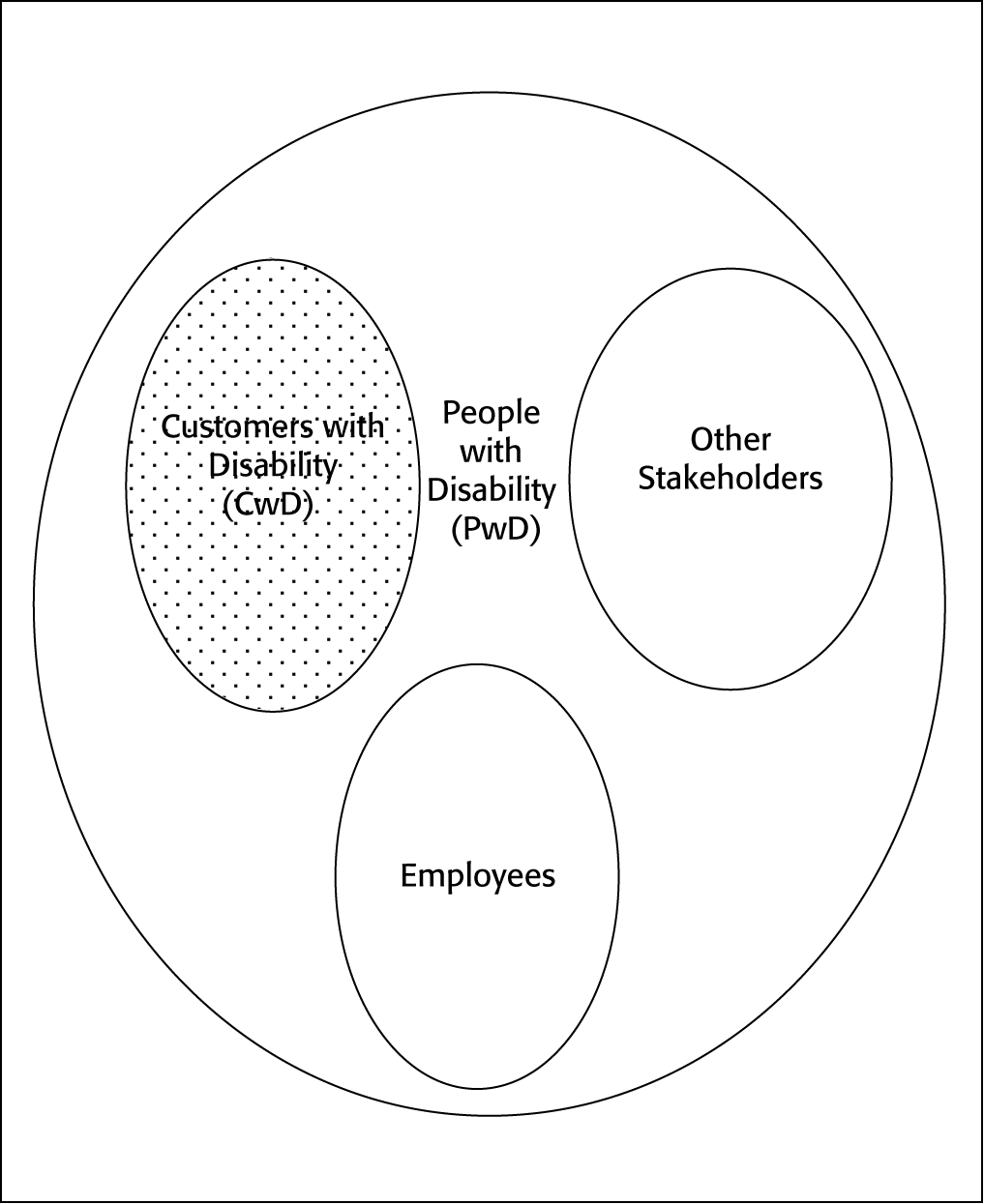
Figure 1 summarizes our viewpoint. In any organization, the diversity inclusion initiatives involve three sets of stakeholders, namely employees, customers, and other stakeholders like vendors. Generally, organizations start such initiatives by providing employment to the PwD. Most of the organizations limit themselves to this level. Some organizations further broaden the outlook by including a second set of stakeholders that consists of suppliers, etc. These organizations evolve policies that require procurement from organizations employing PwD. In both sets of stakeholders, the organizations try to empower PwD. We propose that organizations also need to look at the third set of stakeholders, that is, CwD. This will not only empower the CwD to conduct themselves with dignity but will also present an opportunity for organizations to tap into larger markets. By doing this, organizations will be able to create opportunities for unserved markets and will be focusing on something that is beyond their normal operations. By interacting with a diverse set of customers and addressing their specific requirements, the organizations will also be building their own capabilities. The business strategy of the organizations proposed in this manner (illustrated through Figure 1) falls well in line with the parameters suggested by Hamel (1998) to stay ahead.
Disability Inclusion Strategy
WHY MANY ORGANIZATIONS DO NOT EXERCISE IT?
While we have presented a number of reasons for organizations exercising diversity inclusion, there are several reasons for it not being pursued by many organizations. There are not many organizations that give due thought while developing products and services for CwD. One major cause of this avoidance is possibly the large costs involved in making even minor modification to the products/services for the benefit of a small section like CwD. These customers sometimes have unique requirements, which calls for a great level of customization, and the organizations do not see much return on such investments. This definitely is an issue for small players, which cannot afford to have much experimentation within their limited resources. However, large players with positive cash flow from their regular operations can afford to experiment and should come forward for such initiatives. Another reason for not being proactive to such initiatives can be the fear of failure. What if the idea is not taken well? What if it does not work? What if it is misused? Such stirring questions may keep the organizations away from investing in such exclusive initiatives for a small section of customers.
WHY SHOULD IT MATTER TO EVERY ORGANIZATION?
Direct to Reach Market
We all know that the period of mass marketing is over. This has led to organizations segmenting the markets and making their product and service offerings to different segments of the markets. The principles of segmentation suggest that a segment should be measurable, substantial, accessible, differentiable, and actionable. A market for CwD fulfils the mentioned segmentation criteria, and therefore makes it possible for organizations to reach this set of customers.
First Mover Advantage in Untapped Market
Although the market size of segment consisting of CwD is quoted from 500 million (Despouy, 1988) to 1.1 billion (Donovan, 2010) globally, there have been very limited efforts to tap this market. Donovan (2012) quoted that 25 per cent of the Standard & Poor's 500 companies publicly indicated an interest in this market. However, only 6 per cent of these companies have backed that interest with publically observable and measurable efforts. Thus, there is a large group of customers who are looking for suitable products but their cause is not being helped, as very few organizations have taken interest in catering to this segment. Whichever organization decides to get in to addressing this segment will have the first mover advantage of building a name for itself.
Signalling
By offering products and services for CwD, organizations are making the proverb actions speak louder than words true. When an organization reaches out to CwD through products and services, addressing their unique requirements, it communicates to others that it is cognizant to the special needs of specific segments. By doing this, it also sends signals to other segments of its diverse groups of customers that it is customer centric, and in case of problems faced by customers, it will respond to them in a positive manner. Thus, the believability of any communication that the organization makes highlighting customer centricity will be very high among its target segment.
Connecting with Friends and Relatives of CwD
There is a related group of customers who, though not disabled themselves, are proximal to the CwD. This group consists of the networks of the disabled customers. Although it is very difficult to put a number to this segment, going by the assumption that each disabled person is in close contact with at least four to five relatives/friends, a conservative estimate will put this number close to 2 billion globally and 100 million in India. This is a group that can be potential customers and can be brand loyal for organization's products and services if they perceive that there is a differentiable product/service provided by the organization that others have ignored till now. Also, with the rise in social media, they can become strong advocates of the organization's products and services among their peer group.
FACTORS FACILITATING THE ORGANIZATIONS IN REACHING OUT TO CWD
Government Regulations
The Government of India has implemented Persons with Disability (PWD) Act in 1995 that stipulates equal opportunity, protection of rights and full participation of PwD in terms of education and employment. However, there is no mention of any provision for ensuring availability of products and services for PwD. When the UBI decided to open a talking ATM for visually challenged as its 4000th ATM, apart from its willingness to help the visually challenged, it was also guided by the RBI directive in 2010 that suggested the banks to make their branches and ATMs accessible to PwDs. It directed that banks should install at least one-third of the new ATMs as talking ATMs with Braille keypads and place them strategically in consultation with other banks to ensure that at least one talking ATM with Braille keypad is generally available in each locality for catering to the needs of visually impaired persons (ET Bureau, 2010). Similarly, the Government of Maharashtra has become the first state government to have an e-governance policy that mandates that the government websites should be made accessible for the physically challenged. As a result, BarrierBreak Technologies, which focuses on developing websites for physically challenged, has created 20 disabled-friendly websites, of which seven are for the government (Gopalan, 2012). The government regulation is likely to drive more such user-friendly websites for physically challenged people.
Partnership with Specialist Organizations
When Reliance Energy decided to provide electricity bills to visually challenged people in Braille, it recognized that it would need to make some process changes. It also realized that it required special expertise that they did not have. Hence, they partnered with the National Association of Blind (NAB) for assistance in rolling out the Braille bill. Once the manual metre reading cycle is over, monthly data of all customers who have enrolled for the Braille bill are sent to NAB. After the receipt of data, NAB sends the bill in Braille script within five days to Reliance Energy that dispatches it to the customers. Such partnerships with specialist organizations that understand the specific requirements of CwD and are trained to work with them will facilitate organizations in reaching out to PwDs in an effective manner.
Modifications in Service/Product Delivery Process
Continuing with the example of Reliance Energy, as a process of generating bill, a consumer's metre is read on a particular day in a month after which the metre details are entered in the system. These details are sent to the printer to generate the customer's utility bill. The customer gets a credit period of 15 days to make his/her payment. However, in case of the Braille Bill, the company needed to send the customer's metre details in advance to NAB to complete the process of generating the bill in Braille at the same time maintaining the 15-day credit period for the end consumer. Thus, the manual reading of metres of customers enrolled for Braille bill is done in two cycles. The first cycle takes place in the first 15 days of the month and the second cycle takes place in the subsequent 15 days of the month. This slight modification in the process by Reliance Energy enables it to maintain the credit period granted to the end consumer.
Operations in Pluralistic Society
When an organization caters to a diverse set of customers, it tries to provide product and services that fit their diverse profile. Most of the time, it is not possible to satisfy this diversity with one type of product and service. In such cases, organizations bring product adaptations that make them relevant to a much larger group of customers. When an organization operates with such a mindset, it looks for similar opportunities to serve the groups that differ on various parameters, and is therefore also willing to serve PwDs. Indian Railways—which operates amongst different linguistic, religious, and ethnic groups of commuters—was able to recognize this need during online booking by physically challenged passengers. For the same reason, Reliance Energy, which operates in Mumbai—a microcosm of India's diversity—and was sending bills in 19 different languages, identified that visually challenged also needed to be served in a befitting manner that raised their self-esteem.
Incorporating Technology Solutions in Product Development Phase
Development of products and services for PwDs also gets driven by incorporating different technological aspects during the product development phase. Most of the organizations working in developing technology products are aware of the blurring of boundaries for the usage of different products, and thus develop their products in a manner that they can be used in multiple ways. In this scenario, it does not take much effort on the part of the organization to include features in the product that make it more useful to the CwD. The good part in this story is that in most of the cases, such technological features have already been developed and only need to be integrated in the product. Microsoft Xbox has pre-fitted Kinect technology that was developed by PrimeSense, an Israeli start-up. The Kinect technology is ‘gesture recognition' technology that enables users to interact with the Xbox simply by making gestures without ever touching a game controller (Mitra, 2012). Similarly, the State Bank of India (SBI) has piloted a project where it has used a pre-developed software called Jaws to enable internet banking for visually impaired.
CONCERNS FOR THE ORGANIZATIONS
One of the prime concerns for organizations providing services to CwD pertains to the security of the user, especially with respect to financial transactions. The Jaws software used by the pilot project of SBI will have a safety featurea ‘deadman's switch'—wherein the user can enter this key if he/she fears intrusion to his/her privacy while he/she is doing online transactions, following which the page will collapse and the account will not be accessible for three days or till such time as the account holder approaches the bank to activate it (ET Bureau, 2010). Organizations will need to work out more such features in their products and services that enhance the confidence of disabled users in opting for products and services.
While planning products and services for CwD, organizations should take care to ensure that these initiatives are not seen as charity, as it may hurt the dignity of such customers. The core purpose of promoting such initiatives is that they can facilitate the CwD in leading a dignified life with minimal dependence on others. Thus, the organizations have to understand that the people with disability are an important part of our society and have to be nurtured with utmost care as per their rights as any citizen of country. This requires them to be receptive to the sensibilities of CwD.
CONCLUSION AND THE WAY FORWARD
There is an explicit commitment in the form of well-documented policies by several organizations for the inclusion of PwD through empowerment by educating them and by providing them employment opportunities. In the developed countries, there are strict legislative rules that enforce most of the organizations to take affirmative actions for such communities. Similarly, the Government of India had enacted PWD Act (1995) to provide equal opportunity, protection of rights, and full participation for persons with disabilities. Yet, the PWD Act is still far from showing the desired impact (Legislative Department, Ministry of Law, Justice and Company Affairs, 1996). Whether it is a developed country or a developing country like India, there is still the need for a leap for showing true customer centricity towards CwD. There is still much to be done by organizations for increasing the accessibility of their products and services to the CwD.
Having examined the landscape of doing business with disabled people, the question is whether it is a big challenge for organizations to do it. To us, the answer is a strong no. What does it require for an organization—the intent and only a small initiative that adds value to the product and service, thus, making it relevant to the CwD. It may be a small step for the organization, but for the person with disability, it is a big leap in building, sustaining and boosting his/her self-esteem. No doubt, the facilitating role played by government will drive organizations for adopting the policies that make their products and services friendly for PwD. However, the organizations also need to realize that there is an opportunity that they can tap with very little additional investment. By this, they will be creating social value while also contributing towards the economic value of the organization. Socially responsible business requires that organizations not only serve the set of customers who contribute towards their profit but they also serve the interests of their present and potential customers.
As mentioned in the earlier part of the article, we offer a balanced approach between the social and profit views of disability. We present our thoughts on how organizations can also cater to a large segment of CwD with slight modifications in their products and services. Advocates of the social model can argue about the adverse effects of viewing disability as ‘market' and the need to reach each and every disabled person—men or women, rich or poor and rural or urban. We support this view and contend that it should unquestionably be the ultimate objective of these initiatives. However, we consider this process of inclusion as a phased process, beginning with the need to modify products/services as per the requirements of the general disabled population. Based on the responses, the final phase should roll out such initiatives at a larger scale to reach each one of the needy persons with any sort of impairment irrespective of their gender and socio-economic status. The organizations will be able to chart out the intermediate phases only after they start their journey towards this objective. This is very contextual for India, given the PwD estimates provided by 2011 census data and NSSO.
LIMITATIONS
While researching for this article, we could not find many examples from India where mainstream organizations modified products/services to include different types of physically disabled customers. Even in cases where they have done so, there is a need to generate awareness about their initiatives, especially among PwD; otherwise these initiatives will not deliver the desired outcomes. Also, most of the illustrated examples mainly focused on visually impaired customers. Although this is one limitation, we see it as a great scope for work in this direction, giving due focus on different types of disabilities, understanding their challenges and coming out with solutions to make them a part of the mainstream.