



Abstract
To help support students make music in contemporary styles, music education researchers suggest focusing on how contemporary musics are made with current technologies. The purpose of our study was to understand the learning and music-making practices of music producers who use digital audio workstations. We begin our article by examining literature that focuses music production pedagogy outside and inside of schools. Following, we describe our methodological approach—using semi-structured interviews to engage with 13 practicing music producers to understand how they learn to make music with digital audio workstations. Using an inductive thematic analysis approach, we found that music producers find and make beats with YouTube, use trial-and-error approaches and YouTube tutorials to learn how to produce, and use YouTube to make and learn music collaboratively. We conclude by discussing the influence and impact of YouTube on music production pedagogy and its implications for music education.
Introduction
A music producer can take on many different roles in the process of making a song, and with increases in ease of access and ease of use to recording technologies, the roles of producers have changed markedly since the early 2000s when digital audio workstations (DAWs) proliferated in use (Leyshon, 2009). As a result, providing an operational definition of the term “producer” and comprehensively describing the learning processes associated with it poses a challenge. Extant scholarship on the role of the producer illustrates how this term is enigmatic and evolving. For example, Howlett (2012) lists the various roles a producer might assume, which include: arranger/interpreter/visualizer; engineer; creative director/performance director; logistical facilitator; project manager; psychologist/counselor/priest; mediator (para. 9). Drawing primarily on examples from rock music in the latter half of the 20th Century, Zagorski-Thomas (2014) suggests the following categories to conceptualize different types of producers: manager; creative hub; artist; creative enabler; creative partner (p. 161). Focusing on hip-hop music specifically, Ng and Gamble (2024) define producers concisely as “multi-skilled digital musicians” (p. 5). While it may not be possible to succinctly and satisfactorily define the role of a producer, as researchers of music teacher education we recognize the need to understand and include the varied ways that people engage in music production given its importance in diverse cultural practices of music making (Bell, 2016; Dale, 2023; Hamilton, 2021; Hein, 2017; McArton, 2023; Taylor, 2022; Touchette, 2024) and growing presence in resources designed for music teaching (e.g. bell & Satarasinghe, 2022; Kladder, 2022; Kuhn & Hein, 2021). Building on this previous scholarship on music production in music education, we approached this study with a contemporary conceptualization of producers as people who use digital audio workstations (DAWs) to make music, engaging in a range of music-making actions that often include but are not limited to programing/tracking, arranging, performing, recording, engineering, and mixing. The purpose for our research study was to gain an understanding of the music-making practices of producers at present and the learning involved in producing.
The roots of music production research in music education can be traced back to studies that focused on students using computers to make music such as those conducted by Bamberger (1977), Wilson and Wales (1995), Hickey (1997), Folkestad et al. (1998), Stauffer (2001), and Burnard and Younker (2002). By the latter half of the 2000s, more music education researchers examined how students created music with commercial software, including considerations of the affordances and constraints of these applications (Gall & Breeze, 2008; Mellor, 2007; Ruthmann, 2007). Since this time, several studies have examined students’ music making practices with DAWs—the generic term used to label music production software applications that afford creating, recording, editing, and mixing music (Bell, 2018)—such as ProTools, Logic, and Ableton Live to produce songs (Clauhs, 2020; Evans, 2019; Marrington, 2011; Moir & Medbøe, 2015; Sabet, 2020; Sandiford, 2024; Tobias, 2013; Touchette, 2024). Music education researchers have sought to bridge the gap between school music and everyday music practices outside of school using music technologies (Bell, 2016; Hein, 2017; Sandiford, 2024; Tobias, 2015), and have suggested focusing on how contemporary popular musics are made in order for teachers to support students in the creation of music in these various styles.
In this article, we begin with a review of literature that focuses on (1) Learning with DAWs outside of formal music education settings, and (2) music education studies in which participants assumed various roles as producers and used DAWs to create music in classroom settings. Our methodology describes the process we used to conduct semi-structured interviews with 13 music producers. Our findings, derived inductively from the data, are organized thematically to describe how music producers make and learn music with DAWs at present. We conclude by discussing the implications of the findings for music education.
Music Production Pedagogy: A Review of Related Literature
Music Production Pedagogy Outside of Schools
Histories of music production and how music producers learn concentrate predominantly on white male rock producers and audio engineers in the United States and the United Kingdom. The largest body of research related to music production centers on the Beatles. In addition to the detailed accounts of the Beatles’ recording processes by Lewisohn (1988) and Ryan and Kehew (2006), many others have recounted their experiences working alongside the fab four (Emerick & Massey, 2006; Johns, 2014; Martin & Hornsby, 1979; Scott & Owsinski, 2012). With the notable exception of George Martin, all producers and engineers profiled in these accounts reported learning their trade through an apprenticeship model in combination with using trial-and-error approaches. Within this hierarchical system, entry-level employees in the recording studio assisted with technical tasks such as setting up microphones and running tape recorders, but all the while observed and seemingly absorbed how to be an engineer or producer despite never receiving explicit instructions on how to do so. Recording studios of this era exemplify “complex learning environments” (Dreyfus & Dreyfus, 2005; Knight, 2007) and are characterized by a dependence on tacit learning (Eraut, 2000; Polanyi, 1966)—experiential learning that may not be easily articulated or explained. Beyond the Beatles, similar accounts of learning have been authored by the likes of those who produced Bob Dylan (Ramone & Granata, 2007), Jimi Hendrix (McDermott et al., 1995), and David Bowie (Visconti, 2007). In addition to first-hand accounts of engineers and producers, Moorefield (2010), Schmidt Horning (2013), and Zak (2001, 2010) have detailed the inner-workings of rock-based recording practices during the latter half of the 20th century. A common theme that runs through these accounts is a heavy reliance on tacit learning from/with peers and/or by oneself using trial-and-error approaches (Bell, 2014).
Research on non-rock music production practices in the latter half of the 20th century and early 21st century also reveals the centrality of tacit learning; however, during this period, apprenticing was less common in these practices and trial-and-error learning—such as experimenting with recording technologies to create new sounds—was routine in pop (Warner, 2003), Jamaican dub (Veal, 2007; Williams, 2012), hip-hop (Coleman, 2007, 2014; Rose, 1994; Schloss, 2014), and DJing writ large (Brewster & Broughton, 2006; Butler, 2014; Katz, 2012; Lawrence, 2008; Reiss, 2023). With the exception of pop in which working and learning in small teams of two or three people was commonplace (Warner, 2003), in contrast, many dub, hip-hop, and DJ-based musicians recalled learning by themselves using trial-and-error approaches. Case studies on do-it-yourself (DIY) recording practices in Cuba (Boudreault-Fournier, 2008), Mexico (A. Green, 2018), Trinidad and Tobago (Mohammid & Horst, 2017), and the United States (Bell, 2018), documented the emergence of home-based music producers whose studios consist of a computer with a DAW and whose learning is predominantly self-taught and characterized as being experimental and experiential.
Released in 2005, YouTube came online as the ease of accessing and using DAWs increased in the first decades of the 2000s. There is a range of research on YouTube and how it may be used in/for making, teaching, and leaning music (e.g. Cayari, 2018, 2023; Gulum, 2023; A. J. Kruse & Hill, 2019; N. B. Kruse & Veblen, 2012; O’Leary, 2020; Touchette, 2024; Veblen et al., 2018; J. Waldron, 2012, 2013; J. L. Waldron, 2020), and parts of this body of research directly discuss music production. For example, J. L. Waldron (2020) studied the role of YouTube in learning hip-hop production by a university student and found that they used the platform to learn music production strategies for their own music making. Similarly, using YouTube as a resource to learn how to produce music is evident in the research of Thompson (2012) and A. J. Kruse and Hill (2019). While YouTube may serve as a self-teaching and -learning platform for producers, Røshol and Sørbø (2020) aver that for this approach to succeed in music education, learners need to possess sufficient understanding and motivation to find the right resources. One potential solution to this problem is for the teacher to curate or create YouTube learning resources for their students (Touchette, 2024).
Music Production Pedagogy in Schools
We surveyed music education studies at the pre-secondary and post-secondary levels since 2010 that discuss how students make music with DAWs. In general, we found that these studies focus primarily on students’ experiences working individually or collaboratively in project-based learning environments in which the overarching aim of the teacher (or teacher-researcher in some cases) is for students to create music using a DAW. These studies are characterized as being predominantly student-centered, with a hallmark being that student agency in creative decision making is prioritized, and the teacher’s role is to facilitate students’ creative aims. There are few recent studies that center on music production using DAWs at the elementary and middle school levels. Evans (2019) found that middle school students who participated in a hip-hop songwriting and production program developed a number of musical and extra-musical competencies including social-emotional competencies, risk-taking, ingenuity, initiative, identity formation, agency, “synergy with others,” and technical skills (p. 30). These findings are in alignment with previous research on music production at this level by Ruthmann (2007) and more recent research by Touchette (2024). Studies conducted at the secondary level have focused on different aspects of teaching and learning music production with DAWs including students’ experiences and processes of music making and learning, roles, and creativity. Studies by Clauhs (2020), Dale (2023), Sabet (2020), and Tobias (2013) found that music production skills (e.g. recording, mixing, and editing) were learned amongst secondary students as they engaged in the processes of making their own original music with DAWs, and in some cases, using MIDI controllers for music production such as Ableton Push (Dale, 2023). While most research on music production at the secondary level has concentrated on the experiences and perspectives of students, some studies (Dale, 2023; Emo, 2021; Sandiford, 2024) have focused on how teachers learn to facilitate music production activities as part of their professional development or training.
In addition to studies conducted in schools, researchers have investigated different aspects of incorporating DAWs in post-secondary education. There are some common themes that carry over from research on pre-secondary contexts to post-secondary contexts such as the focus on roles and creativity (Tobias, 2013; Touchette, 2024), but there are also new areas of inquiry that have emerged such as the influence of DAWs on the music production process and comparisons and examinations of roles in the professional music industry and the classroom. Marrington (2011) found that students’ approaches to creating music were influenced by the affordances and constraints of the software they used. He forwards that educators can play an important role in helping students to recognize how DAWs may be leveraged to support their musical creativity, an advocacy argument also employed by Bell (2016), Hein (2017), and Walzer (2020). In alignment with earlier studies on the affordances and constraints of music-making software (Bell, 2015; Gall & Breeze, 2005; Marrington, 2011), Moir and Medbøe (2015) reported that participants in their study believed that technology had an impact on the type of music they created and the role(s) they assumed (i.e. “composer,” “instrumentalist,” “musician,” and “producer”). Sørbø and Røshol (2020) found that when participants were making music with DAWs they strongly identified as “producers,” a term that encompassed a wide range of roles and failed to describe what the participants did when making music.
In his account of how contemporary popular music is produced, journalist Seabrook (2015) detailed the “tracker” process in music production. He described how trackers use a “beat first” strategy to write a song with a DAW, meaning that the role of the tracker is to commence the songwriting process by creating a beat and then add musical elements to it as appropriate based on a given musical style/genre. For example, an additional element could include a bassline and/or chord progression on a keyboard or guitar. Once this first layer is completed, the “track” is then sent to a topliner, also known as a hook writer, whose role is to write melodies that could potentially be used with the track. The assembly line of the “song machine” (Seabrook, 2015) proceeds with the topliner returning the song-in-progress to the tracker who will then hire others to perform other tasks to complete the song, including but not limited to writing lyrics and performing vocals and other instrumental parts. In music teaching scholarship, the tracker model of music production has been described in detail by Bell (2019) and Anthony (2020) with the intention that this approach be taught in post-secondary contexts. Research by these same authors (bell et al., 2022; Anthony et al., 2020) focuses on using the tracker approach to develop students’ songwriting and music production skills.
Assessing the related body of literature as a whole, most of the research on pedagogy in music production focuses on adults outside of formal learning contexts and secondary and post-secondary students inside formal learning contexts. Outside of schools, there is a longstanding practice of relying on tacit learning, often coupled with trial-and-error learning. With the increasing availability of DAWs in the early 2000s, these forms of learning have continued but now occur in home studios. Of the studies conducted in schools, we noticed a trend that many of them engage in music production with DAWs to connect students’ experiences with music outside the classroom to their experiences with music in school. Most studies have focused on the perspectives and experiences of students as they learn production skills simultaneously while creating music, but there is also a small set of studies that have focused on teachers learning production skills as part of their professional training or development.
Purpose and Research Questions
Considering that the producer role is integral to diverse cultural practices of music making and should therefore be included in music education (Bell, 2016; Dale, 2023; Hamilton, 2021; Hein, 2017; McArton, 2023; Taylor, 2022; Touchette, 2024) in tandem with the reality that the practice of producing music with DAWs is ever-changing, the purpose for our research study was to gain an understanding of the music-making practices of producers at present and the learning involved in these practices. The following questions guided our research study:
How do producers make music with a DAW?
What learning processes do producers engage in when making music with a DAW?
Methodology
Semi-Structured Interview and Analysis Procedure
Our research team is comprised of three people with diverse musical backgrounds including but not limited to pop, rock, hip-hop, and classical styles, which reflect the different musical cultures and eras we come from and engage in. We are all active practitioners in music production who make music with various music technologies including DAWs. Studies that seek to understand pedagogy in music production tend to use ethnographic approaches such as conducting interviews and observations, which contribute helpful insights into how learners approach making music with DAWs. In an effort to extend this line of research by continuing to make connections between music-making practices inside and outside of schools (Anthony et al., 2020; Evans, 2019; Tobias, 2015), we sought to understand how music producers make and learn music at present. We employed a semi-structured approach to interviewing participants (Galletta, 2013), a method that has been used in similar studies that focus on music making and learning approaches in popular music (e.g. Bell, 2018; L. Green, 2001; Ng & Gamble, 2024; Sandiford, 2024; Tobias, 2015). After we received research ethics approval from our institution, we commenced the data collection phase of our study by recruiting participants who met our criteria, which was any adult who identified as someone who engaged in the practice of music production with a DAW. We purposefully cast a wide net in recruitment in order to be able to take an inductive approach to data collection and interpretation. We consciously chose not to delimit the producer role to a specific genre or style; however, by specifying that the producers profiled in our study must be DAW users, we aimed to address a delimitation in the seminal research of L. Green (2001), who excluded “rappers, DJs, and musicians who produce highly electronic, synthesized, and sampled musics” (L. Green, 2004, p. 226).
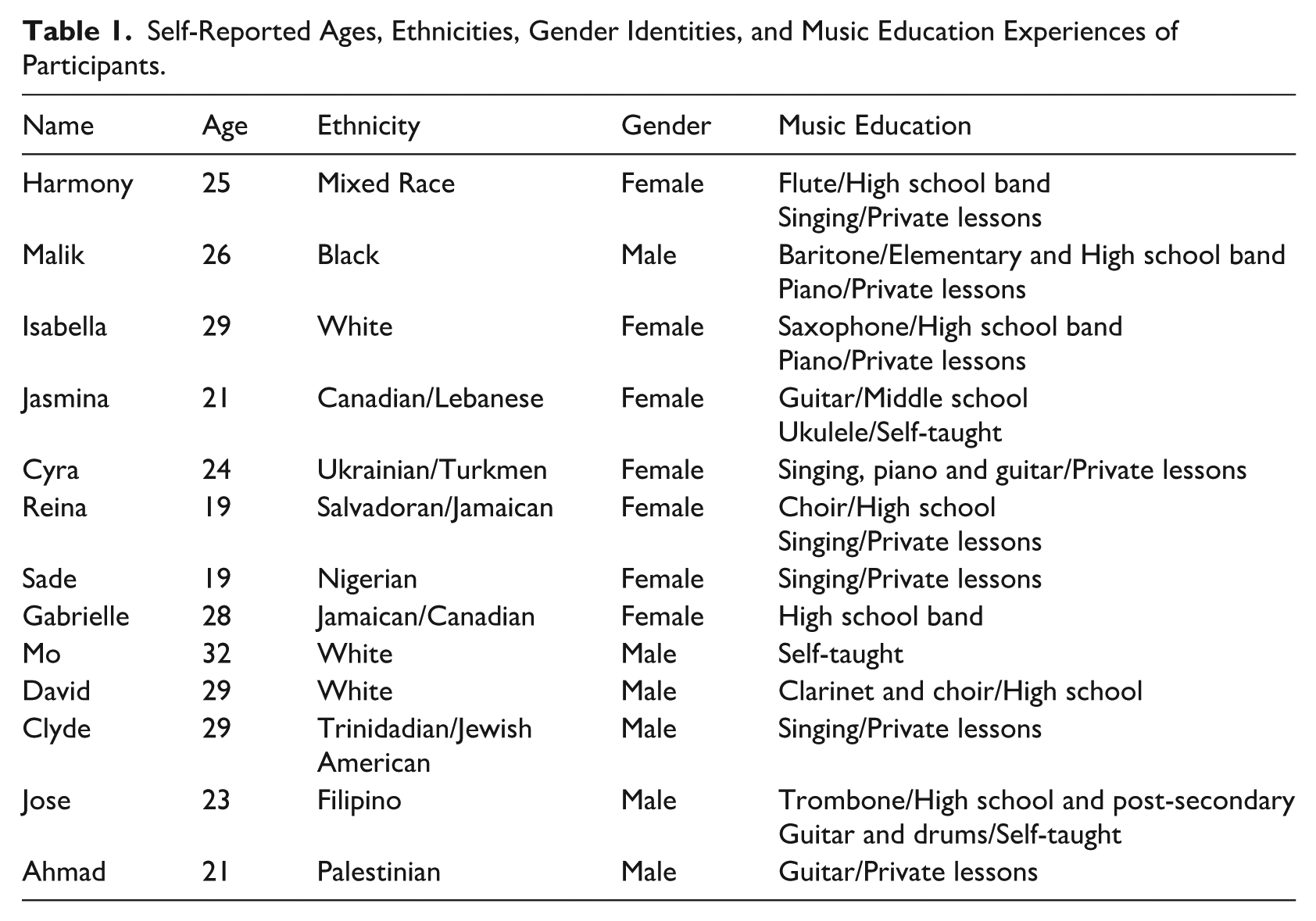
We employed a snowball sampling technique by leveraging the social network of co-author Fereidoon Tavassoli, an active artist/rapper in Canada. In total, 13 participants agreed to participate in an interview with Tavassoli. The participants’ self-reported names, ages, gender identities, and racial/ethnic identities are provided in Table 1. The participants’ names are pseudonyms. While not all participants specified the genres and styles of music they produce, the responses were limited to hip-hop, R&B, and pop. Interview times varied from participant to participant, with the average interview time being approximately 40 min. In keeping with the practice of semi-structured interviewing, Tavassoli employed a conversational approach (Kvale & Brinkmann, 2009). Tavassoli followed the script of questions (Appendix 1) with each participant but also allowed time for himself and each interviewee to discuss other related topics. All interviews were transcribed by co-authors bell and Martinez and subsequently analyzed thematically following the procedure outlined by Galletta (2013). Our codes were not predetermined; instead, we used an inductive approach to identify codes through repeated readings of each interview transcript and used a spreadsheet to organize the dataset. Galletta (2013) advises researchers to begin the process of analysis by focusing on the particularities of each interview and then noting and studying patterns across interviews, inclusive of both commonalities and contrasting dimensions in the data. Following this approach, we derived three themes, which we report in the subsequent section, Findings.
Self-Reported Ages, Ethnicities, Gender Identities, and Music Education Experiences of Participants.
Findings
Our two research questions, “How do producers make music with a DAW?” and “What learning processes do producers engage in when making music with a DAW?” cannot be reported on separately because the participants typically did not distinguish learning from music making in their responses. As the interview data demonstrates, parsing out learning from music making and vice versa is difficult, if not impossible, to do. Our findings are organized into three themes: (a) finding and making beats with YouTube, (b) trial-and-error learning and learning with YouTube tutorials, and (c) making and learning music collaboratively.
Finding and Making Beats With YouTube
Ten participants referenced accessing YouTube to learn different skills including learning music theory, how to use a DAW, playing musical instruments including the guitar and piano, and finding and/or making beats. Of these activities, finding and/or making beats was the most common activity that participants sought to engage with using YouTube. Five of the participants referenced using YouTube to learn about how to make beats whereas five participants used YouTube as a source to find beats as foundations for their songs. The use of the term “beat” in this context varied depending on a participant’s interpretation of the term, which in turn is influenced by the musical genre and style that a participant engages in. For some, the term “beat” is interpreted literally and refers to just the rhythm/drum track(s), whereas for others, a “beat” can include more musical elements, including but not limited to bass and synth(esizer) tracks. We also observed that some participants used the term “instrumentals” to refer to a beat that includes additional musical elements beyond the rhythm/drum track(s), which is helpful in addressing the ambiguity of how we interpret the term “beat.”
Participants made clear distinctions between using YouTube to find a beat versus using YouTube as a resource to learn how to make a beat. For example, Isabella remarked, “When I started writing, just like songs for myself, I find random free beats off of YouTube.” Similar sentiments were expressed by Jasmina, who reflected “I would find random instrumentals off YouTube, and I would start writing lyrics to them,” and Reina, who explained, “I either go on YouTube, and I look for free beats. And then I send it to my producer.” Reina’s mention of sending the beat to “my producer” demonstrates the porous nature between independent and interdependent producing, given that she is engaging in music production by herself but also working with an additional, more experienced producer, as part of her music-making process. On the one hand, as Isabella, Jasmina, and Reina all confirmed, YouTube is a de facto destination to access seemingly free beats to form the bases of their songs using a tracker approach; on the other hand, as Gabrielle explained, in this context YouTube is better understood as a gateway to paying another producer: “I’ve used YouTube producers like quite a few YouTube beats for sure. And then I’ll lease the beat.” The beats (or instrumentals) that are posted on YouTube essentially serve as advertisements for producers seeking to have other musical artists (including other producers) pay to license their music. Ahmad explained how these transactions transpire: Producers, they post their beats on YouTube first. You listen to it on YouTube and then if you like it, then you can just press the link and then it takes you to the BeatStars page to actually pay for it. . .Most people do this, it’s not just me, like, millions of artists do this. They’ll just download the mp3 version of that YouTube link for free and then they’ll put it in a DAW and then they’ll do what they got to do to write the song, and then once they’re finished it, they’ll pay for the beat.
Given that leasing or buying a beat could potentially be expensive (rates vary, but leasing a beat is typically around $25 on BeatStars whereas buying an “exclusive” beat is in the hundreds), Ahmad’s explanation of first auditioning a beat on YouTube and then eventually leasing or buying it is helpful for understanding the process of how a producer such as himself decides whether to proceed with leasing or buying, and the risks involved: Before I buy any lease, or before I buy any beat or like, get serious with it, I usually write a whole song to it, and then I’ll pay for it. . .Because you can download YouTube links that can just export them to mp3s to your DAW. But there’s been instances where I’ve made a song, and then I go to buy it and then somebody already bought it exclusively, so that I could just never release a song. But that’s usually how it is. I’ll have the song written. I just kind of like download the file before I buy it. And then I’ll write to it. And then once I’m set with the beat, I’ll buy it.
Ahmad’s issue of creating a complete song to a beat he has yet to lease, only to find that the beat has been leased by another artist, is not unique to him. Similarly, Gabrielle discussed how he created a song using a beat from YouTube by a producer that he initially thought was not popular, only to find that many other artists were using the same beat: I found him on YouTube and I really liked some of his beats. . .I just, I try to connect with people who aren’t like super super poppin’ because it’s hard to actually talk to them. So he’s really, really talented, but he doesn’t have a ton of subscribers or anything. . .Because, like I have one song and it’s so good. But last time I looked at the beat [it] has like 4 million views or something on YouTube. It’s just like so me and every other rapper in the world. It takes away that being your song.
Finally, while YouTube is a tried and tested medium for artists to find beats with which to craft their own songs, Gabrielle makes the point that there are creative limits imposed by this model, which he realized upon working directly with another producer to build a custom beat from scratch: I recently have had a bunch of beats that are custom made for me and that have actually gone to the studio and been there and we produce it right, do everything all together, which is something I never got to do before. So, it’s crazy, because it’s starting from nothing and making something together is a totally different vibe than finding a beat that you kind of like but you’re like, “Oh, I wish this part was different,” but you kind of have to compromise your sound.
Trial-and-Error Learning and Learning From YouTube Tutorials
Seven participants highlighted that they learned to use a DAW primarily by determining what works and what does not by means of experimentation. Regardless of the musical backgrounds of the producer, the genre and style of music they make, and the level of experience they have producing music with a DAW, their music-making approaches are characterized by playing around with the software for seemingly unending hours (“thousands” according to Jose). The following comment voiced by Malik exemplifies how participants described their trial-and-error approach to producing music with a DAW: I just know what I want to hear. So, I just tweak, I literally just push buttons. I have no idea what I’m doing, but it gets to a point where it sounds okay. I’ve heard people say, “How did you do that?” Like, I don’t know, it just sounds good.
Malik’s reflection reveals a somewhat paradoxical phenomenon regarding learning to produce music with a DAW in that he suggests “I have no idea what I’m doing,” yet both he and his peers readily acknowledge that his music “sounds good.” In addition to the approach of relying on trial-and-error learning, Jose and Ahmad referenced watching YouTube videos to learn how to produce music with a DAW. Examples include step-by-step tutorials on how to perform a specific task such as compressing a vocal performance, but also watching producers recreate popular songs, which tend to be broader in scope and as a result involve using and integrating a palette of production skills. In the case of Jose, he uses YouTube tutorials to supplement and complement his time invested in trial-and-error approaches to learning: “I’ve spent well over 1000 hours in Ableton alone, just trying out every plugin, and making every sound they can make. So, I feel like a lot of it is trial-and-error.” On the one hand, YouTube tutorials were cited as helpful aids in learning to produce music by Ahmad and Jose, but on the other hand, some participants commented that the tutorials they access on YouTube were not always helpful. For example, Sade stated, “They didn’t really help. So, it’s literally just trial-and-error for everything I do. If it doesn’t work, then it doesn’t work. If it does work, then I keep doing it.” Most of the participants did not discuss their motivations for undertaking a predominantly trial-and-error approach to learning with a DAW, but a notable exception was Sade who cited the high cost associated with learning in a professional studio setting: “I didn’t want to pay for studio time, because it’s really expensive.”
Making and Learning Music Collaboratively
Seven participants discussed the importance of collaboration in the music-making process. In our analysis of these responses, we observed that collaboration is conceptualized differently amongst the participants and that participants had varying degrees of dependency on the producers with whom they collaborated. First, Mo and Clyde discussed collaboration as an opportunity to learn from others. Mo mentioned that, “Anytime I collaborate with other producers, I try to watch what they’re doing and pick up. I think learning from other people is the best way to do it.” Clyde described his collaboration with Spencer, his mixing engineer, in the following way: “That’s one of my favorite parts of the process, instead of shipping the song out to some random dude, to do a pass and maybe give me two revisions, I get to sit and watch Spencer and be a part of the process.”
Second, Cyra and Ahmad considered how they rely, to some degree, on other producers to handle certain aspects of the production process, while they maintain control of the overall process. Cyra will start a song using the instruments she can play, record a draft version of it, and then collaborate with another producer, as she explained: “I will take those drafts to a producer in a studio, and I’ll tell them what kind of sound I’m looking for. I’ll give them some inspiration. And they do the arrangement for me.” Ahmad prefers to handle as much of the production process as he can by himself with the exception being when he is intent on releasing a song commercially. Ahmad explained that, “When I record music, and I want to release it, I would go to a studio to get it all done, to get it professionally mixed, mastered, engineered.” In some ways Cyra and Ahmad approach production similarly in that they both produce music by themselves as a means of songwriting, but where they differ is with respect to how much of a song they can create and complete by themselves. Cyra relies on collaborating with other producers to create full(er) arrangements of her songs whereas Ahmad only opts to collaborate with another producer when he deems one of his completed songs ready to be released, thereby necessitating a more professional level of production that he cannot achieve by himself.
For other participants, collaborating was described as a means of finding the right people for the right roles. Reflecting on his approach to producing songs, David shared, “I’m a real collaborative guy. . .I think collaborative efforts on songs where people fit where they’re supposed to, I think it’s a beautiful thing.” In comparison to the approaches described by Cyra and Ahmad, David’s response suggests that his approach to collaboration is less focused on having someone else to help realize a completed song and more centered on co-creating songs with other musicians and producers. Malik’s commentary about collaboration also bears some resemblance to the sentiment of David’s as he explained that while he can write music using the pencil tool in a DAW, if the song requires someone with proficiency on a musical instrument, “I’ll get somebody that knows how to play it better than me and have them come in and do it.”
Finally, online communication and digital platforms were referenced by participants as important ways to facilitate collaborations. Malik commented that collaborators do not always come to his studio in person: “I’ll have people send me some ideas that they’re working on.” Gabrielle detailed how he found a producer abroad through YouTube and collaborated with him: “So, I talked to him and then I paid him to make me a custom beat and he lives in Italy. So, we’ve kind of connected so yeah, it’s just been cool.” Cyra also succinctly mentioned how “artists will reach out and we’ll collaborate.”
In summary, the data of the 13 participants interviewed in this study indicates that YouTube plays a central role in the music-making and -learning processes of producers at present who use DAWs. YouTube serves as a place to find beats, other producers, and community. In addition, YouTube serves as a learning resource for some producers, but other producers interviewed engage in a process of learning characterized by trial-and-error approaches. Finally, collaboration is key to the learning and music-making practices of some of the producers interviewed. For some participants, collaboration is perceived as a means of learning from someone with more experience or a different skillset; for other participants, collaboration can help them realize their musical aims, such as co-creating with others. In all themes, the demarcation between making and learning is often unclear.
Discussion and Implications
Approaches to making music and learning amongst producers is not uniform, and this conclusion may be attributed to the fact that what a producer is and what a producer does may differ between musical genres and even between two people within the same genre. Despite the diversity of approaches to producing practiced amongst the participants in our study, there are characteristics of how producers make and learn that are salient and of value to music educators who wish to facilitate and support this practice (Dale, 2023; Emo, 2021; Sandiford, 2024).
For the producers profiled in this study, YouTube is central in their learning and music-making practices. Most participants recognized that in the process of engaging in the practice of music production, regardless of the level of their experience, they were learning new skills, sometimes by themselves, and other times with peers, which is consistent with related research (Bell, 2018; Touchette, 2024). Participants reported learning from/with YouTube by accessing and engaging with “how to” videos related to their instrument(s), resembling similar findings by Tobias (2015), A. J. Kruse and Hill (2019), and J. L. Waldron (2020). Several participants discussed how YouTube was a valuable resource to learn how to use a DAW and specific music production techniques. In this way, YouTube is used to support and/or supplement participants’ predominantly trial-and-error approaches to learning and making music. In other instances, participants reported watching “walkthrough” videos by other music producers out of a more general interest, which aligns with the findings of Thompson (2012). Watching walkthrough videos is reminiscent of what music production professionals have reported about their tacit learning experiences of apprenticeship roles in recording studios from the 1950s to early 2000s (Bell, 2018). With music recording practices now being predominantly reliant on the digital domain and as a result, recording studio apprenticeship opportunities being few and far between, walkthrough YouTube videos made by experienced music producers may fill an educational void by serving as valuable learning resources for emerging producers who are developing their skills.
Although there are music producers who work independently because it is the norm within their given style/genre (Butler, 2014; Veal, 2007), music production is often collaborative and requires teamwork (Rose, 1994; Warner, 2003). By engaging with the concept of the “tracker,” the research of both Anthony et al. (2020) and bell and Chen (2019), demonstrate an attempt to make learning reflective of contemporary practices in music production, and our findings point out some new directions regarding collaborative work. The participant Reina’s working processes demonstrate how collaborative and interdependent music production is core to her approach and this is reflective of the popular music industry in which the credits of a song are attributed to a large team of people (Seabrook, 2015). YouTube as an online social platform can be used by producers to discover and connect with each other on a global level. The common practice of seeking out a “typebeat” on YouTube with the intent of making music can quickly morph into a financial transaction to purchase a beat. We suggest that knowing how this system functions and understanding that beats are leased and sold as intellectual property on sites such as BeatStars is important for emerging producers to learn. Lil Nas’ viral hit, “Old Town Road” (2018/2019) may be the most well-known example of a song created with a beat purchased on BeatStars (produced by YoungKio), and in the interest of classrooms reflecting current practices, music educators would do well to teach students about how popular songs are oftentimes collaboratively created and how YouTube may play a central role in connecting artists.
The iterative aspect of music making with a DAW, an affordance that allows for continuous tinkering (Rosenbaum, 2015) and experimentation (Bell, 2018), make it possible for the participants in our study to make songs on top of tracks that are publicly available on YouTube. Leasing or buying tracks is one option, but an alternative option, at least in some cases, is to contact a beat maker directly and collaborate in the beat making process with them. These possibilities point to a future in which DIY (do-it-yourself) and DIWO (do-it-with-others) (Przybylski & Niknafs, 2015) music production collaborations are increasingly globalized and potentially professionalized as well. Understandably, there may be concerns amongst teachers, parents, and caregivers of students regarding the crossover of music curricula and music commodification. We suggest that rather than avoiding this potential problem altogether, music educators can develop pedagogical practices to steer students toward supportive collaborations. For example, in a study facilitated and researched by Clauhs (2020), students in his classroom used YouTube as a medium to collaborate with pre-service teachers at a post-secondary institution who served as “producers” to provide musical guidance.
Conclusions
An important limitation of our study is that it is a snapshot in time of a practice—music production—that historically has changed rapidly throughout the history of recorded music (Moorefield, 2010), and therefore we can reasonably expect this trend to continue. What was current and relevant at the time of our data collection may, and likely will, change with the passing of time. A pressing example is the relatively recent inclusion of generative artificial intelligence features within commercial DAWs such as Ableton and Logic, and other prompt-based music creation platforms such as Udio and Suno. Previous music education research on music production in the classroom examined connections to practices outside of schools (Clauhs, 2020; Evans, 2019; Sabet, 2020; Touchette, 2024) and if our findings can be considered as a representative gauge of current, likely ephemeral, practices, it is evident that there is either a disconnect or lag between music production practices in the classroom compared to those employed by producers who are active in the music industry. Historically, the producer role has been amorphous, even enigmatic (Zagorski-Thomas, 2014). The DAW has further factored into this trend (Bell, 2018), and the present study demonstrates how the DAW as a network (Reuter, 2022) adds new dimensions to the producer’s role and what actions they perform in music making and the learning associated with it. Trial-and-error learning remains as a de facto approach for producers at the present time, but it is seemingly less independent compared to what was characteristic of DIY producers of previous eras (Bell, 2018) as YouTube has supplanted other learning mediums and modalities. Instead, a networked interdependence has emerged to support strands of learning, making, and collaborating that are oftentimes tied up together and are difficult to unravel for the purposes of understanding them as distinct practices and processes. For the profession of music education, the primary challenge we foresee having to navigate is supporting students to engage in a practice that resists static pedagogies as it changes at a rapid rate, especially considering that these changes may very well be accelerating amidst developments in generative artificial intelligence. Perhaps, in parallel to the networked DAW, one way to “stay tuned” (at the risk of invoking a relic of a technological phrase), is to establish or enrich networks between teachers, classrooms, and practicing producers to keep pace with the ever-evolving pedagogy of the producer.
Footnotes
Appendix 1

Ethical Considerations
This study, “Popular Music Production,” was approved by the Research Ethics Board of the University of Calgary, REB21-0040.
Consent to Participate
Informed consent to participate was verbal over Zoom as approved by the REB.
Consent for Publication
Consent for publication was included as part of the consent process. Participant names are de-identified.
Author Contributions
Funding
The authors disclosed receipt of the following financial support for the research, authorship, and/or publication of this article: This research was supported by the Social Sciences and Humanities Research Council of Canada.
Declaration of Conflicting Interests
The authors declared no potential conflicts of interest with respect to the research, authorship, and/or publication of this article.
Data Availability Statement
The datasets generated during and/or analyzed during the current study are not publicly available due to confidentiality.