




Abstract
Undergraduate music programs in the United States and Canada have been critiqued for their heavy focus on skills and understandings associated with Western Art Music (WAM) traditions. Such traditions have been linked to Eurocentrism, colonialism, anti-Blackness, and inaccessibility. This is problematic for the field of music education when one considers that post-secondary music education programs—the de facto pathway for music teacher licensure—tend to share the same “Eurocentric core” (Walker, 2023, p. 53). This study quantifies the extent to which Canadian undergraduate music education program audition requirements and curricula reflect WAM values and content. The analysis process included database coding and analysis of specific audition requirements and courses required to complete each degree program. Findings confirm anecdotal perceptions that the majority of Canadian undergraduate music education curricula focus predominantly on WAM content.
Keywords
Western Art Music and Postsecondary Music Education
Pivotal in the development of public school teachers, undergraduate music education programs and the musical practices they prioritize have become the subject of great scrutiny. In the edited book Critical Perspectives in Canadian Music Education (Beynon & Veblen, 2012), Younker (2012) says that “For those who work with prospective music teachers in university settings, it is imperative that questions be asked about the diverse student population that they may teach, the content that will be covered, and the way in which their students will be engaged with music” (p. 165). In Canada, where the authors of this article are also situated, change in music education at all levels has been a topic in academic discourse for decades in an effort to expand practices and worldviews beyond Western Art Music (WAM 1 ) (Bartel, 2004; Bell, 2016; Countryman, 2009; Davies, 1993; Hess, 2015; Mantie et al., 2025; McArton, 2023). Some pertinent examples include those who seek to embed the practices of Indigenous (Hill, 2023; Prest & Vazquez Cordoba, 2024), Chinese (Bell & Chen, 2019), South Asian (Satarasinghe, 2024), and Black (Hamilton, 2021b) cultures, as well as popular music (Bell et al., 2019; Gage et al., 2020; Hamilton, 2021a; Lang, 2016; Snell, 2009; Touchette, 2024; Wright et al., 2012) in relevant, responsive, and respectful ways. Addressing changes in Canadian music teacher education is challenging, in part, due to the significant overlap between music education degree programs and other music programs at the same institutions (e.g., performance, composition). The potential for change in undergraduate music education curriculum is thus limited by the potential or appetite for change within the schools, departments, and faculties of music more broadly; as Bolden (2012) notes, “the amount of music education coursework that is involved in (. . .) the undergraduate Bachelor of Music degree (. . .) varies considerably” (p. 29) between institutions, and the priorities or philosophies of non-music education faculty may or may not align with faculty members working in music education.
WAM has been claimed as commonplace within undergraduate music program audition requirements and curricula in British commonwealth countries (Bull, 2019), reflecting their colonial histories (Green & Vogan, 1991; Hanley, 2012; Hess, 2015). Music education institutions in Canada have accordingly been challenged for upholding Whiteness and anti-Blackness (e.g., Bradley, 2007; Hamilton, 2021a) as well as anti-Indigenous and colonizing practices (Young 2023, 2025). The perceived “neutral[ity]” (Christophersen et al., 2023) of Western classical music enables (or forces) music education programs to maintain the same homogeneous “Eurocentric core” (Walker, 2023, p. 53) as non-education-focused music programs, giving rise to concern that the music teacher graduates of such programs will primarily espouse Eurocentric musical practices.
Indigenous scholar Dylan Robinson (2019) calls for the “transform[ation of] White supremacist and settler colonial structures that guide our music education systems.” (p. 137). He prescribes “instructions for structural change” (p. 138) to Canadian postsecondary music programs that “entrench the centrality of Western music” (p. 138). He offers nine calls for action that seek to address deep-seated systemic issues that have impeded Canadian music institutions from changing markedly and meaningfully, two of which include curricula and admissions, respectively: “Abolish the current configuration of entrance requirements” (p. 138), which typically include audition processes that Koza (2008) has suggested function as “de facto racial and ethnic discrimination”
2
(Koza, 2008, p. 149); and “End the dominance of WAM performance, historical knowledge, and ‘rudiments’ of music (and centralized Western forms of popular music to a lesser extent) across your curriculum” (p. 139). In 2022, a letter signed by 15 music teachers working in the Greater Toronto Area—Canada’s most populous city—was sent to selected faculty members working in post-secondary music programs in Canada. Referencing Robinson (2019), the letter stated: This gatekeeping is stopping many of our best, most musical and passionate students from ever having the chance at becoming musicians, or future music teachers, which further perpetuates these cycles. In brief, we believe it is time for Faculties of Music to move beyond considering admissions models beyond WAM entrance auditions and program structures/requirements, particularly for Education programs, to break these cycles. (Friesen, personal communication, March 16, 2022)
Pathways and Outcomes of Music Teacher Education
The concerns of Robinson (2019) and the Toronto music teachers address a fundamental question that underpins virtually all music teacher education programs: Who can be a music teacher? While there is no singular pathway to becoming a certified teacher in Canada—considering various “back doors,” so to speak—we consider university programs advertised as “music education” to be the de facto standard (or “front doors”) for public school music teacher certification. Given the disproportionately White teacher population in Canada (e.g., Abawi, 2018; Ryan et al., 2009; The Alberta Teachers’ Association, n.d.) and music teacher population in the United States (Abramo & Bernard, 2020; DeAngelis, 2022; DeLorenzo & Silverman, 2016; Elpus, 2015; Rickels et al., 2013), it is worth considering that these programs may not only be suffering from, but also contributing to the diversity gap.
The notion of public, government-funded institutions is an important factor in considering changes to this system. Canadian universities, on average, receive 45.8% of their revenue through the government (Council of Ministers of Education, Canada, n.d.)—and therefore from the public. In the case of music education programs specifically, many are intentionally designed to further support publicly funded schools at the K-12 level by training and qualifying music educators to work in these settings. We aver that music education programs have a responsibility to prepare graduates to provide positive and meaningful musical experiences for the diverse range of school-aged students in their classrooms (Culp & Salvador, 2021; Laes & Westerlund, 2018; Southcott & Joseph, 2010; Thorgersen et al., 2016), and as such deserve the most scrutiny for their potential contributions to ongoing colonialism and Whiteness in a system of publicly funded education.
The concerns raised heretofore are critical in considering the future of music education in Canada, and yet they are predominantly based on anecdotal experiences shared by those who have successfully traversed undergraduate WAM auditions and curricula. As we, the authors, have all worked and studied within the Canadian music education system, we share similar preconceived notions and prior experiences that inspired this study. The barriers we have collectively encountered or observed have provided us with the desire to better understand and challenge the systems we work within, although we must acknowledge that our personal lived experiences “succeeding” within these systems have provided us with the platform to critically examine them.
The purpose of this study was to empirically document music education programs in Canada with the aim of validating and making transparent claims of WAM dominance in auditions and curricula. The findings may prove valuable to those working to critically examine music teacher education admissions and curricula requirements and conventions in other contexts.
The following research questions guided the inquiry:
To what extent are Canadian undergraduate music education program audition requirements explicitly or implicitly reflective of WAM norms and expectations?
To what extent are Canadian undergraduate music education program courses explicitly or implicitly reflective of WAM norms and expectations?
Method
Resembling the research method of Mishra et al. (2011), we employed a database-oriented quantitative content analysis, investigating the curricular construction of undergraduate music education programs in Canadian universities. This included audition requirements and each program’s specific course requirements and electives. Krippendorff (1989) describes content analysis as “a research technique for making replicable and valid inferences from texts (or other meaningful matter) to the contexts of their use” (p. 18). We utilized database and spreadsheet software to categorize publicly accessible information concerning university programs with the intention of making comparisons across institutions to determine trends and patterns of curricular structures.
Our first step was to identify programs that fit the inclusion criteria. The programs analyzed in our study are presented in Table 1. The criteria for undergraduate music education programs to be included in our study were:
The program was either partially or fully designated as a bachelor’s degree in music (B.Mus., B.A., etc.).
We limited our study to 4- and 5-year Bachelor of Music or Bachelor of Arts degrees, or programs that combined either of these with a Bachelor of Education degree. We did not include 1- or 2-year teacher certification (Bachelor of Education) programs on their own. This distinction was made because we wanted to explore the entire scope of music courses—not just music education courses—required of or available to students prior to and during their teacher certification program, if applicable.
2. The program offers “music education” as an official and identifiable concentration, focus, designation, or program track. The only exceptions to this rule were in the cases of combined or concurrent degrees (e.g., entry to a combined Bachelor of Music/Bachelor of Education program directly out of secondary school) where the B.Mus. or B.A. did not offer such a program track.
Based on this criterion, some universities were excluded (e.g., Mount Allison University) because, despite employing full-time music education professors or offering several music education courses, they did not have a listed program track or concentration in music education.
3. The program was actively accepting applicants at the time of data collection (2023/2024 and 2024/2025), a criterion that excluded Memorial University of Newfoundland.
List of Canadian Universities Analyzed.
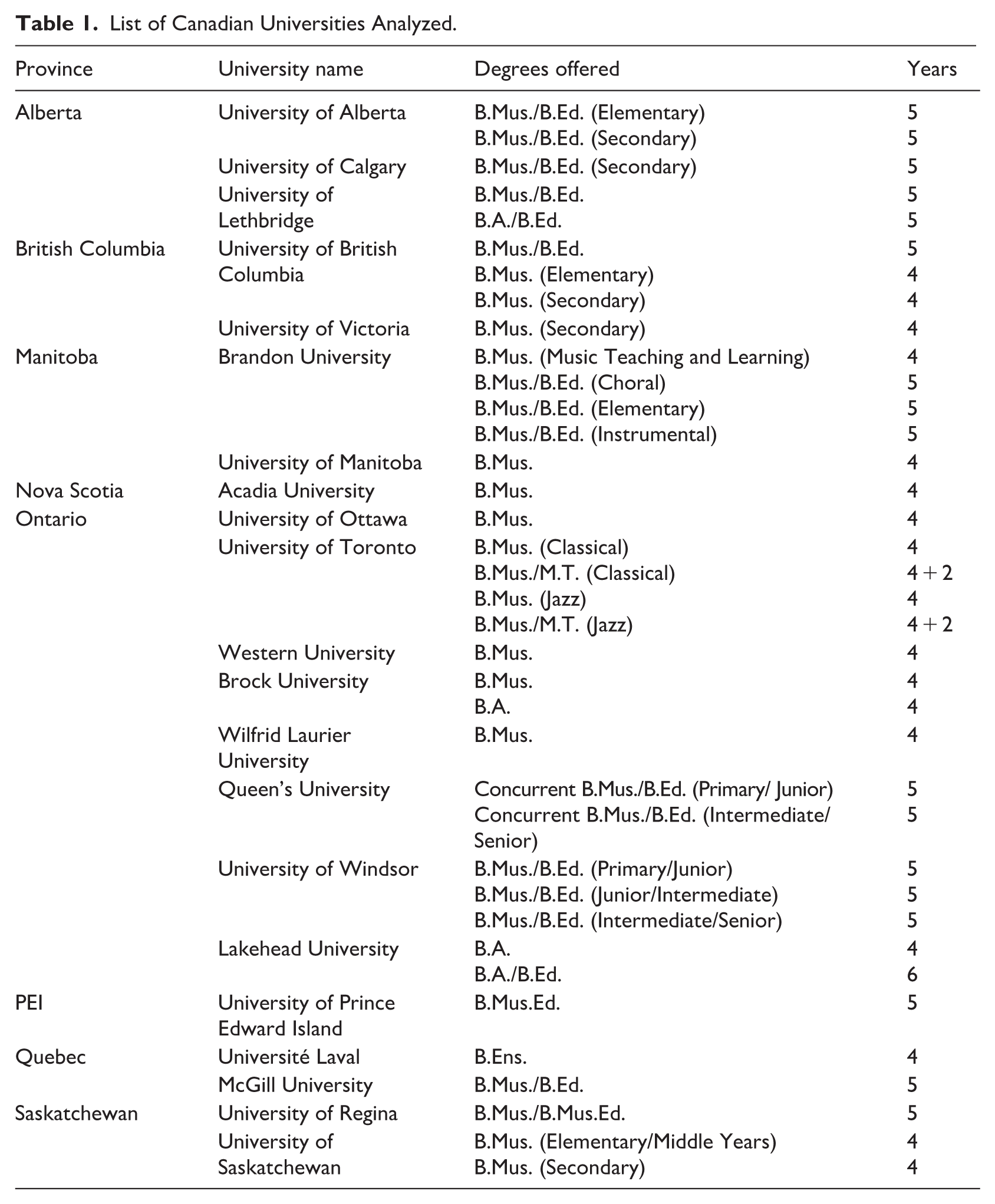
Based on the inclusion and exclusion criteria, we found eligible programs at 21 institutions housing 37 distinct undergraduate programs of study.
Audition Requirements
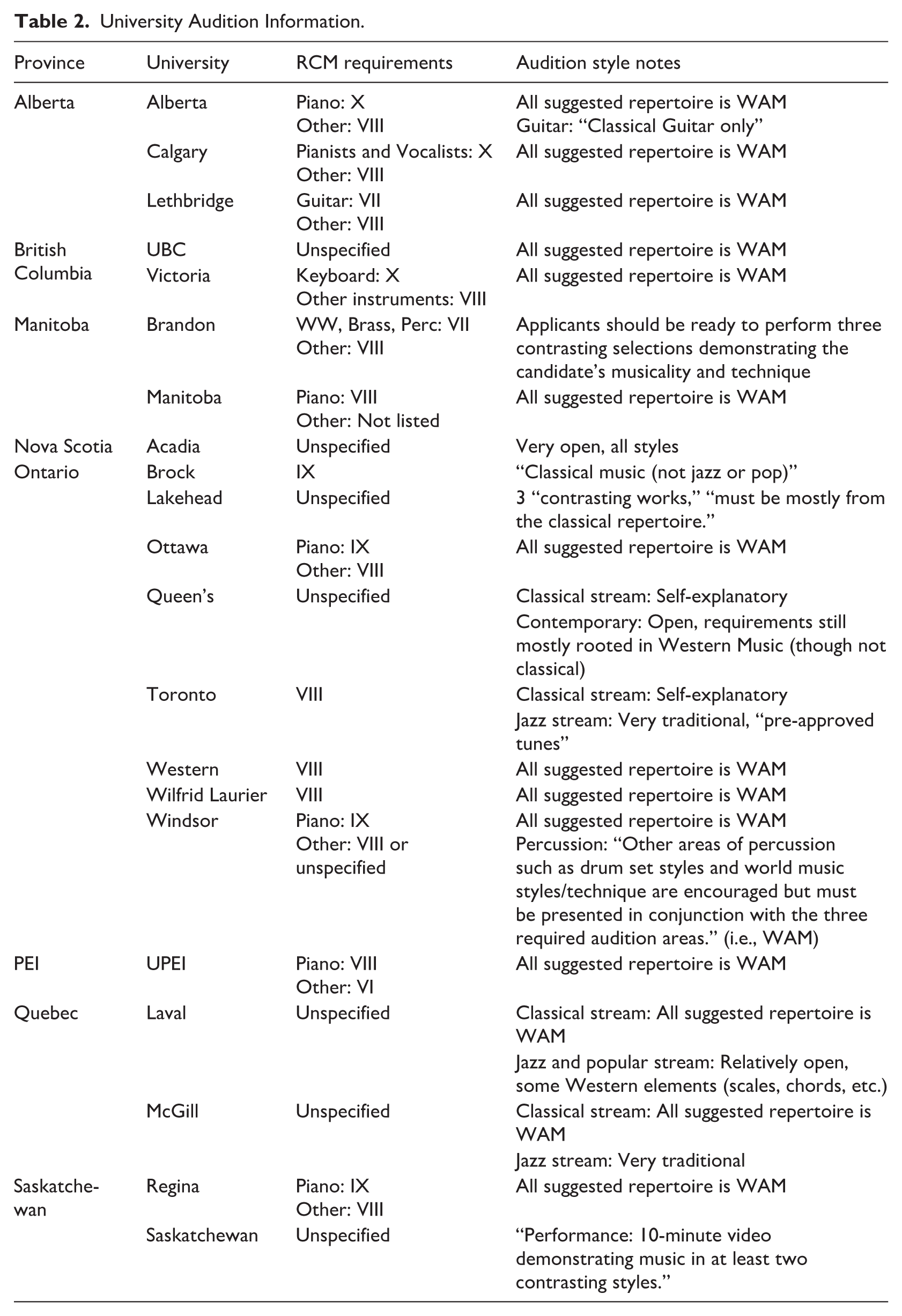
The first component of investigation entailed a survey of music-specific entrance requirements for each program, including Royal Conservatory of Music (RCM) levels when listed. Data were collected through official university web pages describing the audition processes for their music education programs (Table 2).
University Audition Information.
Program Curricula
The second and primary component of our research project involved curricular analyses of undergraduate music education programs in Canada.
For every required course at each institution, we collected the following data: unique institutional code, title, description, and credit/weight. We also included blocks of elective credits as conglomerated entries (e.g., 27.00 credits in music electives), compiling all possible course codes, titles, and descriptions. We experienced many roadblocks and issues throughout this data collection process, due primarily to errors and discrepancies on universities’ calendars and webpages. Some institutions’ webpages were inconsistent or had contradicting course requirements on different pages, some were missing course titles and descriptions, and some institutions’ web pages or program guides presented information in ways that were unclear to the research team. In these cases, we contacted colleagues, the universities’ registrars, or program administrators to resolve the issues.
As part of the data collection process, each course was assessed and coded according to two additional variables. The first coded variable, “course type,” included options such as “music education,” “musicology” (which included history), “music theory,” “ensembles,” “musicianship,” “1-1 instrumental/voice lessons,” and so on. The coded categorization of courses into types was relatively straightforward given the homogeneity of the programs. One potentially contentious result of this process was our labeling of instrument method courses as “music education”; in many cases, the course descriptions included instrumental pedagogy in the particular instrument area as a learning outcome of the course.
The second variable in our study, “WAM Status,” was coded into the following options:
Explicit WAM was assigned to courses that explicitly described practices, artists, genres, content, skills, or worldviews that were tied to the traditions of WAM. Some examples of this category included concepts, skills, and content such as orchestration, classical music (Baroque, Romantic, Impressionist, Serial, contemporary Art Music, etc.), or Western notation-based music theory. For example, Brock University’s Applied Music course is described as “Individual instruction in one of the following: piano, organ, voice, classical guitar or any approved concert band and orchestral instrument.”
Implicit WAM was assigned to courses that implied a focus on WAM but did not explicitly mention the concepts, skills, and content described previously. For example, this applied to all 1-on-1 private instrumental/vocal instruction and “instrument methods” courses, being almost exclusively based on band and orchestral instruments. As a comparative example of the private lesson example above, University of Lethbridge’s Studio Instrument course series is described as “Preparation and performance of appropriate technical exercises, studies, and repertoire assigned by the instructor.” Given that the instruments eligible for this class are all based in WAM (voice, piano, classical guitar, orchestral/concert band instruments), we determined that the description (i.e., “appropriate technical exercises, studies, and repertoire”) is implicitly referring to WAM content and learning modalities.
Partial WAM was assigned to courses where the course, or more frequently, conglomerated elective courses, included some components or options that included WAM but not all. For instance, if a university required an ensemble course for all 4 years at 3.0 credits per year, we created a 12.0 credit “Ensembles” entry for that program; if the ensembles available included: “Orchestra,” “Wind Ensemble,” “Choir,” “Big Band,” and “Global Drums,” the Partial WAM range would be 0 to 100% because a student could conceivably only take Global Drums for credit (0% WAM), or conversely only Orchestra (100% WAM). An example of a single course would be Music (Primary/Junior) at Queen’s University’s Faculty of Education, for which the description is:
An introduction to music in the elementary grades. Focuses on the integrative aspects of music in the classroom and in the curriculum, and introduces effective strategies and materials. Through experiential learning, participants develop their own musical skills and confidence. Various topics relating to arts advocacy, technology and music, music in the early and middle years, instrumental and vocal music, and composition and notation will be addressed.
In the description, the presence of both WAM and non-WAM elements (i.e., notation vs. technology and music) provided the basis of its coding as partial WAM.
“Explicitly not WAM” was assigned to courses whose descriptions pertained to content, skills, and worldviews that were outside of WAM. For example, University of Manitoba’s Cultural Perspectives for Music Educators is described as, “[a] study of non-Western musical practices and approaches to learning music, and implications for music teaching. This course is intended to prepare students for the diversity of the 21st century music classroom and studio” (University of Manitoba, n.d.).
“Unspecified” was assigned to courses where the title and description did not provide sufficient evidence to determine whether the course is rooted in WAM. For example, the description of University of Victoria’s Music in the Elementary School Curriculum is: “Elementary K-7 school music education methods and materials” (University of Victoria, n.d., para. 1).
“Non-Music” was assigned to courses that do not pertain to music and thus were not analyzed according to the extent to which it is rooted in WAM.
We also created a distinct column with a checkbox for “Jazz” that could be applied to conglomerate courses (i.e., typically ensemble option lists and elective option lists) that included jazz content. While jazz can arguably be considered WAM in some contexts, the case is not definitive; the following explanation of our calculations describes how courses coded as “Jazz” were factored in.
The degree to which WAM was represented in each program’s course requirements was determined by the variables below in each music education program:

We first calculated the
The horizontal bars labelled “All Music Highest WAM(%)” in Figure 1 indicate the highest possible proportion of WAM-based courses at each university. This was calculated using the formula below:
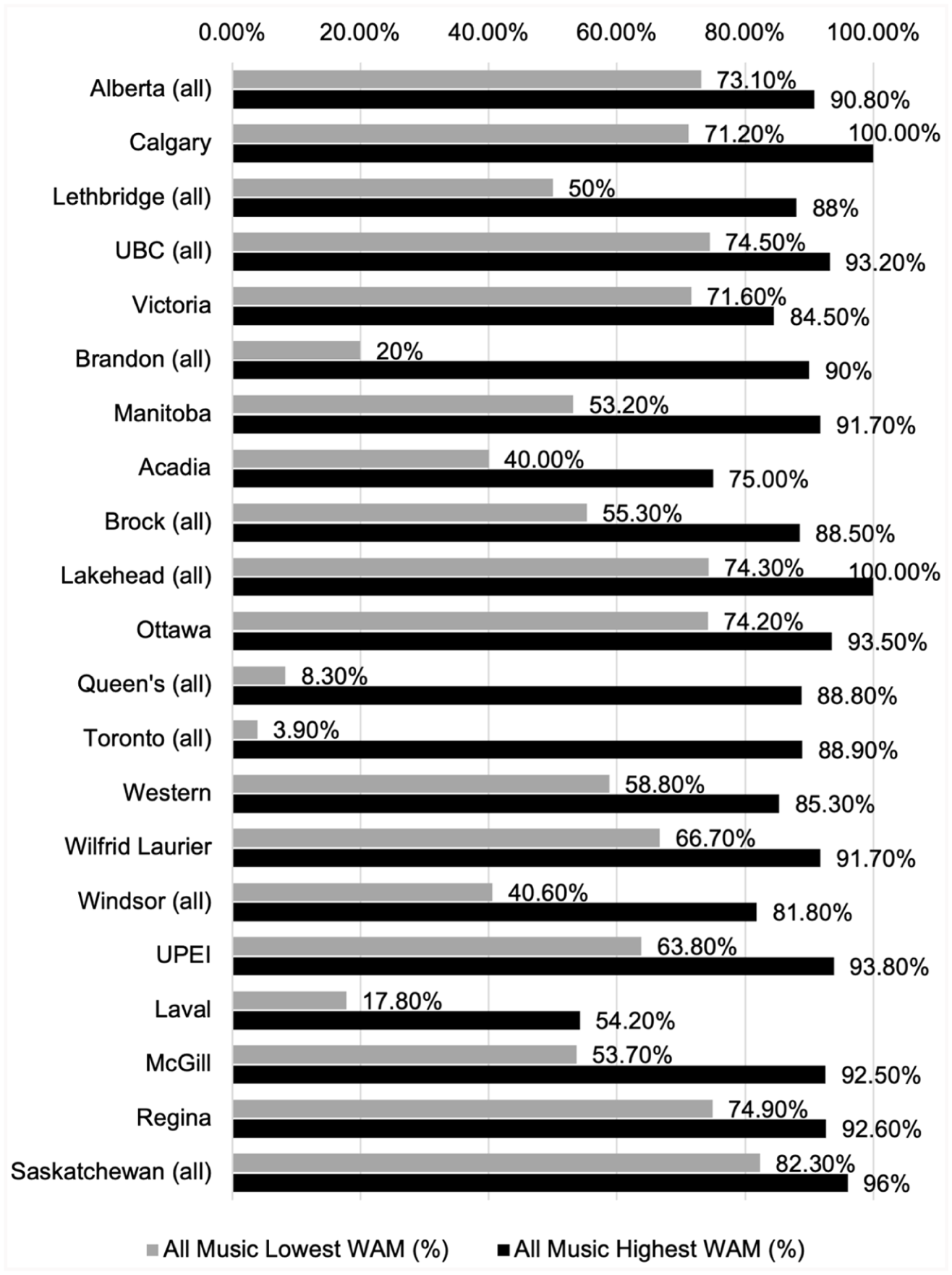
Percent range of WAM content in music courses for each institution.

The “All Music Lowest WAM(%)” column in Figure 1 demonstrates the lowest possible proportion of WAM courses for each of the universities. The formula we used is as follows:

Findings
Audition Requirements
Analysis of the audition requirements for each institution (Table 2) reveals several key findings. Exactly two thirds (14/21) of universities listed specific Royal Conservatory of Music (RCM) levels as guidelines for a minimum level of performance to enter their music education program. The RCM is a conservatory-style institution of musical instruction, rooted in the traditions of WAM, providing fee-for-service examinations and private lessons. The RCM describes itself as “The world’s finest program of music study and assessment” (The Royal Conservatory, n.d.-a, para. 1) in part due to its “rigorous, internationally renowned standard of music education, discipline and assessment and achievement” (para. 3). The RCM is often viewed as the de facto benchmark or “gold standard” (The Royal Conservatory, n.d.-b, para. 4) for evaluating musical performance ability in Canada. Notably, upper-level achievement in examinations is recognized as a music credit in many Canadian high schools (The Royal Conservatory, n.d.-c). The scale for RCM examinations spans Grades 1 through 10. 3 Of the programs analyzed in this study, the most common audition standard listed was RCM level 8, although one program listed level 6.
Some institutions we analyzed (Queen’s University, Université Laval, McGill University, University of Toronto) offer multiple degree program streams/concentrations in music education based on different musical practices. Each of these institutions offers a “classical” stream whose audition requirements either explicitly reference the RCM or list WAM-based repertoire and skills. University of Toronto and McGill University have jazz-oriented music education streams for which the required auditions ask applicants to demonstrate skills and knowledge specific to traditional jazz idioms. Université Laval and Queen’s University, in contrast, have alternative music education streams (Queen’s University: Contemporary; Université Laval: Jazz & Popular) with relatively open audition requirements, although some WAM elements are included (scales, modes, chords, etc.). Apart from Acadia University, University of Saskatchewan, and the Contemporary/Popular streams at Université Laval and Queen’s University, entrance requirements at 17 of 21 universities explicitly demand demonstrations of one’s capacity to perform WAM-based repertoire.
Acadia University appears to be the only program that is truly “open” to all styles in its audition information: “Perform examples of how you currently participate in music in ways that are meaningful to you. Present 2-3 pieces in any style(s) of music. They can be contrasting in styles, genre, moods. Or not. Choose pieces that showcase who you are.” (Acadia University, n.d.). Notably, Acadia does not characterize this process as an audition: Students do not have to audition as part of their application process. Instead, after you’ve been offered acceptance to Acadia, we’ll invite you to Perform-Connect. This isn’t a formal audition, and it includes much more than just listening to you perform. Our approach strives to be inclusive, accessible, and holistic. (Acadia University, n.d.)
Curriculum Analysis
WAM Representation in Music Courses
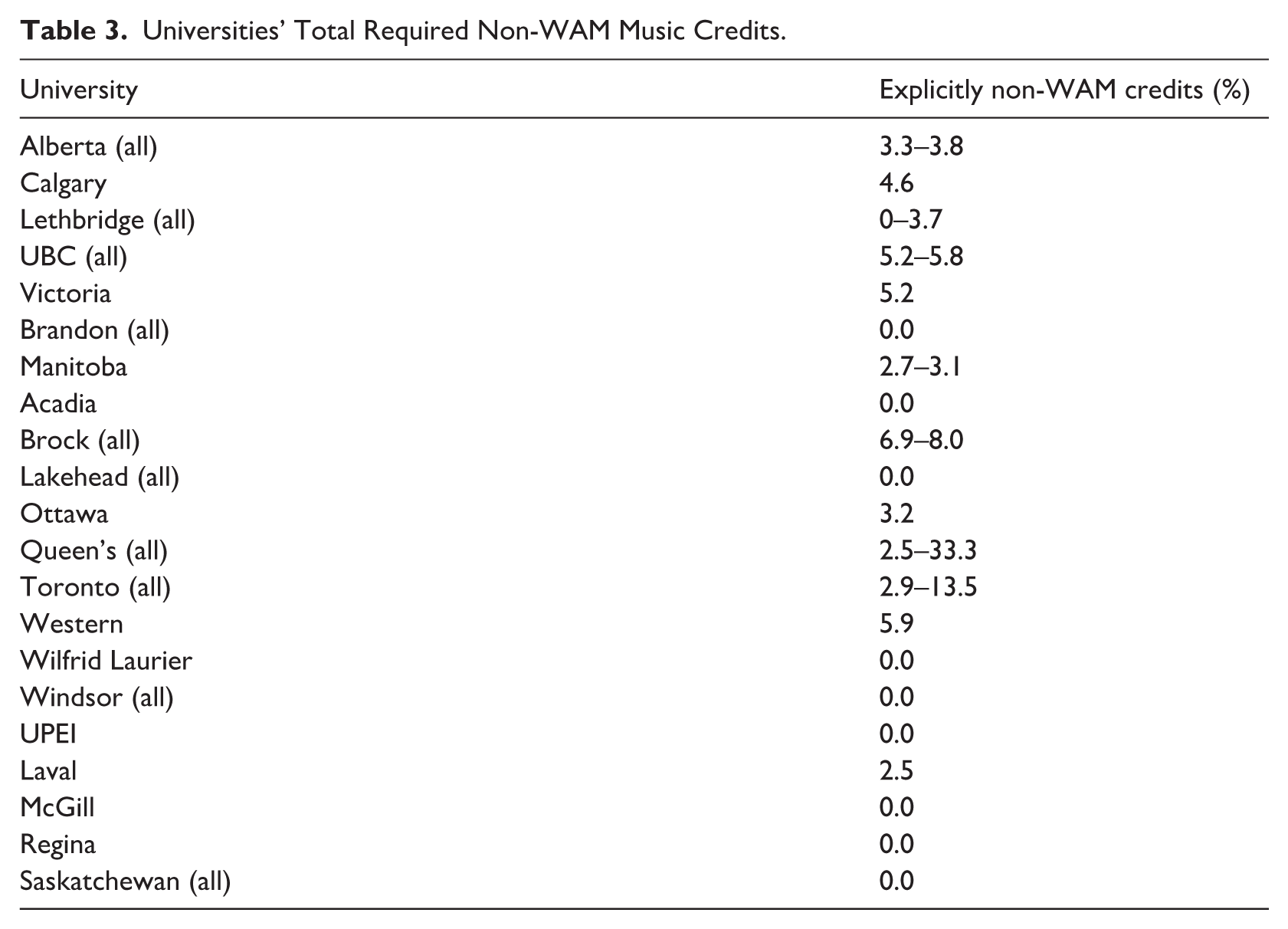
We organized the collected data by university and by province alphabetically respectively, as shown in Figure 1. Some universities offer multiple streams or concentrations. For example, The University of Toronto included four concentrations: classical and jazz concentrations each with the option to combine with a 2-year Master of Teaching in the Ontario Institute for Studies in Education (OISE). To present the data succinctly, we combined all streams or concentrations at one university together, indicated by “(all)” in the “University Name” column of Table 3 and Figure 1. Correspondingly, the numbers in the adjacent columns show the minimum and maximum percentage of music credit course requirements and WAM content for each university, inclusive of all of its music education program options.
Universities’ Total Required Non-WAM Music Credits.
There was a wide range in the proportions of required music course credits among the music education programs, from 38.0% in one of the streams at the University of Lethbridge in Alberta to 98.3% at Université Laval in Quebec. Cross-figure analysis between Figures 1 and 3 reveals notable contrasts among institutions regarding the course settings for music education programs. For example, while the Université Laval’s program is comrpised of 98.3% as music courses, it offers options for students to take the lowest proportion of WAM courses (17.8%). In comparison, the 6-year combined B.A program (Primary/Junior teaching concentration) at Lakehead University contains the second lowest music credit proportion (45.6%), but can offer as high as 100% of music coursework as WAM-based content.
Analysis indicates that at 12 of all the 21 undergraduate music education programs in Canadian universities it is possible to take more than 90% WAM-based music content. The highest numbers are at the University of Calgary and Lakehead University, with the possibility of 100% WAM content in music courses. At 19 of the 21 universities analyzed, students can take more than 80% WAM-related content in their respective mandatory music courses.
As Figure 1 indicates, eight universities contain a minimum of 70% WAM-based content in all of their music courses. Ten universities—nearly half of the institutions analyzed—have a minimum of 60% WAM course content, with 15 of 21 universities requiring at minimum half of all music content in their degree programs to be rooted in WAM-based content.
Music Education Courses
All courses related to music teaching and learning in various settings, such as classroom teaching, conducting, and instrumental techniques (methods classes), were categorized as music education courses. The minimum and maximum range of music education credits is depicted in Figure 2. Compared to all music credits (Figure 1), there was a moderate difference in the proportion of WAM content range, though not particularly significant. Most notable are the differences exhibited by University of Ottawa and University of Prince Edward Island (UPEI), whose lower minimum percentage of WAM content in music education courses suggests that students may have more opportunities to explore non-WAM content in music education classes than in other music classes.
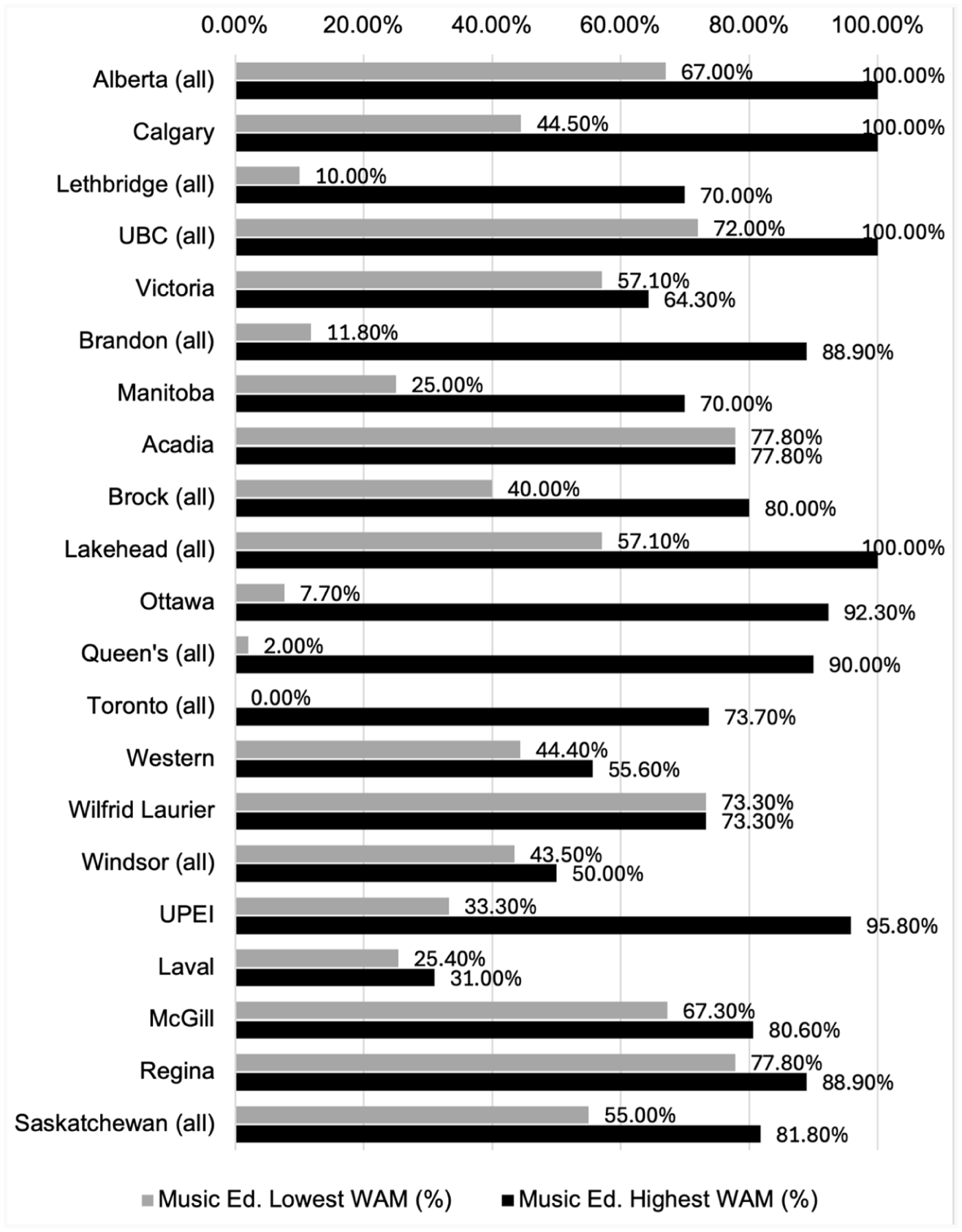
Percent range of WAM content in music education courses for each institution.
Non-WAM Course Content
Notable is the near absence of required courses explicitly not rooted in WAM. Nine out of 21 institutions do not require a single non-WAM course. 4 As displayed in Table 3, 10 institutions require so few explicitly non-WAM courses as to constitute 8% or less of all music courses, with only two institutions requiring more than 10%: University of Toronto’s combined degree programs at approximately 13% and Queen’s University’s Sonic Arts/Production stream at approximately 33%. The latter was included as a music education program in this study as it is technically possible to complete that degree stream concurrently with a Bachelor of Education. The majority of these courses were coded as music technology, though others included musicology (e.g., “Contemporary Pop Music,” “Music in Global Cultures”) and music education (“Theoretical Inquiry in Music Education,” “Progressive Music Pedagogies”).
Credit Distribution
We calculated the proportion of music education course credits and music credits more broadly required within each program (Figure 3). There is a wide range of minimum required music education courses among different institutions; music education courses were fewer in number at many institutions, and often had vague course descriptions, which increased the potential effect of courses categorized as “unspecified” misrepresenting the minimum percentage of WAM content. University of Alberta, for instance, requires as little as 5.6% of course content in music education for their Elementary Music Education program, whereas 55.8% of all degree requirements at Université Laval are music education courses; Université Laval’s program has an exceptionally high proportion of music education-specific courses.
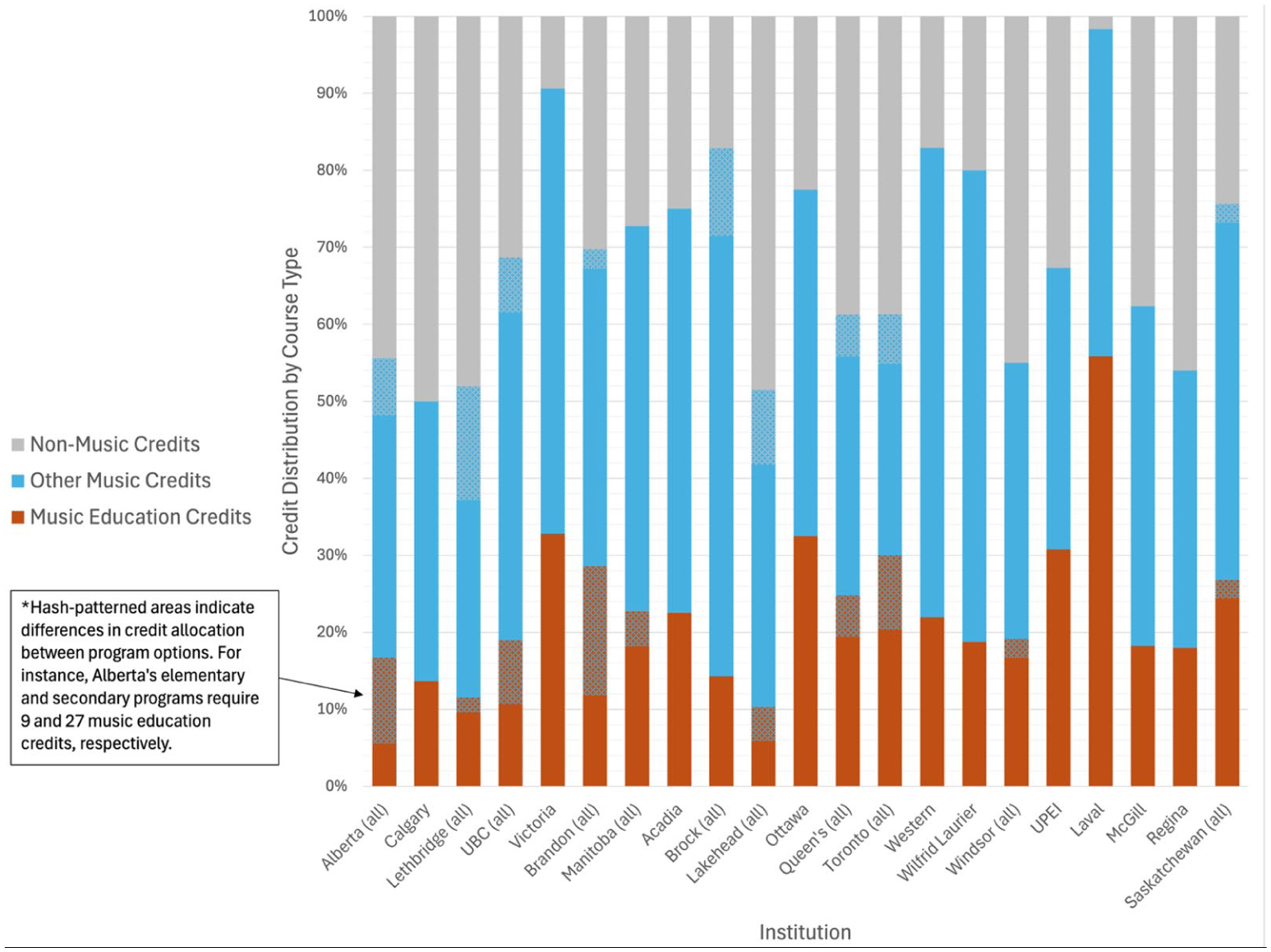
Credit distribution by institution*.
Anomalies
There are two notably unique programs. As mentioned earlier, Université Laval stands out in its high proportion of flexibility and high number of music education courses. Queen’s University, on the other hand, does not offer as many music education programs but instead has multiple music degree pathways through three sub-plans: (a) Classical, (b) Contemporary Instrumental and Vocal Genres, and (c) Digital Music and Sonic Arts (Queen’s University, n.d.-b). It should be noted that there are non-music education equivalents for all three streams, and that this program would not have been included if it did not offer an option to concurrently complete a Bachelor of Education.
Discussion
Auditions and Back Doors
Findings indicate that, with few exceptions, most entrance requirements for Canadian music education programs appear to affirm the critiques of Robinson (2019) and Koza (2008). Regardless of whether one agrees that WAM-based audition requirements function as “de facto racial and ethnic discrimination” (Koza, 2008, p. 149), heavily prescribed expectations advertised at most Canadian institutions represent significant barriers to aspiring music teachers who may not have the means or interest to meet WAM-based audition requirements. While there are alternative pathways to becoming a music teacher in Canada (for instance, obtaining a music degree in a sub-specialization that could potentially lead to a Bachelor of Education with a focus or qualification in music), in practice, not all Bachelor of Education programs in Canada will accept a music degree at face value. For example, at the institution of one of the authors, the Music Department offers a degree in Digital Audio Arts. Graduates from that program have traditionally faced a number of unadvertised barriers and challenges in gaining entry to the university’s Bachelor of Education program.
Curriculum
Findings show that, while the proportion of required WAM courses varied from institution to institution, the overall picture corroborates previous claims that music education programs in British commonwealth countries are based heavily on Western Art Music. The numbers indicated in our findings may actually be underrepresentative of the amount of WAM-based course content owing to courses we deemed “unspecified” that may, in practice, be rooted in WAM. What is clear from our analysis is that the vast majority of programs and courses are rooted in WAM norms and expectations despite critiques (Bartel, 2004; Bell, 2016; Hess, 2015; McArton, 2023), calls for change (Countryman, 2009; Davies, 1993; Rice & Shand, 1989; Walden, 2016) and “calling-ins” (Friesen, personal communication, March 16, 2022; Robinson, 2019) regarding Canadian postsecondary music education programs.
Perhaps the most revealing finding in this study is the extent to which programs do not require courses not rooted in WAM. This lack of musical breadth should be considered a significant problem for the field of music education, given that graduates of these programs will work with an increasingly diverse range of students. While some programs offer diverse opportunities for electives that represent different musical cultures and modalities, their position as “electives” compared to the required “core” WAM courses speaks to their relative status among the priorities of the analyzed programs. Although it would be impossible to quantify to the same degree, it is worth considering that the audition requirements for most institutions analyzed herein imply that students are somewhat inclined to the practices and content of WAM, while not necessarily those of the other musical traditions reflected in elective courses. This discrepancy is reflective of the tokenism described in Hess’s (2015) “Musician-as-Tourist Model” (p. 339). Prospective undergraduate students of diverse musical backgrounds may not perceive themselves in programs who do not explicitly or thoughtfully represent such backgrounds in their curricular structures. Further, it is unreasonable to expect that graduates of such programs, eventually working as music teachers, can develop “inclusive, rich, multicultural, and multi-musical programs in schools” (Southcott & Joseph, 2010, p. 9) without meaningful engagement with multiple practices (e.g., McArton, 2020) during their undergraduate program of study. Meeting these ends will require the further entrenchment of the non-WAM practices already occurring in Canadian postsecondary institutions of music education (i.e., the previously cited examples of Indigenous [Hill, 2023; Prest & Vazquez Cordoba, 2024], Chinese [Bell & Chen, 2019] South Asian [Satarasinghe, 2024] and Black [Hamilton, 2021b] cultures and popular music [Bell et al., 2019; Gage et al., 2020; Hamilton, 2021a; Lang, 2016; Snell, 2009; Touchette, 2024; Wright et al., 2012]).
Some students can afford to pursue music education aligned with their interests outside of public education, but many cannot. Those students’ opportunities are limited to whatever is happening in schools, which is further determined by the skills and understandings of teachers graduating from music education programs. This study provides evidence of the centrality of WAM-based values that continue to dominate such programs in Canada. The ubiquity of WAM in music education programs is inevitably translated to public schools and the music that is made in these settings. It is well past time to consider the creation of curricular structures in music education that can meaningfully reflect the diverse and rich musical knowledges and practices of many who dwell in Canada (Robinson, 2019).
Limitations
The study method and scope present a few notable limitations. All analyzed institutions being situated in a single country impedes the potential applicability of findings to other countries in regard to the extent of WAM being privileged in undergraduate music education programs. Further, the data is limited entirely to coded content analysis of public documents, with no further input from the institutions themselves; as such, beyond the anecdotal and positional perspectives provided by the authors, the study was not designed to highlight anomalous content at specific institutions as our research questions were more quantitative in nature. It is also possible that the actual experiences and content of some courses are not representative of their description or titles, skewing the meaning of our data. Consistently identifying such outliers would not be possible given the scale of our study. Ultimately, we acknowledge that this study represents a curricular snapshot of a moment in time; with multiple snapshots, one might be able to meaningfully measure changes to undergraduate music education curriculum in a given country or region. While many of us continue to build toward better futures behind the scenes, such work is not readily observable in public facing documents until officially reified through the sluggish bureaucracy of postsecondary institutions. It is our hope that future research may continue and build upon this process by monitoring curricular changes across the country (and perhaps other countries), and also seeking to better understand the steps taken toward such changes at individual institutions.
Footnotes
Acknowledgements
The authors would like to thank Bhakti Kawa, Pooya Khorramyar, and Milad Bagheri Torbehbar, for their contributions to some of the initial data collection.

Ethical Considerations
There are no human participants in this article and informed consent is not required.
Author Contributions
Funding
The authors disclosed receipt of the following financial support for the research, authorship, and/or publication of this article: This research study was supported with funding from the Social Sciences and Humanities Research Council of Canada.
Declaration of Conflicting Interests
The authors declared no potential conflicts of interest with respect to the research, authorship, and/or publication of this article.
Dedication
The authors would like to acknowledge the late Janice Waldron, who participated in the initial meetings that gave rise to this study.
Data Availability Statement
The datasets generated during and/or analyzed during the current study are available from the corresponding author on reasonable request.