




Abstract
Chinese people have performed their music in Sydney (Australia) for well over a century, albeit with fluctuating frequency and mostly to Chinese audiences. Since 2015, interest in Chinese music has been mounting in Sydney. This case study explores the experiences of nine instructors who teach Chinese musical instruments at a private music conservatory which one of them founded. The data collected reveal that: teaching Chinese music in a multicultural diasporic context involves a range of unique challenges; while there has been an increase in the number of people learning Chinese musical instruments, the music is still not widely known or popular in Australia, and; the study’s participants are successfully employing a range of novel strategies to address some of the challenges and to raise the music’s public profile. The study uncovers aspects of Chinese music’s dynamism in a multicultural context, and the vibrancy it brings to Australia’s contemporary culture.
Keywords
Chinese music and instruments have long been heard in New South Wales (NSW) (see Williams, 2020, pp. 175–178). In mid 1870, in the “Chinese quarter” of the tiny gold mining town of Sofala near Bathurst, NSW, a traveling reporter for the Evening News was drawn to the sounds of music and was entertained by a small group of Chinese musicians playing traditional spike fiddles and plucked lutes. The instruments heard on that occasion “were not imported from China, but of Sofala manufacture” (Evening News, 2 August 1870, p. 4). In 1892, Chinese instrumentalists and singers shared a recital program with White performers at the Athenaeum in Hay, in remote southwest NSW. The Riverine Grazier (12 August 1892, p. 2) sympathetically described the instruments and their sounds, as well as the singers’ performances, including their costume.
Of relevance to this study of aspects of Chinese music transmission in the Sydney community is the reception of those early performances in NSW. 1 According to Michael Williams, observers at the time “rarely [rose] above their Eurocentric views” (Williams, 2020, p. 183). But there were exceptions, including the instance at Hay just mentioned. A writer who attended the first Sydney season of Chinese opera in 1893 recognized that some Sydney music critics were “slaves of prejudice” who failed to adequately describe the performance, it being “quite beyond them” (Armidale Express and New England General Advertiser, 8 September 1893, p. 6).
As Williams explained in his history of Chinese Opera in Australia, “after a century of limited performance, [it] is once again making an appearance . . . . Once again it is performing to a largely Chinese community audience with a sprinkling of curious others, some of whom are well acquainted with the form” (Williams, 2020, p. 197). Other scholars concurred with Williams’ latter point, noting that “most [current] performances of Chinese music in Sydney are associated with Chinese cultural or community events, or multicultural celebrations, with only occasional performances of Chinese musical instruments in non-Chinese musical contexts” (Ingram et al., 2021, p. 74).
A new development in 2016 saw the practical study of Chinese music being offered by a major NSW public higher education institution, Sydney Conservatorium of Music (SCM) (Ingram et al., 2021); a Chinese music ensemble was established as part of that program (https://www.nicholasng.com.au/scm-chinese-music-ensemble.html). Sydney Conservatorium’s inclusion of Chinese music likely energized the subsequent formation in 2021 of SUCO, the Sydney University Chinese Orchestra, which boasts of being the “first full-sized, student-run Chinese orchestra in the Southern Hemisphere.” 2 Even so, it remains the case that generally in NSW the transmission of Chinese instrumental skills takes place in the community, hence our concentration in this article on a private music academy, Sydney Meya Conservatory of Chinese Music (SMCCM). (It is worth noting that some SMCCM personnel have participated in the Sydney University Chinese instrumental music program, and that yet another ensemble, the Sydney (or Australian) Youth Chinese Orchestra, was formed as part of the wider SMCCM enterprise.)
Founded in 2015 by Chinese flute expert Dong Min (or Meya Dong), the SMCCM represented a major new initiative in the promulgation of Chinese music in Sydney. A recent China Daily feature article explained how for several years Dong has been “enchanting Sydney’s streets with Chinese music” (Meng, 2024, n.p.). Dong is certainly aware of the power of social and self-media in promoting Chinese music. Her YouTube channel is well stocked with competently filmed and edited videos of her street performances in front of appreciative onlookers in Sydney’s Central Business District (CBD) (Figure 1). According to the article, Dong had one million followers online and one of her videos had been viewed over 32 million times (Meng, 2024, n.p.).
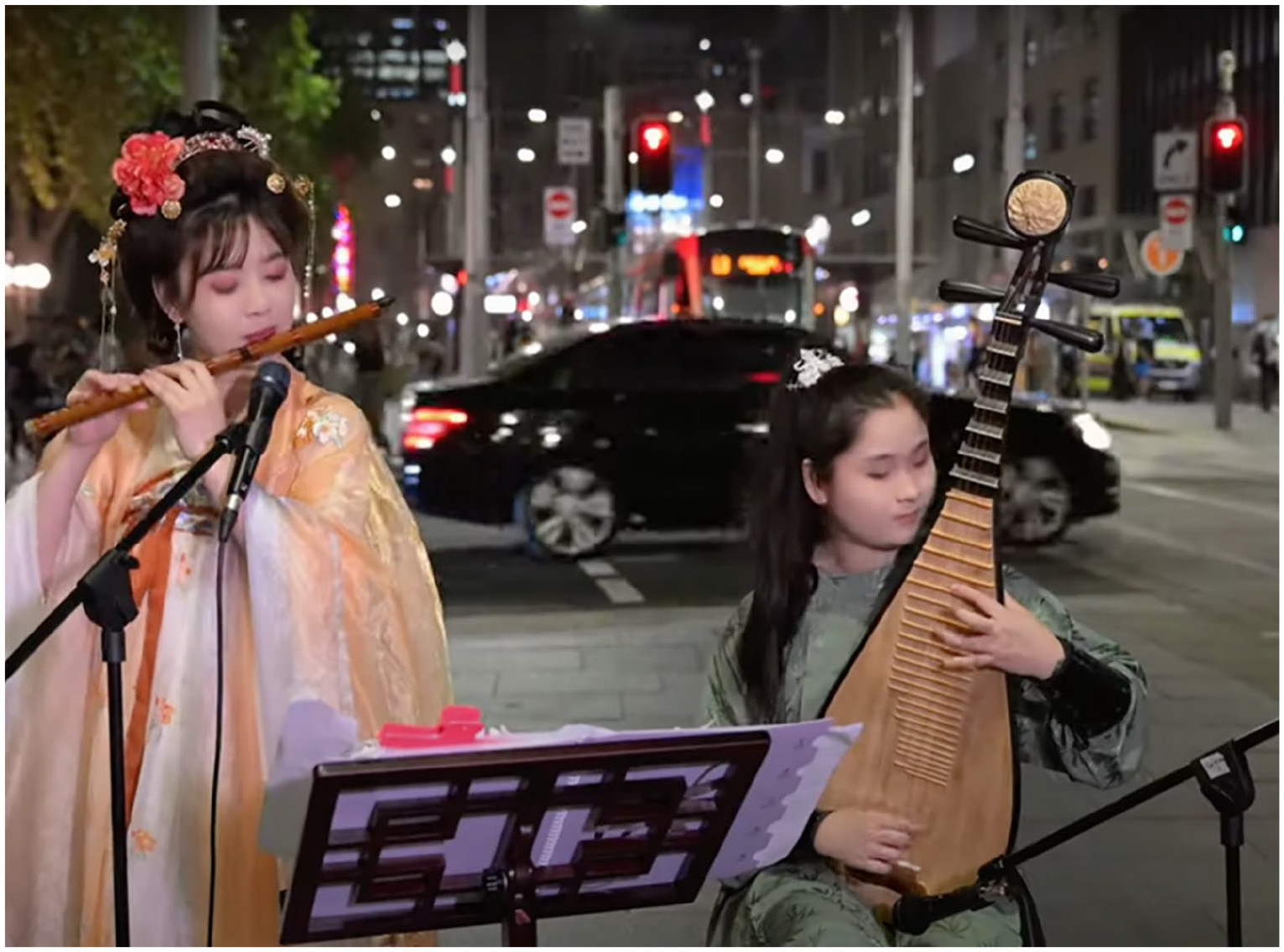
Screenshot from Dong, M. (2024). New Ambush from Ten Sides. YouTube, Sydney, Australia.
In this article we investigate Dong’s motivations and strategies in expanding the community reach of Chinese music, as well as the experiences and viewpoints of some of SMCCM’s instrumental teachers. After surveying the relevant literature, we outline the study’s methodology and participants, then discuss the findings. In the process of our investigation, we mention what the findings have to offer regarding Australian multiculturalism, especially as it applies to music education.
Literature survey
Chinese music
Regarding the study and performance of Chinese instrumental music outside China, it is helpful to understand what kind(s) of Chinese music this involves. “Traditional Chinese music, wrote Derrick Tu, “is any music that originated from local practices and customs in China and based on its own social and intellectual lineage in the development of its civilization” (Tu, 2019, pp. 21–22). Tu excluded “European traditions that entered China in the 20th century and which led to the professionalization of music [as well as] compositions that use Western techniques and approaches leading to a Western sound” (Tu, 2019, pp. 21–22). More broadly inclusive in her approach, Jing Xia wrote: “the monolithic concept of Chinese musical tradition only exists in the imagination” (Xia, 2022, p. 2). Since the mid 19th century, she explained, the “development of modern Chinese instrumental music [has been] heavily influenced by Western classical music” (Xia, 2022, p. 2; see also Chen, 2022). From that time, it underwent “a series of modernizing ‘reforms’ (改革) patterned on Western music, affecting the construction of musical instruments, music education, and performance aesthetics” (Xia, 2022, p. 5). Further, Xia considered the musical knowledge of instrumentalists trained in China from the 1960s onwards to be “thoroughly modern” (Xia, 2022, p. 6). Defining such a complex historical interweaving of music traditions and expressions is challenging and will involve contestation. The music forms and styles being promoted by the SMCCM is of the sort Xia described.
The modern Chinese orchestra
The modernization of Chinese music is epitomized in the Chinese orchestra (CO), an ensemble around which much of the music making in the Chinese diaspora now revolves. Other musical activities mostly take place in relation to the CO, including instrumental instruction (see, e.g. Wong Shengmiao, 2009, pp. 77–80). The modern CO was first formed in Nanjing in 1935, and the first Western format concert by this new type of ensemble took place in 1942 (see Kuo-Huang & Gray, 1979, pp. 14–15). The CO comprises traditional instruments organized in four groups: bowed strings, plucked strings, wind, and percussion instruments, with the addition of a select few Western instruments such as the cello and double bass (Guan et al., 2024; Kuo-Huang & Gray, 1979; S. B. Tan, 2000; C. Wang et al., 2019). The music of this ensemble “is not . . . regarded as ‘traditional,’” writes Nicholas Ng, “but developed from the sizhu 丝竹 (‘silk and bamboo’) genre of the Jiangnan region, of which Shanghai is [the] cultural capital, using traditional instruments that were modified as part of the guoyue 国乐 (national music) movement” (Ng, 2021, p. 177). As Samuel Wong Shengmiao (2009) explains, the “concept” of the CO “spread from mainland China to Taiwan, Hong Kong, Macau, Malaysia, Singapore, and even to Western countries such as the USA and Australia, spawning hundreds of thousands of practitioners in Asia and beyond” (p. xvi). The CO has also served as the basis for instructing players of non-Chinese background in Western (and Westernized) educational institutions. Much of the small body of research literature on Chinese instrumental music making in the diaspora deals in some way with the CO or ensemble, as the literature cited in the next section shows.
Chinese instrument learning
Yao Cui (2022, 2023b) documented the activities of COs in the Greater Toronto Area (GTA) in Canada, which has one of the two largest diasporic Chinese populations in North America, the other being in Vancouver (Cui, 2022, 2023b; Kwan, 2021). She enumerated ways Chinese music knowledge and skills are transferred in the GTA: through individual or group private lessons with expert musicians, including at “music stores and commercial music training schools”; through lessons some community centers offer to “interested youth or seniors”; through partnerships between COs and some local music schools; and through the curricula of some public higher education institutions (Cui, 2023a, pp. 123–124). In short, in the GTA Chinese music training took place predominantly in the community rather than in public institutions (also see Kwan, 2021, pp. 40–41, p. 53).
Keran Li (2023) indicated that in New Zealand (NZ), Chinese community music education included “performances held by Chinese organisations, musical workshops undertaken in community schools, and private music classes conducted by Chinese musicians” (p. 245). She noted that Chinese immigrant “professionals devote themselves to community music education as teachers rather than performers, while amateurs mainly dominate the field of performance” (Li, 2023, p. 237). Professional teachers, she wrote, “organise small ensembles for their students to perform in different communities” (Li, 2023, p. 237).
Writing of the situation in Malaysia, Ellyn Tan and Sergio Camacho Fernández (2023) stated: “Currently, Chinese orchestras thrive in community establishments, comprising . . . educational organisations (primary and secondary schools, universities, alumni associations), clan associations or guild halls, local cultural centres, freelance groups, and other small collectives” (p. 57). At one time, according to Tan and Camacho Fernández, there were nearly three hundred active COs throughout the country, “most of them linked to educational institutions” (E. Tan & Camacho Fernández, 2023, p. 57). The high number of ensembles is explained by the fact that the population of people of Chinese heritage is considerably larger than it is in other diaspora countries (besides Thailand and Indonesia) (see Poston & Wong, 2016).
Wong Shengmiao (2009) learned that among professional CO musicians in Singapore, teaching was “one of the primary sources of supplementary income” (p. 156). These musicians, he explained, “may derive their teaching income from being either conductors or sectional teachers in schools, or instructing private students in a music school, studio, or home. Of all of these sources of revenue in teaching, teaching at schools by far is the most profitable” (Wong Shengmiao, 2009, p. 156 original italics).
The scant literature on the CO and learning Chinese instrumental music in Australia includes two articles that in broad terms contrast with those already discussed. Jane Southcott and Vicky Liao studied the activities of Melbourne’s Chao Feng CO, established in 1982. As they reported, all the members of Chao Feng were skilled music performers before joining the group, and “playing music is the core of Chao Feng” (Southcott & Liao, 2022, p. 177). The Chao Feng CO also performs at local community events, schools, and has a history of performing overseas and in Australia with visiting international ensembles, “acting as a medium through which Western people have been able to experience Chinese culture” (Z. T. Wang, 1997, p. 60). In contrast, in the Sydney Conservatorium of Music (SCM) Chinese music program, “students from all cultural backgrounds, disciplines and musical experiences are invited to learn a Chinese instrument over six semesters while playing in a Chinese orchestral context” (Ng, 2021, p. 177).
Challenges
Cui (2023a) reported that “[i]n Canada, unlike in China, there is no systematized structure of Chinese music education, and fewer Chinese instrument teachers available” (p. 123). This highlights the fact that those who wish to transmit instrument skills in the diaspora face challenges. Subsuming all other challenges is that of negotiating the multitude of musical expectations that come with living and working in a multicultural society. On one hand are the local Chinese community’s notions of musical authenticity—some older Chinese musicians feel modern arrangements of Chinese music are counter to the music’s ancient esthetics. On the other are the assumptions of the non-Chinese public, who expect to hear exotic Chinese sounds (see Tan & Camacho Fernández, 2023, p. 53; Xia, 2022, pp. 112–113).
There are also challenges pertaining to language for wider communication in the diasporic context (see Chan, 2022, p. 57; Li, 2023, p. 266), and the need to find ways to motivate the next generation of musicians to advance the music (see Chan, 2022, p. 57). Further difficulties include: gaining access to scores for teaching and performing, as well as instruments and other resources (see Chan, 2022, pp. 57–58; Li, 2023, p. 106); the use of different forms of musical notation to those commonly used in Western settings (see Chan, 2022, p. 57; Cui, 2023a, p. 126; Xia, 2022, p. 48, p. 96); the “challenge to find Chinese teachers of less common instruments” (Xia, 2022, p. 90); and “musicians’ general lack of training in the business aspects of music” (Xia, 2022, pp. 196–197).
A good example to mention here is John Prescott et al.’s (2008) 3-week pilot program for American students to learn and play traditional Chinese instruments. The program consisted of two teachers from a Chinese university offering nine different instruments for study based on their specialties. As they reported, “the music served to bridge the language barriers between teachers and students so that, at times, no translation was necessary” (Prescott et al., 2008, p. 381).
Diasporic identity
Chinese music in the diaspora plays a significant role in the reinforcement—in some cases the (re)discovery—of individual and group Chinese identity. This many-faceted and complex subject is of interest to us particularly in the ways it feeds into national multicultural identity in Western countries.
In her NZ study, regarding music-based ethnic identification and multiculturalism, Li (2023, p. 244) differentiated according to generation: “under 18 years” (G1); “18 to 60 years” (G2); and “above 60 years” (G3), as follows:
G3 notes that overseas Chinese music has integrated into mainstream society because Chinese music can engage in local activities, particularly political events such as the performance at the Auckland mayoral inauguration ceremony. Moreover, some similar responses from G3 can be classified according to this view, such as the Prime Minister and NZ officials attending Chinese celebrations, and overseas Chinese musicians collaborating with local musicians. In contrast, G2 claims that overseas Chinese music has not totally integrated into mainstream society because Chinese music has not been included in the official education system in NZ (especially compulsory education) (p. 306).
Due to space constraints, we are not able to discuss every aspect of what the literature selected has to say about music and diasporic Chinese identity. We now turn to our case study.
Methodology
For this qualitative case study, we collected data using semi-structured interviews. This allowed us to acquire rich information about the participants’ views, perceptions, and experiences (Cohen et al., 2018). At the outset we devised the following questions to steer the study:
(1) Can you describe your experiences and challenges while teaching Chinese musical instruments in Sydney; in what ways is it different to teaching in China?
(2) How would you describe the level of community acceptance of, or interest in, Chinese music in Sydney?
(3) What strategies have you employed in promoting Chinese music in Australia and how successful have they been, do you think?
We also asked more specific questions in the interviews to assist us in exploring the experiences, views, and initiatives of individual teachers of Chinese musical instruments working in Sydney.
Recruitment
The first author employed snowball purposive sampling (Roulston, 2014) to contact experts in the Sydney community who were teaching Chinese musical instruments. The following inclusion criteria were used: participants needed to be (a) a teacher with at least five or more years teaching experience; (b) teaching a Chinese musical instrument in the Sydney community, and (c) willing to participate in the study. After obtaining ethics approval from the University Human Research Ethics Committees, she posted a recruitment notice on Facebook. A community pipa (lute) player who taught at the Meya Conservatory responded to the advertisement, and the snowballing process began. From a larger pool of respondents, we chose to concentrate on nine musicians who taught at the SMCCM, this after studying the Meya Conservatory’s website and related media content. 3 Given its vision and model of operations, we believed the founders and their staff might offer an interesting perspective on the transmission of Chinese music in Sydney. (At the time of recruitment, there were only 13 teachers of Chinese musical instruments listed on the SMCCM website; this number has since increased.)
According to the website of the Meya Conservatory, the Meya Conservatory’s aim has been to promote Chinese musical culture overseas, mainly in Australia. 4 The impressive Meya Conservatory website presents a youthful, elegant, and cultured image of Chinese music. Operating out of two campuses located at Chatswood and Burwood in Sydney—as well as over the Internet—it supports 24 teachers, 19 of whom teach Chinese musical instruments: dizi (side-blown flute), xiao (end-blown flute), hulusi (free reed pipe), pipa (lute), ruan (lute), yangqin (hammer dulcimer), erhu (spike fiddle), guzheng (board zither), and guqin (board zither). Besides that, it also offers lessons in piano, singing, and music theory.
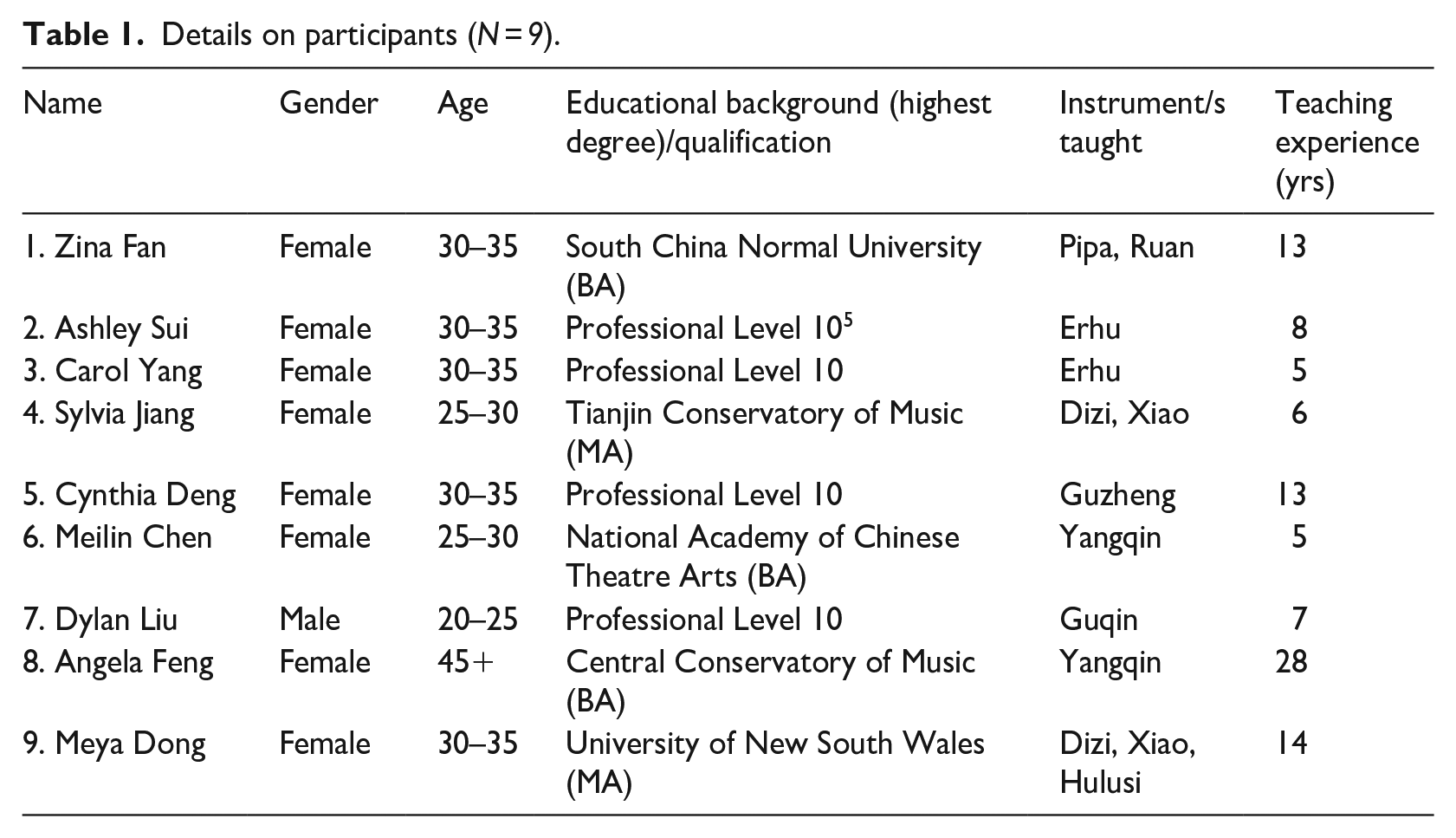
Table 1 shows a profile of each participating teacher (all granted permission for their name to be used, which are also displayed on the school website). As shown in Table 1, eight were female, one was male. Five of the nine teachers are in their early-to-mid 30s; three are younger than that, and one is older. Most had graduated from a conservatory or university in China with a bachelor’s or master’s degree; two graduated from conservatories in mainland China, two from high-ranking universities. One graduated from a top university in Australia. The other four participants did not have a music degree but have achieved Professional Level 10 (see Table 1). Four have over 10 years’ teaching experience. All participants hold Chinese professional music qualifications and are experienced performers.
Details on participants (N = 9).
Data collection
Prior to being interviewed, each participant received an information statement explaining the nature of the study and each one signed a consent form. All interviews were conducted by the first author; all but one were undertaken between mid-September and early November 2023, as the participants were recruited. The founder Meya Dong’s interview took place in June 2024 since she was unavailable earlier. Interviews were conducted over Zoom or in-person, according to individual preference, and were 30 to 40 minutes long. Participants could choose whether to be interviewed in Chinese or English—all selected the former. With consent the interviews were audio-recorded. They were then transcribed, and the transcripts were emailed to the participants for double-checking, following which they were translated into English by the first author. The English versions of the transcripts were lightly edited for smoothness and to reduce repetition.
Data analysis
In analyzing the data, we employed a thematic approach (Miles et al., 2019). Analysis began with open coding, focusing on the instrument teachers’ experiences, perceptions, and challenges. We coded the data independently to reduce the risk of interpretation bias (Cohen et al., 2018), then came together to discuss emerging themes and construct a shared understanding of the findings. Since the original data were translated from Mandarin into English, and the second author does not speak or read Mandarin, during the coding phase of the study especially, he regularly questioned the first author (a native Chinese speaker) regarding both his and her interpretation of the data to arrive at a consensus in meaning. In some instances, this required the first author to re-listen to the interview recording and check her translation (see Cole, 2023, p. 8). Additionally, we conducted member checking by sending the interview transcripts and a summary of the identified themes to the participants for their review and feedback (Lincoln & Guba, 1986). Through this member checking process, the researchers were able to validate the findings and ensure their accuracy and authenticity according to this member checking process.
Findings
The study found that: (a) teaching Chinese music outside China involves a range of differences and challenges that are unique to the diaspora context; (b) while there has been an increase in interest in Chinese music and instruments in Sydney since the mid 2010s it is still not widely known or popular; and (c) Dong and the SMCCM teachers are employing a range of novel strategies to address some of the challenges ([a] above) and to raise the music’s public profile, apparently successfully. These findings are perhaps unremarkable or to be expected, yet as will be seen they do afford insights. Indeed, we sensed among the study’s participants—who belong to a new generation of Chinese immigrants—pride in their Chinese cultural heritage and a related optimism and determination to represent it as possessing the potential to enrich Australia’s multicultural society.
Finding (a): Challenges
Regarding the first research question about their experiences and challenges in teaching Chinese music in Sydney, the participants mentioned a range of difficulties and discoveries, which we grouped as follows: (1) Australians’ extent of familiarity with and acceptance of Chinese music, (2) language issues pertaining to teaching, and (3) the age span and cultural background of learners, and their reasons for taking lessons.
Lack of familiarity and acceptance
In Australia, where the public knows relatively little about Chinese music and instruments, SMCCM founder Dong took a risk in establishing a new Chinese music school. Pipa teacher Zina Fan emphasized: “I believe it will be a long time before Chinese music becomes a mainstream phenomenon within Westerners’ cultural acceptability. Compared to Western music, Chinese music is still relatively unknown [here].” Dong notes that at first “in contrast to now, the public was less familiar with Chinese musical instruments back then [2015]. I conducted street performances in Sydney’s Chinatown and outside Sydney Opera House and other famous buildings to introduce Australians to Chinese musical instruments.” Erhu teacher Ashley Sui also commented on the lack of familiarity with Chinese musical instruments: “When I perform in some parts of Sydney, many audiences of Anglo-Australians or other cultural backgrounds will ask us what kind of instrument it is. This may be the first time they’ve seen a Chinese musical instrument.”
Teachers of less familiar Chinese instruments such as the yangqin (hammer dulcimer) have struggled to recruit students. “The yangqin is a relatively unknown instrument,” said Meilin Chen, “unlike the guzheng, pipa, and dizi . . . . Also, the yangqin is [literally, in Chinese] a ‘foreign musical instrument’ [probably originating in the Middle East], which was adopted into the national family of instruments at a later stage of development, and not many people are familiar with it.” Consequently, “not many students have applied to study the yangqin.”
Dylan Liu shared a similar sentiment regarding his instrument:
The guqin is an uncommon and unpopular instrument, in Australia and China. I started learning the guqin in 2010, and at that time it was [quite] unknown in China, with very few people learning it. In recent years, with the broadcast of some costume dramas and the development of some self-media such as YouTubers, the guqin has begun to attract [more] attention from the public.
Liu admits that he himself “first became interested in the guqin through reading novels” before studying “in Chengdu with Professor Dai Ru at the Sichuan Conservatory of Music.” He went on: “There is no HSC (High School Certificate) or [other] certificate to learn guqin in Australia. For some of my high school students, learning guqin does not give them any role in their school’s music band.” This makes the study of guqin appear less legitimate than learning an instrument that is more well-known.
Carol Yang, another erhu teacher, described the extent of interest in receiving tuition this way: “Although the number of people learning Chinese musical instruments is currently on the rise, most people are still hesitant to learn one. Many parents consider the piano as their first choice . . . for their child and choose based on their child’s interest.” She pointed out that a choice hierarchy was at work (which is to be expected)—Western instruments over Chinese, and certain Chinese instruments over others.
Language of communication in teaching
The participants found issues surrounding language to be challenging. Guqin teacher Dylan Liu explained:
As a Chinese native speaker, I need to teach in English to students who are not very familiar with Chinese. So, the proper translation [of terms] and expression [of ideas] is very important. Because the guqin is an ancient instrument, there is some [obscure] Chinese language in the scores, which makes it difficult for students who are not native Chinese speakers.
The matter of translating and getting across Chinese music terms and cultural context was mentioned by other participants too. Pipa teacher Zina Fan said: “In the process of playing the pipa, the students need to learn [at least] a little bit of Chinese.” And Ashley Sui, who teaches erhu, related: “Many of the [Chinese] songs are related to the era and context in which they were composed, and due to cultural differences, it is difficult for me to explain to Anglo-Australian students that context, so I can only teach from a [purely musical or] melodic point of view.” Yangqin teacher Angela Feng was another one who referred to the challenge of communication, stating, “There will be a language issue in the teaching and learning process. For those who are not native speakers of Chinese, I need to teach in accurate English.”
Students’ age span, cultural backgrounds, and motivations for learning
The SMCCM’s clientele presents its teachers with a particular set of challenges: learners ranging in age and Chinese cultural experience, learners of different cultural backgrounds, and learners with a variety of motivations for seeking lessons. This has meant that since coming to Australia the teachers have had to develop flexibility in their instructional approach. For example, Dylan Liu reported: “The age of [my] students spans a wide range, from ten to about 60 years old. There are more female students. Two-thirds of them are native Chinese speakers, and one-third are either Australian-born Chinese or Anglo-Australians students—fewer are non-Asian.”
Cynthia Deng’s students span a similarly broad age range, from five to around 70 years old, so she has had to employ different strategies. “For teaching children,” she states, “it is most important to attract and maintain their interest in the guzheng. For teaching adults, [one] should not follow the textbook strictly but introduce some Chinese popular songs while teaching the basic techniques.” Angela Feng, too, stated: “I [need to] teach students of different cultural backgrounds and different ages according to their needs.”
Sylvia Jiang clarifies that various teaching approaches are expected, not just according to age but culture:
For adults I accommodate individual interests and [repertoire] preferences and then introduce specialized knowledge and playing techniques. For children, teaching dizi in China is very different from teaching in Australia. In China, parents have a “strict” philosophy and criteria for their children to learn musical instruments, whereas Australian parents usually focus on “happy learning” [enjoyment in learning].
In a related vein, Zina Fan mentioned that there is “a big difference between teaching pipa and dizi and guzheng in China and Australia. In response to the educational concept of ‘happy learning’ and the ‘interest-based’ [engagement] approach of Australian parents, I need to change my teaching strategies” (see Wang, 2025, p. 151).
Differences in age and background have implications for the selection of suitable teaching material. As SMCCM founder and director Meya Dong outlined: “Our approach to teaching beginners is centered on basics. We add age-appropriate repertoire according to students’ cultural background, preferences, and favorites, as they develop their abilities and levels. As practice pieces are usually boring, learning some popular or modern pieces increase the students’ enjoyment and interest in learning.”
Dong and her staff have also had to grapple with learner engagement to maintain enrollment levels. Ashley Sui recalled: “When I began teaching Anglo-Australian students it was a challenge . . . because the erhu textbooks were old, and the repertoire was not current. The repertoire selection was very limiting for me.” Sui also encountered a perception that had implications for choice of teaching repertoire, that is, “a general stereotype of the erhu as a ‘sad’ instrument that cannot play joyful songs. It’s important to break [this] down, to not only play the old repertoire, but also to add a little bit more innovative forms of playing that will attract the audience’s [and learners’] attention.”
Motivations for learning a Chinese musical instrument vary. Erhu teacher Ashley Sui states:
My students range in age from ten to about sixty or seventy. Half are Anglo-Australian and half are Chinese Australians students. Children of Chinese background are mainly influenced by their parents to learn erhu, usually as a second instrument of choice. Adults learn erhu out of personal interest. Sixty to seventy-year-old Chinese heritage students are retired but interested in erhu. They were exposed to erhu when they were young and have always loved traditional Chinese songs, so they learn erhu.
Sylvia Jiang believes retirees take up an instrument for nostalgic reasons: “For Chinese Australians, hearing and seeing traditional Chinese music and instruments in Australia can ease the longing for home and give them comfort and joy.”
Jiang described her clientele in more detail:
Two-thirds of my students are international students, and some of them are in their thirties and forties. They learn the dizi because they understand Chinese culture, but they did not have the time to learn it systematically when they were in China, and now they have the time to develop their hobby, so they start learning the dizi. Older students learn the dizi to pursue their childhood musical dream. Children learn the dizi because they can get into [the SMCCM] orchestra with the dizi as a second instrument. They choose . . . the dizi because it is more portable and easier to learn. A few students learned the dizi because they were going to a [performing arts] school and learning a Chinese instrument was a plus, and some because of personal preference. The percentage of non-Asian students is relatively small, only a few.
Zina Fan’s pipa clientele is also quite diverse:
There are some who have not [previously] been exposed to pipa but have been influenced by popular Chinese style songs and [so] want to learn a Chinese instrument. So far, the number of non-Asian students is very small, only two or three. One is a grandmother [Anglo-Australian] whose granddaughter is of Chinese heritage. She took up the pipa because she wanted to learn an instrument related to her granddaughter’s culture to find some common ground. Another person who followed me to learn pipa is an adult of Southeast Asian background who [has become] a serious fan of Chinese style songs. . . . There was also a student who majored in recording, and according to him, learning the pipa and other Chinese musical instruments will help him in his work.
In summary, many of the challenges the teachers at SMCCM faced are related to those faced elsewhere in the diaspora as outlined in the literature survey above. A difference this finding revealed was that of expectation. The Sydney public’s general lack of familiarity with Chinese music, even among the Chinese immigrant community, meant that there were few expectations to be negotiated.
Finding (b): Community interest in Chinese music
Independently, all participants noted an increase in interest in Chinese music and instruments since they had begun teaching. Significantly, not all of them were teaching at SMCCM from its beginning in 2015—some had only been at SMCCM for a year or 2 years.
Carol Yang spoke of changes she witnessed at the individual student level: “There has been a real change in the acceptance of Chinese musical instruments . . . from ‘wanting to understand’ . . . to ‘gradually becoming interested’ . . . to ‘loving’ it.” Angela Feng said something similar: the public “acceptance of Chinese traditional musical instruments has progressed from ‘looking at it’ to ‘touching or trying it’ to ‘wanting to learn and understand it’. It’s a positive change.”
Sylvia Jiang spoke about both the individual and broader public response: “At first, the students were just a little curious about the dizi, but later they showed a strong interest in the process of learning. This year, I was invited to give a dizi solo performance at Sydney Tower on Chinese Valentine’s Day. I prepared two pieces; one was a Western song and one a traditional Chinese piece. The audience was generally more interested in the traditional Chinese piece.”
Cythia Deng explained the changes she has witnessed as follows:
People first learnt guzheng for fun and did not put much emphasis on it. But in recent years I have noticed that people are paying more and more attention to the guzheng . . . [now] students are quite serious about learning and finishing their assignments. This transformation, I believe, is strongly related to the development of Chinese music in Australia . . . . The most noticeable change is that people now regard the guzheng as a musical instrument rather than a toy.
Understandably, Dong was keen to share her thoughts on the matter: “Over the past 8 years, she related, “I have witnessed the transformation of Australian audiences from being unfamiliar with traditional Chinese music to partial engagement with it now.” Dong provided supporting examples. First was the extensive media coverage and attention SMCCM’s 2023 annual concert garnered, from China News, People’s Daily Online, Xinhua News, the Consulate-General of the People’s Republic of China in Sydney, and the China Cultural Centre in Sydney. Dong proudly declared that
the audience had a genuine opportunity to experience traditional Chinese music and culture, aurally and visually, as the performers dressed in formal dress for the first half of the concert and Chinese hanfu (汉服) and horse-face skirt (马面裙) in the second half.
Second, in 2023 she was invited to take part in the Festival of the Pearl in Broome, Western Australia. “As the only Chinese performer in attendance, I was able to see that through my interaction with the audience and other artists and the public how diverse Australia’s culture is and how well-received Chinese music is here.” Third, she recounted how some Sydney schools have recently visited the SMCCM:
Teachers and students from these schools are interested in traditional Chinese culture and musical instruments. A teacher of Chinese at one of the schools wanted the students to experience Chinese music, in the belief that language, music and culture are all connected.
While the examples are based on Dong’s impression of increased acceptance, it should be kept in mind that she is the one most heavily invested in the success of SMCCM, and as will be seen in the next finding, she has worked strategically to raise the profile of Chinese music in Sydney.
More research is needed to establish whether this finding of increased acceptance of Chinese music extends beyond the participants’ perceptions and experiences over the past several years, among both Chinese- and non-Chinese Australians (see, e.g. Li, 2023, pp. 303–309).
Finding (c): Promoting Chinese music
Earlier we referred to Meya Dong and her colleagues’ street performances and self-media clips. In performance they wear Chinese ‘costume’ and make-up, and Dong has her hair carefully coiffed and decorated. Dylan Liu told of how in 2022, “our organization cooperated with a modeling agency. They’re performing in hanfu, a type of dress worn by the ancient Han people.” The program for this event (Figure 2) indicates that it was a kind of hybrid fashion show and music recital.
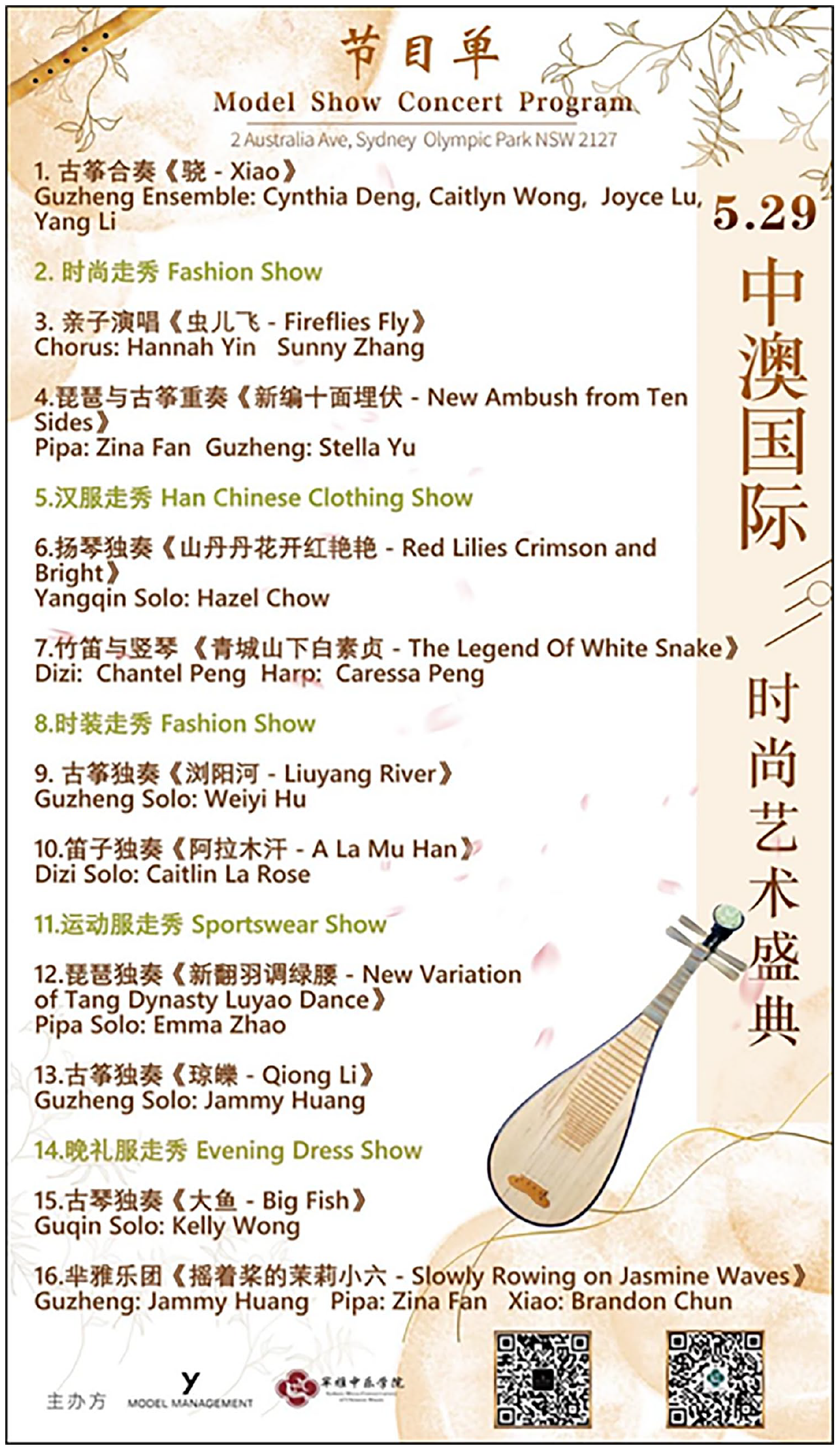
SMCCM. (2022). Model Show Concert Program. Facebook, Sydney, Australia.
Dong spoke in detail about the ways the SMCCM had extended its reach. In the early years, they focused mainly on studio teaching. “During the pandemic,” she explained,
“we added online courses and concerts and I published a flute textbook”. Now “we hold concerts, post videos on social media, and perform in the streets. We have expanded our service to include musical instrument sales, rental music studios and hanfu rentals, as well as hosting special performances and competitions”. She continued: “We have hundreds of hanfu on our campus, so students can play Chinese instruments in traditional Chinese dress and immerse themselves in the experience of [performing on] traditional instruments”. Both students and teachers have commented that this innovation—this ‘music-and-culture’ atmosphere—makes for a memorable experience.
“In the last few years, we have invested a lot of effort in self-media”, Dong explained. We “update video clips of daily street performances”, and “spread Chinese music through social media”, which has been very effective. She also mentioned that “people who are interested in Chinese music will email us to ask how they can participate in activities related to Chinese music”. Finally, “we also often perform at landmarks such as the Museum of Sydney and Sydney Opera House to promote Chinese music”.
Clearly, Dong and her colleagues have gone to great lengths to make Chinese music attractive and intriguing. Rather than hoping the public will somehow discover Chinese music, they take the music to the public. And they often present it as current yet ancient; in ways that hint at autoexoticism (see Li, 2017, p. 393).
Discussion and conclusion
A key theme of this study has been the transmission of Chinese music in diasporic multicultural contexts, specifically in this case, in Sydney. Efforts to bring Chinese music into public education in NSW have met with varying degrees of success, although recently there has been a development in this regard at tertiary level, at Sydney Conservatorium of Music. This is in stark contrast with the situation in Canada, where the “public higher education system has followed a pattern of marked decline since the peak of support between 1990 and 2010” (Cui, 2023a, p. 143). Even so, as might be expected and as the literature confirms, much of the effort to cultivate Chinese instrumental skills takes place within the Chinese community.
The SMCCM represents the single most concentrated effort to date in Sydney to transfer playing skills on a wide range of Chinese musical instruments. Intent on elevating the status and appreciation of Chinese music in Sydney and other parts of Australia, and with teaching at its core, Meya Dong and her teachers have embarked on a multidirectional action-based publicity campaign. Their chief modus operandi is to combine musical instruments, traditional costumes and music in a way that presents the nobility and antiquity of Chinese music, but also portrays its contemporary image of youth, fashion, and elegance.
The study’s first finding regarding the differences and challenges the participants have faced while teaching Chinese instruments in the Australian diaspora corroborates prior research conducted in overseas diaspora communities. However, an interesting divergence is the lack of training in the business aspects of music among musicians trained in China. Our third finding reveals Dong, for example, to be adept at marketing Chinese music, especially through instrument learning and related activities, which with perseverance she and her colleagues are turning into a successful business.
The second finding, which indicates that the participants detect a positive shift in the Australian public’s acceptance of Chinese music, is of course difficult to quantify, yet they (the participants) believe it has occurred at both the level of the individual learner and among the wider public. Moreover, the participants link their perception of greater acceptance to an increase in understanding of the music, which comes through greater exposure to it. That is, the process of increased familiarity and acceptance has proceeded in a cumulatively cyclical fashion.
The third finding relates directly to the second, in that Dong and her colleagues have crafted and projected an attractive image of Chinese music and culture and increased its exposure in Sydney. From the data above, on the conservatory website, and in social media posts, it can be seen that SMCCM offerings are appealing to a widening base: children of the “new generation of immigrant parents [who] recognize the value of preserving their own culture” (participant Zina Fan), local schools where the Chinese language is taught, retiree hobbyists, older immigrants who missed out on such opportunities as children, curious Anglo-Australians, and so on.
Ultimately, we are interested in what the case of Dong and the SMCCM might have to say to theorists and policy makers involved in public music education in multicultural Australia. We have space for only a few brief observations. Megan Watkins and Greg Noble emphasize that among other things multicultural education “should be about developing a robust approach to understanding the processes of globalisation that impact students’ lives” (Watkins & Noble, 2019, p. 307). Examining the ways Dong and the SMCCM operate affords glimpses of the globalized “flows of people, goods and meanings,” including in this case, the ways Chinese music has modernized and how it responds to the demands and expectations of its diasporic contexts (Watkins & Noble, 2019, p. 307).
As they carve out societal spaces, whether virtually, at the community festival or fashion show, in the teaching studio, or in pop-up performances on the busy streets of Sydney’s CBD or at the suburban shopping mall, Dong and the SMCCM present their ancient musical culture as vibrant and contemporary. Understanding the dynamic nature of Chinese music can help us to more clearly comprehend the “relationship between culture and identity built into multiculturalism” (Watkins & Noble, 2019, p. 307). It can help us to better grasp “the complexities of homeland cultures, the changes generations experience” due to migration, and “the flows and relations that structure” peoples’ lives in a globalized world (Watkins & Noble, 2019, p. 307).
Footnotes
Author contribution(s)
Declaration of conflicting interests
The author(s) declared no potential conflicts of interest with respect to the research, authorship, and/or publication of this article.
Funding
The author(s) disclosed receipt of the following financial support for the research, authorship, and/or publication of this article: This research is supported by an Australian Government Research Training Program (RTP) Scholarship.
