




Abstract
Formative assessment is essential in music education as it supports the music learning process, which relies mostly on feedback from self and others to improve performance. Despite growing interest in formative assessment across various subjects, there is a lack of empirical evidence on how it is applied specifically in music education. Given the crucial role of teachers in the effective implementation of formative assessment, this study aims to examine music teachers’ intentions and implementation of formative assessment, along with the factors influencing them, based on the Theory of Planned Behavior. A total of 671 music teachers from 29 cities/provinces of Mainland China were surveyed. The structural equation modeling results indicate that in the Chinese Mainland school music education context, a positive attitude toward formative assessment, a supportive and collaborative social environment, and strong confidence in using formative assessment enhance teachers’ intentions to adopt it. Additionally, greater confidence directly increases actual implementation. However, increased school support did not significantly impact teachers’ intentions or their implementation of formative assessment. The findings suggest that school administrators should focus on helping music teachers build confidence and fostering a collaborative, supportive culture for using formative assessment practices to improve music learning.
Introduction
Formative assessment has gained global attention across various subjects due to its advantages in monitoring student progress, offering feedback, and addressing individual learning needs (Black & Wiliam, 2009; Yan et al., 2021). In the context of Chinese Mainland music education, formative assessment is promoted in policies and curriculum documents to support its implementation in schools for the benefit of students’ learning (Ministry of Education, 2001). However, after two decades of promotion, the implementation of formative assessment in school settings remains unsatisfactory. This is primarily attributed to teachers’ reluctance to adopt new assessment practices and a limited understanding of the factors that could facilitate or impede their formative assessment practices (Yan & Cheng, 2015; Yan et al., 2021). Notably, there has been a lack of efforts to gather large-scale, quantitative data to offer a holistic overview of factors affecting music teachers’ intentions and implementation regarding formative assessment. This highlights a gap in effectively translating formative assessment from theory to practice and underscores the urgent need for comprehensive quantitative studies.
This study aims to investigate formative assessment in the context of mainland Chinese music teaching, particularly focusing on teachers’ intentions and implementation of formative assessment in schools. As both personal and contextual factors are likely to influence these practices (Yan et al., 2021), the study adopts the extended Theory of Planned Behavior (TPB), covering both personal factors and contextual factors, to quantitatively examine the relationships among teachers’ intentions, practices, and influencing factors.
Formative assessment in Chinese Mainland music education
Formative assessment, as defined in this study, is a student-centered approach (SCE) that emphasizes ongoing evaluation and feedback to improve learning and teaching. According to Black and Wiliam (1998), it involves a wide range of activities that provide information to be used as feedback for modifying future teaching and learning strategies. These activities can be carried out by teachers (e.g., questioning and feedback) and/or by students themselves (e.g., peer and self-assessment).
Unlike summative assessment, which summarizes learning outcomes, formative assessment focuses on feedback to deepen understanding and develop skills (Brown, 2019). It helps teachers track progress, address learning issues, and support students in reflecting on their learning and enhancing self-regulation (Booth & Kinsella, 2022). Given these benefits, many national curricula have adopted formative assessment across various subjects.
In the context of Chinese Mainland music education, the concept of formative assessment (Chinese: xing cheng xing ping jia) emerged in the mid-1980s (Lu, 1987; S. Yuan & Shu, 2017). Initially, it was introduced to counterbalance the summative, examination-driven system by tracking students’ progressive learning in music. In 2001, formative assessment was officially incorporated into the school music curriculum to align with the broader goals of Student-Centered Education (SCE), specifically to enhance students’ awareness of their own learning and foster greater autonomy (Ministry of Education, 2001). However, despite two decades of promotion, the implementation of formative assessment in Chinese schools faces significant challenges. Research identifies two key limitations that hinder its effective adoption.
First, while formative assessment includes various activities, such as peer assessment and self-assessment, these practices require additional time and effort to implement (Yan & Cheng, 2015). Given music teachers’ heavy workloads and limited teaching hours, they are often reluctant to invest extra time in learning and applying new teaching approaches, even if they are shown to be beneficial for both teaching and learning (Zhang & Leung, 2023). As a result, formative assessment in practice relies heavily on teacher-directed feedback, with peer and self-assessment rarely observed in both Chinese demonstration lessons and regular classes (Zhang et al., 2023; Zhang & Leung, 2024). This hesitance not only limits the broader implementation of formative assessment but also undermines the core SCE objective of fostering student autonomy and self-awareness.
Second, much of the existing research on formative assessment, both in Western contexts (Booth & Kinsella, 2022; Kordeš et al., 2014) and in China (Deng, 2021; Z. Yuan & Leung, 2021), has been conducted from a qualitative standpoint. While these studies provide valuable insights, they lack the generalizability that large-scale quantitative data can offer. This is particularly problematic in the Chinese context, where the education system is often driven by high-stakes exams, leaving formative assessment practices under-researched at a broader level. The absence of large-scale, quantitative studies makes it difficult to fully understand the extent to which formative assessments are being implemented and what factors might influence their adoption. Therefore, quantitative research is urgently needed to provide a more comprehensive and representative understanding of how formative assessment is practiced in schools and how it can be effectively transferred from teachers’ intention into teaching practice.
Theory of planned behavior and formative assessment
An action being taken from intention to implementation is a complex process, influenced by multiple factors. To understand this process and make connections among factors to human behavior, Ajzen (1991) proposed the Theory of Planned Behavior (TPB) model to explain the prediction of human behavior (see Figure 1). Taking music teaching as an example, this model suggests that music teachers’ intentions and subsequent teaching actions are highly influenced by three core components: their personal attitude (i.e., attitude), perceived social pressure (i.e., subjective norm), and their individual belief in their abilities or confidence (i.e., perceived behavioral control). These components interact to shape music teachers’ intentions. Their attitude and subjective norm will directly influence their teaching intentions, and their perceived behavioral control will both directly and indirectly impact their teaching intentions through its influence on musical teaching behavior.
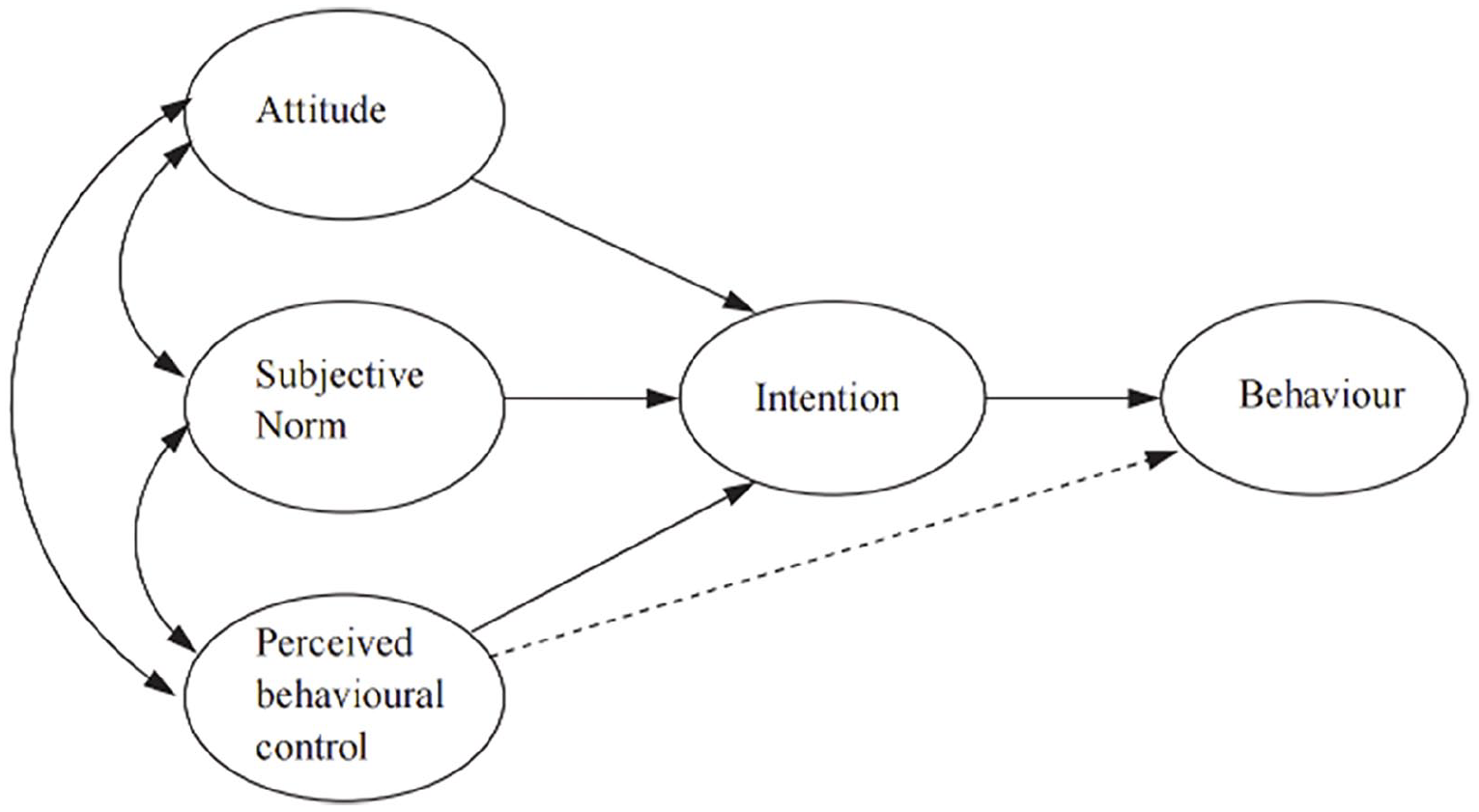
Model of the theory of planned behavior (Ajzen, 1991).
Previously, the TPB model has been applied successfully to interpret various behaviors across different contexts (Oluka et al., 2014), including formative assessment in Hong Kong (Yan & Cheng, 2015). Yan et al. (2022) further differentiated the key factors that shape teachers’ intentions and practices based on personal, school, and course contexts. Despite the original three factors in TPB, they identified high-stakes accountability assessment, instructional environment, school policy and support, and student characteristics as the key contextual factors influencing Hong Kong teachers’ assessment intention and implementation. However, more research is needed to verify the relevance of the additional factors. First, although Hong Kong is part of China, its education system differs significantly from Mainland China’s, particularly in teaching and assessment approaches (Berry, 2011). Thus, given that formative assessment has also been promoted in the Chinese Mainland for decades, a contextual exploration is necessary to understand mainland teachers’ formative assessment practices. Second, Yan et al. (2022) used a small convenience sample (N = 296) with a limited representation of arts-related subjects. Music teachers’ intentions and practices regarding formative assessment remain largely unexplored. To address this, the exploration needs to extend to the music teaching field. Thus, this study employs an extended version of TPB, covering both personal factors and contextual factors, as the theoretical framework.
Purpose of the study
This study aims to use the TPB model to investigate teachers’ intentions regarding the implementation of formative assessment in Mainland Chinese schools’ music teaching contexts. Additionally, since the mediating role of intention clarifies how influencing factors translate into practices and reveals gaps between intentions and actions, this study also examines the mediating effects of formative assessment intention between influencing factors and actual practices in Mainland Chinese music education. Figure 2 presents the model with three hypotheses:
H1: Music teachers’ intention to apply formative assessment is predicted by their personal factors (i.e., instrumental attitude, subjective norm, self-efficacy) and contextual factors (i.e., high-stakes accountability assessment, instructional environment, school policy and support, and student characteristics).
H2: Music teachers’ formative assessment practice is predicted by their intentions, self-efficacy, and all contextual factors.
H3: Music teachers’ formative assessment intention mediates the relationships between formative assessment practice and each predictor of formative assessment.
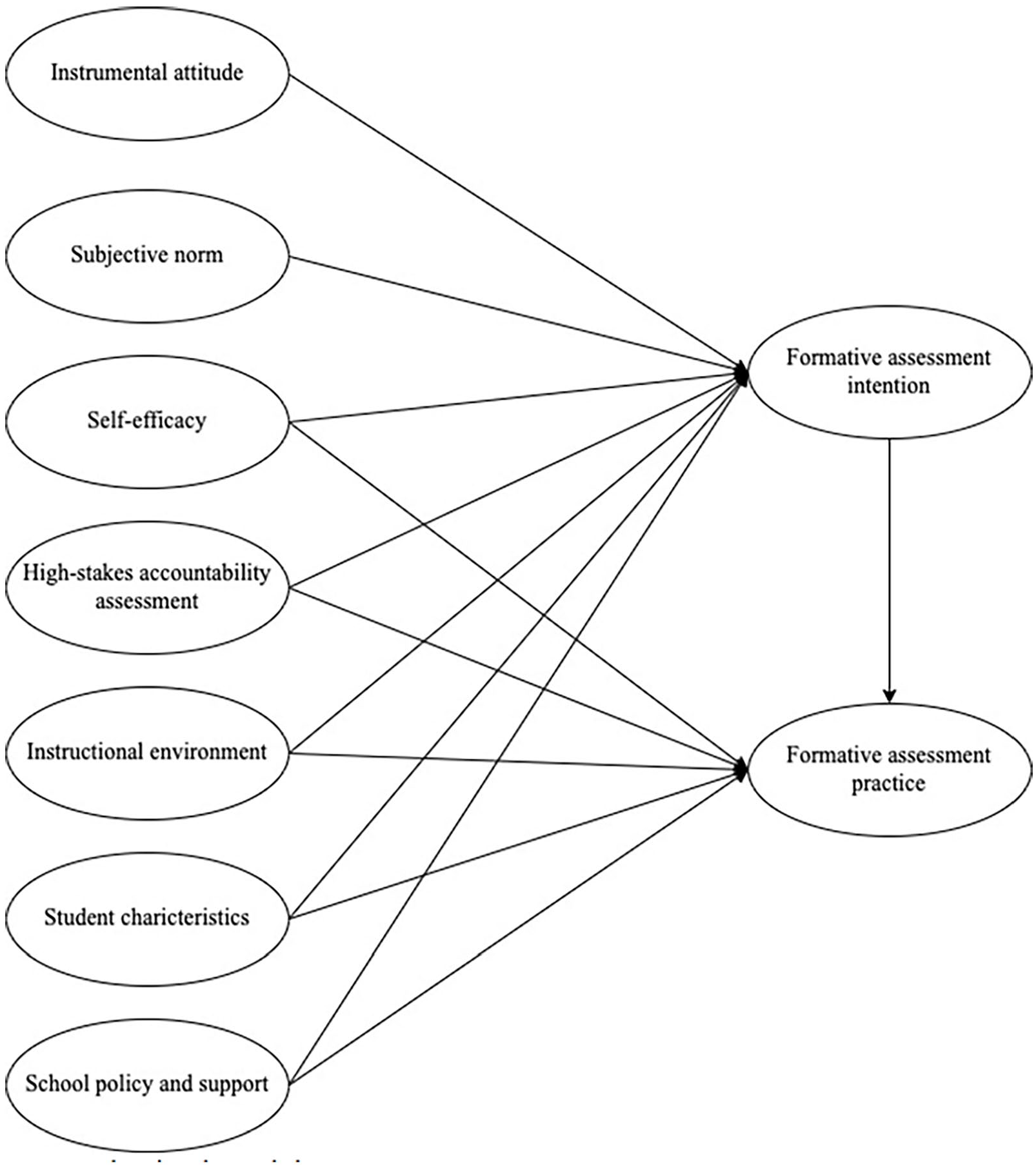
Hypothesized model.
Materials and methods
Participants
A total of 671 music teachers from 29 cities/provinces responded to the survey. Geographically, the survey covered North and Northeast China (46), East China (106), Central and South China (430), Southwest China (67), and Northwest China (22). The sample comprised 443 (66.02%) elementary and 228 (33.98%) secondary school teachers. The numbers of female and male teachers were 589 (87.78%) and 82 (12.22%), respectively. Their teaching experience ranged from 1–5 years (161, 23.99%) to 6–10 years (133, 19.82%), 11–15 years (117, 17.44%), 16–20 years (101, 15.05%), and above 20 years (159, 23.70%).
Instrument
The measurement instrument applied in this study contained three parts. First, four predictors of formative assessment were assessed using the Teacher’s Conceptions and Practices of Formative Assessment Questionnaire (Yan & Cheng, 2015): (a) instrumental attitude (10 items; Rasch reliability = 0.88; e.g., “Formative assessment encourages students to work harder”), (b) self-efficacy (6 items; Rasch reliability = 0.84; e.g., “I have enough time to implement formative assessment”), (c) subjective norm (5 items; Rasch reliability = 0.75; e.g., “My colleagues support the implementation of formative assessment”), and (d) intention (6 items; Rasch reliability = 0.88; e.g., “I am willing to make an effort to implement formative assessment”). The responses were measured on a Likert scale from 1 (strongly disagree) to 6 (strongly agree).
Second, to evaluate how often teachers engage in formative assessment practices, the Teacher Formative Assessment Practice Scale (Yan & Pastore, 2022) was employed. This concise, theory-based scale consists of 10 items (Cronbach’s α = 0.77; e.g., “I ensure homework can reflect students’ learning progress”) and encompasses the five key strategies outlined in Wiliam and Thompson’s (2008) formative assessment framework. The responses are recorded on a Likert scale ranging from 1 (never) to 6 (very frequently).
Third, considering the Chinese Mainland’s high-stakes examination culture and top-down educational system, four scales developed by Yan et al. (2022) were used to assess contextual factors. These scales cover examination culture (5 items; Cronbach’s α = 0.79; e.g., “Students care more about the final examination result instead of using formative assessment to improve their learning”), school support (5 items; Cronbach’s α = 0.86; e.g., “School management teams support the implementation of formative assessment”), teaching environment (5 items; Cronbach’s α = 0.83; e.g., “Before class, I have enough time to prepare for implementing formative assessment”), and student attributes (5 items; Cronbach’s α = 0.84; e.g., “My students positively participate in my class formative assessment activities”) (Yan et al., 2022). This Likert scale ranges from strongly disagree (1) to strongly agree (6).
The above instruments were originally designed for the context of Hong Kong. Given the differences between the educational systems of Hong Kong and the Chinese Mainland, two rounds of revision were conducted to ensure the validity of the content of this instrument. The first round was revised by a university-based music expert conducting music education and assessment research, who ensured that the writing style matched the Chinese Mainland context. The second round was checked by two experienced mainland music teachers with over 15 years of teaching experience, who ensured the readability of the instruments for Chinese school music teachers.
After these revisions, some wording adjustments were made (e.g., “Education Bureau Curriculum Guide” was changed to “National Curriculum Standard”), and three items were newly added. These comprised two items measuring the instructional environment (i.e., “My inspectors’ support provides me with the opportunity to implement formative assessment” and “Demonstration lesson support provides me with the opportunity to implement formative assessment”) and one for subjective norm (i.e., “My inspectors support the implementation of formative assessment”).
The revised instrument included the following components: formative assessment intention (FAI), formative assessment practice (FAP), High-stakes accountability assessment (HSAA), instructional environment (IE), school policy and support (SPS), student characteristics (SC), instrumental attitude (IA), self-efficacy (SE), and subjective norm (SN), which contained 6, 10, 5, 7, 5, 5, 10, 6, and 6 items, respectively. Items collecting demographic information, such as gender, teaching experience, teaching grades, and previous formative assessment training experience, were also included at the beginning of the instrument.
Procedure
Data were collected through a Chinese online questionnaire survey platform, Wenjuanxing, in 2023. Ethical approval was sought and given by the first two authors’ affiliated universities. The survey was sent out through a public online application, WeChat Public Platform. Informed consent was obtained, and the participants were informed that the data collected would be used only for research purposes, that they had the right to withdraw from the study at any time without any negative consequences, and that no identifiable information would be disclosed.
Data analysis
Before analyzing the data, we measured skewness (sk) and kurtosis (ku) to assess the normality of the data distribution using the moment’s package (Komsta & Novomestky, 2015). Kim (2013) suggested that data can be considered non-normally distributed when the absolute values of sk and ku are larger than 2 and 7, respectively. Subsequently, two analytical methods, that is, confirmatory factor analysis (CFA) and structural equation modeling (SEM), were implemented in the lavaan package (Rosseel, 2012) to answer the hypotheses.
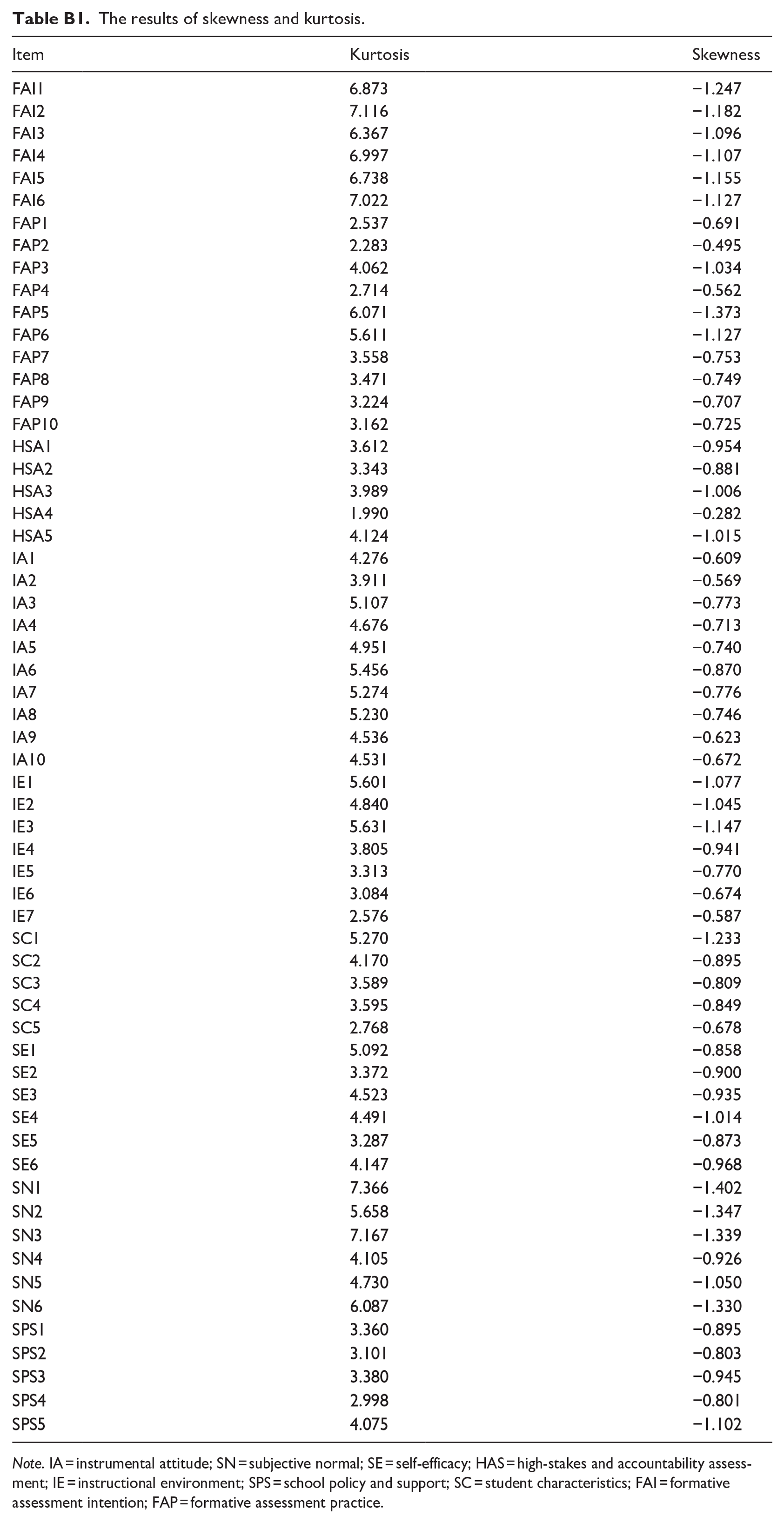
The following two-step approach (Anderson & Gerbing, 1988) was used: (1) the measurement properties of the measurement model were examined via CFA and (2) SEM was used to examine the structural relations among the constructs (see Figure 1). Because the results of the normality test indicated a violation of the normal distribution (i.e., four items’ ku values were larger than 7, see Appendix A. Table B1), maximum likelihood estimation with robust standard errors (MLR) was used for CFA and SEM (Abdullah et al., 2022). Multiple fit indices were used to examine model fit, including the chi-square by degrees-of-freedom value (required to be smaller than 3), the Tucker–Lewis index (TLI, required to be larger than .090), the comparative fit index (CFI, required to be larger than .090), the standardized root mean square residual (SRMR, required to be smaller than 0.08), and the root mean square error of approximation (RMSEA, required to be smaller than 0.08) (Hu & Bentler, 1999; McDonald & Ho, 2002; Wang & Wang, 2019). In addition, composite reliability (CR) and average variance extracted (AVE) were measured to assess the convergent power (Fornell & Larcker, 1981). Cronbach’s α coefficient evaluated internal consistency. Discriminant validity was assessed by comparing the square root of AVE with the correlation coefficients between dimensions. Finally, a bootstrap test with 5,000 samples was performed to test hypothesis 3 (Hayes, 2009). All the calculations were conducted in RStudio version 2023.09.0+463 (Posit Software, PBC).
Results
Psychometric properties of the measurement model
Before hypothesis testing, CFA was conducted to test the psychometric properties of the nine constructs: IA, SN, SE, HSAA, IE, SC, SPS, FAI, and FAP. The measurement model fitted the data well, χ2 = 4069.640, df = 1611, χ2/ df =2.526, RMSEA = .059, CFI = .911, TLI = .905, SRMR = .077. The factor loadings of all items were higher than .400 (.506–.967) (see Appendix A. Table A1). As shown in Table 1, the Cronbach’s α coefficients for the constructs ranged from .828 to .981, indicating satisfactory internal consistency. Additionally, the CR values for the constructs fell within the range of .837 to .977, surpassing the threshold value recommended by Fornell and Larcker (1981) and providing evidence of construct reliability. Moreover, each value of AVE also exceeded the .360 threshold (Fornell & Larcker, 1981), indicating that the convergent validity was acceptable. The square root of each AVE was higher than its corresponding correlation coefficients, showing good discriminant validity (see Table 1).
Reliability values for the main variables in the study.
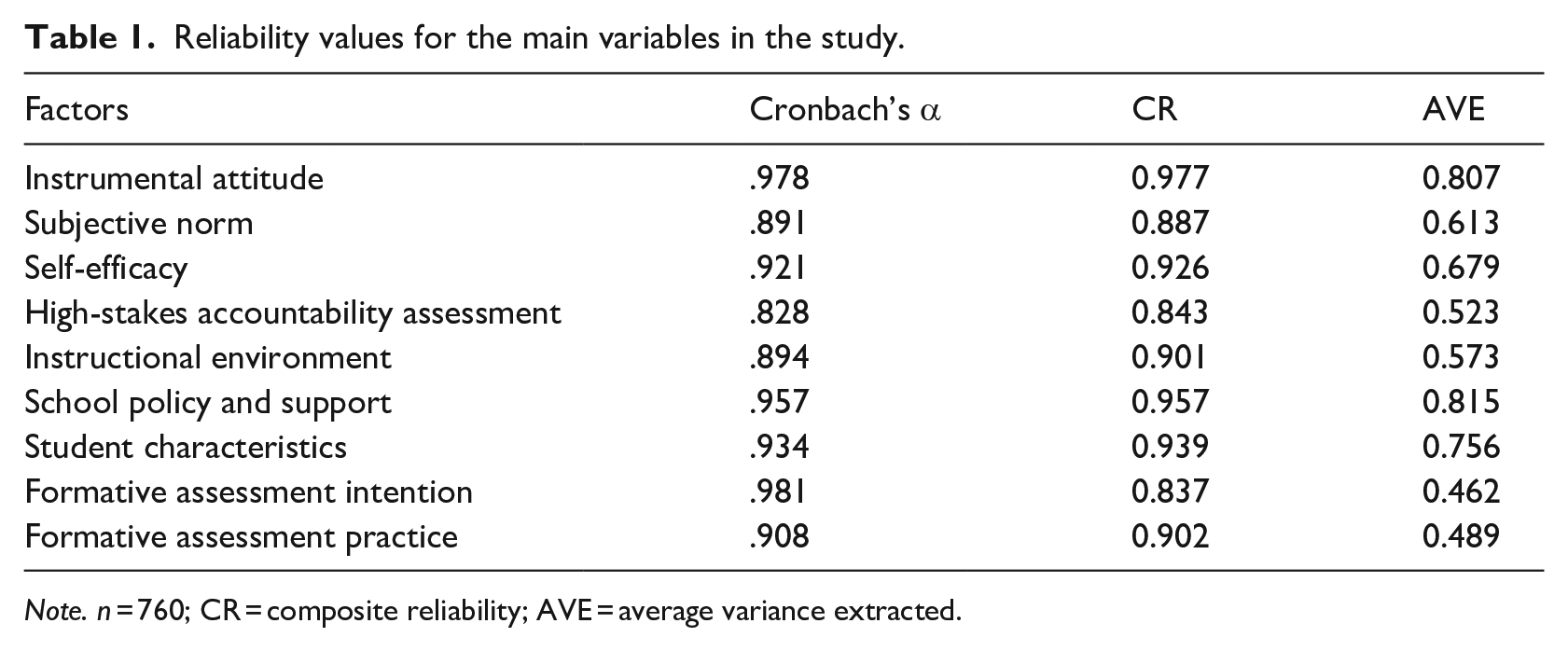
Note. n = 760; CR = composite reliability; AVE = average variance extracted.
Descriptive statistics and correlations
Table 2 provides each construct’s means, standard deviations, and intercorrelation coefficients. The mean score values ranged from 4.203 (SPS) to 5.170 (FAI). For the predictors, teachers exhibited the lowest level of agreement with SPS (4.203) and the highest level of agreement with IA (4.887). All variables were significantly and positively correlated.
Descriptive statistics and correlations for the main variables in the study.
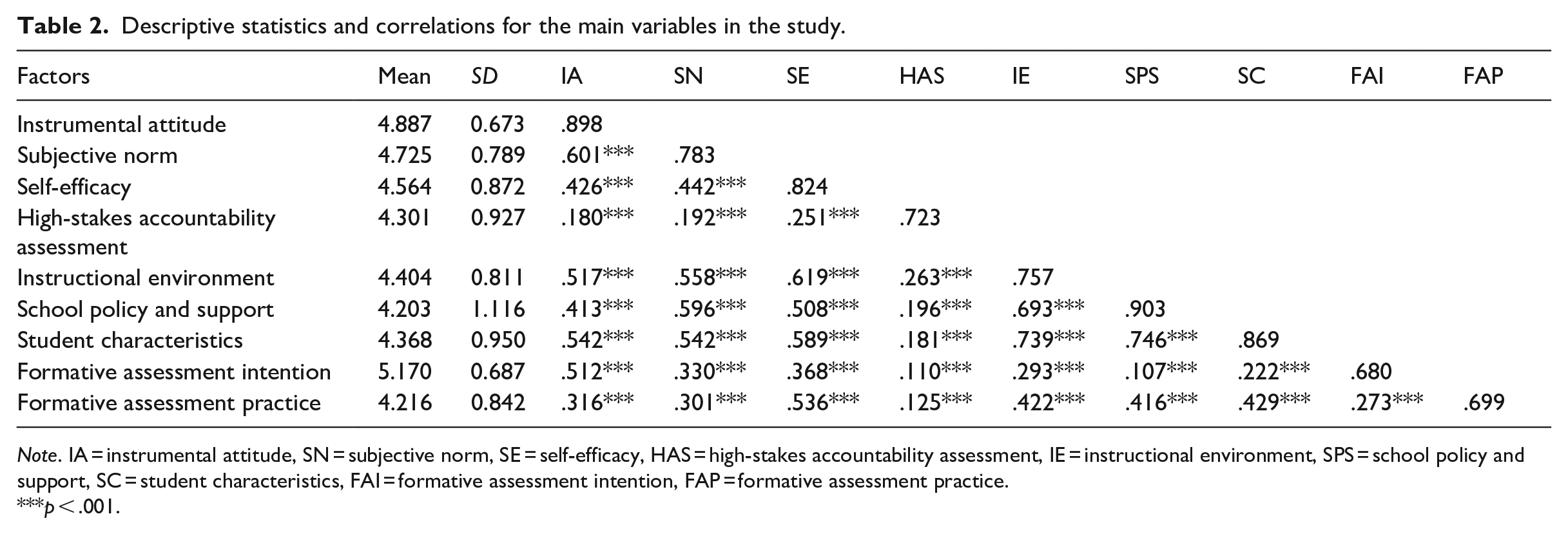
Note. IA = instrumental attitude, SN = subjective norm, SE = self-efficacy, HAS = high-stakes accountability assessment, IE = instructional environment, SPS = school policy and support, SC = student characteristics, FAI = formative assessment intention, FAP = formative assessment practice.
p < .001.
Model testing
Having examined the validity of the measurement models, we performed SEM (see Figure 3) to test our hypotheses. The results demonstrated sufficient model data fit: χ2 = 4233.629, df = 1614, χ2/df = 2.526, RMSEA = .061, CFI = .905, TLI = .899, SRMR = .077. In addition, as shown in Figure 2, FAI had a positive correlation with IA (β = .416, p < .001), SN (β = .181, p < .01), and SE (β = .290, p < .001), but a negative correlation with SP (β = −.317, p < .001). Moreover, FAP had significant positive relationships with SE (β = .460, p < .001), SPS (β = .227, p < .001), and FAI (β = .108, p < .05). There was no significant difference between the model with control for demographic factors (i.e., gender, teaching grade, curriculum standards training, and formative assessment training) and that without control (χ2 = 4.254, df = 3540, p = 1.000).
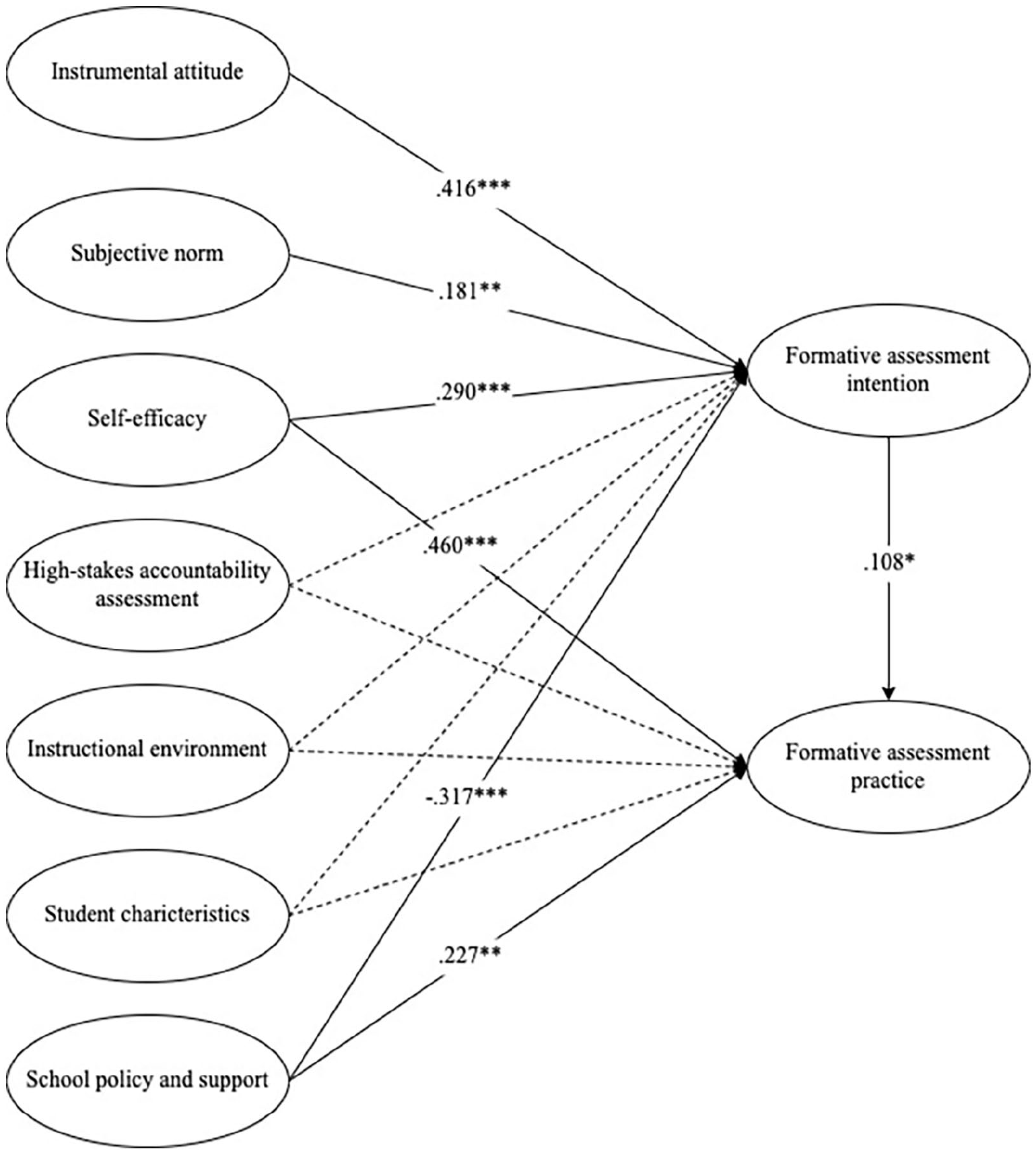
Structural equation modeling for the hypothesized model. Standardized path estimates are reported. Significant estimated values are shown in bold lines, and non-significant values are shown in dotted lines.
Interestingly, for the relationship between SPS and FAI, the path coefficient in SEM (negative) and the correlation coefficient (positive) did not have the same sign. A possible reason is that the original relationship between the two had been suppressed. As Falk and Miller (1992) suggested, this relationship was examined, and the discrepancy was found to be caused by “real suppression,” that is, when the necessary predictor is eliminated, a specification error occurs (the value of R2 changed from .361 to .332). In this case, the correct sign is indicated by the path coefficient. Therefore, SPS had a negative correlation with FAI.
Mediation testing
A significant mediating role of FAI was found for three paths (see Table 3). Specifically, via FAI, 1) IA was positively related to FAP (estimate = .050, SE = .020, p = .014, 95% CI = [.012, .092]); 2) SE was positively related to FAP (estimate = .045, SE = .019, p = .018, 95% CI = [.010, .086]); 3) SPS was negatively related to FAP (estimate = −.024, SE = .011, p = .024, 95% CI = [−.047, −.005].
Bootstrap analyses of the magnitude and statistical significance of the indirect paths.
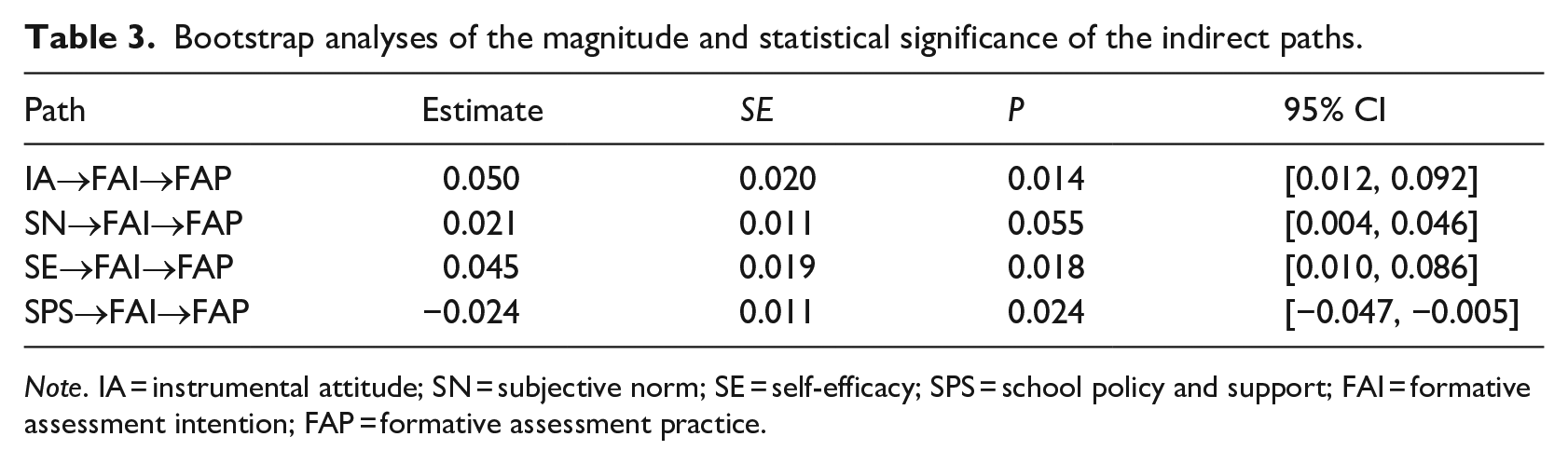
Note. IA = instrumental attitude; SN = subjective norm; SE = self-efficacy; SPS = school policy and support; FAI = formative assessment intention; FAP = formative assessment practice.
Discussion
This study applied an extended TPB model (Yan et al., 2022) to investigate whether (1) Chinese Mainland music teachers’ intention to use formative assessment can be predicted by personal and contextual factors, (2) their practices can be predicted by their intentions, self-efficacy, and contextual factors, and (3) intention mediates the relationship between formative assessment practice and its predictors. Unlike prior research focusing solely on the benefits of formative assessment (Parkes & Burrack, 2020; Wong, 2014), This study provides a structural understanding of the factors influencing teachers’ intention to implement formative assessment and their actual implementation in the Chinese school music teaching context. The first two hypotheses were supported, showing that the components of the extended TPB explained 37.7% of the variance in teachers’ intentions and 36.1% of that in their practices. Highlighting the model’s robustness, these findings align with Armitage and Conner (2001), who found that TPB components accounted for 39% of the variance in intention and 27% of that in behavior based on a meta-analysis of 185 studies. The results are discussed in detail below.
Personal factors
In general, music teachers with positive attitudes (i.e., instrumental attitude), supportive social surroundings (i.e., subjective norms), and high confidence (i.e., self-efficacy) are more likely to intend to engage in formative assessment. High self-efficacy also directly leads to its actual practice.
Regarding formative assessment intention, instrumental attitude was the strongest predictor (β = .416), followed by self-efficacy (β = .290) and subjective norm (β = .181). These findings are consistent with Armitage and Conner’s (2001) meta-analysis of 185 studies on formative assessment intention using the TPB, but partially differed from those of Yan et al. (2022). In Yan et al.’s study, self-efficacy was the strongest predictor of teachers’ intention to practice formative assessment, meaning confidence in implementing formative assessment was the primary influence. Conversely, our study found that instrumental attitude was the most influential factor, suggesting that music teachers who recognize the value and function of formative assessment are most likely to intend to apply it. This discrepancy may stem from our focus on music teachers, whereas Yan et al.’s study encompassed teachers from diverse backgrounds. Specifically, Music learning naturally involves continuous feedback from both oneself and others (Parkes & Burrack, 2020). This constant exchange of input aligns well with formative assessment, which supports ongoing skill refinement and growth. By using formative assessment, music teachers can offer real-time feedback that aids students in refining their musical skills and deepening understanding. Additionally, formative assessment allows teachers to identify individual learning needs and adjust their instruction accordingly. Given this close alignment between the feedback-driven nature of music learning and the goals of formative assessment, music teachers are more inclined to see it as an essential tool, driving their interest and willingness to implement it in their teaching practice.
Additionally, the results revealed the mediating role of intention between instrumental attitude and actual formative assessment implementation, suggesting that the stronger teachers’ recognition of formative assessment, the higher chance they will use it in the classroom. Besides, as other studies reported (Karaman & Şahin, 2017; Myyry et al., 2022), our results also revealed that with higher self-efficacy in applying formative assessment, teachers are more likely to engage in formative assessment practices. Although this relationship was less well explored in music education previously, the significant impact of self-efficacy on music performance is well-documented (McPherson & McCormick, 2006). Our study strengthens the argument that teachers’ self-efficacy regarding formative assessment is a critical pivot point for the uptake of formative assessment practices in classrooms.
Contextual factors
Generally, school policy and support (SPS) was the only significant predictor of formative assessment intention and implementation. However, it shows an intriguing contrast effect, with a negative effect (β = −0.317) on music teachers’ intention but a positive one (β = 0.227) on formative assessment practice. This means that when schools supportively encourage implementing formative assessment, music teachers will follow it even with their opposite intentions of actually not wanting to do it. The mediation analysis further confirmed this prediction, showing that higher levels of perceived SPS led to lower music teachers’ intention to practice formative assessment. Interestingly, previous research found that teachers in supportive schools showed higher formative assessment intention and practice (Brink & Bartz, 2017; Yan et al., 2022), whereas the music teachers in this study exhibited the opposite trend. The context of Chinese Mainland music teaching may explain this.
Detailly, Zhang & Leung (2023, 2024) reported that the Chinese music educational system is hierarchical and top-down, emphasizing standardized learning over individual student progress. Chinese music teachers believe they are implementing Western-based student-centered education (SCE) but operate within a collective-oriented and content-driven environment. Given that this top-down system emphasizes collective SCE, focusing on standardized outcomes for the entire class rather than individual students, teachers face evaluation pressures from national curricula (macro-level), regional inspectors (meso-level), and school-level directives (micro-level). However, as the first two levels are mandatory under the Ministry of Education, the micro-level within school instruction presents the only opportunity for teachers to make their own choices and translate their real intentions into classroom practice. Consequently, there is a high possibility that Chinese teachers might initially express negative attitudes toward new changes recommended and supported by the school. Over time, however, they may adapt to these changes and actually take action with school support, such as the formative assessment practices in this study, as they build resilience to these constraints (Yang & Zhang, 2023).
Implications for teaching and teacher professional development
This study revealed that music teachers’ attitude toward the application of formative assessment was the strongest predictor of teachers’ intention to implement, followed by their self-efficacy (i.e., confidence), which was the strongest predictor of actual practice. These findings have practical implications for teaching and professional development.
First, enhancing music teachers’ confidence in formative assessment should be a priority, as it influences both intention and implementation. Since mastery experiences can enhance self-efficacy (Bandura & Wessels, 1997), professional development programs should provide on-site support to help teachers effectively implement formative assessment and build confidence in its use.
Second, music teachers need to develop a comprehensive understanding of the purpose of formative assessment and its practical application to increase their attitude toward using it in practice. This understanding should go beyond what is written in official documents (Ministry of Education, 2022) and be based on evidence-based outcomes and success stories. Practical training specific to assessing musical skills is also essential, as it equips teachers with necessary assessment skills and strengthens their belief in formative assessment’s benefits.
Third, since this study found that teachers might resist implementing formative assessment even with support, we might need to consider the contextual constraints. Zhang & Leung (2023, 2024) found that Chinese music teachers face challenges like large class sizes, time pressure, and content-driven textbooks, which hinder adaptation to any educational reforms. This suggests that school administrators need to notice these practical challenges when making reform decisions. Since assessment practices are contagious among teachers (Yan & King, 2023), a more positive assessment environment among teachers, students, and school culture is desirable. It is suggested that schools might first create a supportive environment with peer collaboration and a self-assessment culture for teachers to enhance their belief in formative assessment. Once a supportive, reflective, and collaborative school culture is established, teachers would most likely transfer their beliefs into practice, increasing the likelihood of effective formative assessment implementation.
Limitations
This study’s limitations include its explanatory variables and the measurement of formative assessment practice. First, the explanatory variables (e.g., teachers’ years of teaching, teaching grades, or past professional development) were not included in the model. Future research should consider including more explanatory variables to achieve a more comprehensive understanding of the context. Second, this study relied on teachers’ self-reported data, which only captured their current thoughts without elucidating the reasons behind them or verifying whether these thoughts were consistent over time. Therefore, future research could employ qualitative methods, such as interviews, to gain deeper insights into teachers’ intentions regarding and implementation of formative assessment, and record observations to verify the consistency between teachers’ reported intentions and actual practices.
Conclusion
This study contributes to the literature by extending research on formative assessment into an understudied area, namely music education in the Mainland Chinese context. It offers a unique understanding of Chinese Mainland music teachers’ intentions and implementation regarding formative assessment, along with the associated influencing factors. Based on an extended TPB model, the study reveals that a positive attitude toward the benefits of formative assessment, a supportive and collaborative social environment that encourages formative assessment, and strong confidence in using formative assessment enhance teachers’ intention to use it in the Chinese Mainland music education context. Greater confidence in using formative assessment also directly increases its actual implementation in teaching. Given that increased school support did not significantly affect teachers’ intention to implement and implementation of formative assessment practices, school administrators might consider providing more assessment training and fostering a collaborative and supportive formative assessment culture. By doing that, teachers’ pressures might be eased, allowing them time to adapt to educational changes when introducing new assessment approaches.
Footnotes
Appendix A
The results of skewness and kurtosis.
| Item | Kurtosis | Skewness |
|---|---|---|
| FAI1 | 6.873 | −1.247 |
| FAI2 | 7.116 | −1.182 |
| FAI3 | 6.367 | −1.096 |
| FAI4 | 6.997 | −1.107 |
| FAI5 | 6.738 | −1.155 |
| FAI6 | 7.022 | −1.127 |
| FAP1 | 2.537 | −0.691 |
| FAP2 | 2.283 | −0.495 |
| FAP3 | 4.062 | −1.034 |
| FAP4 | 2.714 | −0.562 |
| FAP5 | 6.071 | −1.373 |
| FAP6 | 5.611 | −1.127 |
| FAP7 | 3.558 | −0.753 |
| FAP8 | 3.471 | −0.749 |
| FAP9 | 3.224 | −0.707 |
| FAP10 | 3.162 | −0.725 |
| HSA1 | 3.612 | −0.954 |
| HSA2 | 3.343 | −0.881 |
| HSA3 | 3.989 | −1.006 |
| HSA4 | 1.990 | −0.282 |
| HSA5 | 4.124 | −1.015 |
| IA1 | 4.276 | −0.609 |
| IA2 | 3.911 | −0.569 |
| IA3 | 5.107 | −0.773 |
| IA4 | 4.676 | −0.713 |
| IA5 | 4.951 | −0.740 |
| IA6 | 5.456 | −0.870 |
| IA7 | 5.274 | −0.776 |
| IA8 | 5.230 | −0.746 |
| IA9 | 4.536 | −0.623 |
| IA10 | 4.531 | −0.672 |
| IE1 | 5.601 | −1.077 |
| IE2 | 4.840 | −1.045 |
| IE3 | 5.631 | −1.147 |
| IE4 | 3.805 | −0.941 |
| IE5 | 3.313 | −0.770 |
| IE6 | 3.084 | −0.674 |
| IE7 | 2.576 | −0.587 |
| SC1 | 5.270 | −1.233 |
| SC2 | 4.170 | −0.895 |
| SC3 | 3.589 | −0.809 |
| SC4 | 3.595 | −0.849 |
| SC5 | 2.768 | −0.678 |
| SE1 | 5.092 | −0.858 |
| SE2 | 3.372 | −0.900 |
| SE3 | 4.523 | −0.935 |
| SE4 | 4.491 | −1.014 |
| SE5 | 3.287 | −0.873 |
| SE6 | 4.147 | −0.968 |
| SN1 | 7.366 | −1.402 |
| SN2 | 5.658 | −1.347 |
| SN3 | 7.167 | −1.339 |
| SN4 | 4.105 | −0.926 |
| SN5 | 4.730 | −1.050 |
| SN6 | 6.087 | −1.330 |
| SPS1 | 3.360 | −0.895 |
| SPS2 | 3.101 | −0.803 |
| SPS3 | 3.380 | −0.945 |
| SPS4 | 2.998 | −0.801 |
| SPS5 | 4.075 | −1.102 |
Note. IA = instrumental attitude; SN = subjective normal; SE = self-efficacy; HAS = high-stakes and accountability assessment; IE = instructional environment; SPS = school policy and support; SC = student characteristics; FAI = formative assessment intention; FAP = formative assessment practice.
Author contribution(s)
Declaration of conflicting interests
The author(s) declared no potential conflicts of interest with respect to the research, authorship, and/or publication of this article.
Funding
The author(s) disclosed receipt of the following financial support for the research, authorship, and/or publication of this article: This research study was supported by the Start-up Research Grant (number RG 19/2023-2024R) from The Education University of Hong Kong.
