




Abstract
Performance anxiety is a significant factor that hinders musicians from showcasing their potential. Students receiving professional music education may experience negative effects in both their education and professional lives due to this anxiety. It is important to identify the factors that contribute to performance anxiety in order to overcome it. With this perspective, the research measured the anxiety levels of music students in Fine Arts High Schools using the Music Performance Anxiety Inventory and examined the scores in terms of major instrument, gender, GPA, stage experience, and age. This study was conducted with 337 students from 11 fine arts high schools in Turkey. It was observed that anxiety varies depending on the instrument, with higher anxiety found particularly among bowed string instrument players. Female students were found to have higher levels of anxiety. Students with more stage experience had lower levels of anxiety. However, age did not have a significant effect.
Keywords
Introduction
Performance anxiety is defined as a psychological reaction that causes individuals to make mistakes in front of an audience, avoid performing, and be unable to control their gestures and facial expressions (Dalkiran et al., 2014; Ekinci, 2013; Gozler et al., 2017; Nacakci & Dalkiran, 2011; Osborne & Kenny, 2008; Ozmentes, 2013). Almost everyone experiences performance anxiety at some point, but musicians often face it as stage fright, preventing them from fully displaying their potential (Brotons, 1994; Ely, 1991; Goode & Knight, 1991; LeBlanc et al., 1997; Steptoe & Fidler, 1987; Wesner et al., 1990). When individuals feel uncomfortable performing in front of an audience, their anxiety can become overwhelming, resulting in a lack of concentration, difficulty making decisions, and uncertainty (Canbay & Nacakci, 2015; Kurtaslan et al., 2022). Minimizing negative emotions and anxiety levels caused by stage fright is essential, allowing individuals to exhibit a successful performance.
Music performance is a complex phenomenon resulting from the interaction of many factors, such as genetic factors, environmental stimuli, individual experiences, emotions, and cognitive behaviors (D. Kenny, 2011). Music performance anxiety manifests through cognitive, physiological, and behavioral symptoms, encompassing a range from lack of self-confidence, loss of concentration, fear of mistakes, tremors, increased heart rate, accelerated breathing, sweating, sweaty palms, nausea, dry eyes, and dry mouth, to shortness of breath, dizziness, excessive tension in the throat, hands, and fingers, alongside negative thoughts about performance, feelings of inadequacy, vocal tremors, weakness, and shaking (Brotons, 1993; Canbay & Nacakci, 2015; Cemali, 2017; Cimen, 2001; Deniz, 1998; Dogan & Tecimer, 2019; Hamann & Frost, 2000; Iusca & Dafinoiu, 2012; Kaya, 2016; Kucuksuleymanoglu et al., 2016; Kurtaslan et al., 2022; Marshall, 2008; Orhan, 2006; Osborne & Mcpherson, 2019; Ozevin Tokinan, 2014; Russell-Bowie, 2013; Sarikaya, 2018; S. Yondem et al., 2019).
Given the significant challenge of anxiety in music performance, musicians actively seek various strategies to cope with it, including the use of different practices to alleviate their anxiety. When the studies are examined, it is seen that individuals with performance anxiety resort to methods such as breathing and relaxation exercises, the use of sedative drugs, meditation, the use of energy drinks or alcohol, and psychological help (Egilmez, 2012; Ozgur, 2017; Spahn, 2015). However, it is also observed that individuals cope with performance anxiety using the Alexander technique, mental regulation technique, exposure techniques, and relaxation techniques (Garner, 2012; Ozgur, 2017).
There are numerous studies on music performance anxiety in the literature. In the international literature, Kaleńska-Rodzaj (2020) found that young musicians experience fear and anxiety in their emotional attitudes toward performance. However, they concluded that 30% of the musicians felt positive emotions such as confidence, courage, satisfaction, and joy before the performance. Paliaukiene et al. (2018) aimed to determine students’ music performance anxiety levels in a higher education academy in Lithuania. They found a significant difference between the self-efficacy and success variables and concluded that there was no significant difference with the gender variable. Farley and Kelley (2023) aimed to examine the relationship between self-compassion and music performance anxiety in music departments at the university level. They found a strong negative correlation between self-compassion and music performance anxiety, suggesting that people who reported high self-compassion had low performance anxiety. In their study, Butković et al. (2022) examined the music performance anxiety levels of 239 musicians, consisting of music students and professional orchestra members, and found that 67 musicians experienced clinically significant music performance anxiety. The research found that young musicians experienced more musical performance anxiety, and women’s music performance anxiety was higher than men.
In the literature, there are also studies on Turkish students. Aydin and Isgorur (2018) aimed to examine the music performance anxiety of conservatory music students studying at secondary and high school levels according to various variables. The research found that the anxiety levels of female students were higher than male students. The anxiety levels of the students who played the bowed string instruments were higher than those who performed in the other instrument group; They concluded that the higher the grade level, the higher the anxiety level. Jelen (2017) aimed to determine the relationship between music performance anxiety and piano performance self-efficacy levels of music teacher candidates. She concluded that there was a moderately significant negative correlation between students’ music performance anxiety and piano performance self-efficacy levels. Z. D. Yondem (2012) aimed to determine the physical, behavioral, and cognitive characteristics of perceived performance anxiety in music students. She determined that the students who stated that they experienced more anxiety before the performance exhibited an open and sensitive structure to both their bodily sensations, internal stimulations, and external stimuli. Onuray Egilmez (2021), aimed to determine the effect of music teacher candidates’ well-being and the level of anxiety they may encounter during their stage performances. There was no significant effect of gender or education year on the candidates’ well-being or music performance anxiety. She concluded that there was a negative and significant relationship between the Perma well-being scale scores and Kenny music performance anxiety inventory scores.
It is believed that individuals undergoing vocational music education may face the adverse impacts of performance anxiety throughout their educational and professional endeavors. A comprehensive analysis of factors associated with performance anxiety is crucial for advancing research focused on preventing performance anxiety or developing effective coping strategies for its effects.
In the literature, research on music performance anxiety has primarily focused on university students, leaving a gap in the understanding of this issue at the high school level. In Turkey, high school-level vocational music education is delivered through two distinct structures: conservatories and fine arts high schools. Conservatory students generally continue their undergraduate education at the conservatory and progress towards becoming artists, while Fine Arts High School graduates mostly continue their education in music teaching undergraduate programs. In this regard, fine arts high schools serve as a great resource to train students for the music teaching undergraduate program (Bulut & Tan, 2017). Although the music performance anxiety of conservatory students at secondary and high school levels in Turkey was examined in the research conducted by Aydin and Isgorur (2018), no research was found to examinethe concerns of fine arts high school students.
Given this context, our study seeks to address this research gap by investigating levels of music performance anxiety among fine arts high school students who receive vocational music education. We aim to explore how various factors, such as the major instrument, gender, GPA, stage experiences, and age, may influence performance anxiety levels in this particular group of students. This research aims to provide valuable insights into the dynamics of music performance anxiety among high school students, contributing to a more comprehensive understanding of this issue. The study aims to answer the following questions:
RQ1: Is the major instrument a significant factor in music performance anxiety scores?
RQ2: Do music performance anxiety scores of students differ according to gender?
RQ3: Is there a significant correlation between music performance anxiety scores and general grade point averages?
RQ4: Do the music performance anxiety scores of the students change significantly according to the stage experience?
RQ5: Do the music performance anxiety scores change significantly according to age?
Method
Research model
This quantitative study employs an associational research model. Associational research models investigate the relationships among variables without manipulating them (Fraenkel et al., 2012; Karasar, 2005).
Some researchers divide associational research into two groups, namely correlational and causal-comparative. According to Fraenkel, in correlational studies, more than one measurement is taken from the same subjects, and these data are analyzed using a scatterplot or correlation coefficient. However, in causal-comparison studies, two or more groups are compared.
On the other hand, some researchers do not make such a distinction and generally use the term correlational research. Field (2018) mentions that historically certain tests (such as ANOVA and t-test) have been used more widely in experimental research, and some tests (such as regression and correlation) in non-experimental studies, leading to the false belief that the tests used to compare groups are more appropriate for causal inference.
Field (2018) defines correlational studies as studies that we observe without directly interfering with the variables. He emphasizes that their difference from experimental research is that none of the variables are manipulated.
This non-experimental study gathered data through the survey method without manipulating any variables. Students were given Google Forms links, including a personal information form and the Music Performance Anxiety Inventory. Our analysis focused on assessing changes in performance anxiety scores across various variables, such as major instrument, gender, stage experience, and age. Additionally, we explored correlations between the scores and GPA.
Study group
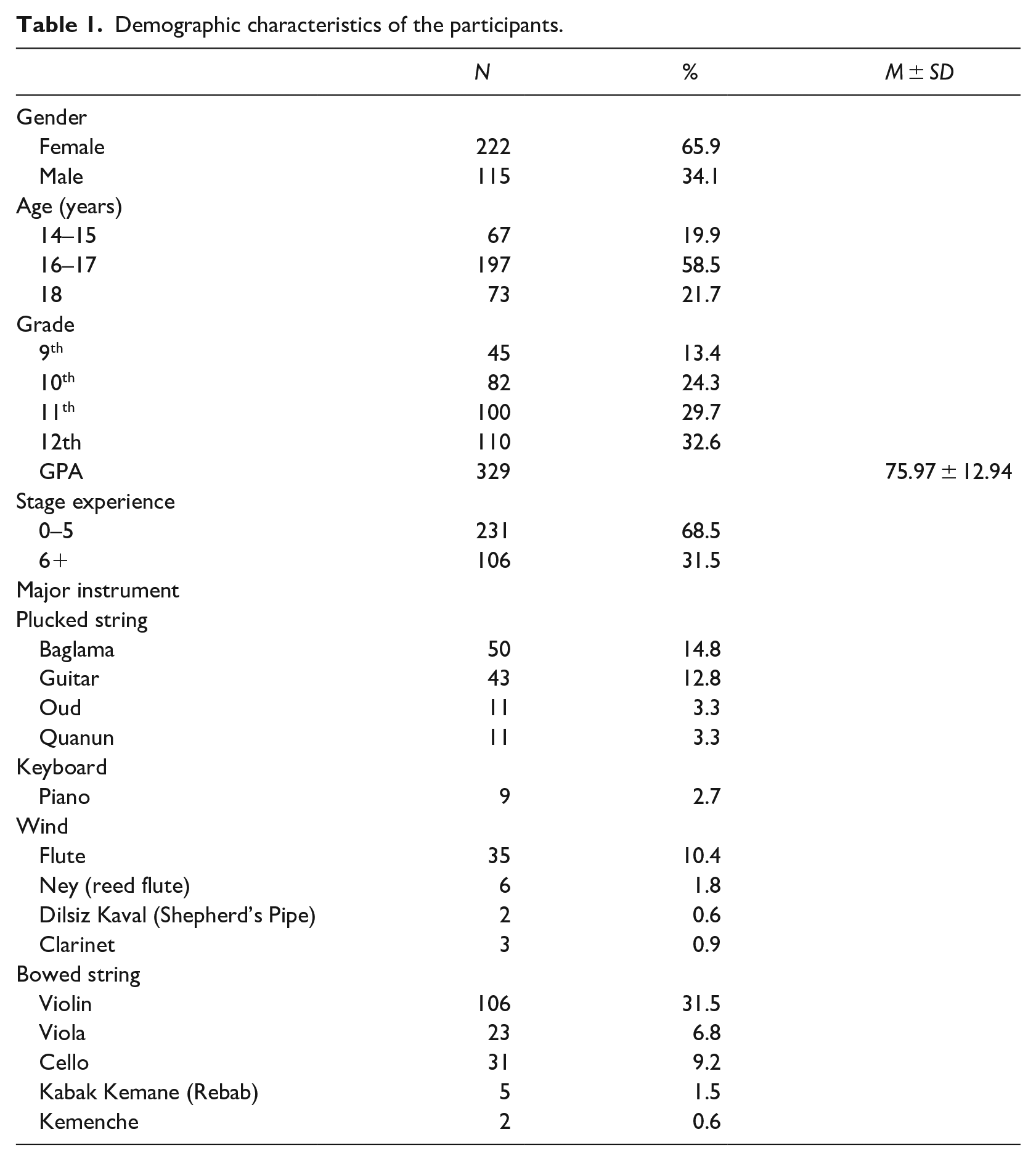
Prior permission was obtained from the Bursa Uludağ University Social and Humanities Research and Publication Ethics Committee (decision number and date: 27.01.2023/01) for data collection. Student recruitment to fine arts high schools is conducted through an entrance exam held within the framework of criteria established by the Ministry of National Education. In this regard, it can be assumed that the students will possess similar attributes. However, it is important to acknowledge the presence of various unpredictable factors, such as cultural and economic variables. Given these considerations, we used a cluster random sampling method to select 14 out of the total 103 fine arts high schools in Turkey, treating the schools as clusters. We contacted these schools and requested that they send Google Forms links to their students. However, we did not receive any responses from three of the selected schools. Ultimately, we received a total of 337 responses from the 11 remaining schools. The study group consists of 337 volunteer students studying at 11 different fine arts high schools in Turkey. Forty-five of the students were in the 9th grade (32 female, 13 male), 82 in the 10th grade (54 female, 28 male), 100 in the 11th grade (70 female, 30 male), and 110 in the 12th grade (66 women, 44 men). Table 1 shows the detailed characteristics of the participants.
Demographic characteristics of the participants.
Data collection tool
The Turkish version of The Kenny Music Performance Anxiety Inventory (K-MPAI) was employed in the research. K-MPAI initially designed with 26 items by Kenny et al. in 2004, underwent a revision in 2009, resulting in a structure of 40 items organized into 12 factors. In the Turkish adaptation study conducted by Ozevin Tokinan (2013), one item was removed from the scale because its meaning was lost in translation, and 14 items were removed from the scale because their total item correlations were below .30. The final version consisted of 25 items grouped under five factors.
Our study evaluated the total score without separately examining sub-factors, given that some factors consisted of a single item. In recent research, the Cronbach’s alpha coefficient for the overall scale was determined to be .970, whereas it was reported as .895 in Ozevin Tokinan ’s (2013) study. Participants were required to assign scores on a 0 to 6 scale to items using a 7-point Likert scale, where 0 corresponds to “strongly disagree” and 6 to “strongly agree.”
Some examples of the items are as follows: “I often worry about receiving a negative reaction from the audience,” “My anxiety and tension about my performance affect my focus and concentration,” “I worry so much before a performance that I lose sleep,” “Being scrutinized by others makes me anxious,” “I worry that a single poor performance could ruin my career.”
Analysis of data
To examine the changes in attitude scores based on gender or stage experience, we conducted a t-test for independent samples. Independent samples t-test is employed to examine whether two independent groups (such as females and males, or those with 0–5 years of stage experience versus those with 6+ years) originate from populations with the same mean. In essence, this test measures whether the observed difference between two samples is small enough to occur by chance, even if drawn from populations with identical means. In many studies, the decision to use either Student’s t-test or Welch’s test is made after testing the homogeneity of variances using the Levene test. However, Field (2018) emphasizes that when variances are equal, Welch’s t-test is as accurate as Student’s t-test, and when variances are not equal, it is more accurate. As a result, he suggests directly applying Welch’s t-test. In this study, the variances of the levels of the gender variable (females and males) and the levels of the stage experience variable (0–5 and 6+) were not equal. Additionally, the group sizes were different. Considering this information, we utilized Welch’s t-tests to determine the impact of these variables on anxiety scores.
Meanwhile, we analyzed the data according to major instrument or age group using an ANOVA. Major instrument variable had four levels (Plucked String, Keyboard, Wind, Bowed String). We used one-way analysis of variance for the comparison of these four groups. Similarly, Age variable consisted of three levels (14–15, 16–17, and 18), and we used one-way analysis of variance for the comparison of these three groups. As known, in parametric tests, a t-test can be used for comparing two groups, while ANOVA is used when comparing more than two groups. However, when it is determined that more than two groups differ significantly, it is necessary to determine from which groups this difference originates. Field (2018) suggests using planned contrasts (a method based on dividing the variance into progressively smaller variance segments) when there is a hypothesis about which group will be higher before starting the analysis. In cases where there is no prior prediction about the groups, he recommends methods related to the comparison of all combinations of group pairs, known as post hoc tests. In this study, when a significant difference was found, post hoc tests were used to compare group pairs and determine which group or groups had higher anxiety.
The GPA ranged from 32 to 100, indicating a continuous variable. Consequently, we utilized the Pearson Correlation Coefficient to investigate the relationship between GPA and MPA.
Findings
To investigate the impact of the major instrument on music performance anxiety, we conducted a One-Way ANOVA. The results presented in Table 2 revealed a significant effect (p = .043).
ANOVA table for the effect of major instrument on music performance anxiety.
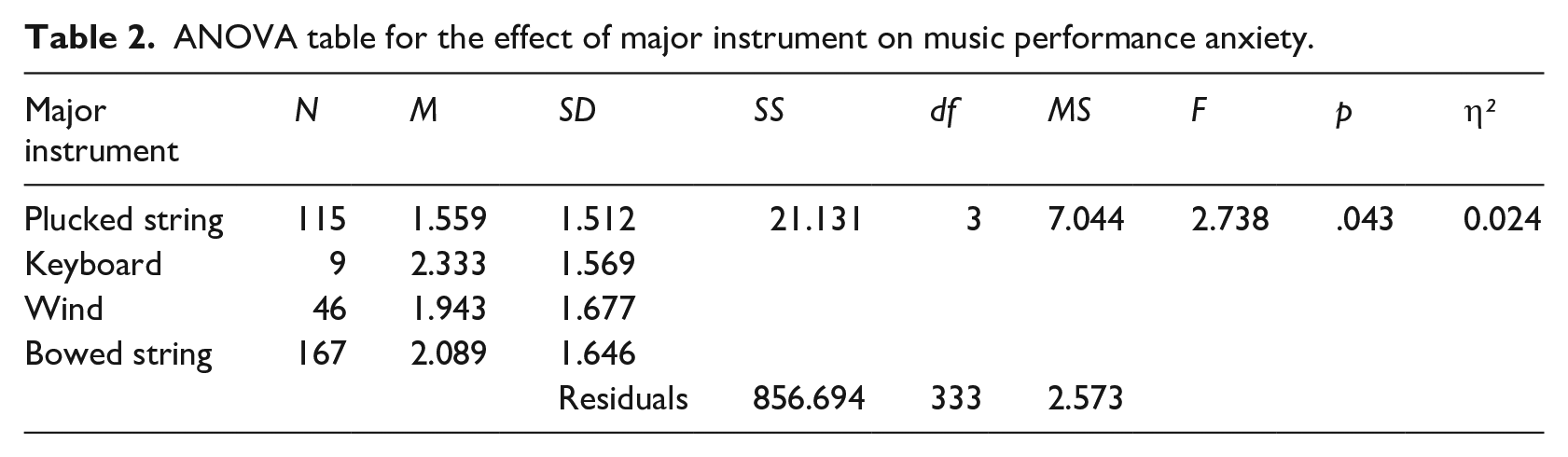
Post-hoc comparisons indicated that playing a bowed string instrument led to significantly higher anxiety levels than playing a plucked string instrument.
We employed a t-test to determine the effect of gender on music performance anxiety. Due to the violation of the assumption of equal variances, Welch’s t-test was utilized, and the results are presented in Table 3. As shown in Table 3, females exhibit significantly higher levels of music performance anxiety than males.
t-test table for the effect of gender on music performance anxiety.

We calculated Pearson’s correlation coefficient to determine if there is a relationship between students’ overall grade averages and their music performance anxiety. As shown in Table 4, no significant relationship was found.
Correlation table for the relationship between GPA and MPA.

We conducted a t-test to determine the effect of stage experience on music performance anxiety. As shown in Table 5, students with five or fewer stage experiences exhibit significantly higher levels of music performance anxiety than more experienced students.
t-test table for the effect of stage experience on music performance anxiety.

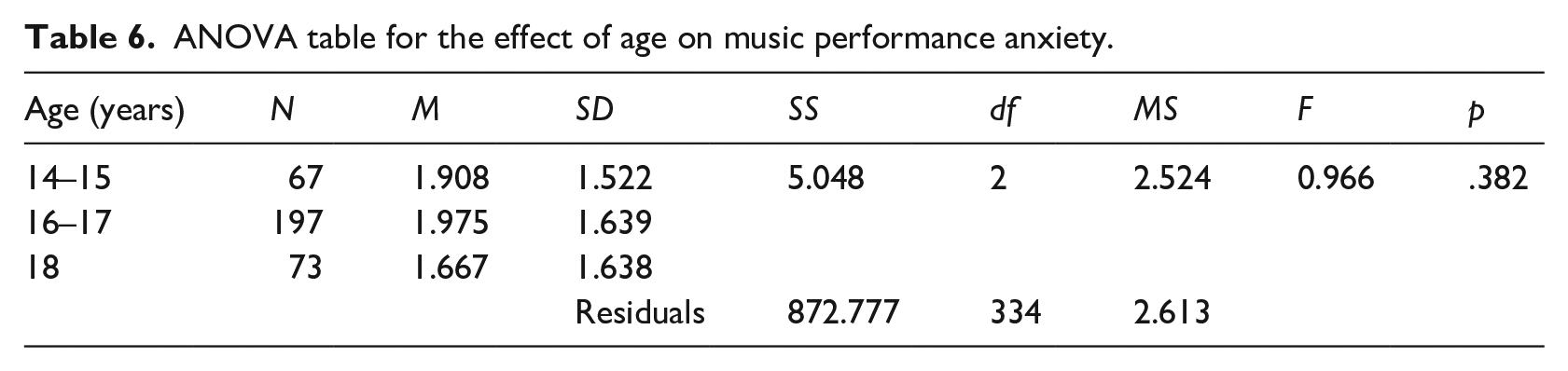
We utilized a One-Way ANOVA to determine whether music performance anxiety varies by age. As shown in Table 6, age did not significantly affect anxiety levels.
ANOVA table for the effect of age on music performance anxiety.
Conclusion and discussion
Upon examining the Kenny Music Performance Anxiety Inventory results of the music department students in fine arts high schools, it was discovered that major instruments significantly affected the scale scores. It can be inferred that bowed string instrument players experience higher levels of anxiety. Other studies also concluded that there are significant differences between individual instruments and performance anxiety. Aydin and Isgorur (2018) conducted a similar study, examining the music performance anxiety of conservatory music students at the secondary and high school levels according to various variables. They found a significant effect of the major instrument on music performance anxiety scores. Specifically, students who play bowed string instruments exhibit higher musical performance anxiety. This suggests that anxiety levels vary depending on the instrument students are trained in, and certain features of instruments, such as being fretless, may pose a disadvantage in terms of anxiety. Furthermore, the genre typically associated with each instrument may also affect anxiety levels. In our sample, Turkish music instruments predominated within the plucked string group, whereas classical music instruments were more prevalent in the other groups.
It has been determined that gender significantly impacts music performance anxiety scores. Similarly, studies conducted by Cornett and Urhan (2021), Zanon et al. (2016), Ozevin Tokinan (2014), and Brugués (2011) have determined that females experience higher levels of performance anxiety compared to males. The increased levels of anxiety found in women may stem from inherently higher neurotic traits, as well as a greater propensity towards expressing these anxieties. For instance, Rae and McCambridge (2004) observed in their study with musicians aged 15 to 18 years that females were more neurotic and experienced higher levels of performance anxiety. Notably, even when neuroticism scores were controlled for, performance anxiety remained significantly higher. This phenomenon was attributed to women’s greater likelihood of openly expressing their anxious states. Gender may also indirectly impact anxiety through societal and cultural associations. The societal association between gender and certain instruments can significantly influence a student’s choice of instrument, as well as how their choice is perceived and approved by their environment, reflecting stereotypes like the notion that flutes are more suitable for girls. Numerous studies have explored these dynamics, focusing on instrument preference, beliefs about the gender-instrument relationship, and the impact of these beliefs on participation in ensembles. For a comprehensive literature review on this topic, refer to Wych (2012). It is crucial to recognize that the influence of gender extends beyond direct effects on anxiety, potentially affecting other anxiety-related variables such as instrument choice and musical experience.
Additionally, in this study, no relationship was found between students’ music performance anxiety scores and their general grade point average. There are studies in the literature that find different results. For example, Gursen Otacioglu (2016) and Paliaukiene et al. (2018) stated that MPA has a negative impact on academic performance. The lack of correlation in our study may be attributed to the multifaceted nature of GPA, which encompasses many skills and activities.
Our study found that students’ stage experience has a significant impact on their music performance anxiety scores, with those having more experience experiencing less anxiety. Similarly, Aydin and Isgorur (2018) found that students’ music performance anxiety levels decrease as their stage experience increases. In contrast to these research findings, Baydag and Alpagut (2016) found no significant correlation between music performance anxiety and stage experience. However, Baydag and Alpagut collected experience data by asking how many years the students had been on stage. It should be noted that this difference could be due to students who have started gaining stage experience more recently but have gained experience by performing frequently. It is also possible that students will develop different MPA coping strategies as their experience increases. Biasutti and Concina (2014) introduce coping strategies as a critical factor, with strategies such as social support seeking and avoidance significantly associated with MPA levels. This suggests that coping strategies may act as moderators or mediators in the relationship between stage experience and MPA.
The research findings indicated that students’ age did not significantly impact their music performance anxiety scores. However, Atilgan Avci and Sager (2021) and Dempsey and Comeau (2019) found evidence suggesting that age is a factor. It should be noted that their studies were conducted with different age groups. Atilgan Avci and Sager (2021) conducted research with adult musicians and found that anxiety was higher in the youngest group (20s). Dempsey and Comeau (2019), on the other hand, studied a sample of children and adolescents and observed an increase in anxiety during adolescence. Our study focused on a narrower age range. A study conducted by Ozevin Tokinan (2014) also utilized a sample of university students within a narrow age range (19–23 years), and no significant impact of age on anxiety could be detected. This suggests that at least among closely proximate ages, anxiety may not have varied enough to be discernible.
Considering the research findings, our recommendations are as follows:
Based on the existing studies and literature, it can be anticipated that performance anxiety may vary depending on the musical instrument being played. To gain a clearer understanding of this phenomenon, there is a requirement for studies that directly address this issue by including a substantial number of participants representing various instruments. Furthermore, it is crucial to consider variables such as whether the instruments are fretted or fretless and whether they are typically played in accompaniment or solo settings. Additionally, those responsible for curricula at fine arts high schools or conservatories should develop mechanisms to help students manage MPA. These mechanisms should specifically address the unique anxiety levels associated with different performance settings, such as solo performances, ensemble playing, and variations arising from the type of instrument played.
In both our study and other research, it is evident that women tend to exhibit higher MPA scores. It remains a subject of inquiry whether this discrepancy is rooted in biological factors or learned behaviors influenced by societal gender roles. While conducting experimental studies in this domain may not be feasible, researching female musicians raised under different upbringing styles could provide a clearer understanding. Moreover, to effectively address these nuances, instrumental and vocal teachers require training to better comprehend and manage student anxieties. This training should consider factors such as the student’s instrument and gender, allowing educators to develop tailored strategies that meet the specific needs of their students.
Reducing the anxiety levels of music students during performances and helping them control this anxiety is important for them to become more effective, productive, and qualified in their professional careers. The study also found that students’ anxiety levels decrease as they gain more stage experience. Based on this, experts in the field should encourage students to participate actively in concerts, shows, and other events by making plans that ensure their regular participation.
It is well-known that various practices have been attempted to alleviate performance anxiety before performing. Spahn (2015) suggests that music performance anxiety can be addressed through various approaches, including psychoanalytic/psychodynamic therapy, cognitive-behavioral therapy, and multimodal therapy. Additionally, alternative treatment methods such as yoga, guided imagery, and meditation are preferred by individuals dealing with performance anxiety. Similarly, Zakaria et al. (2013) aimed to identify proactive strategies for reducing performance anxiety among undergraduate music students. Their research revealed that these approaches increased students’ self-confidence and helped alleviate internal anxiety during live performances. When reviewing similar studies, it becomes evident that the methods commonly employed by musicians are primarily determined through descriptive studies. However, there is a notable lack of experimental studies exploring the effectiveness of these methods for musicians with different characteristics, such as gender, age, experience, instrument, self-efficacy, and more. Therefore, it is recommended that controlled experimental studies in this area be conducted. It is important to conduct studies on the variables that affect music performance anxiety levels to increase performance levels. Additionally, pioneering research by Williamon et al. (2014) and Aufegger et al. (2017) has demonstrated the potential of using simulated performance environments to manage Music Performance Anxiety (MPA). These studies have shown that simulated environments can effectively mimic real performance situations, providing performers with a valuable tool for practicing and managing anxiety under controlled conditions. As advancements in virtual reality (VR) technology continue, the potential for more immersive and realistic simulations grows, offering new ways to explore and address the variables affecting MPA without the logistical constraints of traditional concert venues. This advancement allows for a deeper examination of variables that may influence MPA and provides a practical platform for testing and refining strategies for dealing with this anxiety. As VR technology becomes more widespread, it offers the potential to integrate these immersive simulations into instrumental and vocal training, enhancing educational methods and curricula in music education.
Furthermore, it can be stated that studies incorporating advanced statistical tests, such as structural equation modeling, which explore more complex relationships between variables, would contribute significantly to the literature. For example, does gender influence anxiety not only directly but also by affecting instrument preference? Does instrument preference influence anxiety indirectly through its impact on the number of solo or ensemble playing experiences? Answering such questions requires more complex research approaches that also reveal moderator and mediator effects.
Music performance anxiety is a phenomenon that can affect musicians universally. Given this, it is plausible to consider that the performance anxiety faced by music students in Turkey may share similarities with those encountered by students in other countries, making the findings of this study potentially intriguing on an international scale. On the other hand, societal attitudes towards the arts, culturally ascribed gender roles, the support music students receive from their families, economic conditions, and students’ expectations about the future can vary significantly across cultures. This variability underscores the distinct importance of studies conducted within different cultural contexts.
The universal nature of music performance anxiety, coupled with the unique cultural, societal, and economic landscapes that shape the experiences of young musicians, highlights the need for a nuanced understanding of this issue. By examining the music performance anxiety among Turkish music students, this study not only contributes to the broader discourse on music education but also invites a comparative analysis with other cultural contexts. Such a comparison can enrich our understanding of the ways in which cultural factors mediate the experience of performance anxiety and offer insights into developing more effective support systems for music students worldwide.
Limitations
In our sample, there were students with various levels of stage experience. However, we did not collect data on the time elapsed since their last stage experience. The duration between their last stage experience and the data collection may result in students not accurately recalling their anxiety levels on stage. Similarly, students with minimal or no stage experience might also misjudge their stage anxiety. This circumstance can be viewed as a limitation. Out of 1283 students, 337 (26.3%) responded to our survey. The low participation rate is one of the limitations of this research. It is unclear whether the level of anxiety in students affected their willingness to participate in the study. This should be taken into consideration as it may reduce the generalizability of the results. Furthermore, this study’s exploration of the impact of instrument differences on performance anxiety did not extend to the analysis of musical genres. However, existing research, such as the study by Papageorgi et al. (2013), has shown that musical genre can significantly affect performance anxiety levels, with musicians performing classical music exhibiting higher levels of anxiety compared to those playing Scottish traditional music. This finding suggests that the genre of music, in addition to the physical characteristics of instruments, could play a crucial role in influencing performance anxiety. Although our study included instruments specific to Turkish music, it did not directly compare performance anxiety across different musical genres. The possible existence of a difference in anxiety levels between Turkish music and classical music may have influenced our findings related to instrument differences.
Footnotes
Author contributions
Declaration of conflicting interests
The author(s) declared no potential conflicts of interest with respect to the research, authorship, and/or publication of this article.
Funding
The author(s) received no financial support for the research, authorship, and/or publication of this article.
