



Abstract
This theoretical paper aims to delineate a music-specific interpretation of a concept known as maker education by addressing substantial challenges within educational technologies, particularly in music education. Challenges include the potential constraints on musical agency, limitations to specific music genres and sounds and the environmental impact of increased music technology use in classrooms. In response, the maker education concept is introduced, adapted and refined as a pathway towards a post-digital, participatory and empowering music education. Employing a Design-Based Research approach, design principles for ‘maker music education’ are delineated, and the subsequent steps in the research process are outlined.
Introduction
Musical practice is progressively influenced by diverse music technologies, and within the realm of music education, there has been a noticeable trend towards incorporating music technology into classroom settings for some time (King et al., 2017; Partti, 2012). The term ‘music technology’ basically covers a very broad field of devices and (digital) tools, from the iOS app to the analogue guitar effect pedal to the electric toothbrush. In line with this spectrum, this article is based on a broad understanding of music technology that Hahna et al. (2012) define as ‘the activation, reproduction, generation, amplification and/or transcription of music by electronic and/or digital means’ (p. 456).
In music education, the educational potential and the new musical practices opened up by the use of music technology were emphasised early in the development of the literature on this topic (Partti, 2012). Recently, however, there has been increasing criticism of the uncritical use of various music technologies in music classrooms, as these have a decisive influence on the students’ learning process without this being sufficiently reflected upon (Bell, 2015a; Godau, 2018; Simon, 2020). The general educational discourse has also recently criticised the unreflected or even naïve implementation logic of new technological developments and the associated normative standards like economic growth and the narrative of technological progress (Knox, 2019). Based on this criticism, Selwyn et al. (2020) call for ‘critical educational technology scholarship’ (p. 4), which opposes premature positivism and solutionism and instead examines alternative and experimental spaces for educational technology. In order to take a step in this direction in music education, this article presents initial steps as part of a long-term research project which aims to develop and empirically analyse music-specific maker education formats. The following questions will guide this endeavour:
What are the central challenges based on the current discourse around educational technology?
What implications can be derived for the field of music education?
Inspired by the idea of maker education, what are possible design principles for music education to meet these challenges?
By addressing these questions, this article also contributes to the recently raised discussion on the need for ‘Reconfiguring music education for future-making’ (Buchborn et al., 2022).
In the remainder of the paper, the central challenges of the use of education technology are presented in general and then applied to the field of music education. Subsequently, these challenges are placed in relation to essential goals of general music education. In a further step, the maker education approach is introduced, which in many respects can be seen as a promising alternative to an ‘uncritical’ use of technology in the classroom. This approach is then also extended to the field of music education and finally, as the first step of a larger Design-Based Research project, initial guiding principles for maker music education are presented. In conclusion, the next stage of the research project is presented.
Central challenges of educational technology and how they relate to music education
The discourse related to the field of educational technology is fundamentally characterised by an optimistic belief in progress, which assumes that the increasing exposure to and equipping of schools and students with technological innovations will bring about an improvement in the education system at large (Eynon, 2018; Mertala, 2021; Selwyn, 2011). Selwyn et al. (2020) have recently pointed out that such a positivist attitude towards the use of technology in education hides key challenges such as emerging forms of inclusion and exclusion through the use of technology in educational contexts, the rise of the IT industry in education as a dominant player and the challenges of increased technology use in an age of climate change, overexploitation of finite resources and increasing pollution. Against the background of such fundamental challenges, Macgilchrist (2021) supposes provocatively ‘that edtech is more of a threat to education than a solution’ (p. 1–2).
If we turn our gaze to music education and music classrooms, the integration of consumer music technologies into music education (e.g. iPad apps, digital audio workstation, midi controllers and notation software) frequently entails significant but often overlooked limitations (Buchborn & Treß, 2023). This is because all technologies – irrespective of whether, for example, an analogue synthesiser or a glockenspiel – suggest certain usage scenarios and affordances and suppress others (Bell, 2015a; Simon, 2020). Therefore, a large number of consumer music technologies on the market implicitly and, from a music education point of view, largely unnoticed follow a narrow concept of music, restricted to a small number of (popular) musical styles and genres that are easily retrievable as preset-sounds or templates (Bell, 2018b; Fabian & Ismaiel-Wendt, 2018). For example Morreale (2022) similarly criticises the focus on commercial technologies in the field of music education and pleads for the integration of the most diverse and openly accessible technologies possible.
The ubiquitous intertwining of analogue and digital technologies, seen in music production, reception and performance, can be identified as a feature of the ‘post-digital’ era (Jandrić et al., 2018). The term post-digital is widely used in academic literature, signalling a shift from tool-centric approaches to exploring ‘human engagement within a digital world’ (Clements, 2018). With regard to music education, such an interweaving involves a valorisation of technology as well as material objects in musical practice and the expansion of the concept of the musical instrument (Buchborn & Treß, 2023).
The huge expansion of MusicmakingThings ([‘MusikmachDinge’], Ismaiel-Wendt, 2016) is also remarkable in another respect: The massive increase in demand and the expanding market in the field of home studio equipment has, on the one hand, made it much easier for a wide range of users to participate in musical communities of practice through drastic price reductions (Bell, 2015b; Walzer, 2017). At the same time, however, the permanent upgrade issues that also goes hand in hand with the use of music technology (update constraints, low durability of affordable midi controllers and other music hardware), contradicts a sustainable and eco-friendly approach to technology. Hence the criticism of the unrestrained use of technology without regard for limited resources, and the massive exploitation and pollution of the environment through production and disposal (Parikka, 2016) also applies to the field of music technology in music classrooms.
On the relationship of music technology in music education and educational goals
At this point, the literature makes it clear that the use of consumer music technologies in music classrooms can be in conflict with the educational goals that are often formulated for general music education. Design-related limitations and the focus of musical practice on factory presets highlighted in the previous subchapter severely restrict the musical scope of action for teachers and learners. Hence, the degree of ‘musical agency’, defined as ‘capacity for action in relation to music or in a music-related setting’ (Karlsen, 2011, p. 110), is the more limited the more a particular music technology is designed or programmed for certain production environments, consumer groups or musical practices. A concrete example would be an iOS app for beat making that works exclusively with preset sounds and therefore restricts musical freedom by not allowing individual sampling of own sounds. But even DAWs, which are now very frequently used in music lessons and are increasingly being conceptualised as an independent musical instrument (Bell, 2018a), are essentially designed for music production within certain genres and can only be used in other areas of musical practice with considerable know-how, effort and the courage to misuse them (e.g. for the design of a sound installation project).
Regarding DAWs specifically, it now appears that a few manufacturers of music technology have established a dominant or near-monopolistic presence in music classrooms. This raises concerns about the feasibility of promoting empowerment processes within the realm of music technology as an educational objective. Adams (2008) characterises empowerment as ‘the capacity of individuals, groups, and/or communities to take control of their circumstances, exercise power, and achieve their own goals, and the process by which, individually and collectively, they are able to help themselves and others to maximise the quality of their lives’ (p. XVi). An illustrative case of a powerful position held by a private tech company is Apple, with its iOS-based music production tool, Garageband. The widespread distribution of iPads in schools has – at least in Germany – led to a remarkable focus on this particular app and its possible applications in music classrooms. When a single app is heralded as the ‘Swiss army knife’ for music education and extensively adopted, the opportunities for educators and learners to experience empowerment become significantly limited (Benedict & O’Leary, 2019).
In this context, the use of commercially available music technology in music education may also prove to be an obstacle to musical participation. Fung et al. (2022) see the educational goal of ‘democratised music participation’ as closely linked to ‘opportunities for music participation that are not created by outside stakeholders, but which are created and maintained by the immediate occupants’ (p. 17). However, if software environments are programmed closely along certain usage scenarios without reference to a pedagogical field of application, the opportunities for increased participation also appear to be limited. From an overarching perspective, the question of possible friction and contradictions between the increasing influence of capital-driven technology companies and their platform economies (Knox, 2019) and the ‘Concept of Education As a Public Good’ (Locatelli, 2019, p. 91) also arises in this context.
‘Maker education’: A potential answer to these current challenges?
Given the significant impact of music technology on learning processes and the challenges already mentioned (e.g. design-specific restrictions, increasing influence of tech companies, rapid development and interweaving of digital and analogue music technologies and ecological effects), it seems time for a course correction in the use of music technology in the music classroom. Consequently, Bell (2015b) calls for a fundamental reorientation in this context:
The music educator needs to foster a culture in which learners go beyond simply using music technologies and retroactively navigating their pre-programmed biases to avoid perpetuating a simplistic user mentality. Instead, music educators must engage their students in activities of iterative technological tinkering that nurture a design mentality. (p. 140)
Regarding this demanded paradigm shift in music education, the term ‘maker education’ (Hughes & Kumpulainen, 2021) comes to the fore. Drawing on the ‘Maker Movement’ (Dougherty, 2016), maker education refers to an approach to education that emphasises hands-on, experiential learning through creating physical or digital objects. Learner-centred approaches are intended to encourage students to actively engage in the design, creation and extension of products using a wide range of tools, technologies and materials (Schad & Jones 2020). In a detailed literature review, Soomro et al. (2023) identify key aspects of promoting creativity in maker education settings; they describe joyful engagement, project-based learning, interdisciplinarity, diversity of methods, raising of perceptual awareness, diversity of ideas and the use of diverse tools and technologies as particularly conducive to fostering creativity in maker spaces. Sheridan et al. (2014) state that maker education gives students the opportunity to explore their interests, discover new skills and apply knowledge from different disciplines in a hands-on context. Even though making often entails the production of some kind of a prototype, in educational contexts the focus is on the process of creation rather than just the end product and it often involves open-ended projects or playful challenges that allow for individualised design and self-directed learning (Wohlwend et al., 2018). Kumpulainen and Kajamaa (2020) identify student processes in maker education as, amongst other qualities, ‘interest-driven, collaborative and empowering engagement, evidencing relative expertise and the students’ strong identification with their activity’ (p. 1304). In addition, there is a close connection between maker education and the discourse concerning the circular economy, and the interconnections between technology use and environmental sustainability are manifold (Burbules et al., 2020; Selwyn, 2023). In this sense Dorigatti and Masu (2022) describe making processes and especially the practice of ‘circuit bending to be an environmentally aware practice’ (p. 14), because it involves the creative modification of obsolete electronic devices, particularly children’s toys or musical instruments, to produce unexpected sounds or behaviours. Velicu and Giannis (2020) state that, especially for children, making processes ‘can also raise awareness of issues of global importance through the engagement with waste, encouraging a reassessment of that which was previously considered of no value’ (p. 300).
This cursory overview of the maker literature emphasises the maker education approach’s specific focus on fostering agency, empowerment, participation and education for sustainable development (Clapp et al., 2017, p. 128).
Towards a ‘maker music education’
Although there is a clear focus of maker education within science, technology, engineering and mathematics (STEM; Velicu & Giannis, 2020), projects and educational concepts that actively include arts-based and creative approaches are also increasingly appearing in the discourse (Henriksen, 2014). However, it is particularly noteworthy that the reasons behind this integration often revolve around expected transfer effects, such as the expectation of increased motivation of students for STEM subjects and skills through engagement in musical and aesthetic fields of application. Kayali et al. (2020) bluntly state that the aim of so-called STEAM approaches (where the ‘a’ stands for art) is to provide learners with life skills that can be directly transferred to STEM jobs. The engagement with musical and aesthetic learning processes appears here merely as a means to an end, without being specified or elaborated upon.
Even if the vast majority of the existing literature does not place any particular emphasis on music-specific maker processes, there are already some encouraging points of departure with a focus on music technology: In particular, the concept of ‘Handmade Electronic Music’ (Collins, 2020) and music-specific ‘Circuit-Bending’ (Ghazala, 2005) appear repeatedly in literature as points of reference and seem to offer promising new ways of creatively utilising discarded music technology. The design and enhancement of individual music technology set-ups appears to be particularly promising in terms of opening up agency, empowerment and participation, as the respective scope of artistic expression can be determined by the makers themselves in a creative and explorative way. Again, the intertwining of old and new media and thus the concept of the post-digitality is also of major relevance, both for maker and music education (Gratani et al., 2023).
Hayes (2017) presents an example that follows on from these conceptual ideas; she reports on a large-scale and highly successful music technology workshop-format that was conducted in Scotland. The project focussed on making new instruments and hacking existing devices, encouraging students to use their imagination and discover new ways of combining objects, electronics and computers. The workshops she designed and delivered in various schools were based on the principles of inclusivity, accessibility, legacy (in the sense of ensuring the continuation of the one-time workshop) and the active involvement of teachers in the workshops. In terms of course design, Hayes placed particular emphasis on the facilitation of embodied learning, an active and in-depth exploration of listening and awareness, artistic investigation and the engagement of students in the practice of making and hacking. In addition, she frequently worked with musical improvisation and open-ended group impulses in the workshops. Despite the positive feedback from the participating teachers on the workshop itself, Hayes (2017) sees a considerable challenge to teachers in relation to the long-term establishment of similar formats in schools: ‘[T]he lack of familiarity with both the concepts as well as the technology involved made it difficult for the teachers, despite our efforts to provide training, to assimilate the project into their curricula’ (p. 47).
From a music education perspective, however, these tensions are not only to be found in the field of maker education: they are also typical for creative musical processes in music classrooms such as composing and improvising in groups (Theisohn & Treß, 2022). Nevertheless, in these spheres there are already empirically grounded guidelines on how to cope with these tensions in music classrooms; these could also be adopted in the context of maker education (Treß, 2022).
Given the outlined concept of maker education, a music-specific adaptation appears promising, particularly considering the positive empirical results and the extensive initiatives and applications of maker concepts in the STEM field (Gratani et al., 2023). At the same time, it became clear that the approach has not yet been consolidated for music classroom needs. To date, there has been a lack of empirical findings on the emergent processes of music-making in music education and on adequate design strategies and teaching principles derived from them.
Researching ‘maker music education’
This article is part of a Design-based Research (DBR) project that aims to close the above-mentioned gaps, provide empirical findings on teaching and learning processes in music-specific makerspaces and further develop corresponding lesson designs. DBR is characterised by the core features of generating theories, an interventionist character, the integration of prospective and reflective components, an iterative and cyclical structure and an orientation towards real-world problems (Bakker, 2018; Prediger et al., 2015). DBR provides a framework that is particularly well suited to the empirical study and improvement of educational practices by combining the development and refinement of interventions with the empirical analysis of interaction and learning processes and institutional norms of educational practices. The particular appropriateness of researching maker education by means of DBR is also evident in several studies that have already been carried out in the STEM field (Becker & Jacobsen, 2020; Ingold et al., 2019).
An essential step in DBR is the differentiation of so-called design principles. Euler (2017) describes these as ‘supporting pillars of the interventions to be designed’ (p. 4) that ‘provide orientation for actions within the relevant context’ (Euler, 2017, p. 7). Reinmann (2014, p. 70) also emphasises the crucial importance of the initial design phase for the further research process. Precisely for this reason, she calls for the highest possible transparency regarding the linkage of empirical, theoretical and classroom-based literature with the actual design process. These initial design principles are to be regarded as heuristic, since the empirical analysis of the data obtained during the classroom interventions is primarily directed at the interrelation between lesson design and the practice taking place during the actual lessons. Therefore, in further steps of the cyclical research process, all design principles are subjected to critical analysis and, if necessary, revised or even discarded.
Initial design principles of ‘maker music education’
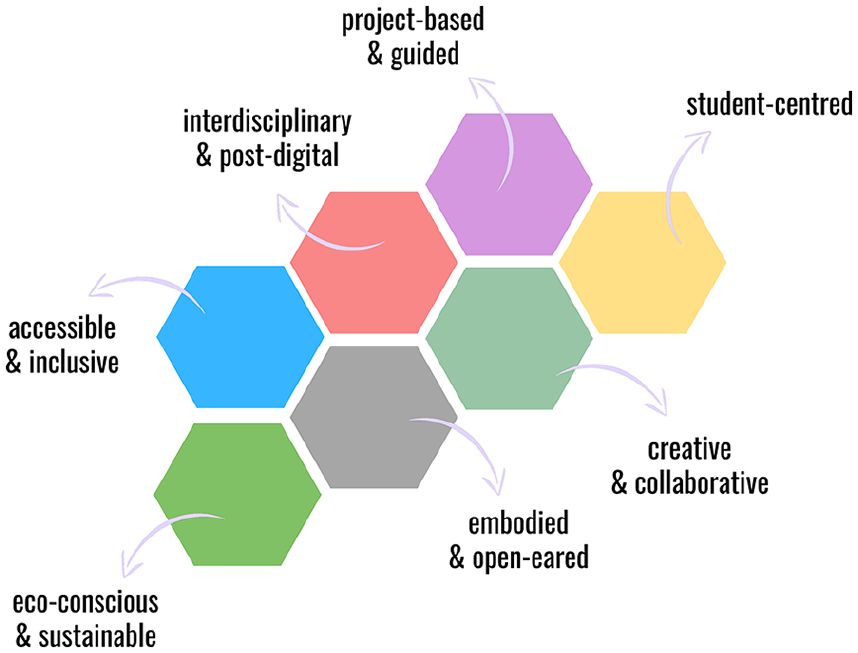
To ensure the aforementioned high level of transparency regarding the educational goals and normative frameworks pursued, the initial design principles of ‘maker music education’ (hereafter MME) are presented and explained in more detail. The following seven design principles (hereafter DPs) are based on the core characteristics of maker education presented by Stilz et al. (2020, p. 147), but the focus here is prominently on music education, based on the previous findings of the article:
(1) Project-based and guided: MME is conceptualised as a guided teaching and learning format that follows the project-based learning approach (Tobias et al., 2015) and can be implemented in informal and extracurricular settings as well as in regular classrooms.
(2) Interdisciplinary and post-digital: MME creates diverse interdisciplinary links (music, art, natural sciences, theatre and sport) and is based on a post-digital understanding of technology (Clements, 2018), according to which both diverse analogue and digital (music) technologies are included in the lesson designs.
(3) Eco-conscious and sustainable: Regarding the technologies and materials used, MME pursues both a sustainable and resource-friendly approach and an eco-conscious view on the consequences of technology use.
(4) Student-centred: MME is primarily directed at the interests of the students, builds on previous life-world experiences and is geared towards initiating aesthetic learning.
(5) Creative and collaborative: Regarding the intended learning processes, the focus is on creative and empowering engagement with technology, along with musical practices such as improvisation and composition. Special emphasis is placed on the initiation of participatory and creative group processes (Treß, 2022).
(6) Embodied and open-eared: In the context of MME, musical practice is promoted as a multimodal practice. Therefore, there is a focus on facilitating the performative dimension of musical practice and embodied interaction and learning processes. In addition, the concept is understood to be ‘open-eared’ and thus assumes a very broad concept of music without adhering to any genre-specific or cultural restriction (Landy, 2012). Consequently, a particular emphasis is placed on active listening (Oliveros, 1971; Schafer, 2002).
(7) Accessible and inclusive: MME strives for a high level of accessibility and inclusivity in terms of heterogeneous learning backgrounds, students’ previous musical experiences and the affordability of the technologies and materials used.
The following figure summarises the seven initial design principles of the MME (Figure 1).
Seven initial design principles of ‘maker music education’.
Conclusion and outlook
This paper has presented overarching challenges related to the use of technology in classrooms and related them to the field of music education. The maker education approach turned out to be a promising concept with regard to current and upcoming challenges in the context of educational technologies. As has been shown, there are numerous links to the concept from the perspective of music education. The concept of MME could point the way towards music education that empowers students, as the design of individual and idiosyncratic performance set-ups, musical instruments, production environments, sound installations, etc. could strengthen the individual’s will to create, promote listening skills and encourage a creative diversity of ideas in dealing with sound, noise and music technology. Since this does not require focussing solely on the next supposedly groundbreaking and disruptive new technology on the market, but also involves incorporating discarded, outdated and seemingly obsolete music technologies in a fruitful manner, MME opens up a profound and critically constructive examination of the ecological consequences of an increasingly accelerated technological progress. Against this background, it becomes possible to ‘embark on wilder, more uncertain, more utopian attempts to design and act on alternatives’ (Macgilchrist, 2021, p. 6). The next major step will be to show whether the potential of MME outlined here can also be realised in actual classroom settings with all its tight framework conditions and circumstances.
Footnotes
Declaration of conflicting interests
The author declared no potential conflicts of interest with respect to the research, authorship, and/or publication of this article.
Funding
The author received no financial support for the research, authorship, and/or publication of this article.
