



Abstract
The impact of neoliberal and postmodern agendas on teaching and learning is explored in this paper through a systematic document analysis of the case of current and recent curricula for the Victorian Certificate of Education Study Designs for Music spanning accreditation periods 2011 to 2027. Careful reading and analysis were conducted to develop emerging themes that revealed patterns of reinvention. It was found that changing language and expectations are intended to be broadly inclusive and focused on student wellbeing. Despite this seemingly noble shift in focus driven by curriculum reform, there is an undercurrent of curriculum reduction and marginalisation that glosses over musically specific terminology, difficult knowledge, understanding and practice. The situation in Victoria, Australia is not unique, but a careful analysis and consideration of this serious issue will reassure school music educators that they are experiencing considerable challenge driven by neoliberal and postmodern agendas. This paper is intended to offer insight and possibly raise caution to those in positions of authority and influence concerning curriculum design and expectations about senior music education.
Keywords
Introduction
In many countries there is a crisis in school systems driven by ‘the combination of a postmodern social constructivist view of knowledge and marketized education’ (Henrekson & Wennström, 2022, p. 142). This has been compounded by radical changes inherent in the ongoing and increasingly significant impacts of technology in education (Humberstone et al., 2024). A postmodern view contends that knowledge is socially constructed (Gergen, 2001) which is pertinent to how we perceive and position contemporary music education principles and practices. In considering what socially constructed music education might mean for students, McPhail (2019) identified the challenge facing school music educators concerning ‘fostering engaging musical experiences for students as well as providing the sorts of knowledge for those students who may wish to progress towards specialisation’ (p. 257). The acquisition and development of knowledge and skills have always been captured in curricular statements, but more recently with overlays of social mediation these have been ‘displaced . . . by curricular approaches that emphasize problem-based learning’ (Wheelahan, 2010, p. 156) that are deemed to be ‘student-centred’. We argue that a consequence of the possibility of an over-emphasis on these factors may result in a reduction of rigor inherent in limiting musical knowledge to that which is less demanding, and which entails less theoretical or practical musicking knowledge, understanding, skill and expertise. We do not negate the importance of ‘student-centred’ teaching and learning. Rather, we argue that music educators should be cognisant of the need for student-centred learning accessible to the comparative novice and the availability of more challenging theoretical and practical knowledge required by those seeking depth in their music education experiences (Crawford, 2018). We suggest that a holistic quality music education requires a balance of both. We are suggesting that by re-framing curricula in secondary school music with a reductive approach to musical skills and knowledge, some students may be ill-equipped for further tertiary study (Gilbert, 2021; McPhail, 2019; Winterson & Russ, 2009). In this regard, McPhail and McNeill (2021) caution that the shift from theoretical to procedural knowledge has led to knowledge fragmentation and ‘frequent avoidance of difficult content’ (p. 69).
In this discussion, we explore these issues as they appear in a recent example of curriculum evolution in music in Victoria, Australia. In Australia, school education falls under the purview of individual states and territories, each of which has an accredited curriculum and assessment authority (Cairns, 2020). The Victorian Certificate of Education (VCE) is received by students for successfully completing their final years of schooling (years 11 and 12). Since 1987 VCE Study Designs have undergone several revisions and re-formulations. For music, the previous accreditation (2017–2022) has been replaced with the new VCE Music Study Design (2023–2027) (Victorian Curriculum and Assessment Authority [VCAA], 2022b). This paper focuses on the changes between the present and past two iterations of the VCE Study Design for Music as a theatre of curriculum reduction and marginalisation that emphasises student-centred learning and glosses over difficult knowledge, understanding and practice (Crawford, 2018).
Current contexts of curriculum change
Schooling exists within current postmodernist societies framed by discourses of globalization that influence educational policy. Blackmore (2002) pointed out that in this metanarrative ‘change is seen to be the constant, all change is good, that we must respond to change, and that [educational] leaders are positioned as change agents’ (p. 199). In the first decade of the 21st century, the modernity of the Enlightenment was deemed to be in crisis and postmodern understandings of knowledge were framed in complex sociocultural and economic development (Seethi, 2001). More recently neoliberalism is seen to be in the ascendant and can be understood as ‘as the extension and installation of competitive markets into all areas of life, including education’ (McPhail & McNeill, 2021, p. 47). The philosophy of neoliberalism is underpinned by advocacy ‘for state governments to institute market-like reforms in all aspects of society to promote individual autonomy, the privatization of assets, and deregulation in all industries and institutions’ (Goble, 2021).
Institutions such as schools remain torn between postmodernist scepticism and challenge on one hand and neoliberal reductions and negations (van Zon, 2013) on the other, depending on which voices clamour most for systematic and curricular reform. In New Zealand, recent sociocultural and political agendas have impacted the music curriculum by encouraging ‘a break with past more liberal and humanistic aims for education’ (McPhail & McNeill, 2021, p. 44). In Australia, it has long been recognised that the place of music in Australian schools is continually challenged by policies and practices that impact curricula, resourcing, teacher education, pedagogical approaches and myriad related matters (Southcott & Crawford, 2011; Stevens & Southcott, 2010).
Australian curriculum change seems to align with similar changes in New Zealand (McPhail & McNeill, 2021), the United Kingdom (Anderson, 2022) and South Africa (Carver, 2020). Previous Australian curricula were focussed on Western art music (WAM) traditions. School music classes mainly focused on ‘developing aesthetic, historical, and analytic knowledge through the study of numerous set works. The curriculum comprised listening, score reading, harmonic analysis, the history of WAM, and some derivative composition. Performing and original composition were not part of the assessed curriculum’ (McPhail & McNeill, 2021, pp. 54–55). Despite incursions of popular music since the 1970s (Swanwick, 1968; Vuillamy & Lee, 1976), for decades the Australian curriculum continued to privilege WAM. The increasing consideration of other musics and other Western genres engendered a gradual loosening of the emphasis on the WAM canon, its notation and theory (Pascoe et al., 2005). This opened space for the inclusion of aural/oral methodologies (Volk, 1998), music technology (Dorfman, 2022) and most recently AI (Yu et al., 2023). These rapid changes and expansions that impact school music teaching and learning in Australia speak to both the neoliberal and the postmodern. For example, concerning the neoliberal the inclusion of music technologies in music education has been accelerated by the social isolation of the global pandemic (Canham, 2023), which has constrained our inability to musick with others (Small, 1998) and led to an explosion of technological applications of varying quality and usefulness marketed to facilitate online learning (Dhawan, 2020; Park, 2022). Judicious use of music technologies requires, frequently time-poor music educators to make decisions that may come down to cost and availability. Conversely, it could be argued that the ever-increasing use of technologies in music teaching and learning reflect a postmodern refusal to recognise the hegemony of WAM, particularly in a teaching environment interrupted by the pandemic, wherein many practices and foci are now questioned. Nearly two decades ago, in Australia the National Review of School Music Education (NRSME) (Pascoe et al., 2005) recommended that curriculum development be flexible and responsive, inclusive and incorporate creativity. The long-standing recognition of the divide between school music and the music that students engage with in their lifeworlds should also be noted (Boal-Palheiros et al., 2001; Pendergast & Robinson, 2020). Agitations for change underscored by both postmodern and neoliberal agendas continue to push and pull at the music curriculum or curriculum framework designed for Australian schools. Either way, the school music curriculum and its enactment in virtual and face-to-face teaching and learning spaces seems to be challenged and progressively constrained. To explore this complex and difficult space, this research was conducted via document analysis of music curriculum documents in Victoria, one prominently known education state in Australian.
Research questions
This study was driven by two primary research questions. First, what do the changes to secondary music curriculum frameworks and guidelines imply about the potential impact of the depth and rigor of school music education in Victoria? This question exists within a policy rhetoric that shapes the possibilities of school music teaching and learning. Second, what are the perceived impacts of postmodern and neoliberal policies and principles inherent in changes to secondary school music curriculum as evidenced in the case of Victoria, Australia? It is noted that our local context and situation is not unique, in that school music education in many locations is impacted by similar concerns as they undergo similar curriculum reforms. It is intended that this research will raise concerns about significant issues regarding senior music curriculum that will have international implications for music education.
Methodology
This research employs a systematic document analysis (Gross, 2018) in which empirical knowledge is constructed through the analysis of documents to gain understanding that contributes to answering specific research questions (Bowen, 2009). Document analysis is a form of interpretative qualitative research that ‘requires researchers to locate, interpret, analyse and draw conclusions about the evidence presented’ (Fitzgerald, 2012, p. 298). The documents selected for this study are the senior secondary curriculum Victorian Certificate of Education study designs for Music with accreditation periods from 2017 to 2022 and 2023 to 2027. Please note that only parts of the study design for accreditation period 2011 to 2016 are considered as it is similar to the accreditation period from 2017 to 2022. A curriculum analysis may be conducted to determine goals, perspectives, biases and understand underlying assumptions (Jansen & Reddy, 2015). The analysis encompasses statements about music from the senior secondary years of schooling (years 11 to 12 generally corresponding ages ranging from 16 to 19 years) as the final years of schooling do not stand in isolation to what precedes them. Some senior secondary units can be undertaken at year 10, dependent on particular school offerings. Our curriculum analysis is based solely on the Victorian Curriculum and Assessment Authority published documents and will explore how learning in music (Arts discipline area) is described and in turn shapes what may be taught, how and why.
Careful reading and re-reading allows the identification of key statements that can be analysed thematically. This is ‘a form of pattern recognition within the data, with emerging themes becoming the categories for analysis’ (Bowen, 2009, p. 32). Preliminary data were arranged and summarised in categorising tables, but required a fuller discussion as in previous research on this topic (Crawford & Southcott, 2017; Southcott & Crawford, 2011). Preliminary categorisations of curricular documents were at times challenging. Finegold and Mackeracher (1986) observed that ‘even those published by a single educational jurisdiction, do not all conform to a consistent pattern’ (p. 356). To add texture to our critique, we include relevant and apposite, direct quotations from the relevant texts.
The analysis will reveal the implicit underlying intentions and develop a narrative about its strengths and weaknesses that contribute to how teachers may interpret curricula for instructional decision-making. Patterns of reflected intentions and inferences will be explored through engagement with the content to develop an understanding of the structures imposed by the government and relevant authorities (Crawford & Southcott, 2017). This study is timely given significant reforms on the senior secondary curriculum that will impact on reviews being undertaken on the Foundation to year 10 Victorian Curriculum. It is acknowledged that all formal government authority publications may include a degree of bias and aspirational goals that situate content within broad-based agendas. While this may be the case in curriculum documents, one of the research aims of this study is to identify the policy agendas that may be driving some of these aspirations. Comparisons will be drawn from the published documents highlighting changes in learning goals, content and assessment requirements from one curriculum accreditation period to the next. We acknowledge that as authors, we hold some degree of bias. Both authors are not only initial tertiary education specialists, but are also very experienced classroom music educators who have long worked under regimes of changing curricula. Further, we are experts in curriculum analysis and have been invited consultants concerning reforms to Australian curricula (Crawford, 2018; Crawford & Southcott, 2017; Southcott & Crawford, 2011; Stevens & Southcott, 2010).
Findings and discussion
Overall VCE structure, aims and assessment
The VCE course is a senior secondary curriculum mostly completed over 2 years and made up of subjects called studies, for example, English, Biology and Music. Each study consists of four semester-long units, some of which must be studied as a sequence, Units 1 and 2 in a student’s first year, and Units 3 and 4 in their second year. A student can take longer than 2 years to finish VCE if required and some schools encourage students to start VCE in Year 10, and in turn some study Units 3 and 4 in Year 11. While Unit 1 or Unit 2 of a subject can be studied as stand-alone units, students must complete Units 3 and 4 of a study as a sequence in the same year if a study score is to be calculated. A study score can be obtained from at least two graded assessments and where students achieve an S (Satisfactory) for both Units 3 and 4. A study score is calculated as a number between 0 and 50 that indicates a student’s ranking which is measured against all students doing that study in that year (VCAA, 2022a). For students to achieve their VCE they must successfully complete 16 units including: three units from the English group (two of which must be a Unit 3 and 4 sequence), and at least three additional Unit 3 and 4 sequences.
Students can select from 20 to 24 units (across five or six studies) in Years 11 and 12. There are over 90 VCE studies and over 20 VCE VET (Vocational Education and Training) programs for students to choose from across the humanities, sciences, mathematics, technology, arts, languages and vocational studies (VCAA, 2022a). The variety of study options is intended to encourage students to pursue a range of interests and build their skills accordingly (VCAA, 2022a). The types of VCE studies and VET programs available to students to select is highly dependent on what the school decides to offer. This is based on a range of factors including resources and whether there are enough students to warrant running a class. If a school doesn’t offer certain studies, the program might be available from another provider.
Units 1 and 2 are marked within respective schools where teachers are tasked with setting a range of assessments to evaluate students’ progress. The assessments receive either S (Satisfactory) or N (Non-Satisfactory). A school may choose to provide a grade for each unit, but only the S will count towards students’ VCE. Marks for Units 3 and 4 have grades calculated from A+ to E, UG (Ungraded) or NA (Not Assessed), as well as an S or N. There are three graded assessments for each VCE study at Unit 3 and 4 level. All VCE VET programs with scored assessment have two graded assessments. Depending on the study, these may be School-based Assessments and/or external assessments. School-based assessments are set and marked by teachers and include School-assessed Coursework (SAC) that is completed at school, and School-assessed Tasks (SAT) that are completed at school and home. The VCAA moderates the marks to ensure consistency and standards are maintained across Victorian schools. External assessments are set and marked by external experts for the VCAA, which are the same for all students taking the same VCE study. This will usually be in the form of an examination – whether written, oral, performance or in an electronic format. All VCE studies are marked to the same standard and there are multiple checks to make sure that marking is consistent and equitable (VCAA, 2022a). All marks submitted to the VCE are moderated. There is further moderation through the use of the General Achievement Test (GAT) which purportedly measures a student’s general knowledge and skills in written communication, mathematics, science, technology, humanities, the arts and social sciences (VCAA, 2022a). The GAT results are used to check that VCE external assessments and school-based assessments but do not count towards students’ final VCE results.
Once results are finalised, they are used in several ways including by tertiary institutions who look at the Australian Tertiary Admission Rank (ATAR) and the combinations of VCE studies students have completed before offering places. ATAR is calculated by the Victorian Tertiary Admissions Centre (VTAC) on the basis of study scores, presented as a ranking between 0.00 and 99.95 (VCAA 2022a). To obtain an ATAR, students are required to have at least four study scores, one of which must be from the English group. This skews results and how the VCE and Vocational Program are understood by all stakeholders. It can be argued that the VCE has been by default a university entrance qualification. Attempts have been made to change this dynamic and make VCE and Vocational Program results more widely applicable (Polidano et al., 2014). After analysing the overall VCE structure, aims and assessment, we note a significant change in the introduction in 2023 of the VCE Vocational Major (VM). This is a new vocational and applied learning program within the VCE that is intended to prepare students to move successfully into apprenticeships, traineeships, further education and training and university through alternative entry programs or directly into the workforce (VCAA, 2022a). This focus on vocational and informal learning (Crawford, 2018) sets the undertone for the new VCE Music study design, which will be considered in the next section.
VCE music study design
Senior secondary Music is based on active engagement in all aspects of music where students are expected to develop and refine musicianship skills and knowledge and develop a critical awareness of their relationship with music as listeners, performers, creators and music makers. The current VCE Music scope of study states:
Students explore, reflect on and respond to the music they listen to, create and perform. They analyse and evaluate live and recorded performances, and learn to incorporate, adapt and interpret musical practices from diverse cultures, times and locations into their own learning about music as both a social and cultural practice. Students study and practise ways of effectively communicating and expressing musical ideas to an audience as performers and composers, and respond to musical works as an audience. The developed knowledge and skills provide a practical foundation for students to compose, arrange, interpret, reimagine, improvise, recreate and critique music in an informed manner. (VCAA, 2022b, p. 7)
The most recent 2023 study offers ‘a range of pathways that acknowledge and support a variety of student backgrounds and music learning contexts, including formal and informal’ (VCAA, 2022b, p. 7). This is the first of the study designs in the accreditation periods analysed that indicates that learning contexts should be formal and informal (Crawford, 2018). What this means or might look like in practice is unfortunately omitted. This lack of explicit guidance for music educators may result in inconsistency of quality and equity in music programs across the state.
Table 1 outlines the rationale, aims and entry level requirements of the Music study designs across the three most recent accreditation periods:
VCE music study design rationale and aims 2011 to 2027.
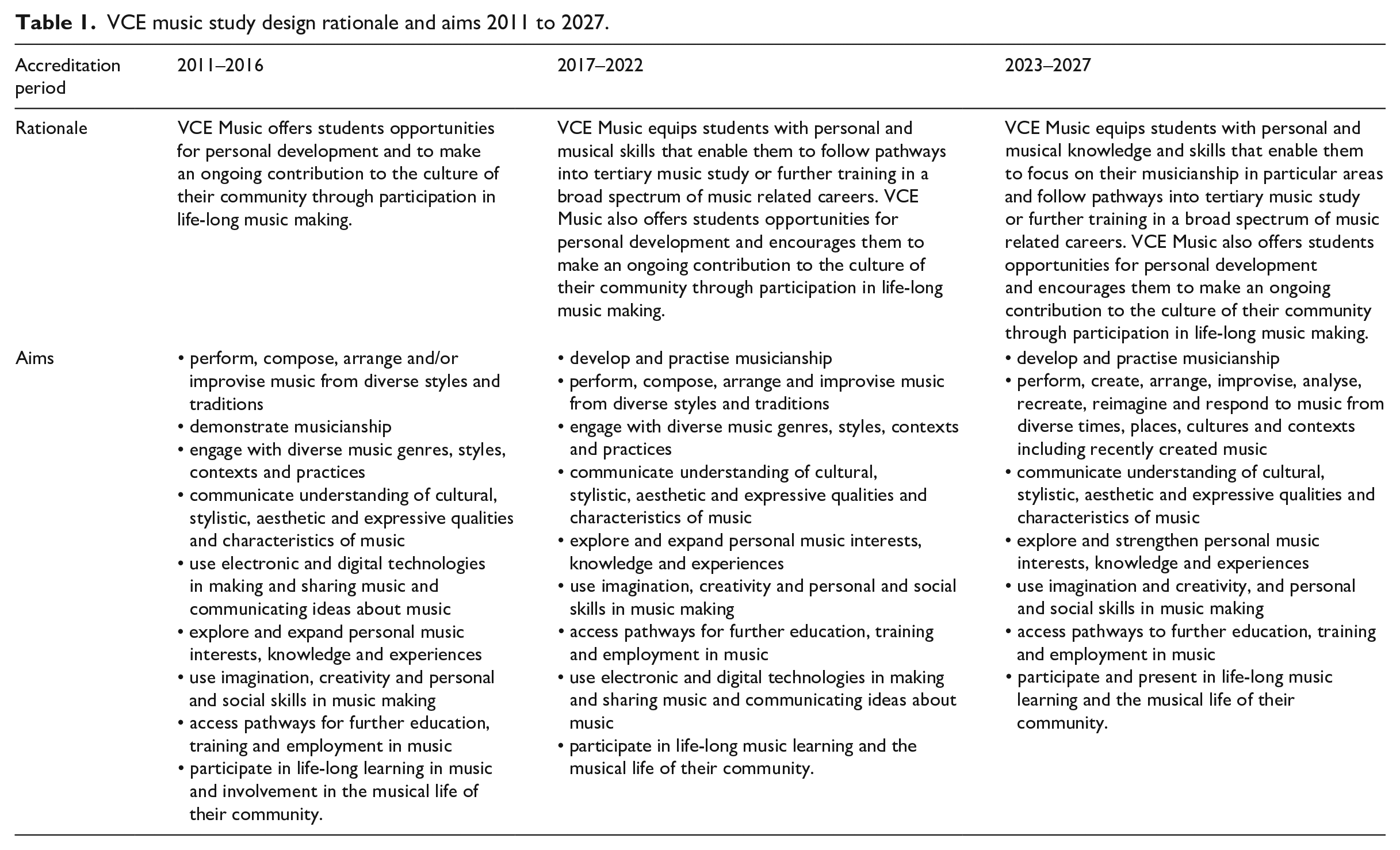
As outlined in Table 1, the rationale for the study design has expanded across the three accreditation periods. The statement about studying music leading to potential pathways in training or tertiary studies was introduced in the 2017 to 2022 accreditation period. We suggest that this may be in response to findings from the comprehensive Australian Institute of Health and Welfare (2017) that indicated that completing schooling and in particular higher levels of education (obtaining tertiary level qualifications), offered more employment opportunities and better overall life outcomes. Low school attainment and poor engagement with school was expected to lead to poorer life outcomes, including unemployment, poverty and social exclusion. In the study design for accreditation period 2023 to 2027 the statement about what music will equip students with is clarified to be ‘personal and musical knowledge and skills that enable them to focus on their musicianship in particular areas’, which implies that a holistic senior secondary music education is not the goal or expectation, but instead a shifting focus to areas of student interest. This totally student-centred focus aligns with other initiatives introduced in 2023 to support such principles, such as the VCE Vocational Major, which is an applied learning program that will ‘enable transitions into apprenticeships, traineeships, further education and training and university, via non-ATAR pathways’ (VCAA, 2023a). This widely inclusive approach was developed on the premise that ‘All students should be supported to choose and access the senior secondary pathway that best aligns with their strengths, interests and aspirations at their local government school’ (VCAA, 2023a). The rationale about life-long learning has been expanded within the three accreditation periods to reflect the current emphasis across education for students to contribute to community and culture (Dabback, 2017; UNESCO, 2021).
The aims of the music study design are fairly consistent across the three accreditation periods, however there are subtle changes in language use that reflect the changing music industry. For example, the term ‘compose’ is replaced with ‘create . . . recreate, reimagine and respond to music’ in the most current accreditation period (2023–2027). ‘Engage with diverse music genres, styles, contexts and practices’ is replaced in the current accreditation period with ‘music from diverse times, places, cultures and contexts including recently created music’, ensuring that there is an expectation that the most current music of the time must be included in the curriculum. Interestingly, removed from the aims of the most recent study design is the use of ‘electronic and digital technologies in making and sharing music and communicating ideas about music’. Although technology is expected to be used in the study of music, as the term appears in other sections, it is no longer a required aim. This implies that the use of technology as a tool in the music curriculum is embedded as a required general capability that runs across the curriculum (Crawford & Southcott, 2017; Southcott & Crawford, 2011).
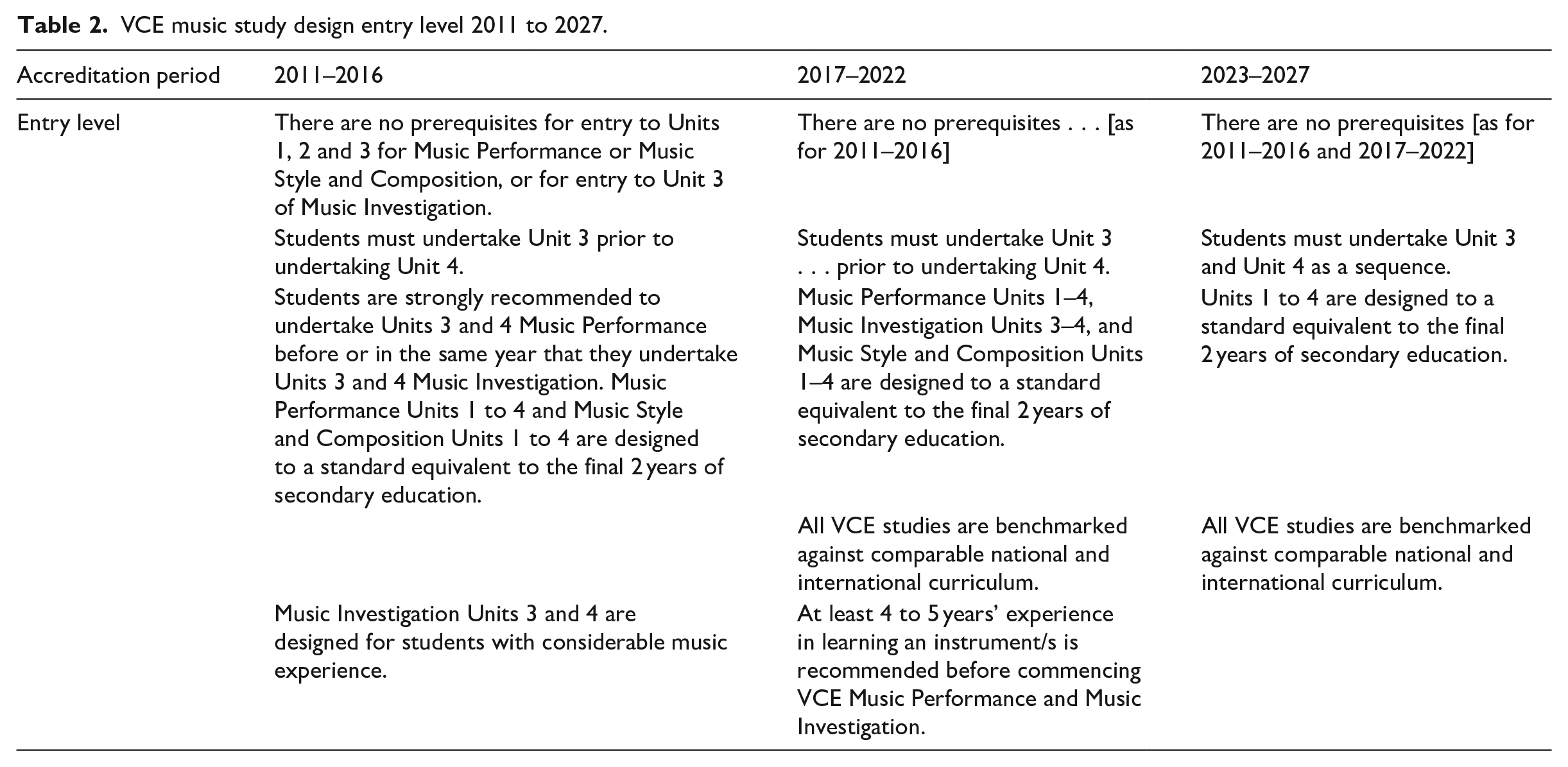
As indicated in Table 2 there remain no prerequisites for entry into any of the first three units in the music study design across the three accreditation periods, but all are designed to a standard equivalent to the final 2 years of secondary education. In addition, the first accreditation period (2011–2016) states that ‘students are strongly recommended to undertake Units 3 and 4 Music Performance before or in the same year that they undertake Units 3 and 4 Music Investigation’ as the latter units were designed for students with considerable music experience. This advice is not repeated in the later study designs. In the second accreditation period (2017–2022), it is explicitly stated that, ‘All VCE studies are benchmarked against comparable national and international curriculum’. This is repeated in the next accreditation period. In 2011 to 2016, at least 4 to 5 years’ experience in learning an instrument/s is recommended ‘before commencing VCE Music Performance and Music Investigation’ (VCAA, 2017, p. 7). In the most current iteration there are no additional statements clarifying music experience and knowledge expectations, suggesting a neoliberal deregulation in which individual autonomy is promoted over the imposition of domain-based expectations.
VCE music study design entry level 2011 to 2027.
The music study design across all three accreditation periods consists of ten units. Each unit deals with specific content contained in areas of study and is designed to enable students to achieve a set of unit outcomes. Each outcome is described in terms of key knowledge and key skills. The structure for accreditation periods 2011 to 2016 and 2017 to 2022 are identical, Music Performance Units 1 and 2 lead to Music Performance Units 3 and 4, and/or Music Investigation Units 3 and 4. Music Style and Composition Units 1 and 2 lead to Music Style and Composition Units 3 and 4. Students may enrol in all units or select specific combinations of units that cater for their interests and intended pathways. In the study design for accreditation period 2023 to 2027 the structure and name of these ten units changes, Music Unit 1 – Organisation in music leads to Music Unit 2 – Effect in music, which leads to the following sequences: Music inquiry Unit 3 – Influence in music and Music inquiry Unit 4 – Project, and/or Music contemporary performance Units 3 and 4, and/or Music repertoire performance Units 3 and 4, and/or Music composition Units 3 and 4. The differentiation between ‘Contemporary’ and ‘Repertoire’ is telling, the former appearing to eschew musical terminology and offering no list of pieces appropriate to different contemporary genres, the latter maintaining lists of recommended works and using more specialised musical terminology.
Across the three accreditation periods (2011–2016, 2017–2022 and 2023–2027) the mandatory duration of each unit remained constant with at least 50 hours of scheduled classroom instruction. The only slight modification was the clarification that these hours would occur during one semester (20–24 weeks), probably in response to schools being flexible with delivery schedules. The type of activities to be included remained fairly constant. Classroom music, instrumental lessons and ensemble rehearsals appeared in every iteration. From 2017 (pre-COVID) there was the addition of masterclasses that could occur in real time or online.
In each iteration there were statements concerning safety and wellbeing. As with duration, there were some constants and some expansions. For example, a constant was referral to governmental regulations by the Victoria WorkCover Authority and the Department of Education concerning acoustic treatments, ventilation, electrical and cabling, posture/seating, physical warm-ups before activities and so forth. Again, it is probable that additional details were added in response to issues encountered in schools. New in the final and current version (2023–2027) was attention to wellbeing. It was stated that,
Performance is more emotionally demanding than lessons and practice. Playing for an audience, especially a critical one, can be a stressful activity. Strategies must be in place to maintain the psychological wellbeing of students across individual practice, performance and post-performance debriefing. The potential for music to positively assist students in developing autonomy, mastery and relatedness to other people should be actively nurtured. (VCAA, 2022b)
This addition may have been in response to the interruptions and challenges caused by the closure of schools in response to extended lock downs (262 days) in Melbourne, Victoria. Not only did the enforced isolation during the pandemic disrupt in diverse ways, the return to the ‘new normal’ has seen an emphasis on including strategies focusing on student wellbeing (Barbeau et al., 2024; Cheng & Lam, 2021). We recognise that the pandemic had an impact globally on school music and wellbeing (Canham, 2023; Habe et al., 2021). We note that the tensions between postmodernism and neoliberalism might have driven a shift of focus towards student wellbeing with the potential to influence the development of a more personally meaningful and relevant curriculum for students. We remain hopeful that a balance between experiential learning and theoretical knowledge will be achieved that can accommodate all students.
Comparing the VCE music unit 1 and unit 3 performance offerings
To provide an example of the key knowledge and skills expected in the VCE Music Study curriculum across the three accreditation periods, the first Music unit offered to the majority of students by schools, has been selected for comparison. Across accreditation periods 2011 to 2016 and 2017 to 2022 this was Unit 1 Music Performance and in 2023 to 2027 the equivalent is Unit 1 Organisation of music (see Table 3).
VCE study design music performance unit 1 outcome 1 (2011–2016 and 2017–2022) and organisation of music unit 1 outcome 1 (2023–2027) key knowledge and skills.
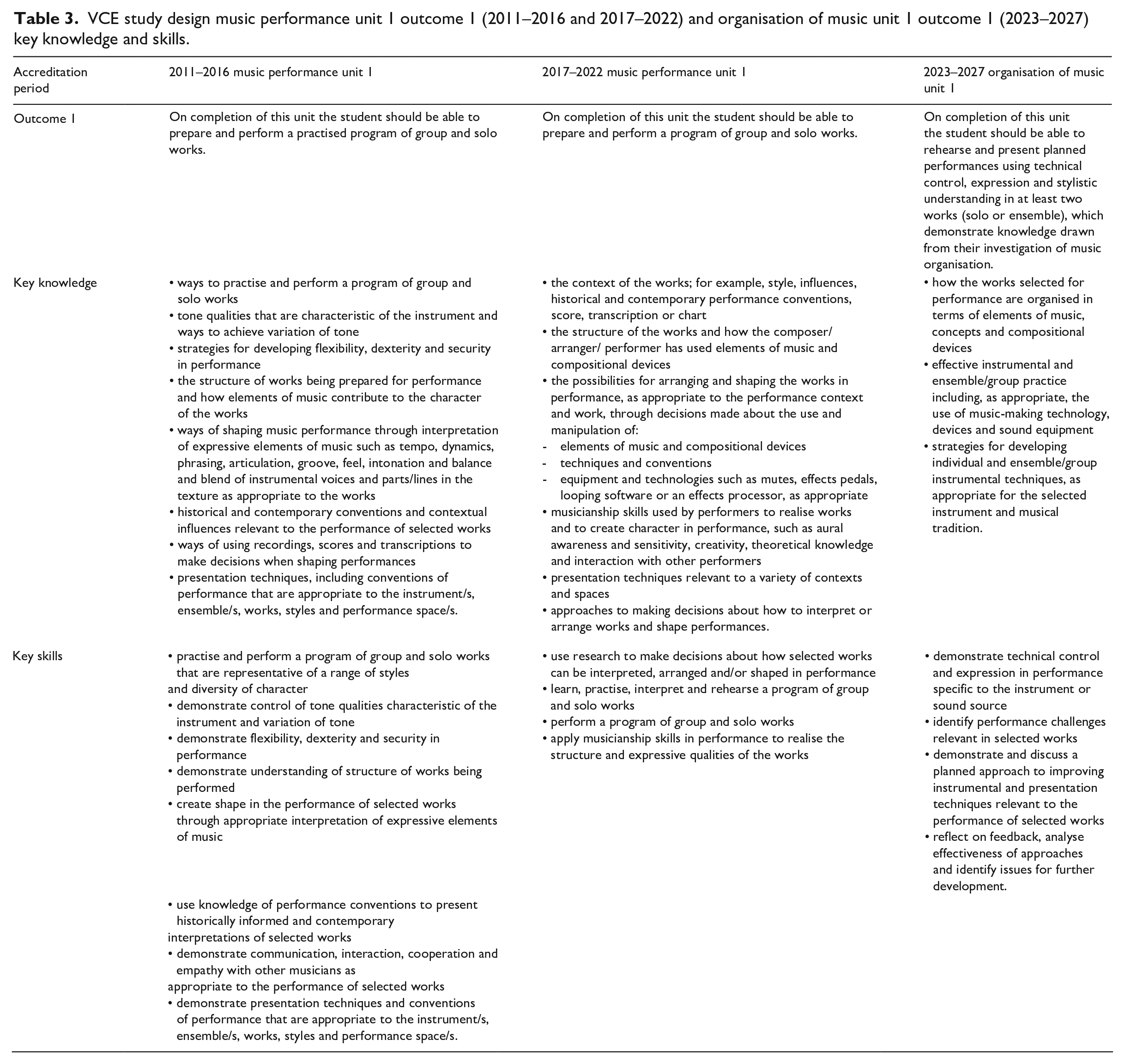
To provide a further comparison Outcome 1 from Unit 3 Music Performance (2011–2016 and 2017–2022) and Outcome 1 from Unit 3 Music Contemporary Performance and Music Repertoire Performance (2023–2027) will be considered (see Table 4). Concerning Outcome 1 (Table 3), across the three iterations of the VCE Study Music Performance Unit 1, the first difference is that the title of the subject has changed from Music Performance to Organisation of Music with the current statement fleshing out what is involved in preparing and performing a program of group and solo works. In the specifications of Key knowledge there is a clear reduction in subject specific terminology. The ‘elements’ of music are consistently noted but it is in the details concerning how music is constructed and made, there is a clear reduction of detail and musical/technical language for example, in 2011 to 2016 there is mention of expressive elements such as ‘tempo, dynamics, phrasing, articulation, groove, feel, intonation’ and so forth; in 2017 to 2022 there is mention of ‘equipment and technologies such as mutes, effects pedals, looping software or an effects processor’; but in 2023 to 2027 there is only mention only of ‘effective instrumental and ensemble/group practice including, as appropriate, the use of music-making technology, devices and sound equipment’. For Key Skills, we note a similar reduction in both detail and musical technical language across the three iterations. There is a transition from very detailed and specific musical performance elements to more concise but still musically specific elements, to succinct, very general and sometimes vague suggestions, for example ‘demonstrate and discuss a planned approach to improving instrumental and presentation techniques relevant to the performance of selected works’. Similar reductions in musical terminology and performance expectations occur in all aspects of the Study Designs across the three accreditation periods.
VCE study design music performance unit 3 outcome 1 (2011–2016 and 2017–2022) and music contemporary and repertoire performance unit 3 outcome 1 (2023–2027) key knowledge and skills.
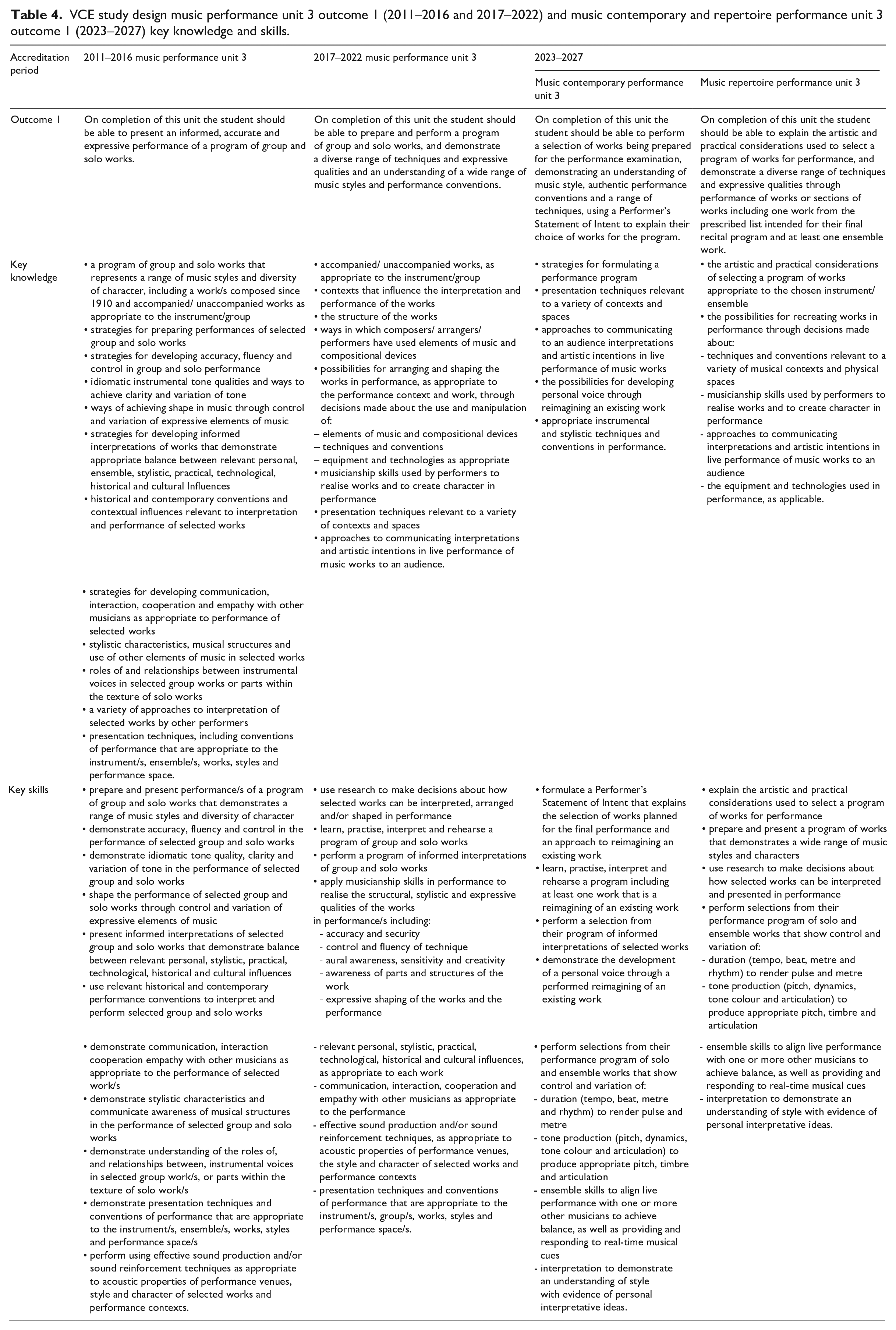
Another example can be offered wherein the VCE Study Design Music Performance Unit 3 (Table 4) does much the same thing. Again, the change in title of the units is telling. In the first two iterations there is only Music Performance, but in the third the subject is split into Contemporary Performance and Repertoire Performance. The latter is close to the previous versions with lists of set works, generally from the Western Art Music (WAM) canon or from established popular styles. Whereas Contemporary Performance is driven by a statement of performer intent and with an emphasis on the development of personal voice. It is difficult to imagine what might be examinable or comparable in performance programs that apply ‘authentic performance conventions and a range of techniques’ when there is no standard indicated for conventions. It is particularly troubling to understand how this can meet the announced standard that ‘All VCE studies are benchmarked against comparable national and international curriculum’ (see Table 2).
It is acknowledged that the intentions of the creators and approvers of these units in ‘Senior secondary education is about developing and realising every student’s potential’ (VACC, 2023b) and accept that only focusing on the WAM is exclusionary, but it seems that by attempting to include all, the descriptions and provisions have become so malleable as to make them at times meaningless. Further, by reducing the music expectations there is also the possibility that those students’ intent on entering the music profession will not be served by an unchallenging set of expectations. There remain tensions between meeting the curricular needs of students who wish to proceed to higher education and those for whom music is not a career focus.
Concluding comment
Returning to the initial position concerning the evolving school music curriculum in Victoria, Australia. It is suggested that experience regarding curriculum reforms in this local context will not be unique, but that music educators in other spheres will be experiencing similar tensions on what they teach and how they teach it. Without clarity and appropriate standards, reforms will be less effective as teachers and their students understand very different expectations and devise diverse ways of meeting what is becoming a fairly low bar. Taking a postmodern view of the construction of knowledge as socially framed, this evolving curriculum (particularly the Contemporary Performance strand) seems to hold the social over the musical in its specifications and demand. Taking a neoliberal, marketised position, we seem to already have reached a time when social media has become an appropriate medium for ‘developing personal voice’ and we acknowledge that this can contribute to teaching and learning (Crawford, 2022; Crawford & Southcott, 2017).
Based on the findings, there appear to be an evolving direction in generations of curriculum that contains spiralling reductions. Between the postmodern and the neoliberal we run the risk of excluding some musics and musicking from the music units. This dilemma has been recognised by others (Brown, 2015; Goble, 2021; McPhail, 2019). Goble (2021) posits that ‘music educators . . . now need to face neoliberalism head on. We need to teach like our instruction has implications for the healthy future of our democratic nations and planet earth itself . . . because it does’ (p. 13). We argue that there could be potentially serious consequences for future generations in music teaching and learning resultant from a reductionist curriculum. More widely, Brown argues, that ‘democracy hollowed out by neoliberal rationality cannot be counted on to renew liberal arts education for a democratic citizenry’ (Brown, 2015, p. 200). The bleakness of these somewhat dystopian predictions of what might be happening in school music as a result of these curriculum reforms is concerning. Multiple examples of musical and educational excellence (in all genres) are acknowledged, but the issue remains that without clear curriculum guidelines, this excellence may be achieved despite the curriculum, not because of it. It is hoped that this exposition of what is being seen offers music educators, particularly those in positions of authority and influence concerning curriculum design, a wakeup call. The evolving lack of clarity and concerning reduction in the perceived rigor of music from expected skills and knowledge found within curriculum documents, may place the perceived importance of music education in the curriculum and schools lower down the pecking order. It is understood that school music educators are all too aware of responding to the challenge of changing curricula driven by neo-liberal agendas.
Footnotes
Author contribution(s)
Funding
The author(s) received no financial support for the research, authorship, and/or publication of this article.
