



Abstract
This article reports on a case study involving 44 adults based in Belfast, Northern Ireland for the research project Bridging Musical Knowledge. Data were gathered via project website creation and an online survey carried out during early stages of the COVID-19 pandemic. Developing an interdisciplinary epistemic framework that draws on theory from music education, ethnomusicology and musicology in conjunction with the analysis of qualitative data, it finds two major tendencies across multiple perceptions/experiences of musical knowledge as reported by participants: first, to value formal and practical aspects in the attainment of musical knowledge, and second, to consider familial, communal and other sociocultural contexts as central to musical knowledge development. Interpreting a dialectical tension between reified and experiential accounts as reflective of historically embedded distinctions, the authors propose a relational model of musical knowledge, encompassing comparative conceptions of music theory and discourse.
Keywords
Introduction
This article reports on the rationale behind the project Bridging Musical Knowledge (BMK) based at Dublin City University and outlines and discusses findings from an exploratory study carried out in the summer of 2020, coinciding with the early stages of the COVID-19 pandemic. The research problem identified from the outset was a perceived disjuncture between phenomenological considerations of musical knowledge, and its disciplinary logos or ‘ology’. As Middleton (1990, pp. 101–126) and others have observed for decades now (e.g. Cook, 2008; Moreno, 2016), musicology, by definition, should embrace all types of music and the different ways that people engage with it. However, outside of empirical studies in music education, ethnomusicology and the psychology of music, to date, there has been no substantial investigation into the different ways that people experience, acquire, produce and share musical knowledge, nor has there been a specific musicology of knowing. We therefore wanted to explore ideas, experiences, exchanges and stories of musical knowledge and gain insights into ‘a musicology of the everyday’ (Solie, 1998). A further long-term aim of the project was to find ways of relating or bridging different types of musical knowledge, among and across individuals, communities and institutions in several locations. Related to this was the aspiration to develop a bottom-up approach to musical knowledge, specific to place and/or space, while of course recognising the criss-crossing pathways of people, music and knowledge (Finnegan, 1989).
As an initial project to explore these grand aims, in the summer of 2020 we set out to interpret ideas and experiences of musical knowledge as reported by adults based in and/or associated with Belfast, and to get some insights into their different pathways and networks, including any special moments or obstacles along the way. Although we originally planned for a blended ethnographic approach to this first phase of BMK, COVID-19 restrictions necessitated an alternative methodological strategy. BMK was visibly launched through its website in May 2020, enabling an online survey that initially sought to recruit a mix of adult participants who were based in, or had previously lived in Belfast, and who were variously engaged with music, from individual listening to amateur participation to semi-professional activity.
We first discuss the origins of BMK, before setting out the project’s underlying principles that draw on perspectives from music education ethnomusicology, epistemology and musicology. Next we describe the online survey design and our analytic approach, before presenting an overview of backgrounds of the 44 research participants. For the greater part of the article we report on and interpret data on types and experiences of musical knowledge, as well as participants’ memories and perceptions of contexts and key moments that enhanced or inhibited pathways to musical understanding. We conclude this article by contemplating how the initial study informed BMK’s developing framework and its plans for future ethnographic research on experiences of musical knowledge.
Background
The idea behind BMK emerged from a perceived dialectical tension between, on one hand, experiential conceptions of musical knowledge as theorized by Swanwick (2002) and other music educationalists, and on the other hand, text-based approaches that have endured in ‘mainstream’ musicology and in many university music departments (Araújo & Salgado e Silva, 2009; O’Flynn, 2023).
The authors had prior links with several community-based music societies and groups in Belfast, along with underground music scenes, and a number of survey participants were convened through social media posts tagging members of these networks. Other points of contact came through links with arts agencies and established music associations. And here it can be noted that while network ‘bridging’ in Belfast and Northern Ireland often carries connotations of cross-community building initiatives following the ‘Troubles’ of 1968 to 1998 and the tensions that continued to surface in post-conflict decades (e.g. Odena, 2010), for the BMK project it was conceptualized in terms of possible associations made between music and musical knowledge.
Challenging embedded conceptions of musical knowledge
The premise of BMK’s inquiry arose from a perceived gap between formalized ideas of musical knowledge and everyday experiences of musical knowing in Euro-Western contexts. This dualism might now appear as largely historical in the context of arts education philosophy (e.g. Shusterman, 2012) and music education research (e.g. Green, 2001) as well as alternative musicological perspectives that emerged from the turn of the twenty-first century (see below). However, we argue that such a dialectical tension continues to hold ideological influence in the curricula of many school systems and higher education contexts, as well as in everyday understandings. Accordingly, we now briefly consider the modern history of formalized ideas of musical knowledge.
While Rousseau’s (1768) philosophy of human self-knowledge focussed on individual development, it was also concerned with social activity and political action; accordingly, his Dictionnaire de musique was developed to increase public access to music scholarship. Yet despite Rousseau’s egalitarian intent, the dictionary’s subtitle, ‘a copious explanation of all words necessary to a true knowledge and understanding of music’, reinforced a Platonic conception of musical knowledge as propositional knowledge, dependent on specialist discourse. This was consistent with a historical Euro-western view associating musical knowledge with ideas of rationality, subjectivity and modernity, later imbricated in musicology’s inscription of a canon of ‘autonomous’ musical works via theory, notation and analysis (Goehr, 1992; Moreno, 2016).
Although ‘new musicology’ at the turn of the 21st century suggested a major shift, and while disciplinary turns towards music reception and performance aligned it with some of ethnomusicology’s socio-musical concerns (Cook, 2008), musicology retains a focus on the aesthetic objects of Euro-western art music, maintaining dualisms of object/subject and musical/social (Tomlinson, 2011). This can be interpreted by the diverse sub-disciplines of music studies that continue to obtain in higher education curricula and across the conference programming of national and international associations for music studies. Remarkably, there has been no empirical study to date that comprehensively interrogates musicology and its associated practices in epistemological terms. Scott (2003, p. 4) suggests ‘intertextual field’ rather than ‘discipline’, acknowledging the broad range of discourses, contexts and functions that contribute to appraisals of music. This goes beyond what Moreno (2016) critically describes as an ‘agonizing plurality’ that, along with multicultural music education curricula and the marketing of world music(s), more insidiously acts to ‘reinscribe and reinforce traditional centre/periphery distinctions’ (Radano & Olaniyan, 2016, p. 12).
Musicology, music education and everyday musical knowledge
The BMK project aims to advance a conception of musical knowledge (and of musicology) that moves ‘beyond the academy’ (Ramnarine, 2008), recognizing continuities with informal and quotidian responses to music (DeNora, 2000; Solie, 1998). Although musical knowledge could be regarded as an aspect of musicology, this can be reversed by considering Euro-western – and other global musicologies (Qureshi, 1999) – as one facet within a kaleidoscope of myriad music epistemologies.
In contrast to an adherence to reified music theory and other forms of propositional knowledge in Euro-western musicology, from the mid-20th century onwards, music education philosophies in Anglophone spheres increasingly advanced epistemologies founded on dispositional and experiential ways of knowing in the arts. Keith Swanwick developed a philosophy of music education that drew on theories of John Dewey, Gilbert Ryle and Louis Arnaud Reid, as well as of anthropologist Blacking (1974) who conducted the first comprehensive ethnography of children’s music enculturation amongst the Venda in Southern Africa. Similar to Blacking, Swanwick (2002) developed his ideas through empirical observations of children’s music making and learning, proposing a theory of experiential knowledge acquisition that accommodated active and enactive ideas of musical discourse, criticism and analysis. Blacking’s and Swanwick’s philosophies each offer dynamic conceptions of knowledge that cut across epistemological hierarchies and eschew institutionalized divisions of musical labour. Common to both is the belief that most people have capacity to engage thoughtfully with music in a variety of ways, including, but not confined to discourses about music. We adapted this principle to our project, recognising that the vast majority of people can produce or gain musical knowledge, with reified and/or institutionalized forms and practices of musical knowledge regarded as just one part of a much wider and culturally diverse spectrum.
Yet, part of the problem with musical knowledge lies in its terminology and ideological underpinnings. In spite of considerable advances in music education theory and practice over the past three decades, particularly in schools and in community settings, in many Western-influenced societies its everyday meaning is more likely to be associated with Rousseau’s understanding of the term. Even where progressive ideas of musical knowledge are adopted in education, including various integrations of informal learning approaches (notably, Green, 2008a), informal and formal music aspects of musical knowledge do not necessarily cohere in students’ experiences (Carroll, 2019). Moreover, institutions can continue to systematically privilege existing musicianship models that combine theory and instrumental skills of Euro-western art music in ostensibly pluralist and/or inclusive curricula (Burnard, 2016; Good-Perkins, 2021). Furthermore, even where more ‘comprehensive’ understandings are adopted, music educators tend to regard musicianship ‘in ways that suit an existing school model, rather than contemporary and evolving music cultures found outside of schools’ (Isbell, 2020).
The above cursory review outlines several problems of musical knowledge, as interpreted by us when setting up the BMK project. Towards the end of this article and in light of findings from the Belfast-based pilot study, we present an outline of a proposed socio-musical framework of musical knowledge, focussing on dynamic conceptions of music theory and discourse.
BMK Belfast: Research design and scope
In developing the first empirical stage of the BMK project, the researchers considered an online case-study survey as best suited for its exploratory and primarily qualitative inquiry into potentially diverse epistemologies of music in people’s lives (Allsup, 2020, p. 38). Its design adapted an approach developed for an earlier online survey of musical engagement across a defined city population (O’Flynn & Mangaoang 2019), while its schedule of survey questions drew on advice from an interdisciplinary steering group representing expertise in music education, musicology, music sociology and social anthropology. The researchers further sought and received approval from the Research Ethics Committee of Dublin City University. Although the subject of the inquiry and data collection methods were deemed low-risk, all participants were pseudonymized and given the option to withdraw their statements at any time during this stage of the BMK project. The first practical step was to design a home web page with introductory content on the topic to be explored, along with short videos in which the researchers shared personal memories of gaining musical knowledge. Thus, while we aimed to accommodate open-ended conceptions of musical knowledge that could allow for multiple individual interpretations, we also believed it important to adopt a reflexive researcher position (Berger, 2015), and to be upfront with potential co-participants about the motivation behind the research. By so doing, we regarded website creation both as a research instrument and as a way of establishing research relationships (Forte, 2004) within the restrictive virtual context of the COVID-19 pandemic.
The first visible item on the home page was a banner that transitioned between three images of musicians and objects connected with intentionally different performance styles and broad stroke descriptions of the project. These were kept purposefully loose, in order to encourage reflection, rather than delimit potential understandings of musical knowledge (Cohen et al., 2018, pp. 475–476), and to reflect our ethos of epistemic equality and diversity (Good-Perkins, 2021, p. 59). The website guided participants towards the survey link page, which hosted an information sheet with a slightly longer, open-ended statement on BMK and a more detailed description of the project, what it involved, and how personal data would be treated. It included the following statement, the wording for which was informed by the literature (surveyed above) and by discussion among the steering group:
Musical knowledge can range from the things we feel, hear, discover, remember and communicate about music in our everyday lives, from what we learn about music by ourselves, with family or friends, or as part of larger groups (communities, clubs, audiences, fan groups) to the ways that different aspects of music are considered and communicated by enthusiasts, bloggers, broadcasters, local historians, music journalists, critics, academics and others.
Survey questions
Questions 1 to 2 of the survey began by asking participants to select from a range of age groups and gender identities, followed by Q.3 ‘Overall, how important is music in your everyday life’, with Likert Scale response options. These were followed by a set of multiple-choice questions, each with long lists to choose from and with options to tick more than one choice and/or describe ‘other’ categories not listed. Here we inquired into ‘types and experiences of musical knowledge’ (Q.4), going on to ask participants: Q.5 ‘Who do you spend time with when engaging with music?’ Q.6. ‘What ways do you engage with music in your life?’ Q.7 ‘In your experience, what have been the most significant aspects of your musical knowledge to date?’.
Having provided opportunities for structured responses, we next introduced open-ended questions that broadly inquired into potential factors inhibiting and/or affording experiences of musical knowledge, and the sharing of such experiences: Q.8 ‘In your experience, are there or have there been obstacles to accessing musical knowledge or to sharing your experiences of musical knowledge?’ Q.9 ‘Could you identify the most important factors that have contributed to your experience of musical knowledge to date?’ Finally, for Q.10 we asked: ‘In a sentence or two, could you recount a particular memory that was important for your development or understanding of musical knowledge?’.
Given this e-survey was conducted early into the COVID-19 pandemic, we were satisfied with the number of responses received through snowball sampling, whereby we capitalized on musical, social and ‘reputational’ contacts in the Belfast area (Cohen et al., 2018, pp. 220–221). We are cognisant however, of gender and potentially other intersectional imbalances, and accordingly interpret the data more as an iterative process than a comprehensive survey. Accordingly, we report on the range of responses associated with different modes of engagement and contexts of musical knowledge, before we interpret the qualitative data highlighting individual experiences and perspectives. Our method of analysis here adapted a grounded theory approach, manually identifying categories that were triangulated with data from the closed questions and peer-reviewed by the steering group. The eventual core categories were subsequently combined with concepts from the literature (Dunne, 2011) to inform a relational model of musical knowledge.
Demographics and overall engagement
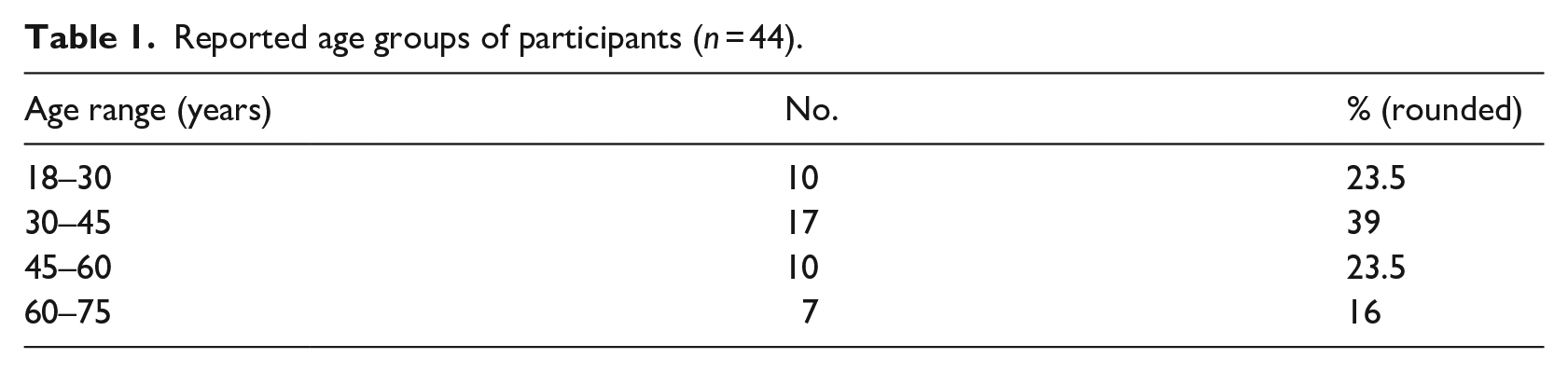
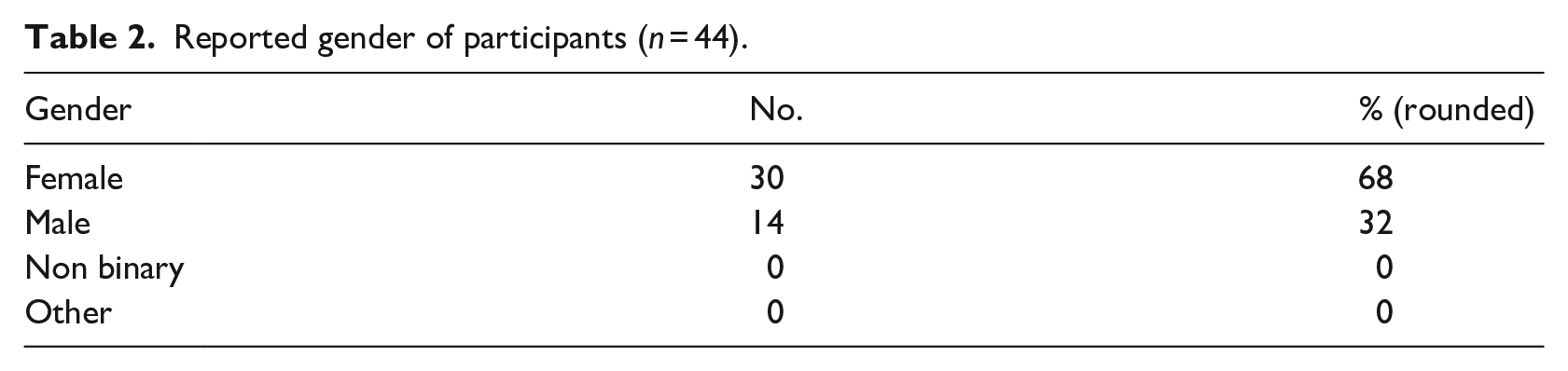
The reported age-categories and gender identities of participants are summarized in Tables 1 and 2 below.
Reported age groups of participants (n = 44).
Reported gender of participants (n = 44).
Unsurprisingly perhaps, all participants in the survey considered music to be either ‘very important’ or ‘important’ in their life. The vast majority of the 44 participants (40) reported listening to music on their own. Most additionally listed listening to music with friends (38), while 26 reported listening with family (26). A total of 17 reported listening with online communities and networks, a number slightly higher than those doing so with local communities and networks (16). Possibly crossing both of the latter types of engagement were those who reported that they listened to music as part of a particular music community, scene or network (27). Related to this, almost half of the survey cohort (20) reported that they were or had been a member of an amateur group, such as bands, folk/traditional groups or choirs and a similar number (18) identified as semi-professional musicians and/or as having been part of a semi-professional group.
Reflective of the specialist interests represented among survey participants (many recruited through amateur and semi-professional music networks) almost a third (13) indicated that they engaged with music along with professional musicians, composers and other producers. In terms of formal music studies, eight participants listed engagement with others while studying music at a training centre, college or university, five registered membership within specialist academic groupings and three reported engagement with others as part of an adult music class. Additionally, seven participants were involved with others in various music media (blogs, broadcasts and magazines/fanzines), while three participants mentioned other groups they spent time with when engaging with music. One worked as a lighting tech and carried out general crew work; another was part of a collective music venue and social space; while a third reported social engagement with music through sessions and teaching.
Data analysis
Table 3 below outlines the list of frequency of responses to the various types of musical knowledge experience listed in the survey (while also including one ‘other’ type identified by one participant).
Reported types of musical knowledge experience (n = 44).
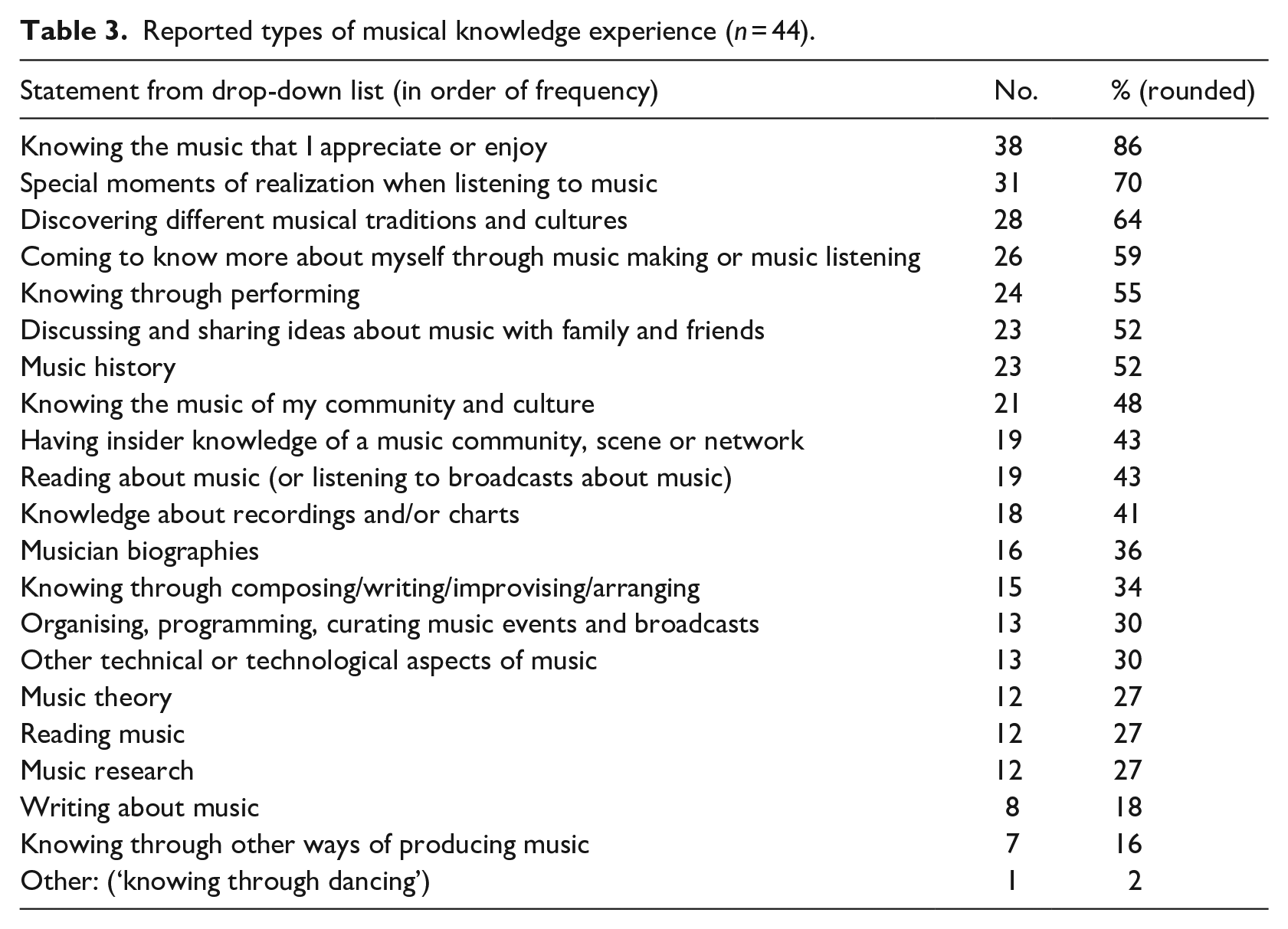
What we first interpret from this data set is how individual and social dimensions of musical knowledge are more frequently identified than those based on propositional knowledge. Indeed, the very high percentages for the first two statements listed above point to awareness of individual epistemologies (Louth, 2012) for most participants. At the same time, we note how performing and other musicking practices are identified as sources of knowledge for many.
Categories
The qualitative data arising from the three open-ended questions at the end of the survey (questions 8, 9 and 10) are interpreted here first according to categories. Table 4 below reports on core categories suggested by words and phrases most frequently used by participants. Here, we wish to point to the two primary areas on the left that correspond, respectively, with ideas and reported experiences of musical knowledge as community-based, and those conceived in more objective/institutional terms. Among the other core categories, we noted the significance for many of musical knowledge experienced through the live production and recording of music, as well as through various media. These broadly corresponded with many of the types of engagement and contexts collectively considered under Table 3. While we did not find the same level of correspondence in respect of Table 4’s core categories of ‘Feelings/Emotional/Experiential’ or ‘Financial’, these were important considerations when interpreting individual participants’ narratives of musical knowledge across all data sets. Overall we interpreted mostly positive statements and much fewer negative statements, although the proportion of these varied according to category.
Categories of musical knowledge attainment and development interpreted from qualitative data.
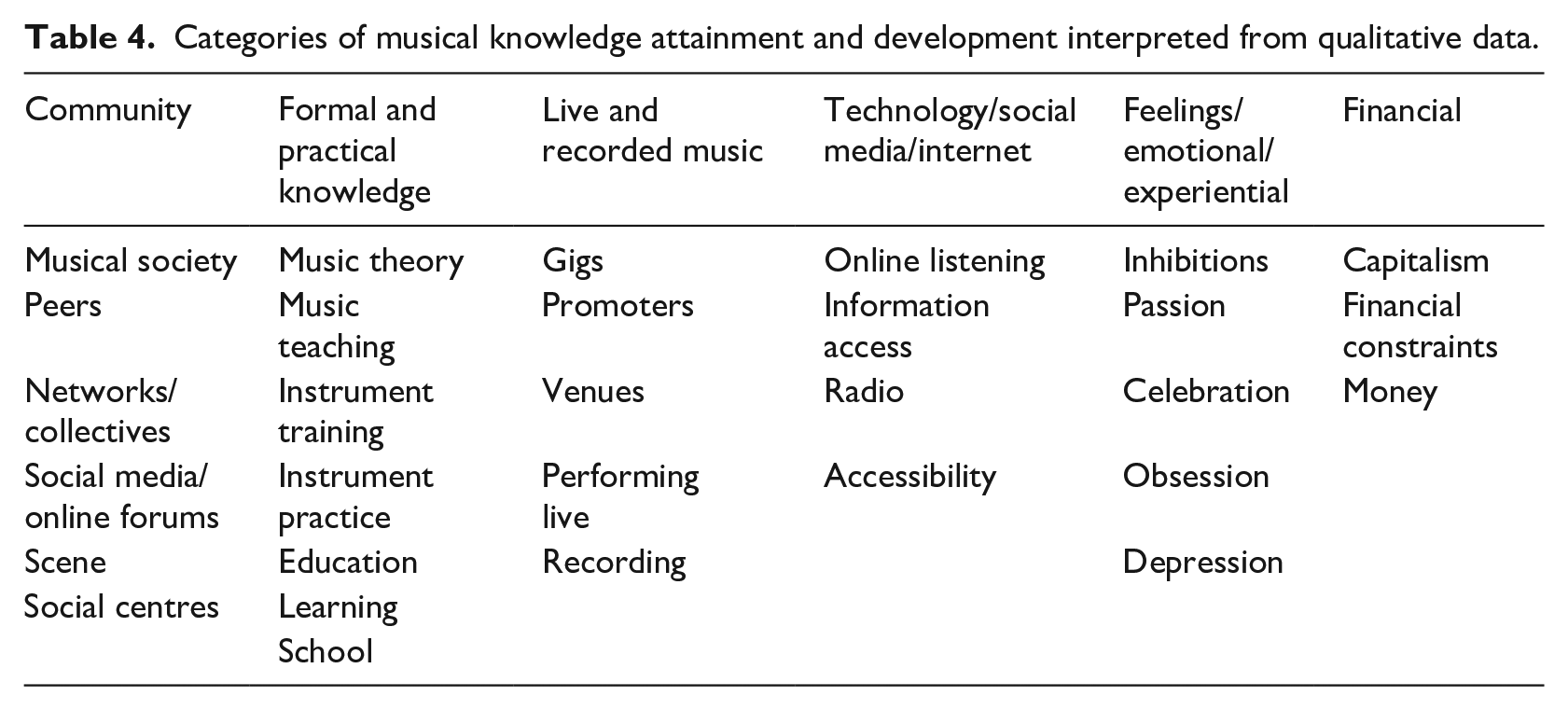
The majority of contributions under the core category of community were positive, with descriptions of the benefits of sharing and learning musical knowledge and enjoying community musical experiences, whether as members of audiences, gig collectives, bands and other performance groups or through family or other social experiences. A small number of contributions described negative experiences, where family or community members obstructed the pursuit of different kinds of musical knowledge, or where access to existing music communities was difficult.
Data under the core category of formal and practical knowledge were more mixed, and in some respects more polarized. Some described early school encounters with formal music theory in highly negative terms, while a greater number reported more positive experiences, a finding that resonates with Green’s distinction between music education experiences that are ‘alienating’ or ‘celebratory’ (Green, 2008b). Several participants expressed a desire to know more about music theory, while others reported the independent pursuit of music theory, unconnected to any academic institution or programme.
The core category of technology/social media/internet reflected the relative frequency of references to media technologies, including TV, radio, the Internet, social media and also music production technology such as synths, DAWS and music editors. Respondents mentioned how various technologies afforded new musical knowledge and information, although a small number also suggested that new technologies could limit access to music, potentially hindering creativity and obstructing musical choices.
The core category of live and recorded music generally included positive statements, but a number of respondents commented on a lack of available rehearsal spaces and venues as obstacles for attaining musical knowledge. Many conceptualized musical knowledge in terms of listening to and recording music, as well as attending live performances and performing. Collectively, participants listed diverse venues where these activities took place, embracing an eclectic range of music genres. The core category of feelings/emotions/experiential emerged from some participants’ personal and social epistemologies of music. This included positive, self-reflexive statements, as well as some negative feelings connected to the category of technology/social media/internet. Finally, the core category of financial was interpreted across a relatively small number of negative responses pointing to limited access to resources, training and live music.
Interpreting a dialectical tension between theoretical and experiential ideas of musical knowledge
Overall, participants submitted narratives of musical experiences that suggested diverse forms of musical knowledge, beyond but also including propositional knowledge. Although just a handful of participants suggested that formal and informal ways of attaining musical knowledge cohered in their experience, in general, responses to the open-ended questions were positive. Negative responses under Q.8 (‘obstacles to accessing musical knowledge/sharing your experiences of musical knowledge’) included those who perceived a lack of relevance of music theory in school education, as well as those reporting difficulties in accessing adult music courses. Several participants involved in Belfast’s popular music scenes recorded a lack of suitable spaces and/or networks in response to this question.
Below, we set out selected individual responses in response to Q.9 (‘most important factors contributing to your experience of musical knowledge’). These are presented under the two main categories identified in the data analysis, although, as might be expected, these categories overlap in individual accounts.
Community
‘Family involvement in music. Studying music at school. Playing music with friends and at gigs’ ‘Growing up in a musical family’ ‘My education, my music colleague/friends, an open mind that resulted in these encounters allowing me to explore more’ ‘Singing in a community choir’ ‘Sitting with friends, finding out that most of my records were in fact covers of older songs that led me to discovering new artists’ ‘The community of musicians and playing an instrument with different people’ ‘Music communities, such as those found at open mic nights have been incredibly important as it has given me a great many contacts to collaborate with, communicate with and enjoy the works of; creating an otherwise difficult-to-achieve sense of community’
Formal and practical knowledge
‘My upbringing, my friends, the opportunity to have instrumental lessons when I was young’ ‘Freedom to explore music, learning through theory, self-critique’ ‘Dance: wanting to learn to dance Argentine Tango came first, then came the interest in learning about the music’ ‘Studying music at school’ ‘Exploring music theory in my own time.’ ‘Hearing (and subsequently playing) in bands at high school had a profound affect on me. This led me to pursue a music degree.’ ‘Music magazines when younger, doing Grade 5 music theory and getting a deeper understanding of keys that work together, anatomy of songs etc.’
Collectively, the above responses display participants’ awareness of different modes of music knowledge attainment, including social, experiential, dispositional and propositional, with many individuals also articulating epistemologies of music. These were enhanced by responses to Q.10 (particular memories that were important for an individual’s development or understanding of musical knowledge). Many participants focussed on experiencing and learning about music with family members, while others found their inspiration – and arguably also their formative musical identity – through attending specific events:
‘Listening to music played by older brothers’ ‘Hearing my mother sing along to the radio’ ‘Listening to my father playing guitar’ ‘Listening to the music preferred by my older brother and sisters’ ‘Some to do with individual performances or recordings of a particular piece; some to do with associating pieces with people; some to do with music studies’ ‘When I attended a summer camp in the US . . . I met a lot of children from other cultures there too and learnt about their traditional music’ ‘I experienced my first punk band at the age of 8 at a protestant community festival. I think this is where my quest for knowledge started. I loved it [but I] don’t think the community did’
None of the 44 participants recalled a particular ‘a-ha’ moment from formal music education, although several memories alluded to particular individuals, classes, texts or technologies encountered outside of institutions, with one respondent explicitly including embodied knowledge in their epistemology, and another (a PhD graduate) recalling how contextual studies enhanced their holistic musical knowledge:
‘Throughout my dance enskilment I have attended several musicality classes which helped me understand the structure and embellishments of tunes and how to dance to them’ ‘Meeting Marc Bolan - he gave me a T. Rex music book so I decided to learn to play guitar’ ‘The use of music in video games, particularly those with industrial or metal-themed composition has helped me understand more about more complex timings and how those can not just exist within music, but serve as a strong foundation for technically interesting pieces’ ‘The first time I have been put in front of oscillators/analogue synthesisers and discover how much you can create without such a professional/technical background’ ‘The contextualization of musical works within their historical and cultural backgrounds strongly adapted my perceptions of music as a product of those particular conditions.’
Overall, just 12 out of 44 participants regarded music theory as a personally significant aspect of musical knowledge, while 37 indicated that they played an instrument, sang or danced to music. Those participants who mentioned engagement with music theory considered it to be valuable enough to maintain even through frustrations, while the majority of respondents did not consider it to be a specifically valuable aspect of their musical knowledge.
Discussion and conclusion
Findings from our online case-study survey suggest that while ideas of propositional musical knowledge continue to influence everyday perceptions of formal and informal music education, other types of musical knowledge are increasingly valued. The survey received responses from a range of age groups and from people involved in diverse musical activities, including fans, listeners, gig goers, event organizers and amateur and semi-professional musicians. Participants provided valuable insights into the heterogeneous ways that musical knowledge can be gained, giving examples of how varied social contexts, as well as events, venues and technologies can transform practices and concepts of music pedagogy and broader musical understanding.
A common theme to emerge was not necessarily a disconnect or opposition between reified and experiential forms of musical knowledge (although this was sometimes apparent), but instead a strong valuation of forms of knowledge derived from, and supporting community connections. Many of our respondents provided accounts of how unique and different pathways of musical knowledge can contribute to individual philosophies and to livelong engagement with music. However, the data also point to negative encounters along these journeys, including alienating school experiences, impediments to accessing adult education and limited spatial and infrastructural supports for some collective music making. Critically, for most participants, formal and practical aspects of musical knowledge did not always appear to cohere in their experience.
Towards a sociocultural theory of musical knowledge
As a relatively new project with limited funding to date, BMK is incrementally developing its relational model of musical knowledge by on-going engagement with relevant interdisciplinary perspectives, and informed through a series of empirical studies (a second project-in-progress is exploring the theme, ‘stories of musical knowledge’). Underpinning the relational model thus far are strands based on sociocultural theory, social justice and contexts of musical knowledge, space and place. While revealing a range of emerging themes, findings from the Belfast-based pilot study highlight a dialectical tension between conceptions and experiences of musical knowledge, as discussed now in our concluding comments.
Key to plans for future ethnographic research components and the development of BMK’s theory, its socio-musical frame considers dialectical relationships between discourses of and about musical knowledge in varied contexts. It proposes to do this by concentrating on epistemologies of music as lived, and by exploring the discursive dynamics between socio-musical dialectics of experienced musical knowledge and the ways that people build and communicate knowledge through interpretive acts (adapting Feld, 1984). A second aspect of the socio-musical frame we posit is a systematic comparison of music theories, not only to deconstruct reified conceptions and/or de-centre dominant models, but critically, to inform a relational model. Baily (1988) distinguishes between ‘operational’ and ‘representational’ theories, a conceptual distinction we adapt and propose as a continuum of music theories and learning practices in diverse contemporary contexts, from practical know-how or learning by discovery to more formalized musical systems, notated or otherwise. The continuum also embraces ‘audiotactile’ theory and learning in jazz (Caporaletti, 2018) and other acoustic musics (e.g. Aho, 2016) and, critically, Feld’s (2015) concept of ‘acoustemology’ (p. 93) – learning and theorizing through engagement with live or recorded music.
Theory can be an elusive quality in popular music practice, partly because many genres involve their own internal discourses or knowledge specific to locality. Qualitative studies, including Bennett (1980) and Green (2001) provide rich insights into how ‘non-classical’ musicians negotiate operational theories, although such tacit knowing has yet to be comprehensively researched across popular and other genres. We speculate here that future annotations of such discourses in diverse settings can help interpret informal processes of negotiation during rehearsals and other co-learning contexts. However, we are also mindful of alternative explications of music discourses, such as eschewals of theory (Rice, 2003) or analytic discourse (O’Flynn, 2011) or broader connections between music and belief systems. Informed by music studies in indigenous knowledge systems (e.g. Diamond, 2019), we further consider epistemic and ontological views relating to subaltern knowledge modes, close-knit and marginalized groups and socio-political values of underground collectives. This complements the principle of polyvocality within socio-musical groups, embracing what is paradoxically termed ‘an ethnography of the individual’ (Ruskin & Rice, 2012; Stock, 2001), and further accommodating ‘personal epistemologies of music’ (Louth, 2012).
The goal of BMK’s pilot project was not to elevate one form of musical knowledge over another, but to understand how people value them, and to provide some clues about how to bridge different forms of musical knowledge in socially meaningful ways. Surveying a broad range of people who engage with music in different ways – as listeners, audience participants, fans, scene members, musicians, organizers, theorists, teachers – is one side of the bridge. The other side of the bridge is musicology, the traditional academic understanding of music theory, along with the concept of music as an acoustic object. Collectively, Belfast-based participants in our study described musical knowledge as a multi-faceted array of practices that range from personal listening to participating in networks and scenes centred around music. No participant described music in the terms that it is taught in theory-focussed music schools, or as it has become packaged within global capitalism – as acoustic objects that can be rendered as individual units and removed from social practices to become art objects and commodity goods. Yet, this one form of musical knowledge often takes precedence over others that are less focussed on technical theory and more concerned with music as a complex social practice. Moreover, its dominance underplays the creative potential of operational theories and discourses and other aspects of knowledge building. If bridges are to be built between reified ideas of musical knowledge and other forms that are centred around social activity and community networks, then the ideological underpinnings of the former requires detailed scrutiny, as much as myriad alternative systems and musical-social transactions need to be researched.
Embedded ideas of music theory as an abstract structure for practical musicianship, and music as an essentially acoustic object that can be removed from social practice were contested by participants’ responses to the BMK survey. While there was a tendency to equate musical knowledge with music theory, in practice and with some prompts, participants did not subscribe to this association. Even though a significant number identified music theory as a personally valuable form of musical knowledge, none expanded on why, instead volunteering perspectives on more participatory and experiential descriptions of musical knowledge.
Participants describe musical knowledge in many different ways, and attribute different functions to the acquisition and use of musical knowledge, and, even for those with a deep understanding of formal theory, the musical knowledge of performance and audience interaction is still more valuable and worth describing in detail. If what is being bridged is the concept of music as a social practice and the concept of music as an acoustic object, the value that participants place on this latter form of musical knowledge must also be understood.
Footnotes
Author contributions
Funding
The author(s) disclosed receipt of the following financial support for the research, authorship, and/or publication of this article: The authors received funding from Enterprise Ireland during the initial stage of the research.
