



Abstract
Previous research has shown that classroom activities in music composition, involve the use of composition strategies during the creative process. This implies that teaching composition strategies may be beneficial to improve compositions in regards to their craftsmanship and their originality. Practical guides on composing for experienced musicians suggest using composition strategies as a way to create variety and novelty. This study aimed to investigate how the use of composition strategies might influence melodic idea generation from the perspective of experienced musicians. Five participants were given two short composition activities. In the first activity, participants composed freely with or without using composition strategies. In the second activity, participants were to include a choice of five composition strategies that were provided. They were subsequently interviewed about their composition process, their experience of the activities and how they viewed the strategies in relation to generating ideas. Results showed that all the participants perceived the as being an external phenomena that sometimes encroached on their more subconscious approach to idea generation and selection. This result has implications for how to assist idea generation during creative musical activities. Instructional sequencing could benefit from including idea generation as a precursor to learning new information.
Introduction
In today’s modern music education culture, the focus has shifted from individual and ensemble performance of existing material to include creative listening, improvisation, understanding cultural context, music composition, creating and self-expression (Partti, 2023; Webster, 2016). That is to say, with the focus on honing an idiosyncratic voice, the student enjoys an active role in their development and expression of their creative practice (Kratus, 2013). Enquiries that consider idea generation can provide the student insight to their existing musical knowledge (Hickey, 2012). Music composition is described as involving creative thinking processes that are used to generate ideas for rhythm, pitch, dynamics and expression, form and structure, timbre and texture (Kang & Yoo, 2021). In the composition process, ideas are generated, then selected for further exploration, developed and expanded and where viable, included into a larger, more whole picture that is then verified against earlier intentions (Barrett, 2006; Webster, 2024).
Composing music involves the imaginative exploration, selection and organisation of musical elements to create original pieces of music (Crawford, 2024). In order to assist the composition process, some composition teaching methods recommend using parameters before starting (Hickey, 2012). This is suggested as a way to make entry into the process of composing easier, as opposed to being confronted with endless possibilities and directions that the composition could go in (Jarret & Day, 2008). Pedagogical approaches adopted by composition instruction include setting parameters with student composers that might include guidance around direction and structure, emotional intent or expression and reference to existing material (Barrett, 2006; Hickey & Lipscomb, 2006).
Composition strategies are known formulas used to manipulate the musical elements such as rhythm, melody and structure to create interest and variety (Kratus, 1994, 2013). These strategies do not prescribe what will be composed but are considered tools to be used in the composition process (Crawford, 2024). Examples of composition strategies include techniques like ostinato, retrograde, repetition, canon, augmentation, diminution and pedal point (Crawford, 2024; Kratus, 2013). Research has shown that students who apply composition strategies during their process, have more successful compositions in terms of their craftsmanship and completeness (Kang & Yoo, 2021; Kratus, 2013). Composition strategies can be found in existing music compositions in a wide range of styles from pop to classical (Hickey, 2012). These strategies are often taught as ways to maintain an original musical idea and manipulate it to create variety (Belkin, 1999; Crawford, 2024; Gould, 2023; Hickey, 2012; Jarret & Day, 2008). Practical guides to composition suggest that applying compositional strategies will help improve compositions and give the composer some guidance at the early stages of the composition process to potentially generate novel and interesting ideas (Belkin, 1999; Gould 2023; Hickey, 2012; Jarret & Day, 2008; Kratus, 1994, 2013). Berklee’s online composer course lists several different strategies as part of its course on learning how to compose (Gould, 2023). These strategies include manipulating melodies through sequencing, rhythmic augmentation and rhythmic diminution, pitch augmentation and pitch diminution (Gould, 2023). The existing research so far considered focusses on the compositional process and its description. By comparison there is reasonably little research that investigates how explicit compositions strategies like the ones recommended in practical composition guides, might influence ideation or audiation in the composition process.
Generating ideas in music
Exposure to music in one’s formative years, instils an individual with a musical framework – a set of familiar sounds, patterns and sequences, by which they can distinguish music and non-musical sounds (Dowling, 2014). With age this framework becomes increasingly nuanced and complex (Barrett, 1996). An individual develops an internal aural structure by being exposed to music from informal settings like listening to music at home, on the radio, from family members and from more formal settings like classroom music lessons (Cuddy, 2014; Dowling, 2014). This aural framework organises and differentiates sounds into a predictable, stable mental model of scales and chord movements (Dowling, 2014). In the example of music, a person might generate a melodic idea and then select certain notes based on the melodies aesthetic value to that individual that is informed by this aural framework (Coulson & Burke, 2013). An individual’s musical framework is also shaped by their social and environmental experiences, implying that their perception of idea generation in music is influenced by these factors (Coulson & Burke, 2013). These aesthetic decisions are linked to their internal framework, developed unconsciously during their interactions and experiences with music (Dowling, 2014; Duby, 2018). When the brain encounters patterns of stimulation like when exposed to Western tonal music, it efficiently processes them by capitalising on regularities within the patterns (Garner, 1966). If certain elements of a pattern are predictable, the brain develops an efficient way to analyse these patterns and form a framework that is primed to recognise and respond to these elements (Dowling, 2014). For example, hearing the dominant chord in a specific context prepares the brain to process the tonic chord more efficiently when it subsequently occurs (Cuddy, 2014). However, this relies on the listener receiving consistent exposure to culturally related music which is not always the case as many young children are exposed to a wide variety of tonal structures outside of the Western tradition (Partti, 2023). Additionally, the generation and selection process will adhere to the norms and conventions of Western tonal music based on informal exposure to music through general life experiences, or more formal ones involving learning in the classroom or individual lessons (Dowling, 2014). In can be argued that adhering to these existing Western musical structures that are implicit in an individual, the generation of new musical material may all sound similar (Cuddy, 2014). By providing composition strategies, an attempt is made not to teach idea generation which might produce derivative musical ideas, but to influence the idea generation process in such a way to create a variety of ideas for the composer and how the student composer might generate ideas.
While there are numerous models of music creativity, this article focusses on how ideas are generated during this process. This current article centres around two ways of thinking about music idea generation. The first is one is internally as ‘mind writing’ or through ‘audiation’, and the second one, externally through interaction and experimentation with the physical world and sounds produced through this interaction (Redgate, 2018). The first theory suggests musical ideas are formed in the mind as internal, imagined sounds (Dowling, 2014). This process is akin to ‘thinking in sound’ or ‘mind writing’ and that the musical idea is first generated inside the mind of the individual and that the process of composition is the process of articulating these internal musical ideas (Burnard & Younker, 2004; Duby, 2018; Redgate, 2018). Students have demonstrated this internal ‘mind writing’ while they considered possible options for music before playing sounds, including using music they have previously played to reappropriate as new musical material (Burnard & Younker, 2004). As a composer works, they are attempting to articulate their imagined sound, which might be something they’ve played before, through interacting with an instrument, their voice or some other means of physical sound production and create a match (Redgate, 2018). The second theory suggests that an individual first experiments with physical sounds and the immediate feedback they get forms and influences their idea generation process (Burnard, 2012). The second theory suggests that individuals generate ideas through the interaction with physical sounds first and these sounds are used to stimulate further musical ideas (Coulson & Burke, 2013; Kupers et al., 2019). What is most likely is that idea generation is formed through a combination of internal ‘mind writing’ and interaction with the external physical sounds (Duby, 2018; Redgate, 2018; Webster, 2016). Instead of the musical sounds that are produced directly influencing the ideas in the mind and one-sidedly steering the idea generation process, the internal mental sounds and the musical sounds produced (Burnard & Younker, 2004; Hickey, 2012).
Composition strategies
Some classroom composition exercises ask students to create melodies or motives, then apply certain modifications (Crawford, 2024). These modifications are referred to as ‘compositional devices’ or ‘composition strategies’ which are typically focussed on manipulating musical elements such as melody, harmony, rhythm, form and texture (Crawford, 2024). It is during the composition process that these strategies can be used to change the rhythms or pitches in interesting ways, such as inversion (taking a melody and flipping it upside down), or transposition (taking the melody and moving it into another key or moving it within the current key). Composition strategies such as these are often taught in practical composition guides as a way to vary ideas (Belkin, 1999; Jarrett & Day, 2008; Hickey, 2012). During the phase of exploration and organisations, the composer might repeat certain ideas, transpose them, rearrange them rhythmically and try to set them to be more complete (Burnard & Younker, 2004). For the purpose of this study, a compositional strategy will refer to a technique to create, manipulate and organise a melodic motive. A student who might struggle with idea generation or idea development when composing, may benefit from instruction that involves some or all of these composition strategies (Crawford, 2024; Kratus, 1994). While compositional strategies can be applied to many of the musical elements, this study will focus on compositional strategies that can be used to manipulate melodic motives.
Teaching composition strategies
Creative music activities in the classroom can be used as a way for students to understand larger and deeper concepts in music (Hickey & Lipscomb, 2006). As part of the feedback process and offering revisions, Hickey suggests that students can be given certain prompts to vary their ideas (Hickey & Lipscomb, 2006). As students gain more experience, larger musical concepts of creating variety, tension and release and overall balance of a whole piece are taught by exploring composition strategies (Hickey, 2012). In the context of idea generation the teacher may use certain prompts, either emotional, aesthetic or problems to be solved (Burnard & Younker, 2004; Crawford, 2024). The idea is then selected, developed further, expanded into something more complex (Burnard & Younker, 2004; Crawford, 2024). In practical situations where music composition is being taught at the higher education level, guides and tools are proposed in the teaching and learning process (Belkin, 1999; Gould, 2023; Jarret & Day, 2008). These tools can help structure the creative process (Sawyer, 2021). Apart from encouraging musical generative activities and the composition process, students also need guidance on how to resolve practical questions of composition such as, how to start, how to link sections, how to finish, how to create interest, how to create tension and resolution (Belkin, 1999; Gould, 2023; Jarret & Day, 2008; Sawyer, 2021). These practical suggestions are often informed by Western musical standards and recommend that there is existing experience and knowledge about the musical elements and musical theory (Belkin, 1999). This current research aims to understand the ways that composition strategies such as inversion, transpositions and changes to pitch and rhythm, might interact with the generation of ideas as perceived by experienced musicians. With this background, two questions motivate the present enquiry:
RQ1: What are the perspectives of experienced musicians on their own idea generation while composing?RQ2: What are the perspectives of experienced musicians on using composition strategies for their idea generation?
Methods
In order to fulfil the aims of this current study, a case study approach was used in the research design. Each participant is considered their own individual case and so this study uses a collective case study approach (Stake, 1995). In a collective case study approach, several cases are used where the focus of the research is the differences within and across cases (Stake, 1995). This qualitative approach takes the position that each case is viewed as ‘having a boundary and working parts’ and is ‘purposive’ (Stake, 1995).
Methodology
Present study
This research study was conceived as a way to examine how composition strategies that modify melodic motives influence idea generation in experienced musicians. The focus was on the way musicians generate ideas, recording them using standard notation. These composition strategies involved manipulating their existing ideas using repetition and varying the rhythm and the pitch (melody). As part of this study, participants were given two composition activities. The first composition activity was open, asking participants to generate numerous short melodic motives. They were informed they that the activities were about composition strategies and could use composition strategies if they wished. Following this first activity, participants were sent a short video tutorial (6 minutes) that defined five different composition strategies and gave them some examples (more details are below). The second composition activity asked participants to choose and incorporate any of the five composition strategies from the tutorial. The goal was to see if composition strategies might stimulate the variety or novelty of ideas they generate from the first activity to the second.
Participants
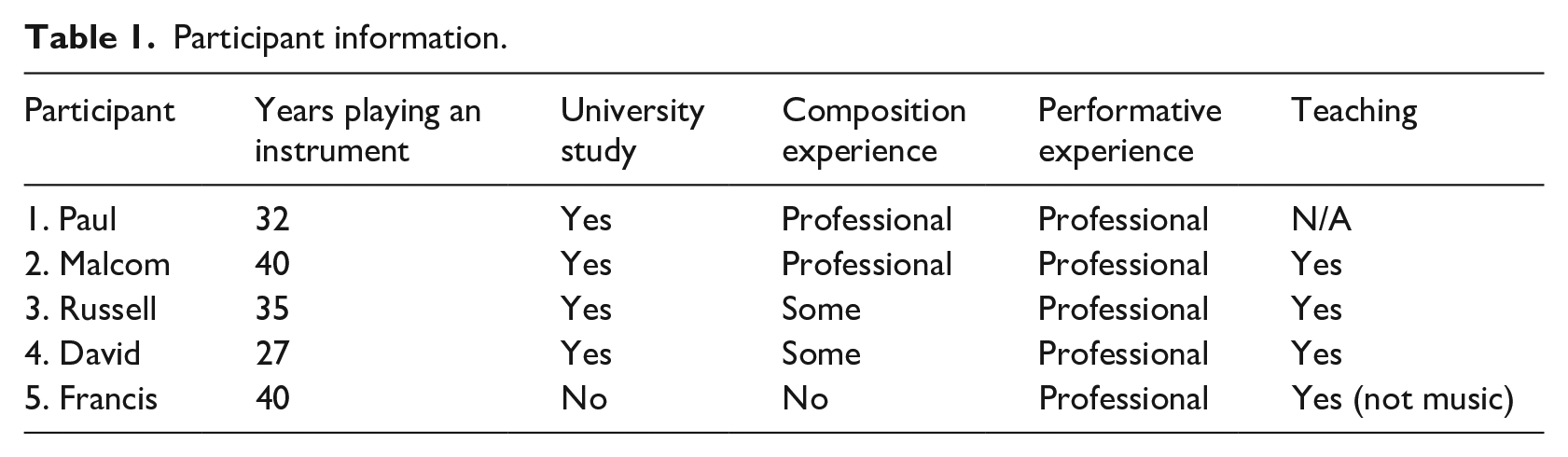
Participants for this study were chosen based on a sample of convenience (Clark, 2007). Each participant was known to the researcher through existing connections in the music and education field. A total of five participants were included in this research and were chosen based on their ability to notate music, their musical experience and their availability. Each participant noted a wide variety of experience including, university study, performance experience, composition and songwriting experience and teaching experience (see Table 1. Participant details). The aim of this study is to discern how composition strategies affect idea generation in experienced musicians without involving learning and/or new knowledge and information common in learning contexts. This aim required that all participants were confident with using musical notation to express their ideas and could read notated music so that the researchers could communicate the composition strategies through examples.
Participant information.
Activity 1
Participants were asked to write as many short melodic motives as possible in 30 minutes, between 4 and 8 bars long, using traditional treble clef notation on their preferred medium (computer or handwritten). The short melodic motives could be in any style. They were free to choose their instrument. Participants were told the activities were about how they compose and they were shown a list of five compositional ‘strategies’ if they wanted to use them, these devices were optional. 1. Melodic inversion, 2. Diatonic transposition, 3. Modulation, 4. Same rhythm, different pitches, 5. Permutation.
Tutorial
Subsequent to completing the first activity, participants were then shown a short video tutorial (6 minutes long) that they accessed through a link in an email. The video described and modelled the five strategies mentioned earlier.
Activity 2
The instructions for the second activity were the same for the first activity, to write as many melodic ideas in 30 minutes as possible, melodies should be between 4 and 8 bars long and use traditional notation. This time the participants were asked to use at least one or more of the five composition strategies from the tutorial. They were told they could use one strategy or multiple strategies to each melodic motive they created. They were asked to detail which strategy was used on their scores.
Data gathering
Each participant was interviewed one on one via zoom once they had completed the two composition activities. To gather data about the participants experience and perspectives, the interviews were recorded via the zoom platform. Each interview lasted approximately 30 minutes. Interview questions were a mix of open and closed questions and were used to guide the conversation (see Appendix for example questions). Where something of interest regarding composition process and idea generation arose from the interview, the researcher adapted and allowed the conversation to deviate.
Data analysis
The process of analysis followed guidelines for interview and transcript analysis by Burnard (1991). The aim of data analysis was to make sense and organise the content of the transcripts from interviews (Merriam, 1998). This involved consolidating, reducing, interpreting the responses of the participants. The first stage of analysis was to listen through and make very broad notes that summarised the content without inferences. The second step in the process of analysis involved transcribing the audio files verbatim from the zoom recording. The next stage was line-by-line open coding which then became more abstract with each subsequent stage of the process. Thematic analysis was carried out by identifying common patterns and concepts from the initial coding, it was during this process of ‘collapsing’ where final themes emerge. Data analysis and reporting of results (themes) was an iterative, interactive process that was ongoing (Burnard, 1991). As part of the process, the authors of this study discussed and reviewed the transcripts, the coding scheme and the themes making necessary adjustments. This was done after a process of open discussion and resolving ambiguities around particular definitions and theoretical inferences from the transcripts. Analysis involved the broad themes being supported by direct quotes from the transcription alongside previous literature on the topic (Burnard, 1991). Participants were asked to check the appropriateness of the interpretations, checking the validity further. While writing the article, the full transcripts were available and referred to. Finally, this article uses verbatim examples to illustrate the themes and link these findings to the aforementioned literature.
Results
The results of this study are presented in two ways. Firstly, the common themes and ideas that were expressed during interviews that were present across the five cases. Secondly, how each individual case differed within the expression of the relevant themes and how that relates to the focus of this study and how composition strategies influence idea generation. Following that, the discussion examines these themes, the idiomatic responses within each case and how they might fit within existing literature on idea generation and composition processes. Finally, pedagogical recommendations are suggested.
Common themes
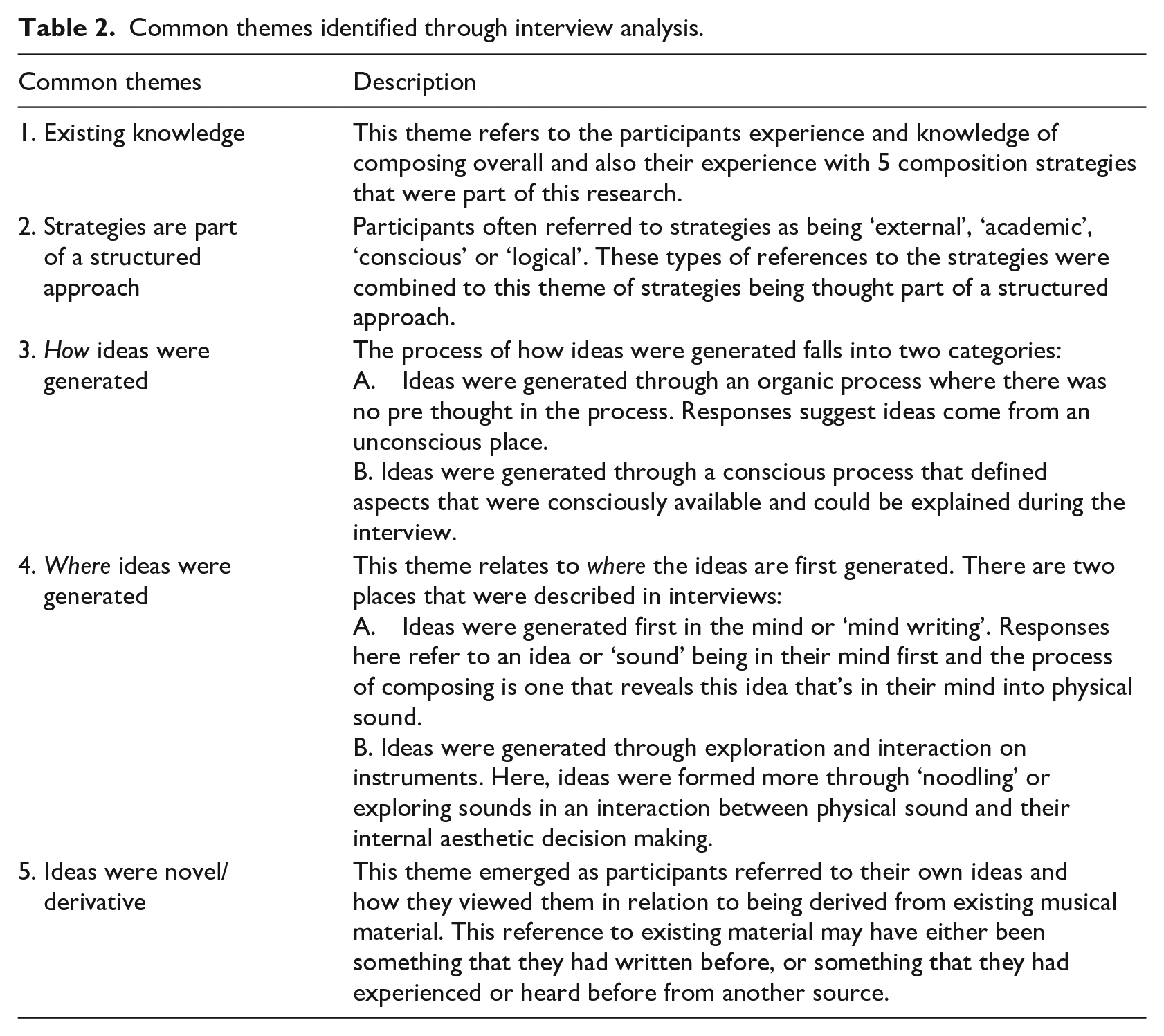
During the process of transcript analysis, multiple categories emerged from the open coding process. From the data set, ten common themes emerged through the data analysis from each of the interviews. In order to answer the research questions, this research focussed on aspects of the interviews that were related to the generation of ideas, composition process, what potential influence the composition strategies had on idea generation, and the related feelings and thoughts of the participants. From the initial 10 themes, 5 themes were highlighted as relevant to the research topic. These five common themes are listed in the Table 2 below. Examples are provided that support the themes and show where variety and interest might be presented within and across each case.
Common themes identified through interview analysis.
Paul – Constraints to innovate
1. Existing knowledge
When the strategies were mentioned in the first activity, Paul recognised them as something he already knew. He expressed that he used compositional strategies in his own work, but they are not consciously applied.
‘I think some of them (strategies) are subconscious because we’ve (inaudible) a lot of them. You hear a lot of melodic repetition and sequences. It’s in the rhythm of the way we set lyrics too. I think so many of them are implied in my work anyway’.
3B. How ideas are generated – A conscious process
Interestingly, Paul felt that having predetermined parameters like the use of strategies, was an important aspect of his idea generation. Without having some parameters, the available options in terms of possible ideas seemed to be overwhelming.
‘Once you (the researcher) did provide techniques and constraints, the framework was easier. I think I wrote a bit faster once I had constraints because it stopped the blank canvas thinking of it could be anything’.
For Paul, such a structured approach was essential. He often described his process as being ‘a logic puzzle’ and being ‘logical’ in his approach. In this case, ideas for him are something that go into a type of algorithm.
4B. Where ideas are generated – Through exploration
Paul described how ideas were conceived through the exploration and interaction with his instrument. In this context, ideas arose primarily through ‘noodling’ or the exploration of sounds, where individuals engaged in a dynamic interplay between the physical attributes of sound and their internal aesthetic judgements.
‘Sometimes I do noodle and I play around in the world until something pops out at me, from a period of meditative improvisation’
5. Ideas were novel/derivative
For Paul, the originality of ideas comes about through the process. It is through this ‘logical’ process that he is able to generate novel and interesting ideas, ‘(I’m searching for something where) it’s musically interesting that doesn’t sound too derivative’. Parameters and limitations force Paul to be more ‘creative’ and look for ideas that ‘solve the puzzle’ as opposed to ideas that come from his own internal database, which to him, seems to be produce derivative music.
‘I’m a big fan of the composition process, giving myself constraints because I think it’s the way you break your own idiomatic patterns and you stop writing the same kind of thing. That a constraint makes you innovate. At least I find that with myself’.
For Paul, the importance of the strategies was not in the generation or stimulation of different ideas. Having to use them and be conscious of them wasn’t helpful in generating specific musical ideas and motives, but more broadly as guidelines that gave him focus from the range of possible ideas that he feels exist in a potential compositional space.
Interestingly, Paul attempts to maintain an important balance between the novelty of ideas and that they are accessible for the listener:
‘I’m working within a world where I want people, like the way that they hear English in theatre writing, I want them to be able to hear music and understand and get it. I’m not trying to innovate, I’m not Schoenberg. I’m not trying to do something that’s never been done in that way’.
Malcom
Existing knowledge
Malcom knew what the strategies were from the first of the activities. For him, there was easy recall about the strategies and their function and similarly to Paul, Malcom also believed that he used similar composition strategies unconsciously, ‘I find that I use a lot of these concepts unwittingly and I don’t actively sit down to compose in that method’.
Strategies are part of a structured approach
Malcom describes the strategies as ‘external’ and ‘unemotional’ structures. For him, they didn’t help idea generation, but could be used to go deeper on an idea or help embody an idea that was originally generated through the more organic process. In this way, the strategies can be used after idea generation, as idea extension and development.
‘So approaching it with some tools in a much more focussed manner I suppose, it’s a more top down process rather than emotive. I’m normally just coming from some emotional standpoint and the thing is flowing’.
How ideas were generated – An organic process
Malcom described his idea generation process as a very heuristic, often referring to his compositional approach as ‘organic’ and ‘emotive’. He identified how using the strategies made him more aware of his own process. Malcom was aware of the interplay between this concept of an emotive approach and a more cerebral approach to idea generation during the second activity and spoke about the interplay between them, ‘It’s not removing the emotion or the spirit of it, it’s going ‘okay I’m going to harness a lot more directly and put a bit of top down processing in there as well’.
This type of references shows how Malcom thought about how he generated ideas from a subconscious place and that this interacted with the more conscious aspects of the composition strategies.
Where ideas are generated – Internal ‘mind writing’
Malcom spoke about pre thought and the concept that the composition strategies may have an effect on the sounds inside the mind at the internal idea generation stage.
‘Because if you know that you’re going to do an inverted thing, or something like that, it might lend towards some sort of subconscious interaction with the melody idea so that it is going to flip a bit better’.
This is a fascinating insight as the composition strategies could be thought of as an analytic tool that are applied in conjunction with ‘mind writing’ before ideas are expressed on an instrument. He expressed that he would use composition strategies in the future as part of his composition process.
Russell
Existing knowledge
Russell did not know what the composition strategies were before starting the first activity and described himself as a relatively inexperienced composer.
How ideas were generated – An organic process
Russell described the first activity in a very positive way, referring to the environment and the mood he was in. This led into his description of the idea generation process in the first activity, ‘I don’t know whether it was just I was in a better mood, but I felt like my first compositions, I felt more creative, more free’. That Russell felt a greater freedom to conceive novel musical ideas in the first activity is curious. For Russell, the second activity was more prescribed and inhibited that natural flow from the first activity.
‘I wrote a couple of bars and then I did the variation on it, on the first two bars or whatever it was, and then did the melodic conversion or whatever. I felt like ‘bang, bang’ I felt a bit more systematic about it, I was like ‘here we go,’ then what’s coming next. Whereas the first one I was just going free, making it so it sounded like there was flow to it and cadence’.
How ideas were generated – A conscious process
In relation to the first question of this study, the effect of composition strategies on idea generation, the cognitive aspect of trying to recall information while simultaneously coming up with ideas was considered a burden on his more natural process.
‘I think I was trying to focus on learning the new strategies, they weren’t already part of a comfortable process’.
This has interesting implications for less experienced composers having to process new information or knowledge while simultaneously trying to generate ideas. For Russell, the composition was interrupted by having to learn and mentally refer back to the strategies during the process of generating ideas. This is explored further in the discussion section.
David
Where ideas came from – Ideas in the mind
When it came to thinking about where his ideas came from, David expressed that the generation of ideas came from an existing repertoire of music already in his mind which implies the concept of ‘mind writing’ before he commits so making physical sounds.
‘I had to go to the repository of my experience – well if I wanna get this task done, I need to be able to dip into lots of different knowledge banks. I don’t think they were very novel, I think everything I wrote you would’ve played or heard before. But at least it did encapsulate a broad range of style genres’.
Ideas are novel/derivative
David often referred to composing things that were derivative and that he had heard before. Interestingly, he described the melodies from the first activity as more creative than the second. He often described his melodies as being like something he and potential listeners have heard before. For David, the process involved avoiding musical ideas that sounded too similar to either existing material or his own previous material. He is not trying to find the mental melody and express it, he is intentionally trying to avoid certain music that exists in his mental database of melodies. ‘But I think that’s been my attitude to composition forever, I think that everything I write sounds like something I’ve heard. And that’s always been my bugbear’. Importantly for David, the ideas that were produced during the first activity, felt more diverse and ‘creative’ than the ideas from the second activity. This result echoes that of Russell’s experience where there was a sense of freedom and relaxation in being able to generate ideas without any parameters (see Russell, for more details). David didn’t feel that there was any improvement from the first activity to the second activity, ‘I might’ve found the exercises from the first were better than the second’. While he had an in-depth knowledge of the strategies, for him, the diversity of ideas was larger in the first exercise when he had no constraints on his process.
Francis
Existing knowledge
Francis was one of the participants with less experience in composing. He didn’t know the strategies beforehand but recognised them after the tutorial and made the connection to his previous experience.
How ideas were generated – Through procedural technique
For Francis, using the strategies gave him momentum. Similarly to Paul, the use of an procedural approach to generating ideas was able to spur him into action instead of facing the ‘blank canvas’.
‘I worked faster the second time. I wrote about the same amount of lines. Rather than just sitting there trying to be creative trying to come up with something, I instead wrote a couple of bars and then practised the techniques shown. That actually. . . .While I was doing it I was thinking this is a lot quicker, I have something to work with, I’ve got a formal path to follow’.
Where ideas are generated – Through interaction
For him, the two activities were quite different. The first was described as an explorative external activity, ‘the first exercise I tried to find some sounds that I found interesting, and note them and do the notation that way and see how that went’. This shows that for Francis, ideas are generated through a process of exploration and interaction with his instrument. He saw the strategies as not having any influence at the idea generation stage, but when developing the idea.
‘I would try and come up with a melody line or hook that I liked. I think if I ran out of ideas, or if I had a task, say to write six lines of notation and that was my job then I would utilise those strategies to fill in some lines’.
This statement refers to how the strategies could help with the idea generation process where the goal might be volume of ideas and therefore the idea generation becomes more structured and explicit as opposed to an experimentation process.
Discussion and conclusion
The use of composition strategies as a way to guide idea generation has been suggested in practical courses on composition and as a way to explain improved variety in student composition (Belkin, 1999; Jarrett & Day, 2008). This study found that for the two participants less experienced in composition, the strategies were thought of as an external device that limited more free flowing internal idea generation and selection process. Where the strategies weren’t as well known, had to be recalled during the generation of ideas and had not been internalised into their musical framework, it seemed to inhibit the potential for novelty. The converse was true for the more experienced composers. That is to say, that the more experienced composers, who understood the composition strategies without any follow up definition or information, enjoyed the constraints of particular composition strategies finding it easier to compose. However, they felt it did not increase the variety or breadth of their ideas in the intended way. In the case of David, he felt the ideas from the first exercise were more diverse as he tried more things. Paul suggested that he already used certain composition strategies in his work subconsciously. Russell felt that the strategies interrupted his natural creative process and being able to think ‘freely’. In both Russell’s and Paul’s case, using the composition strategies wasn’t seen as helpful in the intended way, but for different reasons.
This result is partially supported by previous research. Students that were able to demonstrate compositional strategies in their finished compositions, were typically more experienced than those who did not show evidence of composition strategies (Hickey & Lipscomb, 2006; Kratus, 2013). In these studies, there was no conscious effort from the experienced students to use these strategies, they just seemed to appear natural to the composition process (Kratus, 2013). This shows that there is a constant interaction between the concentrated decision making of an individual and the internalised habits of their musical framework during the creative process. The balance between the two is based on certain conditions such as previous experience, domain relevant skills and the individual’s own aesthetic sensibilities (Kupers et al., 2019). It’s possible that external influence, such as requiring students to use strategies, interrupts this interaction between subconscious and conscious thought processes.
There were several instances where the participants referred to the sounds being something internal, indicating that ideas first appear in the mind and that for them, the process is to reveal these ideas. This is demonstrated in the way they refer to the experience of wanting the music to sound, or not sound, a certain way. In particular, Paul and David both describe wanting their music to not sound derivative. This implies that there is a musical idea that is formed inside the mind first and that this idea is informed by the vast amounts of music listened to, played and experienced by the composer (Hickey, 2012; Webster, 2024). Idea generation that is formed in the mind first may become impacted if extra cognitive requirements are imposed such as composition strategies (Sweller, 2009). For the more advanced composers, they were already considering novelty in the abstract, to paraphrase David, ‘that which I haven’t heard before’ and as Paul said, trying to find ways to ‘break your own idiomatic patterns, but still remain true to the context,’ and ‘I want them (listeners) to able to hear and understand and get it’. Malcom had an interesting remark about how the composition strategy might inform this ‘mind writing’ process if he knew beforehand if he was going to alter the melody a certain way with a composition strategy. When students are faced with open ended composition tasks, like as the first activity in this current study, they may go to their own internal repository of existing music as a place to start (Burnard & Younker, 2004; Dowling, 2014). If this type of ‘mind writing’ is present in a lot of experienced composers, the inclusion of strategies might influence this kind of recall. However, many composition strategies may already exist in some of the internal ‘mind’ melodies of experienced composers without the need for making their application explicit.
Pedagogical implications
The findings of this study carry significant implications for guiding idea generation in creative musical activities. They suggest that instructional sequencing could be optimised by prioritising idea generation as a preliminary step before introducing new information or concepts like compositional strategies (Kapur, 2016; Sweller, 2009). By emphasising idea generation as a foundational aspect of the learning process, educators can create a supportive environment that encourages students to explore and develop their creative ideas before delving into more structured learning objectives. Incorporating strategies to stimulate idea generation early in the instructional sequence may enhance students’ capacity for creative expression and problem-solving in musical contexts, ultimately enriching their learning experiences and fostering a deeper engagement with the material (Kapur, 2016).
In her book on composition, Hickey (2012) explains the virtue of using composition to learn about musical elements and concepts in music. She suggests that students with very limited prior knowledge of musical elements can compose and create music using simple language and collaboration, ‘there is no need to wait until some of the so-called basics are learned first’ (pp 108). Findings in the present study may support this approach and give some explanation as to why. It’s possible that the inclusion of too much content in conjunction with the demand of generating ideas can cause a cognitive burden and stifle the flow of ideas (Sweller, 2016). As a student works, they’re accessing their existing database of potential ideas that are informed by their experiences with music (Dowling, 2014). Learning relevant content thus intersects with the concept of idea generation, requiring we rethink composition’s pedagogical practice.
Future research could explore these results further in education settings with a variety of ages and levels of experience. Similarly, a research design that uses a single-case experimental approach, contrasting the sequence of learning content and idea generation, might also provide more details to elaborate these findings.
Footnotes
Appendix
Author contributions
Declaration of conflicting interests
The author(s) declared no potential conflicts of interest with respect to the research, authorship, and/or publication of this article.
Funding
The author(s) received no financial support for the research, authorship, and/or publication of this article.
