




Abstract
Students undertaking higher education music degrees represent a rich tapestry of experiences, cultures and needs. However, equity and inclusion issues related to music students with disability in higher education are frequently addressed in generic ways, and without consultation or consideration of their unique requirements. With limited research available, this qualitative study within an Australian Conservatorium of Music analysed the experiential and situated reflections of 18 music students with disability. Based on our reflexive thematic analysis, we propose that issues related to equity and inclusion for music students in higher education are multi-faceted and interrelated. By foregrounding the participants’ voice, the qualitative themes suggest that enhancements related to disclosure processes, quality of communication and reliability of resources, would fortify equity and inclusion. The findings span the need for reforms at the institutional level, as well as specific professional development for educators and awareness raising amongst the student cohort. Informed by the participants’ lived experience, the findings call for music educators, professional staff and institutional leaders to effectively apply features of inclusive, caring, professional practices so that music students with disability can thrive in higher education.
Introduction
This paper explores the experiences of students with disability studying higher education (HE) music degrees at the Melbourne Conservatorium of Music (hereafter referred to as ‘the Con’), which boasts one of the largest cohorts of tertiary music students in Australia. At the time of our data collection, 9.3% of students at the Con reported having a disability in their admission documents, considerably lower than the Australian average of 18% (Australian Institute of Health and Welfare, 2022). We contend that access to music education has distinct barriers that flow through to limited representation of people with disability in HE music degrees. Learning adjustments specific to music education are rare in our experience, and therefore access to education is often limited to students who meet traditional expectations for motor function and executive functioning skills (Porter, 1998). A survey study from the UK (Youth Music, 2020) that found 52% of people with disability were unable to access a music teacher who could meet their learning and support needs attests to this predicament.
This study aims to better understand the lived experience of students with disability in HE music related to inclusion and accessibility. We set out to privilege the voices of current students with disability, and therefore align with the social model of disability (see Supplemental appendix). We acknowledge that preferred labels and terminology in the disability field are without consensus, and so adopt the construct ‘person with disability’ used by the United Nations Convention on the Rights of Persons with Disabilities (United Nations, 2006, Article 24). The exceptions to using this construct are the terms ‘autistic’ and ‘neurodivergent’, since there is compelling evidence suggesting that the neurodivergent community advocates for the use of these descriptors (Bottema-Beutel et al., 2021), or when quoting a participant who used different terminology.
Literature review
Studies focussed on specific experiences and needs of HE music students with disability are rare. Bull et al. (2022) found that support for students with disability in music courses in the UK lagged behind those of other minority groups relating to gender, race and class. However, there are numerous studies about the experiences of students with disability in HE more generally that apply to music students. While we contend that music students with disability encounter some unique barriers, we begin by highlighting universal experiences of marginalisation of HE students with disability.
Accessibility in higher education
Shpigelman et al. (2022) explored how HE students with disability experience support services and the challenges they faced. Participants identified academic and administrative obstacles, as well as social and emotional challenges. For example, participants perceived that teachers typically considered accommodations would ‘lower the academic standards’ and increase teacher workload (Shpigelman et al., 2022, p. 1781). To gain access to accommodations, students with disability need to disclose their condition, which opens them up to possible discrimination (Smith et al., 2021). However, non-disclosure often results in negative academic and personal consequences (Moriña, 2022). Research also shows that HE teachers are often unaware of the diversity of needs within the disability community, often assuming a homogenous approach will work for all students (Gordon et al., 2010).
Nuanced distinctions of student experiences and the varying nature of their disability within an HE environment are emerging. Smith et al.’s (2021) survey of students’ experience of disclosure differentiated the findings according to those who had apparent and non-apparent conditions (see Supplemental appendix). They found that students with apparent disability were more satisfied with the processes to request accommodations, while those with non-apparent conditions had more varied experiences. Given that music education is traditionally more accessible to individuals with the required motor functions (Porter, 1998), non-apparent disabilities may be more common amongst this population, and therefore these findings are particularly relevant.
Disability perspectives within music education
There is a body of literature concerning music education for people with disability focussing on earlier stages of learning. However, given our focus is HE, we refer here to literature related to more experienced learners, music careers and music teacher training. Laes and Westerlund (2018) explored ways to equip trainee music teachers to support future students with disability by including experiential seminars led by musicians with disability within a mandatory subject called ‘Special Education in the Arts’. The qualitative data showed that the trainee teachers gained deeper awareness of the discrimination and barriers faced by people with disability, and expressed a commitment to improving access to music education and performance opportunities following their engagement in these classes. Supporting music teachers to translate theory to practice is vital, as previous studies have noted various challenges encountered in applying general principles of inclusion to music education contexts, despite a willingness to do so (Ballantyne & Mills, 2008; Jones, 2015).
Abramo’s (2012) research on music education for people with disability has a strong strengths-based approach embedded in the social model of disability and proposes various practical ways to reduce barriers. Abramo (2012) advocates for teachers to be creative, acknowledge their biases and take more responsibility for removing barriers in the educational environment. McCord’s (2017) book, Teaching the Postsecondary Music Student with Disabilities, includes a plethora of practical details to support students in their learning. McCord advocates for teachers and institutions to be more ‘disability-friendly’ (McCord, 2017, p. 2) by anticipating student needs and preparing a variety of resources and learning materials rather than waiting to respond to access requests. While anticipation of student needs is important, we contend that collaborating with students will still be necessary to build a culture of inclusion.
Music teachers also require knowledge and resources to improve accessibility for students with disability. Erden and Reyhanoglu (2019) describe the experiences of conservatorium instructors teaching Buğra Çankır, an autistic man considered a musical savant. His teachers described facing difficulties resulting from lack of experience and education interacting with and teaching autistic people, and from a lack of institutional policies and procedures to support such students. The authors emphasise the difficulties faced by the instructors, rather than strengths and capacities Çankır might bring to the music education setting. The perspective of Çankır himself is noticeably absent.
Given the limited research in this field, and our alignment with the social model of disability, we planned to gather perspectives of HE music students with disability. We position our participants as experts and posed the following research questions:
RQ1: How is accessibility experienced by students with disability studying at the Con?
RQ2: What changes (if any) do students with disability studying at the Con recommend, to improve access and equity of educational experiences?
Method
This qualitative inquiry is situated as a reflexive thematic analysis (Braun et al., 2019) where we iteratively and deeply engaged with the data. We therefore acknowledge that our own lived experience is entwined with the analysis. Rather than attempting to set these experiences aside (known as bracketing), we instead reflexively managed our subjectivity (Finlay, 2014) while engaging in ‘imaginative variation’ (Moustakas, 1994, p. 97). We aimed to amplify participants’ voices by providing thick description through verbatim quotations revealing both the culture and phenomena under analysis (Barrett & Stauffr, 2009).
Our team of four researchers represent a diversity of life experiences. Three researchers identify as women, one identifies as a man and two identify as disabled. All four researchers have undertaken significant studies in music disciplines including music performance, music education, music therapy and/or musicology.
Recruitment
Students with disability enrolled in any undergraduate or postgraduate degree at the Con were invited to participate in an interview to share their perspectives of studying music in HE. The inclusion criteria were broad since various conditions can result in people being disabled, including chronic illnesses, mental health conditions, vision impairment, d/Deafness and neurodivergence. A recruitment email was sent to all enrolled students in August 2021, explaining the eligibility criteria, anonymity protection and offering a 30AUD voucher to thank participants for their time.
Ethical considerations
This project was approved by the Human Research Ethics Committee at the University of Melbourne (Reference no. 2021-21368-18724-4). Participants received a Plain Language Statement via email and provided signed consent prior to the interview. As part of ethical approval, we prepared information about counselling and support services that could be shared with participants if necessary.
Participants
Eighteen students agreed to be interviewed (M age in years = 25.67; SD = 6.15). Of these, the majority (10; 55%) were undergraduate students. Nine (50%) identified as women, 4 (22%) as men and 5 (28%) had other gender identities. We asked participants to self-describe their disability. Nine students (50%) identified as neurodivergent (autism, Asperger’s and ADHD), 14 (78%) identified mental illness (PTSD, anxiety, psychosis, depression and borderline personality disorder), three as having chronic health conditions, one as vision impaired and two identified ‘other’ disabilities but did not specify. Twelve (67%) students reported having a single condition, with the remaining identifying multiple conditions. No students identified as having a physical disability, an intellectual disability or as d/Deaf/hard of hearing. We therefore consider that most of our participant cohort have non-apparent disabilities and health conditions (see Table 1).
Participant demographics.
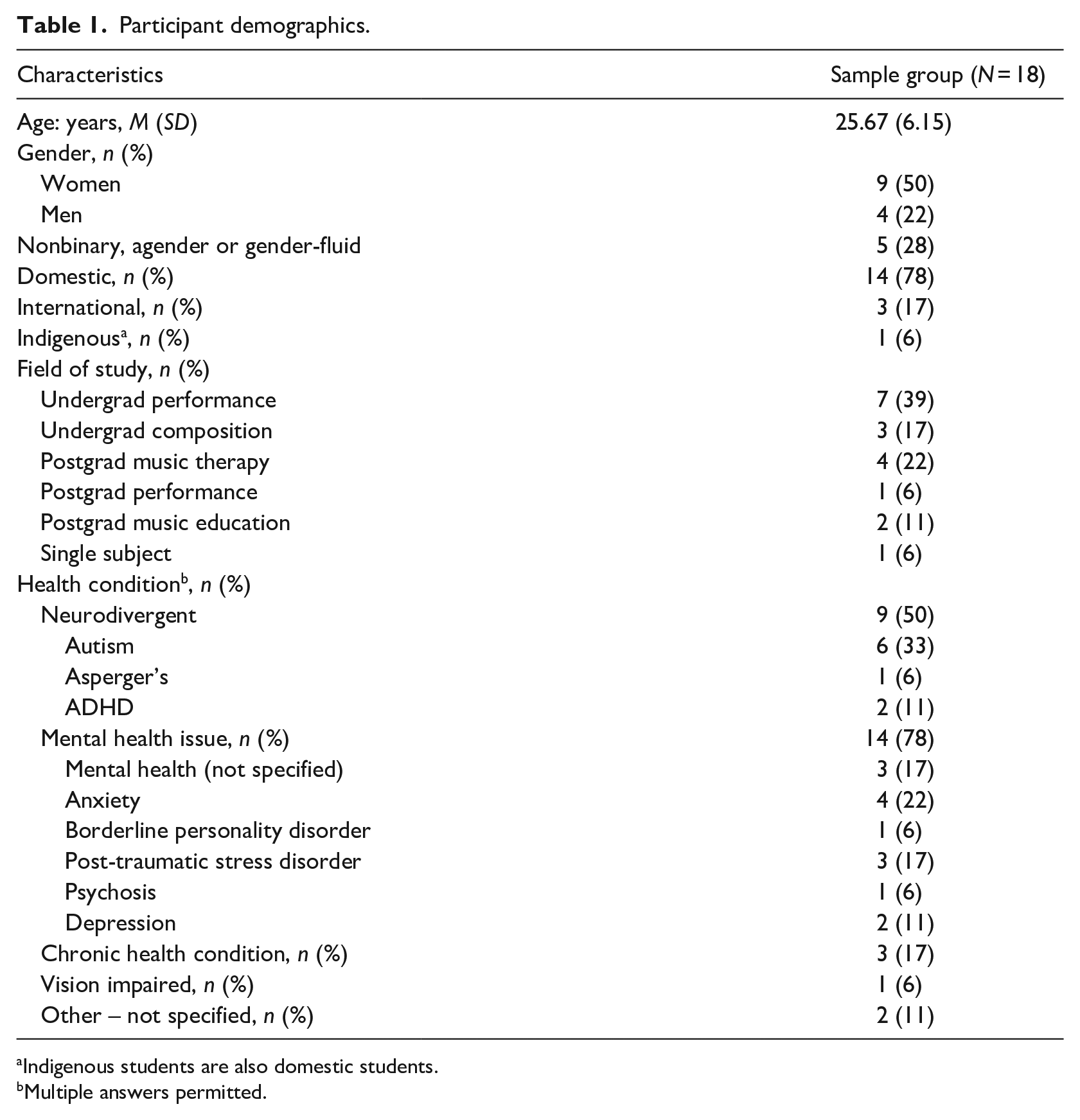
Indigenous students are also domestic students.
Multiple answers permitted.
Compared to the total enrolled student numbers at the Con (total = 832) during data collection in 2021, we have good representation of women (53.8% for the total Con), lower representation of men (45.4% for the total Con) and higher representation of other gender identities (0.7% for the total Con). In terms of disability, 77 students (9.3%) at the Con reported a disability at the time of admission (no further details are available). If we assume all students in our sample disclosed their condition at admission, our response rate is 23%.
Interview
The 18 participant interviews were conducted by three research assistants who were not teachers at the Con. We chose to employ research assistants with disability (d/Deaf, hard of hearing, chronic illness and physical disability) to support accessibility in the interviews, and so that they could empathetically pass on information about university support services if necessary. Skinner (Author four), who holds a non-teaching role, managed the recruitment process, providing briefings and support to the interviewers. Participants were offered different interview formats to meet their accessibility requirements, such as in-person. Teleconference (via ZOOM), written answers and/or bringing a support person with them. Interviews were audio recorded and transcribed. The interview guide included 12 questions asking participants to reflect on their experiences of music education, and their current experiences of studying a music degree at the Con (see Supplemental Material).
Analysis
Our thematic analysis was guided by the a priori research questions (Elo et al., 2014). Transcribed interviews were anonymised by Skinner, who does not teach at the Con, and each participant was assigned a reference code. As an extra safeguard, Skinner allocated interviews for analysis to Author 1 and Author 2 that were not within their specific discipline. For each transcript, key statements were highlighted and sorted into deductive categories based on the interview questions as follows: prior impact of disability; disclosure of disability; personal management of access; barriers to music studies; enablers in music studies; career support; suggested access improvements; advice to peers; and ‘other’ comments. Next, in-vivo coding of key statements took place and sample codes were cross-checked by another team member. Codes across all participants’ data within the categories were then sorted into preliminary inductive themes. Codes and themes were subsequently re-examined and discussed together in reflexive research meetings with all authors, to check our assumptions and analysis. Through this iterative and reflexive process, we derived final themes and sub-themes that addressed the research questions.
Findings
The themes and sub-themes related to research question (RQ) 1 are graphically presented as nested dimensions related to the students’ experience of equity and access. Next, the themes and sub-themes related to RQ2 are presented as a narrative of student recommendations to improve equity and access at the Con. The narrative aims to represent the tone of advocacy from the participants that was evident in the analysis.
The thematic analysis related to student experience of accessibility at the Con (RQ 1), revealed themes and sub-themes across student, teacher, context and institutional culture (see Figure 1). The nested arrangement of these elements reflects the way most participants positioned their music teachers at the forefront of the student experience of accessibility. However, the data suggests that both students and teachers are impacted by issues related to the prevailing cultures at the Con and the broader university. The sub-themes related to institutional culture are graphically represented as orbiting this theme to indicate the complex patterns of interaction with the context. Therefore, the themes and sub-themes are not presented as a hierarchical schema, but as a multi-faceted and dynamic human experience. Each theme and sub-theme will be described below and illustrated with quotes from the participants. Pseudonyms have been used throughout this section.
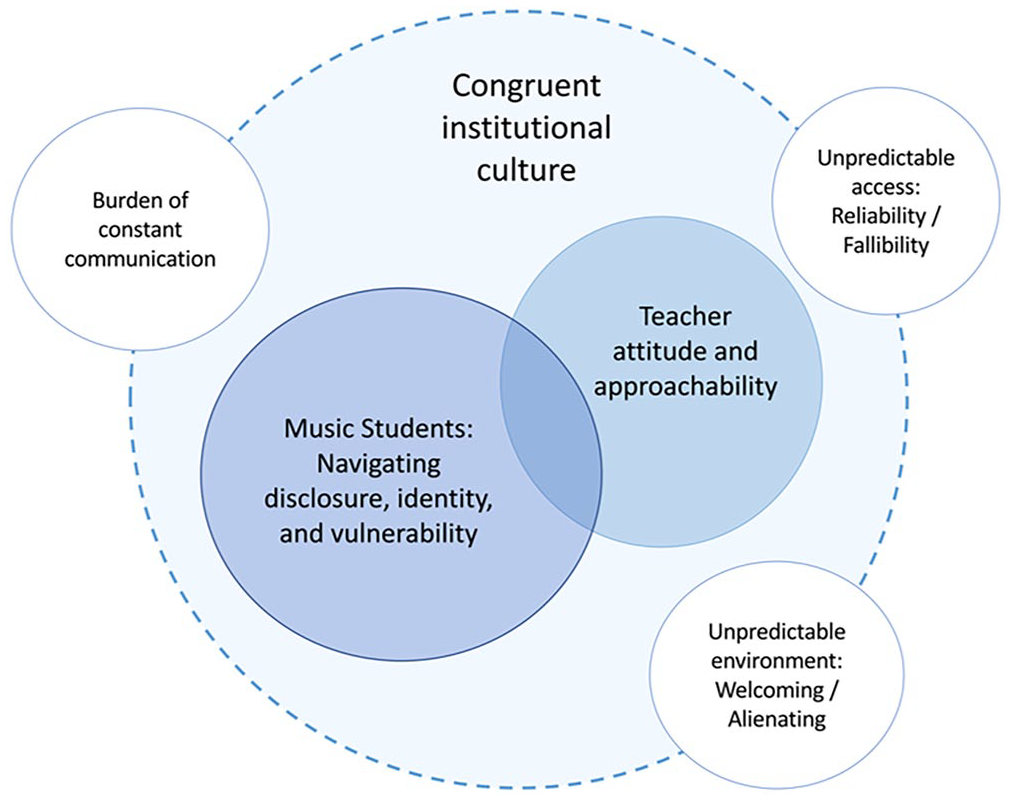
Nested dimensions of equity and access in higher education music.
Music students with disability navigate disclosure, identity and vulnerability
The complexity of the participant cohort was evident in their feelings articulated towards disclosing disability. A wide range of attitudes, confidences and vulnerabilities were expressed as students reflected on their experiences at the Con, as well as prior experiences of music education. Participants described the competitive culture of music education, based on striving for elite performance skills, and the stigma of being viewed as potentially incompetent because of their disability. The sub-themes, explicated with quotes from the participants, are further explored below.
Weighing up whether to disclose
Students expressed in various ways their concerns for how others might perceive them. Jarred declared, ‘I don’t want my condition to be the first thing people think about me’. Mei-Xing said ‘I don’t want people to lower their expectations of me’. Some students described having arrived at the Con with already powerful education experiences, with Amir asserting ‘I don’t disclose because people have bad preconceptions and stereotypes about my condition’. Others explained that when they first commenced HE, they were not yet diagnosed or still coming to understand their disability and its ramifications. The uncertainties some students expressed about disclosure and eligibility for disability services seemed to create a barrier in meeting their access needs. Bao stated that ‘I didn’t think it was serious enough until I sought help. I thought disability support is supposed to be for people who have blindness or something’.
Unsure of attitudes and resources at university
Participants provided insights into their transition into HE from secondary school, revealing a range of expectations and concerns about how they would access resources relevant to their studies. John said ‘I was resistant to checking out accessibility features of Uni at the start, even with an AAP [academic adjustment plan – see Supplemental Appendix] in place’. Lucia was more proactive, approaching her teachers about her AAP, explaining that ‘I told my teachers straight away, though only my closest friend in class knows I’m disabled’.
We asked participants to reflect on accessibility in their music education prior to commencing HE, since past experiences might create expectations of resources being available. Some participants described how their musical talents gave them a positive sense of identity in secondary school, such as Ned who explained ‘I remember I used to go and play and sing at the same time. I would just be singing all the time’. Participants described experiences that were affirming moments of acceptance in secondary school, such as Sonia who said ‘most of the teachers that I had at high school were willing to slow down and explain that to me’ but also recalled enduring stigma, ostracising attitudes and rejection. For example, Peter stated ‘I had this strict teacher for a long time, and she couldn’t deal with my depression and stuff, so she ended up ditching me’. Students’ past experiences seemed to create assumptions, either positive or negative, about accessibility in HE.
Teacher attitude and approachability
Some participants who had openly disclosed their disability to their music teachers described an unexpected ambivalent response, resulting in them feeling ignored or excluded from future opportunities. Fiona shared that ‘teachers’ expectations didn’t change after disclosure, but they should have’. Kate added ‘I don’t think there’s been a teacher at the Con where I’ve felt particularly like, this person is going above and beyond or doing more than is expected from us, or has been particularly supportive’. Sonia remarked that ‘there are one or two [teachers] that are proactive in helping, but the majority tend to ignore me and wish I wasn’t there’. Some participants attested to more clearly negative interactions with teachers. Barry explained: ‘A staff member discussed accessible options and said I wasn’t good enough for this [practical music] stream so I should just go into teaching’.
Not all participants offered negative remarks about their interactions with teachers. For example, Sarah stated that ‘My teachers have been very supportive, and I don’t need to question what’s going on. All my teachers have been great about it’. However, the data from the interviews is skewed towards more negative experiences.
The burden of constant communication
Many participants described the seemingly never-ending communication processes required to receive ongoing support. James perceived a ‘lack of communication between SEDS [university equity office] and the [music] teachers/faculty’. Others detailed how the onus of responsibility and reporting rested on the student with disability with Ned saying ‘It’s a big job and is exhausting to share your AAP with every teacher and tutor’. For students whose disability is not apparent to others, the burden of communication is constant. Joe said ‘All my conditions are invisible, if I don’t explain them, people don’t realize I need extra help’.
Beyond communicating with educators and disability service teams, some participants described the social dimension of communication with their peers at the Con. Monica said that ‘mostly, I don’t mind answering questions about my condition from peers’. However, Peter expressed concern saying that ‘I don’t want people to just identity me as the disabled guy’.
Unpredictable access: Reliability/fallibility
Regarding accessibility to learning, students expressed a range of issues spanning the way they collaborated with music teachers, university services and peers both in- and outside of class. The sub-themes are further described below.
Negotiating access with teachers
Robin encapsulated the unpredictability, describing how some teachers positively convey ‘Okay, yeah, we understand your situation. . .’ while in contrast ‘there’s other staff that just seem to just ignore it’. Peta described how, even when she had documents supporting her accommodations, she could not rely on teachers to remember the details: ‘I was really scared to send my AAP plan to my teachers, but also needing to continually remind them to record or provide modified documents I could access’.
Negotiating participation with student peers
Participants discussed a range of social interactions they experienced with their student peers. Sam said ‘I’m always aware of people that have bad preconceptions and stereotypes about my condition’, whereas Susan said ‘some students just ignore me, and others are downright hostile towards me’. These reflections provide insights into aspects of accessibility to class activities and collaborative work where students with disability are also mediating pre-conceived ideas about their condition from their peers.
Frustrations with university services
Access to support services was raised by several participants who reflected on their frustration with finding help. Roger remarked, ‘I saw a helpline, a hotline once. I rarely see [the Con] people promoting helping people with disability or mental illness. Explicit directions, easy access to advice- I don’t see it’. Student-support services received criticism from some participants. Holly said ‘. . .the university counsellors pretty much only have ‘chit chat’ conversations - only having someone to talk to about ‘what made you sad the other week’ is just not cutting it’. These accounts highlight the important role each service and staff member plays in improving accessibility.
Unpredictable environment: Welcoming/alienating
Environmental issues raised by participants were mostly related to physical infrastructure. While some buildings provide accessible amenities such as elevators and bathrooms, a considerable amount of infrastructure remains ill-equipped and inaccessible for music students with physical and sensory impairments. Joe explained ‘I was timetabled in a building that I couldn’t get access to’. Further, the scheduling of music classes and rehearsals can be cognitively and physically inaccessible. Some participants described needing to take a break from the classroom to self-regulate and engage in sensory strategies that assist in sustained concentration across multi-hour lectures, rehearsals and workshops. Justine remarked ‘I was scheduled for classes in a small and cramped room - the lights continually flickered and each week my anxiety rose as these were known triggers for my episodes. I had to get out and I failed the subject’.
Students revealed the discriminatory ramifications of an unpredictable campus environment. Joan said ‘I’ve earned my right to study at University, but we are still in an age where its only through the help of family and friends that I can find the access and equity I’ve been supposedly promised’. Amir said ‘I just have to spread my course over a number of years because I just can’t access uni or rooms in time. It’s such a waste of my life’.
The online learning environment developed during the COVID-19 pandemic restrictions was seen as improving access in many ways for these participants. At the time of our interviews, the Con was phasing out online classes to promote full attendance on-campus. The planned removal of online learning options was seen as a step backwards by some participants. Jordan strongly explained ‘the music department had this weird thing where it’s like, ‘if you can’t make it in person, there’s no point’. . .that’s not ideal’.
Institutional culture: Congruency between policy and practice
Institutional culture manifests in the people, and prevailing attitudes, policies and actions towards engagement with each other. Cultures operate at the personal, interpersonal, cohort, faculty, cross faculty and wider whole-institution level that operate within the prescribed tenets and ways of being. Culture is nascent in the language around disability, about what is said and unsaid, what is promoted and hidden and what is built to include and exclude. The sub-themes are further explicated below.
Teachers are the face of institutional culture
Some participants provided positive reflections on their music teachers and their engagement with them throughout the semester, such as Robin who said ‘[this teacher has] got this nice attitude, jovial, kind of warm attitude, so it’s helpful’. However, other participants highlighted engagements with music teachers who were uninformed or unwilling to engage with evolving University disability policies and processes. Julie recounted the time she disclosed having ADHD: ‘I think [the teacher] was trying to be supportive. She said, “Well you know, I’m not going to treat you any differently”. And I said ‘I mean, I’m telling you this so that you can treat me differently. I would like to be treated differently because I am different’. Sophie described that information about reasonable adjustments were briefly mentioned in the first lecture, but were ‘broadcast to me in a way that made special consideration for [music] performance as getting an unfair advantage on others’. It seems that adopting a one-way-fits-all approach holds potential to exacerbate rather than alleviate student concerns.
Services and systems reveal institutional culture
Student services operate as a frontline connection, often in intense moments where students seek help or resolution to stressful impacts on their ability to study. Robin recalled an interaction with student services staff where she felt condescended: ‘They talked to me like I was a baby, which put me off trying to talk to someone else about it again’. John raised issues about University online services and systems, explaining that ‘navigating the university’s web site including disability support, enrolling in subjects, using the LMS and just plain finding what I need. . . tries the patience of a seasoned web professional’. A parent who attended the participant’s interview as a support person offered that the Con ‘requires a disability coordinator- someone who can articulate a wider range of possibilities of what the answers or requirements may be to [music] teachers in the faculty, on a regular basis’.
Recommendations from participants
Data related to the changes students recommended to improve accessibility and equity (RQ2) are woven into the following narrative. The themes from the analysis are indicated in italics.
For the most part, participants’ advice to future music students was about being personally prepared. Participants advised future students to plan in advance, be organised with assessment tasks, expect stress and make time for their studies and negotiating bureaucracy. Alongside this personal preparation was advice to openly ask for help. This theme was linked to being personally prepared, since students stressed the need to take responsibility for the clarity of their requests for accommodations. Jarred advised future students to ‘make the extra effort and make it painfully clear what you’re going through and to ask for things’. Linked to this advice was the importance for future students to do their own research and be aware of available services. Participants felt it was useful to have an AAP in place as soon as possible, and to ask other students for recommendations about seeking help.
Participants made various recommendations for increasing accessibility at the Con, which we grouped into three main topics: (1) increased teacher awareness; (2) pedagogical reforms and (3) improved information sharing. Within increased teacher awareness, participants identified the importance of teachers being approachable and willing to discuss access needs. Many participants considered that improvements were needed in terms of teachers’ awareness of the diversity within the disability community. Some participants expressed that teachers needed to convey more openness about their own life challenges or disabilities if applicable. Michelle considered the lack of musical role models with disability as a key issue: ‘I think the lack of openness about disability [is a problem]. The lack of examples and representation’.
In terms of pedagogical reforms, participants’ responses highlight several areas, including the need for more inclusion of disabled artists in the curriculum, more variety in learning materials and assessments and the need for dual/hybrid learning modes (i.e. online and on campus options). The topic of improved information sharing highlighted many barriers identified in participants’ day-to-day experiences. Participants recommended that support services be better advertised and discussed, and that eligibility criteria for disability support was often unclear. For example, one participant explained that ‘they always use those big words, like ‘disability thing, blah blah blah,’ and then you never get the knowledge that that includes you as someone with mental illness. Like, they need to make it a lot clearer’. Some participants saw a need for a dedicated disability support person who could assist students at the Con with pathways to support. Lastly, some students wanted more information and advice about career pathways for disabled musicians.
Discussion
This qualitative study explicates the experiences of 18 students with disability studying a HE music degree at the Con. While accessibility of HE has been well studied (Moriña, 2017; Shpigelman et al., 2022; Smith et al., 2021), accessibility issues at all levels of music education have received limited attention. Even though research into the experiences of disabled music students is limited, there are notable examples of musicians with disability who have built successful careers across various genres and traditions of music (see Supplemental appendix). Despite this, the data suggests that disability remains hidden in Conservatoria, with our findings revealing compelling relational and cultural factors that can have substantial impacts on accessibility.
In our graphical representation of the findings, we centred the student and their experience of navigating issues of disclosure, identity and their own vulnerability related to music education experiences. Alongside the student, the attitude and approachability of their teachers was a primary factor in their experience of barriers or enablers to their learning. It seems that inconsistent and unpredictable teacher responses can place students in a risky position when they wish to disclose their disability to gain access to the accommodations they require. These findings echo previous studies exploring accessibility more generally in HE. Stigma related to disclosure of disability is well described, with differences noted in challenges associated with peers (Smith et al., 2021) and support services (Shpigelman et al., 2022). Those with disabilities that are not apparent to others are described as experiencing added complexity with seeking the accommodations they need, with some choosing to forgo accommodations entirely and risk failure or withdrawal (Moriña, 2022).
While HE can be experienced as a competitive environment across many disciplines, our findings convey a further layer of disadvantage for HE music students with disability. The detrimental attitudinal barriers residing with educators and peers who perceive accommodations for music students with disability as an unfair advantage, or that they are incapable of success, were described by many participants. Within this competitive environment, music students with disability are in the unenviable position of deciding whether to disclose and face possible discrimination (Robinson et al., 2019), or not disclose and experience hardship in their studies (Moriña, 2022). Our study participants are calling for substantial reforms of teacher attitudes, and improved teacher and peer awareness. Many participants specifically assert how a lack of accommodations is in fact discriminatory, and that accessibility accommodations do not create an unfair advantage.
In Figure 1 we chose to encircle both music students with disability and teachers within the broader institutional culture. In doing so, we acknowledge that teachers can also be disempowered by the system. The participants’ experiences provide salient feedback into the adequacy, effectiveness and timeliness of ‘nested’ and sustained help from services in supporting the particular needs of music students. The analysis revealed three dichotomous aspects within institutional culture that impact accessibility. For example, when communication seems never ending, or services cannot be relied upon, or where the culture is perceived as ambivalent towards students’ needs, access falls to individuals and their own personal support systems. Indeed, many participants commented on how their own resources, friends and family supported them to be successful.
When reflecting on the types of health conditions and disabilities that participants disclosed, we also became aware of who was not represented. Those who responded to the broad call for participants were mostly neurodivergent or identified as having a mental illness. Less well represented were people with chronic health conditions (3 of 18), and sensory impairments (1 of 18). No-one in our sample identified as having a physical or intellectual disability or as Deaf or hard of hearing. We further note that some participants did not identify as disabled, or did not consider themselves to have a disability, until they were studying music at university. The issue of late diagnoses, or unknown diagnoses, raises important questions about whether exclusion from music education commences much earlier than in HE (Abramo, 2012).
Reflecting on the themes related to student perspectives on improving access and equity at the Con, we are struck by the high level of personal responsibility that students perceive they need to take. Offering advice to new students to be prepared, and to do their own research, highlights the participants’ perceptions of the institution failing to support students in ways that makes them feel confident and empowered. Music students with disability should be expected and welcomed every year. Further, it is possible that the lack of representation of teachers with disability, visiting artists with disability and musicians with disability in the curriculum, works to continue to convey that disability should remain hidden at the Con, and perhaps that is does not belong at all. We recognise that this critique is not unique to HE music, as there is limited visibility and recognition of disabled musicians at all levels of learning (Bernabé-Villodre & Martínez-Bello, 2018). Previous research has similarly highlighted the benefit of including disability studies in curricula, and the need for greater representation of people with disability (Darrow, 2015). However, we propose that our findings highlight that HE institutions like the Con must be pro-active in encouraging and supporting disabled musicians who might not otherwise see themselves reflected in elite music making.
Limitations
We acknowledge that the themes from this study, which are likely to be linked to the characteristics of the participants, cannot be generalised. With a sample size of 18 participants, we choose to combine the analysis rather than separate participants into subgroups based on their condition, instrumental skills or degree type (music performance, composition and musicology). By combining the analysis, we acknowledge that some of the nuance of experiences relevant to these factors is likely to be lost.
Responses from the participants are skewed towards negative statements. While we asked participants a range of questions designed to capture the breadth of their experiences, it seems that participants took this opportunity to share information about the aspects of accessibility that are not working for them. We set out to authentically capture participants’ lived experience, and their frustration was palpable in the interview process. This is reflected in the balance of findings presented, and suggests possible negativity bias in future research on disabled cohorts. These findings could be viewed as a starting point for deeper explorations in future studies.
Conclusion
The findings from this study suggest more work is needed by HE music institutions to accommodate students with disability. Participants’ regard the interactions with their music teachers as the most impactful factor for accessibility. Teacher-student interactions and engagement remains the window through which students feel accepted, valued and are given opportunity to excel. Professional development that upskills music teachers’ capacity to integrate and differentiate, and systems that allow an ease of secure and safe information sharing, should be within the capacity of our largest educational providers. This study articulates a socio-cultural amplitude for institutional action to consider how academic and professional staff can effectively apply features of inclusive, caring, professional practice and how and where change needs to be effectively operationalised in HE music today.
Supplemental Material
sj-docx-1-ijm-10.1177_02557614241237235 – Supplemental material for Hidden diversity in the conservatoire: A qualitative enquiry into the experiences of higher education music students with disability
Supplemental material, sj-docx-1-ijm-10.1177_02557614241237235 for Hidden diversity in the conservatoire: A qualitative enquiry into the experiences of higher education music students with disability by Grace Thompson, Leon de Bruin, Monica Subiantoro and Anthea Skinner in International Journal of Music Education
Supplemental Material
sj-docx-2-ijm-10.1177_02557614241237235 – Supplemental material for Hidden diversity in the conservatoire: A qualitative enquiry into the experiences of higher education music students with disability
Supplemental material, sj-docx-2-ijm-10.1177_02557614241237235 for Hidden diversity in the conservatoire: A qualitative enquiry into the experiences of higher education music students with disability by Grace Thompson, Leon de Bruin, Monica Subiantoro and Anthea Skinner in International Journal of Music Education
Footnotes
Acknowledgements
We wish to thank our team of interviewers, Alex Hedt, Zoë Kalenderidis, and Jess Kapuscinski-Evans. We thank our participants for their thoughtful sharing of their experiences with us and being willing to reflect on challenging moments in their education. We acknowledge and pay respect to the traditional owners of the lands and waterways on which we work, the peoples of the Eastern Kulin Nations.
Author contribution(s)
Declaration of conflicting interests
The author(s) declared no potential conflicts of interest with respect to the research, authorship, and/or publication of this article.
Funding
The author(s) disclosed receipt of the following financial support for the research, authorship, and/or publication of this article: The project was funded by the Melbourne Conservatorium of Music at The Unversity of Melbourne.

Supplemental material
Supplemental material for this article is available online.
References
Supplementary Material
Please find the following supplemental material available below.
For Open Access articles published under a Creative Commons License, all supplemental material carries the same license as the article it is associated with.
For non-Open Access articles published, all supplemental material carries a non-exclusive license, and permission requests for re-use of supplemental material or any part of supplemental material shall be sent directly to the copyright owner as specified in the copyright notice associated with the article.
