




Abstract
Educational researchers increasingly focus on psychosocial factors, implying the need for an improvement of school settings regarding child wellbeing. However, so far, studies which focus music-related wellbeing of primary school aged children are rare. The paper explores the essential question which empirically based frameworks offer concrete foundations for corresponding educational practices in the music classroom. Hence, the research conducted a critical interpretive review of English-language publications. In a multi-stage process, it sampled publications between 2017 and 2020 targeting children of early primary school age and focussing on a connection between musical practices and well-being. For a full-text analysis, the research selected studies offering theoretical frameworks for synthetic theorisation. Findings show that until now, few studies have focussed on primary school-aged children. However, it also indicates that an integrative model such as the PERMA Well-being Cycle can function as point of reference for the design of educational settings. Departing from ongoing reflections of this research, the paper argues for a differentiated professional perspective on psychosocial processes in the music classroom and music-related wellbeing as an explicit teaching objective instead of following implicit ‘hidden’, yet powerful agendas. The outcome might serve as the clarification of strategies to foster child wellbeing in music education settings.
In an empirical study with 285 elementary school children, 9-year-old Kevin noted: ‘Music is there to make me happy’ (Schmid, 2014, p. 299). He associates musical practices with happiness, which is in keeping with findings of the Youth Music survey, where a ‘colossal 85% of young people told us music made them feel happy’ (Youth Music & Ipsos MORI, 2020, p. 16). Defining happiness is no small feat; it is a complex phenomenon central to the human condition and accordingly beset by polysemy. (Mantie, 2022, p. 130). In philosophical debates dating back to Aristotle, seminal in educational discourse, happiness has convincingly been affiliated with wellbeing (Mantie, 2022, p. 130; Noddings, 2003, p. 20–22). Taking into account both philosophical lines of argument and psychological reasoning, the definition of wellbeing ranges from pleasure to virtue, that is, hedonic to eudaimonic perspectives of the term (Elliott & Silverman, 2014; Reybrouck & Eerola, 2022; Ryan & Deci, 2001; see chapter 2.1). Either way, educational researchers are increasingly focussing on improving school settings regarding students’ wellbeing (Bartels, 2018; Krupp-Schleußner, 2019; Schmid, 2017). However, when it comes to gaining an empirically grounded understanding of enjoyment and wellbeing in the music classroom, the influential factors at work remain largely vague.
There is no shortage of anecdotal evidence where music teachers, students and parents alike refer explicitly to enjoyment and wellbeing as objectives of music classes (Holdhus, 2023). Furthermore, education curricula and policy papers endorse music participation as having positive influences upon human development, despite the evidence not being as clear-cut as assumed (Hasselhorn et al., 2022). Compounding matters, across ancient China, Greece and India rich philosophical traditions have analysed human ‘wellbeing’ and ‘flourishing’, all yielding different conclusions. To complicate matters even more, and even though they are distinct, concepts such as happiness, enjoyment and wellbeing are sometimes used interchangeably across philosophical and psychological literature. Because of this, it is difficult to assess and evaluate the ‘generalisability’ of studies (e.g. Hasselhorn et al., 2022) across qualitative and quantitative research projects. While numerous publications reflect potential implications of ‘wellbeing’ for music education (e.g. Boyce-Tillman, 2020; Elliott & Silverman, 2014; Jorgensen, 2020), few empirical studies have explicitly analysed and examined ‘wellbeing’ in situ (i.e. in the context of concrete music education settings). So far, scoping reviews have tended to focus only on adults and persons with special needs participating in singing or listening interventions, instrumental teaching or arts-based groups (Daykin et al., 2018; Dingle et al., 2021; Sheppard & Broughton, 2020), while reviews attributed to music-related wellbeing in educational contexts and primary school-aged children are rare (Hallam, 2010; Lee et al., 2017).
Accordingly, this paper aims to present an outlook on how our thinking regarding this subject can be substantiated by synthesising the discourse on children‘s wellbeing in the primary music classroom. This paper’s stance calls for a closer look at music-related wellbeing as a teaching objective, thus explicitly highlighting the enhancement of a previously implicit goal.
The paper presents a systematic review which examines how empirical studies systematise wellbeing and enjoyment in the music classroom. Ultimately, of the following analysis is aims to provide principles for the concrete design of music classes child wellbeing that take child wellbeing into consideration, doing so by beginning with the background and research objective. It will then delineate a sampling strategy and method before discussing preliminary findings while suggesting an integrative framework for music-related wellbeing in the classroom. The paper closes with an outlook contemplating the role of music educators as facilitators towards music-related wellbeing. The paper argues for a professional perspective on the psychosocial aspects of musical practices in the classroom. A goal is to provide teachers with explicit teaching strategies aligned with ulterior motives that remained previously implicit and unarticulated. 1 The outcome could serve as a clarification of teaching objectives, allowing for strategies to foster music-related wellbeing in music classrooms.
Background and research objective
The empirical study with 285 elementary school children cited above suggests that from the children’s point of view, music is about doing well or wellbeing (Schmid, 2014). The interviewed students developed music as a base category of vitality (Schmid, 2014), describing numerous indications as to how practicing music can lead to ‘being happy’ (Schmid, 2014, p. 299); however, the definitions of happiness and wellbeing remain elusive.
Wellbeing and happiness
When defining wellbeing, two perspectives with a long philosophical history have been influential, interlinking happiness and wellbeing from different angles: (a) the hedonic perspective regarding wellbeing as situational happiness, pleasure and satisfaction and (b) an eudaimonic perspective focussing on long-term happiness and personal growth or flourishing. 2 To summarise, it becomes clear that:
(a) we can distinguish between short-term happiness (state) and sustainable life happiness (trait) (Chirico et al., 2015) and that
(b) in most literature, happiness and wellbeing are conjunct; ‘philosophical happiness’ is closely related to enjoyment (Mantie, 2022, p. 130).
For music education research there are many seminal publications dealing with music as a source of wellbeing. Edited volumes like Eudaimonia: Perspectives for Music Learning (G. D. Smith & Silverman, 2020a) or Music, Health and Wellbeing (MacDonald et al., 2012) indicate the significance of the subject, the latter displaying a ‘multitude of approaches and many different epistemologies’ (MacDonald et al., 2012, p. 400). Elliott and Silverman contemplate the praxial concept of music (Elliott & Silverman, 2012), where eudaimonia is ‘among the ultimate aims of music making, music teaching and learning’ (Elliott & Silverman, 2014, p. 59). They highlight the good life through musical ‘enjoyment, flow, and happiness’ (Elliott & Silverman, 2014, p. 69), while Randles (2020) emphasises the role of creativity in that respect. Boyce-Tillman (2020) also gives examples of eudaimonic aims within music education as ethical behaviour to self and environment, and Jorgensen (2020) explicitly posits the cultivation of happiness in the music classroom. All these publications tend to favour the eudaimonic perspective (happiness as a trait) and emphasise the pre-eminence of wellbeing as an educational aim, although the link to empirical research is still expandable. Psychological literature, on the other hand, was for many years more concerned with the hedonic, subjective perspective (happiness as a state) and has more recently sought a connection with eudaimonic approaches (Seligman, 2011). 3 Accordingly, we find an array of concepts, here viewed from the angle of their potential for music education: Ryff and Singer (2008) examine wellbeing from the eudaimonic perspective, referring to core dimensions of psychological wellbeing, all of which may potentially play a role in contextualising musical practices, namely (1) self-acceptance; (2) purpose in life; (3) environmental mastery (4) positive relationships (5) personal growth and (6) autonomy. However, the interpretation enlists dimensions of wellbeing rather than offering a clear definition, leaving the question open as to which strategies educators can implement to balance the ‘competing pulls of self vs. other’ (Ryff & Singer, 2008, p.33). Similarly, Ryan and Deci’s (2001) Self-Determination Theory implies a highly complex interplay within the fulfilment of human needs and has been labelled as a ‘macro-theory, encompassing several mini-theories’ (Krause et al., 2019, p.2). From an educational perspective, Ryan and Deci’s (2001) theory could explain varied motivation to participate. Accordingly, Self-Determination Theory has been used as a framework ‘to understand how (. . .) musical participation’ and wellbeing can be fostered (Krause et al., 2019, p. 2). Despite the use of this theory as a framework, it remains difficult to arrive at concrete conclusions for the design of music classes.
Other definitions highlight the dynamic equilibrium theory of wellbeing – or homeostasis (Reybrouck et al., 2022) as the ‘gold standard’ for subjective wellbeing (Cummins, 2010), which focuses on self-regard concerning overall life-satisfaction when researching wellbeing. This is challenging for the music classroom as an ecosystem (Schmid & Doerne, 2020), as it requires a balancing act between the individual’s wellbeing ‘equilibrium’ and the homeostasis of the group. From a subjective angle, the Capability Approach (Sen, 2011) broadly conceptualises wellbeing as subjective satisfaction, focussing upon individual choice as a means for human flourishing while allowing for quantitative analyses of life and domain satisfaction (Hasselhorn et al., 2022). This offers an actor-centred angle for music education when evaluating inclusivity or participation within music programmes. Complementarily, Seligman’s (2011) Positive Psychology has also fundamentally contributed to the discourse and has been referred to in music education. Seligman’s PERMA-wellbeing model lists Positive Emotion, Engagement, Relationships, Meaning and Accomplishment (PERMA) as a framework for feasible dimensions of wellbeing (Seligman, 2011), thus making them accessible for educational analyses. In their recent overview, Hallam and Himonides (2022) accordingly label ‘features of positive wellbeing’ as ranging from competence to life satisfaction (Hallam & Himonides, 2022, p. 413). Obviously, all definitions share the conceptualisation of wellbeing as multidimensional (Hallam & Himonides, 2022), although the interplay of said dimensions has yet to become feasible for the design of classroom settings.
Overall, these concepts have only partially been influential in music education. Ryan and Deci (e.g. Fiedler & Müllensiefen, 2016) as well as Sen (e.g. Krupp-Schleußner, 2019) were well received in empirical quantitative research. The PERMA-model has proven to be a useful framework for analysing positive engagement with music (Krause et al., 2019). Yet so far, the extensive discourse contrasts the relatively small number of empirical studies allowing for concrete pedagogical recommendations (Krupp-Schleußner, 2019; Schmid, 2019).
To be able to fathom concrete pedagogical implications when approaching this complex phenomenon, the following paper begins with the deliberately broad definition music-related wellbeing. The review study regards psychological need satisfaction as the common core connecting eudaimonic and hedonic wellbeing 4 . It equates music-related wellbeing with music-related enjoyment, pleading for an integration of hedonic and eudaimonic aspects (Pancheva et al., 2021). Enjoyment as a nucleus for human flourishing (Noddings, 2003) interlinks short-term (state) and long-term wellbeing (trait). The definition assumes that music-related wellbeing bridges hedonic and eudaimonic wellbeing, which corresponds with Mantie’s connecting enjoyment and good life (Mantie, 2022, pp. 139–143). 5
Thus, the review proceeds from an inductive array and asks how music-related wellbeing is manifested in empirical studies investigating concrete educational contexts. The targeted outcome is a concise model systematising decisive factors for fostering music-related wellbeing in the classroom.
The review focusses on English-language discourse, in which Elliott and Silverman (2014) have explicitly articulated the relevance of eudaimonia as an educational objective; the density of publications on this topic has increased since 2017 and is rich with nuanced insights (Caleon, 2019).
Objective and research questions
A major concern when approaching music-related wellbeing as a potential teaching objective is the deficit in the integration of certain studies’ results within the design of educational settings. Thus, the research presented here asks: Which frameworks found in the English-language discourse between 2017 and 2020 6 offer concrete foundations for a domain-specific differentiation of factors influencing music-related wellbeing, and what model for the design of music classes can be derived from these? The study followed three sub-questions:
(1) How do empirical studies account for wellbeing in the context of musical settings for primary school-aged children?
(2) Is there an explicit model systematising the fostering of wellbeing in the music class, and if so, what is it?
(3) What are the implications of (1) and (2) for (a) research approaches and (b) educational conceptualisations, that is, principles for the design of music classes?
For music-related wellbeing to become a potential educational objective, it is crucial to consider research examining concrete educational settings.
Method and sample
The study’s aim is to condense the theorised results of different empirical studies. This method was chosen because when departing from a critical integrative review (Booth et al., 2016), it is possible to diagrammatically relate the outcomes of different studies to each other. Subsequently, the study distils a model depicting guiding principles as to how teachers can foster music-related wellbeing in the classroom. Thus, the method allowed for a synopsis of diverse research approaches.
Method
A Critical interpretive synthesis is an approach which enables the fusion of qualitative and quantitative data ‘where theorisation (sic) of the evidence is required’ (Booth et al., 2016, p. 257). This type of review seeks ‘to broaden our understanding of a (. . .) phenomenon’ (Booth et al., 2016, p. 22) and to isolate a model which describes the state of the arts (Booth et al., 2016).
In an integrative review, different types of data across paradigms are condensed in order ‘to produce a whole that is greater than the sum of its parts’ (Booth et al., 2016, p.23).
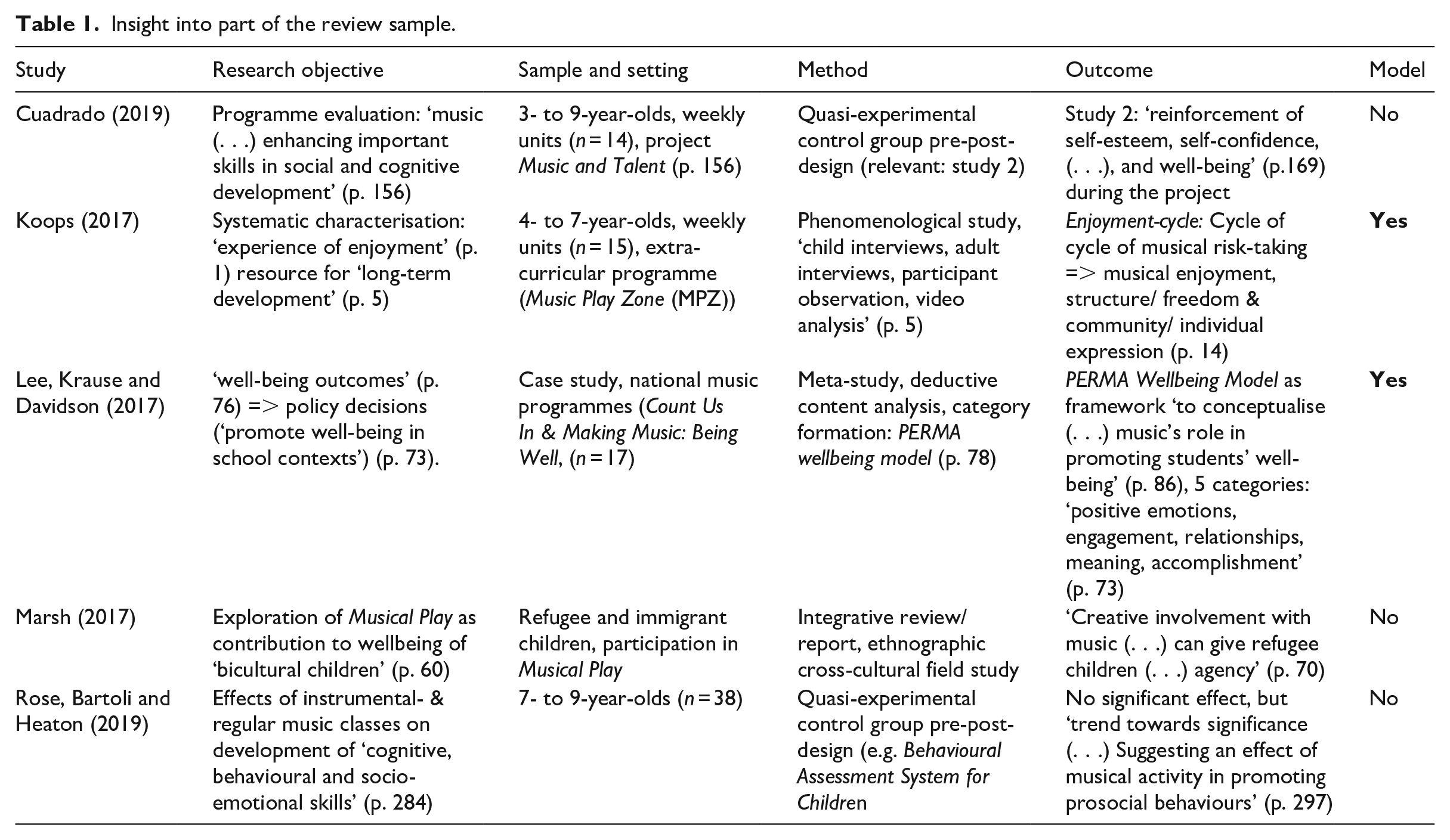
Following this objective, the research presented here conducted a critical interpretive review (Booth et al., 2016) of pertinent English-language publications. The sampling strategy followed an according review protocol (Booth et al., 2016). In a multi-stage process, it sampled publications targeting children of early primary school age and explicitly interrelating musical practices with music-related wellbeing. The search was based on the inclusive definition of wellbeing in conjuncture with happiness and enjoyment. It therefore used the keywords: music classes AND (well-being OR wellbeing OR happiness OR enjoyment) AND children and brought N = 412 results in the field of Education. The results were grouped according to research objective, sample and setting, method and model (see Tab. 1). In the next steps, they were interpreted and condensed in a visualisation interrelating core elements contributing to music-related wellbeing in educational settings.
Insight into part of the review sample.
Sample
In a multilevel procedure based on a systematic search (ERIC & SAGE), papers published between 2017 and 2020 were selected (1) targeting a connection between musical practices and wellbeing and (2) including primary-school-aged children. For an integrative synthesis, (3) studies which offered relevant modelling and/or didactic principles were analysed more thoroughly. Firstly, n = 372 studies were excluded from the original search result (n = 412) which did not refer to educational contexts and/ or music. After an abstract screening, n = 20 studies were excluded, the full- text screening excluded another n = 12 studies and a comprehensive full-text analysis led to the exclusion of another n = 6 studies as shown in the PRISMA flow chart of the review process (see Figure 1). Thus, studies in the field of music education which matched all three criteria, that is
(1) included target group children of primary-school-aged and
(2) examined interrelated musical classes and wellbeing
(3) provided modelling (generalisable factors enhancing wellbeing)
underwent a full-text analysis plus integrative modelling.
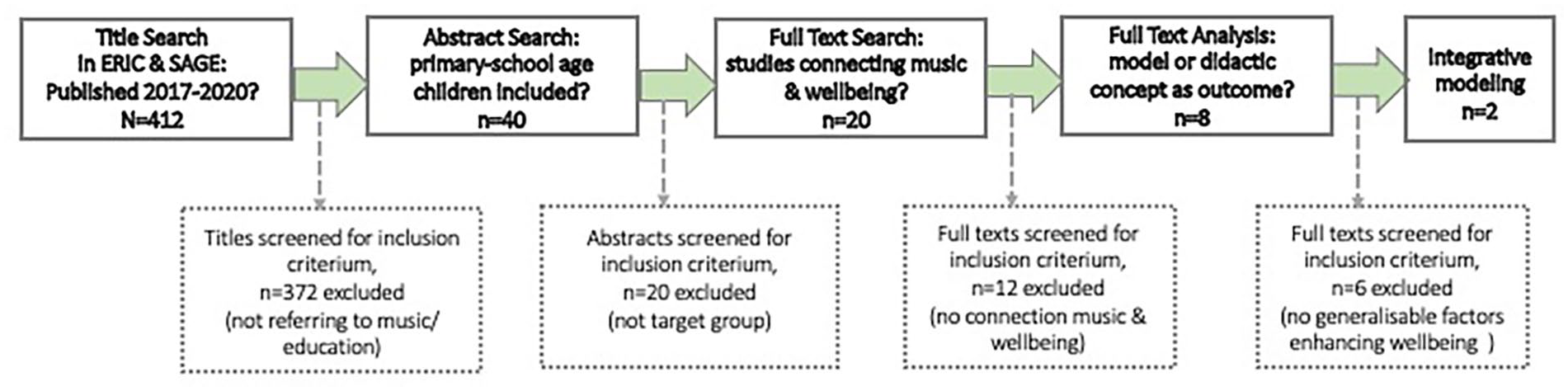
PRISMA flow chart review process – sampling strategy and inclusion criteria (Booth et al., 2016, p. 288).
Additionally, the table below (Table 1) gives an insight into a part of the review sample.
In this manner, the review selected studies which provided frameworks for the systematic isolation of generalisable principles fostering music-related wellbeing in educational settings. This selection criterium was applied via asking whether the studies offered concrete principles for teachers’ classroom design.
Preliminary findings and discussion
It was of interest how the studies in the sample accounted for primary school-aged children’s wellbeing and whether these studies referred to a systematising model. The analysis targeted principles for a practical basis in primary classroom teaching. The data showed that most studies in the sample did not allow for such modelling: Studies either did not refer to primary school children (Arbuthnott & Sutter, 2019; Baker et al., 2017; Krause et al., 2019; Williams & Berthelsen, 2019) 7 or did not provide a systematic description of how exactly the settings enhanced wellbeing. In other cases, the outcomes were unsuitable for modelling the enhancement of music-related wellbeing (Marsh, 2017; Millar & Warwick, 2019). That may be due to Millar and Warwick (2019) referring to a model from the field of health promotion which exceeded the context of music and the premises of music-related wellbeing. Possibly, which is also true for Marsh’s (2017) approach, dealing with young refugees entails a specific advocacy. Notwithstanding, both studies featured the importance of sociality and individual agency, findings which are essential for a framework of music-related wellbeing (see 4.1). Elsewhere, the review could not extract any direct implications for classroom teaching due to an outcome- rather than process-oriented paradigm, focussing on creativity (study I) and self-efficacy (study II) (Cuadrado, 2019), which displayed no effects on socio-emotional behaviour but rather associations between musical aptitude and overall intelligence (Rose et al., 2019) or a focus on self-regulation (Williams & Berthelsen, 2019).
Integrative framework of music-related wellbeing
Presently, two models found in the sample were condensed. The model derived from this integrative analysis is labelled PERMA-Enjoyment Cycle (Figure 1), delineating the theoretical outcome of two empirical studies. The first (Lee et al., 2017) empirically enriches Seligman’s (2011) PERMA-wellbeing model, while the other distils factors enhancing and inhibiting ‘musical enjoyment’ (Koops, 2017).
The latter situates enjoyment ‘within a broader perspective of long-term development’ (Koops, 2017, p. 5). Hence, enjoyment implies more than short-term fun and conveys an eudaimonic perspective, distinguishing between pleasure and enjoyment. In addition, Koops promotes enjoyment as a childlike trait which is considered as essential for human flourishing (Koops, 2017, p. 4). Musical enjoyment thus can be categorised as a nucleus of music-related wellbeing. The study then focussed on documenting ‘the characteristics of enjoyment in musical play’ (Koops, 2017, p. 5) with a sample of n = 12 4- to 7-year-old pre- and primary-school children attending extracurricular weekly classes (n = 15, Music Play Zone (MPZ)). The research design combined interviews, participant observation and video analysis (Koops, 2017). Koops introduces the term enjoyment cycle in the results (Koops, 2017, p. 14), providing insights into (a) what children’s musical enjoyment looked like (i.e. texture of enjoyment) (Koops, 2017, p. 16) and (b) the structural description, or how enjoyment occurred and how it interacted with other elements of the situation (i.e. structure of enjoyment) (Koops, 2017, p. 14).
This review condensed their results (Figure 2), focussing core elements and visualising the conceptualisation of musical enjoyment as ‘a cycle between participation and enjoyment’ (Koops, 2017, p. 11). This cycle involves a continuous interplay between structure and freedom as well as community and individual (Koops, 2017). In the blue inner circle, what Koops observed in the music classes can be seen: Five elements were found ‘that were (. . .) necessary to children’s musical enjoyment’ (Koops, 2017, p. 16). On the left and right side, the model shows how the phenomenon occurred in the concrete setting.
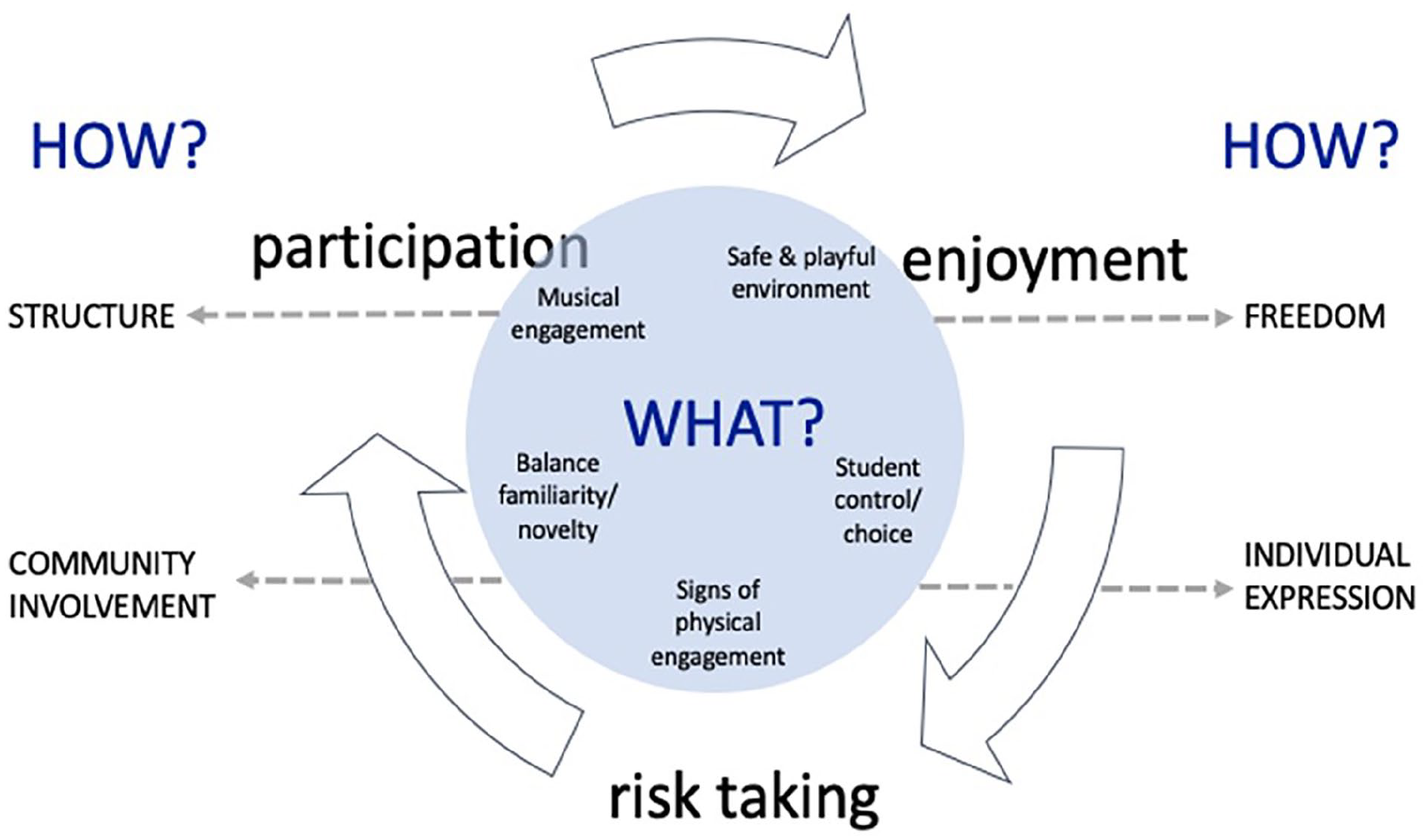
Enjoyment Cycle: model of children’s musical enjoyment (own representation based on Koops, 2017).
Afterwards, this condensed model was confronted with the outcomes of other studies. Only one study offered a similar conclusion regarding systematisation. As such, the model was compared to the study by Lee et al. (2017) study. In their meta-study on the relevance of the PERMA wellbeing model for music facilitation practice in Australian schools, Lee et al. (2017) identified specific factors promoting wellbeing. In a deductive content analysis, they did so by aligning content from 17 empirical case studies to the PERMA wellbeing model (Seligman, 2011) ‘to understand how each wellbeing element was realised through the music programs’ (Lee et al., 2017, p. 73). They aimed to clarify ‘whether or not there are specific types of music-making that promote wellbeing outcomes’ (Lee et al., 2017, p. 76). Their findings indicate that particularly relationship-centred music programmes enhanced psychosocial wellbeing (Lee et al., 2017). The table below gives a condensed insight into the essential elements of the PERMA-wellbeing model (Seligman, 2011) and their alignment with the empirical evidence of Lee et al. (2017) (see Table 2).
PERMA-wellbeing model and empirical findings.
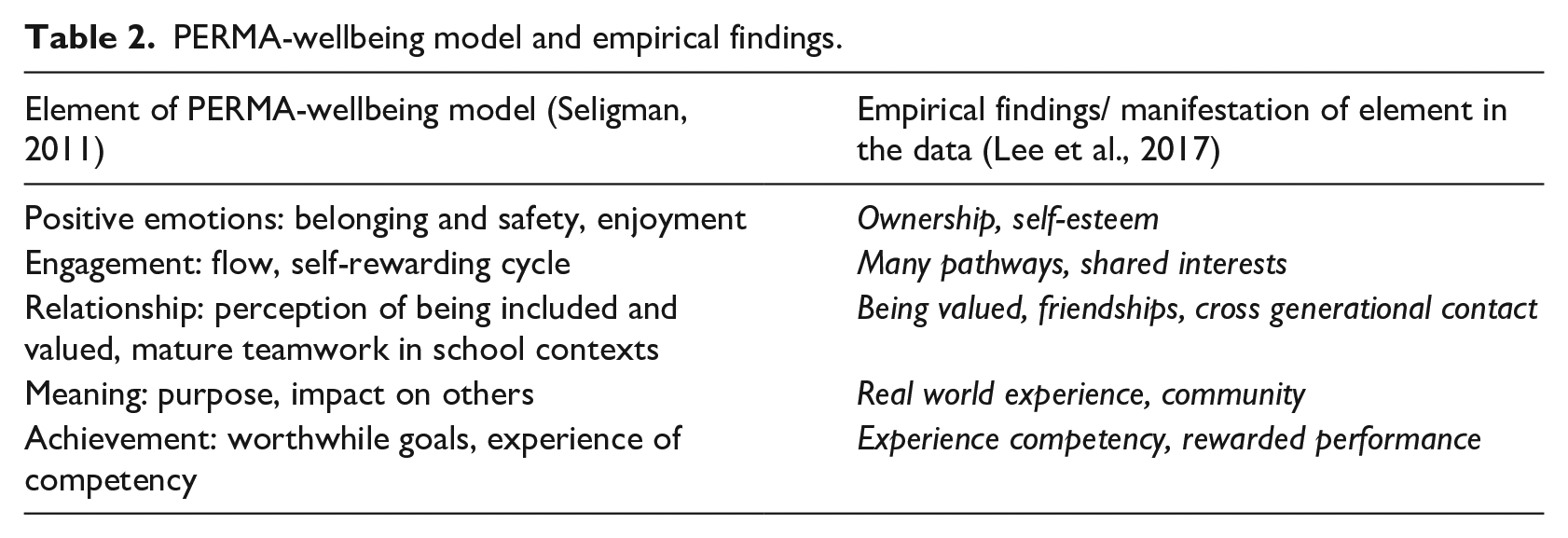
This demonstrates how elements of the PERMA-wellbeing model became manifest. These manifestations complement Koops’ (2017) enjoyment cycle (see Figure 2), the outcomes thereby generating an interpretative model conceptualising the enhancement of music-related wellbeing. The PERMA-Enjoyment-Cycle illustrates how the core elements of the meta-study by Lee et al. (2017) intersect with the elements found in Koops’ (2017) study. In the visualisation below (Figure 3), the letters P-E-R-M-A (Positive Emotions, Engagement, Relationship, Meaning and Achievement) are commented with the corresponding keywords representing the empirical findings by Lee et al. (2017).
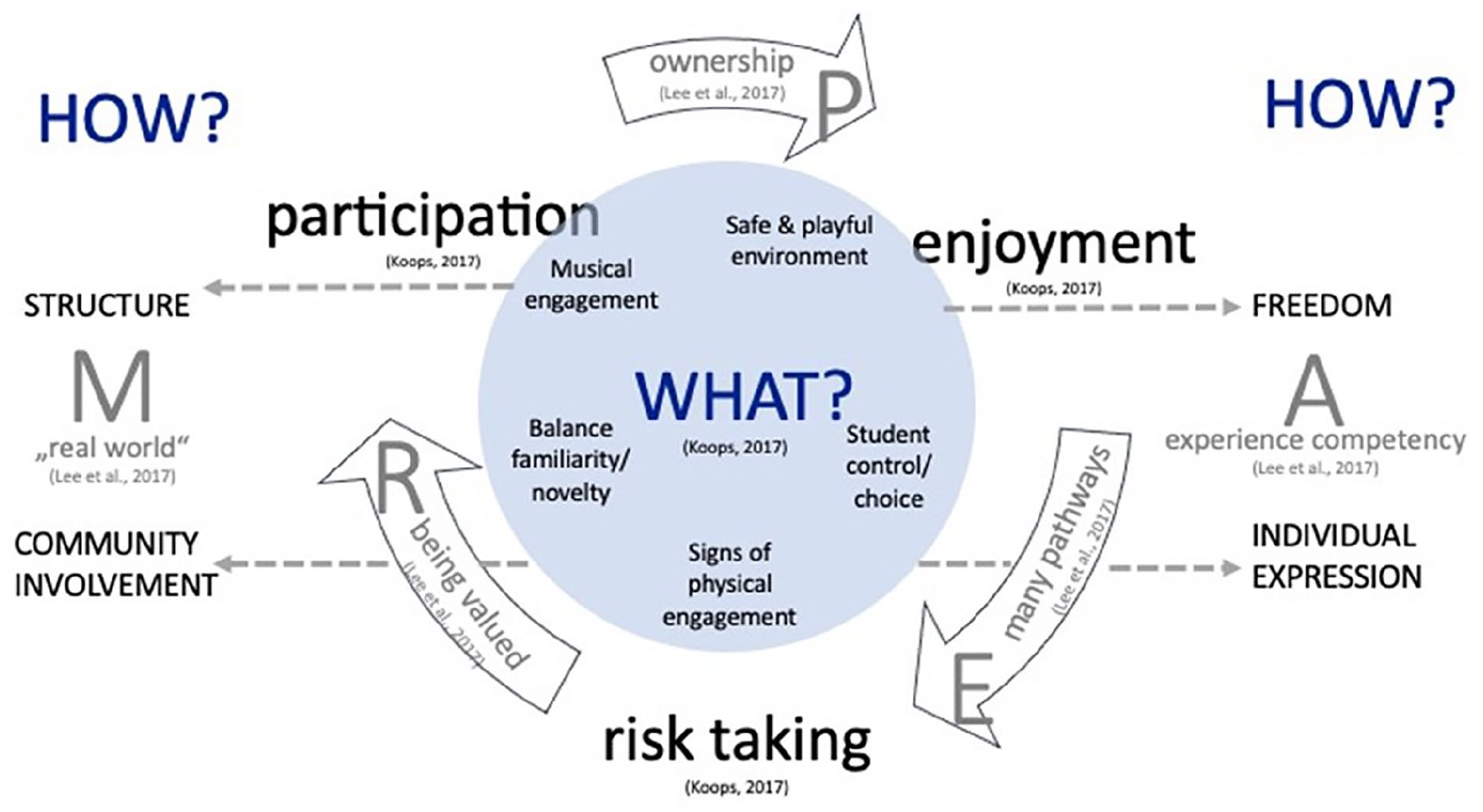
‘PERMA-Enjoyment-Cycle’: children’s music-related wellbeing (own representation synthesised from Koops, 2017; Lee et al., 2017).
Discussion: Interplays, inclusion and individual goals
The PERMA-Enjoyment-Cycle (Figure 3) points out that (1) musical ownership, (2) offering a variety of pathways and (3) the feeling of being valued are pivotal. Offering many pathways enhances risk-taking, being valued leads to student participation and facilitating ownership leads to enjoyment, which in turn leads to vital interactions offering many pathways and so on. Upon reflecting on this model, three themes became apparent: Interplays, inclusion and the eminence of individual goals.
Interplays
The model displays how the interplay between participation and risk-taking is essential for music-related wellbeing. This interplay is situated in another constant interplay also described elsewhere (Buchborn & Theisohn, 2022; Schmid & Doerne, 2020), that is, the interplay between structure and freedom, interlinked with balancing community involvement and individual expression. Accordingly, for Boyce-Tillman (2020) to encourage eudaimonia means individual empowerment, but also a focus on communal enterprise (p. 82). She emphasises teachers’ competencies to balance group dynamics (Boyce-Tillman, 2020, p. 77). Hence, for wellbeing in the music classroom to flourish, it is crucial to consciously orchestrate diverse social constellations (Schmid, 2014, 2019). The preparation of a feasible social dramaturgy via explicit role allocations could be the decisive factor in student risk-taking, for example, when composing or improvising with children.
Inclusion
A second recognition points to decidedly offering many pathways, inducing student participation by fostering risk-taking. This is relevant to inclusive approaches, focussing on student engagement (Burnard et al., 2017) and social-emotional learning (Allan, 2022). Another essential prerequisite for inclusion is that children’s enjoyment becomes manifest in a safe and playful environment. This underlines (a) the relevance of safe spaces in music education (Hendricks et al., 2014) and (b) the importance of playfulness as a design principle (Schmid & Doerne, 2020; Spring-Keller & Schmid, 2015). (a) Safe spaces: a model of ‘safe spaces for music learning’ emphasises teacher attitudes towards fostering trust and thereby risk-taking (Hendricks et al., 2014, p. 35). Music teachers’ roles shift; the nurture of musical flourishing becomes an act of care. (Holdhus, 2023, p. 421) (b) Playfulness: currently a field of discussion in digital media/ popular music in the classroom, musical situations are regarded as an assemblage allowing for ‘a playful understanding between people’ (Arculus, 2020, p. 62). The freedom to play around with musical material, that is, to ‘tinker’ (Spring-Keller & Schmid, 2015) and play with musical affordances seem vital for music-related wellbeing, for example, when implementing music apps to perform compositional tasks. Thus, music-related wellbeing is a highly inclusive teaching objective.
Individual objectives
By emphasising ownership and student control, the PERMA-Enjoyment-Cycle also aligns with the capability approach (Sen, 2011). This approach defines wellbeing regarding the individual’s capability. Accordingly, latest findings show that the more students can develop individual participation goals, the higher their domain-specific wellbeing (Hasselhorn et al., 2022). To foster music-related wellbeing, it seems central to allow leeway for children’s personal goals within the classroom. In this way, primary school children create their own tasks at any level of complexity at which they strive to participate, for example, in body percussion circles. Krupp-Schleußner (2019) claims that the success of musical education programmes could be evaluated by the extent to which students achieve their individual participation goals. The results of this review underline this advocacy, accentuating music as a valuable social practice for the individual lifestyle (Krupp-Schleußner, 2019, p. 96–97). Or, quoting 9-year-old Kevin again: ‘Music is there to make me happy’ (Schmid, 2014, p. 299). Until now, the design of the educational setting that fosters this ‘happiness’ has had little conceptual foundation, as it was not regarded as a ‘proper’ teaching objective.
Conclusion: Music education, music therapy and social change
Considering the advocacy for music as a facilitator for human wellbeing (Hallam & Himonides, 2022) and enhancing enjoyment in the music classroom (Koops, 2017), the review revealed that there are still few studies that focus on primary school-aged children and/ or provide concrete recommendations for the design of educational settings. It has become clear, though, that models such as the PERMA-Enjoyment-Cycle can function as points of reference for practices in the music classroom. Future research could use the model as a starting point for design principles in a design-based research approach, sorting out how robust these ‘principles are across contexts’ (Bakker, 2018, p. 189). Qualitative research could focus on wellbeing, employing child-oriented interview techniques and videography. Large-scale mixed-methods studies adopting wellbeing as a domain-specific construct could examine how the concept oscillates between short-term happiness (state) and sustainable life happiness (trait). The next steps could be another review extending the sample to 2020 to 2023 and further development of teaching designs enhancing music-related wellbeing. Throughout this process, interdisciplinarity will be essential, and the lines between music education and music therapy must be well-reflected:
In a qualitative study on Music Education and Music Therapy, Mawby (2015) found that practitioners saw music education as teacher-led, predominantly focussing on musical goals, ‘whereas music therapy is more child-led and predominantly focuses on non-musical goals’ (p. 6). Looking at the ‘PERMA-enjoyment cycle’, this dichotomy might be questionable. Firstly, the model suggests a ‘more child-led’ focus in music education. Secondly, if music-related wellbeing can be an educational objective regardless of ‘special needs’, the question arises of what ‘non-musical goals’ are. In situated musical interaction (e.g. role-taking or respectfully listening to each other), every ‘doing’ may be generically musical. Music education might then have to reflect upon the entangled affiliations with music therapy, which this paper can barely begin to sound out.
One implication of this study is to regard music educators as facilitators of music-related wellbeing. It would require a shift of perspective to implement models like the PERMA-enjoyment cycle or the Arts Education and Social and Emotional Learning (SEL) Framework. 8 This would also imply a shifting of roles. Professionally, music educators cannot interfere with therapeutic processes, yet it is critical for music educators facilitating music-related wellbeing to reflect upon them. The definitions of music education and music therapy usually refer to primary objectives. Nevertheless, recent publications by Smith and Silverman (2020b) or Hallam and Cuadrado (2019) account for secondary effects as inherent to the discipline. Perhaps music education will have to contemplate music-related wellbeing as a primary effect instead. Biesta (2013) refers to human flourishing as a central objective for musical interaction with children. And while I was writing these lines, Silverman (2023) called for music education to ‘reclaim happiness’ (Silverman, 2023), that is, to ‘purposefully make collective happiness not only an aim of music education, but also a concrete reality in every music teaching’ (Silverman, 2023, p. 15). I could not agree more. This is especially relevant, both in view of future settings as transdisciplinary co-created possibility spaces (Burnard et al., 2017), and of putting children’s wellbeing in the context of environmental and social issues (T. D. Smith, 2021). In these crisis-ridden times, music education cannot refrain from taking part in societal transformation, even if that entails revisioning what music learning means.
Footnotes
Author contribution
Silke Schmid: Conceptualisation; Data curation; Formal analysis; Investigation; Methodology; Project administration; Resources; Supervision; Validation; Visualisation; Writing – original draft; Writing – review & editing.
Funding
The author received no financial support for the research, authorship, and/or publication of this article.
