



Abstract
In higher music education (HME) contexts, free improvisation is currently a rapidly evolving field across musical genres. Previous research indicates that teaching and learning improvisation can be challenging, depending on students’ experience and how improvised music-making is facilitated, but few studies address free improvisation in HME. Our study has explored this field by utilising qualitative interviews with teachers of free improvisation in European HME institutions. Results provided insight into teachers’ motivation and the educational aims which informed their approaches to teaching improvisation. Some teachers referred to a canon of free improvised or experimental music and well-known improvisers, interpreted as a need amongst the teachers to position and legitimise a potentially marginalised subject within institutions. Teachers in our study used different types of frameworks to develop students’ ability to interact and listen. Focusing on musical parameters, limitations of choices or language metaphors were often used as tools for acquiring such aims. Results further indicate that free improvisation should be a safe space, enhance democratic values and disrupt hierarchies of knowledge. In sum, our study contributes to mapping and understanding contradictions and complexities of this developing area of pedagogy.
Keywords
Introduction
Musicians across genres are increasingly expected to be able to improvise, and in Higher Music Education (HME) contexts, improvisation teaching is rapidly evolving to address this need. Improvisation has traditionally been taught as part of western jazz curricula, but it is progressively becoming part of western classical music training (Heble & Laver, 2016). Historically, these and other genre domains have developed different conventions for the role and performance of improvisation. Pedagogies of improvisation will vary accordingly. Tensions such as the one between tradition and liberation (Johansen, 2019), structure and freedom (MacGlone & MacDonald, 2018) and between the individual and the collective (Lewis, 2000) represent pedagogical challenges that may be dealt with differently depending on genre traditions. At institutional levels, such differences may cause friction between various interests and pedagogical values (Johansen et al., 2019), especially if improvisation subjects are treated as silos of knowledge within each genre domain (cf Gaunt & Westerlund, 2016). Traditional hegemonies and hierarchies in the conservatoire culture (Perkins, 2013) may be provoked when decisions about teaching content and learning objectives have to be made, whether the pedagogy draws on jazz, classical or free improvisational performance practices.
This article presents a qualitative study of teaching practices of free improvisation in HME institutions, with the aims of (1) investigating micro-practices within the teaching of free improvisation in European HME institutions through qualitative interviews, and thereby (2) contributing to developing reflective and inclusive practices in teaching free improvisation across genres in HME.
In the following section we expand on challenges identified in previous studies.
Background: Teaching (for) improvisation in formal education contexts
One example of the increased attention to teaching free improvisation is a recent ERASMUS+ project, METRIC, (Modernising European Higher Music Education through Improvisation 1 ), which brought 15 conservatoires together with the purpose of investigating and sharing approaches for teaching improvisation. Other aims were to modernise HME through: (1) Considering how curricula, in both improvisation and performance could be modified in light of new knowledge and (2) supporting development of improvisation teaching, performance and research.
In contrast to formalising improvisation pedagogy as suggested above, ways of learning to improvise have been suggested to resemble informal learning (e.g. Hickey, 2015; Lewis, 2000; Rose & MacDonald, 2016). In this context, participation in communities of musical improvised practices is seen as more important than following prescribed curricula (de Bruin, 2019). In a study of the learning trajectories of expert improvisers, informal learning approaches were recommended in order to develop independent, co-operative and collaborative expertise (de Bruin, 2019). It is therefore interesting to note Wright and Kanellopoulos’ (2010) claim that improvisation provides an opportunity for students to work with aspects of informal learning within formal music education. Improvisation processes represent a ‘rupture with linearity of progress, working against reification of knowledge and glorification of received information’ (Wright & Kanellopoulos, 2010, p. 72). As such, according to the authors, working with improvisation in music education contexts may provide an arena for developing students’ critical thinking (ibid.).
Despite such goals, research reveals challenges in teaching improvisation, as indicated in the introduction. Developing critical and reflective thinking were aims of a Portuguese improvisation project (Costa & Creech, 2019), however, the students showed resistance and their fear of failure became a hindrance for their engagement (ibid.). Other studies have similarly identified improvising for classical musicians to be experienced as risky (Varvarigou, 2016), and making choices in free improvisation felt overwhelming to a group of young musicians in a study by Wall (2018).
Teachers can utilise limitations or frameworks with the purpose of overcoming these challenges. The creation of musical boundaries helped students in Wall’s (2018) study feel more secure in their choices. Based on a study of how to reduce fear in improvisation classes, Alexander (2012) suggests a curriculum containing structured exercises as appropriate for this purpose. In a study of an HME improvisation course, Wilson and MacDonald (2019) presented students with a framework which was a psychological model developed from their own research with professional improvisers for making choices in group improvisation (Wilson & MacDonald, 2016).
In addition to adjusting the teaching content or material to nurture and sense of safety through musical regulations, boundaries and structured exercises, the social environment in learning settings has shown to be important for nurturing confidence and reducing fear of taking risks (Siljamäki, 2022). A central goal for teachers seems to be to facilitate a safe social space where students feel confident to make choices. Confidence has been associated with working in a criticism-free environment (Shevock, 2018). This resonates with the findings in Hickey (2015), where four expert teachers in free improvisation sought to establish an egalitarian learning space to provide a sense of social safety. This was achieved by teachers taking on roles as guides and fellow improvisers, as well as avoiding evaluating the quality of student improvisations (ibid.). The optimal teacher role to nurture a safe space seems to be one that is open and flexible, where the teacher engages with students through interactions free of criticism and evaluation. From the perspective of female students in a recent study, psychological safety was proposed to be a necessary precursor for experimentation and allowed for acknowledgement of the discomfort that can be part of musical creativity (MacGlone, 2023).
An analytical framework for studying the teaching of free improvisation
Within a socio-cultural framework, internalisation describes learning of established knowledge, rules and procedures including socialisation into existing practices in order to become competent members. Externalisation may include personal expressions of acquired skills and novel creations that develop the activity itself (Cole & Engeström, 1993; Engeström, 1999).
Processes of internalisation and externalisation are visible on a collective level in improvisation practices. Development within such practices has been described as heterogeneous and multi-directional (Huovinen et al., 2011). For example, jazz has been described as historically developed through experimentation with conventions and rule-breaking (Johansen, 2018). Thus, learning to improvise may be seen as engaging in an activity that is ambiguous and open-ended (MacGlone & MacDonald, 2018), where ‘the musical outcome of a given task is not known beforehand’ (Johansson, 2008, p. 36). When musical objects are created simultaneously with the learning process, the subjects may engage in explorational and expansive learning (Johansen, 2018). Expansive learning is described as ‘the collaborative creation of new artifacts and patterns of practice’ (Engeström, 2005, p. 387), and seen as creative externalisation on a collective level. In expansive learning, the very practice or activity is being changed and developed.
Tools are culturally developed artefacts that people use to learn (and) to take part in a certain activity (Engeström, 1999), since they regulate the interaction between oneself and the environment (Cole & Engeström, 1993). Thus, they carry specific functions and meanings developed within that activity: ‘(. . .) the tools of thought (. . .) embody a culture’s intellectual history. Tools have theories built into them’ (Resnick, 1994, pp. 476–477). When utilising cultural tools, we are enabled to act and reflect in a direct or indirect interaction within the culture where the particular activity is situated.
As mentioned above, externalisation and the creation of new tools, ‘the search for novel solutions’ (Cole & Engeström, 1993, p. 41) is a crucial part of explorational and expansive processes. Descriptions of how tools are developed and the motivations that drive their development may give insight into cultural and social meaning within this activity.
Based on this account of background and theoretical concepts, we phrase the study’s research questions as follows:
RQ1: What conceptual tools do teachers in free improvisation use in different HME institutions in Europe?
RQ2: How may these tools relate to different cultural and educational values?
Methods
We chose a qualitative methodology as best suited to investigate teachers’ subjective views of their practice. We used a purposive sampling approach to recruit expert participants for qualitative, semi-structured interviews (Kvale & Brinkmann, 2009). A list of teachers was created from a combination of personal contacts and an internet search of European Conservatoires for relevant staff. A total of 55 teachers were contacted by the researchers with an invitation to participate in the study, with 12 accepting.
All interviews were held and recorded on Zoom (Yuan, 2021). The first five interviews were conducted with both researchers present, and the seven remaining were distributed between authors. The interviews were transcribed and participants were anonymised by replacing names with pseudonyms. Using the software programme NVivo (QSR, 2014), transcripts were subjected to a thematic analysis following guidelines from Braun and Clarke (2006, 2021). The process of thematising transcripts is recursive between levels of coding and organising themes (Braun & Clarke, 2021). Firstly, codes representing a single idea are identified (e.g in this data set, develop listening). Secondly, subthemes created from codes grouped together capture specific dimensions of themes (e.g. in this study, safe space encapsulates the teachers’ intention to create an environment where all can participate freely). Thirdly, themes circumscribe a key pattern in the data.
The authors coded the data and created subthemes separately. They then discussed all of the coding and sub-thematising together. Through this analysis, the following three themes were jointly created: Motivation; Frameworks; and Cultural-Historical Repertoires
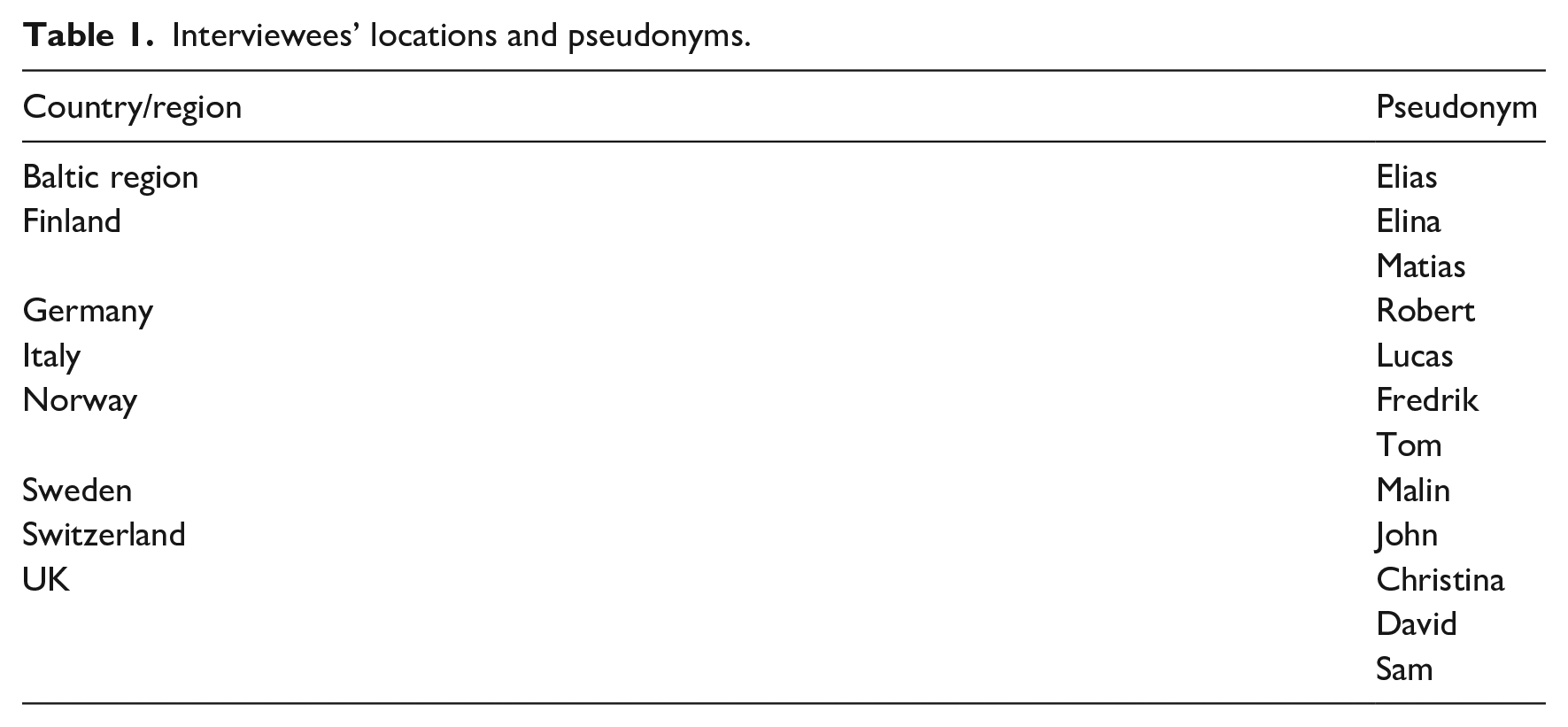
Table 1 gives information about the country/region and pseudonyms of participants.
Interviewees’ locations and pseudonyms.
In the following section we turn to the study’s results.
Results
This section starts with a brief account of the courses and students the participants are teaching or have taught, followed by the themes we identified.
Courses and students
Courses were mostly mandatory, in mixed-genre groups and at times with different study programmes (e.g., community music, music education, performance). Teachers reported that students’ genre backgrounds impacted the ways in which they engaged with course activities. Fredrik stated that ‘for [classical students], just producing a sound based on their own listening and their own imagination is extremely hard’. John proposed, in contrast, jazz students were confident, especially in solo improvisation. However, they still had to learn to be more open ‘to new horizons, and new types of sounds’. While the teachers outlined the challenges in accommodating a wide range of students, they spoke of it positively. For example, Tom proposed ‘I (. . .) find that for that course to work properly, like now when there is (. . .) diverse backgrounds, is when it does work best’.
Motivation
The first theme refers to teachers’ incentives for pedagogical choices, pertaining to their overarching teaching aims and values.
Aims
Teachers expressed their aims for students as developing broad and complex skills; for example, musical awareness, interacting and listening were considered key skills for improvisers. Tom said: ‘The aim of the course isn’t to play a specific form of free improvisation (. . .) the aim is to discover ways of listening and interacting, so that they can spontaneously create music, together’. Matias spoke about the importance of students improving ‘the speed of thinking, your attention, how you can spread your attention, beyond what I’m actually doing’, or put another way, improving students’ ability to appreciate and process what others play, at the same time as playing. Elias described the ability to hear and process another’s playing and make decisions based on this musical information very quickly as a necessary skill for expert improvisers: ‘this is like my secret that you need to [make] faster decisions than they [the other players]’. The ‘secret’ of his was mentioned in the context of a performance experience where Elias perceived his duo partner as vying for musical space. After this experience, he included developing a ‘faster’ and competitive mind-set as a goal in his teaching.
Matias outlined an aim related to improving perception and memory while improvising: ‘You need to remember what (. . .) happened five minutes ago, or ten minutes ago, and then be able to come back to things (. . .) in the infrastructure, musical structure’. This ability to respond in the moment but also to bear in mind the overarching musical structure demands that students are creative on two levels; firstly, what notes or musical gestures they play, and secondly, to be aware of how this may work with or against a structure.
Some teachers recommended that developing these complex combinations of skills was best done gradually. Fredrik explained:
it makes sense to have two or three different things that they should develop. . . the listening, and for the classical students to get to know their instrument from a different angle and to dare to produce sounds that they don’t know from before (. . .). that’s enough for them
In addition to mentioning listening, it was important to give classical students, in particular, the time to mature as improvisers and develop the courage required to use their instruments in a different way. Courage in this context can be understood as students expressing their own musical intentions in a collective development instead of following a score, as well as using their instruments to create sounds in unconventional ways.
Process, product and who decides what’s good
Perhaps because the aims in the previous section were processual goals, such as listening, interacting, attention and speed of thinking, process was generally emphasised more than product. For example, Fredrik expressed that ‘it’s not about creating fantastic music (. . .) but more about listening, and how we work together and not about the quality of the music we produce’. John linked his similar view with a more general trend in education: ‘In the last 70-80 years, [it has] shifted from goal [orientation] to process [orientation]’, most likely referring to the development of a humanist philosophy in education, as opposed to behaviourism or rationalist pedagogy (DeCarvalho, 1991).
Despite the orientation towards process, ‘quality’ was viewed in contrasting ways. For example, Elias quoted a colleague who proposed that music beginner improvisers created was ‘shit’ and improvisation teachers had to be able to ‘put up with it’. This view may be due to students’ inexperience, Elias said, adding that according to his colleague, ‘no one can immediately create such a high quality of ideas’. He did not say if he shared his colleague’s assertion that a lesser quality in students improvising was something a teacher had to endure; but his statement can be interpreted as that this attitude exists, at least for some teachers. Elias’s interest in bringing it up may be to highlight that students should have time to develop their creativity.
Elina represented a contrasting teacher position, when she said that ‘I can notice beautiful moments with how the other people (. . .) in the classroom, how (. . .) they give space to each other (. . .) from those moments I can learn a lot of new things also’. This indicates a different and perhaps wider view of what constitutes quality than Elias’. Where Elias talked about the sonic product, Elina’s description may be interpreted as locating quality in ‘beautiful moments’, characterised by aspects of communicative processes as well as a situation’s affordance for learning.
Another contrast between Elias’ and Elina’s position pertains to teacher role. In Elias’ emphasis on product, it seems that he saw the teacher as the most qualified judge of quality, indicating a hierarchical view. Elina referred to students as ‘the other people in the classroom’, and highlighted how she could learn from observing students’ playing. Thus, she positioned herself like a peer to students. This connects with a view John expressed as: ‘it’s not only me who has to judge what is good music and what not’. By this, he referred to the importance of enculturing an environment where students develop their own critical skills by not imposing his own opinions.
David mentioned a dilemma regarding appreciating and assessing quality, connecting it to demands of grading students.
I am trying to get away from this (. . .) bogus notion of meritocracy that exists within education where we say “this work is an 85% and this work is an 82%”.
2
(. . .) it is making a false illusion of meritocracy and a false illusion of teacher objectivity (. . .) I have to give everything a mark so there is a bit of a paradox here.
Meritocracy refers to the belief that people are rewarded or have success based on their merits, a view that David finds problematic, especially within music education. From this quote, it seems as David’s ideal teacher position resembles that of John and Elina, but the institutional system forces him to go against it and ‘[grade] people’s creative work’.
Safe space
As identified in the background to this article, establishing a safe space for students is seen as a crucial task for improvisation teachers. In previous studies, this may involve creating a learning space where evaluation and criticism is avoided. These values resonate with the teachers in our study. For example. Matias proposed that creating a ‘safe space’ for students ‘[is] part of my job’. Sam claimed he had a ‘heightened responsibility’ as teacher to recognise ‘student comfort levels’. He facilitated this musically: ‘I give demonstrations (. . .) identifying all the levels at which somebody might be able to participate or might want to participate’. Sam also addressed potentially problematic aspects of improvisation. As an example, he described a situation where some students may feel unsafe or unwelcome when other voices were loud or dominant. Sam felt that there was an underlying ‘patriarchal ethos in free improvisation (. . .) to do with soloing’. This may be understood as referring to an ideal where ability to play virtuosic solos gives you a more powerful position in a group than others. According to Sam, this ethos was an obstacle in maintaining a safe space for all students.
In common with Sam, David described the need to accommodate different levels of student confidence saying that for some he would ‘scaffold their experiences a little more robustly than I might scaffold somebody else’s’. He gave the following example:
I think conduction (. . .) is a way of structuring an improvisation but also you are scaffolding people’s improvising because you are taking a lot of the responsibility from how it sounds and how it ends.
Therefore, conducting
3
can function to create a clear structure with fewer options available for students as they have to follow signs from a leader. This may alleviate overwhelming feelings for inexperienced students wondering what to play. David speculated that other teachers may not share his approach: ‘[There is] a trope (. . .) of creating discomfort as an educational technique to try and motivate students to get better (. . .) I have never sought to’. David presented the position as deliberately wanting to create an ‘unsafe’ space as a pedagogical means, to which he distances himself firmly. His experience that such a ‘trope of discomfort’ exists, indicating that the value of creating a safe space for improvisation is not universally agreed upon. Safety was further illustrated by Elina:
If we are really in a safe atmosphere, I as a teacher am the same as the students. Kind of. I am not nothing, but I am giving them some info and they are (. . .) We are (. . .) There is a hierarchy. We are the same in improvisation (. . .) we really could learn things from each other
Elina points to simultaneous positions possible for a teacher in creating a ‘safe atmosphere’. While she wants to position herself on the same level as the students, she acknowledges the hierarchy between her and them. The power in her role lies in her responsibility for ‘giving them (. . .) info’ and for facilitating a safe atmosphere, but also in making the decision to position herself as an equal learning partner to them.
Frameworks
This theme captures descriptions of activities and instructions teachers used to facilitate improvisation and enact the goals outlined in the previous section. They can be understood as exercises, for example bound by time. Malin described how she may begin with ‘very strict frames, which have mostly been about time length, three times two minutes’ Lucas presented a similar exercise, such as an instruction to play for five minutes. Elias used ‘different interval exercises, seconds, thirds and bigger intervals, so that, for every instrument, the aim of this is to study what you can do with this’. He described his method as being influenced by Martial Arts teaching: ‘I was taking a lot of the similarities, technical elements and putting things together and playing with them, not all together, but some limitations and so on, it’s helped me in music’.
Contrasting approaches were found. For example, both Lucas and Fredrik described beginning lessons with a request for the students to play freely, basing subsequent activities on their assessment of the student’s playing. Lucas used this as a way of getting to know student’s skills and ways of expressing themselves, while Fredrik was seeking to find out what would help them develop their listening and courage to produce sound. Similarly, Christina emphasised how developing improvised structures could be student-led and socially negotiated in an open improvisation, without starting from a teacher-led task.
Robert described such open starts of a free improvised session as a ‘just play’ approach, which he found frustrating. Instead, he emphasised the importance of starting from set limitations. He often began classes with a warm-up, drawing from improvisation theatre. Such exercises prioritised interaction across different modes of communication (e.g. movement) in addition to music. He viewed this as providing a space for students to practice concentration and responsiveness in a low-stakes activity. Elina and Sam also utilised movement. For Elina, movement exercises led to a relaxation of the body, and through this preparation she observed that it was easier for students to express their creativity, especially beginners.
Even if teachers’ approaches to beginning an improvisation class varied, all teachers described using limitations and set frameworks in their teaching, as means of focusing improvisation activity. As with Robert and Elina, Matias used theatre and movement activities, explaining that they provided more tangible, concrete references for students who were unused to thinking about music in an abstract way. An example of such an activity was to use adverbs as limitations or starting points. Matias then asked students to add an emotion to explore how they might extend their playing: ‘So you can have a lottery raffle with words and adverbs!’
Conducting is a tool used for improvising ensembles, through for example, systems such as Soundpainting developed first by Walter Thompson (Millà, 2021), or Conduction, developed by Butch Morris (Stanley, 2009).
4
It was positively mentioned by David, however, Lucas problematised it as follows:
I have a problem with conduction. (. . .) because I come from a political experience of dictatorship. To my students, I say the best form of control is self-control, so once you’re able to control yourself, the control amongst [people] in the group becomes much easier (. . .) the control of the conductor can be, for me, a problem, it can restrict the creativity.
Lucas positions students’ taking responsibility for their own musical impulses within the context of the group as crucial for building awareness and an overarching control within the group. He positions a collective form of control as preferable over a conductor’s, perhaps because of his lived experience, but also for the possibilities for collaborative creativity (Barrett et al., 2021).
Cultural-historical repertoire
This theme explores ways in which teachers utilised existing repertoire anchored in a tradition of improvised and experimental music. This repertoire could be articulated as professional knowledge of approaches to improvisation derived from well-known improvisers and experimental composers.
The canon of free improvisation
Canon is a term adapted from classical music and it often refers to a selection of what are considered great historical works (Weber, 1999) and the ‘existence of musical masters’ (Redhead, 2011, pp. 1–2/9). Teachers in our study often referred to well-known improvisers and experimental composers and their works. For example, Tom used exercises from John Stevens’ book Search and Reflect (Stevens, 1985), where he combined the exercises from the book with historical contextualisation of Stevens’ performance and workshop practices (see Toop, 2008). Tom stated that: at some point the people creating this music in the ‘50s and ‘60s won’t be around, so it’s important to have this historical aspect of things and knowing how this music came about, and how they (. . .) I guess the canon, (. . .) And historically informed practice, as well.
Tom’s framing of free improvisation as an historically informed practice and ‘knowing how this music came about’ aligns with Redheads identification of ‘musical masters’. Including an historical perspective may have had the purpose to make students feel that they were part of a continuing practice of experimental music. As well as functioning as enculturation, through positioning John Stevens and his legacy in the forefront, the pedagogical outcomes from Steven’s exercises were important. In Tom’s view, they are made in such a way that they limit the amount of things one can think about, and make the improviser focus on immediate responses: ‘I mean, in most of [the exercises] you have to react intuitively, so (. . .) you’re not listening and thinking about how to respond and what to play, because then the moment’s lost in a way’.
Fredrik provided a counter perspective, describing his reasons for moving away from using recordings: ‘I discovered that quite soon that the students tried to play in the same manner. And since I don’t want this to be genre specific, it’s better not presenting anything’.
Instead, Fredrik used pieces which accommodated student’s genre backgrounds. For classes comprised of all or nearly all jazz students, he used John Zorn’s Cobra (van der Schyff, 2013), as he saw it creating opportunities that suited these students. He appreciated its game-like quality; that it afforded explorations of small sections and awareness of one’s own impulse to play; and strategies such as conducting. For classical students he described presenting Webern’s Passicaglia (Opus 1) to demonstrate collectivity and how a single-line melody can travel through an ensemble, with the aim that this interactivity could be transferred to group improvisation. He explained his choice as follows: ‘Because it helps them to see that it’s (. . .) a more collective kind of playing situation, and not a soloist that is bursting out of their own inner (. . .) something’.
Malin proposed that students could usefully gain a sense of their own musical identity before finding out about others’ work:
I try to break up hierarchies, it feels so typical that we establish “schools” in something that is supposed to be free. (. . .) for (. . .) a beginner (. . .) then maybe it is more exciting to get the tools, try and then you realise that “yes, there is a long tradition, and I know that now”. Then you also become more fearless (. . .) If you immediately get a canon (. . .) or a norm to follow, then you are afraid to make mistakes.
Christina’s syllabus also included esteemed improvisers, but she felt it important to contextualise and even problematise aspects of their practices. For example, she described Pauline Oliveros as an important feminist role model, but also that Deep Listening (Oliveros, 2005), was influenced by Inuit cultural practices, which she thought had not received proper recognition. She also utilised critical analyses of pieces by Cornelius Cardew, viewing this as an opportunity to allow students to evaluate his use of ‘rule books’ (Cardew, 1970). Therefore, rather than treating pieces and improvisers’ approaches as unquestionable, she presented these with the aim of developing student’s criticality and aesthetic identity. Sam shared a similar view and expressed that he wanted to ‘find a balance between a motivation to make sure that the sort of canon of work I was presenting was diverse and representative. But also not having that be the sole motivation (. . .) because [the canon] should be embedded, not tokenistic’. By ‘tokenistic’, Sam refers to the strategy of superficially including certain works or persons into a syllabus by virtue of representing a particular and often minority category to ensure diversity. Thus, they may not be treated with the same professional interest as majority representatives. Nevertheless, he acknowledged that diversity needed to be considered.
Discussion
In this study we investigated the use of conceptual tools in teaching free improvisation in European HME institutions (research question 1). We also examined how the usage of these tools as well as teachers’ reflections and justifications of this usage may be related to cultural values and beliefs (research question 2).
Two categories of conceptual tools were prominent, Frameworks and Cultural-historical repertoire. Tools had distinct purposes tailored to developing broad and complex skills or abilities. Frameworks involved various forms of musical limitations, for example, time length or a limited set of intervals. Other types of frameworks involved multimodal expressions, such as theatre and movement exercises and word games. Conducting was a third type of framework. All had the common purpose of limiting choices for the students. With multimodal exercises, students worked to various degrees away from their instrument, therefore, this approach is a way of eliminating the high self-expectations of performance level that students can associate with their main instrument. Conducting has the advantage of removing some degree of responsibility for making choices away from the musicians in a group to the conductor.
Limiting choice, removing high achievement pressure associated with the instrument, and reducing responsibility all functioned as tools for related purposes, such as building confidence and awareness of others. Theatre and movement exercises were used to create a transferrable and embodied understanding of processes such as imitation and interaction. These tools were also used to reduce the stress and feeling of being overwhelmed that previous studies have confirmed may be associated with free improvisation (e.g. Siljamäki, 2022; Wall 2018).
We argue that these purposes are mainly processual and directed towards developing situational abilities, rather than being product-oriented. While developing a skill may be seen as product-oriented towards a predefined level of performance, situational abilities are concerned with navigating the changing musical situations at hand. In this, the subjects have to simultaneously make meaning of the improvised course while contributing musically. Two key examples of such abilities were interacting and listening. Both of these were described as having multistage processes, consistent with literature on improvisation (MacDonald & Wilson, 2020).
Included in the repertoire of teaching tools, teachers drew on certain well-known works and persons in the history of free improvisation. This was partly done for their pedagogical affordance, but also with a canonical function, that is to teach students about these particular works and persons, positioning them as historically central. Some of these were musical (Cobra and Passcaglia) and were used to demonstrate principles for organising group improvisation. Others, for example, Deep Listening, Treatise Handbook, Search and Reflect, were used to enable reflection or to organise the teaching in the form of concrete exercises. On another level, we argue that the reference to such works or performers mediates a narrative about belonging to a continuous, historical practice. This aimed to contribute to students’ contextual understanding of the principles and ideas they were learning, but in addition it may be seen as means to validate a practice by inciting the existence of a canon. According to Redhead (2011, p. 2/9), the notion of canon rests ‘in the idea that a knowledge or appreciation of the work of some composers is necessary to make a claim for the appreciation of music itself’. Using Redhead’s idea as a theoretical lens it is possible to imagine that teachers felt they needed to validate free improvisation by presenting certain material and selected performers as canonical, indicating the subject is potentially marginalised in HME.
However, the teachers were not unified in their use of or attitudes towards such tools. We demonstrated how some teachers used exercises to establish a sense of safety, concentration and awareness, while other teachers preferred to start openly and let musical frameworks emerge from students’ playing. The latter approach may be seen as risky (imposing too much choice before students have confidence). It may also be seen as showing reluctance to over-scaffold students’ experiences. On the other hand, open beginnings may be an expression of a common norm, namely a preoccupation with democratic ideals. This leads us to discuss how teachers’ conceptual tools are related to cultural values. Standing back as a teacher and giving students initiative to start an improvisation, may be seen as aiming to reinforce their agency. Democratic ideals and views of student agency have bearings on the teacher role, and judgements of quality. We have discussed different conceptualisations of quality, whether product or process were emphasised, and the discrepancy in the way teachers positioned themselves regarding evaluation and views on what counted as ‘good’. For example, teachers emphasising process and students’ own ability to critically assess the quality of their playing, and even critiquing the myth of meritocracy, seem to prioritise egality between them and their students. However, one teacher (Elias) described a more hierarchical view regarding quality in students’ improvising and positioned the teacher as the best judge of this.
While collective control and social responsibility were emphasised as preferable to that imposed by a conductor, conducting could be used as a tool for scaffolding and limiting choice. This is an example of how a tool in itself is neither positive or negative, but where looking at the intent with which it is used is more relevant for understanding its function. The wide array of pedagogical approaches aligns with previous research which found that professional improvisers created their own ‘pedagogical narrative’ (MacGlone & MacDonald, 2018).
Returning to socio-cultural constructs of internalisation and externalisation (Cole & Engeström, 1993) in improvisation teaching and learning, these processes may be identified as follows. In our study, objects such as key musical or pedagogical works and important improvisers were only introduced in some teachers’ practices. For some, these objects were seen as important knowledge to preserve. For others, canonical elements were introduced as tools to inspire students’ own creative explorations, and performers and composers were often subject to critical engagement. The improvisation canon was also a site for exploring ideas of appropriation, power, decentralisation and flexibility to ensure diversification.
Nevertheless, invoking the idea of a canon, even for the purpose of strengthening the position of a potentially marginalised subject, is problematic. Especially within the sociology of music the notion of a canon is heavily criticised. It is seen as a social construction that perpetuates taken-for-granted musical values, creating hegemonies by privileging some works or figures (often male) over others without critique (DeNora, 2003; Weber, 1999). Canon is regarded as being used with a capitalist agenda, ‘seen, for example, in the repeated programming of ‘big name’ composers whose names will sell seats’ (Redhead, 2011, pp. 2/9). The nature of a canon is however, in conflict with the values suggested by Wright and Kanellopulous (2010) outlined in the introduction, who claimed that improvisation challenged ‘reification of knowledge’. The danger is that as improvisation becomes more accepted, the lens through which its understood and practiced may ossify the invention and use of creative tools, and thus inhibit the critical attitude Wright and Kanellopoulous advocate.
Such critiques also resonate with some of the teachers’ resistance against canonical knowledge in free improvisation. Certain teachers adopted a critical stance towards power hierarchies, and a desire to challenge them. The canon was viewed as representing privileged and fixed ‘schools of knowledge’, functioning to inhibit creativity. They proposed that students were able to play with improvisational tools without knowing canonical works, and that it is easier to build confidence when avoiding setting a certain standard of quality through historical models.
The variation we found may appear like contradictory ways of engaging with the canon. Nevertheless, we may see a commonality if we avoid seeing this variation as being ‘for’ and ‘against’ internalising a set of culturally and historically reified objects and procedures (Johansen, 2021; Wenger, 1998). Rather, what is intended to be internalised, is a mind-set where experimentation and developing one’s own voice is the norm. Improvisational knowledge is situated and emergent; engaging with historical objects in free improvisation practice may be seen as learning to develop a critical stance and to challenge the established instead of just accepting what is presented as given. This in effect encourages collective externalisation and expansivity.
Implications
Our study’s results lead us to suggest several implications. Firstly, this study contributes to a deeper understanding of a European teaching practice in free improvisation, its categories and functions of the tools that have been developed and refined over the last 30 years. We found distinct practices with many conceptual tools, which corresponded to diversity in motivations and objectives. We claim that the field of free improvisation and its pedagogy is by definition explorational and expansive. Although teaching improvisation holds many educational challenges, it offers a rich potential for students in HME by developing musical, creative and personal qualities as well as critical thinking embedded in creative music making. Such capacities have been proposed as important for students in previous literature (Rink et al., 2017), and this paper offers insight into how these may be mediated by teachers in ways that embody inclusivity and reflectiveness in higher music education.
Footnotes
Author’s note
Guro Gravem Johansen is now affiliated to Ingesund School of Music, Karlstad University, Sweden.
Funding
The author(s) disclosed receipt of the following financial support for the research, authorship, and/or publication of this article: This research was supported by an Athenaeum Award from the Royal Conservatoire of Scotland and funding from CEMPE, Norwegian Academy of Music.
