




Abstract
This paper discusses an inquiry-based school-university partnership project conducted by history and music education specialists in Scotland. The project was music-led with history underpinning it, namely the musical migration of Scots and Irish to the Eastern United States. From the 18th century onwards thousands of Scots and Irish moved to Appalachia – ‘the wayfarers’ in our title. Their heritage now features in the Scottish school curriculum. However, the wayfarers encountered a range of challenging factors, including forced migration and segregation, which are not yet fully considered in schools. To address this need we co-developed resources with a specialist school to enhance secondary school practices surrounding music education and pupil engagement with challenging histories. This paper critically considers the project stages, supported by secondary and primary sources, including group interviews. In the conclusions we make suggestions for future policy, research and practice, such as to frame traditional songs in schools in their historical context.
Keywords
Introduction
This paper discusses an inquiry-based school-university partnership project conducted in 2021 to 2022 by a team of music, music education and history specialists based at the University of Glasgow, the Royal Conservatoire of Scotland and The National Centre of Excellence in Traditional Music at Plockton High School. The historical context of the project was the musical migration of Scots and Irish to the Eastern United States. From the 18th century onwards thousands of Scots and Irish moved to Appalachia. These were ‘the wayfarers’ that we refer to in our title, and their heritage now features prominently in Scottish education. It is present across all stages in the Scottish curriculum and the National Qualifications (Education Scotland, 2022a, 2022b). The wayfarers encountered a range of historical factors which are considered as challenging for many schools to explore today, including forced migration, slavery and segregation. These factors are not yet fully addressed in contemporary Scottish schools. It was partly to contribute to the growing demand for resources in this area that the project was undertaken. Teachers are not shying away from these complex and challenging factors, as witness their keenness to be involved in the project, but there seems to be a lack of innovative resources to engage with these issues with their pupils. As such an interdisciplinary partnership project, one which drew on history and music, was deemed appropriate to investigate these issues across the disciplinary boundaries of National Qualifications. With the first author having recently established an international network of scholars, performers and stakeholders in traditional music, this project deployed the wayfarers’ musical heritage to confront challenging historical issues, partnering with a specialist secondary school that focusses on traditional music. We drew on prior research on addressing challenging histories (Tonner, 2016) and on the uses of music for social purposes (Odena, et al., 2016; Odena, 2018a, 2023). Guitars, mandolins, fiddles and the other instruments that make up a contemporary traditional band resonate with sonically encoded narratives. Our project co-developed a series of resources, including original song arrangements with students at The National Centre of Excellence in Traditional Music (NCETM). 1
There is a growing number of scholarly studies on music learning in the related pan-Celtic musical traditions of Scotland and Ireland, including with a focus on amateur adult fiddlers (Cope, 2002, 2005) intergenerational Scottish pipe bands (e.g. Waldron & Veblen, 2020) and online traditional music communities (e.g. Bayley & Waldron, 2020; Waldron, 2009, 2016). There is also a plethora of teaching materials and resources such as Scottish song books and sheet music offered by specialist music businesses (e.g. https://musicscotland.com). Most of the above studies and resources, nevertheless, are focussed on out-of-school and informal contexts with adult learners. There is a need for more research on the processes of musical learning of vernacular/folk musics in formal contexts such as schools, to assist practitioners reflect on how best to support their students and we hope our work contributes to address this gap.
Following the introduction, this article is divided into four sections. The next considers the wayfarers project background drawing on historical and musicological sources. Following that is a section on music education in Scotland that will place the background section in our current educational context. In both sections we draw on music literature, which we seek to connect to relevant ideas from music education. Then we discuss the project itself, including its partnership approach. We pay attention to the selection of songs students worked with and consider the students’ experiences as reflected in group interviews. In the conclusion we offer suggestions for other researchers who might wish to take aspects of this project further, education policy makers and practitioners interested in how to address complex historical issues through traditional songs.
Historical and musical background
The 18th century saw the beginning of a circle of cultural exchange that would extend from Scotland and Ireland to the United States, and that would eventually stretch back again across the Atlantic. From the 1760s Scottish and Irish transatlantic migration increased substantially, while English and Welsh immigration would fall to less than 100,000 in the period 1701 to 1780 (Devine, 2003). It is also the case that many of the Irish immigrants were in fact ‘Ulster Scots’, the Presbyterian descendants of Lowland Scots who had emigrated to the north of Ireland during the 17th century. As Devine (2003, p. xxvi) notes, Ulster Scots were ‘part of the Scottish ethnic family, retaining strong Scots cultural affiliations and connections’. Musical instruments such as the fiddle, guitar and mandolin, would function as the mechanism of cultural transmission, and would enable these wayfarers to produce a cultural record ringing with sonically encoded narratives, narratives that speak of existential themes such as death, longing, loss and hope. In and through their songs and wider cultural practices these wayfarers narrated their migration, expressed their hopes for something better and constituted their lives in the new places that they made their homes.
Scottish and Scots-Irish emigrants to what would become the United States took with them music and storytelling that was filtered through the American experience. This would produce new, dynamic forms of cultural expression. Already in 1665 diarist Samuel Pepys had written of hearing the ‘little Scotch song of Barbary Allen’ (Orr & Ritchie, 2014, p. 16). As outlined by Orr and Ritchie (2014) this ballad, ‘Barbara Allen’, which tells the story of a pair of ill-fated lovers, Fair Margaret and Sweet William, would be published in the New World in 1836, and nowadays 198 versions of the song, with melodies from three tune families, have been accounted for.
The wayfarers project sought to enhance meaning-making in traditional music education through situating the social, cultural and historical context of the songs in more authentic ways for teachers and learners. De Nora (2000, p. 5) argues that to understand culture we need ‘an understanding of its articulation through music’ just as much as to understand music we need ‘an understanding of its place in culture’. The argument for authentic engagement in music, particularly vernacular/folk musics is not new. Small (1998, 1999) outlines that music is not a thing but rather an activity people engage with, and that the essence of music does not lie in the musical score but in taking part in social action around it. Elliott (1995) emphasises the centrality of performance and advocates for ‘curriculum-as-practicum’ in music education. And Volk (1998) advocates for teaching a broad spectrum of music cultures in schools to foster the students’ understanding of others and to gain self-esteem. De Nora adds that music ‘articulates social life and social life articulates music’ (De Nora, 2000, p. 5). It was this articulation that we sought to explore with students at NCETM, doing so in such a way as to contextualise the materials selected as exemplary of the wayfaring heritage. The existence of challenging factors was crucial in our song selection, as exemplified in ‘Dùthaich Mhic Aoidh’, a song about the eviction of hundreds of families from Sutherland in the Scottish Highlands to make space for sheep-farming during the clearances, many of whom emigrated to North America (this song is further discussed later).
A little-known fact is that the first substantial group of Scots to arrive in colonial America did so as deported prisoners of war, following the defeat of Royalist forces at the Battle of Dunbar in 1650 (see Gardiner, 2019; Gerrard et al., 2018). They would soon be joined by another group of deported Scots captured at the Battle of Worcester (1651), the final battle of the English Civil War, who were sold into indentured labour in New England. The first slave ship from Africa arrived in Jamestown in 1619, its unhappy cargo being sold there to Virginian colonists. From Africa too would come the banjo, one of the most distinctive instruments to be incorporated into various forms of roots music, from blues to bluegrass and country music (see Orr & Ritchie, 2014). The historical process of the development of roots music in the United States and Scotland, as elsewhere, was and continues to be, marked by cultural transformation and learning where musical instruments such as the guitar, banjo and fiddle, function as the mechanism of transmission. Indeed, we concur with Preston (2000) that without guitars and banjos, whole genres of modern music would not have been possible. Historical facts such as these are scarcely covered in current school curricula (e.g. Bryce et al., 2018) and so our project provided a route in to exploring such emotive subjects as forced migration, forced labour and slavery, integrating them within school resources for History and Music.
Musicians carrying on what is a living tradition now meet and perform annually in international festivals and events, such as at Celtic Connections (Scotland) and the Swannanoa Gathering (USA), to name just two examples. There is a global economy of various forms of folk, roots and traditional music, supported by some of the historic musical instrument companies that have developed in tandem with the music itself, such as Martin Guitars (founded in 1833) and the Gibson Mandolin-Guitar Company (founded in 1902 – now Gibson Guitars). Roots music typically refers to American folk music genres including blues and early jazz, country, western, bluegrass, gospel, zydeco, Cajun, Tejano and Native American. In our project we restricted ourselves to exploring the music that formed the background to contemporary country, blues and bluegrass and to the music of the folk revival which reached its peak in the 1960s, but which left a legacy that is still unfolding today (see Brocken, 2003; McKerrell, 2016).
Ingold (2011) contends that ‘the perceiver-producer is thus a wayfarer, and the mode of production is itself a trail blazed or a path followed’ (p. 12). As the traditional song Poor Wayfaring Stranger has it, ‘I’m just a poor wayfaring stranger, travelling through this world of woe. But there’s no sickness toil or danger in that bright world to which I go’ (Poor Wayfaring Stranger, traditional). Performers in the wayfaring tradition stand at the focal point of a whole range of historical and cultural phenomena and give voice to a rich cultural heritage in creatively dynamic ways. The category of ‘heritage’ itself is inclusive and has recently been taken to gather and to represent ‘the present values in the past’ (Shanks, 2005, p. 222). If we think of heritage as a creative engagement with the past in the present, then it will force us to focus ‘our attention on our ability to take an active and informed role in the production or our own ‘tomorrow’’ (Harrison, 2013, p. 4), an ethos that resonates with both the Experiences and Outcomes documents for Expressive Arts (music) and Social Studies (history) that guide the Scottish curriculum (Education Scotland, 2022a, 2022b). In this regard it is not surprising that popular music, of which roots and traditional music is a subgenre, has become increasingly positioned as something central to individual identity as well as to community and national identity.
Traditional music in Scottish secondary schools
Although rooted in history our project’s ultimate focus was music, with an explicit aim to co-develop resources for Secondary schools. In Scotland the creative industries make a significant contribution to the national economy, with over five billion pounds generated annually through them (Scottish Government, 2022). Contributing to creative industries, music, in particular traditional Scottish Music, adds greatly to the country’s cultural identity, attracting visitors and students from around the world who are keen to gain experience of, and to participate in, a rich and vibrant creative arts sector. The gradual ‘mainstreaming’ and profile-raising of traditional Scottish Music has gained momentum through various musical movements since the 1970s. This mainstreaming is evidenced through the wider broadcasting on radio, television and more recently online, of established national community events such as the National Mod, the World Pipe Band Championships and The Piping Live festival in addition to the annual Celtic Connections festival which attracts large numbers of artists and visitors in a celebration of diversity of Scottish culture.
Running parallel to this growth of profile and appreciation is the establishment of Scottish Music as a key component of the school curriculum. All children and young people have the opportunity to learn and appreciate the nation’s musical traditions as part of their school education. However, this has not always been the case. Prior to the introduction of Standard Grade in the 1980s, Music as a subject in the school curriculum was dominated by Western Classical music (Sloggie & Ross, 1985), focussing on the development of high-level performance skills, theory and harmony, in addition to other rudiments including aural training. Class sizes, particularly in the senior secondary school years, were often small, comprising of those who were likely to pursue Higher Music Education studies.
Although Western Classical music was the dominant genre of the time, pupils, particularly those in Primary and early Secondary, did have some opportunities to learn about traditional and folk music, largely through singing-based activities. These activities, particularly in relation to traditional Scottish music, were ‘patchy’ and often influenced by factors such location and the teachers’ ‘connectedness’ to local community-based choirs and pipe bands (Gebbie, 1984; Hewitt & Dickie, 2018; Sloggie & Ross, 1985). In an earlier paper Gebbie (1984) observed the highly varied, and largely inconsistent, experiences of the music curriculum in Scotland noting the ‘gulf’ between music inside and outside of school. Interest in teaching traditional music in Scottish schools, nevertheless, had been growing continuously since the 1970s. There was a drive through the 1970s and 1980s for children becoming aware of the musical scene locally and nationally, and of the need to promote ‘music for all’, as noted in Curriculum Paper 16: Music in Scottish Schools, prepared by the Scottish Consultative Committee on the Curriculum (1978). The developments contained in this paper, if not revolutionary at the time, were largely well received by primary and (specialist) secondary teachers alike (Davies, 2008; Sloggie & Ross, 1985). The new philosophy contained within the paper included a move towards a more practical, experiential learning experiences for pupils and the need to lay the foundation for a more coherent and progressive ‘music curriculum for all’. Also advocated in this tenet was the need to appreciate, value and learn about a broader range of genres, beginning with Scotland’s own rich tradition. This laid the foundation for the development of the curriculum towards the inclusion of genres of roots music. 2
There is now wide recognition that including Scottish music in the school curriculum would allow students to fully appreciate Scotland’s musical heritage and traditions (Education Scotland, 2022b). Particularly in Broad General Education – lower Secondary in the Scottish system – moving into the National Qualifications, there is greater awareness and appreciation of the strong and varied song culture of Scotland – the Bothy Ballads, Gaelic Psalms and Waulking Songs – and the connection to the land and people (e.g. McKerrell, 2016). The contribution of the various reels, jigs, waltzes and bagpipe forms were also added to the curriculum, demonstrating the breadth and depth of the traditions (Finnerty, 2017, 2019). Instrumental tuition on traditional instruments, particularly bagpipes, has grown in mainstream education, with opportunities for pupils to access piping lessons through school.
While there has been much progress in terms of the presence and recognition of traditional Scottish Music in the school curriculum, there are still children and young people who are unfamiliar with the musical heritage of Scotland. The materials co-developed as part of the Wayfarers project aim to complement what schools already have in place for their Scottish music activities while also being available to history teachers as a useful supplement to their teaching of issues surrounding migration to America. We did not intend to replace what is currently provided by teachers. We did so in an accessible way, either as a series of ‘packaged’ activities or as a stimulus for further development, with the value message that they were co-created by young people for young people.
Co-developing the musical resources: An inquiry-based approach to partnership working
After Tonner and Odena obtained project funding from the UK Economic and Social Research Council, the team was completed with the recruitment of a Research Assistant (Potter) and the invitation to the rest of co-authors to partner. The full team met regularly throughout 2021 and early 2022, often online due to changing pandemic restrictions. As outlined earlier, we aimed to develop interdisciplinary history and music education resources to enhance school practices surrounding traditional music education and pupil engagement with controversial histories. Due to our prior teaching and research experience we deemed that an inquiry-based approach to partnership working would be most appropriate to address this aim. Westin et al. (2014, p. 8) argue that inquiry-based approach can ‘facilitate multi-stakeholder collaboration for the transformation of situations which are contested, uncertain and complex’. Drawing on the action research tradition inquiry-based partnership work revolves around a question or aim that enables collaboration amongst partners. Our inquiry may be seen as a ‘literature-informed one-turn action research’ (Caine et al., 2007) because due to pandemic restrictions work with the students in the partner school lasted three months. Basing the collaboration on an inquiry offers four advantages: (1) facilitates open-ended exploration, (2) creates shared ownership, (3) enables both co-creation of knowledge and transformation and (4) makes it easier to link the collaboration to on-going development processes (Westin, Calderon & Hellquist, 2014, pp. 8–9). We hope that our school-university partnership approach also speaks to what has been called the ‘civic mission of universities (apart from teaching and research) where a university is concerned with not just what it is good at but what it is good for’ (Brackenbury et al., 2022, p. 4). A recent review of school-university partnerships outlines that such collaborations are founded on a recognition of ‘partners as producers of knowledge in their own right and not just recipients of university wisdom’ (Brackenbury et al., 2022, p. 4).
In our case, resources were coproduced with NCETM, which is a specialist secondary school situated in Plockton on the West Coast of Scotland, founded by the Scottish Government in 2000. Students there are selected through auditions and are immersed in an in-depth experience in traditional music, which includes individual tuition, groupwork, workshops and masterclasses. The students learn playing and singing (both live and in the studio), composing and arranging, stagecraft, music technology, the history and context of traditional music and the many other diverse skills which go to make up a modern professional musician. After discussing our intentions with the NCETM leadership they quickly came on board because our plan presented an opportunity to realise many of NCETM’s educational aims in the process of making a contribution to a real-world project. After permission was granted by NCTEM we invited its Director, a respected musician and educator, to the project’s core team (Pincock). As the person on site giving permission for the study, inherent positional tensions were addressed from the outset by inviting him in an expert capacity. It was clear his contribution would focus on not just being the institutional liaison, but on his over 30 years of practical music knowledge.
As an incentive for participating students we recruited a professional traditional musician to work with them to arrange and perform musical examples that then formed the basis for a range of teaching resources. During the first half of 2021 the partnership group considered dozens of songs and finally selected five relevant songs as a result of brainstorming possibilities through nine online meetings and numerous emails. Our work with NCETM may also be seen as a collaborative case study (Yin, 2017) of how 19 students aged 14 to 16 years co-developed musical resources with the aid of a professional musician. However, the emphasis on this paper is on resource development rather than students’ lived experiences (and area we suggest for further research). Although some students may have listened to some of the selected songs at concerts or recordings, they had no prior knowledge of the songs in terms of historical and musical analysis. Ethical permission for participation, video recordings and their dissemination was obtained from the students before the project started. The students were split in five groups of three to five members. Each group arranged, performed and recorded one of the songs. They also discussed their collaborative processes and the message of each song, and recorded a group interview. The videos, including the students’ reflections on the collaborative music arrangement processes are available online and evidence the scope of their work (open access recordings are part of the ethos and activities at NCETM). To make sense of the creative process we repeatedly read the group interview transcripts, song-related materials and team meeting notes, in a process akin to analytic induction (Brinkmann & Kvale, 2018). We examined similarities within and across group interviews, contrasting them with information from songs and team meetings, to develop concepts and ideas. In the following two sections we discuss a sample of songs and the process of resource co-development.
The Programme Leader for music teacher education at the Royal Conservatory of Scotland (Jaap) coordinated the production of a resource pack for each song, including lesson plans and activities for developing understanding of the pieces. In selecting the songs for the project’s resources, an emphasis was placed on musical artefacts that have travelled, bifurcated and settled just as widely as the Scots who performed them. We wanted a repertoire that engaged with challenging issues and had various versions, and selected the following five songs: ‘Mrs. MacLeod Of Raasay’, ‘Dùthaich Mhic Aoidh’, ‘The Slave’s Lament’, ‘Fine Flooers in the Valley’ and ‘Storms are on the Ocean’.
A sample of project songs
For brevity, the following two subsections outline the background and lyrics of two songs. We have chosen them here because they are illustrative of the others and provide a good conduit to discuss resource co-development from the students’ viewpoint in the next section. We refer to primary publications where known, and provide a link to the video recordings.
Dùthaich Mhic Aoidh – First recording
Dùthaich Mhic Aoidh translates from Scottish Gaelic as ‘MacKay Country’, which refers to a region of the northern Highlands known as Sutherland. Like other parts of the Scottish Highlands, this region was greatly affected by the Highland Clearances of the early to mid-19th century, in which many lairds forcibly cleared their lands of clanspeople in favour of sheep-farming, which was becoming more profitable at the time. Many of these people emigrated to the United States and Canada.
As outlined by McKerrell (2016), the song was composed by a former tenant looking back in sadness and anger on their eviction from their home by the Duke of Sutherland. That eviction was led by Patrick Sellar, the Duke’s appointed land manager:
My curse upon the great sheep
Where now are the children of the kindly folk
Who parted from me when I was young
Before Sutherland became a desert? (. . .)
Sellar, you are in your grave
The wailing of your widows in your ears
The destruction you wrought upon the people
Up until last year, have you had your fill of it?
Fine Flooers in the Valley – Second recording
This song has many variants under many different names, such as ‘The Twa Sisters’ or ‘The Cruel Mother’. It is a murder ballad of a particularly unsettling type, in which a young mother describes giving birth alone in the woods, killing and burying her new-born child and being haunted thereafter by the memory of what she’d done, which she nonetheless regarded as a kindness to her baby. The song encourages us to contemplate the social mores and the shame that drove the song’s narrator – probably unwed, perhaps impoverished – to commit this act.
Traditional ballads of this nature have held a popular, if macabre, fascination for centuries, for the visceral truths conveyable in a song that cannot otherwise be expressed in polite society (e.g. McKerrell, 2016). ‘Fine Flooers in the Valley’ was no exception, with many variants on the theme emerging since at least the mid-17th century: for example, a print (or ‘broadside’) of The Duke’s Daughter’s Cruelty: or the Wonderful Apparition of two Infants whom she Murther’d and Buried in a Forrest, for to hide her Shame was published in the 1690s (Anon, between 1688 and 1695). Traditional songs that describe similar sentiments of societal injustice, and sometimes blatant cruelty, are common throughout Europe and America (e.g. Orr & Ritchie, 2014).
Discussing the process of resource co-development
After initial team considerations regarding the intent and nature of the resources, it became apparent that the creation of new recordings would fit well into the normal line of NCETM’s work, with the benefit of having a tangible outcome which would place extra positive pressure on students. NCETM’s regular programme is based on work in small ensembles, and for the 2021 to 2022 session there were five small ensembles. It was therefore a straightforward matter to allocate a piece of music to each group, and task them with making and recording an arrangement of it. This was in line with NCETM’s practice, where students regularly upload collaborative music videos online. Permissions for this type of video sharing are obtained at the start of each year.
An added ingredient from the project was that the students were asked to consider, more specifically than usual, the historical background and context of the piece they were allocated. While this is always part of NCETM’s working method, the additional emphasis on historical context meant that pupils were asked to do a bit more research than usual, and to give slightly more than normal consideration to bringing out the story of the pieces in their musical arrangements. The students responded very well to this challenge, and indeed since then, NCETM staff have noticed an increased interest amongst students in the context and history of all the traditional songs they play and sing. The arrangement process was accelerated by the involvement of professional musician Sally Simpson, an NCETM graduate, in a working weekend dedicated specifically to the creation of the material for the project. Following analyses of group interview transcripts and meeting notes it is apparent the creative process went through six phases, outlined in Table 1.
Phases of the creative process for co-developing the Wayfarers’ music resources.
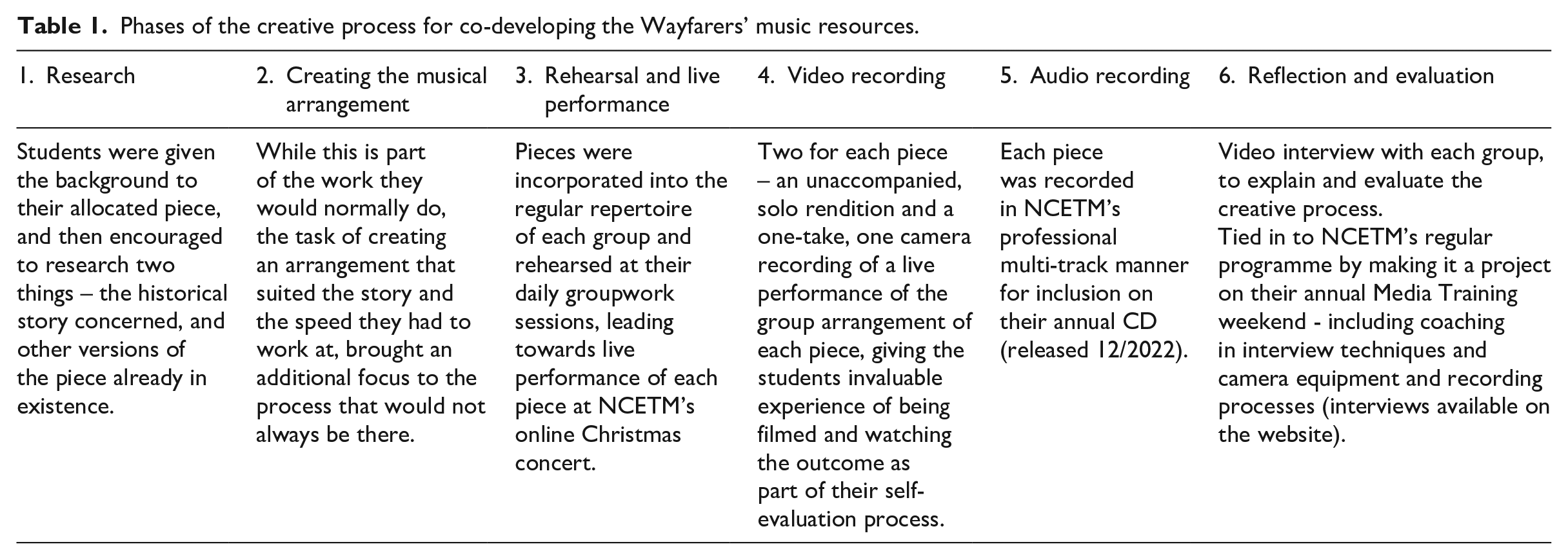
The songs were allocated to the groups at the end of August 2021. Thereafter, the arrangement work was started on the weekend of 4th/5th September, and rehearsals then continued throughout September. The multitrack audio recordings were made over the weekend of October 1st to 3rd, and the video recordings during the following week. The video interviews were recorded on the weekend of 30th/31st October, and all resources were delivered by mid-November 2021. The interviews with pupils were recorded and made available online as part of a Media Training weekend which is run annually by NCETM. The students’ quotations below are transcribed verbatim from these interviews. The pupils were coached in interview techniques by their tutors, one of whom is an experienced TV and radio broadcaster in Gaelic and English. Another tutor is a former student of the Centre who currently hosts a traditional music programme on Radio Skye. The interviews themselves took the form of informal conversations facilitated by Pincock. These were devoted to the process of creating the project’s music. This schedule tied in well to NCETM’s regular curriculum. Even then, the speed of the work was faster than normally expected of students, which gave them invaluable experience of working under the type of pressure they are likely to experience should they choose to pursue a career in music.
It is clear from the group interviews that the students’ understanding and meaning making of the songs was developed further by spending time in the initial ‘Research’ phase of the creative process. This allowed them to engage with the historical context of the songs and to better express musically the emotions they wanted to convey when arranging, rehearsing and performing their arrangements in phases 2 to 4. For instance, regarding Dùthaich Mhic Aoidh the students explained:
‘We learnt how to complement the story of the song using our arrangement, especially in the middle parts where Patrick Sellar is mentioned. He brutally forced a lot of the locals off of their land, and we show how angry these verses are in our arrangement. . .We use dynamics quite a lot. . .as a singer it was really important that I projected my voice to get that message across. . . We used really strong chords at the beginning, and. . .build the powerfulness of the arrangement. . .towards the end we used more delicate chords, so it would have a quiet ending’ (group interview).
The students explained that critically considering the historic background and the lyrics of each song helped them in their creative process during the project, for example to come up with appropriate arrangements. Regarding the Fine Flooers in the Valley, they said:
‘Our approach to this song was firstly to look at the background of it, and the lyrics of each verse, to figure out the meaning, so that we can reflect that in the arrangement’. ‘We also added some harmonics. . .once the ghosts are introduced to the story, to try and create the image that the ghosts were at the church’. ‘The subject matter in this song was very challenging, but we felt that we. . .conveyed the story as best as it could’ (group interview).
Overall, data analyses revealed how the students’ use of dynamics, harmony, instrumentation and voice gained purpose and precision. Deeper knowledge of the songs’ context gave the musical elements a deeper meaning for the students, who could then deploy these musical elements more effectively.
Conclusion and implications
In this section we outline some implications for practice, research and policy, drawing on the ideas discussed in previous sections. The involvement of NCETM in this collaborative project was constructive and a valuable experience for all concerned. As reported by NCETM staff through their director, it was very useful from their point of view to be involved in an external project such as the Wayfarers, as it created a useful partnership for the Centre and provided real-world experience for students. Many NCETM students choose to follow careers in the music industry, but not always necessarily as performers. NCETM’s curriculum includes experience of live performance, studio recording and media work and the project provided good experience of all these aspects. And while students found some aspects of the work challenging, particularly working to camera, they all enjoyed and appreciated the experience and have continued to build on the skills used during their creative process.
A practical implication that follows looking at the six phases outlined in Table 1 is that is worth spending time in the first phase – Research – to critically consider the background of any song, including its historic context, when engaging in school music education. Secondary students are able to grasp how the complexities of history may have influenced the original song. And a deeper knowledge of the context can enhance their emotional engagement with the song and give in turn a deeper meaning to its musical elements during musical performance and appreciation. Existing reviews on musical creativity development suggest how the students’ emotional engagement with the task at hand can act as a catalyst for their creative process. This applies across cultures, as outlined in Odena’s (2012) volume including creativity studies from eight countries. It also applies when using music to develop social cohesion (Odena, 2018a, 2023). This implication resonates with the arguments for authentic engagement in music considered earlier, including that the essence of music lies in taking part in social action around it (Small, 1999) and that to understand culture we need ‘an understanding of its articulation through music’ (De Nora, 2000, p. 5).
In terms of implications for future research, looking back at the project implementation we note a number of successes within the context of Scottish education (Bryce et al., 2018) including the creation of a network and partnership working. The Wayfarers involved three quite different institutions – a university, a conservatoire and a secondary school – working together on a project with shared interests, to utilise their varied expertise (e.g. Dickson, 2018; Jaap, 2012; Tonner, 2018) for the betterment of school learning. We feel that this project evidences the potential of authentic collaborative working with schools. For instance, the students at NCETM had a real ‘hands on’ opportunity to engage with material of international significance and to record it, and have their performances curated online along with resources for teachers. This type of partnership deserves to be further researched to enhance our understanding of its facilitators and barriers. We are aware that students at NCETM were very keen to work with the selected songs. An area for further inquiry is the students’ prior knowledge or engagement with vernacular/folk musics in non-specialist schools. Another area for study is the lived experiences of secondary school students engaged in co-creating their curriculum, within and across subjects. The students’ experience has been the focus of research in primary and lower secondary education, where there is scope for a more flexible curriculum organisation and assessment (e.g. Leitch et al., 2007; Wyse et al., 2012). Perhaps the focus now needs to shift to upper secondary education, although a more rigid curriculum organisation may act as hindering factor.
The project implementation was filtered through the needs created by the pandemic. While our initial plan had been to enable a ‘band’ to work with pupils across schools it became apparent that engaging one musician, and working on a slightly smaller scale, was more appropriate. Going forward, we imagine that this project could be enlarged to include groups of musicians and multiple schools. A positive outcome of the needs created by the pandemic is that all resources developed were digitised and made available online. Potentially, this allows for teachers’ use across disciplines, as and when needed. An implication for policy from the study is that secondary curricula for Expressive Arts and Social Studies (Education Scotland, 2022a, 2022b) would benefit from guidelines on how to integrate work across disciplines. This could be achieved by proposing more interdisciplinary topics and by considering further the creative development literature (e.g. Odena, 2018b; Sangiorgio, 2023). This project was music-led with history underpinning and interweaving into it. Developing the project into a second stage ought to explore how to integrate music and history in new and creative ways, and could explore how the resources are implemented and further developed to address the needs of students in non-specialist schools.
Footnotes
Acknowledgements
We are grateful to the staff and students at Plockton High School for their time during project implementation. Thanks to the anonymous reviewers who provided useful suggestions. We are very grateful for their support and contributions to Emma Campbell, Andrew Munro, Christy Scott and Kathryn Callander (educational resources), Sally Simpson (music workshops) and Jenn Butterworth (Gaelic teaching activities). This article and related resources are the result of team work, each co-author leading the following aspects: Tonner and Odena bid and article writing (with contributions from all co-authors), Dickson and Jaap conservatoire collaboration and teaching resources, Pinnock school collaboration, and Potter web development.
Author’s note
Angela Jaap is now affiliated to University of Glasgow, UK.
Funding
The author(s) disclosed receipt of the following financial support for the research, authorship, and/or publication of this article: The Wayfarers project was funded by the UK Economic and Social Research Council Impact Acceleration Account (award 313523, Tonner PI). Article revision was led by Odena supported by the Royal Society of Edinburgh (grant 62292, The Arts of Inclusion).
