




Abstract
Despite being an unavoidable part of the music teaching profession, bureaucracy remains an under-studied and ill-defined topic in the research literature. However, its investigation may benefit the music teaching profession by re-thinking policy, informing music teacher education programmes and fostering a mutual understanding among music teachers and policymakers. Therefore, in the present study, we aimed to investigate the understandings of Spanish music teachers in relation to bureaucracy and to compare these with the views of the teachers of other subjects in primary education. The perspective of purposefully selected music teachers were thus explored in-depth and contrasted with the views of their counterparts in a multiple case-study design. Our findings contribute a taxonomy of bureaucracy in the music teaching profession. Additionally, we conclude that the views of our music teacher participants on bureaucracy are mainly negative and slightly more pessimistic than those of their counterparts. In discussing our results, we connect these views with the Weberian ‘iron cage’ of bureaucracy and Arendt’s ‘government of Nobody’ as a substitute for democracy in governing education. Finally, we hypothesise a dystopic future of deprofessionalisation as a result of these primary music teachers’ declared lack of control over their own organisational tasks.
Introduction
The term ‘bureaucracy’ is derived from the French word bureau- (desk) and the greek kratos- (power) and was coined by the French political economist Jean Claude Marie Vincent de Gournay in the mid-eighteenth century (Hull, 2012). The historical understandings of bureaucracy have changed throughout human history, ranging from being an instrument for alienation (Marx, 1970/1843), a mechanism of the English monarchs against the emerging democratic parliament (Mill, 1992/1829), a signal of corruption (Wallis, 2006) and totalitarianism (Arendt, 1973), as well as a technical device that is necessary for avoiding arbitrariness in the organisation of an institution (Weber, 1958, 2008).
Despite the different historical conceptions of bureaucracy, its fundamental concept remains imprecise (Bennis, 2017) and its role in any organisation continues to be a matter of concern (Meier, 1997). However, pursuing a more thorough understanding of bureaucracy is particularly relevant to music education, given that it is a source of stress (Hedden, 2005) and concern (Mateos-Moreno, 2022) within the music teaching profession. Adding to this, bureaucracy is not typically the focus of studies in music education but, instead, is relegated to a research finding. Therefore, in the present study, our purpose is to explore how music teachers conceptualise bureaucracy and then contrast these views with those of their counterparts in the primary education stage in Spain. By means of a multiple-case (i.e., multi-case) study, we aim to answer the following research questions:
What activities are considered ‘bureaucracy’ among primary music teachers?
How is bureaucracy experienced by these teachers?
Are there differences in music teachers’ understandings of bureaucracy in comparison with those of teachers of other subjects?
The answers to these questions are important in different ways. Investigating teacher beliefs about bureaucracy may help administrators re-think their policy-making. Furthermore, the examination of teachers’ perspectives on this topic helps in fostering a better school climate between teachers and administrators, as such studies help administrators to see reality from the teachers’ eyes (Trinidad, 2019). In addition, it may contribute to teacher reflection and may inform university programmes in music teacher education in ways that may help the future teacher tackle bureaucracy and counteract discouragement.
Framework
In direct relation to the roots of the word ‘bureaucracy’ that we described in the introduction, the original meaning of this term referred to a type of government that was conducted from an office and had tyrannical connotations (Raadschelders, 2017). As such, the bureaucratic ruling class is thought to have exerted dominion in different periods and societies, such as pharaonic Egypt, Incan Peru or the Soviet Union (Constas, 1958). Drawing upon Hegel’s ‘Philosophy of Right’, the essays of the German sociologist Maximilian Karl Emil Weber (Weber, 2008) at the beginning of the nineteenth century resulted in a radical transformation of the typically negative conceptions of bureaucracy. Weber, as well as the North American politician Thomas Woodrow Wilson, pioneeringly conceived bureaucracy as ‘a technical device which guarantees speed, precision, uniformity, low unit costs, expertness, specialization, and freedom from arbitrary, irrational decision-making’ (Bensman, 1987, p. 63). However, the original conception of Marx (1970/1843) on how bureaucracy represents alienation still remains in the work of Weber as the attributed ‘loss of freedom, loss of creativity, loss of humanity and loss of morality’ (Deva, 1986, p. 150). Indeed, Weber conceived bureaucracy as an ‘iron cage’ that enables an efficiency that modern civilisation cannot live without but at the horrible cost of alienation (Weber, 1958).
Bureaucracy may commonly be defined as ‘a system for controlling or managing a country, company, or organization’ (Cambridge Dictionary, n.d.), having as typical synonyms ‘administration’, ‘paperwork’ or even ‘red tape’ (Collins Dictionary, n.d.). However, the actual meaning of bureaucracy is far from agreed upon, being ‘much easier to deplore than to describe’ (Bennis, 2017, p. 570). In the words of Lefort (1974), ‘bureaucracy appears as a phenomenon that everyone talks about, feels and experiences, but which resists conceptualization’ (p. 31).
Influential historical books in education regarding school bureaucracy in the United States have repeatedly stated the downsides of bureaucracy: a system that perpetuated inequalities in terms of race, class and gender (Bowles & Gintis, 1976), while organisational autonomy, by contrast, was identified as the key factor for the higher efficacy of private and religious schools (Chubb & Moe, 1990). Moreover, bureaucracy has been consistently identified as a source of teacher demotivation across different countries (Grossman & Oplatka, 2021; Lambert & McCarthy, 2006), leading teachers to engage in strategic compliance (Cardoso et al., 2019), suffer from cynicism (Humes, 2022) or boredom (Churcher & Talbot, 2020); with teacher expressions from qualitative studies including ‘the system (. . .) requires us to fill out bureaucratic forms that no one uses’ in Israel (Grossman & Oplatka, 2021, p. 214) or that ‘there is a feeling that one is being manipulated by (. . .) administrators’ in the UK (Henkel, 2000, p. 206–207).
These views notwithstanding, there are also educational perspectives on bureaucracy that highlight its egalitarian values in the school system (Labaree, 2020), with bureaucracy being the best way to undertake large tasks that involve many people (Skipper, 2018). Furthermore, bureaucracy in education is argued to bear an ‘ameliorated’ version of the typical authoritarian character attributed to bureaucracy in general (Humes, 2022). The importance of engaging positively with bureaucracy is also emphasised in order to transform education (Lumby, 2019), with bureaucracy linked to better outcomes for disadvantaged groups in the United States (Grissom et al., 2009) and India (Dhillon & Meier, 2022).
Regarding the specific field of music education, we found no previous study that was entirely focused on bureaucracy in the international literature. However, we found works that partly regard bureaucracy, administrative work, administration, paperwork or similar terms. These tasks have been found to be a challenging (Legette & McCord, 2014) or discouraging (Mateos-Moreno, 2022) aspect of the music teaching profession for pre-service music teachers and music teachers alike. In-service music teachers typically mention bureaucracy as a source of stress (Brown, 1987; Hedden, 2005), particularly when there is a lack of clear administrative directives (Hamann, 1989). The lack of proper support from the teaching administration may also lead to emotional exhaustion and burnout among music teachers (McLain, 2005). More generally, bureaucracy is deemed a cultural aspect of arts organisations (Bennett, 2020).
With regard to the specific educational policies that guided the practices of primary school teachers in the context of this study, these included Ley Organica 3/2020 (LOMLOE) at the national level and Ley de Educación de Andalucía 17/2007 (LEA) at the regional/local level. While these legislations provide detailed descriptions of the organization and structure of the education system, they do not appear to prioritize delineating teachers’ managerial responsibilities. Furthermore, the competency-based system that forms the foundation of LOMLOE has faced criticism for inadvertently increasing bureaucratic demands on Spanish teachers (Quirós, 2021). For a more comprehensive analysis of the legislative framework, readers are referred to Mateos-Moreno and Ossa (2023).
In terms of works that may be relevant to our study and are focused on the same context, Gimeno (2013) highlights the excessive regulations that teachers in Spain face concerning teaching content and student assessment. Furthermore, Gimeno (2021) attributes this issue to the influence of ‘the cult of efficiency’ and the implementation of quantitative educational measures. Taking a critical perspective, Gairin (2015) emphasizes the limited curricular, organizational and economic-administrative autonomy of schools in Spain. Gairin (2000) also proposes the establishment of educational ‘organizations that learn’ and the adoption of an ‘organizational ethic’ as collaborative solutions for improving school administration (Colorado & Gairin, 2021).
Regarding the specific context of our study, we identified several works that specifically focus on music education and are relevant to our research. For instance, Ángel-Alvarado (2020) concludes that there is a crisis in music education in Spain due to the decline of educational institutions, which is driven by an ‘efficientist approach to education’ (p. 10). Furthermore, the author found that music teachers in Spain often work in isolation within their schools, leading to a negative impact on their motivation (Ángel-Alvarado et al., 2021). Additionally, the development of administrative competences is typically overlooked in the study of music teachers’ competences, both in Spain and internationally (Carrillo, 2015).
In summary, we have portrayed different views on bureaucracy and provided a context to our study. On the one hand, the exact scope of what is considered bureaucratic remains ill-defined. Moreover, both positive and negative visions of bureaucracy are present in the academic literature on education, with a bias towards the latter. While there are some studies in relation to the views of teachers on bureaucracy, studies regarding bureaucracy in music education are comparatively scarcer, despite bureaucratic tasks typically being seen as concerning, stressful, and even contributing to exhaustion and burnout by music teachers. Therefore, we conclude that our study may contribute to filling a crucial gap in the music education literature.
Methodology
This research has received clearance from the Ethics Committee of the University of Málaga and is part of a wider project aimed at the investigation of attitudes and motivations in music education contexts. The study design is aligned with case studies (Stake, 1998). As such, the present study is specifically based on a descriptive and comparative, multiple case (i.e., multi-case) study methodology (Yin, 2009), where the two cases are music and non-music teachers.
First, a semi-structured, in-depth interview was created and piloted with n = 3 individuals from the target population, according to the aim of our study and the body of prior research. The interview questions were modified somewhat during the pilot stage to make them more understandable and pertinent to the study’s target group. Thereafter, through Internet searches and direct contact with school principals, the email addresses of primary school teachers from eighteen different schools in both rural and urban parts of Andalucía (i.e., southern Spain) were located. Then, we emailed them with information on our research, a consent form and a short questionnaire to retrieve their socio-demographical and professional profile data, along with instructions on how to participate in the study. In light of the responses received (response ratio of about 30%), we conducted purposeful sampling through variation of subject profiles to enhance the findings across the following variables (Creswell, 2014): urban/rural, age, male/female and public/private schools. The participants were partitioned into two sub-groups: 1) music and 2) non-music teachers. Within the non-music teachers group, we considered an additional variable, that is, their teaching subject(s), in order to include teachers representing the entire spectrum of subjects in primary education. The total number of selected participants was N = 20, encompassing diverse age ranges (M = 39.25, SD = 8.64), with paired sub-groups of music (n = 10) and non-music (n = 10) teachers, where the proportions approximately resulted in: 45% working in urban areas versus 55% in rural ones, 30% males versus 70% females and 60% working in public schools versus 40% in private ones. The exact number of participants represented by those percentages was not an a priori aim, but rather contingent on the subjects who accepted to participate in this study and our intention to maximise the variability of our sample (Creswell, 2014).
Having selected our participants, we asked them to freely write an essay on their feelings, experiences and thoughts regarding ‘bureaucracy’ in their profession as an alternative way to retrieve data, to enrich our results (Bullough, 2014). The participants were then interviewed individually, either in a video conference or in person. The interviews comprised of questions such as ‘How would you define bureaucracy, with your own words?’, ‘Which activities would you classify as bureaucratic in your profession?’, ‘What is your opinion about bureaucracy in your profession?’, ‘What do you consider important about engaging in bureaucracy?’, as well as others formulated ad hoc to prompt the interviewees to develop or explain their ideas. The interviews were recorded and lasted approximately between 35 and 60 minutes each and were later transcribed. Following this, we anonymised and joined the retrieved textual data by assigning alphabet letters to the participants. Next, we used MAX-QDA to analyse the data by means of thematic analysis, following the steps detailed in Braun and Clarke (2006): 1) getting acquainted with the data, 2) creating initial codes, 3) looking for themes, 4) reviewing themes, 5) labelling themes through constant comparison, 6) writing the report. At each of the aforementioned stages, the authors conferred and came to an agreement, leading to the generation of codes and themes in relation to our research questions.
Results
In the following section, we present the results of our study regarding each research question, where the first title refers to the first, the second and third to the second, and the fourth to the third research question. Each number in brackets in this section refers to the number of participants whose data analysis contained at least an appearance of the accompanying code, while the capital letters are the participants’ labels. To illustrate our results, we will include a selection of quotations that we believe will ‘illuminate the subtleties of experience and even provide a vicarious experience’ (Sandelowski, 1994, p. 480) to the reader. In addition, graph 1 provides an overview of the themes that emerged from the analysis of the data provided by music teachers.
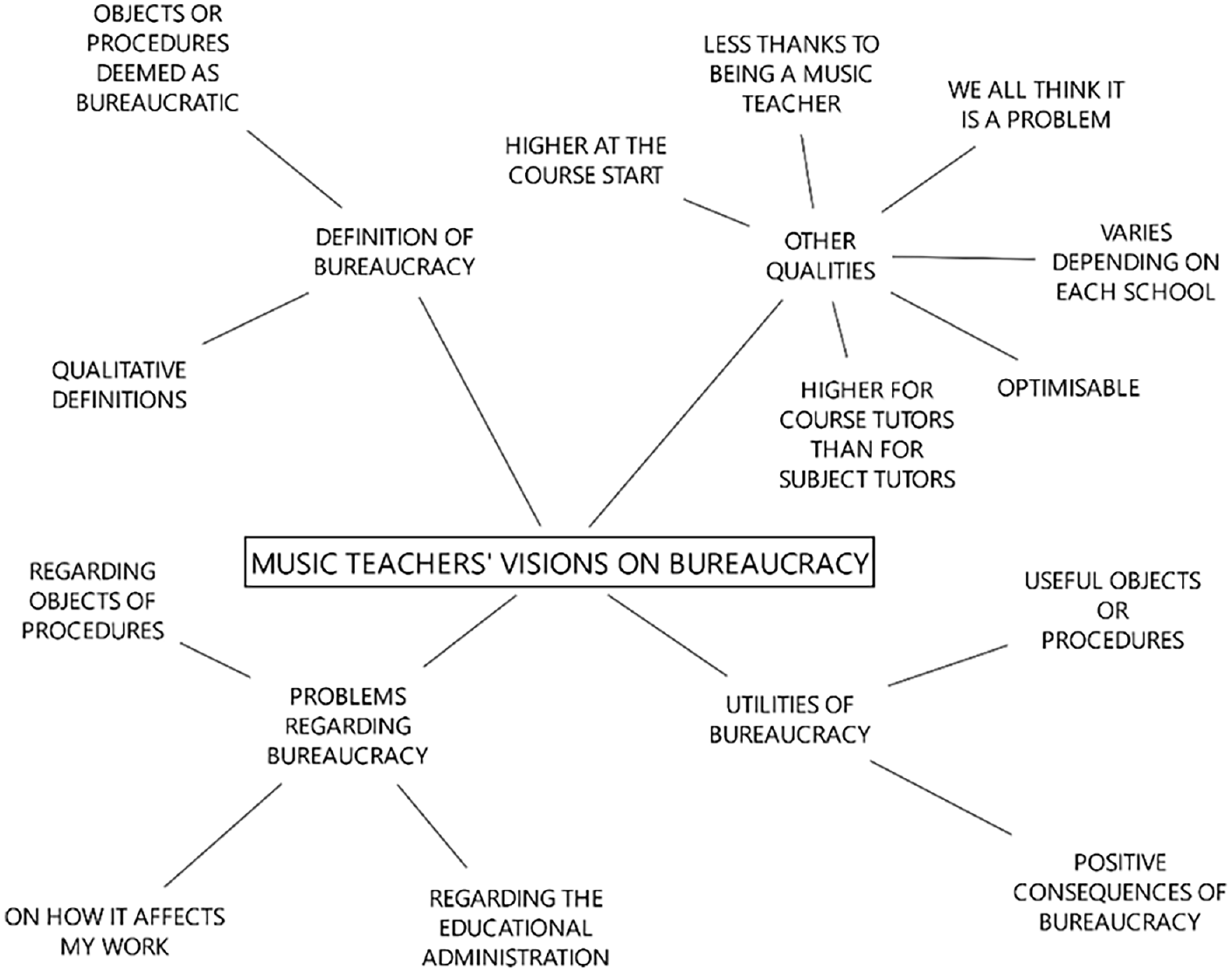
Overview of themes that emerged from our analysis of the data provided by music teachers, up to the third level.
Definitions of bureaucracy
In relation to the first research question, music teachers define bureaucracy by either naming ‘objects or procedures’ that are deemed bureaucratic or by providing a ‘qualitative definition’ for the term. Within the theme ‘objects or procedures’, we found the following codes: ‘reports, forms, documents, items’ [mentioned in general] (9); ‘teaching plans’ (7), ‘digitalisation and the Seneca system’ [this last being a unified, electronic platform implemented by the educational administration] (4); ‘legislative changes’ (3); ‘observational diaries and records’ (2); ‘meetings’ (2); ‘reports regarding curricular adaptations and school supporting programmes’ (2); ‘teacher or student attendance control’ (1); ‘contests for the relocation of teachers’ workplaces’ (1); ‘preparation of ephemeris’ (1); ‘compulsory courses for professional development’ (1); and ‘school plan’ (1). Among these, in relation to ‘meetings’, they clarify: ‘meetings that don’t make sense but have to be done so that everything is justified’ (K). Additionally, in relation to ‘legislative changes’ in education, participants express that
Making a new law should be so that there are visible changes in the class work and not so much in the terminology and in the documentation to fill out. Another problem is that the educational legislation should not be changed every, let’s say, two years because that demotivates teachers and, apart from that, it doesn’t make sense. (R)
The theme ‘qualitative definitions’ of bureaucracy comprise the codes ‘paperwork’ (4) and ‘to satisfy the educational administration or its inspectors’ (4), with expressions such as: ‘documentation required by the educational administration’ (M). Additional codes identified in relation to this theme include ‘useless’ (2), ‘a burden’ (1), ‘a justification’ (1) and even ‘to protect those in charge’ (1). A clarifying expression can be found in the following:
To me, it [bureaucracy] is documentation that we are asked for so that those above have their backs covered. I mean that the responsibility always falls on the teacher and all the paperwork they ask you for, everything, the programming, everything, is so that, in case something is wrong, the ones who legislate have their back covered and can say that it’s not their fault, it’s the teacher’s fault (. . .) The laws are created by people who have not stepped foot in a classroom recently or never in their life, so everything is done by technocrats, by bureaucrats and by lawyers who demand a series of papers from us so that they always have their backs covered; but they do not realize the burden that they impose on us and that it can go so far as to stop you doing your job as a teacher, which is the most important thing. (P)
Problems regarding bureaucracy
Three subthemes were identified with regard to problems with bureaucracy: ‘regarding objects or procedures’, ‘on how it affects my work’ and ‘regarding the educational administration’. In relation to the first, bureaucracy is deemed problematic mainly because the bureaucratic objects (i.e., papers, documents, forms, etc.) or procedures must be done in repeated forms, for example:
We [need to] duplicate many documents, and a lot of information is also duplicated in different documents. For example, the same thing that comes in a teaching plan must be included in a sequencing plan; and that same thing is already in the UDI [didactical units, which represent a typical, thematic organisation of the curriculum that is currently used in Spain]. (L)
Other codes within the subtheme ‘regarding objects or procedures’ include how bureaucracy is perceived as ‘increasing’ (5), ‘useless or meaningless’ (4), ‘not adapted to reality’ (3) or just ‘fictitious’ (2). An example epitomising the data codified within these responses is the following:
Honestly, I’ve been filling teaching plans for years, and I don’t comply with any one [of them]; I write them because they [the educational administration personnel] force me to do it, and that’s it! Then, I do what I want in class. Then, what happens is that my students arrive at secondary education, and they are asked how they can be so [well] prepared. What is my secret? I try every day to motivate myself and not waste time on absurd papers. (P)
In relation to the subtheme ‘on how it affects my work’, all our music teachers agreed that ‘bureaucracy steals time or energy from what is important’ (10) and that it is ‘excessive’ (4), ‘we all think it is a problem’ (3), it ‘limits the organisational freedom of teachers’ (2) and even ‘hinders cooperation’ (1). In regard to what is deemed as important, the respondents tend to mention ‘student-related work’ (K) and ‘preparing in-class work’ (L) instead of bureaucracy and its related tasks and objects.
With respect to the subtheme ‘regarding the educational administration’, almost all the music teachers blame the educational administration (either national, regional or local) for ‘enacting ever-changing bureaucracy’ (9), that it ‘does not provide the necessary training’ to adequately pursue bureaucratic procedures (3), that bureaucracy ‘is never improved’ (3), a ‘poor digitalisation of bureaucracy’ (2) referring to electronic systems that do not work well and the problem of ‘having different bureaucracies depending on each school’ (2).
Utility and other qualities of bureaucracy
The participants identified several ‘utilities of bureaucracy’. Within this theme, two subthemes emerged from our analysis: ‘positive consequences of bureaucracy’ and the identification of ‘useful [bureaucratic] objects or procedures’. The first subtheme included a very limited number of our music-teacher participants (2) who identified the positive side of bureaucracy in ‘justifying [your work] against others’ (1) and ‘identifying aims’ (1). In addition, the second subtheme revealed the most appreciated aspects of bureaucracy by our music teachers: ‘teacher plans’ (5), ‘assessment reports’ (3), ‘absenteeism control’ (2), ‘curricular adaptations and school support programmes’ [for students in need] (1), ‘report of disruptive behaviours or incidents’ (1), ‘class diary’ (1) and ‘student-related bureaucracy’ (1). However, in the texts coded within ‘teacher plans’, several teachers agree that ‘in the subjects where a book is not followed, teaching plans are needed (. . .), but if you follow a book, [creating teaching plans means] extra work that is useless because everything is already done by the publisher itself’ (L).
Regarding the theme ‘other qualities’, bureaucracy is thought to be ‘higher for course tutors than for subject tutors’ (4), ‘optimisable’ (3), that ‘we all think it is a problem’ (3), ‘less [bureaucracy] thanks to being a music teacher’ (3), ‘varies depending on each school’ (2) and ‘higher at the course start’ (1). When our music teacher participants are asked about the ways in which bureaucracy might be optimised, they tend to include strategies such as ‘doing just the obligatory’ tasks (Q), ‘doing it little by little’ (O) or mentioning that
bureaucracy can demotivate you a lot in terms of mood, how you carry out your day-to-day [tasks] and how you face your work, if you don’t learn not to let it affect you. But if you learn to say, okay, it’s there, and I do it because they demand it of me, but I don’t prioritise taking away my time as a real teacher. (Q)
In addition, when they are asked about why they, as music teachers, have less bureaucracy than the teachers of other subjects, they tend to argue that ‘as a music teacher, I have less paperwork for parents, fewer support plans or student reports’ (R).
Comparison of the views of music and non-music teachers
There are no new first-level themes that emerge from our comparative analysis of the teachers’ versus non-music teachers’ data in relation to our stated research questions. However, there are a few differences in relation to the codes and their frequencies, as well as in regard to several subthemes. The differences generated by the analysis of the data from non-music teachers regard the following:
1) within the theme ‘objects or procedures deemed as bureaucratic’, the code ‘excursion authorisations’ (1) is added;
2) within the theme ‘qualitative definitions’ of bureaucracy, the codes ‘the only bad thing about my job’ (1) and ‘school duties’ (1) were added, while the codes ‘legislative changes’, ‘protect those in charge’ or ‘[bureaucracy as] a justification’ were absent;
3) within the theme ‘[problems] regarding [bureaucratic] objects or procedures’, the codes ‘fictitious’ or ‘increasing’ were absent;
4) within the theme ‘[problems] on how it affects my work’, the codes ‘excessive’ or ‘limits the organisational freedom of teachers’ were absent;
5) within the theme ‘[problems] regarding the educational administration’, the code ‘[bureaucracy] varies depending on each school’ is absent;
6) within the theme ‘positive consequences of bureaucracy’, the code ‘identifying aims’ is absent;
7) within the theme ‘useful [bureaucratic] objects or procedures’, the codes ‘evaluation reports’ and ‘absenteeism control’ are absent, while the codes regarding the writing of minutes for ‘teacher-parents meetings’ (4) and ‘teaching team meetings’ (2) are added; and finally,
8) regarding the theme ‘other qualities’, the subtheme ‘less [bureaucracy] thanks to being a support teacher’ is added and the one labelled ‘higher [bureaucracy] at the course start’ is absent.
Some examples of non-music teachers’ expressions within the new codes resulting from the analysis of their responses include the following:
I have to do it, whether I like it or not. Perhaps the bureaucracy is the only bad thing about my job. (C) The teacher-parent meetings’ minutes so that everything spoken remains in written form, or the [minutes] of the teaching team meetings; [the minutes are important] because you can be protected, in case something happens; [so you could argue] well, look, we met on this date, with such people, we discussed this topic, and all that is registered. (F) As a support teacher, we don’t have a lot of bureaucracy where I work because we work with specific programmes, and it simply consists of planning what you are going to do with the students. (G)
Discussion
Regarding our first research question, that is, ‘What activities are considered bureaucracy among primary music teachers?’, bureaucracy is not only defined as specific procedures or objects by our participants but also by qualities related to the organisation of work duties. This evidences how its meaning still seems to be associated with the ancient connotations of bureaucracy as a type of government (Raadschelders, 2017). Moreover, what our participants attribute to bureaucracy agrees to a significantly higher degree with the view of Marx (1970/1843) than with the more balanced one of Weber (1958). When they mention that bureaucracy steals their time and restrains their freedom, they are indeed portraying bureaucracy’s capacity for alienation as described by Marx and highlighting the Weberian iron-cage side of bureaucracy.
Beyond considering bureaucracy as being a burden or useless, our music teacher participants do not always attribute an intrinsic justification for its existence. Instead, bureaucracy is generally seen as an extrinsic obligation to satisfy the educational administration or the school inspectors, which is coincident with extant research on teachers’ loss of respect or trust towards bureaucracy (Cardoso et al., 2019; Humes, 2022). Indeed, one of our music teacher participants depicts bureaucracy as a way to protect those who rule education (i.e., politicians, school principals and managers, policymakers, etc.) in case of any malfunction in the educational system. To our eyes, this aligns remarkably with Arendt’s (1969) conception of bureaucracy as the tyrannical government of ‘Nobody’:
[the] most formidable form of such dominion, bureaucracy, or the rule by an intricate system of bureaux in which no men, neither one nor the best, neither the few nor the many, can be held responsible, and which could be properly called the rule by Nobody. Indeed, if we identify tyranny as the government that is not held to give account of itself, rule by Nobody is clearly the most tyrannical of all, since there is no one left who could even be asked to answer for what is being done. (p. 7)
In close relation to the aforementioned conception, the fact that our participants perceive themselves as being attributed the highest responsibility for the malfunction of bureaucracy in the educational administration system evidences how they feel powerless in the sense of an anti-democratic educational system that prioritises accountability over social and educational aims (Gimeno, 2021; Wrigley, 2003); an ‘efficientist approach’ that may lead to a crisis in music education and to the demise of educational institutions (Ángel-Alvarado, 2020). Likewise, the feeling of losing organisational autonomy due to bureaucracy connects the traditional North American perspective on bureaucracy in education (Chubb & Moe, 1990) with what we have identified in the current research literature in Spain (Gairin, 2015), despite the fact that our participants are associated with a context significantly different from that of the United States. However, in disagreement with the previous North American-centred literature on bureaucracy in education, they did not identify bureaucracy as perpetuating inequalities in terms of class, gender or race (Bowles & Gintis, 1976).
Considering the obvious, central role of planning the lessons for teachers, the fact that our music teacher participants deem teaching and school plans as one of the most bureaucratic objects is of significant concern. While the teachers’ major trouble concerning teaching plans is typically attributed to the discrepancies between teacher education and the needs of in-service teachers in the Anglo-Saxon literature (Zazkis et al., 2009), due to contextual reasons, our case seems to function differently: in the Spanish educational system, the teaching plans are long, highly structured documents that must be followed in accordance with pre-established directives from state and regional educational administrations, as well as the prevailing practices within each school. This explains, in our opinion, why our participants tended to see these documents as bureaucratic and even felt the need to elaborate their own, freely organised, shorter teaching plans in parallel. In line with previous studies, we hypothesise that giving more (or even total) freedom to music teachers in creating their teaching plans would dramatically contribute to mitigating the conflict between bureaucracy and professionalism (Koybasi et al., 2017) among our participants. Furthermore, such a shift could potentially enable a more positive involvement of music teachers in bureaucratic processes by engaging them in the design of their own teaching competences (Carrillo, 2015), ultimately contributing to educational transformation (Lumby, 2019).
In relation to our second research question, that is, ‘How is bureaucracy experienced by these teachers?’, all of our music teacher participants experienced bureaucracy as problematic. The bureaucratic procedures are indeed seen to be pursued in repetitive/duplicate forms, increasing over time, comprising meaningless actions, not being adapted to reality or even fictitious. This dysfunctional nature of bureaucracy is fully coincident with the views of teachers from both a reality close to that of our participants (e.g., teachers in Portugal; Alonso et al., 2022) as well as with the views of teachers from other, far more distant realities (Grossman & Oplatka, 2021; Henkel, 2000). In addition, the perspective expressed by our music teacher participants can be categorized in accordance with the existing literature, which defines it as a fundamental, non-reflective and suboptimal stage in their engagement with administrative tasks; referred to as the ‘individual cognition’ stage in the progression of teacher attitudes towards bureaucracy (Trinidad, 2019). Common characteristics of this stage, such as experiencing a sense of diminished autonomy, cognitive dissonance between reality and bureaucratic processes, and conformity pressure, are evident among our music teacher participants. Furthermore, their mainly negative experiences with bureaucracy are in line with the music education research literature in relation to this topic, as such a pessimistic view might naturally be conceived as stress-inducing (Brown, 1987; Hedden, 2005), challenging (Legette & McCord, 2014) or discouraging (Mateos-Moreno, 2022) to music teachers.
With regard to our third research question, that is, ‘Are there differences in music teachers’ understandings of bureaucracy in comparison with those of teachers of other subjects?’, we did not find major differences in comparing music and non-music teachers’ views on bureaucracy. However, we did uncover subtle ones. Among these, our non-music teachers seem slightly less pessimistic about bureaucracy, having identified comparatively fewer problems and expressed less negative judgements, according to our analysis. This seems paradoxical, given that music teachers in the present study tend to think that they experience less bureaucracy than the teachers of other subjects. We hypothesise that music teachers’ views are perhaps shaped differently than their counterparts’ due to two main factors: a) their tendency to work in isolation within their respective schools in the Spanish educational context (Ángel-Alvarado et al., 2021); and b) the highly creative and diverse nature of their subject, which could potentially provide them with a greater degree of resistance to bureaucratic constraints and accountability. Interestingly, the music teachers suggest that they comparatively hold fewer parent meetings and have fewer reports to fill than their counterparts, which may reflect the argued culturally poor consideration of music as a subject within the Spanish curriculum in general education (Ángel-Alvarado, 2020; Mateos-Moreno & Bravo-Fuentes, 2023). However, this underestimation of music paradoxically results in an advantage for music teachers in terms of their bureaucratic workload, according to their responses: If, in addition to the music teacher, few or even no one within the school community shows sufficient interest in the subject ‘music’, the music teacher’s accountability and bureaucratic demands are likely to be lower. Consequently, more time can be allocated to tasks that are perceived as more relevant.
Conclusions
Our study suggests several dimensions in the understandings of bureaucracy by Spanish primary music teachers: bureaucracy as objects, procedures and ways of doing things. We argue that our music-teaching participants deeming the teaching plan as a major form of bureaucracy is of concern, given its role as a core activity in the (music) teaching profession. Furthermore, they typically see bureaucracy as dysfunctional, while the educational administration is viewed as doing nothing except worsening the situation over time. In addition, our study suggests that their non-music-teaching counterparts have slightly less problematic views on bureaucracy. Future qualitative studies may shed light in identifying other categories, while a quantitative exploration of this topic may provide clues on how generalisable our results are, as our work shares with case studies the impossibility of determining the degree to which our findings are case-dependent (Stake, 1998). Likewise, curricular dispersion among different ‘autonomous communities’ in Spain (Belletich et al., 2016) should also be considered when comparing our findings across diverse populations within the same country.
Implications
According to our participants, the music teaching profession in Spain would highly benefit from a dramatic reduction and simplification of bureaucracy in primary music education. Their feelings about bureaucracy are indeed slightly more pessimistic than those of their counterparts in other educational subjects. These perceptions, in conjunction with an educational administration that is deemed to be increasingly complicating bureaucracy, may lead to feelings of deprofessionalisation among Spanish music teachers. Their perceived lack of power in organising their school tasks is such that we argue it may lead – if it hasn’t done so already – to a dystopic role for Spanish music teachers; one in which Hanna Arendt’s bureaucracy as the government of Nobody would substitute democracy within the educational system. In addition, given that our participants identify ever-changing educational legislation as a primordial factor in complicating bureaucracy, we suggest that the stability of educational legislation should also be an aim in the Spanish context.
Supplemental Material
sj-docx-1-ijm-10.1177_02557614231196594 – Supplemental material for The iron cage of the music teaching profession: A multi-case study on how primary music teachers in Spain understand bureaucracy
Supplemental material, sj-docx-1-ijm-10.1177_02557614231196594 for The iron cage of the music teaching profession: A multi-case study on how primary music teachers in Spain understand bureaucracy by Daniel Mateos-Moreno and Paloma Bravo-Fuentes in International Journal of Music Education
Footnotes
Acknowledgements
The authors would like to express their gratitude to the Spanish jurist, Mr. Emilio Triviño, for his insightful recommendations of bibliographical sources in relation to bureaucracy and democracy. These recommendations have significantly enriched the theoretical framework of the present study.
Declaration of conflicting interests
The author(s) declared no potential conflicts of interest with respect to the research, authorship, and/or publication of this article.
Funding
The author(s) disclosed receipt of the following financial support for the research, authorship, and/or publication of this article: This work was supported by the Spanish Research Agency (Agencia Estatal de Investigación, MCIN/AEI/10.13039/501100011033), under grant to Project Musihabitus (ref. PID2020-118002RB-I00).
Ethical review
This study is derived from a research project which has undergone ethical review and has received approval from the University of Malaga.

References
Supplementary Material
Please find the following supplemental material available below.
For Open Access articles published under a Creative Commons License, all supplemental material carries the same license as the article it is associated with.
For non-Open Access articles published, all supplemental material carries a non-exclusive license, and permission requests for re-use of supplemental material or any part of supplemental material shall be sent directly to the copyright owner as specified in the copyright notice associated with the article.
