



Abstract
A standalone literature review was conducted to ascertain the extent and status of research on the practical inclusion of Chinese music in Western educational contexts. The study identified a body of journal articles and postgraduate theses on the topic. The papers were analysed to discern what might constitute best practice classroom approaches to teaching and learning Chinese music. Based on the review’s criteria for inclusion – papers were in English, praxis-oriented, peer-reviewed and published over the past three decades – the study found that the number of publications was limited (19) and that in terms of established pedagogical approaches they engaged, some gaps existed, certain pedagogies were minimally represented and some were perhaps too recent to have been trialled. Even so, the study concluded that while best practice is an elusive notion, Chinese music forms and styles appear to be compatible with a range of educational settings and Western-oriented music teaching and learning approaches.
Keywords
Introduction
In this article we examine developments relating to the inclusion of Chinese music in Western and Western-type formal education settings. Our study – a systematic or standalone literature review – assumes that music educationists working and publishing in this field are in pursuit of best practice within multicultural or culturally diverse music education, even if they do not explicitly state it. We approach the topic from an Australian perspective, where, as 5% of the total population, Chinese Australians comprise one of the two largest immigrant minorities in the country (the other being Australians of South Asian ancestry), yet Chinese music appears to be underrepresented within education, particularly in primary and secondary school settings. We share D. Tu’s (2019) recently expressed concern that often in educational contexts, ‘Chinese music is situated in a dualistically hierarchical relation with Western music’ (p. 31). We have chosen to approach both issues – best practice and the prevalence of Chinese music in Western education – through a systematic survey of research literature relating to the classroom incorporation of classical and folk vocal and instrumental music traditions.
We first discuss the general concepts on which our study is based and explain its research design, that is, our paper selection criteria, search method and analytical approach. Next, we set out an overview of the content of the papers we ultimately selected: a corpus of 19 representative peer-reviewed journal articles, conference proceedings paper and academic theses published between 1991 and 2021. Finally, we analyse and discuss the papers’ musical content in relation to the established pedagogical approaches they engage, attempt to draw conclusions relating to current notions of best practice in the classroom teaching and learning of Chinese music, and make several recommendations for future developments in this area of culturally diverse music education.
Part 1 Definitions and research design
Multiculturalism, Chinese music and best practice
As intimated, this study relates to multicultural or culturally diverse music education, hence it is necessary to comment briefly upon the trajectory of this subfield of music education since its emergence in the 1960s. Also, it is helpful to have a clearer idea from the outset of what we mean by the terms ‘Chinese music’ and ‘best practice’.
Multiculturalism
As Elliott (1989) states, descriptively ‘multicultural’ means ‘culturally diverse’ (p. 14). But he goes on to say that the term ‘is also used in an evaluative sense. It connotes a social ideal: a policy of support for exchange among different groups of people to enrich all while respecting and preserving the integrity of each’ (Elliott, 1989, p. 14). A substantial literature exists that approaches multicultural music education from various political, ideological and philosophical perspectives. As Howard et al. (2014) explain, ‘[t]he present momentum in multicultural practices in [American] music education is built on a long and multifaceted lineage’ (p. 27).
Over time terminology has shifted in keeping with these changing theoretical and practical approaches – and in accordance with shifting notions of best practice in teaching global music forms and styles – from multicultural music to world music, culturally diverse music, cross-, inter- or transcultural music and so on, not necessarily in strict linear succession. Not always helpfully, some of these terms are used interchangeably (Kim, 2017). Such shifts have been influenced by the field of ethnomusicology and developments in culturally responsive education (Gay, 2010), as well as by societal changes relating to population movements, so that the notion of ‘diversified normality’ is among ideas more recently being promoted by music educationists (Carson & Westvall, 2016). This involves curricular decisions that are ‘informed by a dynamic reading of the larger community – its goals, challenges and contexts – not by a focus on a single, idealized vision, that, at heart, would be unavoidably exclusionary or reductive’ (Carson & Westvall, 2016, p. 48).
Chinese music
In discussing how we use the term Chinese music, we turn to Fung (1994, p. 51) who points out that ‘it is not a single musical category’ (Fung 1994, p. 50). Jones (2003) provides an indication of the enormous scope of Chinese traditional music alone. Fung (1994) rightly insists that insider understandings must be valued; ‘viewing music of other cultures from one’s own particular cultural viewpoint’, he argues, ‘defeats the purpose of studying other musics’ (p. 50). Like Fung (1994, pp. 48–49), Tien (2015, p. 2) explains that although the Chinese word ‘yinyue’ (音樂) is typically translated as ‘music’, the activities and ideas these two words point to vary. Both Fung and Tien urge educators to ‘become aware of the ideas underlying [Chinese] musical practice and ideas such as the contemplation of harmony between nature and humanity’ (Fung, 1994, p. 50). More prescriptively, D. Tu (2019) writes: Traditional Chinese music is any music that originated from local practices and customs in China and based on its own social and intellectual lineage in the development of its civilization. It includes historical practices from local areas as well as modern compositions using local practices as the basis of its creation. (p. 22)
For the review we include regionally distinct solo instrument and ensemble traditions, folk instrumental and vocal traditions of ethnic majority and minority groups, court music including various operatic traditions, nursery rhymes, contemporary art music based on traditional themes and traditional-style popular songs. We omitted articles dealing with most Chinese popular music, not because we consider it to be less Chinese than other music forms, but because at this stage of our research we wish to concentrate on those styles and sounds that have traditionally formed the core of the category.
Tien (2015, pp. 6–7) elaborates on Tu’s two-part delineation by way of a helpful table that divides music of the Chinese ancient period into three sub-periods and music of the modern and contemporary period into two sub-periods. In general terms, the authors of the papers in our review below adhere to this understanding of Chinese music, although it must be said that the majority are quite accommodating of Western musical understandings and apply these freely to Chinese music. In D. Tu’s (2019) terms, this has the unfortunate effect of positioning ‘Chinese music within the Western musical canon as a form of non-Western music’ (p. 28). He believes Chinese music needs ‘repositioning [. . .] from being an “inferior” type of music to one with a complex history and rich performance practices’ (D. Tu, 2019, p. 28).
Best practice
Best practice refers to ‘a procedure that has been shown by research and experience to produce optimal results and that is established or proposed as a standard suitable for widespread adoption’ (Merriam-Webster, 2022). In our desire to identify best practice approaches to teaching and learning Chinese music, as per the discussion above we have tried to keep in mind Tu’s call for the repositioning of Chinese music and Tien’s point regarding distinctions between the terms yinyue (音樂) and music. To be clear, we did not embark on the research with a fixed idea of what constitutes best pedagogical practice regarding Chinese music. Rather, we anticipated that ideas regarding what constitutes best practice might emerge from the study. This, we expected, would involve offering students an informed insider’s experience of some facet of Chinese music. We acknowledge that what music educationists consider to be best practice in this field will vary according to the specifics of historical and educational context.
Research design: Selection criteria, search method and analytical approach
The research comprises a standalone literature review, which is ‘a journal-length paper that reviews the literature in a field without the author’s collecting or analyzing any primary data’ (Okoli, 2015, p. 882; see also Kraus et al., 2022). We based the framework of our study on Okoli’s (2015) eight-step guide to conducting such a review. The first step in such a process is identifying the purpose of the review. To build on what we have already stated, our intention is to assist teachers, no matter what stage they have reached in their career, with a summary analysis of the practice-based research that has been conducted to date on the teaching and learning of Chinese music in Western and Western-type educational settings.
We were prompted by our perception that praxis-oriented research on Chinese music in culturally diverse music education offerings in the West (or in Western-style education contexts) had only been conducted to a limited extent. We wished to establish whether this was in fact the case. Also, we wondered whether such studies as had been undertaken were informed by a discernible ‘Euro-centric binary between Chinese and Western music for intercultural learning’, that is, approached Chinese music from a Western music perspective rather than a Chinese one (D. Tu, 2019, p. 33). More generally, we were seeking ways to encourage teachers to explore and develop a measure of competence in some area of Chinese music so that they might feel better prepared to confidently provide their students with a glimpse of this diverse, ancient-yet-living form of musical expression about which so little seems to be known in Western education settings.
When selecting papers for inclusion in our review we applied four criteria. First, the papers had to have been produced over the past three decades, to ensure that the research on which they were based and the knowledge they produced was likely to be relevant or useful. Second, the items had to be praxis-oriented, that is, they needed to relate to classroom teaching and learning in a practical rather than a merely theoretical way, involving direct engagement with musical repertoire and processes. Third, the papers had to be research-based and peer-reviewed, hence we included both journal articles and academic theses within our purview. These criteria ensured that each paper included was produced by an accredited specialist, bore a certain weight of authority and accountability and that the material under discussion in each case had been tested either under classroom conditions or in some related scholarly way. Fourth, the papers had to be in English, since we were keen to examine the extent to which Chinese music was being commended to music teachers in Western education contexts. Applied together, the criteria led us to identify a small yet rich corpus of 19 papers published between 1991 and 2021. Eleven of the papers were journal articles, one was a conference proceedings paper, and another seven were academic theses.
We conducted the literature review in three broad stages. In the initial stage, we developed the keywords and phrases for our search, selected the databases for locating such sources, then began identifying resources by searching with the keywords and phrases. We carried out the search by using the following academic search engines, listed in order of frequency of consultation: Google Scholar, CORE, BASE and Semantic Scholar. The most common keyword combinations we employed were: Chinese+music+multiculturalism East Asia+music+diversity+classroom Chinese+music+classroom+education Chinese+music+instruments+education Chinese+folk songs+education
As we identified papers for consideration, we each undertook an initial screening of each paper’s abstract to determine whether the paper fitted our topic. During this process we came to an agreement regarding whether we should include or exclude a source, or whether it required closer scrutiny to make this decision. In the second stage, working separately we further evaluated the authors’ aims and intentions through a detailed reading of each text, following which we compared notes. Through this process we compiled our set of papers. In the third and final stage, to generate the research findings, we analysed each article and thesis that met our criteria. We did this in several steps, identifying themes through a kind of meta-coding process as they emerged from our study of the papers.
Of the 22 authors represented in the 19 papers we ultimately selected, we noticed that based on their names alone 17 appear to have a Chinese cultural background. (With Christina Ho [2019, p. 8], we ‘note that a Chinese surname does not necessarily imply that [an author] self-identifies as Chinese’.) This may be expected given researchers’ motivations of cultural identification, it may be a product of where expertise lies due to background training, or it may be a by-product of working within a Chinese-oriented education system, in Hong Kong and Taiwan, for example. We mention this simply to draw attention to who appears to be undertaking the research, as a consideration for those considering training in the future, whether they are of Chinese or non-Chinese heritage.
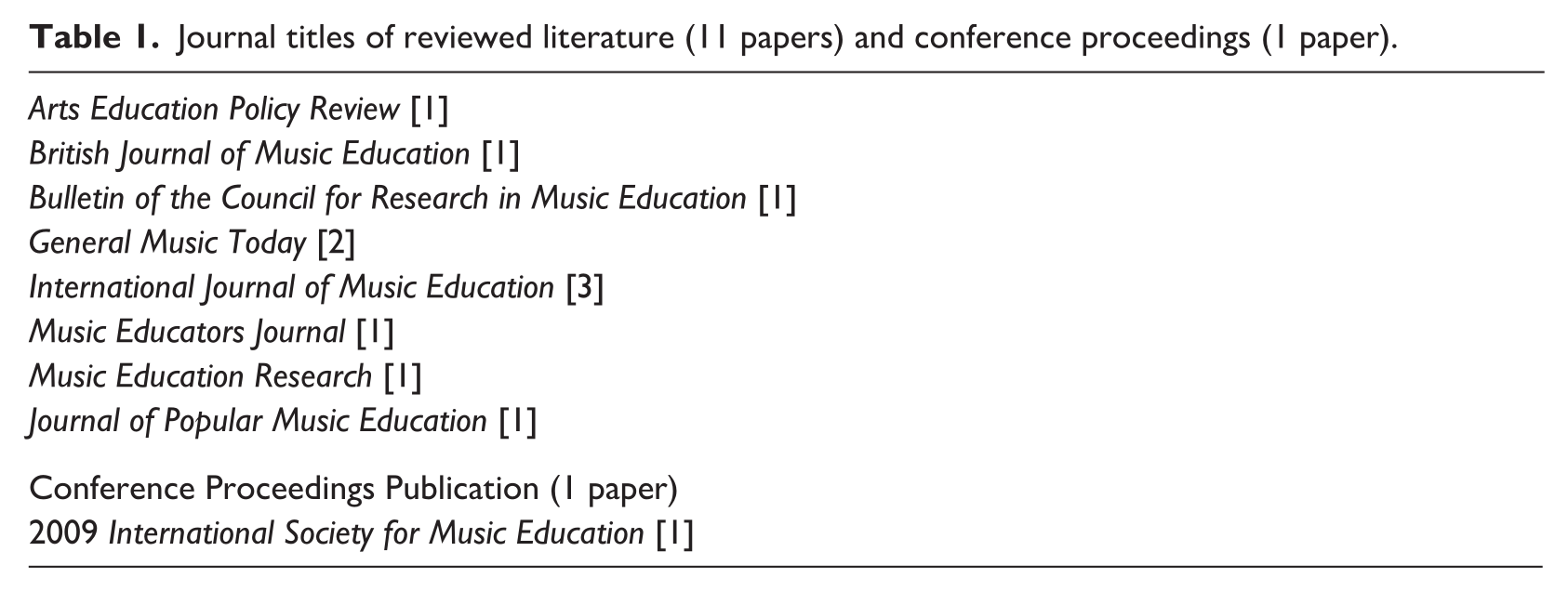
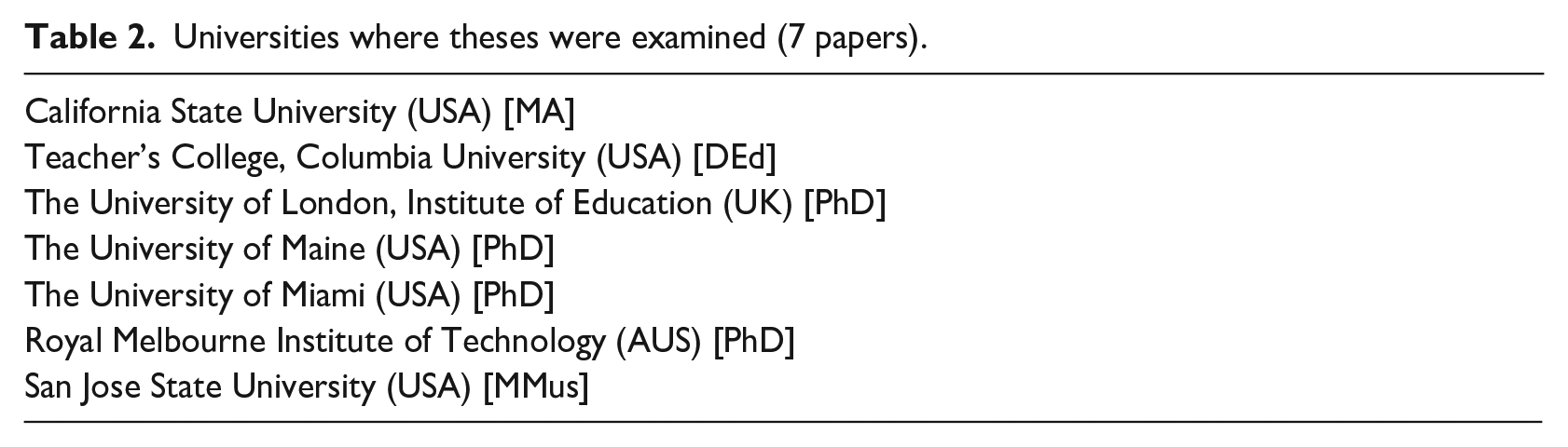
Before describing and thematising the content, we compiled a list of the journals represented in our collection of papers (Table 1), and of the universities represented by the theses selected (Table 2). This helped us to gain an impression of the distribution of Chinese music education scholarship and of the academic standing of the publications and institutions involved in producing such research.
Journal titles of reviewed literature (11 papers) and conference proceedings (1 paper).
Universities where theses were examined (7 papers).
Next, we attempted to determine the methodological approach adopted in each paper. In the 19 papers, we identified four categories: qualitative research, quantitative research, mixed methods research and musicological research. Notably, eight of the studies are qualitative in orientation, four are quantitative, three are mixed methods and four are musicological. From this we discerned that the research involved a balance of available methodologies and approaches, although it was weighted more heavily towards qualitative research.
Part 2: Descriptive overview of content
Prior to undertaking a detailed analysis of the papers, we created a descriptive overview of each item based on a set of basic categories that would assist in comparing the papers and in understanding the ways in which they relate to our overall study aims. First, we determined the targeted or intended educational setting in each paper, that is, whether it was aimed at the primary, secondary or tertiary learning setting and so on. Then we took note of the country or culture concerned – whether the author/s specified mainland China, Hong Kong, Taiwan or Singapore as their paper’s geo-cultural focus or research context. We also took note of the musical focus of each paper, for example, whether it was vocal or instrumental music, folk music or art music and so on. Lastly, we glossed the teaching and learning focus, for example, whether a creative approach was taken or commended, or one based on repertoire learning, or whether the approach centred on listening and analysis, and so on (Table 3).
Content overview of investigated articles and theses.
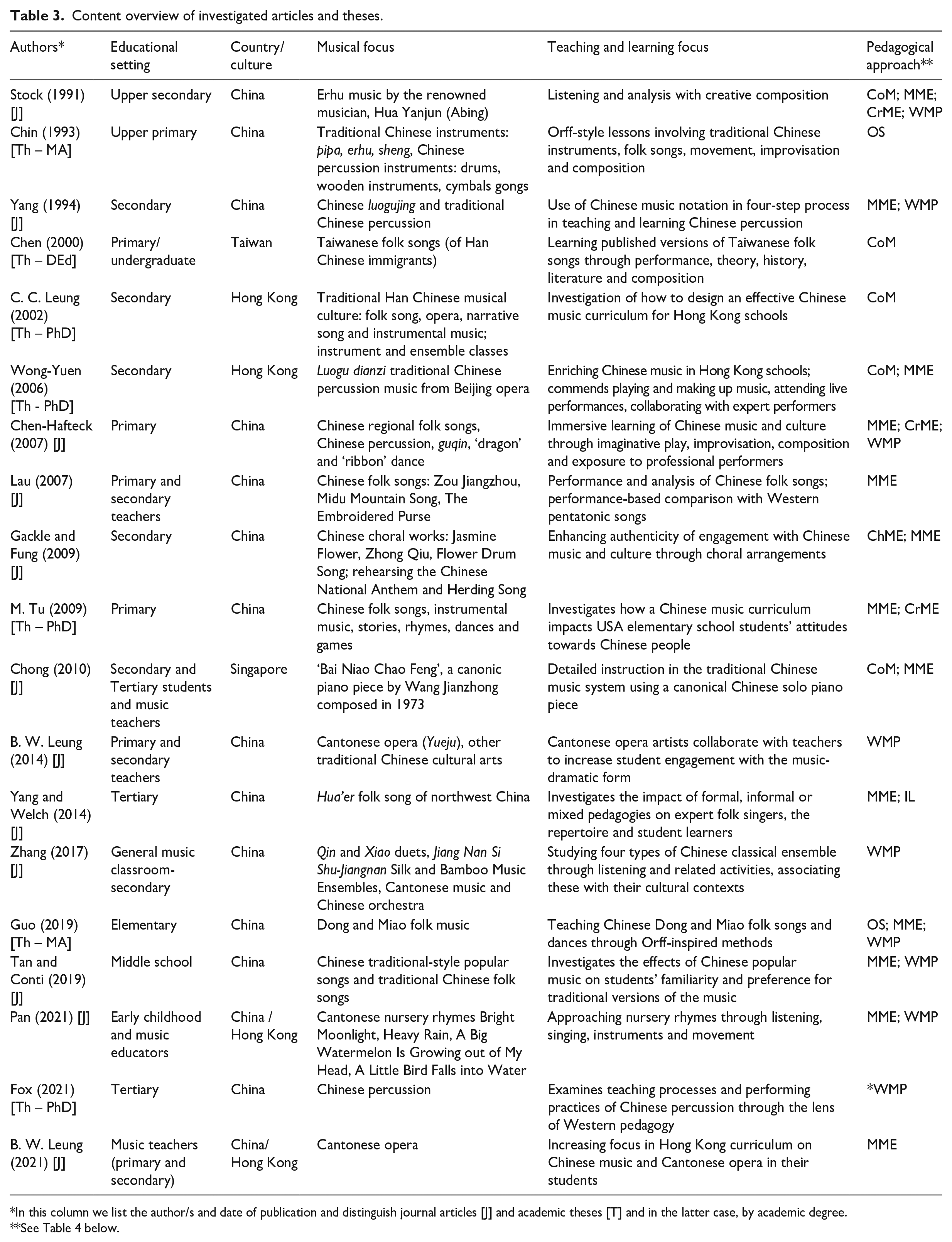
In this column we list the author/s and date of publication and distinguish journal articles [J] and academic theses [T] and in the latter case, by academic degree.
See Table 4 below.
Part 3: Analysis and discussion
At the next, analytical, stage of our research process, we attempted to develop a more granular understanding of our dataset. This permitted us to discern several findings, which we now outline and discuss, and to conclude with some provisional recommendations. The ordering of the findings is non-hierarchical, that is, the numbering is not an indicator their significance.
Finding 1: Only a limited number of praxis-based studies have been undertaken
Within the field of multicultural or culturally diverse music education over the past three decades, practice-oriented English-language studies relating to teaching and learning of Chinese music have not been abundant, but neither are they scarce. Plotting the publication of the papers over the three decades (Figure 1) indicates that the research output was slow in the 1990s and early 2000s, mid-1990s, and that it increased in 2007, yet with a significant identifiable gap between 2010 and 2014.
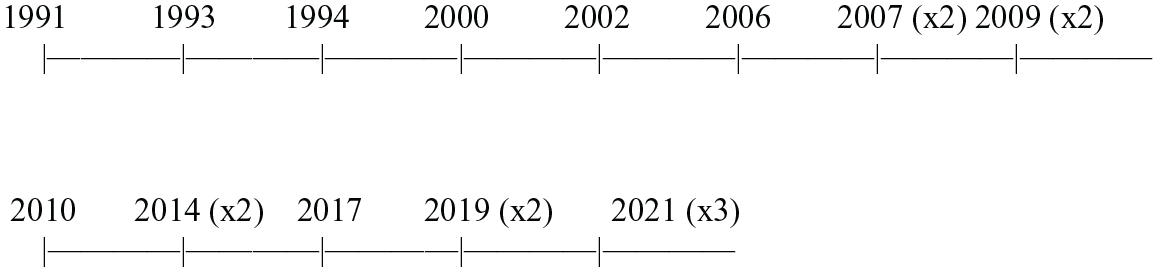
Paper distribution timeline across the three decades.
To assert such a finding with greater confidence would entail replicating our study for other musical cultures or culture areas as a basis for comparison. Nevertheless, our findings support the claim that Chinese music traditions have received little attention in the literature (Zhang, 2017, p. 26). While it was beyond the scope of our research to account for this apparently limited yield of papers, we do believe it to be worthy of attention.
Finding 2: The gamut of educational settings is represented
The papers sourced for the study represent a wide range of instructional settings, from early childhood/pre-school, primary and secondary, to tertiary or pre-service music teacher training and in-service music teacher training settings. In other words, most typical formal educational settings are represented. Most of the papers – 12 out of 19 – were directed towards primary and secondary stages: 5 focused on the primary setting and 7 on secondary. Also, seven focused on the in-service music teacher setting. Considering the papers together, this is notional confirmation at least that Chinese music can be taught across the Western formal educational spectrum.
While most of the authors explicitly mention the pedagogical setting to which their study corresponds, where this is not the case, we determined the author’s probable target setting. As noted, the bulk of the papers address the needs of secondary and primary classes. Many of these also address pre-service teachers, that is, those who are still completing their training, as well as teachers who are already in the field. It is helpful to now look more closely at the ways the authors address specific pedagogical settings and their justifications for doing so.
Commentary on the papers’ educational settings
Pan (2021) argues that exposing children of various cultural backgrounds to Cantonese nursery rhymes during infancy is a way to promote their musical, phonological and linguistic development. This is because ‘Cantonese-speaking children tend to sing more discreet pitches in contrast to English-speaking children, who sing more smoothly’ (Pan, 2021, p. 3). The former group ‘also remembers melodies better than words, whereas the latter does the opposite’ (Pan, 2021, p. 3). Early childhood, Pan argues, is ‘a perfect time to expose [children] to different tonalities’ (Pan, 2021, p. 3).
Studies by Chin (1993), Chen (2000), Chen-Hafteck (2007), M. Tu (2009) and Guo (2019) concentrate on the primary educational setting. Chin (1993) aims to ‘acquaint [American-Born Chinese] students with the various styles of Chinese folk song experienced through the Orff-Schulwerk process of music education in grades four through six’ (p. 2). Chin (1993) combines ‘Carl Orff’s approach with Chinese instruments’ and believes Orff’s integration of music, movement and ‘performance on primitive instruments’ preserves the ‘basic vitality and integrity’ of Chinese music (p. 20).
Guo’s (2019) aim and approach is close to Chin’s (1993), although it involves a different cultural repertoire. She wishes to ‘enrich the Chinese folk music resources found in [USA] elementary music education by introducing music from the Miao and Dong ethnic groups through an Orff-inspired methodology, as well as to provide an accessible path for music educators’ (p. 115). Guo (2019) shows that employing this approach can provide an authentic cultural setting for elementary (primary) school classes (pp. 95–96). She emphasises language pronunciation and cultural context in the study of Chinese folk music.
Chen’s (2000) designed a new elementary school curriculum focusing on Taiwanese folk songs, as a way of ‘providing a model for music-educator training based on comprehensive musicianship’ (p. i). Through a ‘unique’ combination of musical content and pedagogy, she contends that students will ‘gain solid training as a musician via the acquisition of aural and performance skills’, in combination with studies in music history, literature and theory (Chen, 2000, p. 20).
Both Chen-Hafteck (2007) and M. Tu (2009) conducted a 10-week project with groups of students in grades 5 to 6 and 3 to 5, respectively. Chen-Hafteck (2007) designed an interdisciplinary program for primary school students that provided an immersive, multicultural musical experience across three schools involving 6 teachers and 250 students. This involved ‘live demonstrations by professional Chinese musicians and dancers’, lessons that integrated music and culture and ‘students’ hands-on creative projects’ (Chen-Hafteck, 2007, p. 225). M. Tu (2009) took a different approach, although she too utilised ‘hands-on activities to foster student learning of [. . .] selected Chinese children’s songs, dances, and games’ (p. 5) in a study involving 141 students across six classes in a single school. M. Tu (2009) measured the ‘impact of a Chinese Music Curriculum on children’s cultural attitudes, aural discrimination, singing accuracy of tonal patterns, and acquisition of Chinese song lyrics’ (p. 48).
Four articles and theses address secondary school students. Stock (1991) does not state the intended educational setting of his study, although it seems suitable for middle-to-upper secondary classes. Beginning with a detailed, comprehensive analysis of a piece for erhu, a single string fiddle, as performed by the legendary musician Abing, he discusses classroom opportunities for analytical listening, performance and creative compositional activities (Stock, 1991, pp. 116–117).
Yang (1994) introduces the Chinese luogujing to Australian secondary school students. Through four steps, students ‘learnt some performing skills of Chinese percussion ensemble, and develop rhythmic sense and ability, as well as [. . .] help strengthen students’ knowledge of varied cultures [and] broaden their outlook on the world’ (Yang, 1994, p. 22).
Both C. C. Leung’s (2002) and Wong-Yuen’s (2006) studies are concerned with teaching Chinese traditional music in Hong Kong secondary schools. Leung investigates the status of Chinese music in Hong Kong secondary schools while Wong-Yuen investigates which teaching strategies can help students appreciate and experience Chinese music. By contrast, C. C. Leung (2002) develops six models and four notions to facilitate the development and advancement of Chinese music education. Wong-Yuen (2006) proposes that ‘teachers [. . .] work with experts or artists in the community to provide opportunities for students to experience authentic traditional Chinese music’ (p. 167).
Studies by Yang and Welch (2014), Tan and Conti (2019) and Fox (2021) concentrate on the Tertiary/preservice educational setting. Yang and Welch (2014) examine the challenges of teaching Hua’er songs in higher education in China. They propose a teaching model that ‘requires openness towards a more interactive learning process, which contains well-organised classroom activities of authentic performance and appropriately supportive pedagogical strategies being adopted’ (Yang & Welch, 2014, p. 215). Tan and Conti (2019) seek to discover whether undergraduates’ short-term exposure Chinese popular music will lead them to a preference for listening to Chinese traditional music. They also offer lesson plans for introducing middle school students to Chinese music. Fox (2021) analyses American and Chinese tertiary percussion classrooms to reveal insights about contemporary Chinese percussion and to fill the knowledge gap in the training of Western percussionists. He argues that Western percussionists need to ‘extract helpful performance traditions from the Chinese classroom, as well as reconcile them with elements of contemporary Western percussion pedagogy’ (Fox, 2021, p. 190).
Seven articles and theses are aimed at the in-service setting. Lau (2007) aims to ‘provide background on the cultural and musical nature of Chinese folk songs to help music educators teach these songs more authentically’ (p. 22). She provides model lesson plans to teach Chinese music. She found that ‘the musical horizons of American youngsters are broadened and their aesthetic experience enriched’ through learning Chinese folk songs, (Lau, 2007, p. 26).
Chong (2010) does not state an intended educational setting. He shows how alternative interpretations of the Chinese solo piano piece ‘Bai Niao Chao Feng’ (百鸟朝凤) can lead to a deeper and more authentic understanding of the use of the pentatonic of the Chinese music system. He wishes to ‘help music educators to design lessons that go beyond a superficial mention of pentatonic elements in Chinese music, adding a level of depth to the student’ appreciation and listening experience’ (Chong, 2010, i).
Zhang (2017) presents sample lessons relating to four Chinese ensembles to encourage students to perform, create, respond to and connect with Chinese classical music. She ‘provides ideas and pedagogies for those music teachers who wish to enrich their curricular infusion of Chinese music and inspire their students with broader music world’ (Zhang, 2017, p. 31).
Both B. W. Leung (2014) and B. W. Leung (2021) deal with Cantonese opera. The first advocates a ‘teacher-artist partnership’ approach in school, through which teachers can ‘reflect on their teaching to respond to the curriculum reform and change their habit of mind’ (B. W. Leung, 2014, p. 130). The second advances the idea that teaching Cantonese opera can foster students’ sense of national identity. To this end, Leung investigates the teaching of Cantonese opera in Hong Kong and Guangdong to explore music teachers’ interests, confidence levels and perception of their cultural identities.
Gackle and Fung (2009) documents and evaluates the process of learning Chinese choral works by a youth choir in the United States. It found that choir members’ engagement with these pieces was enhanced and was considered more authentic when the choir director collaborated with a Chinese language and music specialist in preparing the works for performance while on tour in China.
Finding 3: A moderate range of Chinese music forms is represented
An inventory of the Chinese music forms and styles represented in the 19 papers indicates that they cover folk and classical instrumental music, including ensemble music; Chinese percussion music; folk songs; choral works; modern piano music; Cantonese opera, music of several Chinese ethnic minorities; popular music versions of Chinese traditional music; and nursery rhymes. The focus repertoire contains few surprises or ‘out of the ordinary’ repertoire items.
Finding 4: Multiple pedagogical approaches are represented
As we studied our corpus of papers, it was apparent that pedagogically, some papers drew upon recognised pedagogical approaches in the field of music education, some of which were more prevalent in the United Kingdom and Europe, others in the USA.
Commentary on the papers’ pedagogical approaches
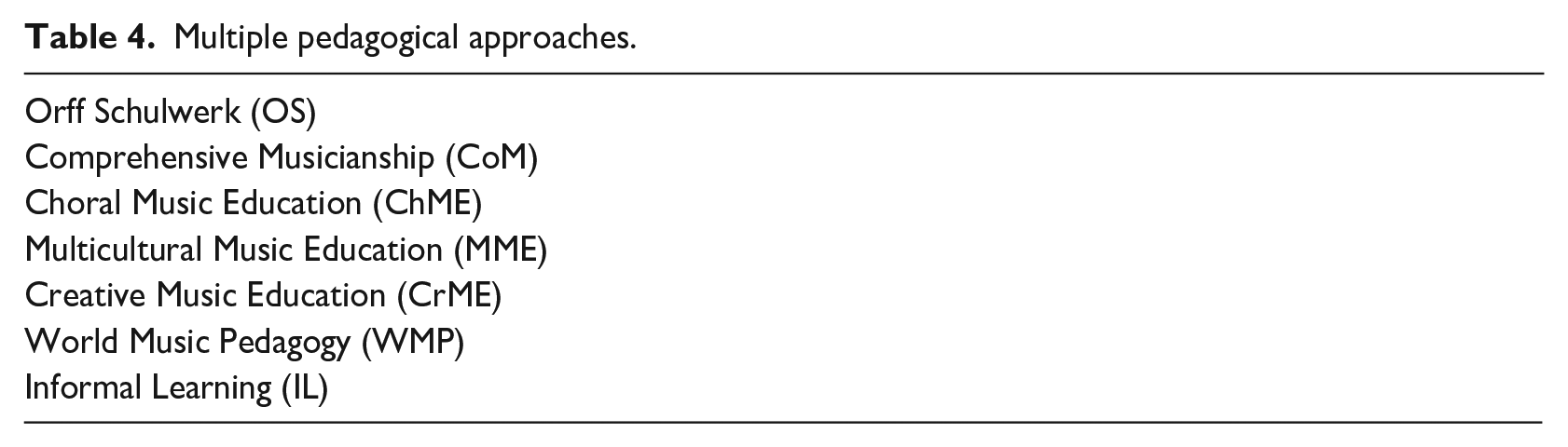
From our analysis of this selection of 19 papers oriented towards a pluralist or culturally diverse approach to music education we determined that collectively the authors engage the following specific music education pedagogies (Table 4): Orff Schulwerk (OS), Comprehensive Musicianship (CoM), Choral Music Education (ChME), Multicultural Music Education (MME), Creative Music Education (CrME), World Music Pedagogy (WMP) and Informal Learning (IL). In some of the papers the authors are explicit about the music education approaches they engage. Where this is not the case, we have attempted to discern the pedagogy closest to the teaching and learning approach the author commends. What follows is a concise summary of how we understand each author draws on one or more of these approaches (we are aware of some overlapping of features between some of the pedagogies). We assume readers are familiar with the approaches under discussion.
Multiple pedagogical approaches.
Although he does not refer to any specific music education pedagogy, Stock (1991) commends an approach that is like CoM. He proposes that Chinese music be taught through ‘a combination of [. . .] theory, history, listening, composition and performance’ (Stock, 1991, p. 102). In Stock’s (1991) paper it is also possible to detect the influence of the CrME approach associated with British music educationist John Paynter and others (p. 117). Further, it can also be observed in the article, that Stock, who is an ethnomusicologist, touches on MME ideas (Stock, 1991, p. 102) and anticipates aspects of WMP associated with Patricia Campbell (Stock, 1991, p. 102) (cf. Campbell & Wade, 2004, pp. 26–27).
Papers by Lau (2007) and Chong (2010) take a similar approach to Stock, although one that fits more squarely within the MME paradigm that was a forerunner to WMP. While not as analytically sophisticated as Stock, Lau commends a combined cultural and musical approach to teaching Chinese folk songs and she studies the ‘three tone patterns’ that appear in the melody of several songs (Lau, 2007, p. 24). Lau (2007) cites Patricia Campbell at the outset of the article (p. 22), thus noting that author’s influence on her work. Chong’s (2010) paper concentrates on a canonical item in the Chinese piano repertoire and draws on Chinese scholars’ analyses of the piece with the aim of achieving ‘greater depth and authenticity in understanding the Chinese musical system’ (Chong, 2010, n.p.). While Chong’s (2010) ‘ideas for classroom teaching’ section is extremely brief, its reference to listening and compositional activities echoes Stock’s approach (p. n.p.). Hence it is compatible with the CoM paradigm. Given that its focus is an item of Chinese music, Chong’s paper can be considered an example of MME.
Theses by Chen (2000), C. C. Leung (2002) and Wong-Yuen (2006) relate to the CoM approach. According to Chen (2000, p. 1), who alludes to MME in passing, a solid musical training can be obtained through information acquisition, critical thinking skills and creativity, aural and performance skills, as well as the study of music history, literature, and theory (p. 20). C. C. Leung’s (2002) thesis adopts a similar approach to Chen’s. While all three papers ultimately create models for Chinese music education (in Taiwan and Hong Kong), C. C. Leung’s (2002) music development model is considerably more broad-based and may be used in other Asian countries (p. 289). Focusing on luogu dianzi non-melodic percussion in Beijing Opera performance, Wong-Yuen’s research (2006) leads her to conclude that teachers need to guide students towards a personal knowledge through direct contact with music. This includes live performance and practical music making activities that occur together with live miming of the opera action to understand the context of luogu dianzi (Wong-Yuen, 2006, pp. 167–169). Although Wong-Yuen (2006) does not explicitly mention an educational approach in her thesis, her ideas are consistent with the CoM and MME paradigms (see p. 169).
Chen-Hafteck (2007) proposes an interdisciplinary approach to teaching Chinese music and her key reference point is the MME pedagogy. Also, she expressly mentions Campbell’s and Wade (2004) WMP (p. 231), and the importance of studying music in its sociocultural context. The notion of creating a new song and dance, of making a musical instrument and improvising a piece of music for meditation are all hallmarks of the CrME workshop approach associated with Paynter and others, although perhaps these elements have been absorbed via other educationists. B. W. Leung’s (2014) paper makes no explicit reference to a music education model, although the adoption of a ‘teacher-artist partnership’ approach reflects the WMP ideal of collaboration with musicians and artists (p. 130). Both Chen-Hafteck and Leung emphasise the need for music teachers and music educators to take a broad view of music learning. Also, both papers provide suggestions for how to increase music teacher confidence in the classroom, as well as how to reflect on and transform their teaching methods (Leung, 2014, p. 130) and develop music programs that give students immersive musical experiences.
Yang (1994), M. Tu (2009), Guo (2019), Pan (2021) and B. W. Leung (2021) all draw on the MME pedagogy, with Yang (1994), and Pan (2021) either anticipating (in Yang’s case) or using the WMP model. Yang (1994) pioneered the application of ethnomusicological approaches in the secondary music classroom in Australia (p. 17), using traditional onomatopoeic notation to facilitate the learning of Chinese percussion ensemble rhythm patterns. He introduces a four-step teaching-learning sequence: organising a Chinese percussion ensemble; oral exercise; written exercise; and performing practice (Yang, 1994, pp. 19–21).
Fox’s (2021) thesis is a response to the increasing prevalence of ‘Chinese-inspired works [. . .] in the Western orchestral repertoire’ (p. 1). On the one hand he consults prominent Chinese percussion specialists, while on the other, he largely dismisses Chinese pedagogical approaches, all the while wanting Western musicians to develop ‘a clear concept of Chinese percussion practices in practical terms’ (Fox, 2021, p. 191). He aims to achieve an authentic musical outcome while side-stepping cultural approaches to learning. Although Fox never refers to music education models or approaches, he nevertheless touches on a component of WMP – consultation with cultural experts.
The studies of both Zhang (2017) and Tan and Conti (2019) refer to Campbell’s and Wade (2004) attentive listening and engaged listening methodology, which is part of that author’s WMP approach. They apply these methods to teaching Chinese music (Zhang, 2017, p. 27; Tan & Conti, 2019, p. 340). These authors advocate establishing culturally authentic music materials and the involvement of a culture bearer, which are hallmarks of WMP (Zhang, 2017, p. 31; Tan & Conti, 2019, p. 333).
Guo (2019) explains that she incorporates ‘Orff Schulwerk methodology into World Music pedagogy’ by ‘integrating musical play, dances, and story-telling’ to create an ‘encouraging and respectful environment for multicultural music study’ (p. 3). She introduces Chinese minority Dong and Miao music and dance to elementary school music classrooms in the United States. In outlining her research paradigm, which is in keeping with MME, M. Tu (2009) refers to the writings of Bennett Reimer and David Elliott (p. 1). She attempts to develop an age-appropriate ‘Chinese Music Curriculum’ for elementary schools in the United States (M. Tu, 2009, p. 6).
B. W. Leung’s (2021) study is an interesting case of MME in that it advocates the re-inclusion of Cantonese Opera in the Hong Kong and Guangdong music curriculums after schools there had largely turned to the teaching of Western music. Pan (2021) emphasises the relevance of multicultural learning in music education, thus framing her study in MME terms (p. 1). Her frequent references to Campbell suggest that WMP informs Pan’s thinking.
Chin (1993), Gackle and Fung (2009) and Yang and Welch (2014) each adopt a different music education approach. Chin (1993) contributes a ‘teaching method that integrates Orff music education methods with Chinese folk songs and instruments’ (p. 20), aiming to fully explore students’ ability to imitate, explore, improvise and create, as well as deepen their understanding of Chinese musical culture through exposure to various combinations of music, language and movement. Chin refers in passing to MME (Chin, 1993, p. 2) and anticipates culturally responsive pedagogy in her research (Chin, 1993, p. 3) (see below).
Gackle and Fung (2009) concentrate on Western-style choral arrangements of Chinese folk songs to examine the relationship between culture and choral sound. Although their study falls squarely within the North American ChME approach, they attempt to broaden its scope by inviting Chinese choral directors to evaluate the study’s participating choirs’ performance of several folk songs. The spirit at least of a certain model of MME is invoked in their work.
To some extent Yang and Welch (2014) employ Green’s (2008) IL pedagogy as a reference point in their exploration of the complex issues involved in teaching and learning ‘authentic’ Hua’er folk music in a contemporary Chinese tertiary education setting (Yang & Welch, 2014). Other points of reference are Schmid’s (1992) and Campbell’s (1992) work on non-Western music transmission approaches, Sheridan and Byrne’s (2008) study of folk music in a higher education setting, and Rodriguez’s (2009) discussion of IL. Their paper emphasises the need for ‘a more cooperative relationship amongst authentic singers and teachers’ and greater ‘openness towards a more interactive learning process’ (p. 215).
Finding 5: A breadth of best practice principles is represented, yet some paradigm lacunae are apparent
First, we note that best practice is somewhat subjective notion. Even so, from our detailed study and analysis of the 19 papers, we (tentatively) conclude that best practice in the teaching of Chinese music in Western educational settings could result from engaging various pedagogical approaches (see Finding 4), either separately or in combination, if culture-bearing insider experts are involved in the selection and contextualisation of the classroom materials to be studied (see our earlier point about the papers’ Chinese authors). As multicultural pedagogical approaches have shifted over time and new approaches have been developed, researchers have explored new ways to incorporate Chinese music into teaching and learning schemes. From this we conclude that Chinese music forms are compatible with many if not most major Western-style music education pedagogies.
Identifying the seven music education paradigms led us to question first, whether any of these paradigms was under-explored in the selected papers, and second, whether any key paradigms were absent from the literature on Chinese music in music education. For our purposes, a key paradigm is one that has been developed or adapted to incorporate musical pluralism or cultural diversity in the curriculum. We discovered the following issues after conducting a thorough investigation and review of the 19 selected papers.
The application of IL and ChME to Chinese music have thus far been little explored. In contrast with formal learning, IL is co-constructed by students and teachers, and it emphasises that ‘learners are empowered to participate in activities with minimal restrictions, control, and intentional immersion’, as well as that students have a say in the direction and progress of their learning. Choral Music has recently been merged with WMP and its potential for incorporation into culturally diverse music education has yet to be thoroughly researched (Bartolome, 2019).
An approach resembling that of culturally responsive pedagogy (CRP), is commended in Chin (1993), however codified forms of CRP have only been a focus in music education research since the early 2010s. It will be worthwhile watching how the pedagogy is applied to contexts involving students of Chinese heritage. Culturally responsive pedagogies are those ‘that actively value, and mobilise as resources, the cultural repertoires and intelligences that students bring to the learning relationship’ (Morrison et al., 2019).
Two of the most widely used music education methods of the twentieth century, those associated with Dalcroze and Kodály, have not been applied in the teaching of Chinese music in Western educational settings and it remains to be seen whether they can be successfully adapted.
Finding 6: Best practice principles
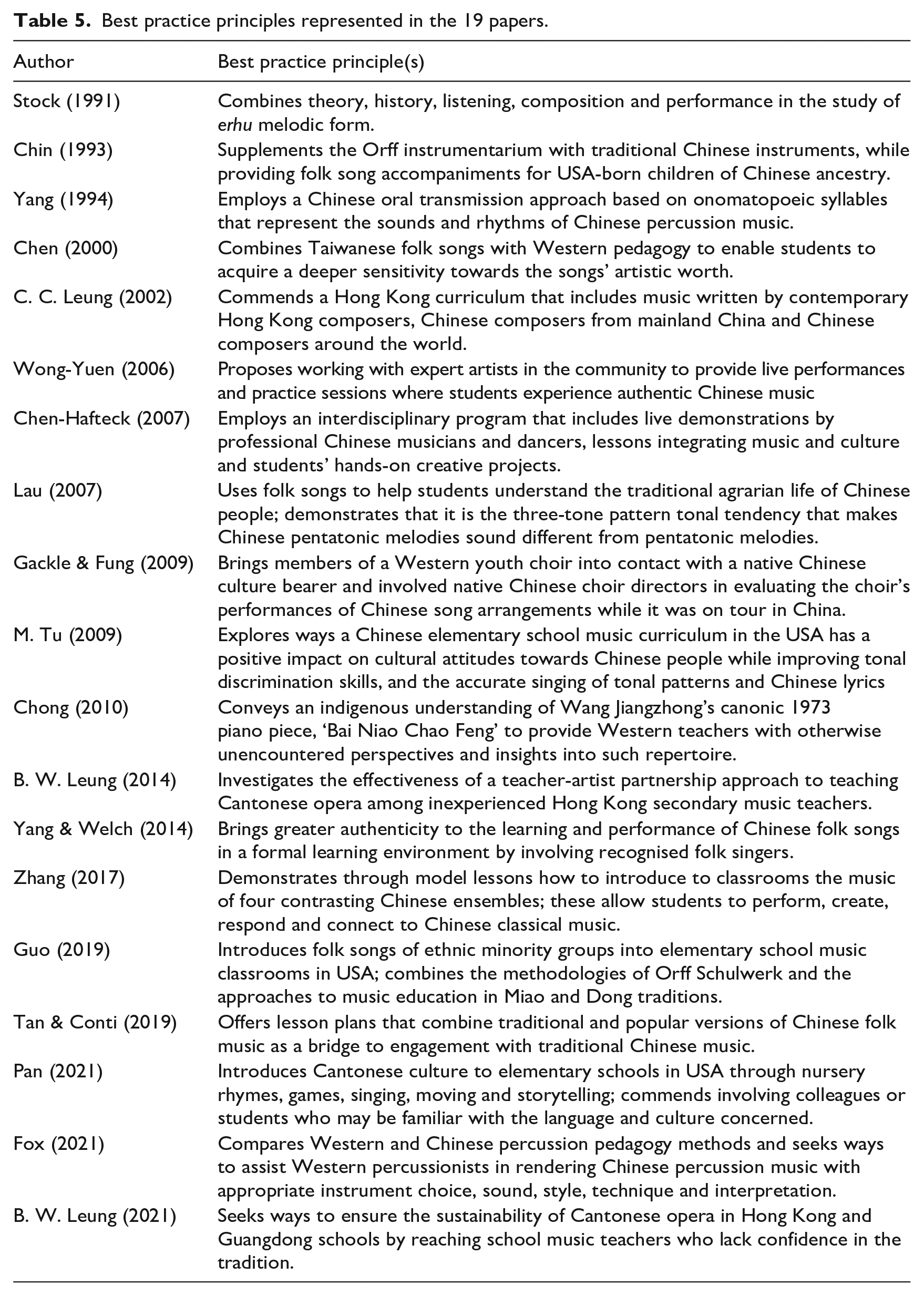
From our detailed reading and analysis of the 19 articles and theses, we discerned that each author sought to identify robust and reliable means of transmitting and embedding Chinese music in Western formal education settings that went beyond superficial encounters with the music. Each author was keen to cultivate a deeper knowledge of the music’s technical, social and cultural qualities. Applying our guiding criterion of ‘active classroom engagement’, we have attempted to summarise the ways each author or pair of authors addresses what we believe could be termed best practice in their pursuit of seeing Chinese music more firmly embedded within Western style educational offerings (Table 5).
Best practice principles represented in the 19 papers.
Conclusion: Repositioning Chinese music
We set out to determine how and to what extent Chinese music has been represented in Western and Western-style music education settings over the past three decades. We also sought to discover what might be considered best practice approaches to the transmission of Chinese music in these formal education contexts. We found the following: (1) only a limited number of praxis-oriented papers have been produced; even so, (2) the gamut of educational settings is represented in the corpus of extant papers; and furthermore, (3) a moderate and modest range of Chinese music styles is represented; as are (4) multiple pedagogical approaches; yet (5) pedagogical lacunae remain; and finally, 6) a breadth of best practice principles is represented in the corpus of papers.
For those interested in advancing the teaching of Chinese music in Western settings, this is a somewhat encouraging picture of the state of the field, as much good work has already been undertaken. However – and to address each of these findings succinctly – it can be confidently stated that much room remains for further research-based comprehensive studies to be undertaken, and detailed ‘how-to’ exemplar lessons to be produced, by trained researchers and experienced practitioners. With respect to educational setting, both the early childhood and tertiary settings could be better represented in future research studies and articles. Also, teacher education needs far greater attention, as well-prepared, knowledgeable and enthusiastic teachers are crucial to the music’s classroom appeal and successful transmission. Further, the Chinese music forms and styles represented in educational offerings could be expanded considerably to include an even broader range of regional musical styles – of opera, for example – as well as more modern and contemporary Chinese music, including art and popular forms. Diasporic Chinese music innovations should also be a focus of future work. Regarding pedagogical approaches, much more research is required, especially as it relates to the music’s transmission in classroom settings. Existing established approaches such as Informal Learning and others could be explored further, especially if creative music making is a priority. Collaborative models – between insider and outsider researchers, as well as between classroom teachers and performers or composers – also need greater consideration for the benefits they can contribute. For example, Watts and Zhang (2021) includes numerous Chinese musical traditions performed by 32 men and women of various ages, occupations, geographic regions and ethnicities, supported by live recordings and pronunciation guides. This will undoubtedly serve as a model for elementary and secondary school music teachers and students keen in learning about the diversity of Chinese music culture in an authentic way.
In conclusion, we note Wenzhuo Zhang’s (2017) recently issued challenge to Chinese national education policy makers to ‘truthfully, respectfully, and authentically diversify [China’s] own ethnic cultures in the national education system’ (p. 78). We believe this is a worthy ambition too for educational authorities and practitioners in countries that are home to the 45 million people worldwide who identify as Chinese (Jaivin, 2021, p. 2).
Footnotes
Author Contributions
Ke Wang is a PhD candidate at the Sydney Conservatorium of Music, The University of Sydney. She graduated from the China Conservatory of Music with a bachelor’s and master’s degree in music education. Wang is interested in inclusive and culturally diverse music education in and outside China, East Asian music in Western education settings and music psychology. Besides being published in refereed journals, her translation of North and Hargreaves’ 2008 volume, The Social and Applied Psychology of Music, was released in 2021. Michael Webb is an ethnomusicologist and music educationist. Until 2021 he was an Associate Professor at Sydney Conservatorium of Music, The University of Sydney.
Declaration of Conflicting Interests
The authors declare that there are no potential conflicts of interest with respect to the research, authorship, and/or publication of this article.
Funding
The author(s) disclosed receipt of the following financial support for the research, authorship, and/or publication of this article: This research is supported by an Australian Government Research Training Program (RTP) Scholarship.
