




Abstract
The Norwegian schools of music and arts are publicly funded institutions which offer extra-curricular activities for children and adolescents in music and other art forms. According to Norwegian legislation, each municipality is required to provide such education for its inhabitants. By parliamentary decision the schools are expected to be for all children and youth. In this article we explore this mandate through research questions focussing on how the schools work to increase their local significance; what their strategies of inclusion are; and how these strategies are experienced by the parents of school users, with a special attention towards tensions that may arise with respect to inclusion/exclusion. The exploration is based on an interview study among headteachers, teachers and parents belonging to five strategically sampled schools of music and arts. The data comprise 30 interviews. The findings show that the schools put considerable efforts into increasing their local significance as well as developing and executing a multitude of strategies of inclusion. Still, they reach only a limited selection of children and youth. Using a Bourdieusian framework, we suggest that this may partly be due to the patterns of cultural domination existing within the Norwegian school of music and art system.
Introduction
The Norwegian schools of music and arts are publicly funded institutions which offer extra-curricular activities for children and adolescents in music and other art forms. Although a curricular framework exists, the schools are not obliged to follow it; neither are the schools of music and arts considered to be a direct supplement to the teaching of arts subjects in compulsory school education. Still, according to Norwegian legislation, each municipality is required to provide school of music and arts education for its inhabitants (Education Act, 1998, pp. 13–16). These schools are expected to function as cultural hubs and central initiators and collaborators in their respective local contexts (NOU 2013: 4), thus potentially having large local significance and serving the population of each municipality quite extensively. This broad mandate is also detectable in the legal text governing these organisations’ existence: All municipalities, either alone or in collaboration with other municipalities, must provide courses in music and other cultural activities for children and young people, organised in association with the school system and local cultural life. (Education Act, 1998, pp. 13–16)
The above text also makes clear that the primary stakeholders of the Norwegian schools of music and arts are ‘children and young people’ – unspecified in number and thus potentially all of them. This goal of broad inclusion is strengthened by the fact that there are no general entrance exams for applicants, and through the stated vision of the schools’ national council, namely: ‘Schools of music and arts for everybody’ (Norsk kulturskoleråd, n.d.). Recently, the wish that these schools should serve such a large segment of the population was further reinforced by a parliamentary decision to stand behind this vision, and to support the actions necessary to fulfil it (Meld. St. 18 (2020)).
According to Berge et al. (2019), the schools of music and arts’ work of being local initiators and collaborators is widespread, but takes very different forms and has different outcomes. Recently, 86% of the schools reported collaboration with other, local and municipally run institutions such as schools and kindergartens, and, similarly, 85% collaborated with local voluntary arts associations (Berge et al., 2019, p. 93). The local ‘owners’ of the schools – the municipality leaders – also reported them to be important for the enhancement and enrichment of local cultural life. Still, at the same time, these leaders saw the schools of music and arts as quite conservative organisations which were little prone to development. This perception is strengthened by our own findings, gained through a national survey among Norwegian school of music and arts headteachers (Jordhus-Lier et al., 2021), in which only about 30% of the schools reported explicit plans for further development. In Berge et al.’s (2019) study, the municipality leaders also saw the schools of music and arts as fairly ‘closed’ in terms of student demography and access (p. 163). Thus, as has also been shown by other studies (Bjørnsen, 2012; Gustavsen & Hjelmbrekke, 2009), although the Norwegian schools of music and arts may employ strategies of collaboration and wider inclusion, and also envision the participation of ‘everybody’, these efforts do not necessarily work to target the intended groups.
In this article, we report on an interview study among Norwegian school of music and arts headteachers, teachers and parents which was conducted within the frames of a larger research project exploring processes of cultural inclusion and exclusion in the broader landscape of musical upbringing and schooling in Norway (DYNAMUS, n.d.). In a Norwegian context, the schools of music and arts are the main suppliers of extra-curricular music activities. Consequently, these schools have constituted one of the main research areas of the larger project. In this article, we explore how the schools of music and arts work to collaborate with their surroundings in inclusive ways by asking the following research questions:
RQ1: How do Norwegian schools of music and arts work to increase their local significance?
RQ2: What are their strategies of inclusion?
RQ3: How are the articulated strategies experienced by parents of the schools’ users, and which tensions arise in this regard that may have significance with respect to inclusion/exclusion?
Previous research
Worldwide, there are very different solutions to organising extra-curricular music education for children and adolescents, depending on, among other things, the organisation of the general school system, state economy and tradition. Still, as Schmidt (2013) reminds us, variation in music education policy thought and action should not prevent us from thinking local policy ‘within a global reality’ (p. 103) and also aiming to be meaningfully informed by situations and initiatives elsewhere. When it comes to creating a backdrop of previous research on extra-curricular music education in connection with the present study, however, we have chosen to limit our overview to research focusing on Norway, Sweden, Finland and Denmark. Following the observations of Björk et al. (2018), who state that the ‘[c]urrent aims for music education in schools for music and performing arts are shared by all the Nordic countries’ (p. 11), also knowing that the social organisation and contextual circumstances of such schools are fairly similar within these countries, we have found this limitation to be sound in relation to the case at hand.
The focus on inclusion and access to extra-curricular music education has been strong among Nordic music education scholars in recent years, however more from an overarching point of view than from digging into actual schools’ particular strategies and ways of working. Researchers have looked into the broader legislative and policy aspects of school of music and arts participation (see e.g. Holst, 2020; Karlsen & Nielsen, 2021; Tillborg, 2021; Väkevä et al., 2017), and more specifically into how such participation has been made possible or hampered with respect to demographic characteristics such as ethnicity (Kallio & Heimonen, 2019; Kallio & Länsman, 2018), dis/ability (Laes, 2017; Tillborg, 2020), sexual minorities (Suominen et al., 2020), age (Laes, 2015) gender (Kuoppamäki, 2015) social class (Berge et al., 2019; Jeppsson & Lindgren, 2018) and geographical location (Jordhus-Lier et al., 2021). A large proportion of this research has also concerned the music and arts schools’ implementation of El Sistema, often for the purpose of integrating children and youth from socio-economically disadvantaged backgrounds (see e.g. Bergman et al., 2016; Emstad & Angelo, 2017; Sæther, 2018). The prolonged scholarly attention towards the opportunity gaps existing within the Nordic systems of schools of music and arts does not seem to have remedied the situation, however. On the contrary, Finnish researchers concluded recently that the seemingly free choice of extra-curricular music activities which these schools represent can be characterised as a form of hidden elitism (Väkevä et al., 2022).
If the claims about hidden elitism are true, how are such circumstances produced, and why are the mechanisms giving rise to this not made explicit and dealt with? Some hints can be found in recent studies conducted in the Swedish context. Kuuse (2018) interviewed music teachers employed by a school of music and arts to work in an El Sistema-inspired programme and found that these teachers described the socially conscious aspects of their work as something different from and outside of their professional work as music teachers: ‘A music teacher’s teaching is, in other words, expected to be the same everywhere, in any kind of music educational context. Contrastingly, the social mission is constructed as vague, indistinct, heavy and arbitrary, a kind of work that, despite being important, lies completely outside the music teacher profession’ (Kuuse, 2018, p. 38, our translation). In another interview study among school of music and arts music teachers, Jeppsson (2020) showed that, although the teachers could think of ways to disrupt social reproduction and also made certain efforts in this regard, they found it hard to challenge the existing social and cultural patterns and positioned ‘obstacles to change outside their sphere of influence’ (p. 68). Also interviewing school of music and arts leaders, Jeppsson (in press) recounted that these leaders saw their employed teachers as being ‘relatively badly equipped to handle new [and] unfamiliar (teaching) situations’ (p. 22, our translation). Still, the leaders expected the teachers to reach new student groups and work towards broader inclusion.
In terms of strategies of inclusion, it may seem that such strategies are expected at the leadership level, but that teachers find them hard to establish or even inadequate. The teachers also seem to believe that the social and cultural circumstances governing school of music and arts attendance are beyond their own control.
Theoretical framework
The theoretical framework of our study builds on a Bourdieusian logic and underpins our understanding of the social dynamics of music and music education in general. This framework emphasises, among other things, music education and the ability to engage competently with music as a valuable form of cultural capital (Bourdieu, 1984). This means that for people who learn to master and appreciate music in its various forms and articulations, such skills and knowledge will have an impact that goes beyond the mere musical outcome, and it will have significance for their social standing. The valuation of music engagement as cultural capital does not happen indiscriminately, though. To cite Bourdieu himself, ‘nothing more clearly affirms one’s “class”, nothing more infallibly classifies, than tastes in music’ (Bourdieu, 1984, p. 18). Consequently, which musics one engages with is important with regard to the accumulation of capital. Also, accepting the logic that certain musics are more important for building cultural capital than others, implies ‘a form of recognition of the dominant values’ (p. 386) which again may allow for ‘cultural domination’ (p. 395). Through his concept of habitus, Bourdieu shows how the capacity to ‘produce classifiable practices and works’ as well as the ability to ‘differentiate and appreciate these practices and products (taste)’ (p. 179) becomes embodied and is generative to producing lifestyles which again come to connect or divide individuals so that they have a feeling of belonging to particular social classes. Exploring this phenomenon in a UK context, Bull (2019) shows how learning to play an instrument within the Western classical music tradition works as a socially stratifying device, one whose logics and traditions of teaching also greatly correspond with the logics and forms of upbringing predominantly preferred by middle class parents. Given the exponential gentrification of popular music within all levels of Nordic music education (see Dyndahl et al., 2021), we claim that in our context – Norway – similar socio-musical dynamics are connected also to learning and engaging with other academised musics, such as jazz, rock and pop (Dyndahl et al., 2017). Here, we might also add the observation that ‘music [instrumental] lessons seem especially socially exclusive’ (Brook et al., 2020, p. 115) with regard to the participation of children and youth since such lessons are expensive and participation to a large degree depends on household income. Even though school of music and arts attendance in Norway is supposed to be affordable for all, studies show that the fee and other costs connected to such attendance may function exclusionary here as well (Berge et al., 2019; Gustavsen & Hjelmbrekke, 2009). All in all, given that the cultural capital that comes with learning legitimised musics may be vital for people’s life chances, it is also of importance, from our point of view, to explore the questions of who has access to accumulating it and how such access is distributed. From this arises our research interest in how the Norwegian schools of music and arts work with and within their surroundings, which strategies they have developed regarding inclusion and, not least, how these strategies are experienced, and thereby can be seen to work.
Method
As mentioned in the introduction, the present interview study is part of a larger project in which one research area focuses on schools of music and arts in Norway. Earlier sub-studies within this particular research area of the project include a discourse analysis of all curriculum frameworks of this national institution (Karlsen & Nielsen, 2021), a nation-wide survey among the schools’ headteachers (Jordhus-Lier et al., 2021), and a survey among a selection of school of music and arts teachers (Nielsen et al., 2022).
Design and sampling
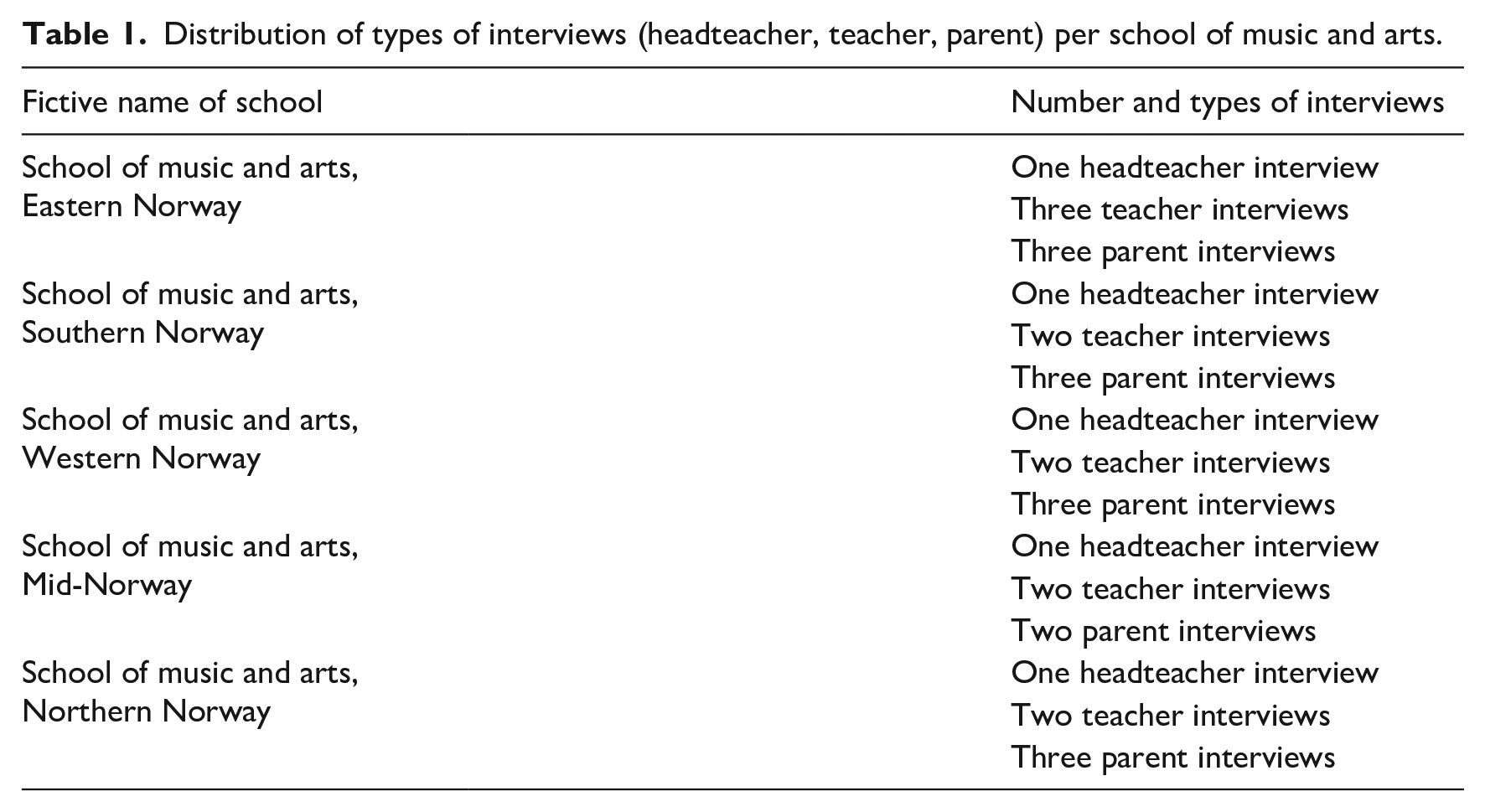
The interview study was designed using semi-structured interviews and selecting school of music and arts headteachers, teachers and parents belonging to five strategically sampled schools located in different parts of Norway. Altogether, the data comprise 30 interviews. The schools were selected according to variation in geographical location and what was offered, content-wise, with regard to music instruments and genres. The selection was based on knowledge obtained through a survey distributed among all school of music and arts headteachers in Norway (Jordhus-Lier et al., 2021). The distribution of types of interviews per school is shown in Table 1.
Distribution of types of interviews (headteacher, teacher, parent) per school of music and arts.
Due to the Norwegian General Data Protection Regulation on privacy (Personopplysningsloven, 2018), we could not access lists of teachers or parents to music students from the schools. Thus, headteachers were interviewed first since their names would appear on the schools’ webpages, and teacher interviewees were selected after suggestions from headteachers. Parent interviewees were selected after suggestions from either headteachers or teachers.
Procedures
The interviews were carried out during the period of October 2020 to December 2021. Throughout this period, Norway suffered from several rounds of lockdown and taxing travel restrictions due to the Covid-19 pandemic. The interviews were therefore conducted digitally, using Zoom, and audio-recorded using an external device placed next to one of the interviewers. The interviews were semi-structured (Kvale & Brinkmann, 2009), which means that the interviewers used pre-developed interview guides which were also offered to the interviewees prior to the Zoom meeting.
The authors worked in pairs when interviewing. All interviews, except two, were conducted by two researchers. On one occasion, only one researcher conducted the interview, due to practical reasons. On another occasion, the interviewee preferred to answer the interview questions by e-mail. Interviewing by Zoom was not ideal, but was necessary due to heavy restrictions. The decision to employ two interviewers at the time was made to ensure that more nuances in the interviewees’ speech and body language were captured so that fruitful follow-up questions could be posed. Also, the interviewers always set time aside after the interview to discuss their experiences and preliminary understandings to strengthen the ‘intersubjective reliability’ (Kvale & Brinkmann, 2009, p. 245) of their interpretations.
Analysis
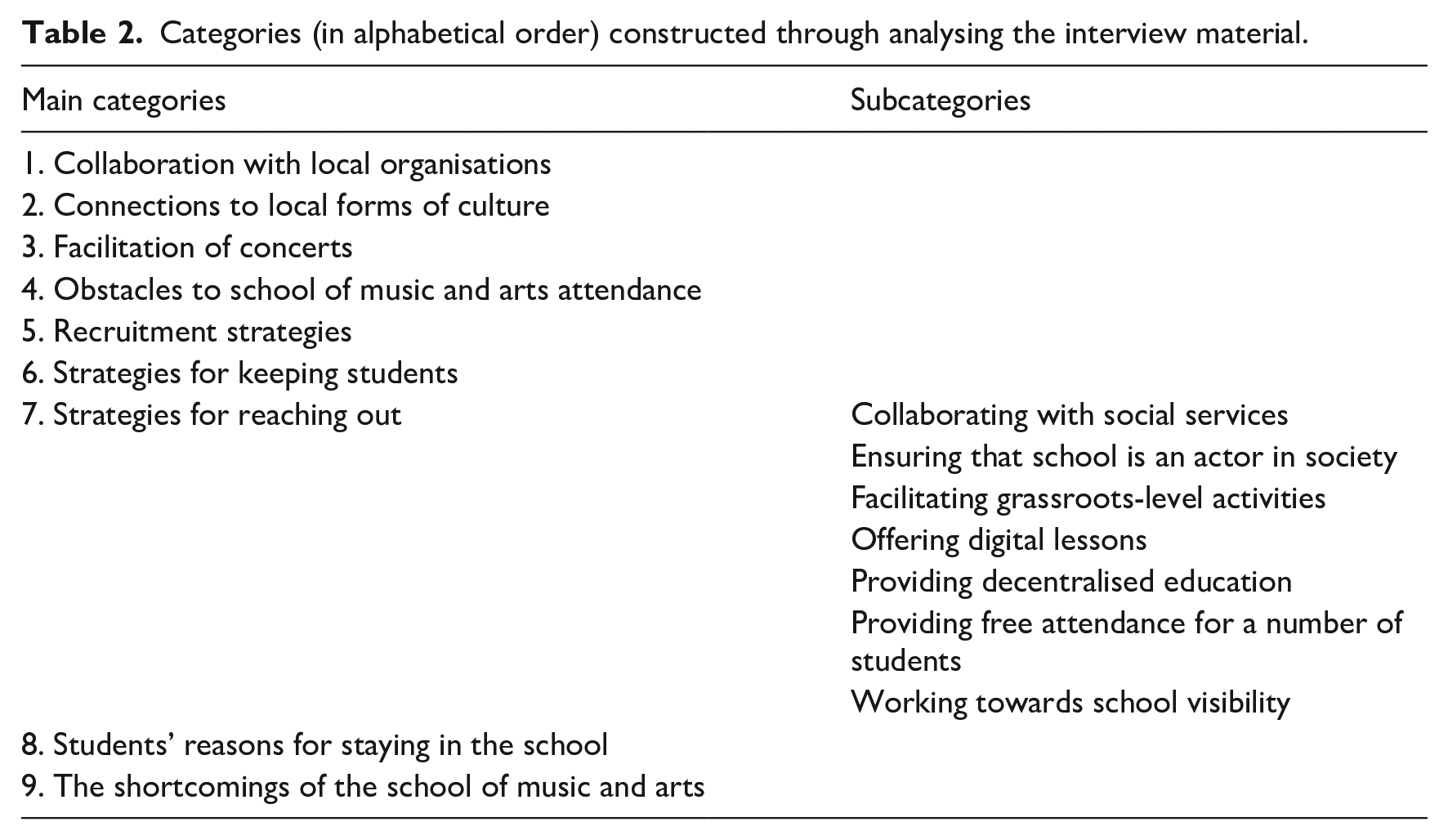
The interviews were transcribed and subsequently analysed by way of ‘data-driven coding’ (Kvale & Brinkmann, 2009, p. 202), using the software NVivo. The research questions (see above) were also kept in mind while performing the analysis. An overview of the main categories constructed is found in Table 2. For the sake of providing transparency, we have also chosen to show the subcategories of one of the main categories (Strategies for reaching out). The remaining subcategories have been omitted to limit the size of the table.
Categories (in alphabetical order) constructed through analysing the interview material.
The coding was done by one researcher only, but the categories constructed and tensions detected were discussed with the other researchers during the process of analysis to strengthen the reliability of the findings.
With respect to writing up the findings below, the contents of main category 1 and 2 were predominant in formulating how the schools of music and arts work to increase their local significance. The description of the schools’ strategies of inclusion is mainly based on main categories 3 to 7, while the two final categories – 8 and 9 – were utilised for explicating the parents’ experiences. During the analysis we also worked to detect tensions in the material, which were often found by looking across categories, in particular with regard to how the ways of working and strategies described by headteachers and teachers were experienced as inclusive (or not) by the parents.
Ethical considerations
The interview study was submitted to the Data Protection Service of the Norwegian Agency for Shared Services in Education and Research for ethical evaluation, and subsequently approved. All interviewees were given information about the research prior to the interviews, and they also signed an agreement giving their informed consent. The five schools of music and arts involved have been given fictitious names (see Table 1) to protect the participants’ anonymity, and all interviewees are referred to by their status only, either as headteacher, teacher or parent. Teachers consented to us interviewing parents of children that they taught. Likewise, parents consented to providing information about their own under-age children. In the cases where information about children above the legal age (15 years) was included in the material, informed consent was sought by the youngsters in question as well.
Findings
The findings are presented in accordance with the order of our research questions. We start by addressing the question of how Norwegian schools of music and arts work to increase their local significance; then we move on to describing the schools’ strategies of inclusion. Finally, we give examples of how the inclusion strategies were experienced by parents of the schools’ users.
Working to increase local significance
Altogether, the five schools included in our sample worked in a myriad of ways to maintain and increase their local significance, mostly through various forms of collaboration with other local and municipally related entities. Here, we have chosen to divide the partners and forms of collaboration into four different levels, going from the most internal to the national one. First, effective collaboration with parents was emphasised as crucial for the schools’ existence and so was the collaboration within the schools themselves, across various departments and art forms. Such internal work was often necessary to create bigger performances and productions, which also made the schools visible in the local community. Second, the existence of projects and larger concerts and other performances also depended on vast collaboration with other local organisations, often offering leisure-time pursuits for children and adults in the field of culture and music. The partners involved at this level would include wind bands, festivals, fiddlers’ associations, amateur theatre groups, private music schools, religious organisations and other local societies. The third level involved collaboration with more formal local bodies, such as schools, also including the after-school programmes, the local municipal administration, and the local houses of culture (community houses typically designated to cultural activities and organisations). Regarding the municipal administration, some of the headteachers recognised the benefits of being organised under the local school council, rather than the local council of culture. Having experienced both forms of organisation, one of them said, relating to the quality of the collaboration: [Previously, when under the school council] we used to be present at the headteachers’ meetings, we had the opportunity to inform them [. . .] I think it is a pity [that we are now under the council of culture]. I do not think it is fortunate, but now they have made that decision. So, we must make the most of it.
Still at the same level, being situated within a larger house of culture context was seen as very beneficial for increasing the local significance of the schools of music and arts, not least in terms of visibility: ‘When the school of music and arts is included in such a community house, that is a huge advantage. [The school] becomes a more everyday common thing, instead of being a hidden thing’. The fourth level contained locally based collaboration with national organisations such as The Cultural Schoolbag, a state-funded, national programme that exists to ensure that all school-age children in Norway have access to experiencing professional arts and culture (Den kulturelle skolesekken, n.d.). This form of collaboration at the same time involved collaboration with local schools.
As part of their work to connect to surrounding society and thereby increase their local significance, some of the schools participating in this research also chose to emphasise a musical repertoire that was locally rooted. This could manifest as embracing the local folk music, but also as including the music of local minority groups, be they national or immigrant minority populations.
Strategies of inclusion
Combined, the participating schools of music and arts also had a multitude of strategies of inclusion, some of them tailored to the specific circumstances found in the local municipalities, and other more generalised ones.
Strategies for reaching out and adjusting to the needs of specific user groups involved, among other things, offering digital lessons and providing decentralised education where geographical distances within the municipality were large. Some schools provided free attendance for a limited number of students to allow families who struggled financially to enrol their children. However, both headteachers and teachers remarked that these places could be hard to fill. Facilitating low-threshold grassroots-level activities was another way to facilitate for broad participation, and it was also seen as important to make the school visible so that potential users knew that it existed. Some of the teachers interviewed emphasised the need to accommodate to the already-existing students’ needs in order to keep them as students for the future.
Strategies for inclusion of old and new user groups – students whose families were already acquainted with the school of music and arts system and those whose families were not – were visible through the wide range of activities implemented to recruit students. Such approaches involved being visible in social and local media, having an open day, getting in touch with potential students via local wind bands, the Cultural Schoolbag programme or after-school programmes, as well as recruitment via friends, parents and other family members, teachers and current students. One headteacher emphasised the visibility the school gained through participating in the National Day parade as important for attracting new students, while other interviewees pointed to talent programmes as crucial for keeping students who were seen as musically gifted.
With respect to the specific inclusion of new user groups, we found two strategies that were quite common, but which seemed to work in very different ways. The first and most successful one went through collaboration with local compulsory schools. Such collaboration could take various forms, whether through school concerts to show off what was available in terms of instruments and teachers, through all first-graders receiving individual invitations, through the after-school programmes, or through the music and art school teachers being involved in actual compulsory-school music lessons. One of our participating schools offered a so-called carousel of culture to first- and second-graders in some of the municipality’s compulsory schools. This carousel was a short, introductory course with titbits of what the school of music and arts in question had to offer. The interviewed headteacher had noted a significant difference in recruitment between schools whose students had access to this particular course and those who did not. He had also investigated further, and found that ‘the six [compulsory] schools that that had the lowest degree of school of music and arts [student] participation did not offer the carousel of culture’.
Another strategy, quite successful in general, was the arena of recruitment that the schools’ rich portfolios of concerts and other performances constituted. Some of these events were described as the ‘cultural highlights’ of the local communities by both headteachers, teachers and parents. Still, whether they actually worked in terms of reaching and including new and underrepresented groups of students was debatable, as illustrated by a quotation from one of the headteachers: The concerts provide visibility, but we often see that the audience consists of students’ relatives who would have attended the concerts anyway: grandparents, aunts and uncles. It is important, because smaller siblings are there, too, as audience, so I do believe it is an important arena for recruitment.
The relative circularity and social reproduction of student recruitment were touched upon when talking about obstacles to school of music and arts participation as well. Many of the interviewed teachers and headteachers had noticed that most of their students came from resourceful families; ‘mainly white children with well-to-do parents’ as one of them said. Discussing why some groups in society seemed difficult to reach, the most frequently given reason for lack of school of music and arts attendance was the cost of participating. ‘It is pretty expensive’, as one of the headteachers put it, and this aspect was also highlighted by some of the interviewed teachers. Only two interviewees – one headteacher and one teacher – mentioned a possible discrepancy between cultural worlds as a reason, and both of them in rather condescending ways. ‘Lack of leisure-time or cultural competence’ was thus the characterisation ascribed to the non-users of the schools of music and arts.
Strategies and tensions as experienced by parents ?
Many of the school of music and arts strategies of inclusion described by headteachers and teachers were validated as both existing and well-functioning by the parent interviewees. Sometimes their own children had even been recruited to the school through the routes described. Given our interest in how the schools cater to their stakeholders, we were also interested in the tensions experienced in this area, as indicated in the method section above. While the voices of children and young people would of course have been important in detecting such tensions, they proved also to be detectable through the accounts of the interviewed parents. In fact, we did find a few interesting examples in this regard, all quite localised in how their specific composition of assumptions led to particular actions which were supposed to work in inclusive ways, but which somehow missed the mark since the assumptions were misguided with respect to what actually worked or was experienced as inclusion. Still, what these examples had in common was that they all exemplified what we have chosen to call ‘cultural mismatches’ – a discrepancy between the cultural world (and sometimes also habitus-related) conceptions of headteachers and teachers of schools of music and arts on the one hand, and the cultural worlds and logics lived-in by the interviewed parents and their children on the other. We will give three brief examples of such mismatches.
Homeland music, or mainstream music courses
One school offered courses in music that was specific to a local minority group of immigrants. When interviewing this school’s headteacher he explained clearly that he did not believe this or similar courses were necessary: ‘This has been a myth, “Oh! Our new fellow citizens should have [courses with] their own folk music instruments, because then they will be integrated”. That’s just nonsense!’ In his understanding, students with immigrant backgrounds first and foremost wanted to, and should, attend what he saw as the mainstream courses of the school. The significance and value of this particular course was, however, emphasised by some of the parent interviewees whose children participated in it. The music learned was embedded in the families’ wider cultural and religious life, and it also allowed for a fellowship between generations living continents apart in their daily life. One of the parents said: ‘I believe it is good that the children receive this knowledge, what forms of music, culture, exist among [name of minority group]. There are only benefits connected to this’. While this example would allow for an interesting dive into the discussions relating to the difference between integration and inclusion, it is included here mainly to exemplify one version of a cultural mismatch – a course dismissed as unnecessary by the headteacher, but experienced as valuable by the parents.
Belonging to the folk music community, or being left out
Another school had chosen to emphasise the local folk music. This seemed to be a source of joy and pride, and involved collaboration with the local fiddlers’ association and participation in various folk music contests and festivals. When larger, more official events took place in the municipality, the fiddlers and folk dancers were often asked to contribute. One of the interviewed parents explained: ‘The fiddle and the dance are often emphasised; we are a “fiddle municipality”. The fiddlers will often be asked [to play] in connection with opening ceremonies and events’. Participating in such events did not only require mastery of the music and dance. It also meant wearing expensive folk costumes – bunader – and preferably the ones from the area in question. A Norwegian folk costume is often made of high-quality fabric with lots of embroidery, and silver jewellery to go with it. Typically, it will cost from NOK 50,000 (≈ €5,100) and upwards, with all parts included. While it is customary to wear a costume from an area to which one has a genetic or residential connection, it is not obligatory. However, in one of the parent interviews, a mother described how she felt about this, and how the expectations created a certain pressure. Not originally from the area, the family had not inherited or invested in the local folk dress: There is a difference between those who have a folk costume and everything in order, and us who have a cardigan . . . [These events] suit those who have everything the best . . . [At one particular event] I really felt it. All the girls had a full folk dress. We had inherited a small children’s folk dress, but it was not from [here] or anything.
Thus, a musical tradition and strategy that was supposed to create cohesion and a feeling of belonging did quite the opposite for this interviewee’s daughter. The mother described how they were currently at a crossroads with respect to continuing to play the fiddle, explaining that her daughter ‘did not quite feel at home with it’; ‘it’ referring to both the local folk music and the culture surrounding it.
The youth’s own music, or what the teacher is able to teach?
Our final example is derived from a school which focused quite heavily on popular music. One of the parents interviewed had a son who attended guitar lessons at the school. During the interview, she alternated between expressing, repeatedly, that she was very pleased with what the school had to offer, on the one hand, and describing the obstacles her son faced when wanting to learn style-specific traits connected to his favourite music, heavy metal, on the other hand: ‘The guitar teacher is very honest about not knowing this [heavy] metal technique very well’. The mother went on to explain that her son was quite independent, and that he did not really want to lose the uniqueness in style that being self-taught in heavy metal music had afforded him, and maybe therefore was not so easy to teach. Acknowledging both that she wished the school had a qualified heavy metal guitar teacher, and that her son could benefit from learning other styles and techniques as well, she ended up saying about her son and his fellow band members: ‘At least once in a while it would be great if they were allowed to play what they enjoy the most [within the school of music and arts context]’. Interviewing the guitar teacher in question, we learnt that he indeed was very honest about not mastering heavy metal: I have two students who are really into metal now . . . I struggle a bit with this, but I am pretty honest about it. Still, I am able to find solo pieces that they find it fun to work with. It is more about musical schooling. Phrasing, vibrato, and so on . . . I try to work with their very musical understanding. I know that they may not prefer to work with this, but I try all the time to convince them that it is good to learn these things . . . They are going to need this later.
‘Later’ was in this connection seen in relation to the teacher being of the impression that the two students in question wanted to attend the music programme in upper secondary school. The exclusion of the heavy metal that his students preferred to play was thus not only explained by the teacher’s inability (or unwillingness) to teach this particular popular music style, but also legitimised by his (assumed) knowledge of what participation in the upper secondary school music programme would require from his students. Consequently, at the same time as this was an act of exclusion, it could also be interpreted as a long-term inclusion into the legitimised musics of subsequent forms of schooling, and a building up of the student’s cultural capital in this regard.
Discussion
The Norwegian schools of music and arts explored in this article seem to put considerable efforts into increasing their local significance as well as developing and executing a multitude of strategies of inclusion. Through this work, they fulfil their legal obligation to collaborate with the local school systems as well as local cultural life. In both cases, the connections made seem to be intensive and mutually prosperous. This resonates well with the findings of Berge et al. (2019), who report much the same collaborative and inclusion patterns as found in our data. A phenomenon partly clouding the otherwise wonderful efforts of the schools of music and arts of reaching out, is the fact that they only reach a limited selection of their primary stakeholder group – children and young people. In fact, in 2019, only 13% of Norwegian children and youth made an attendance (Berge et al., 2019, p. 9). These schools are therefore quite far from fulfilling the politically endorsed vision of being for everybody. How does this situation arise?
There are of course several answers to this question. Some have to do with the limited size and financing of schools and a consequent lack of available places. Others are related to the fact that people have different interests and simply choose other leisure-time activities. Still, the fact that the select group of students who are there have certain similar characteristics, such as being white, middle-class and female (Berge et al., 2019; Jeppsson & Lindgren, 2018), could support the claim that there is hidden elitism (Väkevä et al., 2022). In our view, some of our findings above give hints about how this elitism is produced and reproduced, and they also show traces of a certain circularity of cultural logic. We will provide a few examples: In the section about increasing local significance, when the interviewee expresses the wish that the local school be included in a house of culture, the justification given is that it would increase the school’s visibility. Still, such an arrangement would not only have made the school less hidden; it would also have reinforced its connections to certain forms of (middle-)classed culture and thereby made it potentially more inaccessible for students with other class backgrounds. In the section about strategies of inclusion, when another interviewee claims that the non-attendees have a lack of leisure-time and cultural competence, the denigration sensed in this utterance can be one of the reasons why the free places of the schools of music and arts are not so easy to fill. In our cultural mismatch examples, the experiences of cultural domination (Bourdieu, 1984) are quite visible: The headteacher seems rather unaware of the fact that other people have different systems of cultural value than his own, at least with regard to the particular case and course he is talking about. In the folk music example, there seems to be little awareness about how outsiders are produced through facilitating a very strong in-group cohesion, here also involving aspects of a possible economically related exclusion. Finally, in the last example, the teacher is unable to engage with the students’ non-academised and culturally contested
(see Bennet et al., 2009; Dyndahl et al., 2017) favourite music. Altogether, these examples suggest that among school of music and arts headteachers and teachers, there exist at least some people who take their own (middle-classed) cultural world for granted, and who seem to be rather unaware of others’ cultural logics and value systems and of how their own actions and ways of speaking may suggest such logics and systems to be illegitimate. Thus, when other researchers (Jeppsson, 2020; Kuuse, 2018) have found that school of music and arts employees find it hard to challenge the existing social and cultural patterns and also perceive this task as being outside their own area of responsibility, this might be because they are heavily, but perhaps also mostly unconsciously, involved in these patterns’ reproduction themselves. Indeed, quite a bit of professional and epistemic reflexivity (Bourdieu & Wacquant, 1992) is required to become aware of one’s own habitus and its social doings. As has also been observed in other research (Dyndahl et al., 2017), changing the teaching content by gentrifying more popular musics into the system certainly is not enough to transform patterns of cultural domination and exclusion. One possible way to transformation might, however, come through sociologically inspired approaches like the one presented in this article, aiming, as Bourdieu (2000) claims that sociologists in general do, ‘to tell about the things of the social world, and, as far as possible, to tell them the way they are’ (p. 5) trying to ‘break the enchanted circle of the collective denial’ (p. 5). Still, we acknowledge, also with Bourdieu (1984), that hard-wired patterns of cultural domination may be hard to change, since the ones involved in reproducing them have invested quite a bit in upholding the games of culture underpinning them.
Concluding remarks
In this article, we have shown how the Norwegian schools of music and arts, despite putting considerable efforts into increasing their local significance and developing and executing a multitude of strategies of inclusion, still reach only a limited selection of children and youth. Using a Bourdieusian framework, we have suggested that this may partly be due to this school system’s patterns of cultural domination. For a state-funded national institution with a politically endorsed mandate to be an arena for everybody, such an underpinning exclusionary cultural logic may, in our opinion, render its societal justification vulnerable, at least in the long run. Stevenson et al. (2017), claim that ‘the “problem” of “non-participation” [in cultural organisations] is not a “problem” for those who are not participating’ (p. 101); it rather represents a problem for the organisations themselves. On this background, we find that the main implications of our findings should be to encourage the Norwegian schools of music and arts to look into and aim to dissolve their patterns of exclusion, since much of these schools’ societal legitimacy depends on their ability to cater satisfactorily to their defined target groups.
