




Abstract
This action research study provides insight into the learning of university music education students who participated in a popular musicianship experience. The participants were thirty-four music education students (i.e. pre-service music educators) at an American university enrolled in a student-directed Popular Musicianship course. Although given access to “rock band” instruments and sound equipment during the semester-long experience, they did not receive any direct instruction from the faculty instructor of record. After organizing into bands, the participants were challenged to prepare for performance two or three songs, including one cover and one original song. They also indicated the confidence they had in their ability to lead their future students in popular music making. This measure of self-efficacy was collected at the beginning, middle, and end of the experience. Also, participant written descriptions of their experiences was analyzed qualitatively. The findings of the study indicated that participants believed their overall musicianship benefited from the experience due to the challenging nature of vernacular music making, which was also enjoyable and rewarding. The experience also appeared to impact their teaching philosophies for the future. Finally, their self-efficacy increased significantly across the experience.
The need to incorporate popular music into school music education has long been recognized by the profession, including at the 1967 Tanglewood Symposium, whose culminating declaration asserted that “popular teenage music” was needed in an expanded curriculum (Choate, 1968, p. 139). It is questionable whether American music education has changed substantively since then to keep pace with the ever-evolving musical world. Walker (2007) asserted that “Popular music is to be found now in practically all school music curricula across the western world” and that “most, if not all, university music departments include popular music as part of their academic and performance offerings” (p. 103). To the contrary, though, in Wang and Humphreys’ (2009) study of a large and comprehensive American university music school, undergraduate pre-service music teachers estimated spending less than 1% of their studies on popular music. Mantie (2013) found that American discourse about popular music teaching had remained focused on legitimacy and repertoire quality, whereas discourse outside the U.S. had moved on to discuss how to use popular music effectively in learning activities.
What has unquestionably changed over the years is the body of published work on the potential benefits of teaching with popular or “vernacular” music, including in the research literature. This work has shown it imperative to define terms which are often used in discourse; the terms popular music, vernacular music, and informal music learning cannot always be used interchangeably (Woody & Adams, 2019; O’Flynn, 2006). Popular music refers to a wide range of music genres that with widespread appeal among ordinary (musically untrained) people, such as rock, hip-hop, country, rap, pop, blues, folk, and reggae, among others. Vernacular music refers to a type of participatory processes used by makers of popular music and other traditional styles outside of formal settings. Informal music learning refers to the processes typically carried out in vernacular music making, specifically in which musicians in self-chosen small groups collaborate to make music they have chosen for themselves; and their music making is done primarily by ear and incorporates much experimentation, improvisation, and other forms of creativity. Aural musicianship is authentically part of vernacular music making (Woody & Adams, 2019; Woody & Lehmann, 2010; Baker & Green, 2013; Feichas, 2010). Music learners involved in this kind of music making experience musical choice and autonomy, collaborative idea generation, and personally evoked emotional expression through music, all of which develop an independent musicianship supporting continued musical engagement beyond the confines of a school music program (Isbell, 2016; Smart & Green, 2017). With music education that includes such informal learning and vernacular music making approaches, students have reported an enhanced experience of music in school and more positive feelings about school altogether (Byo, 2018; Hallam et al., 2017a).
Teachers themselves have expressed the belief that vernacular music making can advance musical growth and develop students’ independent musicianship (Abeles et al., 2021; Hallam et al., 2017b; Kastner, 2014, 2020). Still, it can be difficult to convince some to change their methods to incorporate nontraditional strategies; resistance to do so can result from feelings of uncertainty or fear, and a perceived lack of expertise or training (Hopkins, 2015; Legette, 2003; Springer, 2016). Woody & Adams (2019) attributed music educators’ rejection of it to two factors: being unwilling to teach with popular music and being unable to do so; they argued that those who are willing but unable are the ones “on which music teacher educators should focus their transformative efforts” (p. 898).
Some music teacher educators have focused their efforts on whom they assume are willing by offering popular music making experience to pre-service music teachers (e.g. Woody, 2011b; Davis & Blair, 2011; Isbell, 2016; Vasil et al., 2019). The specific formats and contexts of these experiences have varied, but all have prioritized learner autonomy, creativity, collaboration, and authenticity in performance practices. To effect change in music education, teachers likely need opportunities to experience popular music making for themselves, in order to build confidence toward offering similar experiences in their classrooms (Randles & Smith, 2012; Rolandson & Conn, 2022; Vasil et al., 2019). Simply engaging them in experiential vernacular music making seems to be preferred to directly training them to insert popular music into existing traditional teaching methods, which would risk the “schoolification” of popular music (Cremata, 2017).
There remains a question of how potentially transformative experiences can be provided by current music teacher educators (i.e. university music faculty members), many of whom themselves do not possess vernacular musicianship. In theory, expertise in vernacular music may not be necessary for music teacher educators to give valuable experiences to their students. A number of researchers have advocated allowing music students to self-facilitate their own learning with minimal instruction or direction from a teacher (Green, 2008; Jaffurs, 2004; O’Flynn, 2006). An informal learning environment seems to be key to students experiencing a level of comfort and positive affect (free from anxiety-inducing factors), which is a core value of popular music learning (Powell & Burstein, 2017). Augustyniak (2014) indicated that the informal “shared learning” approach of a garage band may be well suited for more experienced musicians and those who are passionate about music outside of the classroom. Perhaps university music education students are just the kind of musicians who could thrive in such a setting.
Isbell (2016) reported on the perceptions of music education college students who participated in a vernacular musicianship experience that was very similar to the one described in the present study. Even though his participants found the experience enjoyable and beneficial to their musicianship, they doubted whether it could be applied to a school music setting. Thus, Isbell stated that even after completing his study, it remained a question whether a vernacular music making experience will affect music educators’ overall teaching philosophies.
The primary research question that guided my approach in this study asked whether vernacular music making experience can affect the teaching philosophies of pre-service music educators. I theorized that teaching philosophies could be affected if this desired outcome was explicitly stated to the music educators-to-be. In my study, I communicated this by periodically asking them to imagine their upcoming teaching careers and report their confidence in their ability to lead vernacular music making with students. My study also addressed whether popular music making experiences for university music education students must be led by faculty instructors with vernacular musicianship expertise. For years, I had hoped that such expertise was not necessary. I had created a popular musicianship course at my university to give formally-trained music education students an experience that they would not otherwise have. I took on this challenge despite my own musicianship lacking any advanced skills with popular music making. My own musical background had been devoid of rock band membership or much learning music by ear. I was, however, an avid consumer and fan of popular music. I came to believe that what my musical development had really lacked was opportunity to learn how to make popular music a part of my musicianship. I decided to try to not let my own limitations become those of my students.
Method
I utilized a mixed-methods approach to an action research study of an informal student-driven vernacular music-making learning experience had by music education majors. I sought to determine what effect the experience had on their self-efficacy in popular music teaching. Action research allows practitioners to reflect on their teaching, evaluate its effectiveness, and refine practices (Creswell & Guetterman, 2019; McNiff, 2017). The study reported here shares one practitioner’s experience. Years ago, I had decided to offer a popular musicianship experience to the music education majors at my university. At the time, the book How Popular Musicians Learn: A Way Ahead for Music Education (Green, 2002) prompted me to consider other research on popular music learning (e.g. Allsup, 2003; Campbell, 1995; Jaffurs, 2004). Professionally, I was heartened by the prospect of music teachers broadening their offerings to include more popular styles as a means of reaching more students with music education. Personally, I was intrigued with the prospect of merging my formal experiences with traditional school music with my out-of-school love for popular styles (Woody, 2014). My formal music experience mainly consisted of playing trumpet in school marching band, concert band, and jazz band; my love of popular music was largely focused on the music of 80s bands such as Journey, Bon Jovi, and U2.
This study can be considered action research in that I served as the instructor of record for the university course, a one credit hour course called Popular Musicianship, in which the study’s participants were enrolled. In this course, upper-level music education majors rehearsed and performed in four- or five-member “rock bands” and engaged in songwriting. One of my primary purposes for carrying out this research project was to reflect on what the course provides its students. I collected data at the beginning, middle, and end of a semester-long experience. I aspired to hear from them, in their own words, about how they experienced vernacular music making; I also sought to measure what effect the experience had on their teaching self-efficacy (related to popular music).
At the initial class meeting of the semester, I briefly introduced my plans for the research project. I explained that I was interested in their perceptions of the experience which was designed to be student-directed rather than instructor-led. All students agreed to participate. I assured them that their identities would be kept confidential. I assigned a pseudonym for each student prior to data analysis.
Participants
Participants (N = 34) were upper-level music education majors at my institution, a large public university in the Midwestern United States. All were students in a Popular Musicianship course, an elective offered to students in the Bachelor of Music Education degree program. Typical registration for the course is 15 to 20 students, so the study’s 34 participants encompassed two semesters of enrollment (15 students in one iteration of the class and 19 in the next).
The sample consisted of 15 females and 19 males and the average age was M = 20.6 years. Participants’ principal areas of applied performance as a university music student were Voice (35.3%), Strings (14.7%), Woodwind (23.5%), Brass (14.7%), Percussion (5.9%), and Piano (5.9%).
Procedure
The Popular Musicianship course met once weekly for 50 minutes per session during a 15-week semester. Initial class sessions were used to help students organize themselves to form rock bands of four or five members; my involvement was to ensure that every student had a group. After the formation of groups, I communicated expectations of students, namely that they would find time outside of class to rehearse with their bands and that by the end of the semester they would have prepared for public performance two or three songs of their choosing—including one cover and one original. Although I led the weekly class meetings, I did not “teach” per se. I used the sessions to facilitate group discussions with students and to provide opportunities for in-class “checkpoint” performances by the bands for their peers. Because class meeting time was so limited, students understood that the expected learning would take place outside of the weekly meetings. For students, the course provided them access to two electric guitars and amps, an electric bass and amp, a drumset, microphones, and sound system (mixing board, two monitors, and two speakers). They learned to play the instruments from their peers in the class who had some experience to share, from other acquaintances in their personal lives, and via internet resources (e.g. YouTube videos and TAB sites). As such, my approach followed key principles of informal learning, as outlined by Green (2008). The semester experience culminated in a public concert, in which all the bands performed. The concert took place in the building that housed the institution’s School of Music and in the hour immediately following the School-wide undergraduate convocation.
Data collection
I used a quantitative instrument to measure participants’ self-efficacy. Participants were instructed to imagine the teaching context (i.e. grade level, specialization within music) that they expected to be in at the start of their teaching career, then indicate their confidence in their “ability to lead students in popular music making” by marking a line through a 100-mm horizontal line. The line was gradient-colored, increasing in darkness from left to right, anchored on the left by “I cannot do it at all” and on the right by “I’m certain I can do it well.” I measured self-efficacy three points times in the semesters: the beginning (pretest), the midterm (week 8), and the end (final measure).
At the first class meeting, participants also completed a questionnaire collecting biographical information related to past study on their instrument and vernacular music experiences. Questionnaire items were used in the computation of another quantitative variable, a vernacular musicianship index (VMI). The questionnaire asked participants how often they did 13 music activities before college and during college, responding on a Likert scale of 1 to 5, on which 1 = Never, 3 = Sometimes, and 5 = Very often. Eight of the music activities in these lists are considered contributors to vernacular musicianship and were drawn from the results of two past studies of ear-playing and vernacular musicianship (Woody, 2020; Woody & Lehmann, 2010); see Table 1 for a listing of items and statistical summary of participant responses. Other activities were added to the questionnaire so that participants with little vernacular music background would have some items on which they could reply on the high end of the Likert scale (e.g. memorize music from notation; sight read written music).
Summary of vernacular musician index data (N = 34).
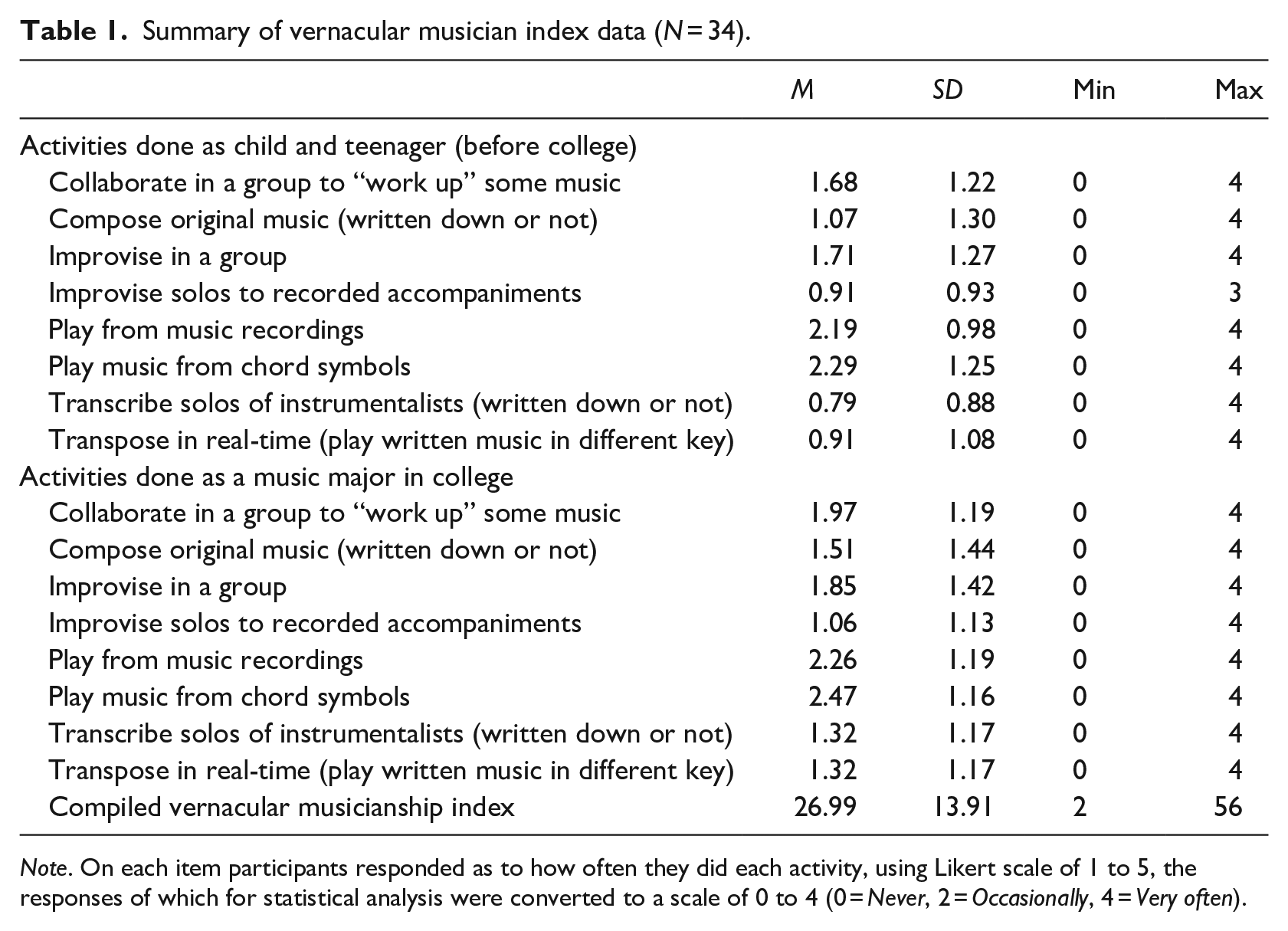
Note. On each item participants responded as to how often they did each activity, using Likert scale of 1 to 5, the responses of which for statistical analysis were converted to a scale of 0 to 4 (0 = Never, 2 = Occasionally, 4 = Very often).
I collected qualitative data from participants by having them write responses to a prompt asking them to describe their experiences in their rock band. They provided these written narratives at two points: midterm (week 8 of the semester), and the end of the semester.
Data analysis and verification
I qualitatively analyzed participants’ written responses using an approach informed by interpretive phenomenological analysis (Smith & Osborn, 2008). I began with open coding, assigning short low-inference descriptors or in vivo codes, drawn from participants’ own words (Creswell, 2013). I carried out the next stage of axial coding after separating the narratives into midterm and post-experience responses. As I reviewed the open codes for these, related categories became evident and themes emerged. I used member checking to establish the validity of the findings (Creswell & Miller, 2000). In meetings with a focus group of participants, I shared the categories and preliminary themes that had emerged in the data analysis. Participants confirmed that the assigned categories accurately reflected their experiences. Their comments in these meetings contributed to the final themes as reported below, along with exemplar participant quotes.
Regarding the quantitative data collected, items used in the VMI collected participant responses on a 1 to 5 Likert scale. I converted these data to a 0 to 4 scale, because it seemed appropriate for the scale to have a zero point (i.e. an overall VMI score of 0 would result from a participant responding Never to all items); this follows the precedent set by Woody (2020). Self-efficacy measures on the 100 mm gradient lines (i.e. the visual analog scale items) produced participant responses on a 0 to 100 interval/ratio scale. With data collected from the entire sample, I used parametric statistics. N = 34 is an adequate size and examination of the data gave no cause to question the normality of distribution (e.g. see Figure 1). For analyses of smaller groups (i.e. dividing the sample), I used nonparametric statistics, which are better suited for small sample sizes (Beatty, 2018; Siegel, 1956).
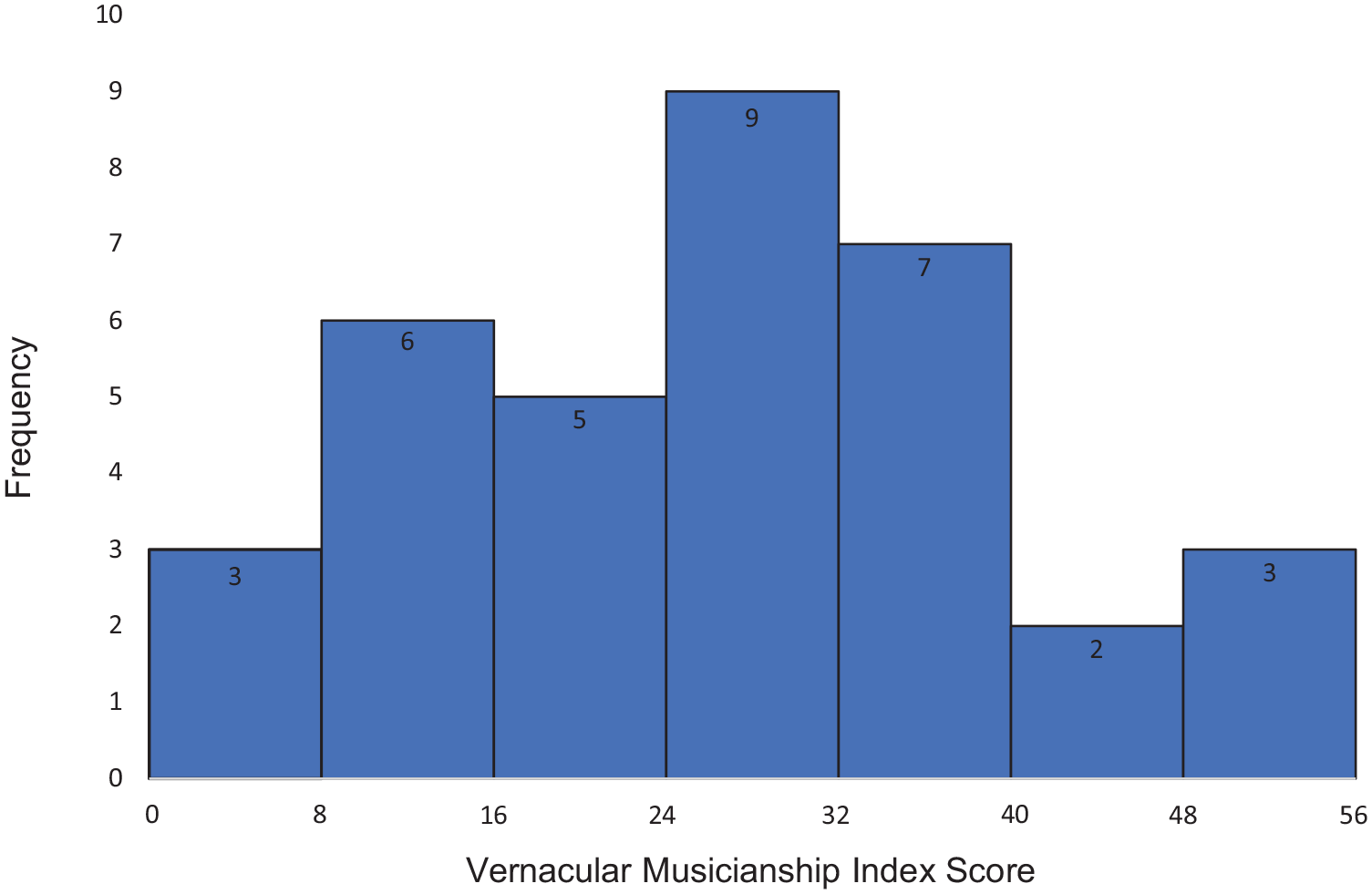
Distribution of scores on the vernacular musicianship index.
Findings
Vernacular musicianship index
The calculation of the VMI was based on 16 questionnaire items, each with a possible response range of 0 to 4, producing a maximum possible score of 64. Table 1 presents a statistical summary of participant responses on items used in the VMI. Figure 1 presents the distribution of VMI scores. It is suggestive of a normal curve and the results of a Shapiro-Wilk test supported the null hypothesis that the VMI scores were normally distributed, W = 0.9696, p = .450. I found concurrent evidence for the criterion validity of the VMI by comparing participant VMI scores to their pre-experience self-efficacy in leading popular music making. Pretest self-efficacy in leading popular music correlated with with the VMI, r(32) = .666, p < .001, indicating a strong correlation (Cohen, 1988).
To explore VMI results further, I divided the sample into quartiles based on VMI scores. A Kruskal-Wallis H test showed that between the participant quartile groups, there was a statistically significant difference in pretest self-efficacy ratings, H(3) = 17.163, p < .001. This main Kruskal-Wallis H test of all quartile groups established a significant difference between the lowest and the highest groups; additional pairwise comparisons showed a significant difference only between the Q2 (lower-middle) and Q3 (upper-middle) quartile groups, H(1) = 5.558, p < .05. Thus, for subsequent analysis I divided the sample at the midpoint to produce a Low VMI group (Q1 and Q2) and a High VMI group (Q3 and Q4).
The average pretest self-efficacy in leading popular music making for the entire sample was M = 64.54 (SD = 19.95). As shown by the left-most data points plotted in Figure 2, the mean self-efficacy was significantly higher for participants in the High VMI group (M = 77.57) as compared to those in the Low VMI group (M = 51.12), as indicated by a Mann-Whitney test, U = 28.5, p < .001.
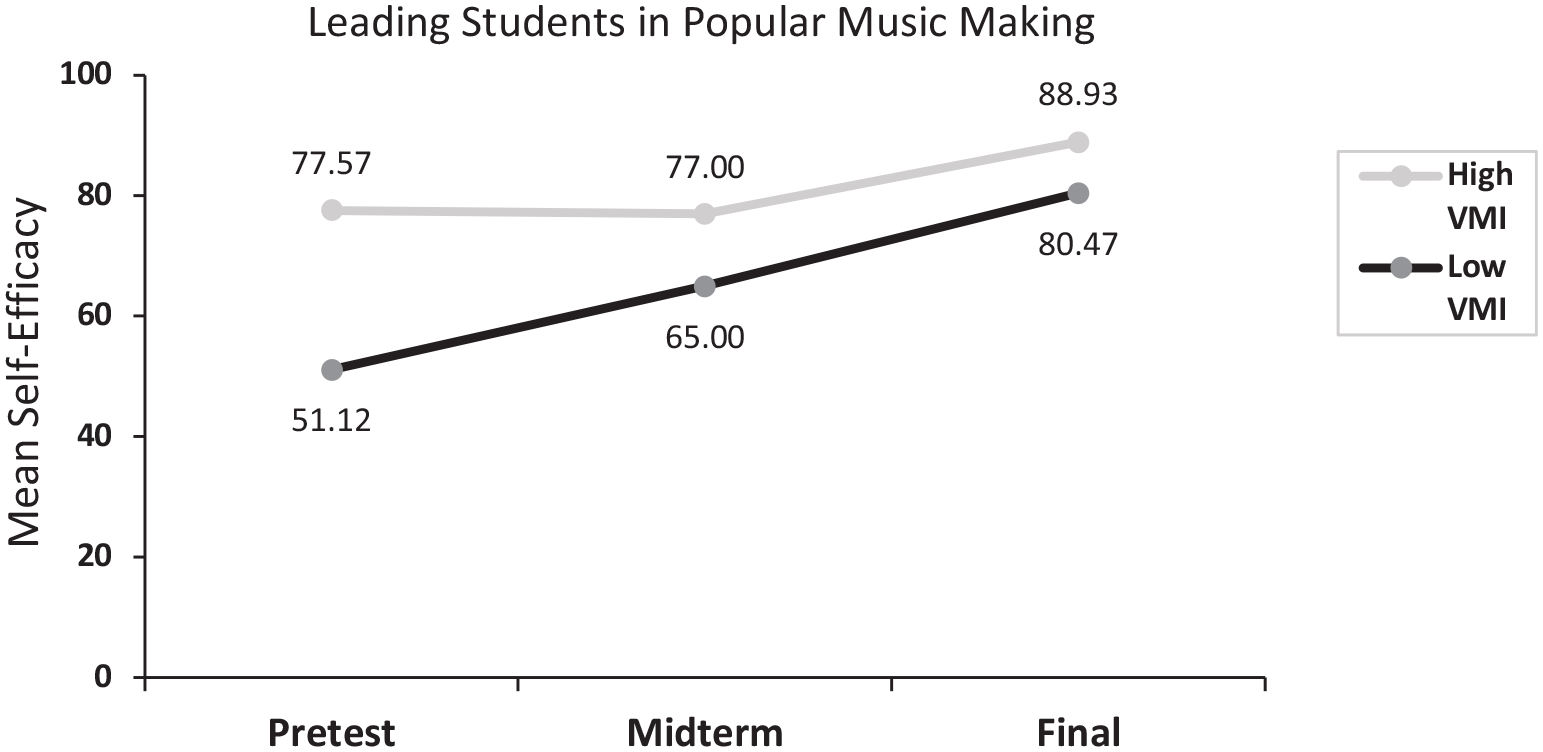
Mean self-efficacy across the experience, by VMI groups.
Midterm data analyses
Compared to the pretest point, the entire sample’s self-efficacy increased from pretest M = 64.54 to midterm M = 71.56 (SD = 12.52). Although the self-efficacy ratings of High VMI participants did not change statistically, the self-efficacy ratings of Low VMI participants increased significantly (from pretest M = 51.12 to midterm M = 65.00), as indicated by a Friedman Test for repeated measures, χ2(1, N = 17) = 9.94, p < .01. Even with the gains made by participants in the Low VMI group, the average self-efficacy rating of the High VMI group remained significantly higher. (M = 77.00 vs. M = 65.00), Mann-Whitney U = 47, p < .001.
Qualitative analysis of participant written narratives revealed two themes in the data collected at midterm. Renewed enjoyment and release captured participants’ emotional gratification experienced, often presented in contrast to the music making activities required of them as university music majors. Thriving on the challenge of collaborative creation reflected participant’s realization of the effort needed in vernacular music making, even as they enjoyed the synergy afforded by a group endeavor.
Midterm theme 1: Renewed enjoyment and release
Participants expressed positive emotions in their comments about the music making done with their peers. Kelsey commented, “I enjoy it a lot! I feel like a totally different musician when I rock out.” Multiple participants, in describing their positive experience, referred to their childhood or ideas that they had about music when they were younger. For example, Bailey stated: I’m really enjoying it. It makes me think of my childhood dream. It’s nice to do music for fun and not study. Re-motivates me why I’m in music in the first place. It also opens a new door of music that isn’t traditional/Western classical that we have in the classroom.
The experience gave occasion for reconnecting with part of their musicianship that some felt they had lost. It prompted participants to recall how, as children, they had done music purely for the fun of it and had focused on the songs and styles that they personally liked most.
Increased motivation was commonly associated with the positive emotions experienced and this, in turn, was linked to learning. Participant Carson put it simply: “Getting joy from it provides me more motivation.” Sabrina remarked, “I’m getting the opportunity to learn things I otherwise wouldn’t learn.”
Several of the participants referred to their music making as “jamming.” More broadly, these sessions were described as safe, relaxed, or “chill.” Some such descriptions consisted of comparisons to what they typically did as part of their studies as music majors. Wallace explained, “This is the first class where I have full control in a group. It’s very freeing to be able to rehearse music I enjoy off the clock.” Similarly, Dena stated: This is a new experience for me, so it’s fun and challenging to be able to just tell each other what chords to play and just jump into it. We listen to the song and try to sound the most like it as possible, which is very different than my usual music making.
Overall, the enjoyment and release experienced by participants was described in highly favorable terms; several used the word love to describe how they felt about the popular music making experience. Release was seen in comments about feeling freed from the constraints of classical or formal music making. Although the term fun was also commonly used, additional description provided made it clear that the enjoyment experienced was not superficially amusing, but personally rewarding and meaningful.
Midterm theme 2: Thriving on the challenge of collaborative creation
Although the participants technically were classmates and fellow students, they typically referred to each other as peers and friends. To make music with people they liked and knew well was spoken of as a special opportunity. This realization—that “making music with friends” is very rewarding—was described by Carson as “a big epiphany.” The closeness with their bandmates was an important element that made the experience feel safe, relaxed, and freeing, as mentioned in Midterm Theme 1 above. Participant Fara explained it this way: This is my first experience in a rock band and making pop music with peers. I really like it since it’s a safe environment. I know that I can make mistakes & my group members will help me grow. I feel like I’ve learned a lot through this process.
While their music making sessions were consistently described as safe and relaxed, they also included a dynamic that led participants to give their best. The camaraderie felt was important as they engaged in a kind of music making that was largely unfamiliar to many of them. Sam stated, “I’m excited to try, but also nervous because I really want to do well” and Owen described his emotions in sessions as “fun and slightly uncomfy.”
This type of music making was described as very different from what they typically did as music majors. The relative novelty for them seemed to foster an exploratory mindset for some. For example, Cam explained that he and his bandmates “feed off each others’ energy and are willing to try new things.”
End-of-semester data analyses
At the end of the semester-long experience, the average self-efficacy for the entire sample reached M = 84.82 (SD = 11.71). It is also interesting to note that the variation in confidence across all participants as a group lessened from the pretest to midterm to final points. The standard deviation of self-efficacy went from pretest SD = 19.95 to midterm SD = 12.52 to final SD = 11.71.
As shown by the right-most data points plotted in Figure 2, the mean self-efficacy was M = 88.93 for participants in the High VMI group and M = 80.47 for those in the Low VMI group; a Mann-Whitney test indicated that this difference was not statistically significant, U = 91, p = .067. As indicated by the upward sloped lines (in Figure 2) connecting the midterm data points to the final data points, self-efficacy ratings increased from midterm to the end of the experience. The increase was statistically significant for the entire sample, paired samples t(33) = 7.01, p < .001; group increases were statistically significant as well, Low VMI, Friedman Test χ2(1, N = 17) = 13.24, p < .001, and High VMI, χ2(1, N = 17) = 9.94, p < .01. It is important to note that the High VMI participants, as a group, recorded significant increase in self-efficacy by the end of the experience, even though they did not change from pretest to midterm.
Qualitative analysis revealed two themes in the participants’ reflections at the end of the semester-long experience: Popular music making as difficult work and Popular music making as very rewarding work. These, referred to here as final themes, were somewhat similar to the midterm themes reported above, but also included some important distinctions which are detailed below.
Final theme 1: Popular music making as difficult work
The words of participant Lucia, offered at the conclusion of the semester-long experience, encapsulate this theme very well: I think about popular music very differently now. There’s a lot more work than I thought that goes into making/performing this type of music. Rocking is much harder than it looks. There are a lot of musical skills required to make a rock band sound good.
Another participant, Alli, discovered that “it’s harder to put together a band than I thought, but twice as rewarding.” She added that “to produce something musical that you create is indescribable—everybody should do it at least once.”
What made rock band performance difficult, according to participants, was the musical independence required (e.g. there is only one musician playing each instrument part) and that overt creativity and personal expressiveness is paramount. Participant Will admitted that “it can be challenging to get over your own insecurities to be personally creative.”
The investment of time and energy was surprising to some and in at least one case, not well-received. Mordecai explained: I really did not enjoy being in a rock band as much as I thought I would. It’s fun to make casual music with my friends, but scheduling made us meet pretty late, and I never wanted to come to rehearsal of put in any actual work. It is nice to see the reality and know from experience that it actually does take some work. (It was still a great experience and I’m glad I did it).
This theme was similar to midterm theme Thriving on the challenge of collaborative creation, but also distinct. The midterm theme reflected how vernacular music making was challenging primarily because it was unfamiliar, that is, different from what they had typically done in school. Thus, the challenge described at midterm was moving outside of their “comfort zone” (but being motivated to do so). In contrast, the end-of-term theme was more a realization, as they looked back over their experience as a whole, that performing popular music requires time and energy and this contrary to common characterizations of popular music being simpler than “classical” music. They had found the time and energy to really invest in this experience; and it seemed to happen almost covertly, because they were so focused on the enjoyable aspects of it, that they often did not notice how much time and effort they exerted.
Final theme 2: Popular music making as rewarding and valuable work
Whereas the similar midterm theme of Renewed enjoyment and release framed their vernacular music making as an enjoyable deviation from the assigned and expected activities required of music majors, this end-of-term theme was more about substantive rewards experienced. The rewards described here included experiencing a benefit to their musicianship and close relationships built with their musical peers.
For participants who had very little or no past experience with this kind of music making, there was an element of surprise when they realized the value of it to musicianship development; several of them used terms such as “eye-opening” and “shocked.” For example, participant Carson, in calling vernacular music “super important,” explained, “Prior to this, I was pretty stuck up on the idea of just teaching ‘classical’ music but this has opened my eyes to something different.”
According to participants, the skills gained in a vernacular music making setting can be applied to performance in other contexts. One of the ways mentioned was by taking a less formal enjoyment-oriented mindset to other music activities. Cam said he learned that he needed to “smile more and enjoy the people I’m making music with, and not get so caught up in the seriousness of it all.” Similarly, Bailey said that the experience taught her to be “more open and free” in her music making and as a result, she had become “more willing to just go for it and try and fail than in the past.” Participant Pete said he had learned to “let loose as a musician” and “have fun in performing.” In addition to their music performance activities, participants also applied insights to their music teaching aspirations. For example, Fara explained: This has been such an incredible experience. Even though it took time and a lot of work, I felt so motivated to play and learn from my peers. So, now I truly believe that the best way to learn music is “play.” Music is fun! And as teachers, we should help our students to feel the charm of music.
Regarding insights for teaching, participant Tabitha summarized it this way: I realized how rewarding it truly is to form a rock band and for music students to lead the process rather than a class being controlled by the teacher. It’s nice to think that my future students could take control of their learning and develop leadership skills along the way.
Another way that participants applied the experience more generally to their music activities was by reflecting on the value of small group music making. Participant Irvin, an accomplished solo trombonist and symphonic player, stated: I wish I did this sooner. The skills I acquired from the collaborative creativity in our rock band have advanced my musicianship. I believe this is a more modern chamber music. I firmly believe that creativity in music is highly rewarding and educational. While this might not be possible to do in a large ensemble, I hope to take some of these ideas and apply it to as many students as I can.
Participant Schulyer said the experience “proved the value of small groups” and that “musical independence gained was the most important aspect.”
Collaborating with peers (without a teacher) was widely valued as well. Participants acknowledged learning much from their bandmates. They found it very rewarding to contribute to the group and combine their contributions with those of others. This creative dynamic added to the closeness felt with their peers, which was also very rewarding. As teachers-to-be, participants indicated that they hoped to bring the rewards of vernacular music making to their future students. Leila explained her insight: “Musicianship can be a lot more relaxed and centered around jamming. Being a music teacher of this sort of music requires giving more feedback and giving students the chance to be independent.”
Discussion
As an action research study, the results reported above are first and foremost important to me, as the instructor of the Popular Musicianship course described herein. It is reassuring to have collected evidence that indicates that my music education students have found the experience beneficial to their musicianship and impactful to their philosophies as future teachers. The findings also give me confidence to encourage other music teacher educators to offer popular musicianship experiences even if they do not possess any particular expertise as popular music performers themselves. Although the research method of this study does not readily lend its results to wider generalization, others may still find this study interesting and useful if they are involved in music teacher education. No doubt some will see similarities between my students and their own, as mostly formally trained musicians who are avid listeners to popular music in their personal lives (Woody, 2011a). Perhaps there are others who wish to see school music expand to be inclusive a popular music, but heretofore have not acted on it because of a self-perceived lack of expertise. The experience reported here should serve as encouragement by showing at least one situation in which university music education students were able to learn and grow without the active direction of an expertly-skilled instructor.
Some of the most encouraging findings in the present study were those related to participant self-efficacy. From the beginning of the experience to its end, participants grew in their self-efficacy; this growth was had by participants in both the Low VMI and High VMI groups. Moreover, despite starting with significantly lower self-efficacy, the participants of the Low VMI group essentially “caught up” with their High VMI counterparts, reaching a higher self-efficacy level that was not statistically different from that of the other group. Additionally, in an outcome that differed from that reported by Isbell (2016), the participants in this study did indicate that the experience affected their teaching philosophies going forward into the start of their teaching careers. I made this a focus of my study from the onset, by way of the self-reported measures of self-efficacy in leading activities as teachers. Thus, I would suggest that in any vernacular music making experience offered to music education majors, it is important to pay explicit attention to their identities as future educators.
This study’s qualitative results provided important insights into how the participants were able to grow in their self-efficacy. From a motivational standpoint, they were highly engaged in the experience, both as learners and as the suppliers of learning opportunities (for themselves and others). These results corroborate past findings by Byo (2018), Green (2002, 2008), Hallam et al. (2017a), and McGillen and McMillan (2005). Adding to their motivation and engagement was the fact that this music experience varied much from those that had characterized their program as music education majors. Many of the music performance experiences that required or expected of university music students rely on their being extrinsically motivated; students are rewarded with a sense of accomplishment or of satisfaction for doing something important or beneficial. In contrast, the informal vernacular music making provided in this study’s popular musicianship experience shows many of the powerful characteristics associated with intrinsic motivation, namely enjoyment, social connection, personal expression, learner-direction/autonomy, creativity/experimentation, and identity (Woody, 2021).
In summary, this study reinforced the idea that an informal student-directed vernacular music-making experience can contribute substantively to pre-service teachers’ confidence about teaching with popular music. Growth in self-efficacy was shown by all participants as a whole, but it was perhaps most impactful among those with who had little vernacular music experience in their backgrounds. For such university musicians, an experience of this kind can become the first time that they have ever written a song, played music by ear, and or performed the kind of music that they listen to most frequently in their lives. For them, newly developed vernacular music skills can round out a musicianship that was previously built exclusively through formal instructional experiences. Through the activities that make up informal vernacular music making, they can learn just how robust their musicianship can be and how to be resourceful and self-sufficient in their musical growth. Additionally, it seems realistic to expect university musicians, once they become music teachers, to in turn provide popular music experiences that will allow their students to be creative and personally expressive through vernacular music making.
