



Abstract
Feedback is a powerful influence on learning and achievement in the instrumental music lesson, though this impact may render positive as well as negative implications to learning. The impact of feedback is thus foundational to the ways music teachers impart knowledge, skill, planning, reflection, and student motivation. This article provides an analysis of feedback- feed up-feed forward concepts through a musical instruction lens, and reviews evidence related to the impact of feedback given on student learning and achievement. A qualitative investigation of Australian instrumental music teachers working in secondary schools, this study analyses cohorts of novice, developing and expert level teachers, progressing through initial theory-practice constructs, towards development and expertise of personalised and experientially dynamic feedback episodes. Expert level teachers reflect on a wider palette of approaches, with wisdom, passion, and the capacity for accommodating diverse learners and differentiated strategies. Discursive analysis of constructivist and student-centred approaches that infuse with explicit instruction are used to offer implications to how feedback can be used to enhance enduring learning and teaching in instrumental music studios and classrooms. It provides insights into teacher growth, knowledge, and development of instrumental music teachers in the profession across the lifespan.
Introduction
Effective instrumental and vocal music teaching not only involves constructing activities that impart information and understanding to students, but that also involve assessing and evaluating students’ comprehension and application of information received. The instrumental music lesson provides an intriguing and potentially dynamic perspective to approaching feedback, particularly within the intensity of the one-to-one studio music environment. Teacher feedback provides information, knowledge, and skill, assisting progress by informing the student of details about an immediate iteration of musical practice or performance.
Research on feedback in educational settings has established that feedback occurs within a three-step process that includes (1) a teacher verbal antecedent, (2) a student response and (3) a teacher verbal consequent (Becker et al., 1971). Building on the foundational concept of direct instruction (Rosenshine, 1976), feedback is a key component in the education process (Cranmore & Wilhelm, 2017), requiring timely, specific and individualised approaches for effectiveness (Marzano, 2007).
Significant findings of feedback research indicate that feedback needs to address a clearly defined ‘gap’ between actual performance and desired goal attainment (Locke & Latham, 1984). Teachers’ feedback is informed and acted upon by perceptions, interpretations and decision-making in the lesson (Blömeke et al., 2015) reliant on professional vision (Gold & Holodynski, 2017), instructional quality and promotion of achievement (Charalambous & Praetorius, 2018). Hattie (1999) urges that most effective feedback is via audio and/or visual cues. Kluger and De Nisi (1996) assert that feedback is more effective when it provides information on correct rather than incorrect responses and when it builds on changes from previous trails.
Research on feedback in music education is problematised by regional variances in curriculum, timetabling, and contextual approaches. Hale and Green (2009) urge the importance of a daily diagnostic approach providing on-going feedback in US ‘band’ programmes, with MacLeod and Napoles (2012) finding ‘positive’ feedback more effective in such environments. Early music education research establishes how positive feedback can be derived from teacher verbal reinforcement (Kuhn, 1975), and gestural reinforcement (Kazdin & Klock, 1973). Killian (1981) found instrumental technical skills that increased successfully were those which were more immediately reinforced by the teacher, arguing the necessity of discrimination training, and discrete and timely instructive practices used by teachers to develop specific skills in students. Instrumental teacher intensity and sustained control of the student/teacher interaction has been evidenced in instrumental rehearsal settings (Byo, 1990) and undergraduate music pre-interns (Madsen et al., 1992). Madsen and Geringer (1989) identified optimal feedback occurred through specific elements of engagement that included efficient, accurate presentation, enthusiastic affect to correcting student work, and effective pacing of feedback throughout the lesson.
Specific instructive behaviours used by teachers in the music studio have been described as a continuum between a passive process of direct student copying on the one hand, and a highly active conception of participation in a community of practice on the other (Burwell et al., 2019). Yarbrough and Price (1989) found variance between experienced music teachers and undergraduates in presentation of task, student response, and reinforcement, describing a clear teaching cycle observed in experienced teachers.
Central to the role of teacher feedback is the utilisation of a dialogic pedagogy whereby teachers expand students’ thinking beyond learners’ internalisation of knowledge. de Bruin (2017, 2018a) asserts how dialogue can afford or impede interpersonal positivity, and Burwell (2012) points out students’ skill requirement in transforming dialogic feedback into performative action. Colwell (2011) saliently remarks that it is the students’ motivation to act on feedback that ultimately determines its success. Communicative confluence that is embedded in feedback relationally orients engagement and facilitates the active ‘doing’ of teacher modelling, coaching, scaffolding, and reflective episodes that guide the student towards developing skills, growing independence and confidence in the learning process (de Bruin, 2017, 2018b).
Practical knowledge of feedback delivery is routinely gained through professional experiences and authentic contexts, environments, and teacher motivations (Mattsson et al., 2011). There is a dearth of literature exploring how and in what ways both the understanding and delivery of feedback processes and procedures evolves over the teacher lifespan. This study on professional instrumental music teachers in Australia explores experience-based wisdom and knowledge a teacher might draw on to determine feedback actions, contextual situations and appropriate messaging that is actionable by the learner.
Feedback actions
Recent conceptualisations of feedback (Hattie & Timperley, 2007) posit three significant intensions that feedback is aimed to respond to; that is, engaging students’ perception of: where am I going? (feedback); how am I going? (feed-up); and what do I do next? (feed-forward). These questions address important aspects of teacher-to-student feedback, that span three key components constituting pre-requisite properties for feedback: (i) information on the goal of performance, (ii) information about how performance meets the goal, commonly referred to as the ‘gap’ and (iii) strategies to address the gap and goal orientation.
Feedback operates as a moment-to-moment guiding of students’ immediate actions. This in turn impacts student learning management processes (Korpershoek et al., 2016). Feedback provides information for ‘now’, as well as ‘future’ provisions for the student. Feedback plays an important part of developing students’ self- regulative capacity, helping students form ‘self-generated thoughts, feelings, and actions that are planned and cyclically adapted to the attainment of personal goals’ (Zimmerman, 2000, p. 14). Feedback thus can feed into capacities of autonomy, self-control, self-direction, self-discipline, and goal orientation. Just as teachers’ direct feedback/feed-up/feed-forward information, students may also be enculturated into capabilities of seeking and dealing with feedback information, the capacity to create internal self-assessment, and attribute levels of ‘success’ or ‘not yet’, and seeking help (Brown et al., 2016). Butler and Winne (1995) argue that from teacher feedback, effective learners create internal feedback and cognitive routines for improvement, emphasising the influence modelling, scaffolding, and coaching plays in the provision of performative and dialogic attunement.
Comparisons between general classroom novice and expert teachers identifies superior perception, more accurate monitoring, and faster recognition of the learning climate, with experts’ interpretations tending to be more elaborate and interconnected (Copeland et al., 1994). Experts apply well-developed, efficient, event-based knowledge and elaborate schemata for sense-making perceived from student actions, enabling them to act more holistically than novices (Bromme, 2001). Experts generally also make more suggestions for alternative courses of action than novice teachers (Copeland et al., 1994), adapt feedback specifically for the student as hand (Anthony et al., 2015) and focus more on their impact on student learning (Wolff et al., 2017).
Comparative studies
Studies that juxtapose novice and expert level teaching abound, spanning knowledge teachers use to interpret situations (Shulman, 1986), knowledge informing the substance of teacher/student interactions Ropo (1987), and the complexity of perceptions and responses experienced teachers offer (Peterson & Comeaux, 1987). Copeland et al.’s (1994) study of generalist teachers, as well specific instrumental music studies such as Goolsby’s (1997, 1999) band director/rehearsal studies, Pike’s (2014) group piano strategies, and Bergee’s (2005) study of conductors each take a beginner, developing and expert level analysis and comparison. Such studies offer insights into developmental plateaus, intensifications, and confidence in which skill manifests (or not) through experience. Within the field of music education, this study may offers strategies that impact preservice teacher training, better preparing those about to embark in music teaching, and better informing professional development services for mid and late career music educators.
Little is known about the development of both the ‘how’ and ‘what’ of feedback quality, nor its evolution over the lifespan in instrumental music educators. What is evident is that feedback entails a complex tapestry of specific attention to modelling, detailed scaffolding, dialogue, content and time sensitive context within the lesson. It can include aspects of instructional management, affective-motivational management, and teachers’ self-presentation techniques and actions that pedagogically ‘lead the child’ through planning, action, and reflection of and on musical actions (Bandura, 1986; Schon, 1987). This study is interested in novice, developing and expert teachers’ perceptions of intent and quality regarding the feedback they offer students, as well as the developmental progression, and apperception of teacher feedback evolution over the lifespan.
Methodology
Instrumental music in Australian secondary schools largely operates as a co-curricular activity- in Victorian Government schools since 1970, with one-to-one or small group classes scheduled once per week during school hours (removed from core learning subjects on a rotating timetable) and ensembles before or after school. This renders the instrumental lesson a singularly powerful educational context appropriate for the study of differences between novice, developing and expert teachers’ perceptions and understandings of feedback. Fifteen secondary school (12–18 year old student populations) instrumental music teachers in Victoria, Australia were interviewed and asked to reflect on what they perceived feedback to be, how they provided it, and what important components occupied their concepts of effective feedback in the instrumental music lesson. Purposive sampling included five novice (1–5 years’ experience); five developing (5–10 years’ experience) and five expert teachers (more than 10 years teaching experience). All novice and developing participants had experienced a Bachelor Degree of Music Performance within a Conservatoire, as well as a 2-year Master of Teaching degree that accredits standing as a professional teacher in Australian schools. The five expert teachers had either completed requisite 4-year Bachelor of Education (Music) degrees, or a Bachelor of Music and Diploma of Education for professional accreditation. Four of the five expert teachers were Heads of Music Department within their School, and the remaining 11 operated as peripatetic instrumental teachers working across at least two schools, as do most instrumental music teachers in Victoria. Three expert teachers had over 20 years teaching experience and one had completed a Masters degree by research in Music Education. Questions that guided the interview protocol included:
RQ1: How do novice, developing and expert teachers differ in the use of feedback (perception, interpretation, and decision-making)?
RQ2: How do novice, developing and expert teachers perceive of their focus and atunement of feedback they give towards instructional management, affective-motivation, or context?
RQ 3: How do the teachers perceive of their development towards the use of feedback, both in quality and quantity in the music lesson.
Qualitative research methods were appropriate to answer the research questions related to instrumental music teachers’ experiences and perceptions of feedback. With ethical approval the sample of 15 teachers were individually interviewed, and the audio recordings transcribed. The rationale behind this sampling was that differing levels of understanding, experience and expertise among participants might provide a broad, diverse range of perspectives on feedback related actions and experiences. Detailed descriptions and recollections allowed understanding of critical factors spanning the behavioural, environmental, motivational, and social (Bandura, 1998) which influenced participants’ experiences, values, beliefs, and attitudes towards type and quantity of feedback they gave. Semi-structured interviews using a narrative approach were used to understand teachers’ reflections, but also allowed for recollections of specific incidents, described as in-the-moment events.
A phenomenological approach (Smith, 2016) allowed focus upon the specificity of participants’ understandings of the phenomenon under investigation (Smith, 2016). Van Manen (1997) urges that phenomenological research facilitates explorations into the structure of the human lived work or Lebenswelt as experienced in everyday situations and relations. The researcher remained vigilant, maintaining epoche, or the suspending of assumptions. Husserl (1964/28) posits that ‘reflection is not retention and reproduction. . .but a subjective, temporally constitutive consciousness’ (p. 436). This provided a glimpse of deeper meanings ‘sequestered in time and cultural distance’ (Brady, 2005, p. 980). Phenomenological meaning-making through the coding and analysis process revealed actions, feelings, opinions, interpretations, and reflections of teaching incidents expressed in time and over time, that captured essences of ‘what was it like for you’ (Polkinghorne, 1989, p. 47).
Analysis began with open coding, focusing on teachers’ experiences, successes, and challenges in their enactment of feedback. Throughout the coding process, I relied on the constant comparative method (Glaser & Strauss, 1967/2017) to refine codes and to look for similarities and differences across interviews. Meaning units identified successes, challenges, and contributing factors sifted through the lenses of corporeality, intentionality, and relationality to categories of feedback that spanned diagnosis, evaluation, assessment, goal orientation, confluence, studio management, reflection/meta-cognition and positive praise.
Methodological mediation was utilised in associating comparability about experiences rendered as unique events. As an insider (teacher) the researcher seeks participants’ ‘reflective glance’ (Schutz, 1967, p. 71) as a means of coming to an understanding through language (Gadamer, 2013). Ensuring consistent and systematised rigour, trustworthiness was ensured through member-checking and triangulation via independent coding of 30% of the transcripts that determined intercoder reliability (Campbell et al., 2013). The mapping of the coding process outlined the interpretations of various teacher feedback and experiential recounts, some of which are provided in Table 1. The findings are provided across the three major cohort capacities of novice, developing and expert teacher lenses of inquiry.
Coding and correlated mapping of experiential accounts.
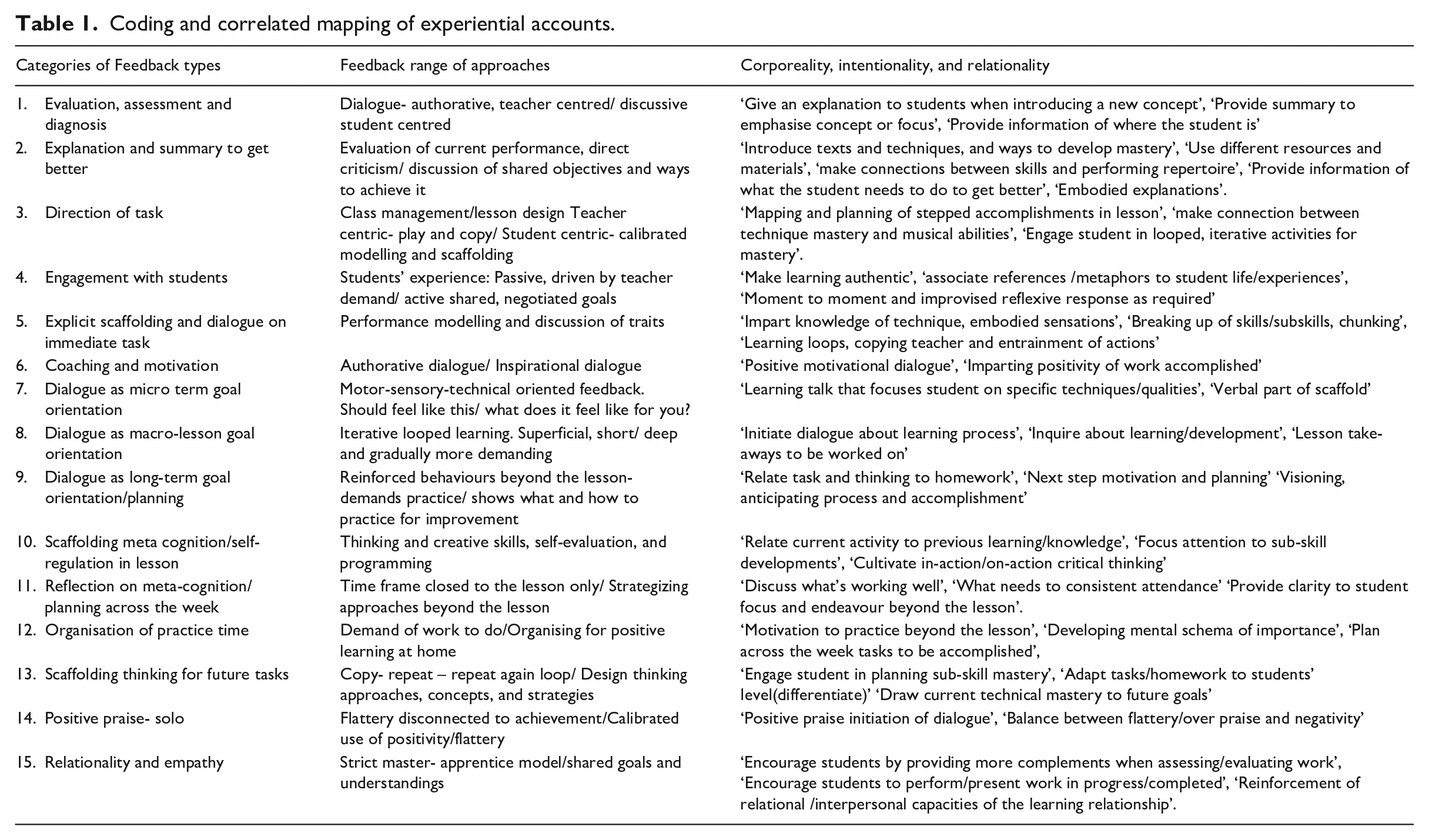
These significant modes of feedback moments spanned the fifteen categories indicated. Each category reflected differences across novice/developing/expert level feedback, and this is explored more fully through these distinct experience levels. Importantly not all novice teachers described ‘novice’ level qualities and vice versa for ‘experts’. The findings illuminate traits of analysed teacher performance in relation to feedback offered.
Findings
Novice
Whilst the relationship between feedback and goal-related challenge is complex, novice teachers’ reflections highlighted a working through events, with discussion operationalised around utilising strategies from a ‘toolkit’ perspective. Novice teachers discussed recollections of incidents, such as:
P2: I tend to apply a ‘what, why, when, and how’ approach to my feedback. It provides a mental checklist.
Another novice:
P3: The student would stop, and then I would show them what to do, and then I would get them to repeat it.
And another:
P1: I try to give feedback around a SMART goals orientation. With feedback I talk too much and don’t reach goals I set out for the student
This teacher reflected on her approach:
P5: I play for them and draw comparisons between their version and mine. My ‘go to’ discussion is a ‘so what was good about that approach?’ Then we talk about that.
Another teacher remarked on providing feedback on immediate errors, this teacher responded:
P4: I talk about fixing wrong notes, sharps, flats, dynamics, and breathing, and then go to other detail like reading all the rits and ralls notated on the music as well.
These experiential accounts reflect a processural application of knowledge by these novice teachers. The meaning disclosing attribute of this data reveals a not surprising application of a strategic toolkit and fundamental approach to utilising it in a practical sense. Novice teachers also discussed focus and extent of feedback:
P2: Im a stickler for tone and talk a lot about that, but sometimes they don’t seem interested.
P1: I focus on ensuring fingers are correct, breathing and posture are working- lots of feedback on what to do.
P4: I make sure they get their scales right, drilling and accuracy.
Teacher involvement can become very involved in the minutae and exactitude of what is correct and what should be demonstrated now. These accounts reveal intense focus on what the teacher wants the student to immediately demonstrate or replicate, offering a teacher-centric approach to discourse and engagement. Vague, repetitive, or misdirected feedback can distort actual performance. Unclear or vague goal attributions can reduce effort and engagement on task, and feedback that is lacking in clarity or focus may increase this discrepancy. Novice teachers also recalled organisational and relational aspects:
P1: I start with a positive thing to say, then a critical suggestion, and then try to be affirming.
P3: I often ask the student to initiate discussion, asking ‘so what did you think was good about that?’. I’m keen on starting off with saying something good about a students’ work.
P5: I think there is a time in the lesson to just step back and give feedback on how they are going. I’m still judging that right time- usually when frustrated sets in
P2: I try to keep all talk on task – I’m there to teach flute and keep it business-like, I would rather err on the side of discipline than being social.
These novice teachers recollected clinical training of studio music teaching such as behaviourist ‘feedback rituals’ that emphasise didactic teacher centred master-apprentice oriented dynamics. Whilst this may be a beginning point in ones’ teaching career, more experienced teachers generally discussed a more complex level of understanding and approach.
Developing
Developing teachers recollected events that tended to reflect learning cultures they sought to establish, student attainment, and progress. The data is represented in these quotes:
P6: I get a range of different students–explaining things differently is frustrating sometimes, but I know it’s important.
P9: I see myself more than a teacher or modeller, a motivator and organiser of their time- I help find solutions to promote making progress in music but also enjoying it as a learning process.
These participants offered more self- critical appraisal of their use of feedback:
P8: I talk to get inside their heads more through questioning for understanding.
P6: I give less praise now than when I started, but I do let them know when they’ve given a good performance
P7: I now explain the way practice works, whereas before I just expected it. I can explain things better now, and confident in my abilities as a teacher.
P10: I take the strengths and capacities of each student and work with those rather than a one size fits all approach.
Developing teachers provide conceptions of one who is gaining experience and becoming a journeyman music educator. Their higher levels of confidence exude in their familiarisation of procedures and learning processes, and emerging fundamental approaches that are now considered more valuable through the hindsight of experience. They see themselves becoming more strategically replete and connected with the negotiations of leading a student through the learning process. They are able to discern more and less appropriate actions to take, and their level of differentiation is becoming more pronounced and can be enacted in practical ways. They see how the instrumental music lesson situates an interesting application of drilling for technical mastery, but also relational capacities, and that in the one-to-one lesson there is a dynamic and moment-to-moment negotiation of interpersonal connection and procedural intent. This teacher provided an insightful orientation to self-development:
P10: I used to be quite rigid, and teacher centred. . . taking more time ensuring students know what to do, and why they do it seems to make a difference. I model and scaffold students’ learning but I’m now more judicious in the way I use each strategy. Though, I do still occasionally have to stop and collect my thoughts and think ‘how am I going to best make learning happen here?’
Participant (P10’s) recollection above emphasises a contemplation event in which they consider how feedback might best enhance a ‘Where to next?’, that provides groundwork towards the student attaining a higher level of competency. Other participants (P6, P7) express a report-to-progress phase, in specifically addressing next steps by providing information that leads to further possibilities for learning. This participant reflected on feedback that promoted adjustment of student practice behaviours:
P8: I play, talk, and encourage through descriptions that may click with the student. Getting the student to realise successful processes and accomplishments is important feedback- it’s about promoting the intangible, what’s just around the corner.
Another teacher remarked on actions and thinking beyond the lesson:
P7: I alert them to iterative processes that develop fluency. I emphasise processes, self-evaluation, and self- realisation through hard work done.
Motivating students is an important aspect of feedback. Performative approaches can encourage a student to be motivated, but this is different to students being motivated, and taking action on their own volition- an elusive quality teachers seek to unlock in their dialogue, empathic and relational connection with students.
Expert
Expert teaching can transmit experience, wisdom, and craft student reflection on successes and near misses. Expertise grows from a sustained and developmental perspective honed from experience. This teacher remarks:
P11: Tuition offers much moment-to-moment action and thinking- it’s quite improvisatory. There are moments when I am quite explicit, and times when I am less so and ask students to find solutions. My studio lessons tend to be like a ‘going through the gears’ with students. But my feedback also involves not just what happens in the lesson, but developing the learning culture and expectations of how a lesson will unfold, and what they will do beyond the lesson.
Another expert teacher responded to the learning environment and student thinking they cultivated:
P13: Developing a culture of open-ended questioning is the basis of a learning relationship – it opens windows into understandings, progress and joy derived from that process.
This teacher discussed a reflection on engagement with students:
P14: Applying feedback that is appropriate for the time, space, and place is not easy. There is not one way I approach feedback, but many, as some students respond enthusiastically to one approach whilst others need something different. Good decisions come from experience and experience comes from evolving judgement bases.
This teacher discussed their evolving sense of connection with students:
P12: As a beginning teacher, perhaps I tried too hard in being ‘good’ in the eyes of students – a great player, fun teacher. I didn’t have that when I began – So, 20 years down the road, I’m nowhere near the player I was, but my ability to communicate and help students is what’s valuable now.
Expert teachers have the experience and a substantial knowledge from which to make informed decisions that allows them to identify areas of greatest pedagogical need, and the relational application to best serve the students’ best interests. This spans both an apperception of feedback that engages students to examine their own logic and critical thinking in and on practice at a level with language that is accessible by the student. Effective feedback involves ‘attuning’ the kinds of activities, the kind of dialogue used to convey the message, and relational affiliation that is appropriate to students’ level of development. This teacher reasons:
P15: My teaching style may vary throughout the course of a day. Some students want to be told what to do and how to do it, others are extremely sensitive to my dialogue, the pitch and volume of my voice and my gesture. I have various teaching ‘hats’ that I put on that allow me to attend to the various students I have. Some are aspirational and my feedback responds to that energy. Others just like playing music with an adult and learning at their own pace. I need both in my bands – that’s something I didn’t appreciate in my younger teaching days.
Discussion
Feedback can be about a task, product, a process, or performance towards completing a task. Feedback plays a role in influencing student self-efficacy, self-regulatory proficiencies, and self-beliefs about themselves, and their capacities as learners, sustaining enthusiasm and motivation to continue on a task in and beyond the lesson. Feedback entails a complex tapestry of modelling, scaffolding, dialogue, and time sensitive contextual thinking that evolves over the lifespan. Whilst this study does not seek to create classifications for analysing the component parts of effective teaching, it does offer significant detail concerning teacher perspectives to development of both the ‘how’ and ‘what’ of feedback quality, and how this is conceived and articulated across a range of novice, developing and expert teachers.
In comparing across these three teacher levels of experience, it is evident that novice teachers think and discuss feedback through an operational ‘nuts and bolts’ approach to disseminating skill and knowledge gained from clinical pre-service teaching. All participants referred to positive learning relationships (Wubbels et al., 2006) though novices overtly reflected on finding balance between affiliation and authority. This is to be expected. From a theoretical perspective, novices’ cognitive schemata are less elaborate, interconnected, and accessible by students, than more experienced teachers (Borko & Livingston, 1989). Novice and some developing teachers’ use of questioning revealed lower-level investigation of student understanding, and feedback via mechanistic repeating of tasks. Contrastingly, expert level teachers applied questioning as a range of techniques used to provide focus, elaboration, and argumentation in seeking better understandings of what is transpiring inside the students’ mind (Bruner, 2009).
Novice teachers used feedback constructs such as the Positive Instruction in Music Studios (PIMS) approach (Patston & Waters, 2015), SMART goals, and the ‘feedback sandwich’ (Henderson et al., 2005) which are constructs taught in pre-service teaching and that endure in the early years of teaching but get unpacked and elaborated on through experience. Novice teachers referred to their developing purposes, processes, and relationships, with novice and developing teachers tending to frame statements of educational purposes in rather simplistic and comparatively shallow terms, such as maintaining control and rote learning. By contrast, experts focused on increasing the quality of student thinking, engaging students in the process of learning, and improving their disposition towards learning in and beyond music. Descriptions of novice teacher links between teacher and student action and anticipation of actions were general and descriptive, whilst experts’ awareness of and pedagogical application to differentiated needs described more elaborate, fluent and fluid pedagogical knowledge, inferring the capacity to be more in the moment, flexible and improvisatory (Sawyer, 2018).
The findings suggest that specific components of experience become manifest in expert teachers’ data gathering. The accumulating of knowledge by novice and developing teachers is an evolving one that informs diagnosis and evaluation of a students’ engagement and feedback action. Expert teachers displayed adept and comfortable reflections of evaluations offering comparatively clearer understandings of important educational purposes, acquired repertoire of teaching actions and linking of these appropriately. Purveying more experienced senses of feedback pedagogically, expertise resides in the interaction between the teacher, student, and context in which they operate (Glaser & Chi, 1988). Not only do experts’ recollections articulate more elaborate and interconnected schemata, but significantly there are characteristics or traits of their schemata in applying feedback that connects conceptions of educational purpose, modelling and scaffolding tasks intended to accomplish these, and pedagogical practices and time management techniques engaging students in timely, achievable tasks. The analysis suggests that evolution to expert levels may be related to a more developed and articulated understanding of educational purposes, a more elaborate concept of time and space (durée, see Husserl, 1964) within and across the lesson – inferring a more phenomenologically informed sense of the students’ lived experience as learners.
Whilst novice and developing teachers positioned themselves discursively as the font of knowledge in a largely one-way direction of dialogue (see/hear the problem- fix the problem), experts engaged students into contemplating their own problem solving and critical thinking processes that promoted metacognitive function (de Bruin, 2021; McPherson et al., 2017). Though the timing of dialogue was not measured, this study questions the notion purported (Goolsby, 1997) that less verbal instruction and more performance time are associated with more effective instrumental music teachers. It places emphasis on the intent, context, and quality associated with the specific feedback given.
Experts who enhanced student thinking within the lesson were more opportunistic in their problem solving. They were able to act quickly and flexibly as they improvised responses to unanticipated student actions, questioning and evolving learning cycles that spiralled student learning upwards. Berliner (2002) posits that such ‘opportunism’ is evident due to more elaborate, interconnected, and more accessible schemata utilised by experts at strategic points throughout a lesson. This study offers the possibility of an extended and more detailed understanding of meaning making that underlies the coming together and threadedness of an expert teachers’ educational palette of explicit instructional and relational intensions of feedback in the music studio.
Conclusion
Perhaps one of the greatest difficulties of novice teachers is knowing precisely how they are being perceived and received by students (Berliner, 2001). Acknowledging feedback is a two-way process and that the concern of this study is of teacher reflections of their feedback actions, it is evident that novice teachers may traverse a critical state of working through theory-to-practice as they transition towards experience and mastery of the studio teaching domain. Expert teachers can rely on a wealth of experiential and situated encounters from which to calibrate and balance pedagogy, direction, motivation, authority, and relationality.
This study highlights the idiosyncratic and complex approaches evident in teacher practice. Carless et al. (2011) argue that a ‘more fundamental reconceptualisation of the feedback process’ is required (p. 2.); this study providing focus to how this may manifest in the studio music lesson. Key overarching principles evolved from this study are applying explicit, iterative tasks and discrete learning loops that are calibrated to engage learners towards ‘bridging the gap’ with achievable performance targets. Pedagogic ability to develop feedback cultures and healthy feedback habits and create learner dispositions that value and respond to feedback provided. Lastly, teachers should consider feedback and dialogic connection that threads explicit music instruction with streams of engagement that provide a warm, inclusive, challenging and encouraging educational environment. This places onus on teacher reflexivity and differentiation in considering the point and orientation of feedback given and how it is received.
This study does illuminate constructivist, teacher-oriented perspectives, and further qualitative study should investigate both intention and student receptiveness to feedback given. It promotes dialogue, modelling and coaching strategies that provide discrete feedback-feed-up-feedforward opportunities in the lesson and how we as teachers develop these skills and improve over a teaching career. Feedback remains a decisive interactional component of music teaching. Questioning how we engage students in learning and bring them on sustained and enduring learning journeys highlights the need to consider how we may teach music, the instrument, but also the child in more engaging and holistic ways.
Footnotes
Funding
The author(s) disclosed receipt of the following financial support for the research, authorship, and/or publication of this article: This project benefited from a University of Melbourne Research Development Grant 2021 for the research gathering component of this article.
