




Abstract
Forced to navigate and negotiate their positionality and subjectivity, queer music educators confront unique challenges in heteronormative schooling environments. This minority group is often associated with the music industry. Still, upon entering an educational context, they navigate and negotiate their identity, specifically the tension between their queer selves and the heteronormative requirements of their teaching context. This article analyses the narratives of five queer music educators situated in a South African context. Being a queer music educator myself, I used a relational approach, the Listening Guide, to listen for the contrapuntal voices that come to the fore when my participants reflected on their professional identity negotiation as music educators. The participants developed various strategies to negotiate their professional identity, with some reporting on its negative impact on effective teaching. This article suggests that heteronormativity in music education should be challenged to allow for an inclusive and affirming space for queer music educators and students.
Introduction
Problem
South Africa is known for its progressive constitution, which, since 1996, has protected queer people. With the help of LGBTQIA+ 1 activists, the African National Congress has made the post-Apartheid constitution the first to outlaw discrimination based on gender and sexual orientation. This constitution paved the way for South Africa to become the fifth country in the world to recognise same-sex marriage in 2006. The same principles of the constitution are reflected in the South African Schools Act of 1996, which aims to establish an inclusive environment for teachers, learners and other stakeholders.
Despite the prohibition of discrimination on gender and sexual diversity, systemic discrimination persists. South African schools are such sites where heteronormative ideals are valued and discrimination towards queer learners and teachers are present (Bhana, 2014; Francis, 2017; Langa, 2015; McArthur, 2015; Msibi, 2012). Moreover, South African schools lack the awareness and critical engagement of queer identities (Francis, 2017). How do queer music educators negotiate their professional identity in such a contradicting context?
Heteronormativity operates through the compulsion to repeat heteronormative ideals while punishing those who step out of line, by not complying with heterosexual norms (Ahmed, 2006). Therefore, in South African schools nonnormative identities are required to negotiate between upholding the heteronormative ideal, or disrupting, or challenging the heteronormative beliefs, which could lead to the marginalisation and ostracisation of the queer learners and teachers. Intersectionality describes the political meanings (such as gender and race) that are inscribed on the body and dictate one’s positioning, privileges/oppression and how one interacts in a certain context (Crenshaw, 1991). The South African school context points out the friction between the policy and implementation of inclusivity, and the effect it has on the politicised body. This friction confronts queer music educators with an ethical predicament: meet the requirements of the heteronormative context or enact their true, queer selves.
Elliott et al. (2016) remind us that praxial music education entails ‘active reflection and critically reflective action guided by an informed ethical disposition to act rightly, with continuous concern with protecting and advancing the well-being of others’ (p. 6). Praxis for queer music educators, therefore, requires a consciousness of how they are situated in their contexts, what meanings their bodies bear and how they should use their positioning for the enhancement of the wellbeing of others.
In light of the intersectional positioning of queer music educators, the aim of this article is to understand how South African queer music educators negotiate between their professional and queer identities in their teaching praxis by listening to the contrapuntal voices that come to the fore. In this study, identity negotiation should be understood as the processes through which people perform their self-representation in different contexts (Butler, 1990; Swann Jr. & Bosson, 2008). Gilligan et al. (2003) explain that ‘. . .the psyche, like the voice, is contrapuntal (not monotonic) so that simultaneous voices are co-occurring. These voices may be in tension with one another, with the self, with the voices of others with whom the person is in relationship, and the culture or context within which the person lives’ (p. 159). The term ‘contrapuntal voices’, therefore, refers to the different strands of a person’s identity.
Even though the South African context is used as the site to explore the effects of heteronormativity on queer music educators, there might be shared experiences with queer music educators situated in other contexts. I hope that this article serves as a catalyst for more significant inquiries into the impact of heteronormativity in wider music education contexts.
Theoretical lens
In this article I rely on a queer theory perspective on gender and sexuality. Queer theory destabilises, critiques and problematises essentialist stable gender and sexualities (Jagose, 1996). Central to queer theory is the concept of performativity. This theoretical lens regards gender as being performatively produced, materialising the sexed/gendered body through acts regulated according to the heteronormative ideals and norms – through adhering or violating the norms associated with their appearance (Butler, 1993). Queer theory does not consider gender to be an expression or performance of a subject’s internal identity, but that gender is performatively produced through repeated acts and interpreted by social technologies (Butler, 1990, 1991; De Lauretis, 1987). Butler (1991) explains that ‘gender is a kind of imitation for which there is no original’ (p. 21), meaning that heterosexuality is a mere imitation of a heteronormative ideal, and this leads to an effect of itself. The compulsion to repeat heteronormative acts creates the naturalised, causal effect of gender as an expression of an internal identity.
Heteronormativity, as Butler (1990) explains, is a matrix of power that prescribes gender and sexual performance. Gender and sexual performances are therefore measured according to heteronormative ideologies. Queer performativity, or incoherent performativity, destabilises heteronormativity and thus leads to the punishment of those who threaten the heterosexual matrix (Butler, 1990, 1991; Gould, 2009).
Terminology
Queer is a multidimensional term that does not only serve an umbrella term to encapsulate any nonnormative identities (such as the identities represented by the LGBTQIA+ acronym) as well as social/cultural categories such as butch and femme, but could also be used as a political identity or stance that opposes, challenges and resists heteronormative ideals (Ahmed, 2006; Jagose, 1996; Taylor, 2012). Jagose (1996) points out that ‘queer is less an identity than a critique of identity’ (p. 131). Taylor (2012) adds that ‘queer’ includes various practices, identities and scenes that cannot be understood as heteronormative or homonormative. Queerness, therefore, does not necessarily aim to oppose or reject heteronormative culture entirely, but can reconstruct aspects thereof (Taylor, 2012). In this article ‘queerness’ refers to being positioned as having a nonnormative identity.
Methodology
Data gathering
Data was collected through semi-structured interviews with five queer South African music educators. Each interview was between 40 and 70 minutes and was recorded using my cell phone’s voice-recording application, then stored on an encrypted hard drive. I transcribed the interviews in written form to conduct the analysis. The transcription process encouraged me to consider multiple ways of interpreting the participants’ narratives – not only through what they said, but also how they said it.
Participant selection
The participants have all taught music at a school, community project or institution and self-identity as queer or non-heteronormative. Because some queer people prefer to maintain a discreet identity, participants were identified through snowball sampling, where I asked the participants for referrals (Merriam & Tisdell, 2016). I was mainly referred to white gay male music teachers, and no black participants were suggested. I was referred to only one woman of colour. Most of the participants were between 20 and 35. Most of the participants interviewed would be considered middle class, teaching at middle and upper-middle class institutions.
Data analysis
The data was analysed using the Listening Guide (Gilligan et al., 2003). This is a collaborative and relational approach that brings the researcher into a relationship with the participant whereby the researcher systematically attends to the polyphonic, multi-layered voices of their expressions of their lived experience through listening multiple times to the same extract (Gilligan et al., 2003). Therefore, in this approach, the researcher’s voice is also brought into the analysis as their understanding is formed by their lived experience (Gilligan et al., 2003).
The first step entails ‘listening for the plot’ (Gilligan et al., 2003, p. 160), which involves listening for the chain of events as well as the listener’s ‘response to the interview’ to understand the multiple contexts from which the subject is speaking. The second step, ‘I poems’ (Gilligan et al., 2003, p. 162), focuses on the first-person voice. The I Poems are constructed by selecting the I’s and the verbs – in order of appearance – and any other important words that are attached to them. The third step, ‘listening for contrapuntal voices’ (Gilligan et al., 2003, p. 164), requires listening for layers of experiences. In this step, the strands that address the research question are identified and specified to identify the progression or movement (e.g. tone, pitch, timbre, tempo, etc.) of each strand, exposing the tensions and harmonies between the different voices (Gilligan, 2015). In the final step, ‘composing an analysis’ (Gilligan et al., 2003, p. 168), the researcher draws on what they have learned about the subject that addresses the research question.
Trustworthiness
Subjectivity is part of this analysis as it requires my subjective response and interpretation of the interview. Furthermore, I am an insider in this population as I am also a queer music educator (Merriam & Tisdell, 2016). This shared identity adds trustworthiness to the study (Mertens, 2009; Taylor, 2012).
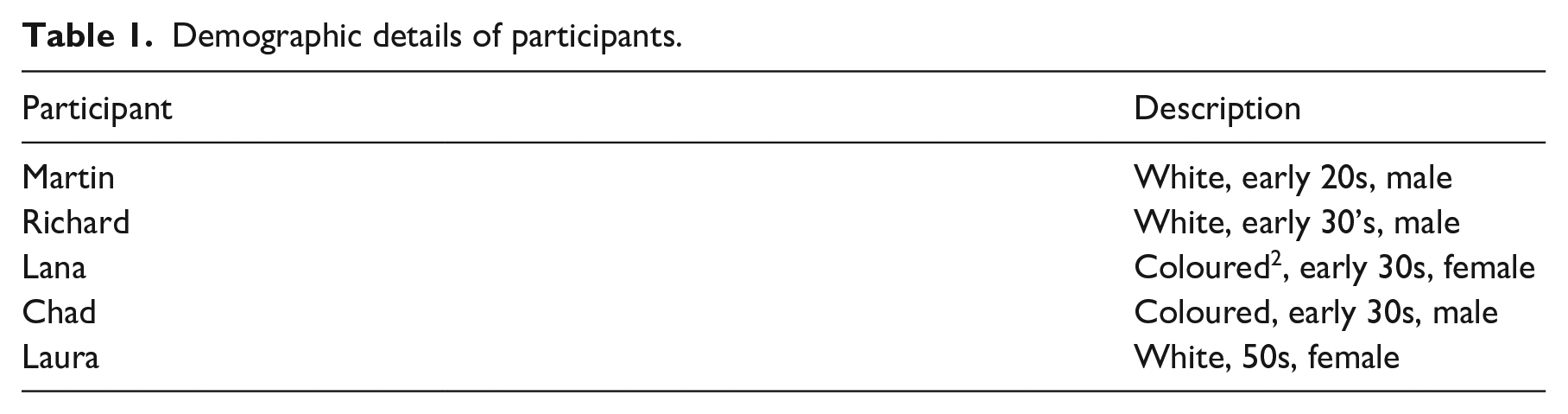
My participants were not representative of the diversity of queer and ethnic identities (see Table 1 below). This could be because music education in South Africa excludes or suppresses queerness. Msibi (2018) states that some communities would remain discreet because of the homophobia associated with their communities. Because music tuition in South Africa is still associated with private and middle-class schools (Pooley, 2016), the lack of diverse representation could also be due to exclusive access to music education which does not allow all ethnic identities and socio-economic classes to participate in music education (in South Africa class and race are inseparable).
Demographic details of participants.
Ethics
Ethical clearance was obtained from the Faculty of Humanities at North-West University. The participants signed consent forms and granted me permission to record and transcribe the interviews. Pseudonyms have been used to ensure the anonymity of the participants and the people and contexts referenced.
Findings
Martin
Martin is an undergraduate music education student who has taught students since he was at high school. He is currently teaching private students at university and also teaches at a community music project. Throughout his interview there was a strong ‘
In the interview he mentioned a recent court case of a gay teacher who allegedly sexually harassed one of his students.
In this narrative, Martin expresses how he experiences being positioned as a gay male music teacher. He states that he is placed under surveillance because of this positioning in his teaching practice. Because of this, he tries to ensure transparency in his music lessons by leaving the window open as a precautionary measure. This precautionary measure becomes a type of policy that he enforces for the sake of demonstrating ethical conduct. However, this policy negatively impacts his lessons as the open window is a distraction.
This self-imposed surveillance places him in an awkward predicament: accepting being under scrutiny and teaching uninterruptedly and more effectively, or being transparent and accepting being hindered during his teaching.
In the extract, the ‘under scrutiny voice’ is interrupted by the ‘I do voice’. After reading the extracts again, ‘and that also distracts me’, from the first extract, stands out. Because of his queerness, he feels the need to protect himself and put precautionary measures or policies in place, as encapsulated by the ‘I do voice’. These measures ‘distract’ him from his teaching and hinder him from teaching comfortably. Being distracted like this, and being hampered from teaching comfortably, is a consequence of the emphasis on heteronormativity in education. I cannot help but wonder if non-queer teachers experience the same pressure to be transparent. This interview took place in the same room in which he teaches. I too was distracted by the window, but I too did not want to close the window.
Richard
In Richard’s interview, he regularly reminded me that he feels completely accepted in his school, an experience he knows he would not find at all schools. I kept on asking him for narratives that might contradict this statement. Many of these contradicting narratives sounded like the one below, where he did not seem to be affected by others’ attempts to reject his queerness. In the following extract, two voices come to the fore: an ‘
Richard demonstrates how he integrates his queer identity into his teaching context. His queerness here is produced through his openness about his marriage to his husband, Jacob. His marriage allows him to participate in talking about marriage as a heteronormative institution (Butler, 2002; Hopkins et al., 2013), which accounts for his relatedness to his colleagues, but simultaneously challenges the heteronormative ideals in his context.
The function of the ‘
The tension between the two voices is indicative of his contradictory positioning – challenging and affirming heteronormativity by his marriage. This tension can be heard in the I Poem:
The opening two lines encapsulate his experience: he had never felt like he had not been accepted, until he had ‘one co-worker’ who opposed his queerness. The next two lines, when read continuously, sound like he understands her perspective, almost as if he admits to ‘flaunting’ his sexuality, stabilising the heteronormative comment. ‘Flaunting’ sexuality refers to gender-atypical appearances that serve as a reason for discrimination (Lick et al., 2014). The second stanza emphasises his attempts at integration. The last one-line stanza can be interpreted as his attempt to make sense of the backlash against his trying to participate in heteronormative practices. The first two stanzas are in direct opposition to each other, which creates tension between the homophobia of the first and the openness or integration of the second. This tension is indicative of his contradictory position. In this I Poem, he tries to participate in heteronormative practices, but is reminded that he will remain an outsider. When interpreted this way, the second stanza serves as a plea for acceptance.
Lana
Lana is a music teacher at a primary school. Because of her queer identity, she fundamentally believes that ‘we should be treated equal’ and she, therefore, tries to encourage inclusive practices in her classroom that recognise gender and sexual diversity. In this extract she elaborates on her attempts at inclusivity in her classroom. On her queerness she commented: I don’t think it’s kept me back, I think it’s pushed me forward. [. . .] Um. . . because you just think of things a little differently.
This conversation continued with her elaborating on this statement with two audible voices – the ‘
C: So, what would be [. . .] your ideal school or your ideal teaching situation? L: Oh gosh, kids that practice. [laughing] That would be ideal.
In this extract she expresses her frustration with other staff members who reinforce heteronormativity and exclusive practices that stabilise heteronormative binary gender roles: having the boys and girls perform different moves according to binary gender ideals. Elsewhere she also mentions that boys have to do the manual labour, such as carrying chairs. Above she demonstrates how she ‘[would] think of things a little differently’ and offer an alternative, inclusive practice. Lana, therefore, tries to recognise the complexity of gender and sexuality.
She later gives an example of how she likes ‘to shake it up’; the reproduction of heteronormativity at her school: . . . My favourite one is they stand and they can only leave once I tap them on their shoulder then I put them all mixed, then the teacher gets them a mess.
She does, however, admit that she likes this imperfect context because an ideal school would be ‘boring’, perhaps because this imperfect school allows her to advocate for inclusivity. In this case her heteronormative context drives her action to advocate.
When I listen to these distinct voices, the meaning of the ‘
Chad
Chad recently started teaching at a new school. In the discussion that follows, he refers to his previous school. During his time there, the school changed: it aimed to become more inclusive. This ethos changed after the students protested about exclusive school policies and practices about language spoken at the school as well as Eurocentric hair policies and discrimination against non-heteronormative learners. Chad was actively involved in the changing of the school’s policies.
In this extract I hear two voices: a voice that reflects on his own queerness in his lived experience – the ‘
[. . .] [T]he day of the protests,
Later in the interview he briefly reflected on this event:
Chad’s intersectional identity – racial, class, religious and sexual – led him to advocate for inclusivity. The day of the protests, his positioning in the school changed through his becoming vocal about his positioning in the school and in society. His fight for inclusivity used to be through his queer and resistant performance – through just being himself. But it was then that his role changed. He became the spokesman for inclusivity, and he said, ‘The [learners] knew that I was on their side, and they trusted me’.
Laura
Laura works at two departments, the theatre, and the music department. These two departments, as she describes, are different not just in their artistic practices, but also in the way sexuality is dealt with. In the following extract she speaks about her experience in these two departments. Below two voices are heard: the ‘
What is, what is, what is bad with my [theatre] students is. . .
She describes a tactic that she employs in her class, assuming ‘they all know’ – probably to avoid publicly coming out to her students and being ‘defined’ and limited to an identity as a lesbian. After she realised that her queer identity was not implied in her music class, she explained the predicament she is in. She is torn between them not knowing and them knowing about her sexuality: if they do not know, there is a tension in the class, and when they know she experiences that some of them, the ‘conservatives’, start reacting differently to her. She expresses that a similar tension takes place in her theatre classes, but it is here that she wants the tension to resolve. She wants the students to know about her queerness because this tension restricts their ability to work well together.
The I Poems of her reflection read as follow:
In the first stanza Laura tries to be comfortable about her queerness with her students without making ‘big moves’ like ‘jumping’. In the second stanza, she describes a dissatisfaction with how she deals with her queerness. The last stanza, written in the imperative voice, highlights her desire for her queerness to be explicit in the theatre class – she wants the tension to break.
Listening to this extract again, I hear it as two distinct sections – not identifiable as the music and theatre context, but as a tension and resolution. The ‘
Discussion
Upon listening to these interviews, I found myself listening for tensions in the contrapuntal voices – the negotiation of two opposing forces. For me, these are heteronormativity and queerness – the negotiation between being open or in hiding. In addressing such ideological clashes, I turn to the work of Foucault (1978): ‘[w]here there is power, there is resistance. . .’ (p. 96), meaning that heteronormativity opens the opportunity to be challenged by queerness, and vice versa. Considering this, I noted that the participants all responded to heteronormative forces differently in their various contexts.
Martin’s reaction to heteronormativity demonstrates that it has the power to interrupt his teaching, question his integrity as the teacher, as well as interrogating and monitoring him. Martin’s positionality as a male teacher (not necessarily the fact that he is gay, due to his emphasis on ‘male music teacher’) leaves him ‘under scrutiny’ and leads him to self-impose a policy that is distracting him from his teaching. I argue that, in his teaching context, being male is queer. I argue that this resulted from an internalised heteronormativity and the need to assert himself as a professional, place himself under surveillance and debunk the heterosexist assumptions about his queerness and its impact on his teaching practice (Msibi, 2018; Reed & Leuty, 2016).
Laura’s experience shows, firstly, that the context matters for one’s queer performativity – some being accepting, perhaps encouraging, while others are not. Secondly, her experience shows the predicament with her current positioning: being limited to only a queer identity when coming out or embodying an ‘open secret’ when remaining closeted: both of these stances create tension with her positionality within her teaching context. She made use of an ‘implicitly out’ (Griffin, 1991, p. 194–199) queer identity, but this hindered her group membership of a queer community (Pfeffer, 2014) and the possibility for acceptance of her queerness.
Richard, on the other hand, easily found acceptance at his school through participating in marriage as a heteronormative practice (Butler, 2002; Hopkins et al., 2013). He was, however, still under surveillance and policed when he did not perform according to the heteronormative ideals (Lick et al., 2014). He embodied a ‘gay’ identity within a heteronormative framework, meaning that he positioned himself as ‘the other’ parallel to heteronormative identities (Ozturk & Rumens, 2014). This explains why he was accused of ‘flaunting his sexuality’ – his membership in the heteronormative context allows marriage, but not queerness. Richard also shows that, by relating to heteronormative others, he is forced to entertain perspectives that could oppose one’s queerness. Richard’s marriage has an ambiguous effect – it allows him to relate to others while also challenging their heteronormative ideals.
Some of the participants displayed a sense of activism that is rooted, inherently, in their lived experiences. Both Lana and Chad used their queerness and otherness as driving forces for their efforts at inclusion. For Lana, her queer experiences have given her insight and serves as a catalyst for her inclusive practices that opposes her teaching context’s heteronormative ideology. Chad uses his queerness and positioning to oppose heteronormativity and exclusion. Chad opposes heteronormativity, and other forms of discrimination and exclusion, by his positionality as an intersectional racial, class, religious and sexual identity. He consciously uses his body as a political agent to bring about change in his context. Richard’s way of opposing heteronormativity is different. He aims to integrate his queerness into his teaching context by relating to his colleagues, and in this way opposes the heterosexual/ homosexual binary practices. Both Lana and Chad’s activism is reminiscent of the activist role that Bergonzi (2009) encourages the queer teacher to embody. Because the curriculum promotes hetero-exclusive content, queer educators take it upon themselves to share the untold queer stories or the censored queer stories (Bergonzi, 2009). Chad’s activism is different. Chad positions himself as queer in his context and tries to queer the context and problematise the workplace, policies and practices (Ozturk & Rumens, 2014).
These participants show that being a queer music educator in South Africa places you in an uncomfortable position where you have to negotiate between upholding and challenging the heteronormative ideals of the schooling and community context. Homonormativity explains that even though some of the practices seem progressive and liberating – such as being open about your same-sex marriage, or assuming that everyone knows about your queer identity – they may not oppose or challenge the heteronormative ideals, norms, or practices, but rather supports and maintain them (Duggan, 2003). Ahmed (2006) argues that, in terms of social order, those queer people who participate in homonormativity, exclude the other queer people who do not participate. For the most part, the participants all participated in homonormativity to some extent, as they did not contest the heteronormative ideals of their teaching contexts. Martin, for example, complied with being under surveillance, Richard participates in the heteronormative practice of marriage, and Laura is not challenging the heteronormative assumptions imposed on her. Throughout the interviews, all the participants could recognise that their queer identity, to some degree, negatively impacted their positioning in their contexts as they could not participate the same way that their heterosexual counterparts did, however, with the exception of Chad, the participants did not actively contest this to destabilise the heteronormative ideals. This silencing is a core part of how heteronormativity functions.
Conclusion
In a South African context, music educators occupy spaces where they need to be professional and meet curriculum outcomes. However, their politicised bodies have inherent meanings that influence how they understand themselves and engage in the world as well as how the world understands and engages with them. The participants all showed a different understanding of their queerness and the responsibility the context requires of them. Some felt the need to be discreet about their sexuality, perhaps as a way of preserving heteronormativity or avoiding conflict, while others aimed to oppose the heteronormative ideologies in their context to challenge our exclusive education practices. The participants showed how their politicised bodies either led to their hiding or to activism, making the body a site for oppression or agency. The contrast between the different levels of acceptance and openness in the participants’ different teaching contexts emphasised the limited mobility of queer professionals and the various strategies needed and adopted to negotiate subjective positioning in a teaching context. The participants could all recognise the oppressive and silencing power that heteronormativity has within their teaching contexts; where they may be queer, but not too queer.
