




Abstract
‘Simultaneous Learning’ (SL) is a pedagogical approach aimed at fostering enjoyable and proactive music teaching. Developed by the British educationalist Paul Harris, SL has been taught worldwide for the past two decades but has not yet been investigated by a scholarly publication. We thus focused our research on the first usage of SL in the context of one-to-one instrumental music lessons by training a selected group of teachers who had no prior experience with this approach. The data was collected through in-depth semi-structured interviews, focus group interview and journals kept by the teachers. We then used Interpretative Phenomenological Analysis (IPA) to understand the teachers’ and students’ experiences of instructing and being instructed according to the SL approach, respectively. Based on our results, we provide a structure to their lived experiences and explore the meanings they attached to them, among which positive experiences, challenges and the influence of SL on particular skills are identified. Furthermore, we offer implications that may benefit studio music tuition based on the insights provided by our analyses.
Introduction
Harris (n.d.) is a British educationalist, clarinettist and composer who has regularly taught at the Royal Academy of Music in London and at the Danish National Academy of Music in Odense. He is the author of over 600 publications, primarily books and articles for music magazines on topics related to music education. Within Harris’ contributions, ‘Simultaneous Learning’ (SL) stands out as a teaching ‘approach’ (Harris, 2012, p. 39) or ‘philosophy’ (Harris, 2014b, p. 35) that aims to make ‘pupils [come] to know music through imaginative and effective teaching that results from careful management of the lesson’s activities and monitoring of the pupils’ responses’ (Harris, 2014b, p. 44). Furthermore, the author conceived it as a customisable way of teaching based on what ‘good teachers’ more or less already intuitively do (Harris, 2014b).
The present study introduces SL to the scientific literature by exploring music teachers’ and students’ initial experiences with this approach according to a training in SL. In doing this, we aim to answer the following research questions in the context of One-to-One Music Teaching (OMT):
- What is the structure of their experiences?
- What meanings do the participants attach to these experiences?
Our results should consequently shed the first light on the participants’ life-worlds regarding their initial approach to SL. In turn, these findings should provide an original framework for further research on SL and similarly offer near-to-praxis insights that may benefit OMT.
An introduction to simultaneous learning
SL has been developed through multiple writings by its author and lacks a formal training method as, for example, that of the Suzuki teaching method. SL is currently built on four main principles (Harris, 2014b):
(a) Teach proactively, by anticipating the students’ mistakes.
(b) Teach through each piece’s ‘ingredients’, that is, its prominent traits and difficulties (namely its key, signature, rhythm, character, technical challenges, etc.).
(c) Make meaningful connections among the practice of these ingredients during the lesson.
(d) Empower students; don’t control or judge them by encouraging the use of positive, supportive language in the music lessons.
SL was coined for the first time in the book ‘The Music Teacher’s Companion’ (Harris, 2000). The aim was to ‘develop a young musician’s technique in the widest sense’ (Harris, 2000, p. 71). Later, in the first of the book series ‘Improve Your Teaching’ (Harris, 2006), Harris contrasts SL approach with what he calls ‘bar-one teaching’: ‘Instead of beginning at bar one, we’re going to use some of these ingredients to make connections with aural work and concept development through musicianship activities and games, improvisation and memory work’ (p. 16). Examples of these activities may include clapping a rhythm, singing a melody, learning something by ear or improvising within a certain scale, just to mention a few. Facing the whole piece is indeed the typical last step within SL and is conceived as a more joyful experience than structuring the lesson the other way around. In addition, an important principle within SL is the focus on positivity as ‘all teaching should be a joy’ (Harris, 2006, p. 8).
A new basis for SL developed in the book ‘Teaching Beginners’ (Harris, 2008): working on ‘the four Ps’ from the very first lesson: ‘Posture’, regarding technical aspects; ‘Pulse’, regarding rhythmical aspects; ‘Phonology’, regarding the timbre of the instrument when playing; and ‘Personality’, regarding character and intention in playing a musical piece. In the book entitled ‘The Virtuoso Teacher’ (Harris, 2012), the author elaborates further that ‘Simultaneous Learning is driven by three principles’ (Harris, 2012, p. 39), namely ‘teach pro-actively rather than reactively’, ‘teach through ingredients’ and ‘everything connects’ (Harris, 2012, p. 39). According to Harris (2012), proactive teaching is focused on preventing students’ mistakes as a way to improve the teaching and learning experiences: ‘the typical reactive lesson invariably goes along the same old route: pupil(s) play, make mistakes, and teacher reacts. (. . .) Teachers inevitably get frustrated and it slowly wears down pupils’ (Harris, 2012, p. 39).
Two years later, SL gets crucial new developments in the book ‘The Practice Process’ (Harris, 2014a), in which Harris (2014a) discusses ‘the simultaneous learning practice cycle’ (p. 11). This is conceived as the three-stage process of ‘integration-representation-connection’ (p. 11). ‘Integration’ is about the importance of referring to (home) practice often during the music lesson; ‘representation’ regards the need for a written representation of what is to be practiced; and ‘Connection’ refers to how, from the very beginning, the lessons should draw upon what students have practiced since the last lesson. In addition, the so-called ‘practice map’ also appears for the first time in Harris (2014a, 2014b) as a means to graphically represent the activities that guide both the lessons and the practice in the form of bubbles to be filled and connected collaboratively during the lessons. In Figure 1, we present a blank example freely designed by the authors according to the original bubble-titles in Harris (2014a).
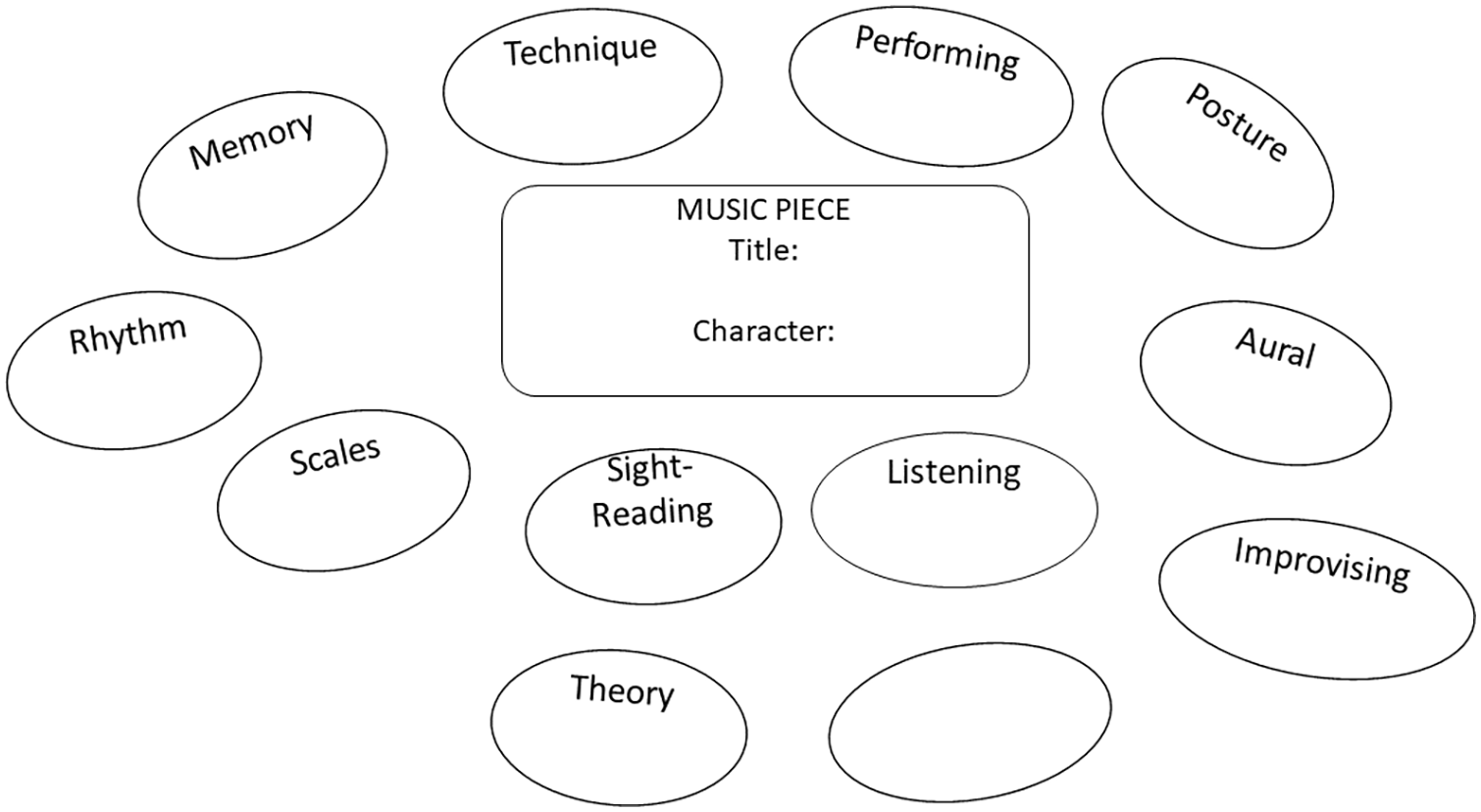
Example of a practice map freely designed by the authors. Please see Harris (2014a, p.19) for the original layout.
Finally, in the book ‘Simultaneous Learning, The Definitive Guide’ (Harris, 2014b), Harris articulates the main principles of SL mentioned at the beginning of this section, including the last one (d) for the first time. In this sense, Harris encourages a joyful climate during the lessons and avoiding the feeling of being personally judged.
Related research
Research on SL is almost non-existent at the moment. We succeeded in finding a single study on SL in the form of a master’s thesis (Brammeld, 2010). This work was aimed at exploring the educational value of clarinet textbooks created under the guidelines of SL; 6 music teachers and 20 music students (ages ranging from 9 to 11 years old) were tasked with using these materials before being interviewed and responding to a questionnaire. According to the music teachers, the students reported an improvement in both their regular practice and their competencies for sight-reading as a result of using this material.
As concerns the exploration of specific approaches in vocal and instrumental OMT, the traditional approach is named in regard to the relationship between the teacher and the student. This ‘master-apprentice tradition’ depicts a hierarchical structure wherein the teacher is regarded as having a superior role (Jørgensen, 2000). The embodied educational practices in the traditional master-apprentice tradition typically involve imitation (Jørgensen, 2000) and reactive error-correction (Duke & Madsen, 1991). Furthermore, these practices are also described as being typically isolated from the non-technical aspects of playing an instrument or singing, given that the teaching does not necessarily take place with any direct connection to music theory lessons, music history or other musical knowledges (Burwell et al., 2019; Carey & Grant, 2014). Negative consequences of this approach have also been reported, such as the adverse effects on the students’ well-being, including a high degree of anxiety and stress (Carey & Grant, 2014; Patston & Waters, 2015). However, recent developments of this tradition, termed cognitive and sociotransformative apprenticeship, have evidenced a positive impact on the child as a developing musician by incorporating approaches such as coaching, scaffolding and collegial relationships (Abrahams & Abrahams, 2016).
In regard to the exploration of alternative music teaching approaches in OMT, several studies have focused on the research of the Suzuki method (e.g. Colprit, 2000; Reuning-Hummel et al., 2016), which draws upon the ideas of the Japanese violinist and pedagogue Shinichi Suzuki (1898–1998). Many favourable outcomes may be found in the research literature exploring this approach, such as how the Suzuki method could be used as a framework for positive psychology (Patston & Waters, 2015) and how the Suzuki teachers provide more positive than negative feedback (Colprit, 2000). Furthermore, the Suzuki approach leads to gratifying learning experiences according to the study of particular cases (Reuning-Hummel et al., 2016).
The rest of the works investigating music teaching approaches in OMT are focused on the examination of specific teaching strategies, including learner-centred teaching (Daniel & Parkes, 2019), applying concepts from school teaching in studio teaching (McPhail, 2010), peer mentorship (Hasikou, 2020; MacLeod et al., 2020), engaging students in taking responsibilities for their own progression (Nerland, 2007) and combining studio lessons with small group and master class lessons (Bjøntegaard, 2015). Particularly relevant to our research are those studies involving the implementation and evaluation of a studio educational intervention. This is the case in Carey et al. (2018), who implemented a programme for improving studio music teachers’ professional skills as well as students’ learning skills through reflection and collaboration. Their results highlight the potential of that programme in improving the music students’ learning outcomes and how its success rests on two factors: a) properly supporting students in pursuing self-critical reflections and b) supporting the teachers in fostering their students’ reflective competence. Baca-Rodríguez and González-Moreno (2021) similarly developed an educational intervention where the traditional teaching was changed to systematically include activities to improve sight-reading. According to their results, the most important impressions perceived by the participants were the enjoyment of changing class routines and the opportunity to work on new skills within the class. In addition, the phenomenological approach has been acknowledged as a popular and useful method of investigating music teaching strategies (Joubert & Van der Merwe, 2020); however, we did not find a direct antecedent to our study that was (a) based on this approach and (b) simultaneously aimed at implementing a new strategy in OMT.
Methodology
This research is aligned with a post-modern view of Design-Based Research (DBR), wherein qualitative methods and the researchers’ own intuitions (based on our expertise in both SL and the education of pre-service and in-service teachers) are encouraged in the planning and assessment of pedagogical interventions (Connolly et al., 2018; Pogrow, 2015). The research design and the involved procedures have been reviewed and approved by the ethics committee of the University of Málaga. A total of 3 teachers and 11 students participated in this research during 2020 and 2021. We aimed to include a relatively small number of participants that would allow us to both handle the training of the participant teachers in SL and to obtain a significant but manageable amount of data; we purposely selected participants that embodied varied profiles, including several subpopulations, to enrich our results (Gerring, 2008). First, we contacted the instrumental and vocal teachers of eight music schools (n = 42) in both rural and urban parts of mid-west and south Sweden and the south of Spain. Thereafter, we sent a short questionnaire to those who agreed to participate (20% approximately) to obtain sociodemographic data and information on their teaching profiles. This included questions such as ‘How many years have you been teaching?’, ‘Have you ever heard of SL?’ or ‘What are the three most important aspects of your teaching acting as guidelines for your teaching philosophy?’. Then, we pursued a selection based on their differences in experience and placement and the analysis of their teaching philosophies. Three teachers with no previous knowledge of SL were selected:
- Teacher 1 (T1), a Norwegian female fully-trained Suzuki violin teacher in an urban area of southern Spain who is experienced (approximately 20 years in the profession).
- Teacher 2 (T2), a Swedish male violin teacher in a rural area of the Swedish Midwest who is newer to the profession (5 years of teaching experience) and has not adhered to any specific teaching methodology. However, his teaching philosophy was assessed as being closest to Praxial Music Education (Small, 1977).
- Teacher 3 (T3), a Swedish female piano teacher in a rural area of the Swedish west who is very experienced (more than 25 years in the profession) and has not adhered to any specific teaching methodology. Her teaching philosophy was assessed as close to that of Music Education as an Aesthetic Education (Reimer, 1970).
Regarding the selection of students, we aimed to include more than one pupil from each of the teachers and to engage participants of different ages who had had at least 1 year of tuition under their teachers. We instructed the selected teachers to contact and inform their respective students and their parents on the authors’ behalf regarding the present research. Thereafter, they made a selection based on the aforementioned criteria as well as the students’ and guardians’ acceptance to participate. The age of the students participating in this study ranged from 9 to 18 years old (M = 11.90, SD = 2.46).
The study was conducted across four phases. During each phase, the teachers were encouraged to contact us and ask any questions via email, SMS or videoconference, which they did on several occasions. The students were equally encouraged to contact their teachers or the researchers if anything was unclear. The first phase started with the elaboration of a training programme on SL. This programme was assessed by an external teacher and researcher who is experienced in the training of teachers, whose suggestions were included. In addition, we pre-tested the programme using only teachers as the participant; this pilot study allowed us to qualitatively assess the programme before its usage in the present research (Outhwaite et al., 2020). A description of the training programme and the research tasks are presented in each of the following phases. Within this first phase, the participant teachers attended an online live presentation on SL led by the researchers (75 minutes approximately). The presentation was designed according to the present framework of SL and contained multiple examples of SL applied to different genres. Following this, we undertook and recorded a focus-group conversation (1 hour approximately) in which we retrieved the teachers’ first impressions on SL. Additionally, the teachers received materials to study at home, which included several original writings of Paul Harris on SL. In the second phase of the study, the teachers applied SL with their students over the course of 2 months (ranging from four to six lessons for each participant). They were advised to keep a journal with their impressions after each lesson, which they would thereafter send to us. The third phase consisted of semi-structured recorded interviews (40–80 minutes each) with each participant by either videoconference or physical form. During these interviews, we explored how SL was experienced by the teachers and their students. For example, we asked the students ‘How do you experience the SL lessons?’, ‘In which areas did SL have an impact?’, ‘What are the most interesting aspects of SL to you?’. However, the questions to the students were slightly reformulated depending on each participant’s age and understanding. For example, we substituted the words ‘SL lessons’ for ‘the new way the teacher instructed you’. In addition, examples of questions to the teachers included ‘How do you think it went to teach within SL?’ and ‘How did you experience the practical value of simultaneous learning?’ We followed these with additional probing questions based on the flow of the conversation. In the fourth phase, we combined all the retrieved data and proceeded with anonymisation (teachers represented with labels T1–T3 and students with labels A–K). We then analysed the data through Interpretative Phenomenological Analysis (IPA). We chose this particular approach within phenomenology as it is well-suited to our purpose of uncovering the essence of the participants’ lived experiences through its capacity to explore the way in which the participants make sense and attach meanings to them (Smith et al., 2009). Furthermore, IPA focuses on the investigation of the participants’ life-worlds by acknowledging a process of interpretation which is unavoidably based on the life-worlds of both the participants and the researchers (Smith et al., 2009). In this case, both researchers are also music teachers well-acquainted with SL and who have used this approach on several occasions with positive outcomes. However, after reflection on these preconceptions, the researchers attempted to consciously suspend these to grasp the experiential world of the participants. As is typical in IPA, a process of interpretation by the researchers was followed by the development of patterns of meaning which were thematically reported and illustrated using quotations from the participants (Larkin et al., 2006). The analysis included analyst triangulation through independent coding and several discussions to reach an agreement by the researchers on the final codes and themes.
Results
The themes portraying the general structure of the participants’ experiences are represented in Figure 2. In the next sections, we provide the reader with rich descriptions of the participants’ experiences that illustrate the meanings they attached to those experiences and how their experiences varied among them. We also provide examples in the participants’ own words that epitomise other responses and thereby afford a vicarious experience to the reader (Sandelowski, 1994).
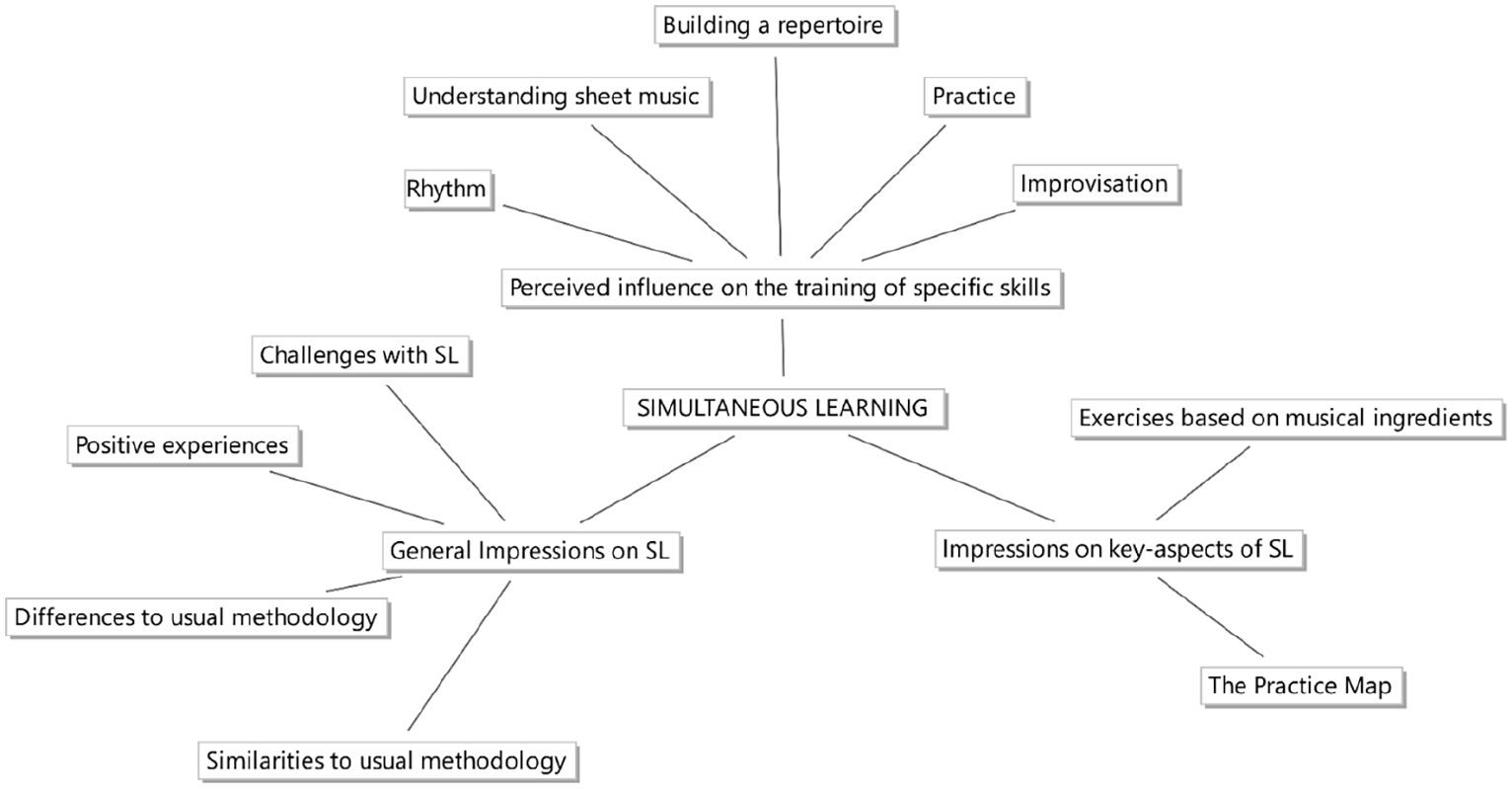
Structure of the experience of participants.
General impressions on SL
This first theme regards the participants’ views on various, general aspects that are not focused on a very specific music skill or SL methodological topic. All the participants deemed their experience with SL to be positive; for example, ‘it was cool’ (J), ‘funny’ (B) or ‘it helps’ (D). In the case of the students, these are generally associated with a greater ease in learning new pieces. This newfound ease is commonly attributed to (a) the benefits of working with ‘ingredients’ before going through each piece and (b) a more organised practice, for example: Helped me to know what I do have to practice at home. (D) I think it was interesting because at first one thinks that working on these different exercises is not important, but then, when you play the piece, [it] all makes sense, and having worked in such a way makes things easier. (B)
Furthermore, SL was perceived as ‘efficient’ by several students. In particular, some of the Suzuki students were surprised at how SL, though sharing some similarities with Suzuki, could still support them in achieving ‘good results’ despite being less based on listening. This is epitomised by the following expression: I felt that we could overcome difficulties not so much based on the listening. I felt that this method is in many ways similar to what we do in Suzuki, but at the same time, it feels very effective. It was surprising how the different bubbles, which first seem unrelated, come to [make] sense when playing the piece. I felt that it made things much easier, and I understand why. (C)
For both teachers and students, this positive feeling is often associated as well with a desire to continue using SL, either simultaneously, in substitution of or in combination with their usual approach. One of the teachers was indeed so impressed that he took action by spreading the word about SL among his colleagues: ‘My boss was very curious about this [SL]. I'm actually going to present it a bit to my colleagues at the music school’ (T3). Even the Suzuki teacher, who was the least effusive in her appraisals of SL, is now considering incorporating aspects from the SL approach that were not sufficiently addressed in her regular way of teaching: ‘Maybe I should try to include [more] harmony in my teaching’ (T1). Interestingly, one teacher specifies that the intensity of the positive feelings with SL may develop in relation to the age of the students, perceiving SL as better-suited to younger students: ‘Build a lesson this way [regarding SL] and it will be pretty good, as it was (. . .) especially with the younger students’ (T2).
In the theme ‘Similarities to usual methodology’, the majority of codes within this category were identified in the answers of the Suzuki students and mainly regard little to no change in the experienced conditions for practicing at home: same parent support and motivation to practice as well as similarities between the SL practice map and the Suzuki notes. On the contrary, the data encoded under the theme ‘Differences to usual methodology’ is more varied and does not match a specific group of participants. Regarding this last theme, working with preparatory exercises before confronting each piece and the development of many skills at once are the most mentioned differential aspects of SL according to the students. The teachers share the view of the students and conceive SL as a more ‘systematic way’ (T1) of incorporating different elements in the lessons. In addition, the teachers highlight other differential aspects of their experience with SL, such as those encoded as a ‘new way of thinking’, ‘not teaching linearly’ or having a ‘different focus’; for example: It’s a new way for me to think about teaching (. . .) I would just play a line and then just notice that which worked there and that which did not; [once it goes] well with the first part, then [I would go] through the second part. But now [with SL], it was completely back and forth in some way. (T2)
The participants also experienced challenges in using SL, among which the time constraint is the most consistently mentioned by the teachers, especially in terms of the demands of working with preparatory exercises in every lesson; for example, ‘a problem with simultaneous learning is that it is difficult to get everything done if you have limited time’ (T1). In addition, undertaking exercises on improvisations were also perceived as challenging. Interestingly, some students identify improvising also as a challenge, albeit ‘a desired’ one: ‘The improvising [was difficult], but I want to continue doing that. I like the feeling of being free that I get from music, and improvisation helps with that’ (D). In addition, another challenge identified by the teachers is making the lessons varied over time. Finally, some of the Suzuki participants were unique in identifying a decreased amount of listening time than they were used to before approaching the pieces.
Impressions on key aspects of SL
This second theme regards key aspects within SL, as two of these are focal objects in the experience of the participants: using the practice map and doing exercises based on the pieces’ ‘ingredients’. To the students, the practice map indeed makes clearer what and how to practice at home in an attractive, pictorial manner; for example, ‘It makes [it] easier to see the different aspects that are in need of work. It also helps in planning your study time’ (F). To the teachers, it is seen as a useful tool for mutual collaboration in annotating the lesson contents, which contributes to a better understanding for the students: ‘It gave us a common vocabulary’ (T2). Furthermore, the teachers also found it useful as a tool for planning the lessons beforehand: ‘I have had that map visible, or I have had it in my head or put it on the music stand. [I] always thought about it’ (T2).
Regarding the exercises based on the pieces’ ingredients, the students describe these with expressions such as ‘cool’ and ‘funny’, while the teachers highlight the relevance of their connection to the piece; for example, ‘what feels good is that you connect the exercise with the piece itself, so that there is no detached finger exercise, but you benefit from it directly connected to the piece. That is absolutely right’ (T3). Moreover, in some cases, the teachers experience these exercises as the most valuable insight that they gained from using SL: ‘This was new; to do exercises that are connected to the piece beforehand. That was the best thing about it all, I think’ (T3).
Perceived influence on the training of specific skills
This last theme regards specific areas involved in the development of a music performer. According to the participants’ experiences, the training of five of these areas are particularly affected by the use of SL: rhythm, score reading, repertoire, practice and improvisation. In the case of aspects related to rhythm, SL is viewed as particularly contributing to establishing and keeping a pulse. Regarding score reading, some of the Suzuki students felt that not listening as much to the pieces as they were used to in Suzuki did not help them in approaching the scores. On the contrary, the rest of the students tended to experience SL as helpful for developing this skill. Furthermore, some students and teachers agreed that SL facilitates the process of playing from memory. In relation to the skills associated with building a repertoire, working more on the character and stylistic traits of the pieces is perceived as salient by both the students and the teachers when comparing their previous lessons with those within SL, for example: I often want to imitate the character that I feel in the song, and it becomes like another melody depending on how you play it or whether you play it happily or slowly. It does a lot to the song. (G) One problem that I think the [SL] method can solve that I may forget [in my usual teachings] is related to being able to establish character and style in a good way. (T2)
When it comes to the influence of SL in practicing at home, the students are clearly divided into two groups: The Suzuki students, who tend to experience no change in their practice, and the rest, who tend to experience a more varied and connected-to-lesson practice within SL. One of the teachers is indeed suspicious as to whether all students had practiced according to SL and provided some reasons on why they would not: I tried to say that now you can do these exercises at home exactly how we did [them] in the lesson. But then, I do not really know if they would do so. Some [students] might have tried it, but they may not have really gotten it. I think some may have gone back to their old practice or just may have played the piece right away. (. . .) They may just think that [going through] the piece is more important because that [i.e., playing the piece] is ‘the lesson’. Maybe it was a bit my fault then; I could have been clearer in explaining that the exercises themselves are the lesson. (T3)
Regarding skills related to improvisation, all participants are unanimous in their positive experiences within SL. Additionally, some students declare that they, for the first time, have included improvisation as a part of their regular practice at home.
Discussion
The results of this study reveal three main domains in the structure of the participants’ experiences of SL: (a) Impressions based on comparisons to the methodology they are used to and the identification of positive and challenging aspects of SL; (b) a salient influence on the training of specific skills within SL, that is, rhythm, understanding notation as presented on musical scores, building a repertoire, practice and improvisation; and (c) analysis of the data reveals that two aspects of SL, that is, (a) using the practice map and (b) doing exercises based on the pieces’ ‘ingredients’, are essential to the SL experience to both student and teacher participants alike. As a first discussion, we find that this structure is in no sense against or alien to the principles of SL but, on the contrary, is closely related to central aspects of SL (e.g. the practice map, the ‘ingredients’, the SL ‘four Ps’, etc.). Moreover, the introduction of a new approach in the participants’ life-worlds may logically be expected to induce comparisons. Therefore, the structure of the participants’ experiences favours the success of the implemented educational intervention as a training programme on SL.
Regarding the main meaning attached to the participants’ experiences, all of them deemed the use of SL rewarding. Moreover, they expressed a desire to continue using SL instead of their usual approach or, at least, to incorporate some insights gained from SL. These positive attitudes towards the use of new routines in OMT is common to other studies (Baca-Rodríguez & González-Moreno, 2021; Carey et al., 2018). In the case of the students, they tend to consider SL as ‘efficient’, which they attribute primarily to the SL preparatory exercises before playing a piece and the facilitation of an organised practice; these results thus support the findings of Brammeld (2010) on the effects of SL on practice. In the case of the teachers, they highlight the utility of SL for planning the lessons and for systematising the development of skills. In addition, the teachers experience SL as a ‘non-linear’ way of teaching. This last suggests that SL is experienced in opposition to the typical reactive nature of the master-apprentice approach (Duke & Madsen, 1991), which Harris (2006) refers to as ‘bar-one teaching’.
Complementary to the aforementioned general, positive experience of SL, difficulties were also identified by the participants. The teachers indeed think that SL is time-demanding and thus difficult to be regularly practiced against deadlines or concerts. Moreover, they expressed difficulties in making the lessons varied over time and in incorporating improvisation in their teachings. This last favours the existing view on improvisation as an overlooked activity in music education contexts (Larsson & Georgii-Hemming, 2019) and supporting the teachers being a key aspect to the success of implementing new pedagogic approaches (Carey et al., 2018). However, the teachers recognise that SL provides an adequate framework for developing improvisational exercises through their connections to the repertoire. The students also experience improvisation as a challenge, albeit a ‘desired one’, thus supporting the motivational power of improvisation (Pellegrino et al., 2019).
Our results coincide with the extant literature suggesting that working with new skills is a motivational factor for the students (Baca-Rodríguez & González-Moreno, 2021). Moreover, many participants attributed to SL an awareness that they were lacking sufficient work on certain musical skills (e.g. harmony, improvisation, style, etc.) within the lessons or the practice. This advocates for the necessity of a more holistic pedagogy, one aimed at the global development of a musician in a wider, more intelligible way. Similarly, this finding confirms how, at least for the studied cases, this tuition remains quite isolated from the non-technical aspects of learning how to play an instrument (Carey & Grant, 2014).
Regarding the most influential aspects of SL in the development of skills, our results suggest that two among the SL ‘four Ps’ (Harris, 2008) were relevant objects in the experience of the participants: ‘pulse’ and ‘personality’, with neither ‘posture’ nor ‘phonology’ being mentioned. In the case of the former, the use of SL was experienced as helpful in establishing and keeping the pulse. Regarding ‘personality’, working on character and style were experienced as being significantly improved by SL. Why the other two SL Ps did not become relevant is an open question which may be attributed to the short length of the intervention, for example, or the particular priorities of the teachers. Also, as highlighted by one of the teachers, it is possible that the students did not fully apply SL in their practice by possibly only going through the pieces as they were used to. However, there are participants who identify many additional skills as influenced by SL: improvisation, rhythm, music theory, harmony, writing music and planning of the practice.
According to our results, variables such as the teachers’ experience in the profession, the different countries and the rural versus urban areas where they work did not make any significant difference in our participants’ life-worlds in relation to SL. The teachers’ approach did significantly impact the experiences of the Suzuki group. Our results suggest that the Suzuki participants experienced the least changes in comparing SL to their usual teaching and learning approach. Particularly, they experienced the same parent support, little or no changes in their practice and found similarities between the SL practice map and the Suzuki lesson diary. This is coherent with the analogies between SL and Suzuki, given that score-guided playing is also postponed in Suzuki, and the Suzuki teachers make abundant use of planned music exercises (Barber, 1991). Moreover, the Suzuki lesson diary may resemble the SL practice map as a didactic resource, although without the graphical, interconnected bubbles and the teacher-student collaborative approach. In addition, regarding the case of the Suzuki teacher, while she recognises having achieved useful insights as a result of participating in this research, she is the least effusive regarding SL. In contrast, the Suzuki students tend to be more impressed with SL, even expressing surprise at how SL also supported them in achieving valuable results. However, their opinions are divided: some enjoyed the shift away from ear-guided exercises in SL, while others found this transition difficult.
Conclusion
The implemented training programme in SL has changed the participants’ life-worlds, as evidenced by their desire to either continue with SL or to incorporate new insights into their regular approaches. Moreover, our educational intervention has awakened an awareness among the participants regarding how certain relevant skills (e.g. knowledge on harmony, improvisation, style, character, etc.) were lacking in OMT. Therefore, our results fully support the potential of SL for shifting the traditional OMT towards a more modern, proactive and holistic pedagogic approach. In the case of the students, SL is generally experienced as ‘efficient’ based on its preparatory exercises on ‘ingredients’ and its power for improving the practice. In the case of the teachers, the meanings attached to SL reveal its strengths in lesson planning, systematising skill development and fostering proactive teaching. However, the participants identified some challenges in using SL, including the students’ age, time constraints, the use of music improvisation and making the lessons varied. Likewise, our results highlight the experienced similarities between SL and Suzuki. Given the limitations derived from the reduced number of participants in our study and the short length of the pedagogical intervention, further research is needed to continue exploring the strengths and challenges of SL as an approach in OMT.
Implications
Our study supports a holistic pedagogic approach where OMT is not confined to developing technical skills. Furthermore, our results support the SL approach of following a ‘non-linear’ teaching strategy based on preparatory exercises derived from each student’s repertoire. Similarly, the use of a graphical tool collaboratively built during the lessons, such as the SL practice map, may be helpful in many ways. Indeed, it serves to project the lesson contents in practice and embodies a meaning for this practice in responding to ‘Why should I practice this isolated skill?’ and ‘What is next?’, thereby leading to a more efficient and organised practice time. Likewise, the SL practice map also offers a direct method for teachers to plan their lessons and assure comprehensiveness in the development of the students’ skills. Among these, improvisation has been revealed as one that is particularly motivational yet overlooked. Finally, the overall proactive nature of SL, underpinned by preventing the typical error-correction cycle in instrumental and vocal tuition, provides the students with more opportunities for success and may, therefore, positively influence their motivation. We also hypothesise that the error-correction cycle may be broken by developing the students’ independence, which may be achieved by taking the SL approach further in ways not foreseen by its author, such as by asking the students to fully build their own practice maps and discussing these during the lessons.
Footnotes
Declaration of conflicting interests
The author(s) declared no potential conflicts of interest with respect to the research, authorship, and/or publication of this article.
Ethical review
This study is derived from a research project which has undergone ethical review and has received approval from the University of Malaga (ref. 143-2021-H).
Funding
The author(s) disclosed receipt of the following financial support for the research, authorship, and/or publication of this article: This work was supported by the Spanish Research Agency (Agencia Estatal de Investigación, MCIN/AEI/10.13039/501100011033), under grant to Project Musihabitus (ref. PID2020-118002RB-I00).
