




Abstract
Throughout much of the 20th century, the Western classical vocal aesthetic dominated tertiary singing training in the Republic of Ireland. At the turn of the 21st century, and reflecting similar movements internationally, Irish institutions, examining boards and private teaching studios diversified to include musical theatre and popular styles of singing in degree programmes and syllabi. The purpose of this study was to further understand voice teacher perceptions of these shifts in pedagogical culture. This research questioned how classically trained teachers of singing negotiate teaching across styles in popular music genres, and also questioned if implicit, embodied cultural ideas about classical singing defined their educative approaches to popular music vocals. Data were collected through in-depth qualitative interviews with classically trained teachers of singing in the Republic of Ireland. Analysis of interview data revealed a number of themes which are discussed within a theoretical framework drawn from the work of Bourdieu, revealing that the participant teachers are involved in processes of negotiation and re-negotiation of personal and institutional habitus.
Introduction
Towards the 21st century, traceable social and cultural changes impacted the landscape of music education in the Republic of Ireland, and beyond this, the stylistically plural field of Western vocal pedagogy more broadly (Hoch, 2019; Potter, 1998). Rapid diversification of interests increased demand for singing teachers in Ireland to cater to newly developed popular and musical theatre exam requirements. Findings from this study reveal engaging insights and important issues which contribute to a broadened understanding of singing education within the complex cultural, social and political milieu of the Republic of Ireland.
Review of literature
For the majority of the 20th century, formal music education in Ireland was rooted within the Western classical tradition, and singers engaging vocal training at third level 1 were predominantly trained within this culture and aesthetic. Structures for Western classical singing took many decades to develop in Ireland, and along with sporadic provision in schools, scholarly discussion has posited that classical music education throughout Ireland has never been resourced on par with other European counterparts (Heneghan, 2001; White, 2005). White (2005) strongly laments the neglect of classical music through the Irish education system and is highly critical of popular music culture, which he links to declining structures for classical music. The relationship between music education, singing and culture in Ireland was also further complicated by nationalist and colonial agendas in the aftermath of Irish independence (McCarthy, 1999), forging perceptions of cultural, linguistic and musical division. In recent years, with the globalisation of Irish music (Motherway, 2013) and the prevalence of diverse and popular genres, Irish music education has broadened (Flynn & Johnston, 2016; McCarthy, 2004; Moore, 2012, 2015). This is reflective of similar diversification internationally, which has been much discussed in music education discourse (DeNora, 2003; Elliott, 1995; Green, 2006).
In the teaching of singing, cultural values may pass on from teacher to student, which often mark social divisions between musical traditions (Thomaidis, 2017; Walker, 2019). Singing lessons are sociocultural spaces, where teachers transmit knowledge and skills. The voice lesson space has been discussed as a setting where habit becomes habitus (Bourdieu, 1977; Gvion, 2016). With changes to the landscape of music education in Ireland, it is pertinent to consider how singing teachers trained within classical institutions teach genres outside of their own embodied habitus. At the turn of the century, examining bodies such as the Royal Irish Academy of Music began to offer exams in Musical Theatre and Popular Singing, and tertiary degree programmes in these styles were also introduced. Unlike most other European countries, Ireland has not succeeded in sustaining an active voice teachers’ association, and therefore opportunities for professional development in voice pedagogy within Ireland have been limited and sporadic. Sing Ireland is the national organisation for group singing; however, there is no current Irish equivalent to voice teacher associations such as NATS 2 or AOTOS. 3 Increasingly, pedagogical training in a variety of singing methods and topics has become available online, providing opportunities for professional development across borders.
These shifts in pedagogy have echoed changes to vocal curricular offerings internationally, where the altered pedagogical landscape has been much discussed within professional voice teacher associations and broader academic discourse (Bartlett, 2014; Bos, 2015; Harrison & O’Bryan, 2014; LoVetri, 2002). Terms such as Contemporary Commercial Music (LoVetri, 2008) and Popular Culture Musics (Hughes, 2014) emerged within the discourse as a means of constructing legitimised spaces for pedagogical discussion of various ‘non-classical’ styles of singing. Publications and conferences in voice pedagogy (ICVT, 4 Eurovox, 5 VASTA 6 ) are now diverse and interdisciplinary spaces, reflecting broader social and cultural movements in an increasingly globalised world (Potter, 1998; Thomaidis, 2017).
With a broadened conceptualisation of the styles of singing within voice pedagogy, the historically hegemonic status of classical voice pedagogy within the discourse was challenged by the emergent popularity of many different styles of singing (Fisher et al., 2014). While many tertiary-level pedagogues may sustain teaching careers solely within their own genre specialism, singing teachers maintaining private studios are frequently crossing genres in their teaching (Bartlett, 2010; Edwards & Meyer, 2014; LoVetri & Means Weekly, 2003; McCoy, 2013). Multi-genre adaptability and core knowledge of vocal function and mechanism is emphasised as key for any pedagogue crossing over to work with musical theatre or popular singing students (Fisher et al., 2019; Kayes, 2004). As pedagogical approaches to various singing styles evolve internationally, it is now appropriate to pose the following research questions to further understand the impact of such changes on the singing teaching landscape within the cultural context of the Republic of Ireland. The main research questions of this study are as follows: How do classically trained teachers of singing in Ireland negotiate teaching popular music genres? Do implicit, embodied cultural ideas about classical singing define their educative approaches?
Method
Research design
The research design was qualitative, and participant interviewing (Bryman, 2008) was chosen as the most appropriate means of gathering experiential data. Primarily concerned with the subjective experiences of the research participants, the research is situated within an interpretive paradigm (Denzin & Lincoln, 2008; Snape & Spencer, 2003). This perspective is concerned with examining the lived experiences of the research participants from their emic points of view (Hennink et al., 2012). Data collected included the perspectives of nine participant voice teachers, who each separately participated in a singular, semi-structured interview (Brinkmann, 2013). The design of the research involved an inductive approach to the research questions (Tracy, 2012). The research was concerned with examining a number of aspects related to the experiences of interview participants and did so without constructing a prior hypothesis. The observations and findings of the research were connected to theory following data collection and subsequent analysis (Bryman, 2008).
Selection of participants
Information about the study and criteria for participation was initially disseminated online through social media pages of national organisations such as Music Generation 7 and Sing Ireland. 8 The study sought participants who self-defined as classically trained teachers of singing and who were teaching in the Republic of Ireland. Participants needed to be teaching classical repertoire along with popular and musical theatre styles. All who volunteered through this process were contacted for interview in accordance with University research ethics guidelines, and nine participants were engaged for interview. Participants were fully briefed on the purpose of the study and the nature of their participation. The primary focus was to illuminate and present their attitudes and experiences in relation to the central research questions, and to allow them to describe these from their unique points of view and social and cultural positions (Hennink et al., 2012). All participants were classically trained and seven out of nine were female. All participants maintained their own private teaching studios, with some also teaching part-time hours in school or third-level contexts. Participants were located in both urban and rural areas, with informants dispersed throughout every province in Ireland except Ulster. Interview times ranged from 45 to 90 min, and all interviews were carried out during a 4-month research period in 2017. Interviews were recorded and transcribed verbatim at a later date. All transcripts were fully anonymised. Pseudonyms were assigned and each participant was provided with the opportunity to review their data (Table 1).
Summary of participants.
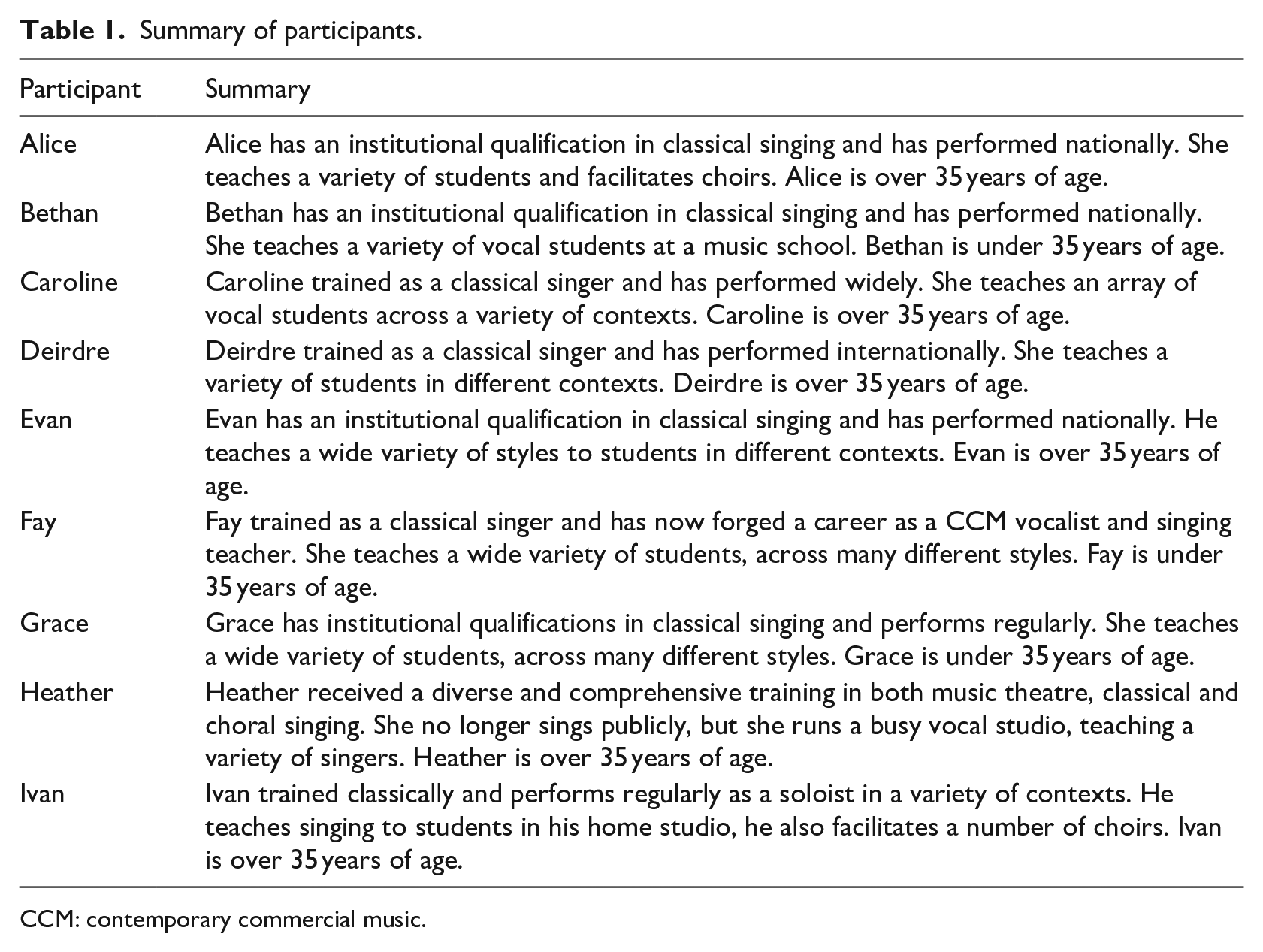
CCM: contemporary commercial music.
Data collection and analysis
The research design employed a semi-structured approach to interviewing (Bryman, 2008). The structuring within the interviews was designed to ensure that interview time was used effectively, with capacity for open-ended responses. The interviews were conversational in style and the participants were encouraged to speak without a sense of strict adherence to ordered questions. The function of the interviews was threefold. The first was to gain an understanding of the background of the teachers, which involved asking the participants to discuss their singing experiences prior to teaching. The interview process allowed participants to narrate aspects of their lives, revealing formative experiences that they had had in their own training, as well as identifying influential teachers and key moments within their development as teaching professionals. The second function was to contextualise their teaching practice. This section of the interview was designed to establish the various contexts in which the participants teach, the students that they teach and the styles of repertoire that they work with. Participants were encouraged to reflect on these areas, discuss their experiences and highlight any issues. The third function of the interview was to examine participant attitudes to ongoing professional development, professional networks, training courses and their views on professional development both for themselves and for other teachers. Analysis of transcribed interview data involved systematic coding to identify themes and patterns (Tracy, 2012). The inductive approach and subsequent analysis produced emergent themes which provided a basis for interpretation and connection to theory.
Findings
Theme 1: cultural dissonance – literacy, orality and musicianship
All but two of the participants emphasised the value of notated music and musicianship. All participants spoke of the cultural differences and dissonances that they perceived between classical and popular singing. For many, these differences manifested through perceptions of these cultures of singing as binary and opposed, reinforcing their perception of a dominant and hierarchical classical singing culture. For three of the participants, this indicated a desire to actively repress the ‘non-classical’ other. Two participants were aware that these ideological binaries have led them to challenge and question the hegemony of their own training culture, as well as those inherent narratives of opposition.
Emphasis on music literacy
Participant formative experiences with music and vocal training revealed cultural attitudes and ideas about best practice that underlie their teaching approaches and decisions. Four of the participants cited strong familial involvement in classical music and singing (Alice, Caroline, Deirdre, Grace). Instrumental study and theory formed a large part of musical engagement for these participants, and they articulated the many ways in which their own performance and teaching identities developed and were shaped by these structures. Participants who had a strong family background in classical music also placed a strong emphasis on musical literacy and a singer’s ability to read notation and interpret musical instruction. Both Deirdre and Alice appeared to connect dipping standards of musicianship and literacy with musical diversification and cultural change. Deirdre stated that all singers, regardless of genre, should be able to read notated music. She posited that low literacy in school music education in Ireland is getting worse, and she attributed this to the broadening of educational syllabi to include non-classical music. Alice shared Deirdre’s belief that a broadening of the school music curriculum has reduced the emphasis placed on classical music education, which has contributed to poor levels of musical literacy in Ireland. ‘I think that music education has been dumbed down massively, even from when I did my Inter Cert to what they are doing for Junior Cert 9 now’ (Alice).
The aural/literate binary
For five of the participants (Alice, Bethan, Caroline, Deirdre, Grace), negotiations with teaching popular music singers begin in the perceived opposition between written and aural learning practices, and they highlighted a strong duty to text, composer and notated music. This dedication to written music and text proved problematic as they spoke about negotiating popular styles. Popular culture musics may be notated but may also place emphasis on sound, aural learning and individual style. In addition to this, equating individual sound or style with ‘ego’ as an undesirable trait also creates an additional point of cultural dissonance in relation to ideological positions on the agency and creativity of the individual singer within a given genre of music.
For Bethan, aural learning results in ‘manufactured’ and ‘inauthentic sound’, which she states must be avoided. Alice rarely departs from written music and also relies on notation to teach popular music styles. For Deirdre, the construction of success and professionalism in the ‘real world’ is rooted in her own experiences within a Western classical working environment, which brings with it all the demands of that particular context, along with a strict adherence to the notated music.
‘Natural’ ability
Relying on aural learning and natural ability clashed with implicit beliefs and ideologies of voice building, literacy and ‘making the most’ of natural ability held by some of the participants. This created moments of dissonance as participants negotiate this within their own training narratives and within their conceptions of the broader educational landscape.
Participant definitions of natural voice did not align. Some indicated a belief that the natural voice is the voice prior to engaging in a voice training process. Bethan referred to natural voice as an end goal of the training process and posited that the desirable ‘natural voice’ may be accessed in isolation of the aural world, through notated music that students are unfamiliar with. Her focus on natural sound implied that unnatural sounds were prevalent in her students as a result of their dependence and reliance on aural learning and mimicking singers in their ‘sound world’. ‘They are trying to replicate something that they have heard on the radio, so for training, it’s trying to get them to use their natural voice as much as possible’ (Bethan).
Cultural differences
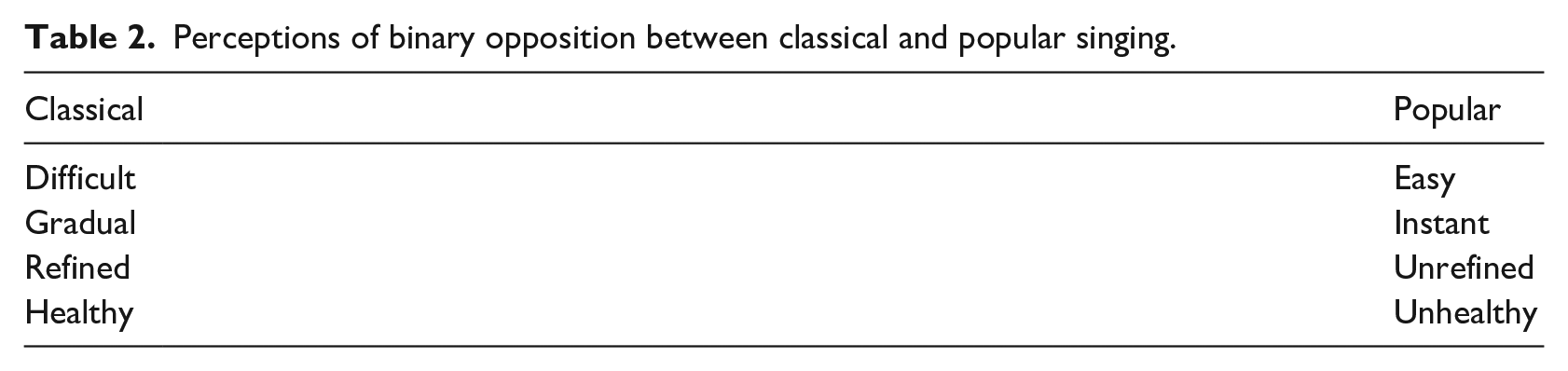
Five of the participants (Alice, Bethan, Caroline, Deirdre, Grace) outlined a very stark divide and opposition between classical singing and popular singing worlds, and they highlighted a number of issues which they viewed as culturally incompatible between classical and CCM 10 /popular culture. These participants displayed a sense of ‘dilution’ of classical singing. A number of emergent binary motifs evolved from their discussion of the separateness of these cultures. Table 2 illustrates a distillation of these binaries in relation to CCM styles, popular culture and the comparison of such with their perceptions of the classical vocal culture.
Perceptions of binary opposition between classical and popular singing.
Fay, Evan and Heather spoke knowledgably about vocal function and the importance of engaging with continuous professional development for teaching singing. With robust knowledge, and clear engagement with recent research and pedagogical discussion, these three participant teachers displayed confidence in their abilities to work with students across classical, music theatre and CCM styles. They were quite critical of many of the cultural narratives and implicit beliefs that they had been taught through their own classical training. Participants such as Fay, Evan and Heather described searching for this mediated understanding through the pursuit of knowledge that can help them to understand the process and dissolve boundaries.
Theme 2: vocal health and responsibility
Perceptions of what constituted healthy and unhealthy singing greatly varied between participants and impacted their perception of and negotiation with popular styles of singing. In general, each of the participants felt responsibility of care to student vocal health, but there were a number of ways in which this manifested. Participants who predominantly based their teaching on their own embodied training also appeared to hold greater reservations in relation to teaching popular singing styles. Three participants (Fay, Evan and Heather) renegotiated their own training experiences through targeted ongoing learning to further expand their knowledge for teaching across different styles.
Vocal injury
Many of the participants described the vocal training process as ultimately health orientated, and five of the participants were particularly concerned that popular repertoire would be damaging to their students, citing popular artists as being a ‘negative’ influence on their students. For many of the participants interviewed, vocal training was something that they entered to make the most of their natural abilities, but it was also a process that they felt would teach them to safeguard their voices by developing technique and efficiency.
Re-directing to classical repertoire
Bethan, Alice and Grace spoke of directing students towards their own experience base and guiding them to repertoire that aligned with their ideas of ‘healthy’ sound. Bethan stated that she uses repertoire from older, more legit musical theatre shows to connect to student interest, and emphasised that she avoids modern musical theatre and popular repertoire, as she perceived what she termed ‘chest voice’ to be problematic and something that she tries to avoid. ‘I as a general rule, stay away from letting the girls sing in their chest voices’. Alice also expressed concerns for student vocal health in CCM styles and cited examples in her teaching of redirecting students to more appropriate repertoire in a classical or legit music theatre style. She described working with a student who was predominantly interested in popular music and stated that she could ‘hear the soprano in her voice’.
Good and bad singing
Participants who discussed technique in binary terms displayed more anxiety and uncertainty around vocal health in general. Fundamentally, many of the participants were of the opinion that many popular singers are ‘technically unsound’. Ultimately, vocal health and longevity was a large concern for many of the participants, with some strictly adhering to sounds and techniques that they felt assured would not be damaging to their students.
Theme 3: continuous professional development
Eight of the participants identified a lack of emphasis on vocal pedagogy within their own performance training backgrounds. The findings demonstrate that participants were critical of the fact that pedagogical qualifications are not required to teach singing. Some participants were content in their accumulated experiential knowledge, while others sought information from written sources. Two of the participants (Evan and Fay) invest in pedagogical discourse and training outside of Ireland to increase their knowledge base in their negotiations with stylistic pluralism. All participants felt that it would be useful to have some sort of networking opportunity in Ireland to discuss and attend masterclasses and conferences with other singing teachers, but some of the participants worried that such a network would not be successful within what they viewed to be a competitive and hierarchical landscape.
Lack of training in voice pedagogy in Ireland
With a lack of infrastructure and support for singers beginning to teach, many of the participants identified their initial teaching years as being difficult, with some speaking of feeling inadequate and uninformed. Grace recalled finding her first lessons scary and questioned whether teaching solely from experience is enough. ‘I remember finding it really scary taking on students, because I don’t really have any qualifications in this. My experience is my qualification, and I don’t know if that’s enough. Is that enough?’ With no particular standards to adhere to, Bethan acknowledged that, often, teachers teach alone, and this can be difficult to self-regulate. It is the responsibility of the individual teacher to make sure that they are staying accurate and up to date in their teaching. Seven of the participants spoke about the isolated nature of the one-to-one teaching setting in their interviews also.
Professional development beyond embodied classical training
For some participants, the pluralistic teaching landscape has begun to prompt a questioning of their own knowledge along with the reasonable limitations of a singing teacher’s role of responsibility. Grace stated that she sometimes feels that students come in to her and expect her ‘to have all the answers’. Evan, Fay and Heather identified major cultural and contextual differences between classical and popular styles of singing, and discussed adaptability of approach to singing which they rooted in knowledge of vocal function, voice science and cultural context. Their descriptions of process were very scientifically detailed, revealing in-depth study of the mechanism and processes involved, along with detailed anatomical knowledge.
Evan discussed the differences that he perceived between his education as a classical singer, and his subsequent interactions and professional development within a specific singing teaching community. It became clear during the interview that Evan now perceives two vastly different and divided cultures of teaching, although he himself is an agent in both cultures. Fay stated that ongoing learning has provided technical options for finding efficiency in sounds that she may have previously held reservations about. She identified early in her teaching that the exercises that she had been taught were not applicable to some of the styles that she was working with, and investment in her own learning gave her the skills to find functional and efficient ways of working within CCM styles.
Discussion
Negotiating stylistic pluralism
This research has shown first that classically trained teachers of singing in the Republic of Ireland are teaching and negotiating popular music and musical theatre styles of singing in their voice studios. While specialised studios might be possible in a more densely populated country, it would be difficult for voice teachers in Ireland to sustain a career on teaching to one specialism alone. The interviews with research participants revealed some variation in participant negotiations with CCM. For the most part, participants held some reservations around vocal health in popular styles, with some participants opting to direct students towards repertoire that aligned with their own classical training and performance practice.
The research findings have shown a lack of professional development for singing teachers to explore and expand pedagogical approaches that include the CCM styles of singing that are now being taught. This lack of development among Irish singing teachers may also be symptomatic of the absence of a singing teaching network to advocate for and represent this community in Ireland. A small number of participants identified a gap between their own formative classical training and the CCM styles they found themselves teaching and invested in professional development. These participants appeared to be confident in their teaching abilities and expressed a wish for other voice teachers to engage in learning more about pedagogical approaches to CCM. These participants highlighted areas where they felt that classical pedagogy might be incompatible with some CCM styles.
Participant negotiations with CCM emerged from their habitus (Bourdieu, 1977) and embodied training experiences. Habitus has been widely discussed by a variety of theorists in relation to an array of disciplines throughout the past century. Western classical singing, through the discipline of classical training and musical canon, conditions vocalisation to the accepted structures defined and dictated by the social and cultural world, referred to by Bourdieu as the field (Bourdieu, 1993). Embodied ways of doing and techniques are adopted by singing bodies (Gvion, 2016), and singers are enculturated to operate within certain social roles and structures which are often reproduced. This pedagogical model enforces codes of behaviour valued by the musical and professional culture to which it belongs, reproducing this culture of vocal behaviour and affirming its status.
Participants revealed that their profession challenges them beyond their habitus – that is to say, the embodied training and culture to which they were socialised has expanded beyond the scope of what many feel comfortable teaching and performing. The findings of the study revealed that many of the participants perceived CCM to be culturally separate and oppositional to Western classical singing culture. Only two participants actually demonstrated an awareness of the growing body of pedagogy for CCM internationally. Participant negotiations with these seemingly oppositional cultures resulted in preoccupations with binaries and power relationships, with many participants struggling to negotiate deeply socialised and embodied experiences of singing as constructed by one culture, when encountering the other. Participants, who displayed difficulties in adapting to the other, described pedagogical decision making that reinforced dominant cultural ideologies or redirected student tastes to align with their own embodied experiences of classical vocal education in Ireland, thus choosing to negotiate CCM by reproducing the classical training which they themselves were taught.
While these findings are within an Irish context, they also reflect current discourse in vocal pedagogy outside of Ireland (Edwards & Meyer, 2014). Returning to the uniquely Irish setting of this research, Moore (2012) examines musical habitus and cultural capital upon entry to higher education, and in the discussion of these research findings, it is interesting to consider the negotiations undertaken by those inscribed with a ‘classically trained’ identity through their institutional training. Many of the participants were also graduates of training institutions, and Moore (2012) makes an interesting case for probing the different values which exist both inside and outside of these institutional settings in Ireland. This research reveals that many of the participants are now dealing with a teaching landscape that far exceeds what they themselves have covered within their own training.
The findings of this study suggest that for many of the participants, re-production of habitus is favoured to develop cultural capital for what they perceive to be essential within their experiences of the professional landscape in Ireland. Indeed for some of the participants, it was clear that they perceived the idea of training the voice as classically defined.
Ideological differences: the perceived decline of classical music in Ireland
The popularity and accessibility of CCM singing was seen to perhaps threaten a direct reversal of power relations within the perceived classical/CCM binary or signify the toppling of the desired hegemony that many of the participants felt a duty to reproduce. As Potter (1998) speculated, ‘it is not inconceivable that this fragmentation into stylistic pluralism will eventually see mainstream classical singing reduced to one variety among many in competing taste markets’ (p. 198). A proportion of the participants lamented what they perceived to be a decline in music education and expressed a wish for more musical appreciation in schooling. Their positions are closely aligned to arguments put forward by White (1998, 2005) and Heneghan (1995, 2001). By contrast, international scholarship in music education embraces discussion on musical and cultural diversity (Campbell, 1991, 2005; Clayton et al., 2003; Green, 2006).
Some of the participants expressed opinions that positioned CCM styles of singing as easy, accessible and, in addition to this, also potentially injurious to vocal health. A perceived reduction of classical music education underpinned many of these viewpoints, with some participants finding it difficult to distribute value equally across genres. Participants who were socialised in classical music and singing education from childhood, and who subsequently formed very defined and internalised classical vocal identities through their embodied training, emerged as the participants who displayed the least engagement with pedagogical literature, professional development or further education in vocal pedagogy for genres outside of classical. Some of these participants were content that their classical training would be broadly applicable across genres. As discussed by Bourdieu (1977), habitus is both structured and structuring, and therefore, through social upbringing and education, this defines the ways in which participants develop aesthetic ideals and tastes, thus contributing to status, class differences and social currency within capitalist society.
Renegotiating habitus: adapting to a diverse landscape
Two of the participants demonstrated a response to student demand and learning requirements for different genres by choosing to question and re-negotiate aspects of their habitus. These participants recognised that their embodied training did not hold enough currency within the rapidly changing Irish or international vocal pedagogical landscape. While the other participants recognised change, and avoided, resisted or accommodated popular styles on their own terms, these two participants sought to navigate the stylistically plural landscape by connecting to international networks outside of Ireland. This approach furthered their understanding of current discourse within the interdisciplinary field of vocal pedagogy.
Conclusion
The findings of this study presented singing teacher participant negotiations with cultural, social, historical and physical aspects of teaching singing in Ireland. The data revealed challenges, differences and opportunities presented by such a diverse and plural landscape of vocal expression. The scope of this study did not extend beyond the perspectives of classically trained singing teachers, but there are many directions for further research in this area. It would be interesting to explore the pedagogical perspectives of teachers from different backgrounds. While stylistic pluralism is not new, the educational landscape has changed, and expanded knowledge in areas such as vocal acoustics and voice science has the potential to broaden and enrich the experiences of students and teachers alike.
Footnotes
Declaration of conflicting interests
The author(s) declared no potential conflicts of interest with respect to the research, authorship and/or publication of this article.
Funding
The author(s) received no financial support for the research, authorship and/or publication of this article.
