




Abstract
The Norwegian municipal school of music and performing arts has diverse tasks it must manage; the school not only intends to offer its students opportunities to specialise, but it also aims to facilitate social inclusion and be a school ‘for everyone’. Handling these two seemingly opposing tasks requires a great deal from its staff. This article explores how music teachers negotiate versatility and specialisation through identifying with professional subject positions. Based on 16 teacher interviews and document analyses, the study finds six analytically subject positions for teachers to identify with. Most of the teachers identify with several subject positions, either at the same time or interchangeably, based on the situation. Together, these subject positions shape their professional identities. This has implications for the institution’s management of its competencies. While being a school ‘for everyone’ is a widely shared commitment, this does not necessarily require versatility from each of its teachers, as long as the school can become a versatile institution through assembling teachers with different specialised competences. This in turn would entail the future music teacher education to be broad-based with possibilities of specialisation, which could lay the groundwork for teachers’ flexibility and their ability to further develop their competence after graduation.
Keywords
Introduction
[I] hope we are not getting to the point where you are supposed to manage everything between the earth and the sky. If we are to reach for everything, there might be nothing left. (Laura)
This quotation comes from a music teacher I interviewed, and it introduces the key concern of the current article: the tension music teachers experience between versatility and specialisation when working within Norwegian municipal schools of music and performing arts (SMPA). The Norwegian SMPA aims not only to cater for the next generation musicians but also to provide arts experiences for all children. It is a system of extracurricular activities for children and youth in music and other art forms. The law governing it states that each municipality, alone or in collaboration with other municipalities, should provide voluntary music and arts courses for children and young people, and collaborate with the school system and the local community music and arts field. The SMPA targets all children regardless of social and economic background (Norwegian Council for Schools of Music and Performing Arts, 2016), a principle reflecting the values of the Nordic welfare state. Therefore, breadth, versatility and social inclusion are key tenets of the school. However, policy documents also focus on depth and specialisation, reflecting the school’s historical tradition and the practice of many of its teachers.
While tensions connected to teacher identity are not unique to the Norwegian SMPA (see Bernard, 2005, and Bouij, 1998), they nevertheless have a distinct expression and timely relevance in the Norwegian case as the schools receive more and diverse tasks to manage. To explore the tension music teachers experience between versatility and specialisation, I studied professional identities of music teachers working in SMPA. The aim of the current article is to answer the following research question:
Research question 1. What subject positions do music teachers in Norwegian schools of music and performing arts identify with, and how do the teachers negotiate the tension between versatility and specialisation?
The SMPA as a field of tensions is discussed in my thesis (Jordhus-Lier, 2018), where I found the field to be constructed by several discourses competing to define it, including school versus leisure activity, local autonomy versus centralised governance, and breadth/versatility versus depth/specialisation. Also, the most recent report on SMPA (Berge et al., 2019) points to the field being torn between being a place either for learning, arts or leisure, and between breadth and specialisation. Di Lorenzo Tillborg (2017) finds several tension fields within Swedish music and arts schools: between educational and leisure discourses, between regulation and freedom, and between reaching all children and improving a few children’s special skills. This resembles what we see in Norway.
Theoretical framework
The overarching theoretical framework builds on Laclau and Mouffe’s discourse theory (Laclau, 1990; Laclau & Mouffe, 2001), where discourse is perceived as a totality of language and practices. Laclau and Mouffe (2001) understand everything as discursively constructed, meaning that access to physical objects emerges through discourses. This suggests that identities are also discursive. The current study builds on the notion of identities as a temporary attachment to subject positions, where the subject is multiply constructed across different discourses and practices (Hall, 1996; Laclau & Mouffe, 2001). This means that an individual’s identity is constructed through identification with subject positions, where discourses, here through language, designate positions for people to occupy. Identity is understood as constructed through difference, to what it is not (Hall, 1996; Laclau, 1990; Mouffe, 2005). Hence, identifying with subject positions involves both identifying with some and rejecting others. Discovering available subject positions in the field is therefore about searching for positions the teachers identify with or reject, which implies distinguishing positions from one another. How one identifies with various subject positions shapes her or his professional identity. This is, however, not given once and for all and can always change. Identities are seen as contingent, possible, but not necessary, which mean they could have been, and can become, different (Laclau, 1990). The subject is always positioned by several conflicting discourses; it is overdetermined because the discourses are always contingent (Laclau & Mouffe, 2001), and it might identify in various ways according to the situation.
Understanding identity as a temporary attachment to subject positions, where the subject is multiply constructed across discourses, opens up for a dynamic understanding of professional identities in the Norwegian SMPA. A teacher could identify with the subject position Music Teacher when she or he teaches music groups in compulsory schools and with Instrumental Teacher when she or he gives piano lessons. In the current study, I perceive the subject as having some degree of agency with the possibility of resistance towards ideologies but with discourses limiting the subject’s freedom of action. This opens up for identifying negotiations between agency and structure.
In order to better understand which subject positions are constructed and how tensions are created within the system of music teacher professionalism, this article is informed by theories of professions (Abbott, 1988; Freidson, 2001; Molander & Terum, 2008). Combining discourse theory and non-discursive theories implies, however, a need for understanding the latter within the frame of the discursive approach selected for the present study. Common to discourse theory and theories of professions is that they both provide systems for understanding the social: discourse theory through discourses and theories of professions through logics or ideologies. In the current study, theories of professions are integrated into the concept of professionalism, which is understood discursively as a discourse of professionalism. There is support for a discursive understanding of professionalism in the literature. Evans (2008) states that professionalism means different things to different people and that professionalism cannot be seen as an absolute but rather as a socially constructed concept in use. Evetts (2006) sees professionalism as a discourse of occupational change and social control, where discourse refers to ‘the ways in which occupational and professional workers themselves are accepting, incorporating and accomodating to the concepts of “profession” and particularly “professionalism” in their work’ (p. 523). To understand what it means to interpret professionalism discursively, I refer to Dunn and Neumann’s (2016) definition of discourse, where it is understood as a system having a certain degree of regularity that ‘constructs the reality for its subjects’ (p. 4). In the literature on professions, professionalism, professionalisation and professions are understood as, among others, systems, logics, values or ideologies – which all have some kind of regularity. Seeing professionalism as a discourse requires an understanding of the system as being socially constructed, however. It is a system that has influence because someone has spoken on its behalf; it is constructed through language. It is constitutive for occupations, workplaces and professional identities.
Earlier research on teacher professionalism and identity
Teacher professionalism is studied by Ingersoll and Merrill (2011) who find that despite the centrality of specialisation in professionalisation, some school reformers argue that teacher specialisation is a step backward for education because it fragments the educational process and does not address the needs of the ‘whole’ child. They have examined out-of-field teaching, meaning ‘the extent to which teachers are assigned to teach subjects which do not match their fields of specialty and training’, where the source of it lies in the lack of fit between the teachers’ assignments and their fields of preparation, not in lack of training or education (Ingersoll & Merrill, 2011, p. 190). Angelo (2016) focuses on music teachers’ professional understanding, which includes power, identity and knowledge on the personal, collective, institutional and political levels, in her discussion of music teachers’ expertise and mandate. Georgii-Hemming (2013) asserts that the education of professional music teachers requires well-founded pedagogical knowledge, value reflexivity and interpretation precedence: in short, a ‘carefully considered music-pedagogical philosophy’ is crucial in order to develop professional knowledge for individual music teachers and for the profession as a whole (p. 210). Holgersen and Burnard (2013) argue in favour of a new model of professionalism among music teachers; a creative professionalism which emphasises the ability to cross-link different aspects of knowledge in order to meet the needs of the knowledge society.
While professionalism helps us understand professions as collectively expressed, their individually experienced dimension is better captured by the notion of professional identity. But how do we understand professional identities? Bouij (1998) argues that we all carry a ‘role identity structure’ where one can occupy more than one role identity. He provides a socialisation model where the horizontal axis goes between role identity as musician and as teacher and the vertical axis between broad and narrow musical comprehensiveness that shows how pre-service music teachers can navigate towards imagined salient role identity (Bouij, 1998). The concept of ‘role identity’ has, however, been criticised. Bernard (2005), for instance, finds it insufficiently flexible and implicating socialisation from one role to another – here, from the musician role to the teacher role. Bernard (2005) conceives of identity as individuals possessing multiple identities (layers) that are continuously shifting and changing (for a critique of Bernard’s position, see, for instance, Roberts, 2007).
Ballantyne and Grootenboer (2012) find that music teachers first identify as performing musicians. This impacts their way of perceiving themselves in their teaching practice. However, they also find that teachers’ perceptions of their professional identity, their abilities as discipline specialists and their pedagogy are interrelated (Ballantyne & Grootenboer, 2012). Ballantyne and Zhukov (2017) show that early-career music teachers see themselves as both teachers and musicians, with their identities being comprised of many sub-identities. The teachers were experiencing isolation and heavy workloads, but also displaying resilience when facing difficulties. This demonstrates, according to the authors, their ability to navigate through their career, away from potential burnout. However, this is dependent on the space and support teachers are given (Ballantyne & Zhukov, 2017).
Methodology
The current study is methodologically anchored in qualitative research (Miles et al., 2014; Patton, 2015), and discourse analysis is the overarching method for investigation (Laclau & Mouffe, 2001; Potter & Wetherell, 1987; Wetherell et al., 2001). The data consist of semistructured interviews with 16 music teachers in three different SMPA and document analyses of the SMPA curriculum framework (Norwegian Council for Schools of Music and Performing Arts, 2016). The study was approved by The Norwegian Social Science Data Services (NSD), and the participants received information in writing and signed a letter of consent. Member check was done by sending transcripts of the interviews back to the informants for approval and comments.
The schools, teachers and documents were selected purposefully to acquire rich information. The selection of schools and teachers was made (1) according to given criteria and (2) according to the purposeful sampling strategy maximum variation sampling (Patton, 2015). I chose medium-sized schools, as these were large enough to have teachers to choose from while maintaining anonymity and small enough to get a good overview of the schools in order to contextualise. Maximum variation sampling was based on the following criteria: collaboration with different institutions and geographical dispersion. From these schools, I selected teachers according to the following criteria: all should have a degree in music education or music performance, be employed as a music teacher in an SMPA, and have at least a 40% employment position (in order to give rich information). The criteria used to maximise the variation included instrument, age, seniority, genre, gender, pedagogical education and collaboration practices (see Table 1). In order to keep the participants’ anonymity, I gave them fictitious names and did not identify the schools to which they belong.
Sample demographics.
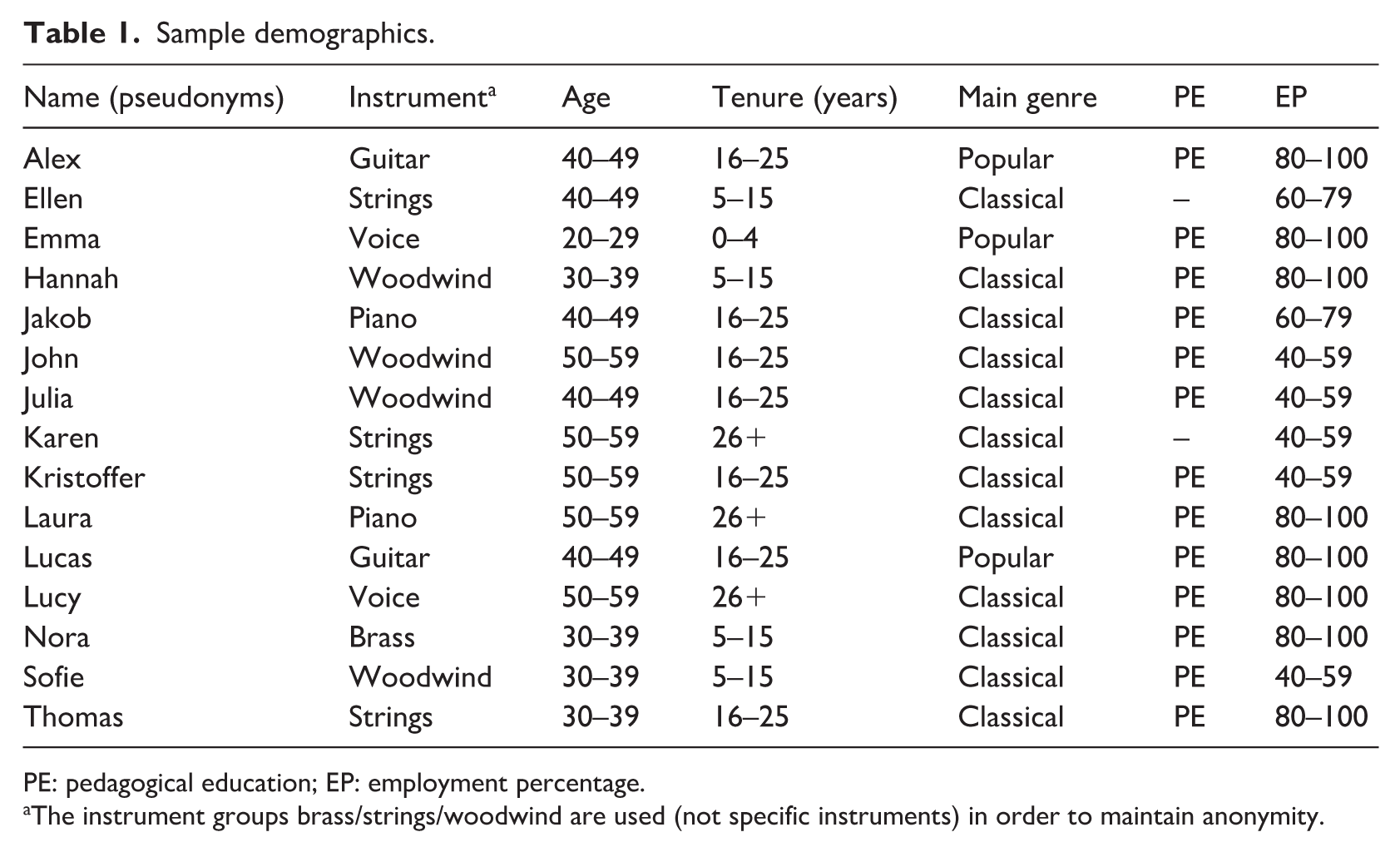
PE: pedagogical education; EP: employment percentage.
The instrument groups brass/strings/woodwind are used (not specific instruments) in order to maintain anonymity.
The interview guide consisted of four topics: the teachers’ background, understanding of their professional identity, how they saw SMPA as a centre in the local community and their thoughts on being a music teacher in the future. The analytical process started with identifying central discourses in the field, with codes emerging from the data. These codes were organised into groups and hierarchies, also informed by discourse theory and other literature (for instance, theories of professions). The first step in searching for available subject positions was to identify the master signifier/nodal point of identity in the data. Following Lacan, nodal points are privileged signs that play a central role in the fixation of meaning; they are empty and get their meaning by being related to other signs (Laclau & Mouffe, 2001). What unified the teachers in the current study were their positions as music teachers in SMPA, but I found in the data that there were different ways of interpreting music teacher. Therefore, ‘music teacher in the school of music and performing arts’ became the nodal point of identity, and the analytical process continued with investigating how this nodal point was articulated by discourses into subject positions by being linked to various signifiers. The analytical process of identifying subject positions has thus its base in the data, informed by discourse theory, but not directly connected to other literature. However, because the subject positions are constructed within central discourses, some of them are also theoretically informed. One example is how Musician emerged through the analytical process as a subject position linked to the nodal point by the empirically informed signifiers (see Figure 1). At the same time, I found Musician constructed within the discourses of depth/specialisation, music as experience, collaboration and professionalism (Jordhus-Lier, 2018), the latter informed by theories of professions.
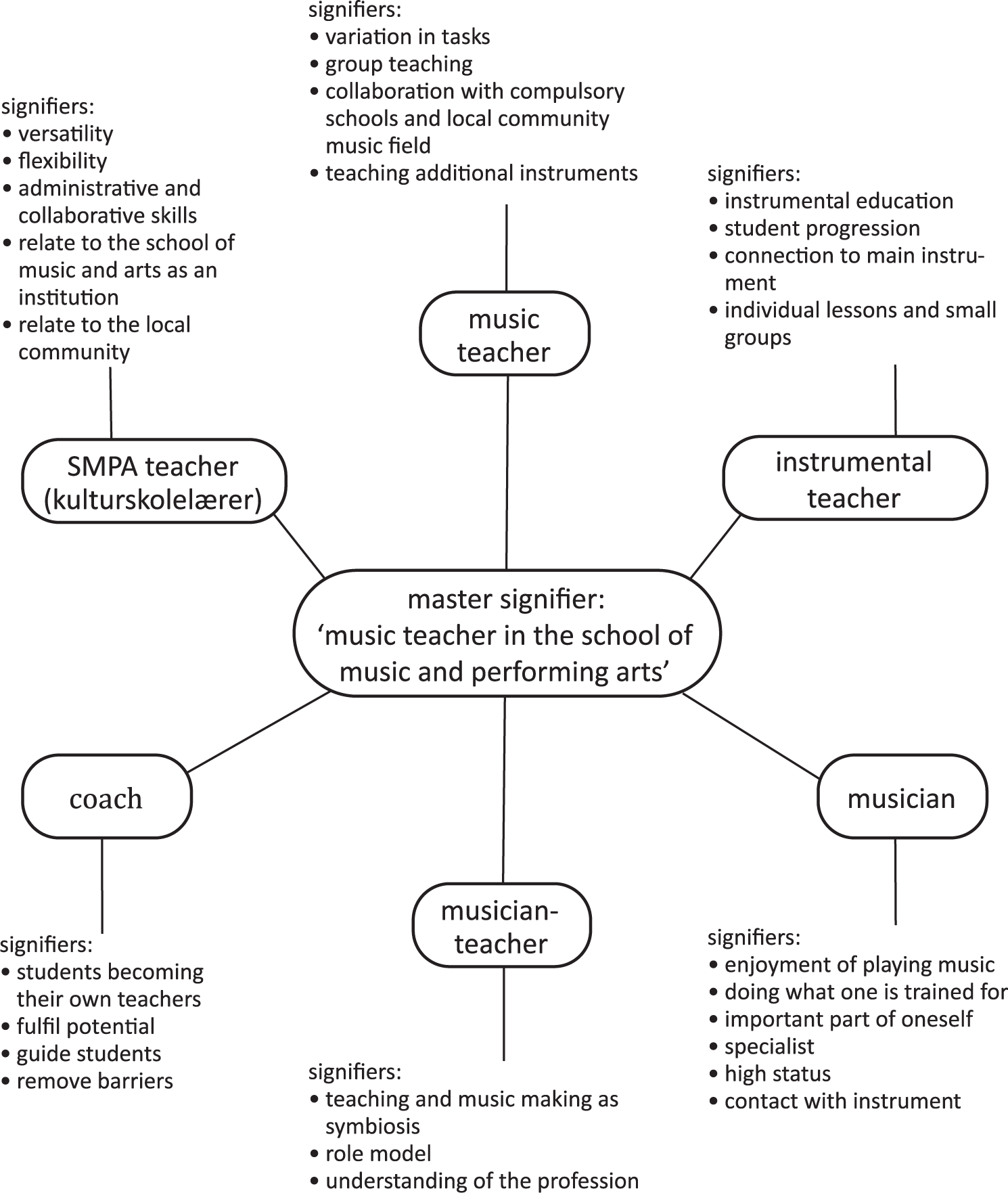
Subject positions in the school of music and performing arts field.
Identified subject positions
Six subject positions were identified in the data material, through interview statements about teaching and the teacher role and through representations of music teachers in the document material. These were Music Teacher, Instrumental Teacher, Musician and Coach (terms also used by the teachers) and Musician-Teacher and SMPA Teacher (in Norwegian: Kulturskolelærer). Musician-Teacher is a term I constructed, but it is also used in previous research, for instance, Bernard (2005).
Music Teacher
The analysis showed that variation in tasks, group teaching, collaboration with compulsory schools and the local community music field, and teaching additional instruments are central to the subject position Music Teacher. About one-third of the teachers identified with this subject position. One of them described it as follows:
I feel I am doing a lot of different things, which fits with being a music teacher. [. . . ] It embraces a lot, I think. [. . . ] Conductor, musician, I feel everything is embraced by music teacher. (Nora)
Nora’s emphasis on variation in tasks reflects the centrality of breadth and versatility. However, being specialists with their instruments to be able to teach these instruments properly and being role models were also important to the teachers who identified with this subject position. Some of them found it, however, difficult to maintain what they considered to be a sufficient level of expertise with their instrument because of a varied workload and lack of time. Hence, there is a contradiction between their idea of what a music teacher should know and be and what they find is possible within the field. An important reason for identifying with or rejecting this subject position was work experience. Some of the teachers who rejected this subject position were trained as music teachers (broad education) but had subsequently mostly taught their main instruments to individuals or small groups.
Instrumental Teacher
Central to the subject position Instrumental Teacher
1
is instrumental education, student progression, teaching individual lessons and small groups, and a connection to the main instrument. The latter is visible in the following statement:
The instrument is my identity. [. . .] It has to do with my education, I guess, and I have my strength there. (Hannah)
About half of the teachers identified with this subject position, and the tasks performed by them were less versatile and more connected to learning an instrument than those performed by teachers identifying with the subject position Music Teacher. This means specialisation and depth are central, as well as seeing the SMPA as a school as opposed to a leisure activity.
The analysis revealed that most teachers were concerned about avoiding stagnation in their work but found different solutions for doing so. For teachers identifying with the subject position Music Teacher, not stagnating was related to competence development to vary their work tasks, where mastering new tasks was seen as important. In contrast, for teachers identifying with the subject position Instrumental Teacher, not stagnating was achieved by going in-depth into their instrument’s repertoire and traditions. Hence, specialisation is central. This is evident in one of the teacher’s commitment to his instrument.
I know the flute
2
community, to put it that way. I have a lot of awareness about being a flute teacher, to be a flautist and . . . what is composed for the instrument, about traditions; about everything that has to do with it. I pay attention to what is going on, and try not to stagnate. (John)
On the contrary, John saw versatility as important for future teachers, especially connected to genre. He is classical trained himself, but admired the younger teachers who he perceived as having a more versatile genre competence. Another teacher, Laura, saw herself as lacking competence in teaching large groups and non-classical genres, but expressed a strong attachment to her instrument. She also compared herself to the younger teachers, whom she admired for their versatility and level of training. She expressed a belief that the SMPA should be versatile but that each teacher could be a specialist. In such a belief, she could find her place in the school.
Musician
Enjoyment of playing music, doing what one is trained for, important part of oneself, specialist, high status and contact with the instrument are all central to the subject position Musician.
3
About half of the teachers identified with this subject position. This statement from one of them shows the centrality of being able to play music:
I am proud to be a SMPA teacher also, but the other side is more important to me personally. The SMPA teacher should put the students in front and be a catalyst or . . . . But me as a violinist is more me and my personality. (Karen)
Specialisation and depth are fundamental on the path to becoming a musician. However, some teachers expressed musicians not only as artisans but as also requiring competence development and reflective practice, where breadth and holistic thinking were important. Within this understanding, a musician is flexible and versatile to play different instruments in different situations, but also a specialist because being a good musician or music teacher requires a certain level of proficiency with one’s instrument. The importance of specialisation is linked to quality, which is evident in the teachers’ reflections on instrumental and genre versatility. William, a string player, said he also plays piano and that he ‘messes around with other instruments like ukulele and mandolin, but it is no quality . . . ’, and John, a classically trained wind player, also plays jazz and rock, but ‘only at an amateur level’.
In the data, the subject position Musician was also constructed as a rejection of it. Teachers who rejected it saw themselves as different from those they perceived as musicians. The reasons given for rejecting it include not working in an orchestra, not being good enough, not practising enough, not performing concerts, not being a soloist and not playing professionally but only with amateurs. Kristoffer saw himself as opposed to those he defined as musicians:
I have a lot of respect for calling yourself a cellist.
4
Then you are professional, you play partitas for an audience, and you play Beethoven sonatas. You play concerts. I do not play concerts as a soloist, but I play in ensembles. As long as I do not play solo concerts, I will not call myself a cellist. (Kristoffer)
When those teachers who did identify with the subject position Musician talked about being a musician, however, they expressed no difference concerning performing as soloists or part of an ensemble, and several did not see performing concerts as crucial but only practising and ‘being in contact’ with their instrument.
Musician-Teacher
About a quarter of the teachers saw teaching and music making as one and the same thing. They identified with the subject position Musician-Teacher. Central here is being good role models, having an understanding of the profession and the symbiotic nature of teaching and music making. The latter is here expressed by one of the teachers:
To be a teacher is part of being a musician; it belongs together. You cannot be the one without being the other. That is just how it is. (Ellen)
Ellen is educated as a musician and not as a pedagogue. Her education as an instrumentalist was specialised and ‘narrow’. Still, she said she feels like a musician in ‘the widest sense’, as she put it, which implies that being a teacher is part of being a musician.
Teachers who lacked pedagogical education or had done teacher training after music performance studies were well represented in identifying with this subject position. They did not see music teaching as a separate subject but rather as an integrated part of being a musician. They were concerned about being specialists at their instruments and that teaching and performing music is intertwined because it creates better role models for students and a better understanding of music teaching as a profession. Thomas was one of those teachers:
It also has to do with the understanding of music teaching that one requires the other. If you are going to perform, you need to teach it also, if you are going to teach something, you need to know it before you teach. (Thomas)
Within this understanding of being a music teacher, I also found an emphasis on not only the importance of students listening to good musicians and experiencing music but also the need for them to practice to make progress.
SMPA Teacher (Kulturskolelærer)
Central to the subject position SMPA Teacher is versatility, flexibility, administrative and collaborative skills, and the ability to relate and adapt to the various things going on both inside and outside the school, for instance, the local community music and arts field. Five of the teachers identified with this subject position but not first and foremost. Only one did so. Most of the teachers were concerned with specifying what kind of SMPA teacher they were. In the curriculum framework, on the contrary, I found the SMPA Teacher to be the primary subject position, where teachers’ versatility, including administrative and collaborative skills, were emphasised. The curriculum framework (Norwegian Council for Schools of Music and Performing Arts, 2016, p. 16, my translation) describes the many roles of ‘the professional school of music and arts teacher’ as ‘pedagogue, performing artist, leader of small or large groups, organiser, project leader, coordinator, inspirer, cultural carrier, evaluator and colleague’.
Sofie, the one teacher who identified primarily with this subject position, expressed the value of collaboration with other teachers because it ‘makes teaching more dynamic’. She accentuated the importance of being open to others’ ideas, and she saw flexibility as important. Flexibility is central to this subject position, that one is able to adapt and change according to the surroundings and what is needed. Flexibility is highlighted in the curriculum framework (Norwegian Council for Schools of Music and Performing Arts, 2016) and by the teachers as even more important in the future of SMPA. The data showed, however, that teachers also experienced negative effects of teacher flexibility and versatility. Nora asserted that she had ‘become a potato that can be used for everything [adaptable to multiple contexts], who does not really focus on, or is passionate about, one single thing’, and Laura warned that ‘if we spread ourselves to cover everything, there will maybe be nothing left’. This relates to Freidson’s (2001) concerns about a future scenario where occupations might disappear and that jobs no longer will be defined by tasks but rather flexible skills.
Coach
The analysis showed Coach as being a subject position where students become their own teachers and fulfil their potential, and teachers guide the students, removing their barriers. This builds on the belief that everyone has talent. Related to this is Dewey’s idea of ‘learning by doing’, in which learning happens through experience and not transmission of knowledge (Dewey, 1938). This could also be seen in opposition to the master/apprentice scheme, where transmission of the teacher’s skills and knowledge to students are central in the learning process. One of the teachers identified with this subject position:
I want to meet them [the children] and think that they know this much better than I do. [. . .] Many who teach music think it is the teacher who should tell the student what to do. [. . .] But I believe in getting the student to achieve an understanding of what she is actually doing. It is about removing barriers and going to the organic idea of handling an instrument. (Ellen)
Versatility is central to this subject position because a teacher needs to be versatile to respond to what the various students bring in. However, depth and specialisation are also important because of the idea of individualism – that each student should be able to fulfil his or her whole potential. Central is also the students’ ability to work independently. However, some of the teachers experienced difficulties in encouraging students to do so, which they found was because of students wanting to receive instead of putting in effort, meaning they expected the teachers to teach them instead of taking responsibility themselves. These students did not see the SMPA as a school but rather as a leisure activity, which does not correspond with how most of the teachers viewed the SMPA’s role.
Administrator as a subject position?
Several of the teachers emphasised administration as an important part of being a teacher in an SMPA because you must organise students, projects and concerts. However, the teachers did not speak of themselves as administrators, not even those who worked directly with administration. Some of the teachers had taken or planned to take administration and management courses. Their reasons for considering including administrative tasks in their jobs included needing variation, better working hours, possibilities for increased employment and new challenges. They were, however, worried that working with administration would hinder them from other parts of their job, which they found important. Julia expressed being confused after taking a management course, pondering over if she ‘wish to be a leader or work with the grassroots’. Thomas had mixed thoughts:
It [working with administration] has to do with working hours because I have a family now. And it is an obvious alternative. [. . .] But I do not know if I want it. [. . .] I see that if I do it, I can forget about being a musician, at least at the level I want. (Thomas)
Freidson (2001) asserts that heading for a staff position often troubles those who identify strongly with their craft because it often implies forsaking the practice of one’s occupation. Teachers in the current study worried that moving on to staff positions would entail losing touch with their instrument and their teaching. This could be one reason why teachers expressed ambivalence towards moving on to staff positions and also why they did not view themselves as administrators, even though they performed administrative tasks. Hence, Administrator as a subject position seems to be in conflict with the other subject positions; the teachers could not identify with the other positions if they were to follow the ‘administrator’ pathway. Administrator was not identified as a subject position in the data.
Discussion
The analysis has identified six subject positions among music teachers in the Norwegian SMPA. Two of the teachers identified with a singular subject position, while the rest identified with several, either at the same time or interchangeably, according to the situation. Several discourses shape the SMPA field, where no single one has established a hegemonic position and where the binary discourses of breadth/versatility versus depth/specialisation are central (Jordhus-Lier, 2018). Subject positions constructed within discourses in binary opposition are difficult to identify with at the same time. Consequently, teachers have to negotiate their professional identities and, as part of that, they experience tension between versatility and specialisation.
Identity in this study is understood as temporary attachments to subject positions. In this dynamic notion of professional identity, the subject has some degree of agency within discourses limiting its freedom. This resonates with Ballantyne and Grootenboer’s (2012) study, where teachers enacted a pedagogy unconsciously reflecting their identities, and where the teachers’ perceptions of their own professional identity, their abilities as discipline specialists and their pedagogy were interrelated. To the teachers working within the SMPA field, discursive structuring would often be invisible or implicit, and as a consequence, they would be unconscious of which subject positions are unavailable. Understanding teachers’ negotiation of identities as limited by discourses corresponds with Bouij’s (1998) analysis of pre-service music teachers. These navigated their role identities in a social context where the ‘code of education’ and ‘school code’ where central in providing norms and values and prescribing the limits for possible actions. The dynamic understanding of identity employed in this study is, however, more in line with how Bernard (2005) conceives of identity: ‘as processual, as positions and contexts that constantly shift, and as constructed on multiple levels’ (p. 5).
Part of having a professional identity is being a member of a professional group. Identifying with subject positions and negotiating identity is thus a way to express professional belonging. Freidson (2001) points out that a profession can be composed of several different subcommunities. However, the demarcation of these professions and subcommunities is open to interpretation. Some teachers in this study linked their profession to their instrument and perceived themselves as members of, for instance, the piano teaching profession. Others saw music teaching as their profession. However, none of them perceived SMPA teaching as their profession; instead, they identified with a less versatile group. However, as elaborated on earlier, SMPA Teacher is the dominant subject position in the curriculum framework. This could point towards the curriculum framework indicating SMPA teaching as the profession in which all the teachers are members. This means the teachers are constituted as a group according to the logic of equivalence (providing a relatively large group with a common platform) (Laclau & Mouffe, 2001); that teachers are members of the same profession whether they teach dance or music – or more specifically hip-hop or violin. The common ground is where they teach (in the SMPA) and that they teach an art subject. This understanding could provide the SMPA and its teachers with a strong political voice because of the group size, and it makes the institution SMPA central within the profession.
Perceiving music teaching as the profession, on the contrary, would not centre around the institution but rather the subject music and the practice of teaching. Because most of the teachers saw music teaching (or even more specific) as their profession, they tended to perceive the profession of which they are members according to the logic of difference (taking internal differences into account) (Laclau & Mouffe, 2001). This means that each of the knowledge bases that the various professions build on are more homogeneous than if all the SMPA teachers were to be members of the same profession. It also implies that the institution is not as central and might have a less united voice, which could weaken the common ground for mobilisation. Instead of focusing on a shared workplace, this view sees the members of the profession as sharing a common subject: music. This would exclude teachers from other art forms than music but could include music teachers who work outside the SMPA. To see oneself as a ‘piano teacher working in a SMPA’ and not as a ‘SMPA teacher’ is one way to negotiate versatility and specialisation (being a specialist in a versatile institution).
When teachers identify with various subject positions and negotiate their identity, they express and define their competence. The analysis showed that work tasks shape teachers’ notion of their competence – if it builds on education and training. Hence, their educational background and work tasks are closely linked to their identification with subject positions. The findings also indicate that teachers prefer some variation in tasks, as long as the tasks are within their area of competence. But who should determine teachers’ skills and competences? The teachers themselves? The profession? Or headteachers and politicians? Expressing and defining their competence through identification with various subject positions is a strategy for the teachers to prevent what Ingersoll and Merrill (2011) address as out-of-field teaching. One of the teachers in the present study, Laura, expressed confidence in teaching classical piano but not in other genres or large groups. She felt the pressure to be more versatile and identifying exclusively with the subject position Instrumental Teacher was a way for her to define her competence and oppose the increase of versatility she experienced.
Finally, collaboration is a critical factor to teachers when negotiating versatility and specialisation. Institutional collaboration (for instance across the municipality) can lead to larger employment percentages and provide opportunities for teachers to use more of their specialised competence, while teacher collaboration helps in expanding the teachers’ knowledge, thus increasing their versatility because they learn from each other. The latter is important to experienced teachers and early-career teachers alike. Ballantyne and Zhukov (2017) point to the importance of mentoring and professional development, as well as administrative support, in the early years of teaching in order to prevent burnout.
Concluding remarks
By way of conclusion, I will return to the key concern of this article: the tension music teachers in SMPA experience between versatility and specialisation. As the SMPA aims at providing music education for a variety of children – from those seeking leisure with no strings attached to those aspiring to become musicians – this concern is experienced by many teachers. Being a school for everyone is an idea shared by both teachers and actors in charge of representing or regulating the SMPA. But how to be that school, and how to be a good teacher when there is a rising demand for more versatility?
A key question is whether all teachers need to be versatile in order to maintain the school’s tasks and mandate. Could the school be a versatile institution by assembling teachers with different specialised competences? The teachers in this study accentuate having a ‘diversity of professional competences’ as one of the SMPA’s strengths. You get to use your competences, but you also learn from each other. In this way, a diverse group of teachers with different specialised competences are able to cater to versatility and breadth at an institutional level. The aim of reaching everyone, however, would arguably require the role of the specialist to be understood in its broad sense, and include, for example, group teaching or general music as forms of specialisation.
An implication of this study is also the relevance of focusing on music teaching as the main profession for music teachers within SMPA, rather than the wider category of SMPA teaching. For educational institutions, this could imply maintaining the various professions within the SMPA as separate educations. In those educations, there seems to be a need for not only a common ground for knowledge and reflective competence but also opportunities to choose specialisations. To offer a degree in the broad SMPA teaching could lead to all teachers being versatile and none being specialists. This, I would argue, would make the SMPA less versatile, because the teachers would all have roughly the same competence. In addition, the quality of teaching could decrease without specialised training. In other words, efforts to make the SMPA more versatile could have the opposite effect.
This position would have certain implications for teacher education. A broad-based approach, with possibilities of specialisation, could lay the groundwork for music teachers to become flexible and to be able to further develop their competence after graduation. I suggest there is need for educating ‘open-minded specialists’. This can be seen as an expression of creative professionalism, emphasising the ability to cross-link different aspects of knowledge that Holgersen and Burnard (2013) argue in favour of. It can also be understood in relation to Georgii-Hemming (2013) ‘carefully considered music-pedagogical philosophy’ (p. 210). She understands professional knowledge as a prerequisite for teachers to be able to make informed decisions, where music educators must be able to relate their teaching to theoretical and philosophical considerations (Georgii-Hemming, 2013). I found that teachers relate to their backgrounds when identifying with subject positions, but they also maintain that their identities are flexible – they could change according to work tasks and the development of the professional field.
Footnotes
Declaration of conflicting interests
The author(s) declared no potential conflicts of interest with respect to the research, authorship and/or publication of this article.
Funding
The author(s) received no financial support for the research, authorship and/or publication of this article.
