




Abstract
This paper investigates the impact of Dalcroze Eurhythmics on fostering creativity and autonomy in classical instrumental pedagogy. The research took the form of an arts practice investigation which included devising, rehearsing, performing and documenting two performance events, drawing on Dalcroze Eurhythmics techniques rather than conventional classical music approaches. Autoethnography and other arts-based methods were utilised to develop and gather data. The paper presents an overview of Dalcroze Eurhythmics from the perspective of a performer, namely this researcher, and discusses how the method informed my arts practice investigation. It concludes with a discussion on key findings around creativity and autonomy, and the proposal that this approach has the potential to greatly enhance students experience of performance music education, as well as improve performance quality and satisfaction in their ensuing professional careers.
Introduction
I have enjoyed a rich and varied performing career as a classical violinist, both as a soloist and chamber musician, also teaching violin and chamber music on a master’s programme in classical string performance. Like many conservatoire trained classical musicians in the Western Art music tradition, I was groomed to search for perfection and virtuosic brilliance in my musical development (Greenhead, 2016). Engagement with Dalcroze Eurhythmics, a method of musical education in and through movement, has since led me to question my conservatoire training. It exposed and helped address what I felt to be a lack of creativity and autonomy. This research investigated my arts practice as a professional musician, in relation to the philosophy and methodologies of Émile Jaques-Dalcroze (1865–1950), a Swiss composer and creator of Dalcroze Eurhythmics, (henceforth DE) from the perspective of a performer and string teacher. There has been relatively little study of the method and philosophy, in relation to the professional musician (Gaunt, 2010; Greenhead, 2008), even though it was while Jaques-Dalcroze was working with aspiring professional musicians that his ideas began to grow. This is an important ‘raison d’être’ of this research paper, and is therefore an essential addition to literature in the field.
Dalcroze Eurhythmics: A brief contextual overview
While teaching Harmony, Solfège and Composition at the Geneva Conservatoire, Jaques-Dalcroze (1945) witnessed a strong focus on developing intellectual concepts such as analytical composition exercises, while basic skills, such as a good sense of rhythm and pitch were being neglected. He noticed how his students’ singing was often accompanied by a physical movement of some kind, whether foot tapping or head movements, and he wondered whether he could devise musical teaching exercises that would channel these natural impulses (Mead, 1994). From these insights, he invented a series of exercises, intermingling ‘sensing, action, feeling and thinking endlessly’ (Westerlund & Juntunen, 2005, p. 2), which later became known as ‘Eurhythmics’, meaning ‘good flow’. From the piano, he improvised musical examples that helped the students to express pitch and rhythm in movement, working on the elements of time, space and energy (Mead, 1994). His aim here was to educate the whole body; ears, eyes, mind, muscles and breathing – to deal with all aspects of music (Farber & Parker, 1987).
There are three main branches to the Dalcroze method – Rhythmics, Aural Training and Improvisation, culminating in Plastique animée, the realisation of music through movement. Dalcrozians utilise specific ways of learning and teaching, including improvisation, to interconnect these strands, creating balance between movement and music, practice and theory, and working solo or in a group.
Rhythmics
Jaques-Dalcroze comprehended that music should not be separated from the body. As the body is our primary instrument, he considered that we need to train it in the same way we approach learning a musical instrument. He devised a series of exercises called rhythmics, aiming to develop the two-way communications system between brain and body. The student learns by firstly doing and experiencing, then analysing and intellectualising, followed by experiencing again with greater understanding. Jaques-Dalcroze (1945) described this process as developing ‘a fast and light system of communication between all the agents of movement and of thinking’ (p. 231). The rhythmics class includes exercises that develop motor and social skills, musical, physical and spatial awareness through movement and quick response, always drawing on the students’ own sense of creativity and self-discovery.
Aural training
Alongside standard solfège teaching methods, which tend to primarily focus on developing pitch, rhythm and musical literacy, aural training in a Dalcrozian context also places a strong emphasis on improvisation, rhythmics exercises and movement. ‘It teaches pupils to hear and mentally recall all kinds of melodies, to sight-read and improvise them vocally, to write them down and to compose’ (Jaques-Dalcroze, 1920/1965 in Jaques-Dalcroze, 1965, p. 61). Aural training through DE enhances aural perception, harmonic awareness and active listening skills, and fosters musical creativity, expressivity, interpretation and communication, vital for any performer.
Improvisation
Improvisation, what Abramson described as ‘the mind at play’ (Choksy et al., 2001, p. 76), is embedded into every part of Dalcroze education. It is ‘the soul of music and lies at the juncture of each musician’s ideas, skills and feelings’ (Campbell, 1991, p. 21). It is the teacher’s primary musical tool, while also being an exercise within a class where the student can explore and self-inform, both in music and movement. Abramson (Choksy et al., 2001) noted how Jaques-Dalcroze described his students as having a mechanical, rather than a musical grasp of the art of music and how they could not invent even simple melodies. I have seen many times during my professional life the expression of fear in a colleague when asked to improvise. By developing this ability to instantly create worlds of varying sounds, colours, nuances, movements and feelings, the better equipped we teachers are, to guide and expand the expressive interpretation of our students repertoire. As a teacher and performer, I have experienced that the world of improvisation opens doors to spontaneous self-expression and adds layers of liberation and enrichment to the practice process, teaching studio and performing experience.
Improvisational practices applied to composed music help a performer make discoveries about nuances that must be heard and felt in addition to what actually appears on the printed page. They help a performer to understand and feel the different reasons for a composer’s choice of variations and repetitions of ideas. (Abramson in Choksy et al., 2001, p. 79.)
The DE way of integrating improvisation skills with rhythmic and ear training creates a learning environment, where ‘the search for technical improvement or enlargement of knowledge could take place naturally and form an internal necessity’ (Feichas, 2010, p. 55). This learning environment is crucial for the fostering of autonomous creative musicians, empowering students to express what they want to say through their music making. As Jaques-Dalcroze (1932) notes, ‘music is a language and all language should be capable of revealing thought in all its shades at the right moment. . .in all its freshness’ (p. 375).
The following figure 1 outlines the primary components of the method and how they funnel into Plastique animée, which played a key role in this research investigation.
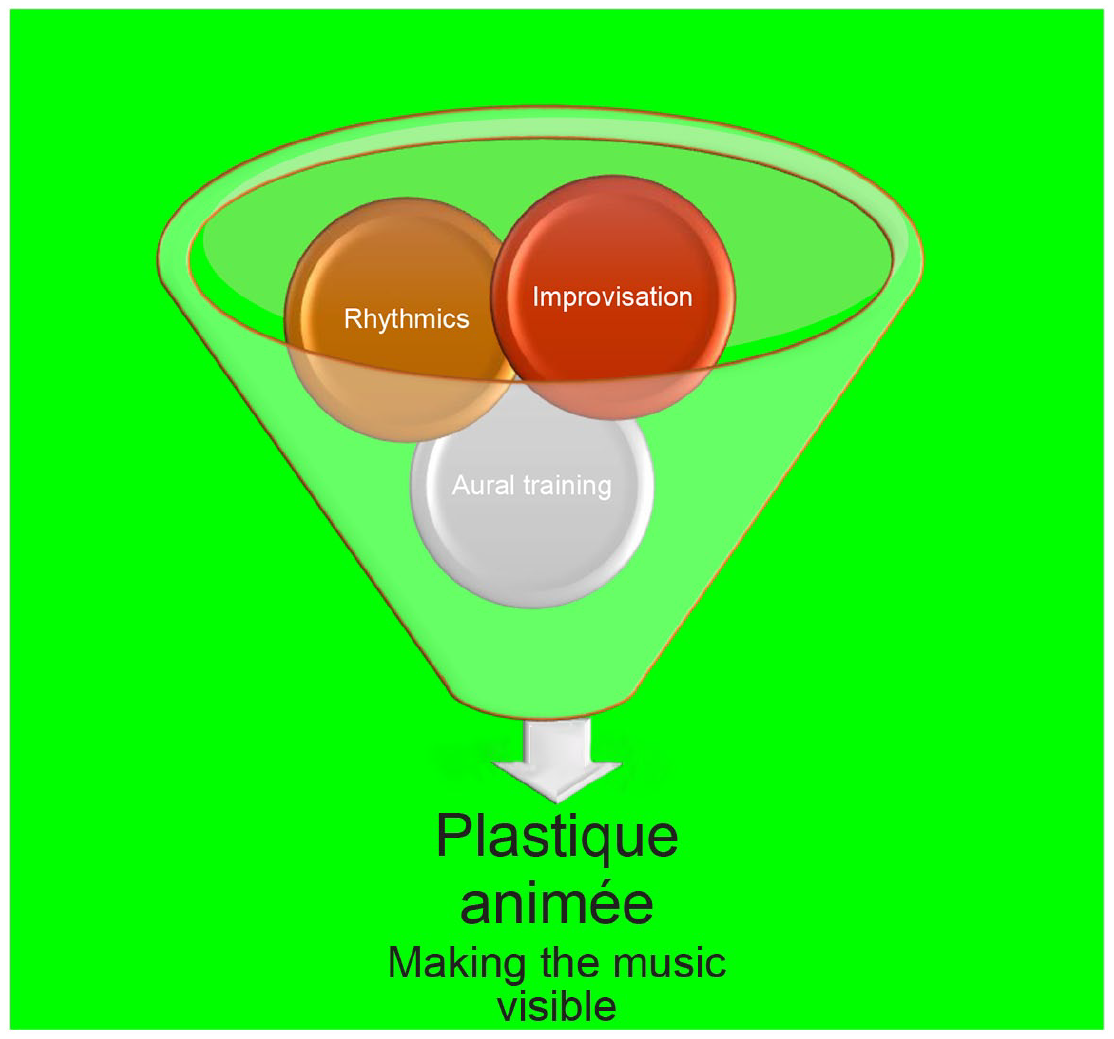
Primary components of Dalcroze Eurhythmics.
Plastique animée
Plastique animée is an interpretation and realisation of a piece of repertoire in movement and space (Jaques-Dalcroze, 1924). Its outcome is an embodied, deeper understanding of the music. It is seen as a living analysis in real time, where one can show everything they have learnt in Rhythmics, Solfège and Improvisation, making the music visible (Greenhead, 2009; Jaques-Dalcroze, 1921/1967). There are various ways to engage with plastique, creating ‘different relationships with the music, such as contrast or dialogue’ (Greenhead & Habron, 2015, p. 96). Learning repertoire through and in movement is an unparalleled way to study music, ‘to analyse it, to dig deeply into it, to find out how to express its meaning and intention’ (Bachmann, 1991, p. 80).
Method
Arts practice research
In order to discover whether DE could have an impact on my practice as a classically trained violinist, it was necessary to examine my own performance as the subject of my research enquiry. This raised issues concerning how I was taught and how I practiced as a student, and how I practice and perform now as a professional violinist. Arts practice research facilitates such interrogation, for as we reach deeply inside ourselves we can ‘discover aspects of our experience that are not yet verbalised, but rather known at a tacit level’ (Etherington, 2004, p. 123).
Arts practice research is predicated on the documentation and analysis of creative practice (Frayling, 1993/94), requiring a variety of documentary methods, all of which need to reflect the qualitative and subjective nature of the process of inquiry (Creswell, 2013; Denzin & Lincoln, 2018). I created a multi-disciplinary, mixed-mode empirical framework, combining explorations in my practice as a violinist, in conjunction with my experience of DE theory and practice, employing arts practice methods to develop and collect data. The arts practice and Dalcroze related literature helped me to develop a theoretical underpinning, which facilitated the process of fusing these strands together. This, in conjunction with my research methodologies, including autoethnography (Bartleet & Ellis, 2009; Daly, 2021) and other arts-based methods, (Leavy, 2009) enabled the creation of two performances and subsequent data analysis. This performative method of inquiry (Spry, 2011), permitted me to use bodily experience before analysis – as is the DE way, and to realise in physical movement the concepts of embodiment, presence and creativity while playing the violin (Daly, 2019). Embodiment in this context entails becoming more physically and emotionally connected to my instrument and to my music: being an integrated vessel of expressive communication. Practice theory, embodiment theory and performance studies supported the investigation and enabled me to underpin the research with solid theoretical structures (Melrose, 2006; Schechner, 1998; Sheets-Johnstone, 1981; Shusterman, 2000, 2008).
Two specifically devised performances became the main drivers of this research insights and findings.
Performance 1: Sonata for Solo Violin, No.2, Op. 27 by Ysaÿe
In preparation for the first performance, I took the primary components and underlying concepts of DE as starting points in an exploration of learning and memorising repertoire as a solo performer. It was solely devised in order to investigate the process of preparation and ensuing performance of the second Solo Sonata for violin, Opus 27 by Eugene-Auguste Ysaÿe (1858–1931), primarily learning this work through a Dalcroze lens. I designed a preparation schedule that focused on learning the full sonata through the body as the primary instrument, with the violin itself taking a less active role. For example, starting with a specific physical warm up at the beginning of every rehearsal, targeting an aspect of the music needing to be worked on. The rationale for this was to connect all the human faculties through music and movement, from the outset of each practice session. I also built in a 10-minute mindfulness body scan into my warm up routine, as I felt it was crucial to develop a mind-focusing practice and to learn to leave unhelpful thoughts outside the practice room door. Before playing any repertoire, I improvised freely around scale and chordal structures, often using my open strings as drones. I experimented with creating spontaneous soundscapes in the keys of the passages I needed to rehearse, as a way to embody various harmonic sound worlds. The purpose being to connect the vibrations of my violin to the vibrations of my body and to incorporate improvisation into my practice from the outset.
There are two other warm up exercises I did every day, based on developing increased sensitivity to muscular tension and release in my body. One was a very basic vibrato exercise, where I started with no vibrato at all and then changed speed, intensity and colour, observing the shifts in muscular tension. This exercise allowed me to incorporate work on ‘independence’ between the arms. I had noticed, particularly in the fourth movement, ‘Les Furies’, how it was essential to have tremendous energy and speed in my bow arm, but yet crucial to keep my left-hand fingers soft and relaxed for the double stops and three-part chords (Figure 2).
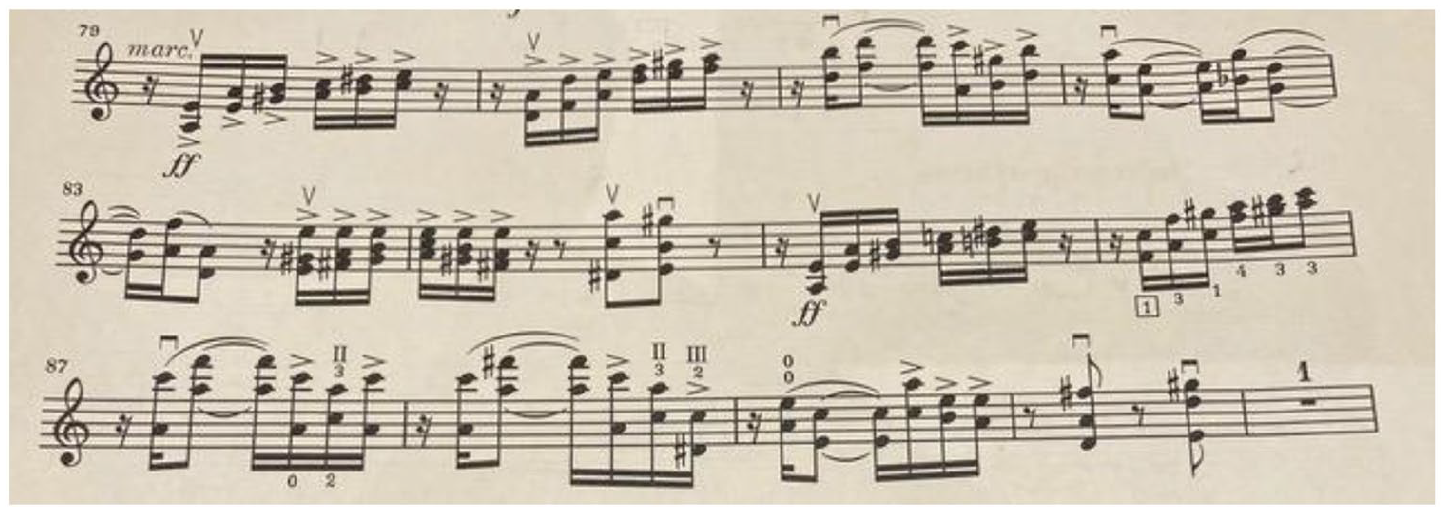
Bars 79 to 91 from the fourth movement, Les Furies.
I incorporated Dalcroze’s exercises on association and disassociation to explore these issues of independence between the hands, through use of the whole body in movement. For example, moving through space in a smooth, snakelike, legato way while the arms and fingers simultaneously created staccato, perhaps flicking paint gestures at the walls around me.
The second exercise centred around my bow arm, where I tend to hold a lot of tension. In order to develop greater body awareness I began every day by relaxing my bow arm weight fully into the string. The feeling of pulling the string, sensing the roughness of the horse hair, creates a ‘sizzling’ sound that is wonderful for bow arm sensitising, and also contributes to sound production and variety of colour. I would then explore the transition to just allowing the strings to vibrate naturally by holding my bow just at the endpin and exploring the natural resonance in the instrument, especially when I played as close as possible to the bridge. At this point in my practice, I felt that I was now warmed up; physically, mentally and emotionally.
For the main body of each practice session, I selected relevant exercises from DE classes in rhythmics, aural training and plastique animée that helped me to embody the music of Ysaÿe, resulting in a more creative approach to practicing. These elements were explored primarily away from the instrument, using self-movement and my body in space as a learning tool to explore the interpretation, characterisation, memorisation and communication of the Ysaÿe sonata. For instance, (a) expressing in body movement the tension and release of a specific harmonic progression (see Figure 3). As an example, in bar 31 the unexpected Ab major chord prompted me to create a backwards lunge gesture, while a sudden turn for the A major chord helped me to express the release in tension, going from bar 34 into bar 35.
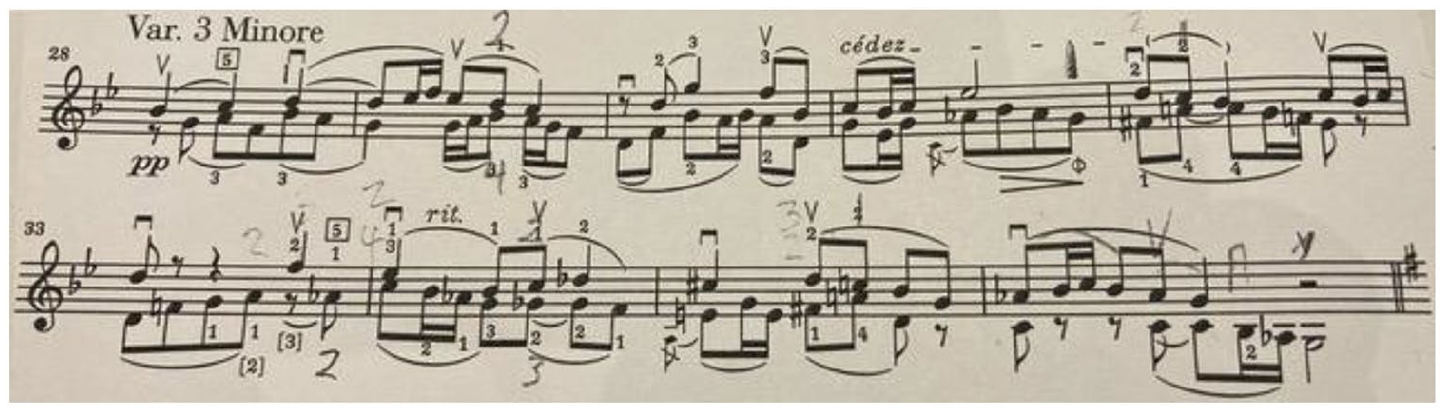
Bars 28 to 36 in the third movement ‘Danse des ombres’.
(b) Mapping the phrases out in movement in the physical space, with particular consideration to the elements of time, space and energy; (c) exploring gestural movements to express articulation and accent; (d) improvising on certain passages in different keys and styles; (e) stepping and singing 2 part lines to hear and feel how the parts were more fully integrated (see Figure 4).
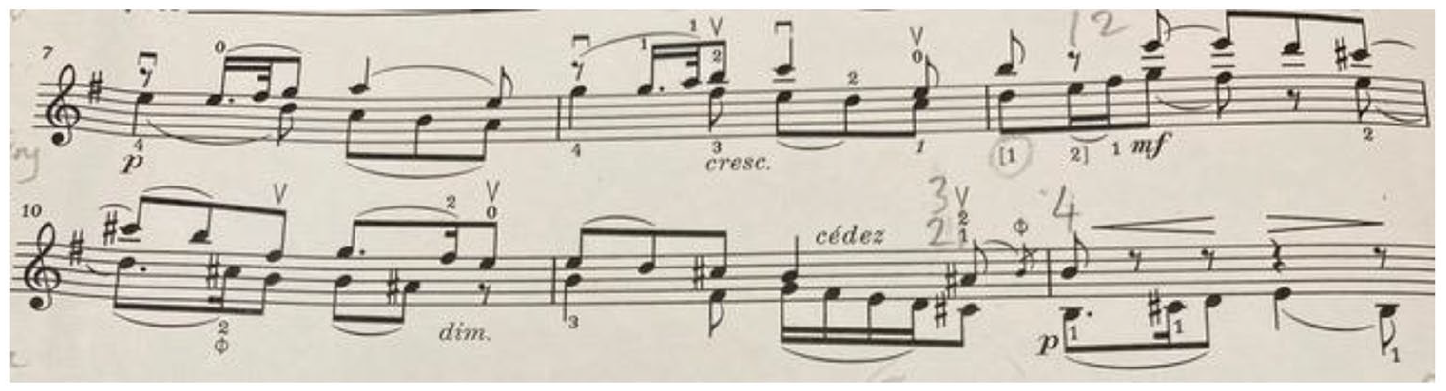
Bars 7 to 12 in the second movement ‘Malinconia’.
By applying this kinaesthetic approach to my practice routine I embraced Jaques-Dalcroze’s vision of a ‘special education seeking to order the nervous responses, to tune muscles and nerves, to harmonise mind and body’ (Jaques-Dalcroze, 1965, p. 6).
Performance 2: An original multi-disciplinary piece, Songs my mother taught me
The research inquiry of integrating my experience of DE to my violin practice led me in a very clear direction – I wished to create and connect: to my instrument, to my body and to my music (Carless & Douglas in Bartleet & Ellis, 2009). I subsequently devised a second performance that further explored the Dalcroze elements embedded into the first performance, in addition to placing a strong focus on improvisation and composition in both music and movement.
In deference to Jaques-Dalcroze’s collaborative work with the great pioneer of modern staging and lighting techniques, Adolphe Appia (Beacham, 1985; Lee, 2003), I chose to develop theatrical, visual and movement aspects in the creation of an original work, ‘Songs my mother taught me’. This movement theatre piece was underpinned by a sound collage that incorporated my own musical composition, selected historical music recordings and improvisation. The performance centred around the juxtaposition of audio clips concerning the regime of my practice experience as a child, with the liberation and freedom of movement and somatic improvisation. I use the term somatic in this paper as an understanding of playing the violin from a place deep inside my body, promoting a performance experience devoid of external focus.
The interrogative lens of autoethnography, with rigorous documentation and data capture formed an integral consistency as I sought to ‘express meanings that otherwise would be ineffable’ (Barone & Eisner, 2011, p. 1). As typified by autoethnography within arts practice research, the researcher was at the heart of the inquiry which centred around connection and separation: theory and practice, technique focus and music focus, mind and body, and audience and performer (Daly, 2021a). In pursuit of connection, I, the researcher, have therefore chosen to weave my self-narrative, my experience and my practice throughout this research (Barbour, 2011; Bochner, 2001).
Data collection and analysis
To elicit research data, all rehearsals and performances were documented. I engaged in rigorous journaling throughout the preparation and post-performance phases of both performances. All rehearsals were video recorded and watched back on a daily basis. In order to gain external perspectives I utilised the ethnographic research tools of interviews and focus groups (Kamberelis & Dimitriadis, 2011).
I interviewed a cross section of six professional musicians and three Dalcroze practitioners and asked them about aspects of my playing. The questions focused on areas concerning communication, practice techniques and ease of movement in the body while playing. These interviews took place regularly during the research, particularly during the preparation stages for each performance as I was discovering new ways of integrating DE into my practice.
I organised a focus group which took place immediately following the first performance (Chang, 2008). The participants, who represented a wide range of artistic disciplines, were invited to respond to their experiences as audience members. In view of the arts-based nature of my research journey, participants also presented me with pictures, drawings, poems and text (Clandinin & Connelly, 2000). The responses from the focus groups and audience members fed into my post-performance one journals and helped me in the devising of my second major performance.
Throughout the research, I engaged in systematic coding of my journals, interviews, recordings and other forms of data collection and adopted a colour coding technique in which I assigned different colours to different themes and different shapes to sub-themes. This allowed me to identify the emergent themes. In order to bring my data from a place of chronological order, I brought the same colours together which grouped my data thematically. Finally, I created tables of quotes and excerpts relevant to the themes, using mind mapping software (Inspiration version 9) to facilitate a better understanding of the relationships and connections between the ideas and concepts.
Findings
The findings from the data related specifically to the first performance, showed that learning Ysaÿe’s second solo violin sonata primarily away from the instrument, had an positive impact on many aspects of my practice and performance. These included performance anxiety, physical pain, memorisation, communication and engagement with the audience. Learning the music in a movement-based way meant that I was able to discover more quickly and deeply, a truer interpretation of the music once the instrument and its technical issues were removed. In doing so, I learnt to trust my body.
I had prepared specific focus group questions centred around audience experience of the performance, for example whether the use of lighting and physical movement assisted or detracted from the communication. The first question however asked was very general. ‘Can you describe how you felt at the end of the performance?’ The first response, coming from a contemporary dancer was ‘I have never been so moved by a classical music concert before, it was surprisingly creative’. This response initiated a discussion where the focus members examined why they were surprised to see my creative side on the classical music performing stage. They had not expected me to perform Ysaÿe’s violin sonata in a kinesthetic way, moving my whole body in and through the performing space. My desire was to make the music visible by showing the expressive qualities and inherent movement within the music as I played. In addition, the lighting projections and movement artist behind the screen intensified this multisensory experience that one participant described as ‘unbelievably powerful and engaging’.
The findings arose specifically around the second performance spotlighted the area of composition. I had never composed anything before, and this process of creating my own work from beginning to end was extremely gratifying and rewarding. The audience submitted feedback forms and out of 23 participants, 21 commented on how surprised they were that the piece was fully devised and performed by me. The words ‘creative’ appeared 19 times, ‘powerful’ six times and ‘engaging’ 17 times. My journals reflected how challenging and time consuming it was to compose my own soundscape, and how I struggled with the recording technology, but there was an underlining sense of pride throughout, that for the first time in my musical life, I was creating and performing my own work.
From this moment on, the themes of creativity and autonomy within the culture of Western classical music performance and training began to emerge throughout the research. Analysis of the data from the focus group discussion, journals and interviews revealed that my physical movement while playing, created a greater emotional connection to the violin, the music and the audience. One member of the focus group described this as ‘embodied presence’. This was the result of having devised DE ways to explore the music and fused these approaches into my practice and performance. In order to rehearse repertoire through the lens of rhythmics, plastique animée, aural and improvisation exercises, I had to learn to listen to and with my whole body. By bringing this embodied presence into the practice room and onto the performing stage, I could allow myself to be spontaneously creative at all times. This new found creative approach to practice allowed me to find answers for myself, thus promoting autonomy.
Both performances interestingly revealed similar themes even though they were totally contrasting in terms of style and execution. The first was an interpretation of an existing work by Ysaÿe and the second was an autoethnographic exploration through gesture and movement-based composition and improvisation. The application of DE in the preparation and performance of both was the primary commonality, revealing that DE can create transformation in relation to creativity and autonomy in the practice room and on the performing stage.
Discussion
Eurhythmics was created to address the lack of musicianship that Jaques-Dalcroze recognised in his pupils. I can see within my own professional development a microcosm of the same cause and effect. My performance musical education (violin and piano tuition) was dominated by intellectualism, theory, and rote learning of repertoire. I have spent many years trying to expand my musical self, with DE playing a key role in this, offering a means of exploring and improving my sense of musical movement, improvisation and rhythmic ability. DE aims ‘at deepening musical understanding and feeling, at intensifying musical listening and hearing, and at developing a student’s concentration, expression and bodily skills’ (Juntunen, 2002, p. 15). What this research has shown is that DE when applied to performance greatly enhances the performer’s embodied presence, both in the practice room and on stage. This in turn, fosters greater creativity and autonomy.
In my performing life, I am generally paid to perform whatever music is placed on the music stand in front of me. Rarely do I choose what is to be played or who to play with. As a young child I was told when and what to practice. As a student I was told what and how to play. This led to a reliance on external feedback. As an adult, my role in the Irish Chamber Orchestra generally revolves around blending my sound with the musicians beside me, breathing at the same time as others, playing in the same part of the bow as others, matching fingerings, vibrato, colours and even when I am leading the orchestra, I have to fulfil the conductor’s musical vision and interpretation. Thus, the autonomy and creativity I experience is very limited, building a lack of confidence in my own ability to be my own artist. This research journey was initiated from a sense of curiosity as to what could happen if I rigorously applied a Dalcroze approach to my violin playing. Having done this, I can now affirm that I experience much greater creativity and autonomy in my practice and performance.
In my first performance, I investigated if it was possible and/or effective to show elements of living analysis while playing at the same time, which I called Creative Embodied String Performance. Engagement with plastique animée throughout this research investigation enabled me to ‘break down the oppositions which paralyse the free development of one’s powers of imagination and creation’ (Jaques-Dalcroze, 1924, p. 30). I prepared the third movement of the Ysaÿe sonata fully as a plastique animée, finding ways to go deeper into the music every day by exploring the piece in full body movement, away from the instrument. Contrary to my own conservatoire training, the focus was on process and the kinaesthetic experience of musical concepts, and not placed on the final performance (Frego, 2009). Every rehearsal began like this and without fail, whenever I played it immediately afterwards, I felt my articulation, characters, phrasing and interpretation grow more convincing. I could feel that this way of learning the music was facilitating an increased analytical and holistic awareness.
A violinist must be extremely aware of every movement of her fingers, as well as the sound entering her ears and of the total form of the piece she is playing, both analytically, note by note and holistically, in terms of its overall design (Csikszentmihalyi, 1990, p. 64).
This path to embodying the composer’s wishes in preparation for the first performance, clarified my communicative gestures so intensely that I ended up showing elements of how the music moved, moving in the space, whilst also playing the instrument. The post-performance one focus group participants, were particularly struck by how this multi-sensory experience affected the audience. The data analysis strongly referred to ‘a visual, aural and kinaesthetic experience which transformed the performance space’. The University of Limerick where I teach has since introduced Creative Embodied String Performance as a module on their Masters programme in Classical String Performance.
In the second performance I choose to investigate further the theme of creativity that had emerged during the first performance. I was determined to create my own work, from start to finish, not interpreting someone else’s creation, therefore unlike anything I had ever done before (Daly, 2021). I felt the time had come to express what I really wanted to say as a musician, culminating in a one-woman multidisciplinary theatre performance, using movement and music.
In 1921, Jaques-Dalcroze described how his work could liberate students who felt repressed and restricted in their music making (p. 239) and Moore (1992) articulated how musicians often feel bound by the strict formal traditions in our culture (p. 79). Students are rarely given a choice as to what repertoire they wish to study and often string players are forced to use the same fingerings and bowings as their teachers. Such aspects of ‘cloning’ are prevalent in many conservatoires and both the work of Jaques-Dalcroze and this research has highlighted how important it is to embed autonomy into instrumental classical music education and to avoid acting by rules alone (Vanderspar, 1992). In my teaching I also feel I have to fight for autonomy against a system that often cares more about exam results and competitions, rather than fostering a sense of self confidence and creativity in students (Kanellopoulos, 2012).
DE is an experiential education where students are encouraged to become their own teachers (Carver, 1996; Dewey, 1934/2005; Southcott, 2007), but in my experience, this characteristic is rare in one on one Western classical music instrumental lessons (Gaunt, 2010). Jaques-Dalcroze wrote passionately about how ‘aesthetics should be born of ethics’, equating this form of teaching to the mechanical handwriting of a copyist, in comparison to the writer who can follow his own inspiration (Jaques-Dalcroze, 1921/1967, p. 239). This tendency towards cloning in instrumental teaching is reinforced by a lack of person centredness, which promotes a disconnect between students’ faculties and hinders the blossoming of creativity (Greenhead, 2017).
Jaques-Dalcroze wished to release his students’ musical abilities ‘enabling them to turn technique into a way of externalising and fulfilling themselves. . .instead of devoting it obsequiously to the pursuit of second-hand thoughts and feelings’ (Jaques-Dalcroze, 1909/1917, p. 65). The engagement with DE throughout this investigation enabled this release, allowing elements of creativity and autonomy to find their rightful place (Leavy, 2009; McPhail, 2013) in the teaching and performance of Western Classical music. The application of DE to every aspect of my practice has freed me from traditional formal performance constraints, opening wide the doors of improvisation, rhythmical liberation, inner hearing, expressive musical movement and allowed me to tap into the source of my own musicality (Farber & Parker, 1987).
The research interrogation up to and following the first performance yielded many insights, particularly in the realms of autonomy and creativity, but nothing could have prepared me for the transformative impact that completely devising my own work from inception to delivery had on my practice as a Dalcroze influenced violinist. I recall the words of Juntunen and Hyvönen (2004), where they claim that even accomplished musicians can attain a richer or transformed musical understanding by engaging with DE.
This simultaneously fed into my teaching, as I recognised the importance of encouraging students to learn repertoire through plastique animée. They quickly observed how the process greatly aided their memorisation skills, prevented performance anxiety and enhanced their clarity of interpretation. Most importantly, it encouraged my students to learn how to ask the right questions. How does the music move? How does this chord make me feel and how can I convincingly convey that feeling? Where is the focal point of this phrase? Why did the composer perhaps add that detail? Where in my body do I feel this? What part of my body can help me to communicate the melodic line? How can I fill this performance space even while playing pianissimo? The application of this Dalcrozian Socratic teaching style in the teaching and practice room, fosters autonomy in our music students, awarding them the space to self-discover by asking their own questions and finding their own solutions.
Conclusion
The engagement with DE throughout this investigation has highlighted the importance of learning to ‘trust bodily knowledge as part of our inner guidance’ (Palmer, 2004, p. 106). This new-found trust in my body cultivated the freedom to make my own artistic choices and decisions. It unleashed a stronger sense of self confidence and self-esteem and I have learnt to believe in my ability to make autonomous artistic judgements. By the end of the process, I felt I had become a more creative, autonomous performer and artist. In the teaching room, I had now a very valuable resource: the realisation that my students did not need me in the way I had previously and naïvely believed. Of course they needed guidance with specific technical and/or musical issues, but once they were encouraged to bring everything back to the body, they were empowered to solve the majority of issues by themselves. In an instrumental lesson where elements of rhythmics, aural training, improvisation and plastique animée are embedded, students can solve their own problems, whether they concern intonation, rhythm, sound production or interpretation. They learn to trust in their own musical bodies, rather than relying on external input, therefore developing their own sense of creativity and autonomy. By using these techniques and offering our students the opportunities to create and think artistically for themselves, we are instilling the belief that everything they need is already inside them. They therefore become not good students, but creative artists.
Footnotes
Declaration of conflicting interests
The author declared no potential conflicts of interest with respect to the research, authorship, and/or publication of this article.
Funding
The author disclosed receipt of the following financial support for the research, authorship, and/or publication of this article: The Author received a Government of Ireland Postgraduate Scholarship awarded by the Irish Research Council.
