




Abstract

The global mental health crisis demands innovative therapeutic approaches. In India, where psychiatric disorders contribute significantly to disease burden yet remain undertreated, the need for novel interventions is particularly acute. Psilocybin, a naturally occurring psychedelic compound found in particular mushroom species, has emerged as one of the most promising candidates for treating conditions refractory to conventional therapies, including treatment-resistant depression, post-traumatic stress disorder, and substance use disorders. 1
International clinical trials have demonstrated remarkable efficacy for psilocybin-assisted therapy. In treatment-resistant depression, psilocybin therapy has shown response rates of 67% compared to 17% with conventional antidepressants. 1 Research indicates that psilocybin’s therapeutic mechanisms extend beyond traditional neurotransmitter modulation, with systematic reviews demonstrating significant antidepressant effects persisting for weeks to months after brief treatment courses.2,3 However, the high cost of synthetic psilocybin manufacturing poses significant barriers to accessibility in resource-limited settings. 4
What distinguishes India’s current position is a unique convergence of legal, cultural, and scientific factors that could enable research approaches unavailable elsewhere. The Narcotic Drugs and Psychotropic Substances (NDPS) Act, 1985, classifies psilocybin and psilocin as controlled substances. Section 8 has permitted licensed medical and scientific use of all controlled substances since its inception, enabling clinical use of morphine, methadone, and benzodiazepines. However, operationalizing this for psilocybin mushroom research has faced practical barriers. However, a decade of judicial interpretation has progressively clarified the relationship between intact biological organisms and their psychoactive constituents. The Karnataka High Court’s ruling in Saeidi Mozdheh Ehsan (2013) established that prosecution requires precise quantification of psilocybin content, not merely species identification. This precedent was reinforced by the Madras High Court in S. Mohan (2022) and Salomon et al. (2024). 5
Most significantly, Rahul Rai v. State of Kerala (2025) explicitly distinguished between mushrooms as biological organisms and their psychoactive compounds, stipulating that only the actual psilocybin content by weight determines regulatory status under the NDPS Act. These substance-specific rulings create a distinctive regulatory pathway for psilocybin-containing mushrooms that does not currently exist for most other NDPS-scheduled substances, distinguishing intact organisms from their quantified psychoactive content.
While these judicial precedents provide crucial clarity on evidentiary standards, it is essential to emphasize that they do not exempt mushrooms from NDPS control or permit unlicensed possession. Instead, they establish procedural rigor for prosecution, a distinction that parallels existing regulatory frameworks for other natural psychoactive products. Similarly, cannabis, which is controlled as whole plant preparations (ganja), resin extracts (charas), and isolated compounds under Section 2(iii), psilocybin mushrooms remain scheduled controlled substances requiring explicit licensing for any research or medical use.
This jurisprudence provides a potential framework for controlled research involving whole organisms containing subthreshold quantities of regulated compounds, an approach that may position India uniquely among global jurisdictions. This manuscript examines how this distinctive legal interpretation, combined with India’s mycological biodiversity and pressing mental health needs, creates unprecedented opportunities for pioneering whole-mushroom psychedelic research that could address fundamental questions about accessibility and therapeutic equivalence.
Discussion
The Case for Whole-mushroom Research
The “entourage effect,” well-documented in cannabis research, remains a hypothesis requiring validation in psilocybin mushrooms. Whether the complex interplay among multiple bioactive compounds (including psilocybin, psilocin, baeocystin, norbaeocystin, aeruginascin, and various alkaloids) produces synergistic effects distinct from those of isolated psilocybin remains a critical empirical question that reflects broader scientific uncertainty. 6
This uncertainty, however, is precisely where India’s distinctive position emerges from a convergence of factors not present in most other jurisdictions. While Western research remains constrained by regulatory restrictions on synthetic psilocybin, India’s evolving judicial clarity, particularly regarding quantification requirements under the NDPS Act, opens a legally defensible pathway to investigate whole-mushroom preparations. This framework, combined with the country’s exceptional mycological biodiversity, provides a natural laboratory to examine whether whole mushrooms confer therapeutic advantages through potential entourage effects, an evidence gap that remains globally unaddressed. If such preparations prove therapeutically equivalent or superior, cultivation-based approaches could democratize access where synthetic manufacturing costs remain prohibitive.
Although several regulatory and ethical principles outlined in this article apply to other narcotic and psychotropic substances controlled under the NDPS Act, psilocybin mushrooms occupy a uniquely situated nexus of factors. Recent Indian judicial decisions have addressed psilocybin-containing mushrooms specifically, distinguishing intact organisms from their quantified psychoactive content and thereby defining a more straightforward pathway for whole-mushroom research than presently exists for most other scheduled substances. Coupled with India’s rich psilocybin-containing mycoflora and the growing evidence base for psilocybin-assisted therapy, this substance-specific constellation justifies the focused scope of the present analysis.
Recent methodological advances have addressed the primary challenge in whole-mushroom research: Standardizing dosing. Goff and colleagues developed chocolate-based delivery systems that meet regulatory dosing requirements while maintaining a stable psilocybin content across batches.7,8 This breakthrough demonstrates that natural product variability can be systematically managed through rigorous protocol development, opening new avenues for standardized psychedelic research.
The potential advantages of whole-mushroom preparations include substantially lower production costs than synthetic manufacturing, compatibility with local cultivation, which reduces import dependencies, and alignment with traditional knowledge systems, which may facilitate cultural acceptance. These factors could dramatically improve accessibility, particularly for underserved populations.
Cultural and Historical Context
The exploration of psilocybin mushrooms in India exists within a rich historical continuum rather than representing an entirely novel concept. The Vedic substance “Soma” has been hypothesized by Wasson and colleagues as potentially psychoactive mushrooms, though this interpretation remains debated; alternative plant candidates are described in Atharva Veda texts. Ethnomycological scholarship, including a recently published comprehensive review that documents ritualistic psychoactive mushroom use across diverse Indian cultural and regional contexts. 9
This cultural precedent may facilitate research acceptance and provide insights into traditional preparation methods that could inform contemporary therapeutic protocols. The integration of traditional knowledge with modern neuroscience represents a uniquely Indian contribution to global psychedelic research.
Implementation Pathway and Coalition Building
Successful research advancement requires strategic engagement across multiple stakeholder groups. International models demonstrate the importance of coalition building among researchers, clinicians, patient advocates, and policymakers. In the United States, researchers secured state-level funding by building coalitions with military veterans, first responders, and mental health professionals’ groups with compelling interests in novel trauma treatments. 8
Arizona allocated $2.75 million for whole-mushroom psilocybin research, while Michigan designated $13 million for related psychedelic studies. These initiatives succeeded by emphasizing medical necessity rather than drug policy reform, creating support that transcended ideological divisions. 8
Similar approaches could prove effective in India, where mental health advocacy organizations, traditional medicine practitioners, academic institutions, and patient support groups might collaborate to advance responsible research.
Within this coalition framework, however, the foundational requirement remains unchanged: All research requires explicit Central Drugs Standard Control Organization (CDSCO) approval and NDPS licensing under Sections 8, 9, and 10. Crucially, India’s established CDSCO pathway, already successfully implemented for cannabis research and opium cultivation, provides institutional infrastructure and procedural precedent that many jurisdictions lack. This existing regulatory framework, rather than presenting an obstacle, creates the institutional capacity and regulatory predictability necessary for the advancement of systematic psilocybin research.
Ethical Framework
Research involving psilocybin demands substantial adaptation of standard ethical protocols. 10 The compound’s profound consciousness-altering effects raise unique considerations regarding participant capacity, consent procedures, and therapeutic relationship dynamics.
Informed consent must comprehensively address psilocybin’s psychoactive effects, potential risks including adverse psychological reactions and precipitation of latent psychiatric conditions, participants’ absolute right to withdraw consent, and confidentiality protections under Indian privacy laws. 11 The unique therapist-participant dynamic in psychedelic-assisted therapy necessitates clear protocols and specialized training aligned with professional codes of conduct established by Indian medical councils. 12
Research Priorities and Future Directions
A systematic research agenda should proceed through clearly defined phases. Foundational research must include comprehensive mycological surveys that identify and characterize psilocybin-containing species across India’s ecological regions; the development of standardized methodologies for quantifying psilocybin and related alkaloids; the establishment of protocols to differentiate psychoactive species from toxic look-alikes; and preclinical safety studies that evaluate toxicity profiles and drug interactions.7,9
If foundational work proves promising, well-designed clinical trials adhering to international best practices should investigate safety, efficacy, and optimal dosing of intact mushroom preparations for psychiatric conditions prevalent in India, with potential comparative studies evaluating therapeutic equivalence or differential effects between whole mushrooms and synthetic psilocybin.10,13
Research should also explore optimal therapeutic settings, preparation, and integration protocols adapted to Indian cultural contexts, and training approaches for mental health professionals in psychedelic-assisted therapy techniques suitable for diverse populations.
India’s Position in the Global Context
Having examined the domestic landscape for psilocybin research, it is instructive to situate India’s legal framework within the international regulatory environment. The global legal landscape for psychedelics, shaped by the 1971 UN Convention on Psychotropic Substances, has historically imposed nearly universal prohibition. However, in recent years, national approaches have diverged, ranging from complete legalization to decriminalization to highly controlled therapeutic pathways.14,15
As of 2025, various jurisdictions have adopted distinct regulatory models: Some countries, such as Jamaica, Brazil, and the Bahamas, have never prohibited psilocybin mushrooms or permitted them under specific conditions; Portugal and the Czech Republic have decriminalized personal possession; Australia and several US states have created regulated therapeutic access programs; while Switzerland and Canada allow compassionate use under special authorization. Table 1 presents a comparative analysis highlighting these diverse approaches and India’s distinctive legal interpretation.14–20
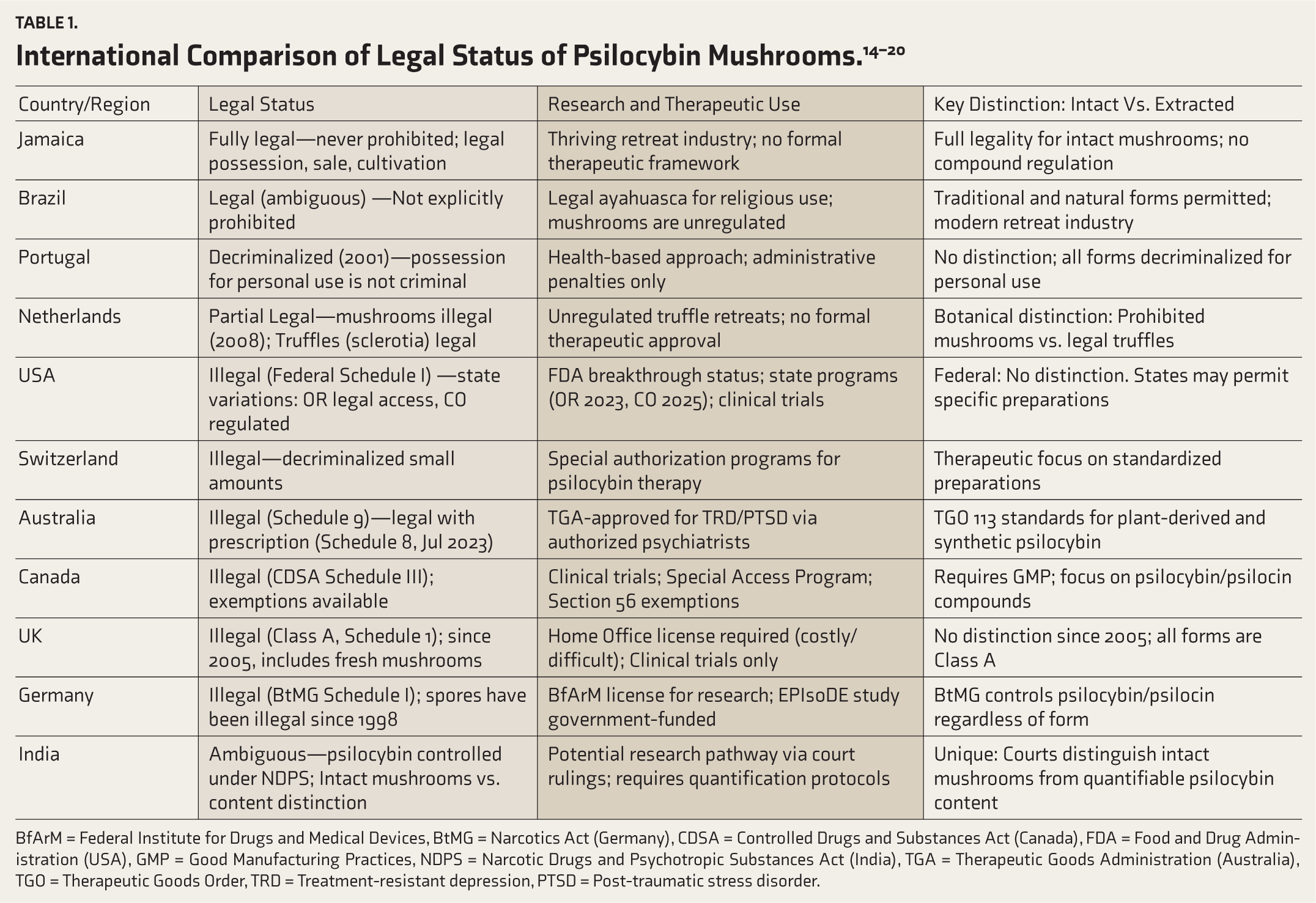
BfArM = Federal Institute for Drugs and Medical Devices, BtMG = Narcotics Act (Germany), CDSA = Controlled Drugs and Substances Act (Canada), FDA = Food and Drug Administration (USA), GMP = Good Manufacturing Practices, NDPS = Narcotic Drugs and Psychotropic Substances Act (India), TGA = Therapeutic Goods Administration (Australia), TGO = Therapeutic Goods Order, TRD = Treatment-resistant depression, PTSD = Post-traumatic stress disorder.
This comparative analysis reveals three broad regulatory categories globally. First, a small number of countries, Jamaica, Brazil, Nepal, and the Bahamas, maintain full or de facto legality for psilocybin mushrooms, often reflecting the absence of explicit prohibition or recognition of traditional or religious use. 15 These jurisdictions have developed thriving wellness retreat industries but generally lack formal therapeutic frameworks or research infrastructure.
Second, several jurisdictions have adopted harm-reduction approaches through decriminalization (Portugal, Czech Republic) or special therapeutic access programs (Australia, Switzerland, parts of the United States, and Canada). These pathways typically emphasize synthetic psilocybin or highly standardized extracts to ensure dosing precision, pharmaceutical-grade quality control, and regulatory compliance. Even progressive therapeutic programs focus overwhelmingly on isolated compounds rather than intact organisms.
Third, the majority of countries maintain strict prohibitions under international treaty obligations, with research requiring extensive licensing (e.g., in the UK and Germany) or remaining effectively prohibited. These jurisdictions make no legal distinction between intact mushrooms and extracted compounds; any detectable presence of psilocybin constitutes a violation.
India’s legal framework appears to occupy a unique fourth category. While psilocybin and psilocin remain controlled substances under the NDPS Act, recent judicial interpretations have distinguished between intact biological organisms and their quantifiable psychoactive content. This jurisprudence-based approach differs fundamentally from the Netherlands’ botanical distinction (mushrooms vs. truffles), which arose from morphological classification rather than chemical quantification.
India’s decades of regulatory experience managing cannabis controlled as whole plant preparations (ganja), resin extracts (charas), and isolated compounds under NDPS Section 2(iii) demonstrates proven institutional capacity to oversee natural psychoactive products. This precedent reduces implementation barriers for psilocybin research, as existing regulatory frameworks for quantifying variable natural products, managing cultivation licenses, and ensuring chain-of-custody can be adapted from established cannabis protocols.
The convergence of this distinctive legal interpretation with India’s exceptional mycological biodiversity, compelling cultural precedent, and pressing mental health needs positions the nation uniquely among global jurisdictions. While countries such as Jamaica offer unrestricted access but limited research infrastructure, and nations such as Australia provide controlled therapeutic access to synthetic compounds, India may be positioned to pioneer rigorous scientific investigation of whole natural products, addressing fundamental questions about entourage effects, accessibility, and therapeutic equivalence that remain unanswered globally.
Conclusion
To ensure clarity and prevent misinterpretation of the preceding discussion, judicial interpretations have refined evidentiary procedures for prosecutions, but do not create exemptions from NDPS control. All research involving psilocybin must operate under explicit CDSCO approval and NDPS authorization. Within this regulatory framework, however, recent judicial clarifications of evidentiary standards combined with India’s mycological biodiversity and pressing mental health needs have created a distinctive legal environment that may permit pioneering research approaches.
Realizing this potential requires addressing substantial scientific, safety, and ethical challenges through systematic, rigorous research approaches. Success will depend on building strong coalitions among researchers, clinicians, patient advocates, and policymakers, securing adequate funding for comprehensive studies, and demonstrating therapeutic benefits that justify the regulatory and ethical considerations involved.
The path forward demands cautious optimism grounded in scientific rigor and cultural sensitivity. By developing protocols that maintain strict compliance with the NDPS Act while advancing understanding of psilocybin’s therapeutic potential, India could revolutionize both domestic mental healthcare and global approaches to accessible psychedelic therapeutics. This opportunity merits serious consideration from the psychiatric community, regulatory authorities, and research institutions as we collectively address the mental health challenges facing our nation and the world.
Footnotes
Acknowledgements
We acknowledge all contributors to this work.
Data Sharing Statements
Data sharing does not apply to this article as no datasets were generated or analyzed.
Declaration of Conflicting Interests
The authors declared no potential conflicts of interest with respect to the research, authorship, and/or publication of this article.
Declaration Regarding the Use of Generative AI
No part of this article was written or generated by a generative AI tool. The authors take full responsibility for the accuracy, integrity, and originality of the published article.
Ethics Committee Details
NA.
Funding
The authors received no financial support for the research, authorship, and/or publication of this article.
Informed Consent/Assent
Not applicable.
Prior Presentations
Nil.
Registration
Not applicable (viewpoint article).
Simultaneous Submission to Another Journal or Resource
NA.