




Abstract
Medical students’ mental health distress and their limited engagement in psychiatry—both in clinical and research contexts—remain pressing concerns globally and in India. 1 Literature suggests that sustained exposure to psychiatry through academic interactions, mentorship, and research can enhance understanding, reduce stigma, and foster interest in the field of psychiatry.2,3 Informal academic activities, such as journal clubs (JCs), mentor-mentee programs, and enrichment initiatives, have been utilized by educators to bridge these gaps and provide safe spaces for dialogue. 4
In response, we implemented a combined initiative to address these needs through: (a) Regular mental health talks, (b) fostering a research environment that supports student-led, faculty-mentored projects, including psychiatry research, and (c) a structured Undergraduate Research Forum (UGRF) with psychiatry faculty actively involved.
Discussion
“Mental Health Conversations” are student-led sessions where faculty members from the institute or guest faculty are interviewed by a faculty member from psychiatry or pharmacology (also co-authors of this paper), due to former’s popularity among students, approachability, and active involvement in student affairs. Discussions often focus on the invited faculty’s undergraduate experiences, such as managing workload, relationships, regrets, and experimentation with substances. These conversations demonstrate that the challenges students face are common, helping to normalize undergraduates’ concerns and making faculty members more relatable and approachable. Such discussions sensitize students and promote help-seeking, which students might otherwise hesitate to use. The conversations also help students reflect on academic careers, role models, and the balance between aspirations and professional demands. Guest speakers have enriched the series; notably, Dr. Vikram Patel, 5 contributed an international perspective on global mental health. Attendance has steadily grown from about 10 initially to around 25 participants. An informal thematic analysis of students’ feedback suggests that such interactions humanize faculty, reduce mental health stigma, and foster a sense of belonging, findings consistent with the existing literature. 6 Integrating similar conversations into routine formal teaching sessions may improve reach, though our initiative demonstrates the value of voluntary, small-group, student-driven platforms.
The Undergraduate Research Forum (UGRF), launched in April 2023, serves as the research arm of the initiative. Faculty in psychiatry (the corresponding author), along with colleagues from basic (also the co-authors) and clinical sciences, ensure that psychiatric perspectives remain visible on the core committee. Early sessions reflected this integration—the inaugural workshop, led by a psychiatrist, addressed assessing research quality, while the first student-led JC focused on substance use disorder.
The UGRF builds methodological skills and encourages collaboration through student-led, faculty-moderated JCs and structured workshops. Initially a 10-session series, research methodology training has since been embedded into monthly programming. The forum also organized a national undergraduate academic festival (“Genesis”), featuring workshops on mental status examination, cognitive assessment, and personality evaluation—areas often overlooked in the undergraduate curriculum despite their clinical importance. Such sessions provide non-intimidating exposure to psychiatry, sparking curiosity and promoting engagement with the subject. Globally, mental health-related research led by medical students has been shown to reduce stigma while enhancing confidence and networks. 7
This supportive environment has produced measurable outcomes. Intramural research grants awarded to Bachelor of Medicine, Bachelor of Surgery (MBBS) students rose from 6 in 2022 to 25 in 2024. Applications for the Indian Council of Medical Research (ICMR) Short-Term Studentship (STS) increased sharply to 85 in 2024–25, with many projects focusing on mental health, including liaison psychiatry, substance abuse, and the pharmacogenetics of antipsychotic drugs, among others. 8 Students have also presented psychiatry-related work at national and international conferences, published articles, and secured awards.
The novelty of our model lies in combining mental health promotion with structured research training, two domains often addressed separately. International examples, such as the Nottingham Welfare Hub (United Kingdom) or integrated wellness curricula in the United States, have underscore the importance of wellness programming but typically lacked direct research pathways. 9 Our approach unites both domains in a co-governed structure, equipping students with psychological support and research engagement. This is particularly valuable in hierarchical educational environments, where students may hesitate to disclose their mental health concerns or approach faculty for mentorship. Integrating psychiatry into both well-being and academic spaces increases its visibility, a subject otherwise marginalized in the medical undergraduate curriculum.
Beyond the UGRF, the department of psychiatry of our institute has pioneered an “early exposure psychiatry enrichment program.” The program offers motivated students early clinical exposure, research mentorship, and innovative learning methods in psychiatry. Two editions have been completed, involving 31 fourth-semester (second-year) MBBS students. Although outside the UGRF’s scope, the program has contributed to a more informed campus culture, reducing stigma and fostering empathy toward patients and peers. 10
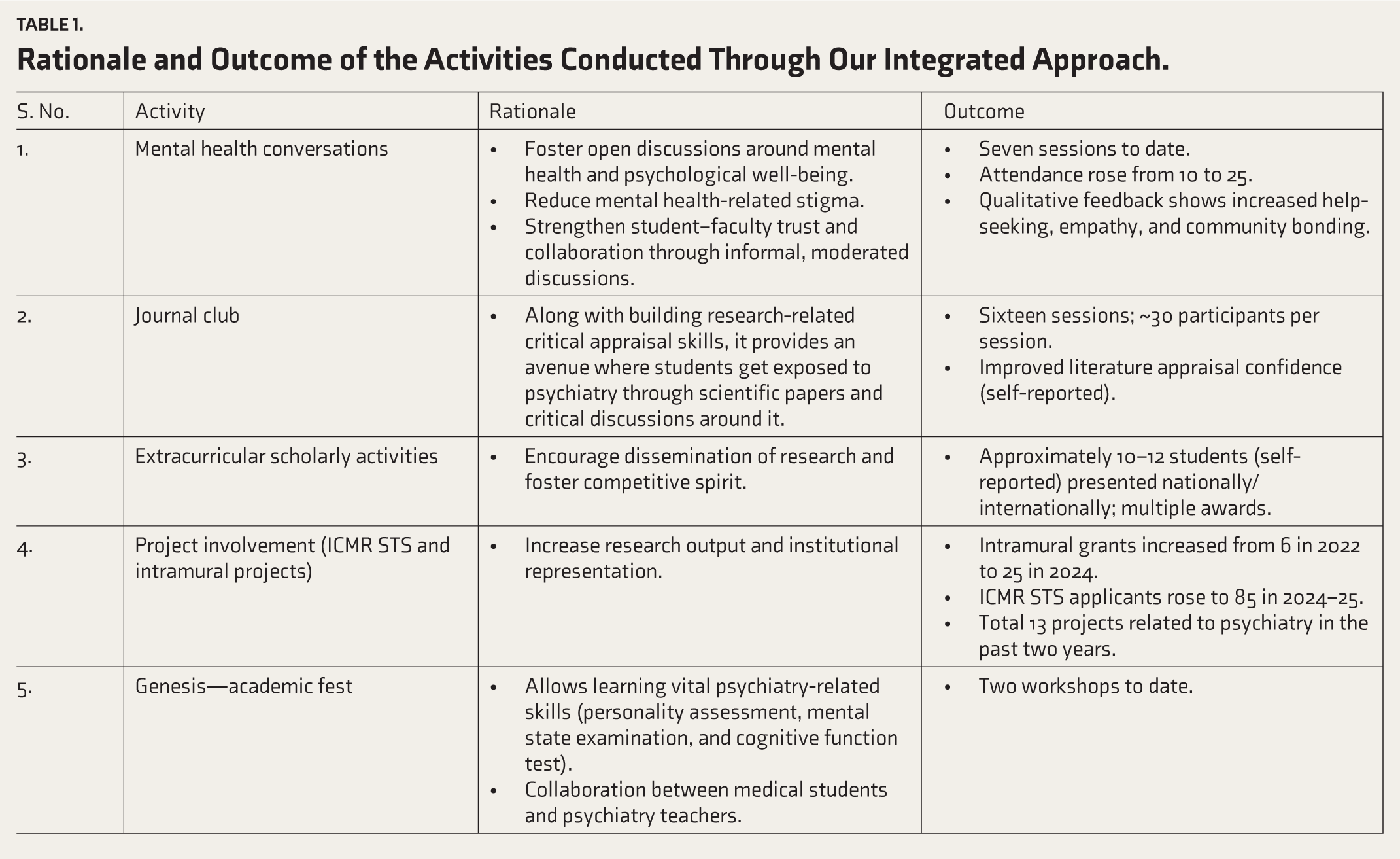
A concise overview of our activities, their rationale, and outcomes is presented in Table 1.
Rationale and Outcome of the Activities Conducted Through Our Integrated Approach.
Conclusions
This co-designed model seems promising in promoting openness around mental health while enhancing research participation and engagement between students and psychiatrists. Its low-cost, integrability, scalability, and adaptability make it a feasible framework for medical colleges across India.
Our experience can inform medical institutions and students to adopt integrated approaches that bring together mental health promotional and research activities, as synergistic, rather than parallel, pillars of medical education, including psychiatry.
Supplemental Material
Supplemental material for this article is available online.
Footnotes
Acknowledgements
We would like to extend our gratitude to Tithi Shah, Divyansh Sharma, Sreekari Palakodeti Adityaraj Patidar, Aditya Khatri, Debprosit Karmakar (medical undergraduates at AIIMS Bhopal), and Dr. Garima Goel (Professor of Pathology and member of UGRF, AIIMS Bhopal) for their support and role in the various UGRF activities.
Appropriate Permissions from the Concerned Authorities
Not Applicable.
Data Sharing Statements
Not Applicable.
Declaration of Conflicting Interests
The authors declared no potential conflicts of interest with respect to the research, authorship, and/or publication of this article.
Declaration Regarding the Use of Generative AI
None used.
Ethics Committee Details
Not Applicable.
Funding
The authors received no financial support for the research, authorship, and/or publication of this article.
Informed Consent/Assent
Not Applicable.
Name of the Institutional Ethics Committee/Independent Review Board
Approval Ref. No: NA Date: NA
Registration
Not Applicable.
Trial registry name: NA URL:NA Registration number: NA
Simultaneous Submission to Another Journal or Resource
No.
Source of Funding
None.
Status of Your Study (for Study Protocol)
NA.
References
Supplementary Material
Please find the following supplemental material available below.
For Open Access articles published under a Creative Commons License, all supplemental material carries the same license as the article it is associated with.
For non-Open Access articles published, all supplemental material carries a non-exclusive license, and permission requests for re-use of supplemental material or any part of supplemental material shall be sent directly to the copyright owner as specified in the copyright notice associated with the article.
