



Abstract
Aggression is a way of releasing and showing emotions. It is a disorganizing emotional response that is rooted in anger. Aggressive behavior develops in stages throughout life: immediate, actual aggression is more common among children; the second stage, which is during primary school, is explicitly immediate verbal animosity; and finally, the overall aggression, which, step by step, manifests during adolescence. Studies have shown that levels of aggression are highest between the ages of eleven to fifteen as they face a lot of changes (physical, mental, and emotional) from phase of childhood to phase of adolescence. 1
Adolescents can be helped and guided to learn techniques for managing and controlling their violent behavior. They need to use peace education methods and approaches and interact peacefully with other members of their peer group or family.
According to UNICEF’s definition, peace education is “the promotion of knowledge, skills, attitudes and values” to create behavioral change in children, young people, and grown-ups to prevent overt as well as structural conflict and violence. 2 Reardon has analyzed more than a hundred peace lessons and curriculum guides currently in use in the USA from kindergarten through high school. Reardon believes that there are as yet no clear and precise limits to, nor any standards for, what is to be included in peace education. 3
It is very important from the educators’ point of view to set a practical curriculum for schools that could be practiced throughout the world, helping adolescents control their aggression. 4
The modules and the lessons need to address the most common issues among adolescents that are leading to conflicts. For example, adolescents have less patience and tolerance toward differences in society, which may lead to conflicts and violence among them and other members of society. Adolescents can learn to overcome these differences by conflict resolution techniques and peer mediation approaches. 5
We investigated how peace education affects adolescents’ ability to control their aggressive behavior and decreases their level of aggression.
Peace Education Module
The lessons of this module have been designed based on research done on adolescents between the ages of 12 and 14. These lessons are taught in a classroom setup, followed by the activities related to each lesson. The activities were such as role play, drama, songs, drawings, and field visits. 6
Effectiveness of Peace Education Module
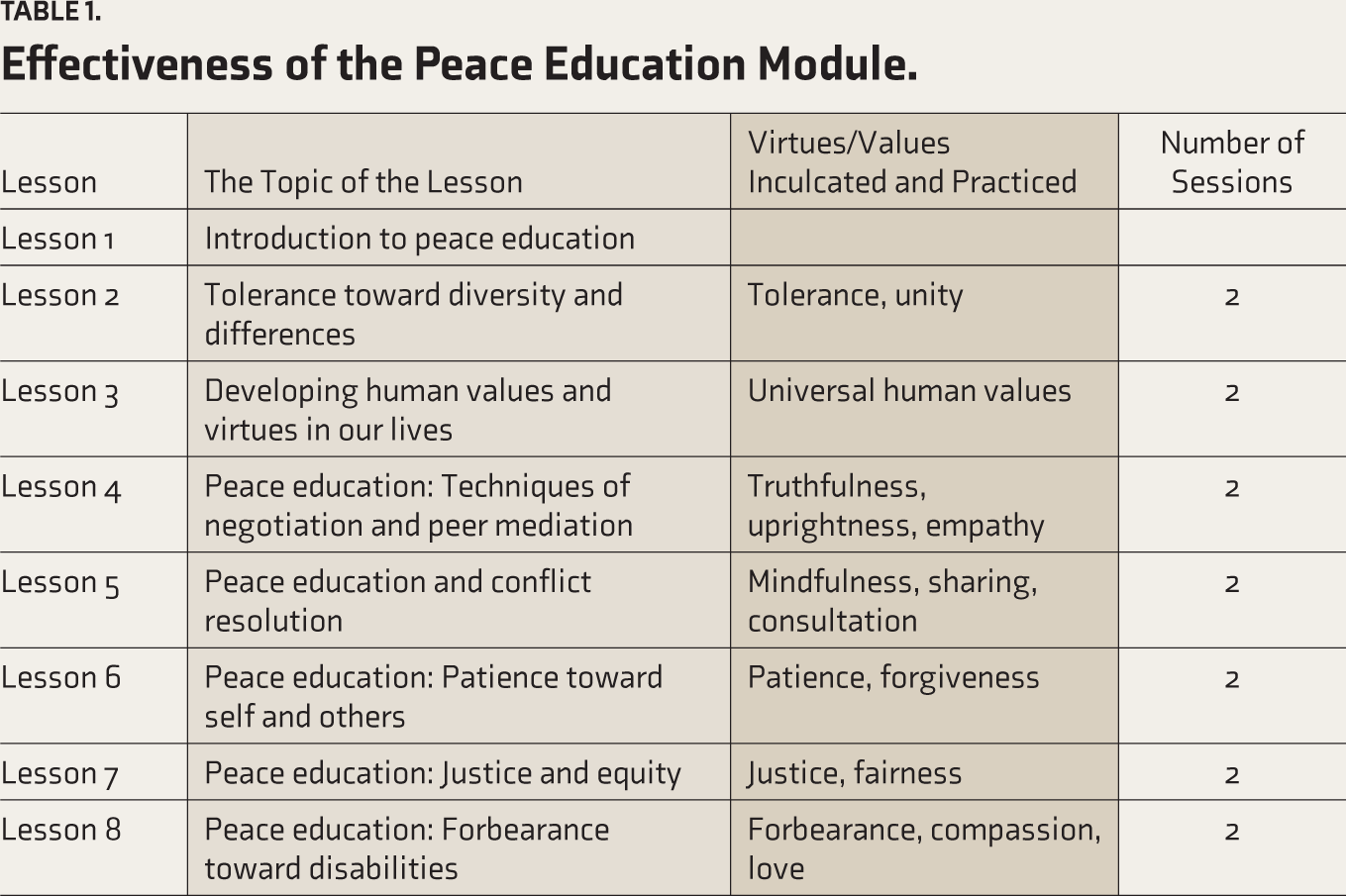
Every lesson of the Peace Education Module introduces a virtue that represents one of the parameters of peace. In every lesson, the students learn the practical aspect of practicing virtues and the signs of success as they implement them in their day-to-day interactions. Two sessions of 45 minutes each were allotted to each lesson. The effectiveness of the peace education module with reference to the virtues and values being inculcated in adolescents is mentioned in Table 1. 6 As the research was done in a school setup, the challenge faced by the researcher was mainly getting a suitable period and suitable room, despite the regular timetable schedule of the school. In consultation with the Principal of the School, the library period was replaced by the peace education session for the participants of this study.
Effectiveness of the Peace Education Module.
Case Series
The Buss and Perry Aggression Questionnaire was administered to measure the aggression level of the adolescents in this study. 7 The researcher analyzed the scores of the pre-tests and post-tests through the t test. The following are the case studies of four of the adolescents whose aggression scores were very high in the pre-test. After the completion of the sessions, the researcher asked the following questions of the students and compiled the case studies of four students.
Have the peace education sessions helped you to tolerate diversity and differences and control your anger?
Have you started practicing the values and virtues in your day-to-day interactions with your peer group and your family members?
Is there any reduction in the frequency of conflicts between you and your friends after practicing the Golden Rule (Do not wish for others what you do not wish for yourself)? 8
How far has practicing patience, justice, and equity impacted the reduction of your level of aggression?
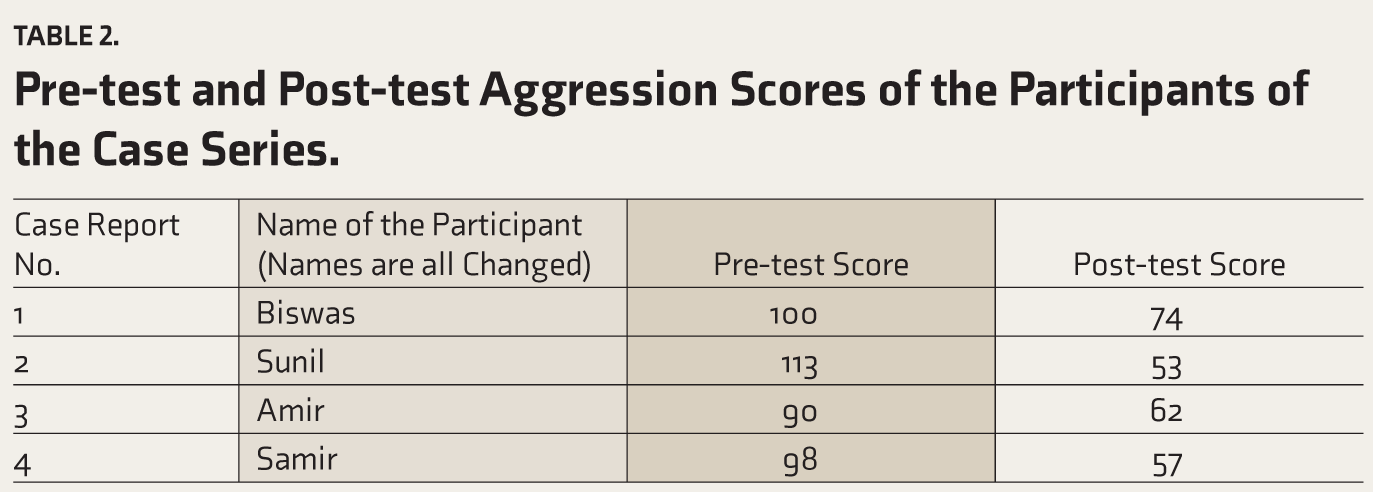
The following case studies reveal that these students’ aggressive behavior has tremendously changed after the peace education. The sessions were the same for all the participants. The teachers observed the participants’ behavior at school and at home by the parents. Feedback was collected from the teachers and the parents during the parents-teachers meet at the school. In Table 2, the Pre-test and Post-test aggression scores of the participants of the case series are recorded.
Pre-test and Post-test Aggression Scores of the Participants of the Case Series.
Case 1
This is the case study of Biswas (name changed), an adolescent boy of 14 years of age, studying in class 8 of an English medium school in Bhubaneswar. Biswas was known as “Intolerant and Aggressive.” He shared the following:
Initially, I did not know what the peace education classes were for, but after attending a few classes, I understood that I should modify my behavior to be a peacemaker. Earlier in the playground, I used to argue a lot with other students, but now I have changed my thought process. Earlier, when my friends teased me, I would get angry and react to them. Nevertheless, now I tolerate their behavior. In the playground, I often become the mediator and help the students to sort out their differences. My parents also see changes in me. I used to get angry at home and argue with my parents, but now I have become peaceful.
Case 2
Sunil (name changed), an adolescent boy of 13 years of age from class 8, shared his verbatim quote as follows:
I used to disagree with others and had verbal conflicts with my peers very often. When I first attended the peace education classes, I was worried because I did not know what this was all about. It was the first time that we were attending such a class. As I attended a few classes, I learned that I should not become aggressive. My conflicts with my friends have reduced to a great extent. In peace classes, I learned about tolerance, so I do not get angry with my friends and I tolerate the differences. I have been practicing the golden rule in my dealings. I have done mediation with my siblings at home, especially during the arguments at the dining table. When my friends have conflicts, I try to help them overcome their conflicts. Peace education lessons are needed for adolescents. This year, I am more peaceful than last year. When I am the monitor of the class, I am trying to maintain peace in the class. We need peace education classes to continue so that they will fully impact the adolescents’ aggressive behavior.
Case 3
Amir (name changed), an adolescent boy of 14 years of age, was a participant in the peace education classes. He shared the following narration of his feelings:
Right from the beginning, I liked the classes very much; they helped me a lot. I used to get very angry earlier, especially when I used to argue with my friends, not being able to forgive others, and used to have negative arguments. However, now I have control over my anger. These classes are very helpful for adolescents. I feel the changes in my relationship with my peer group. When I have a conflict with my friends, I don’t get angry; I try to solve the conflict through conflict resolution techniques. At times, when my friends take away my books and notes, I try to stay calm and ask them to return the books and notes peacefully. I practice forgiveness instead of being revengeful. Forgiveness helps me to stay calm and forget the differences between me and my friends. It has also affected my behavior with my family members. I used to get angry at home, but now it has reduced to a great extent. I discussed peace education classes that we had at school with my parents; they appreciated them and told me not to miss them. I also spoke with my friends about it, and they said that they wish these lessons would be a part of the school curriculum.
Case 4
Samir (name changed), an adolescent boy of 14 years of age, was a very aggressive boy from class 8. His aggression score, as per the Aggression Questionnaire in the pre-test, was 98. Samir was short-tempered with irritating behavior. He got a post-test score of 57.
I used to be short-tempered and used to get angry at every small irritation, but now I can tolerate different situations. The Golden Rule was very useful for me. I try to stay peaceful. When I fall into an argument with my friends, I am the first one to say sorry because I do not want to prolong the argument.
I have understood that forgiveness is a virtue that anyone can practice. When I forgive and forget my friends’ mistakes, I can have a more positive relationship with them, and as a result, we don’t argue much. Peace education classes should continue with more activities. We feel cheerful after the peace education classes.
Discussion
Sagkal, Turnuklu, and Totan conducted research in Turkey on sixth-grade students aiming to prevent violence from leading to a decrease in aggression. They applied a program on peace education in a study titled, “Peace Education's Effects on Aggression,” which focused on the strategy to develop positive peace and peacebuilding. 9 These researchers administered the Buss and Perry Aggression Questionnaire. They found that the experimental group of sixth-grade students’ post-test results showed a decline in both reactive and proactive aggression. In contrast, the control group’s post-test results showed a small increase over their pre-test results. They concluded that the sixth-grade students’ level of aggression had decreased as a result of the peace education program. 9
In this case series, we examined the efficacy of peace education in aggression management in adolescents. Hence, a group of adolescent students of class eight with high levels of aggression were selected, and the Peace Education modules were administered. After the completion of the modules, the aggression scale was once again administered, and it was found that their level of aggression had reduced greatly. They had become less aggressive and developed several other values and virtues.
In the present study, the researcher has focused on the behavioral changes in the participants as a result of peace education. It was observed that several cognitive and behavioral transformations occurred in adolescent participants, which controlled the level of their aggression. A few of the behavioral and cognitive transformations are as follows:
The participants’ cognitive change led to a change in their aggressive behavior. This cognitive change was developed after the module’s lessons were implemented. Acceptance (self-understanding) is developing the ability of adolescents to resolve conflicts themselves. Self-realization leads to positive thinking and positive relations. Self-control and tolerance reduce aggression to a great extent, and developing patience during hard times leads to self-confidence. The ability to be of service to others and help others solve their problems. Self-conviction and determination which leads to a change of behavior. Understanding the position and situation of other individuals, in turn, helps the adolescent accept people the way they are, reducing the level of irritation.
Peace Education administered in this study is in tune with the National Education Policy 2020. 10 Harris stated that the objectives of peace education were to help pupils comprehend that peace encompassed more than just the absence of conflict and to develop a deeper regard for the lives of all living things.
According to Harris and Morrison, the pedagogy of peace education should include “a skill of listening, reflection, problem-solving, cooperation, and conflict resolution.” 11 In the present study, the pedagogy of peace education is derived from the parameters of peace in the context of adolescents’ behavioral patterns. 12 In these case studies, the researcher observed the impact of the modules of peace education on the behavior of the adolescents.
Mishra researched the implementation of peace education to help adolescents become more aware of the reasons for conflicts and the ways to resolve them on a day-to-day basis. 13 Its components include learning about tolerance, practice sharing, and being honest in interactions with all. In the current study, it has been observed that once adolescents practice tolerance of diversity, their conflicts based on their differences are controlled to a great extent.
According to Baldo and Furniss, the best conditions for peace education to occur are those in which students actively acquire the skills of peacemaking and conflict resolution and where the educational setting serves as an example of peacefulness. 14 Peer Mediation lessons of the Peace Education Module in the present study have been practically practiced with adolescents and proved to be effective in resolving their conflicts.15,16
Conclusion
The significance of peace education has been examined in this study of adolescent boys. In the case studies mentioned above, it is observed vividly that peace education has helped adolescents not only in controlling their aggressive behavior but also have been successful in acting as mediators in bringing harmony and understanding among their peer groups. Peace Education will be effective in overcoming various disorders related to aggression in adolescents, such as conduct disorders, mood disorders, behavioral disorders, antisocial personality disorders, and delinquency. Peace education will help the students increase their capacities to develop fundamental life skills in such a manner that they can overcome various disorders related to aggression in their life situations. Peace Education Curriculum will be used for both teachers’ training and parents’ training, enabling them to help adolescents control their aggression.
Supplemental Material
Supplemental material for this article available online.
Supplemental Material
Supplemental material for this article available online.
Footnotes
Acknowledgements
The authors acknowledges with thanks the cooperation of all the participants, their parents, class teachers, and school principals.
Declaration of Conflicting Interests
The authors declared no potential conflicts of interest with respect to the research, authorship and/or publication of this article.
Declaration Regarding the Use of Generative AI
The authors declared no use of Generative AI with respect to the research and/or authorship of this article.
Ethical Considerations
The Institutional Ethics Committee provided the ethics approval (Ref. No.: IEC/UU/2022-02). Assent was obtained from the participants, and consent from their parents.
Funding
The authors received no financial support for the research, authorship and/or publication of this article.
References
Supplementary Material
Please find the following supplemental material available below.
For Open Access articles published under a Creative Commons License, all supplemental material carries the same license as the article it is associated with.
For non-Open Access articles published, all supplemental material carries a non-exclusive license, and permission requests for re-use of supplemental material or any part of supplemental material shall be sent directly to the copyright owner as specified in the copyright notice associated with the article.
