



Abstract

Dear Editor,
Homocysteine (Hcy) is a sulphur-containing amino acid implicated in cardiovascular diseases. 1 The harmful effects of Hcy occur when the blood concentration of Hcy is elevated, referred to as hyperhomocysteinemia (HHcy). The HHcy is multifactorial and thus can be easily modified by Vitamin B12 and folate supplementation and maintaining a healthy lifestyle. 2 Apart from its role in the cardiovascular system, recent studies suggest an association with cognitive decline and dementia. Hcy can affect the brain structure and cognitive functioning through both vascular and degenerative pathways. 3 Since Hcy levels are highly variable, it is important to study the prevalence of HHcy and its relationship with cognition in the Indian population specifically. The present study aims to assess the association of HHcy with cognitive functioning in older adults in South India.
Methods
Using a power of 0.95, a significance level of 0.05, and an effect size of 0.67, 4 the sample size was calculated to be 118. Thus, the current study recruited 120 participants between June 2023 and April 2024 from the Tata Longitudinal Study of Ageing (TLSA), an ongoing urban cohort study of non-demented individuals aged ≥45 years. 5 The study was approved by the Institutional Ethics Committee (IEC), and voluntary written informed consent was obtained from all the study participants. The participants underwent detailed clinical assessments. Cognition was assessed using the screening test - Addenbrooke’s Cognitive Examination-III (ACE-III) and Computerised Assessment of Adult Information Processing (COGNITO) neuropsychological test battery. The examiner assessing the cognitive functions of the participants was unaware of their Hcy status. Blood samples were used to quantify Hcy, vitamin B12, and folate concentrations. Using the global cutoff for HHcy, participants were classified into normal (≤15 µmol/L) and HHcy (>15 µmol/L). Based on the normality of the data assessed by the Kolmogorov–Smirnov test, independent t-test or Mann Whitney-U test were used to compare means of continuous variables among the two groups. Statistical analyses were performed using IBM Statistical Package for Social Sciences (SPSS) software version 28.0.1.1.
Results
The mean age of the participants was 63.48 ± 8.54 years. Among the 120 participants, 59 were males (42.9%) and 61 were females (50.1%). The group had mean and median Hcy levels of 15.30 ± 6.96 µmol/L and 13.41 (11.68, 16.66) µmol/L, respectively. Males had significantly higher mean Hcy levels compared to females (p < .001). Hcy level was not significantly correlated with age but was significantly negatively correlated with vitamin B12 (p < .001) and folate (p = .002) levels.
Using 15 µmol/L as the cutoff, we identified 46 participants with HHcy and 74 normal participants. The sociodemographic characteristics of the two groups are given in Table 1. The HHcy group performed poorer in the categorical fluency test when compared to the normal group (p = .017). When stratified based on gender, it was found that males with HHcy had significantly higher mean Hcy levels than females with HHcy (p = .005). Males with HHcy had higher reaction times than males with healthy Hcy levels (p = .037). On the other hand, females with HHcy scored better in ACE-III total (p = .009), ACE-III memory (p = .002), ACE-III fluency (p = .030), and episodic memory immediate recall task (p = .042) than females with healthy Hcy levels.
Sociodemographic Characteristics and Biochemical Measures in the Total Study Sample, Normal and HHcy Participants.
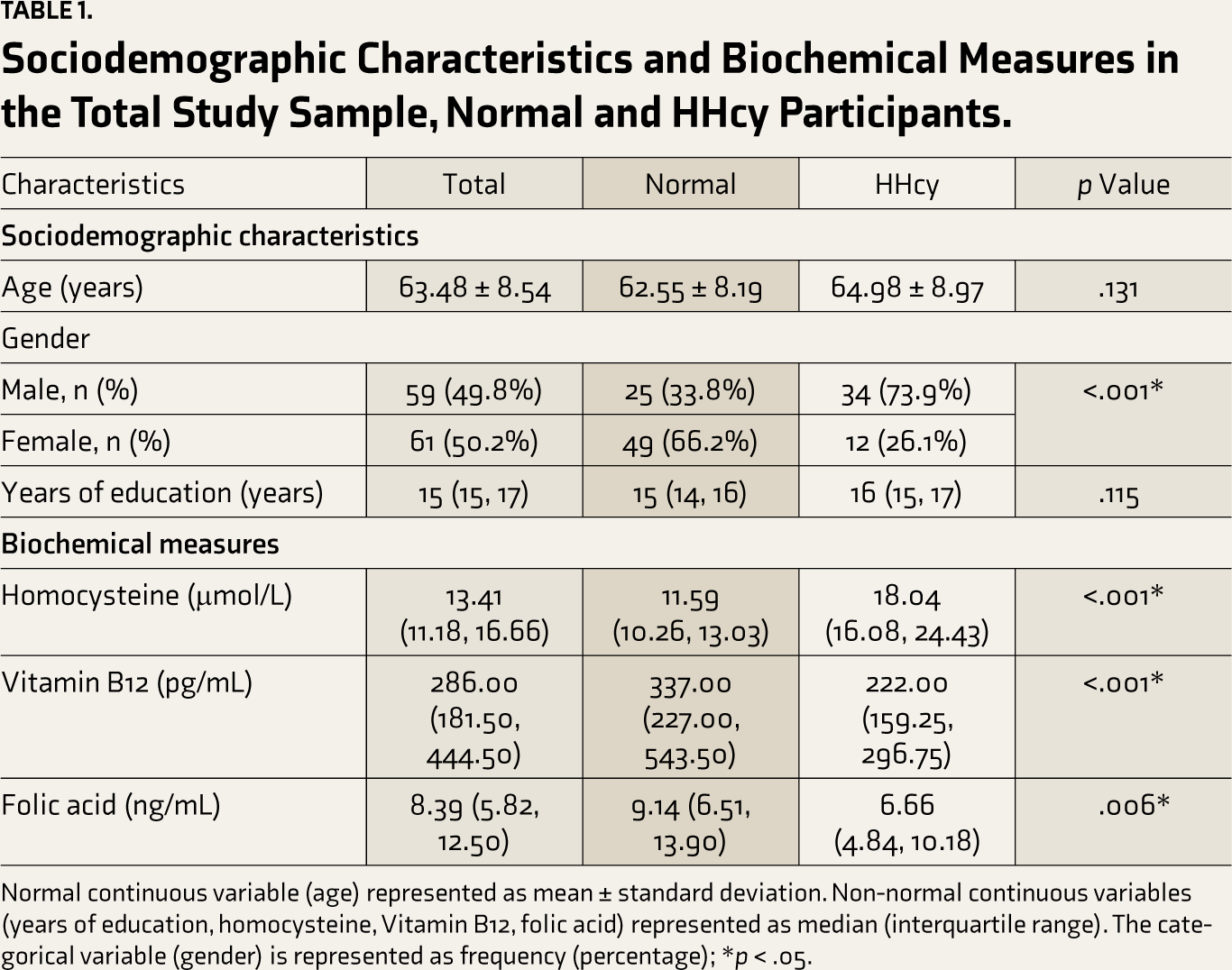
Normal continuous variable (age) represented as mean ± standard deviation. Non-normal continuous variables (years of education, homocysteine, Vitamin B12, folic acid) represented as median (interquartile range). The categorical variable (gender) is represented as frequency (percentage); *p < .05.
Discussion
The results of our study were consistent with previous studies where a higher concentration of Hcy was found in males than in females, which can be due to hormonal and muscle mass differences. 6 Interestingly, in our study, the Hcy level was not related to increasing age. A study conducted by Yao et al. (2017) elucidated that Hcy levels exhibited a sharp increase with age only in late-life (>65 years of age) but not in their middle-aged counterparts. 7 A higher proportion of participants in the middle-aged group in the current study can explain the absence of a significant correlation of Hcy levels with age.
Previous studies have shown that cognitive domains, primarily memory and language, are affected in HHcy. 8 This finding is in line with our results, where categorical fluency was found to be affected in individuals with HHcy. However, with respect to females performing better in cognitive tasks compared to males, our study findings were slightly inconsistent with the previous literature, which suggests that HHcy is associated with poorer cognitive functioning irrespective of gender. 9 A possible reason could be the difference in the severity of HHcy among genders. It is seen that males with HHcy have higher mean Hcy levels than females with HHcy. Also, the highest Hcy concentrations seen in females and males were 17.89 µmol/L and 49.34 µmol/L, respectively, suggesting that females in the HHcy group have Hcy concentrations that are only slightly higher than the cutoff. Since the severity of cognitive decline depends on the concentration of Hcy, HHcy in females might not have been severe enough to result in further cognitive symptoms. 10
Conclusions
The study results exhibit the patterns of HHcy in a non-demented population in South India. This study reveals that people with HHcy show cognitive complaints, which are dependent on the severity of HHcy. This highlights the need for continuous monitoring and maintaining healthy Hcy levels to reduce the incidence of cognitive impairment.
Footnotes
Acknowledgements
We want to thank all the participants for their active participation and cooperation.
Data Availability Statement
The data used for the present study is from the institution’s ongoing cohort study and is not publicly available. The data required for the analysis was acquired after approval from the study’s corresponding author.
Declaration of Conflicting Interests
The authors declared no potential conflicts of interest with respect to the research, authorship and/or publication of this article.
Declaration Regarding the Use of Generative AI
None used.
Ethical Approval
The TLSA study was approved by the Institutional Ethics Committee (IEC) of the Centre for Brain Research, Indian Institute of Science, Bengaluru (CBR/42/IEC/2022-23).
Funding
The authors received no financial support for the research, authorship and/or publication of this article.
Informed Consent
Written informed consent was obtained from all the participants.