




Abstract

Dear Editor,
The skill-versus-chance debate has continued in the context of fantasy sports, and there are no final answers yet. 1 India has emerged as one of the world’s fastest-growing markets for fantasy sports. 2
We attempted to capture the perspective of people who have identified themselves as “engaging in gambling” about the gambling risk potential associated with fantasy sports. Such information is potentially relevant to various stakeholders, including policymakers, program administrators, the judiciary, developers, the fantasy sports industry, those interested in these fantasy sports, and their caregivers. The research on these factors still needs to be expanded globally. Currently, published studies have yet to capture this information from India.
The institute ethics committee approved the study (IEC-490/17.06.2022, RP-06/2022). The evaluation was conducted using the assessment tool to examine the potential of gambling products developed by Meyer and colleagues. 3 The tool evaluates the risk potential of gambling types based on 10 relevant characteristics: event frequency, multigame/stake opportunities, prize-back ratio, light and sound effects, variable stake size, availability, jackpot, cashout interval, near miss, and game continuity. The scores accorded to gambling types range between 11.65 and 60.65, wherein higher scores represent higher risk potential.
Seventy-seven patients with substance use disorder seeking treatment were screened for engagement in fantasy sports. Twenty-two participants (28.57%) were identified, and data were captured. The participants engaged in different types of gambling activities. These included playing cards for money, betting on sports, playing dice games, playing numbers, or betting on lotteries. The participants reported engaging in 32 fantasy sports in total (multiple participants and some participants engaged in the same fantasy sport engaged in more than one fantasy sport). The sample’s age range was 18– 47 years, with a mean age of 28.12 (SD = 6.75). The total number of fantasy sports played by an individual ranged from 1 to 3, with an average of 1.75 (SD = 0.762). Around 54% of the participants also met the criteria for gambling disorder (GD).
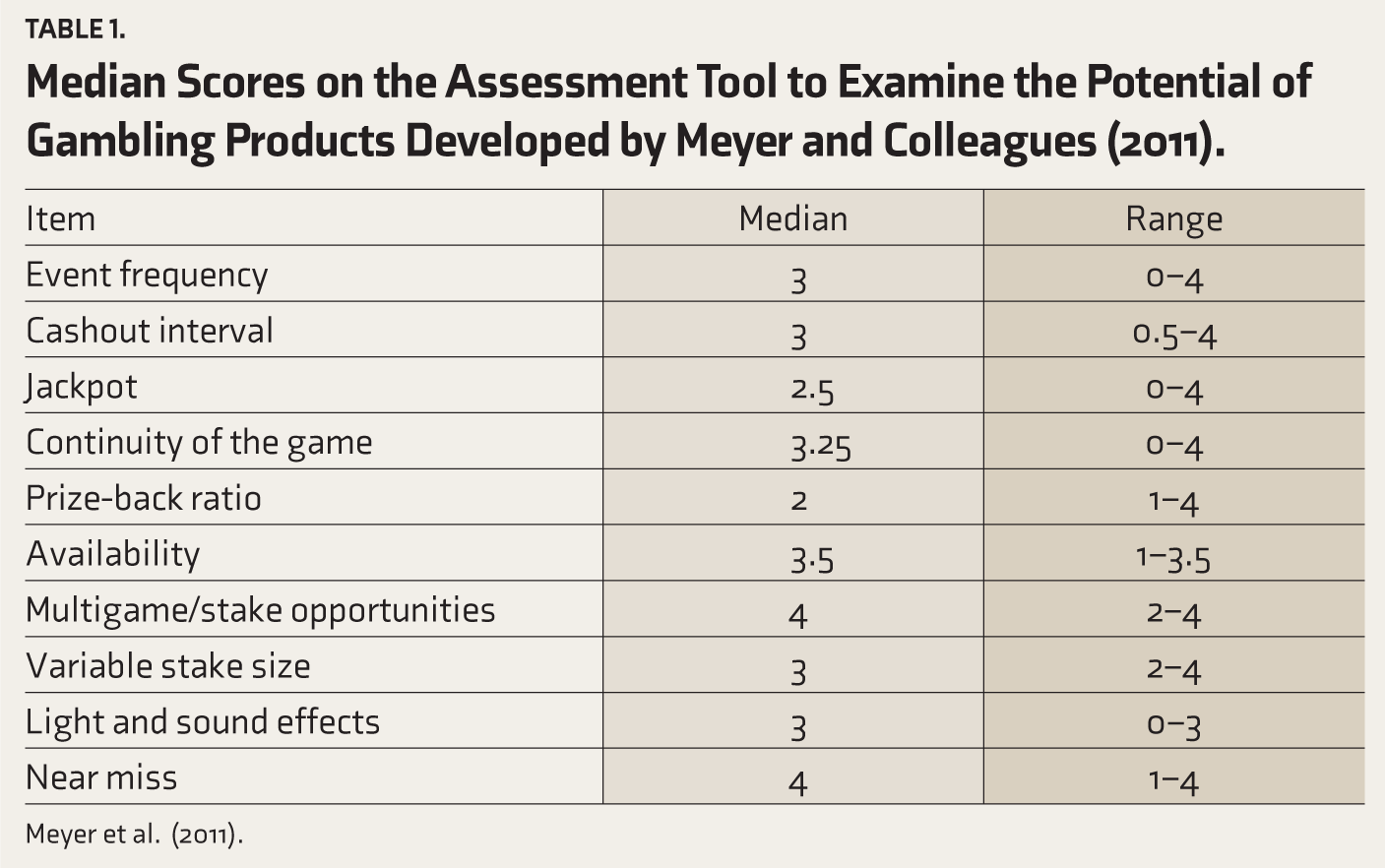
The median score of the participants on the assessment tool for gambling potential has been presented in Table 1. The score on the tool was 45.15 (range: 36.85–54.3). The fantasy sports scores corresponded to clusters 1–3, as Meyer et al. identified, indicating moderate to very high gambling risk potential. This is comparable to the gambling risk potential associated with slot machines, online poker, roulette in casinos, live sports betting via the internet, TV raffles, scratch cards, and fixed odds betting, as reported previously. 3
Median Scores on the Assessment Tool to Examine the Potential of Gambling Products Developed by Meyer and Colleagues (2011).
Meyer et al. (2011).
Fantasy sports platforms offer players multiple options for applying stakes and stake size (i.e., fixed, variable, limited, variable, and unlimited). They also provide players with many options regarding time between stake outcome and proximate stake and a cashout interval ranging from less than 15 seconds to 24 hours. Additionally, players are allowed to continuously engage in single and/or multiple games without a break. The auditory and visual effects in the game also keep the participants engaged.
Participants continued to engage in fantasy sports despite reporting that in 68.8% of the fantasy sports, the near miss was intentionally introduced by the providers and occurred frequently. Additionally, the probability of winning was perceived to be more than 49%, only in 3.13% of fantasy sports. While in 40.63% of fantasy sports, the probability of winning was expected to be between 0% and 4%.
The current study’s risk potential associated with fantasy sports indicates how inherent structural (fantasy sport-related) and situational characteristics, as perceived by the consumer, may exacerbate, facilitate, and perpetuate gambling behavior in some of those who engage in fantasy sports. The importance of structural and situational characteristics of internet gambling has been highlighted in previous publications. 4 There is some evidence to support the idea that easier and faster access, the proliferation of advertisements and inducements, and the expansion of innovative betting products have intensified many aspects of online gambling. 5 These findings can guide the changes to fantasy sports that can help mitigate the gambling potential.
The current study has certain limitations. Being an exploratory study, we included a small sample size. We included participants who presented to us with the main complaints of substance use disorders. Also, we could not comment on the gambling potential of individual fantasy sports due to the limited sample size. Despite these limitations, the current study offers the first understanding of the perception of the gambling potential of fantasy sports among persons seeking treatment for substance use disorders and those who have engaged in gambling activity. Future studies should aim to assess the gambling potential of individual fantasy sports and its correlates in diverse population groups.
Footnotes
Declaration of Conflicting Interests
The authors declared no potential conflicts of interest with respect to the research, authorship, and/or publication of this article.
Declaration Regarding the Use of Generative AI
None used.
Ethical Approval
The institute ethics committee approved the study (IEC-490/17.06.2022, RP-06/2022).
Funding
The authors received no financial support for the research, authorship, and/or publication of this article.
Informed Consent
Written consent was obtained from the study participants.