




Abstract
Purpose of the Review:
Delusional procreation syndrome (DPS) consists of sequential delusions related to human procreation. It was first coined in a case series in 2010. The most common delusion among DPS is related to pregnancy. It will be interesting to look into its further research and impact on the scientific community.
Collection and Analysis of Data:
We performed a citation analysis using the search term “delusional procreation syndrome.” For the citation, we searched Google Scholar, Web of Science, and Scopus.
Results and conclusion:
Citation analysis found that 12 other articles have cited the original publication in different contexts and were published on all continents except South America. Apart from the primary article, the subsequent citations reported the delusion of delivery, the delusions of polygamy in proxy, twin delivery, and triplet pregnancy. Thus, DPS remains an interesting and active area of research.
Asyndrome is a recognizable complex of symptoms and physical findings
that indicate a specific condition for which a direct cause is not necessarily understood. 1 There are several syndromes in psychiatry, of which delusional procreation syndrome (DPS) is a recent addition. DPS was first published by Manjunatha et al. in 2010 and is considered the primary paper throughout this article. 2 DPS consists of sequential delusions based on “logical thematic content” in every possible stage of procreation, such as having a spouse/partner, getting pregnant, having delivered a child (labor and childbirth), becoming parents/grandparents, etc. It is a broad rubric term in the model of delusional misidentification syndrome. Among DPS, the delusion of pregnancy is the commonest. DPS is seen in various psychiatric disorders such as schizophrenia, schizoaffective disorders, delusion disorders, affective disorders, and organic disorders such as epilepsy, dementia, and organic brain syndromes. 2 It has been more than 12 years since the first description of DPS, and it will be interesting to look into its impact on the scientific community. Hence, we aimed to perform a citation analysis and a mini-review of published literature related to DPS.
Methods
The current article investigates citation analysis and review of DPS after the first primary article was published in the Asian Journal of Psychiatry in 2010. 2 On May 29, 2023, we searched Google Scholar, Web of Science, and Scopus for the citation analysis of DPS using the search words “delusional procreation syndrome.”
Citation analysis is a bibliometric study that measures how often a published work is cited. A citation represents a relationship between the cited and citing documents. The easiest technique for citation analysis is to use the citation count, determining how many citations have been received by a given document or set of documents over time from a particular set of citing documents. 3
In the review, the authors aim to understand the clinical profiles of DPS from published literature. We could find 12 other citations of the primary article 2 from the searches on Google Scholar, Web of Science, and Scopus since 2010. The authors reviewed these articles for the clinical profiles of DPS-related delusions.
Results
Out of the 13 articles that were available on Google Scholar (including the primary case series), two articles were excluded in view of non-English versions. Further, one article cited the primary article in a different context of fascinating delusions, and it has been included in this review as the primary objective is citation analysis. We could not find any citations in the Web of Science. We found seven citations in Scopus, but all were also in Google Scholar. Thus, we have analyzed 10 cited papers in this article.
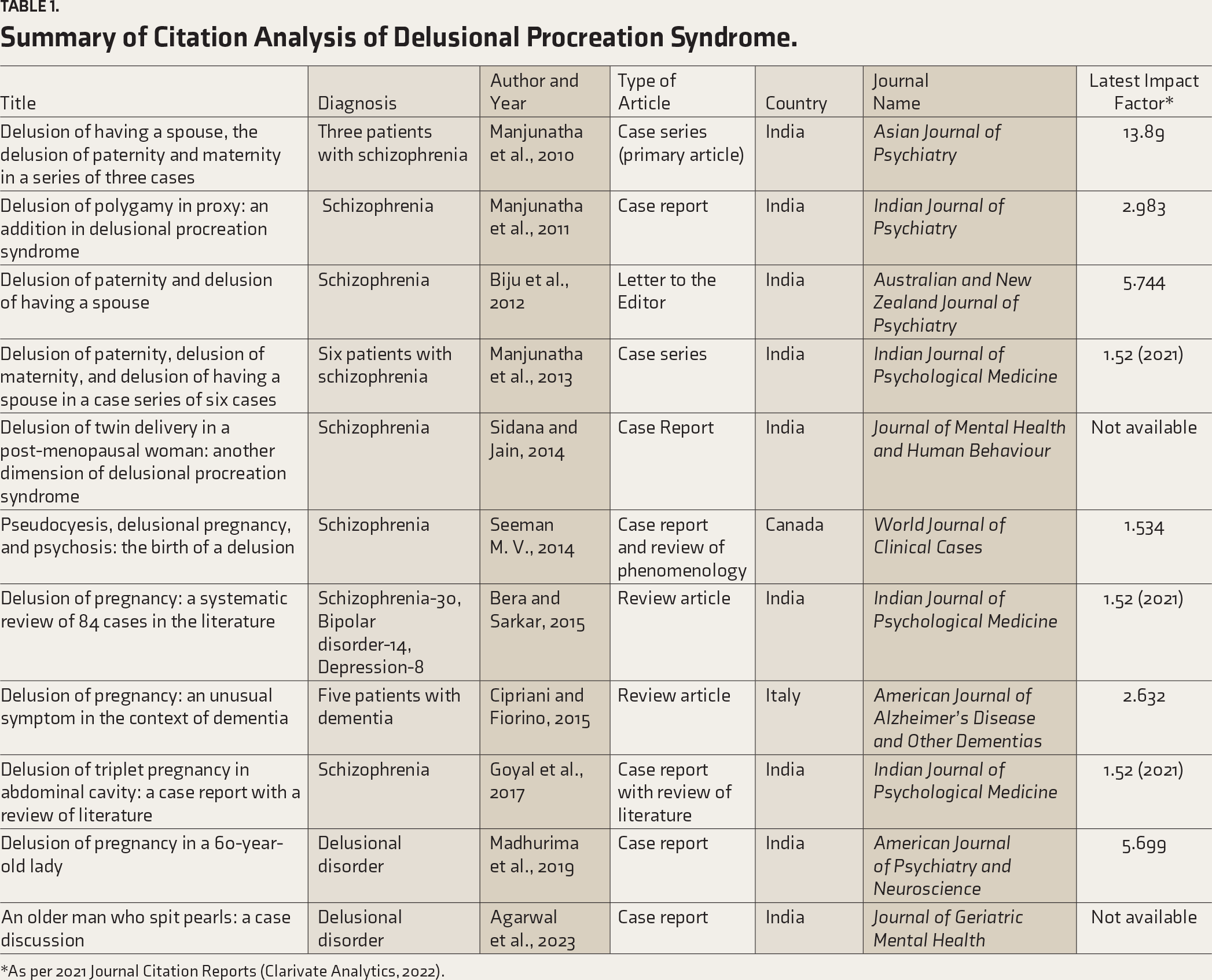
Out of all citations, three are self-citations by authors and the rest from others. The cited articles include two case series, five case reports, one review article, one case report with review, and one letter to the editor. The case report with review included a discussion on pseudocyesis and delusion of pregnancy and the factors influencing them. One citation is from Italy, 4 one is from Canada, 5 and the rest are from India. DPS articles are published in all continents except South America. 4 Table 1 provides an overview of all the citations.
Summary of Citation Analysis of Delusional Procreation Syndrome.
*As per 2021 Journal Citation Reports (Clarivate Analytics, 2022).
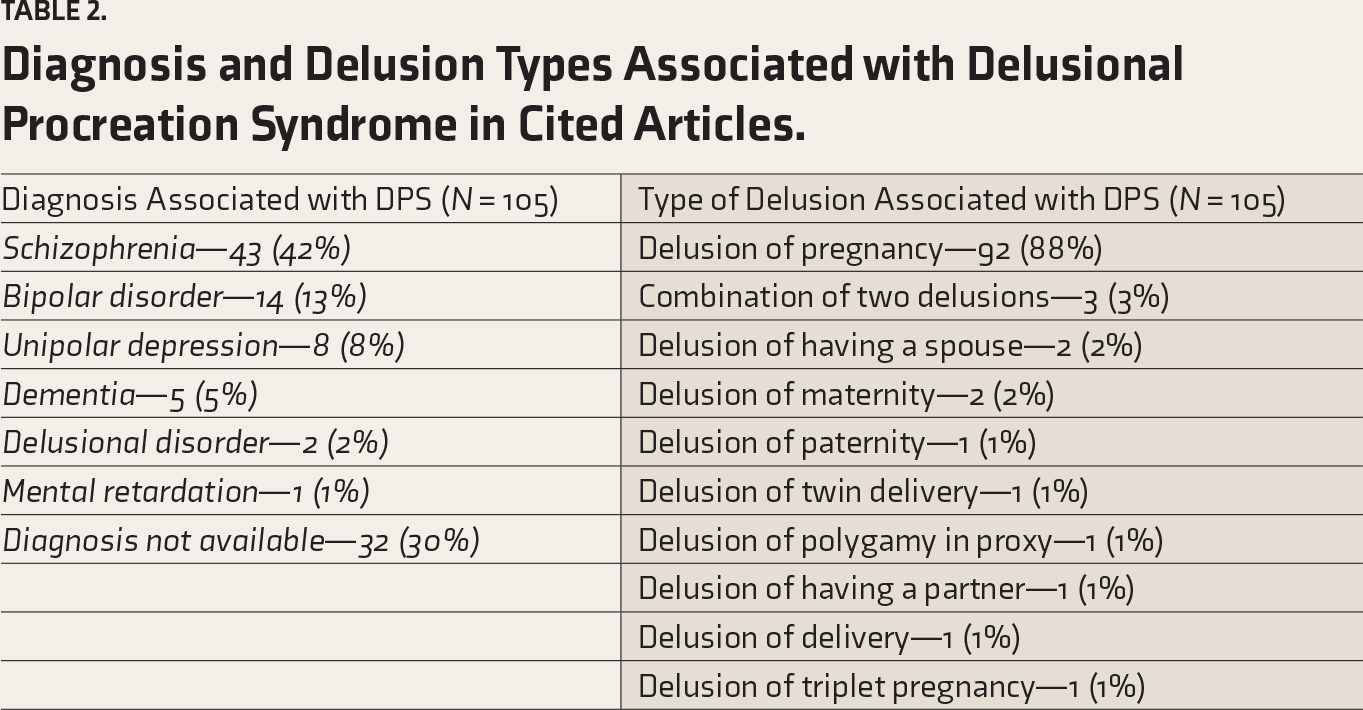
In this mini-review, we reported one or the other delusion(s) associated with DPS in a total of 105 patients. Out of this, 80 are females and 25 are males. Thus, though DPS appears non-binary, it can be seen in males too. However, the figures clearly show that it is significantly high in females. Delusion of pregnancy is reported to be the most common delusion, seen in 87.6% of patients.
Further, the psychiatric diagnoses associated with DPS were available in 73 of the above subjects. Schizophrenia was the most common psychiatric diagnosis (42%), followed by bipolar disorder (13%). Table 2 provides all diagnoses and types of delusions in the above studies.
Diagnosis and Delusion Types Associated with Delusional Procreation Syndrome in Cited Articles.
Discussion
Delusion of pregnancy is not so uncommon in psychiatric literature. It has been reported much before the nomenclature of DPS. However, DPS, as elaborated by Manjunatha et al., 2 consists of sequential delusions in every possible stage of procreation, with the central feature of procreation being pregnancy. The first published case series described three patients belonging to the lower socioeconomic status, with the delusion of having a spouse and delusion of paternity in one case diagnosed with paranoid schizophrenia and delusion of maternity in two cases diagnosed with undifferentiated schizophrenia. 2 Other case reports of the authors with different delusions are elaborated in the results section. Some of their patients had more than one delusion.2,6,7 This is supported by Viswanath et al., where the case of a 45-year-old man presenting with the double delusion of DPS has been reported along with a psychodynamic explanation. 8
Interestingly, the delusion of pregnancy did not figure in any of the publications by Manjunatha et al., the originator of the concept, and hence, the authors initially concluded that the delusion of pregnancy need not be the commonest presentation in DPS. 7 The delusion of polygamy in proxy 6 and the delusion of identical twin delivery of male babies 9 are subsequently added dimensions. Then, Seeman reported a delusion of pregnancy with a review on phenomenology, differentiating it from pseudocyesis, psychological antecedents, effects of culture, and galactorrhea due to antipsychotics worsening the delusion. The author cited the primary article on DPS and explained the range of related delusions centering around procreation. 5 Subsequently, a systematic review of the delusion of pregnancy involving 84 patients has cited it while listing the shortlisted articles on the delusion of pregnancy for the review. The authors infer that schizophrenia is the most common diagnosis, though the diagnosis was not available for 32 subjects in their article. According to them, the delusion is widely prevalent across the world. The psychosocial factors, especially wish fulfillment (in 64.3% of patients), coenaesthopathological processes (in 20% of patients), socio-cultural factors (in 42.9% of patients), and antipsychotic-induced hyperprolactinemia (in 15.5%), are implicated as etiological factors in the genesis of delusion of pregnancy.10 Delusions in 64% of patients reported good improvement with antipsychotics. 10 An article from Italy has reported delusion of pregnancy exclusively among patients with dementia. It infers that this should be carefully differentiated from schizophrenia, especially if it is early-onset dementia. 4 Delusion of triplet pregnancy in the abdominal cavity 11 and chronic delusional pregnancy in a 60-year-old woman 12 are the other recent additions, with the former citing the original article for the delusion of experience of labor and parturition in the context of listing unusual presentations. The latter has defined DPS as conceptualized by Manjunatha et al. The most recent citation of DPS is from a case report of an older man who had delusions about spitting pearls. The author cited the DPS here in the context of different fascinating delusions in psychiatric literature. 13
Based on the reference point in the content of the delusions, Manjunatha et al. 6 divided delusions into self-referential versus proxy delusions. In “self-referential delusions,” the patient is the content of the delusion. In “proxy delusions,” the reference is other than the patient. A proxy delusion is also reported in DPS by the primary author. 6 Psychodynamic and biological theories can explain the etiological basis of DPS. Psychodynamic theory suggests that DPS may stem from repressed wishes related to marriage and having children among affected patients who are never married or have had a disturbed marriage. 2 The psychodynamic concept in the Indian context among Hindus can also be linked to the stage of Grihasthashrama (household life). This stage is meant to experience wealth and pleasure. DPS delusions often revolve around the unfulfilled wishes of the individuals evolving through this ideal household stage. 14 On the biological front, increased prolactin levels have been observed in patients with DPS, both with and without antipsychotic treatment.15,16 These findings, discussed in Manjunatha et al.’s primary publication, 2 contribute to understanding the biological basis of DPS.
Thus, while some of the citations have contributed further to DPS by reporting delusions similar to the ones in the primary publication or by adding newer dimensions to DPS, other articles have cited the primary paper in the context of reviewing the existing literature on the delusion of pregnancy. All in all, the broader term “DPS” appears relevant and convenient in explaining the delusions associated with the different stages of procreation. The qualitative difference, if any, in the delusions associated with DPS in different psychiatric disorders is an area that has yet to be explored.
Conclusion
DPS is the latest psychiatric syndrome to explain the sequential delusions in every possible stage of procreation. This citation analysis of DPS revealed 12 citations of the original publication. Some of them have directly contributed to further expanding the dimension of DPS. DPS is present most commonly in schizophrenia, followed by bipolar disorder. The delusion of pregnancy is the most common among DPS. Thus, DPS can be a relevant and useful umbrella term for delusions associated with procreation for future research.
Footnotes
Declaration of Conflicting Interests
The authors declared no potential conflicts of interest with respect to the research, authorship, and/or publication of this article.
Declaration Regarding the Use of Generative AI
None used.
Ethical Approval
Not applicable.
Funding
The authors received no financial support for the research, authorship, and/or publication of this article.
Informed Consent
Not applicable.