



Abstract
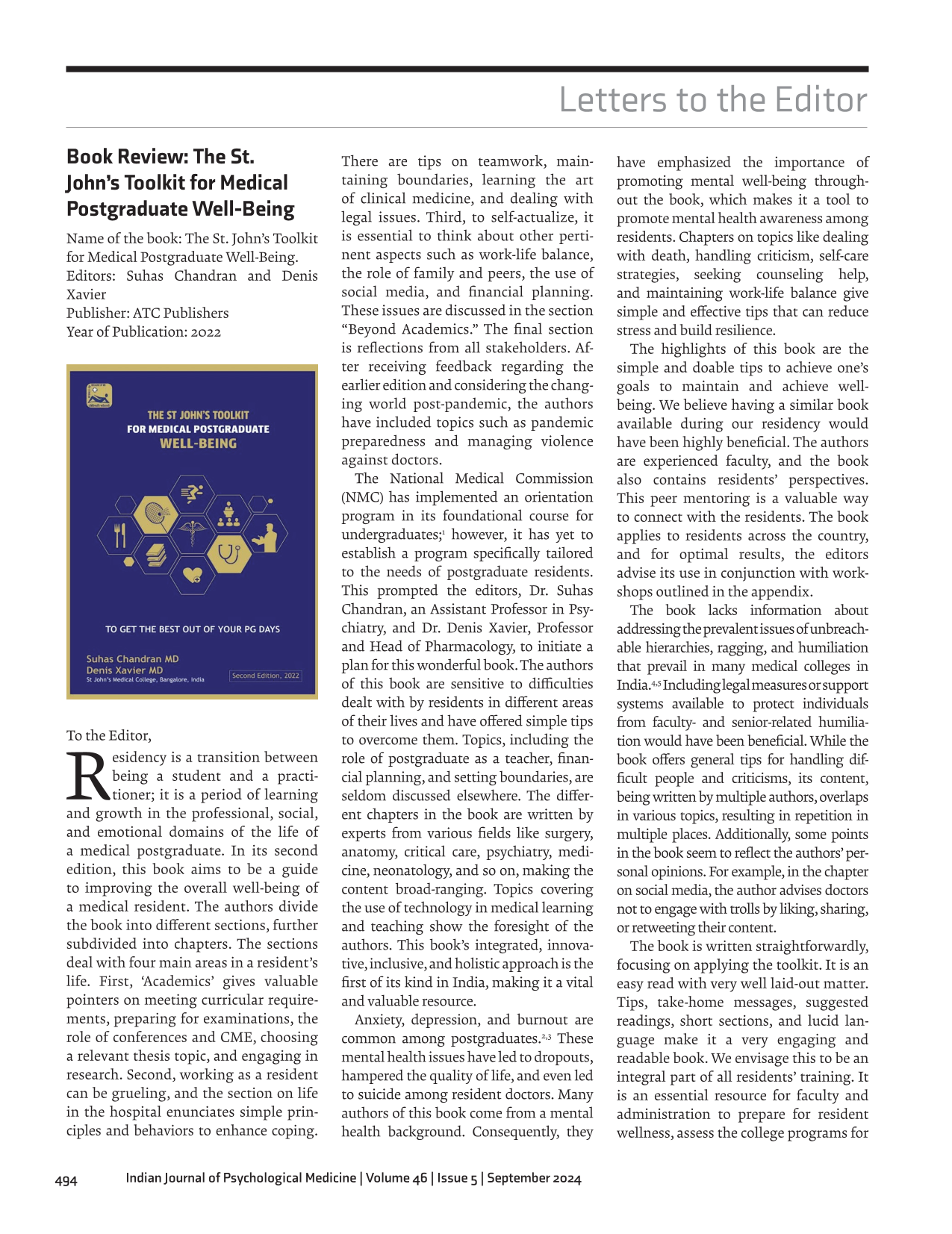

Name of the book: The St. John's Toolkit for Medical Postgraduate Well-Being.
Editors: Suhas Chandran and Denis Xavier
Publisher: ATC Publishers
Year of Publication: 2022
To the Editor,
Residency is a transition between being a student and a practitioner; it is a period of learning and growth in the professional, social, and emotional domains of the life of a medical postgraduate. In its second edition, this book aims to be a guide to improving the overall well-being of a medical resident. The authors divide the book into different sections, further subdivided into chapters. The sections deal with four main areas in a resident’s life. First, ‘Academics’ gives valuable pointers on meeting curricular requirements, preparing for examinations, the role of conferences and CME, choosing a relevant thesis topic, and engaging in research. Second, working as a resident can be grueling, and the section on life in the hospital enunciates simple principles and behaviors to enhance coping. There are tips on teamwork, maintaining boundaries, learning the art of clinical medicine, and dealing with legal issues. Third, to self-actualize, it is essential to think about other pertinent aspects such as work-life balance, the role of family and peers, the use of social media, and financial planning. These issues are discussed in the section “Beyond Academics.” The final section is reflections from all stakeholders. After receiving feedback regarding the earlier edition and considering the changing world post-pandemic, the authors have included topics such as pandemic preparedness and managing violence against doctors.
The National Medical Commission (NMC) has implemented an orientation program in its foundational course for undergraduates; 1 however, it has yet to establish a program specifically tailored to the needs of postgraduate residents. This prompted the editors, Dr. Suhas Chandran, an Assistant Professor in Psychiatry, and Dr. Denis Xavier, Professor and Head of Pharmacology, to initiate a plan for this wonderful book. The authors of this book are sensitive to difficulties dealt with by residents in different areas of their lives and have offered simple tips to overcome them. Topics, including the role of postgraduate as a teacher, financial planning, and setting boundaries, are seldom discussed elsewhere. The different chapters in the book are written by experts from various fields like surgery, anatomy, critical care, psychiatry, medicine, neonatology, and so on, making the content broad-ranging. Topics covering the use of technology in medical learning and teaching show the foresight of the authors. This book’s integrated, innovative, inclusive, and holistic approach is the first of its kind in India, making it a vital and valuable resource.
Anxiety, depression, and burnout are common among postgraduates.2, 3 These mental health issues have led to dropouts, hampered the quality of life, and even led to suicide among resident doctors. Many authors of this book come from a mental health background. Consequently, they have emphasized the importance of promoting mental well-being throughout the book, which makes it a tool to promote mental health awareness among residents. Chapters on topics like dealing with death, handling criticism, self-care strategies, seeking counseling help, and maintaining work-life balance give simple and effective tips that can reduce stress and build resilience.
The highlights of this book are the simple and doable tips to achieve one’s goals to maintain and achieve well-being. We believe having a similar book available during our residency would have been highly beneficial. The authors are experienced faculty, and the book also contains residents’ perspectives. This peer mentoring is a valuable way to connect with the residents. The book applies to residents across the country, and for optimal results, the editors advise its use in conjunction with workshops outlined in the appendix.
The book lacks information about addressing the prevalent issues of unbreachable hierarchies, ragging, and humiliation that prevail in many medical colleges in India.4, 5 Including legal measures or support systems available to protect individuals from faculty- and senior-related humiliation would have been beneficial. While the book offers general tips for handling difficult people and criticisms, its content, being written by multiple authors, overlaps in various topics, resulting in repetition in multiple places. Additionally, some points in the book seem to reflect the authors’ personal opinions. For example, in the chapter on social media, the author advises doctors not to engage with trolls by liking, sharing, or retweeting their content.
The book is written straightforwardly, focusing on applying the toolkit. It is an easy read with very well laid-out matter. Tips, take-home messages, suggested readings, short sections, and lucid language make it a very engaging and readable book. We envisage this to be an integral part of all residents’ training. It is an essential resource for faculty and administration to prepare for resident wellness, assess the college programs for the same, and facilitate the creation of a safe working and social milieu for postgraduate training.
Footnotes
Declaration of Conflicting Interests
The authors declared no potential conflicts of interest with respect to the research, authorship, and/or publication of this article.
Declaration Regarding the Use of Generative AI
None used.
Funding
The authors received no financial support for the research, authorship and/or publication of this article.