




Abstract
To the Editor,
Disulfiram is a deterrent agent for treating alcohol dependence. 1 Many factors influence acceptance of and adherence to disulfiram treatment. The adverse effects could be dose-specific, necessitating regular follow-up. 2 Psychological interventions facilitate acceptance and a positive attitude toward treatment. Studies have opined that brief psychological interventions can teach people about their problems with alcohol and further motivate and bolster their confidence to maintain sobriety. 3 Nurses, the largest workforce of the healthcare team, can play a crucial role in strengthening the pathways to treatment. 4 Therefore, we developed a module for a psychoeducational intervention regarding disulfiram. The development of this module was part of an interventional study that evaluated disulfiram adherence in the alcohol de-addiction settings of north India (CTRI/2022/04/041865).
This module was developed in two stages. In stage 1, the initial draft of the sessions was formulated through surveys and expert consultation. A synthesis of the existing literature was used for developing the module. Initially, face validity was established through two language experts who provided several modifications on the sentence structure, linguistic complexity, and suitability, based on the module’s objectives. The principal investigator (JJ) incorporated the expert suggestions and the same was cross-verified by the author DK. Content validity was established through anonymous consultations, and the preliminary draft was evaluated by 16 experts, including those from psychiatry, clinical psychology, psychiatric nursing, and psychiatric social work. The experts were requested to rate the relevance and appropriateness of each of the three sessions on a scale from 1 (strongly disagree) to 5 (strongly agree). Scores of 4 and 5 were considered as an endorsement of the relevance and appropriateness of the session. The content validity is deemed high if the value exceeds 70%.5, 6 Furthermore, an overall rating of the module was obtained using a three-point Likert scale ranging from 1 (poor) to 3 (excellent).
In stage 2, a pilot study was conducted to ensure the module’s feasibility and clarity, which involved 10 participants undergoing disulfiram therapy. All the patients were recruited by convenience sampling after obtaining written informed consent, and the study was approved by the Ethics Committee of the Institute.
Based on the experts’ opinion, the overall content validity of the module was estimated as 71.42%, indicating the module’s appropriateness to the target population. In terms of individual sessions, all achieved modest validity values (70%–77.5%). Table 1 summarizes the values for the overall and individual sessions. All subjects were male, with a mean age of 49.2 years (SD: 6.1). The average duration of the sessions was 10–20 min. All subjects expressed interest in attending the face-to-face session (Session 1), while three were resistant to engaging in telephonic sessions (Sessions 2 & 3). The sessions were delivered by a nurse (JJ) who is a Ph.D. scholar in Psychiatric Nursing and has considerable experience in brief educational interventions in the mental health care setting. 7 The key components of the individual sessions were as follows:
Content Validity Percentages of the Sessions in the Module.
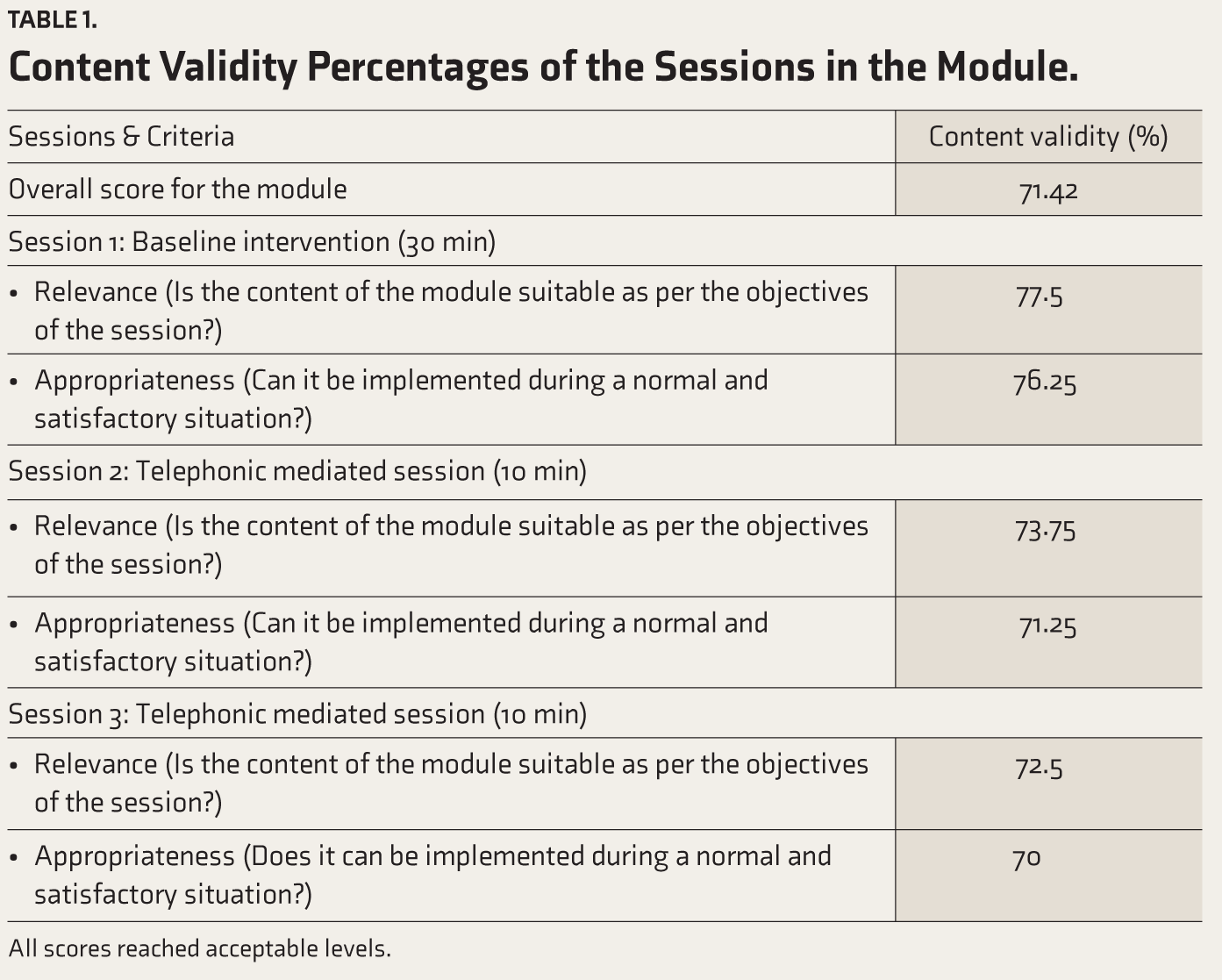
All scores reached acceptable levels.
Session 1
The objective of this brief (30 min) session, delivered face-to-face, was to facilitate alcohol abstinence and adherence to disulfiram.
Session 2
As disulfiram does not reduce craving, the objective of this session was to enhance craving management skills. This was facilitated by incorporating concepts of craving inventory and a craving control plan with a confidence meter.
Session 3
Its objective was brief education regarding relapse management skills, which was facilitated by the identification of possible reasons for relapse such as pleasant and unpleasant emotions, physical discomfort, and so on, followed by the discussion of suggestions for preventing relapses. The details of the three sessions are available upon request from the authors.
Healthcare professionals such as nurses have a significant role in improving patients’ adherence to alcoholism treatment. 8 Addressing the barriers to conducting such brief psychoeducation is critical for ensuring its sustainable delivery in clinical settings. A good content validity routed in the latest literature would improve the credibility of the module for use in the target population. 9 Future studies should address the short-term and long-term efficacy of interventions based on the module.
Footnotes
Acknowledgements
The authors are truly grateful to the experts and study subjects who supported the content validity process and pilot testing of the module.
Declaration of Conflicting Interests
The authors declared no potential conflicts of interest concerning the research, authorship, and/or publication of this article.
Funding
The authors received no financial support for the research, authorship, and/or publication of this article.