



Abstract
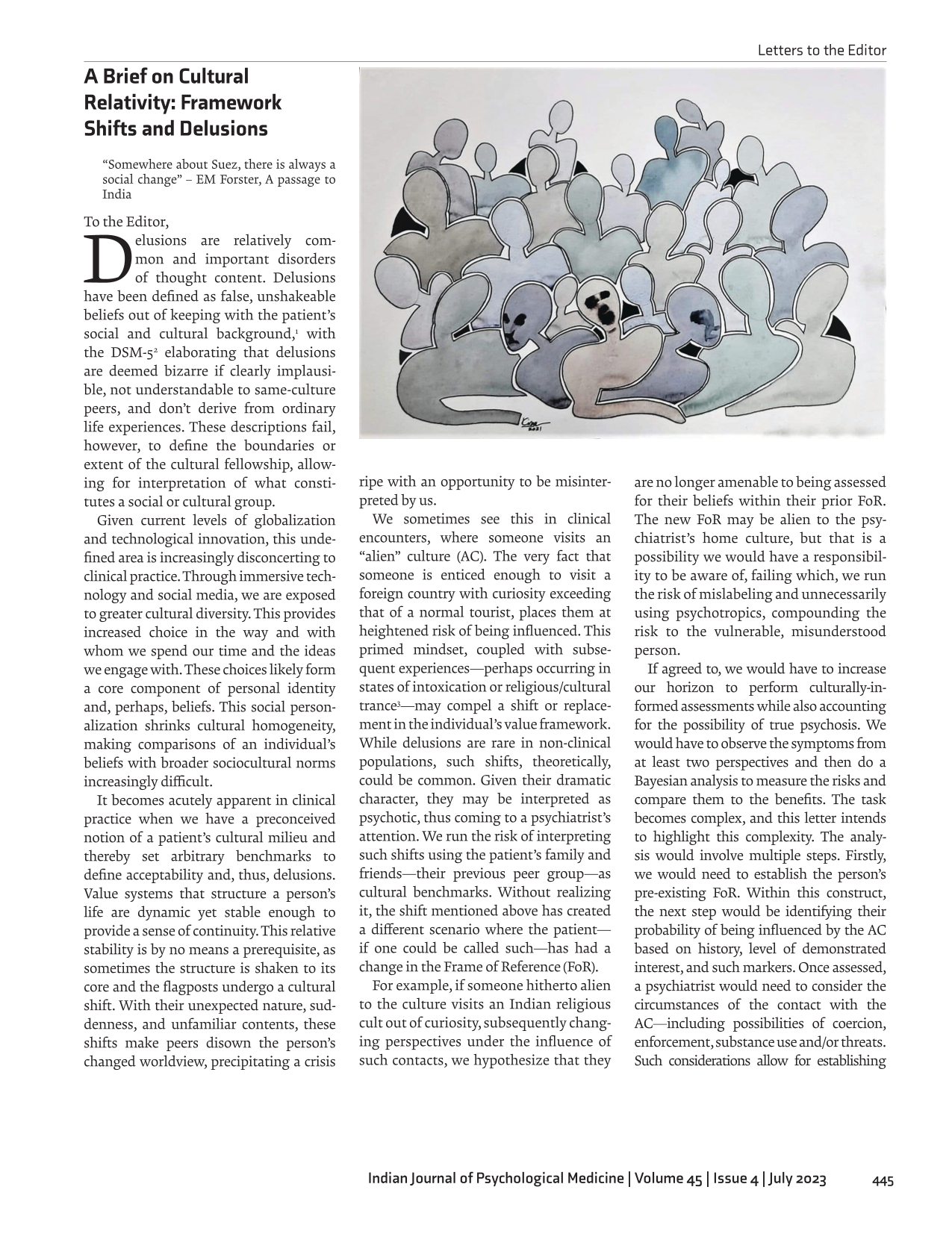
“Somewhere about Suez, there is always a social change” – EM Forster, A passage to India
To the Editor,
Delusions are relatively common and important disorders of thought content. Delusions have been defined as false, unshakeable beliefs out of keeping with the patient’s social and cultural background, 1 with the DSM-5 2 elaborating that delusions are deemed bizarre if clearly implausible, not understandable to same-culture peers, and don’t derive from ordinary life experiences. These descriptions fail, however, to define the boundaries or extent of the cultural fellowship, allowing for interpretation of what constitutes a social or cultural group.
Given current levels of globalization and technological innovation, this undefined area is increasingly disconcerting to clinical practice. Through immersive technology and social media, we are exposed to greater cultural diversity. This provides increased choice in the way and with whom we spend our time and the ideas we engage with. These choices likely form a core component of personal identity and, perhaps, beliefs. This social personalization shrinks cultural homogeneity, making comparisons of an individual’s beliefs with broader sociocultural norms increasingly difficult.
It becomes acutely apparent in clinical practice when we have a preconceived notion of a patient’s cultural milieu and thereby set arbitrary benchmarks to define acceptability and, thus, delusions. Value systems that structure a person’s life are dynamic yet stable enough to provide a sense of continuity. This relative stability is by no means a prerequisite, as sometimes the structure is shaken to its core and the flagposts undergo a cultural shift. With their unexpected nature, suddenness, and unfamiliar contents, these shifts make peers disown the person’s changed worldview, precipitating a crisis ripe with an opportunity to be misinterpreted by us.
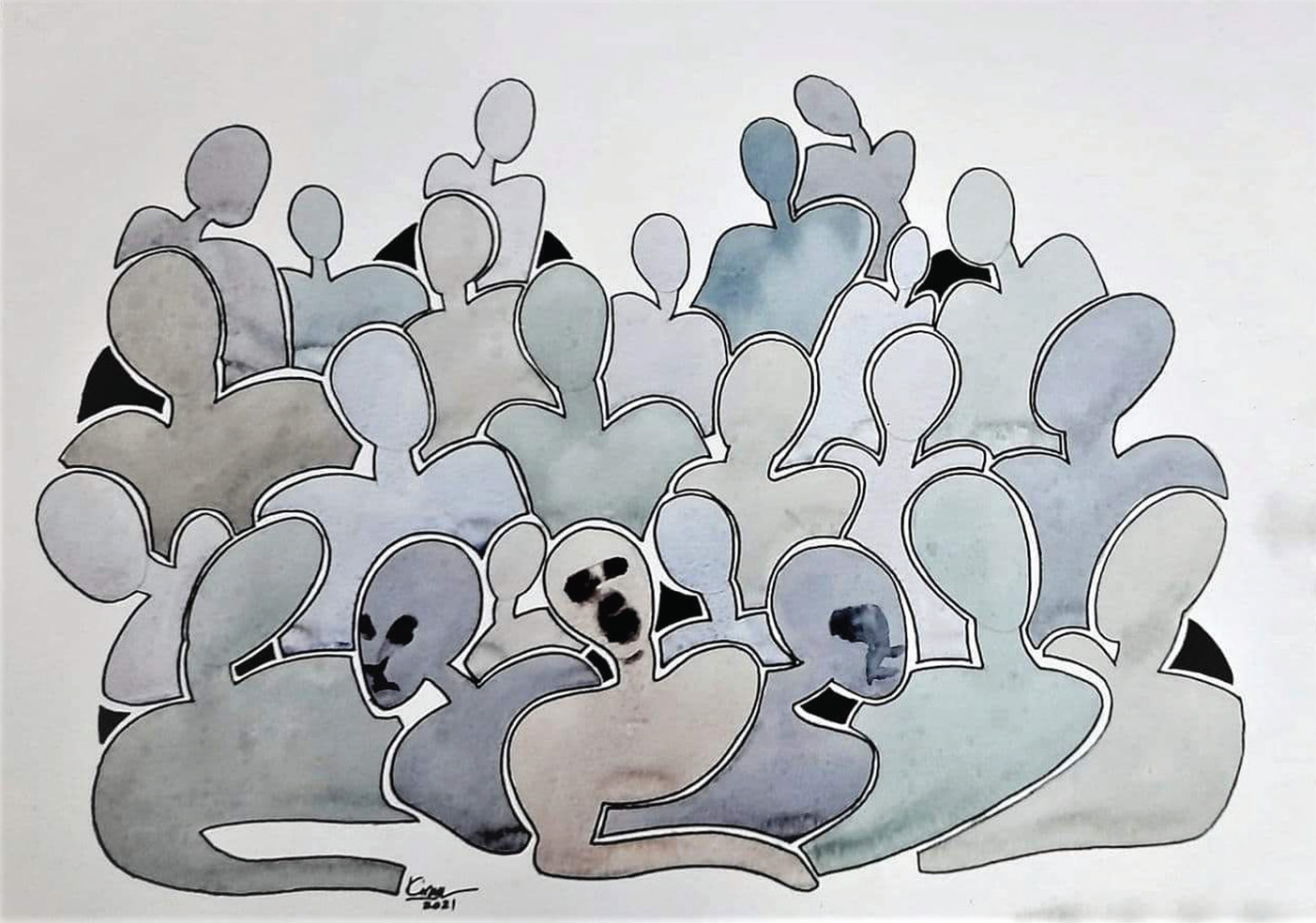
We sometimes see this in clinical encounters, where someone visits an “alien” culture (AC). The very fact that someone is enticed enough to visit a foreign country with curiosity exceeding that of a normal tourist, places them at heightened risk of being influenced. This primed mindset, coupled with subsequent experiences—perhaps occurring in states of intoxication or religious/cultural trance 3 —may compel a shift or replacement in the individual’s value framework. While delusions are rare in non-clinical populations, such shifts, theoretically, could be common. Given their dramatic character, they may be interpreted as psychotic, thus coming to a psychiatrist’s attention. We run the risk of interpreting such shifts using the patient’s family and friends—their previous peer group—as cultural benchmarks. Without realizing it, the shift mentioned above has created a different scenario where the patient—if one could be called such—has had a change in the Frame of Reference (FoR).
For example, if someone hitherto alien to the culture visits an Indian religious cult out of curiosity, subsequently changing perspectives under the influence of such contacts, we hypothesize that they are no longer amenable to being assessed for their beliefs within their prior FoR. The new FoR may be alien to the psychiatrist’s home culture, but that is a possibility we would have a responsibility to be aware of, failing which, we run the risk of mislabeling and unnecessarily using psychotropics, compounding the risk to the vulnerable, misunderstood person.
If agreed to, we would have to increase our horizon to perform culturally-informed assessments while also accounting for the possibility of true psychosis. We would have to observe the symptoms from at least two perspectives and then do a Bayesian analysis to measure the risks and compare them to the benefits. The task becomes complex, and this letter intends to highlight this complexity. The analysis would involve multiple steps. Firstly, we would need to establish the person’s pre-existing FoR. Within this construct, the next step would be identifying their probability of being influenced by the AC based on history, level of demonstrated interest, and such markers. Once assessed, a psychiatrist would need to consider the circumstances of the contact with the AC—including possibilities of coercion, enforcement, substance use and/or threats. Such considerations allow for establishing the tenacity of the new FoR, and only within this framework can psychiatrists search for evidence favoring psychoses. This exercise would go beyond utilizing maximum corroborating evidence from multiple sources and would require the psychiatrist to view this evidence through the new FoR.
This letter intends to re-emphasize a basic tenet of delusions—their cultural relativity. We also wish to remind ourselves that FoR shifts are plausible and, therefore, should be discounted with extreme care and diligence. In the modern world, we cannot rely on past conceptions of social or cultural belief, easily separated by a nation’s geographical boundaries. In an ever- developing technological age characterized by immersive virtual experiences and intellectual and ideological echo chambers, moving forward, we must question the conceptualization of cultural background.
Footnotes
Declaration of Conflicting Interests
The authors declared no potential conflicts of interest with respect to the research, authorship and/or publication of this article.
Funding
The authors received no financial support for the authorship and/or publication of this article.