



Abstract

Drug use and road traffic injuries (RTIs) are two major public health concerns worldwide. Approximately 1.3 million people die yearly due to RTIs, 93% of which occur in low- and middle-income countries. 1 RTIs are projected to become the fifth leading cause of mortality globally by 2030, according to the World Health Organization (WHO), imposing a huge burden on economic, healthcare, and social systems. 2 RTIs require substantial skilled human resources, health care systems, and socioeconomic and legal infrastructure and warrant preventive initiatives globally and nationally.
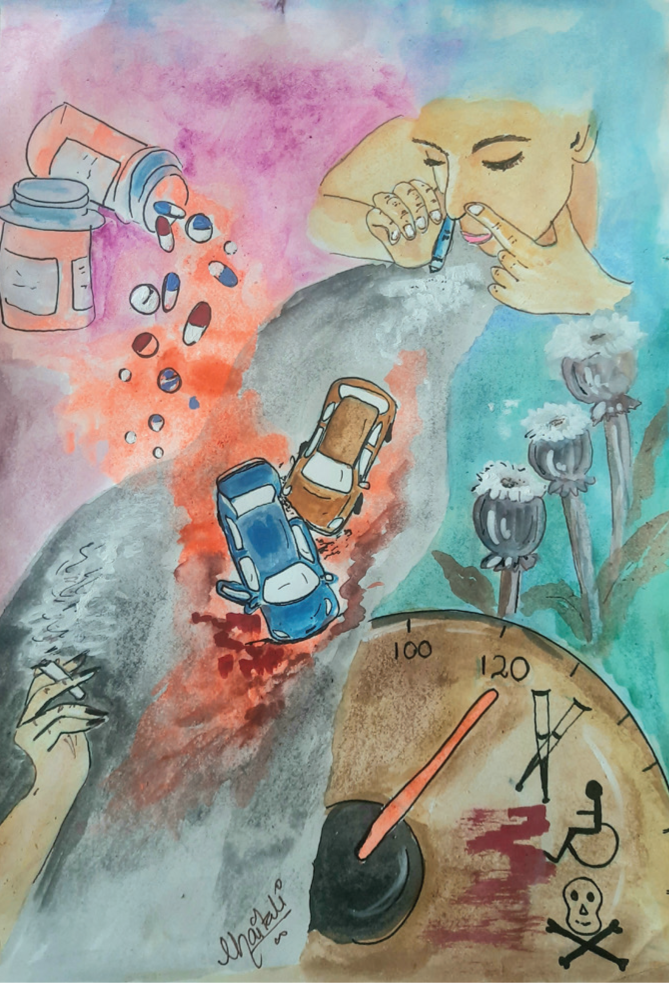
Among the various preventable causes of RTI-related morbidity and mortality, driving under the influence of alcohol and other drugs is a crucial factor.1,3 Psychoactive drugs alter mental functioning, including delayed reaction time and information processing and reduced perceptual-motor co-ordination, motor performance, and attention.4–6 These effects may lead to impaired vehicular control, resulting in RTIs. Driving under the influence of drugs (DRUID) is associated with high-risk behaviors like over-speeding, violating traffic rules, and increased lane-weaving, which endanger the life of not only the driver but also the passengers, other drivers, and pedestrians on the road.7,8 Potential effects that are unsafe for driving, like sedation, impaired concentration, and delayed reflexes, have also been observed with the use of prescription medications such as benzodiazepines, antidepressants, and antipsychotics.9,10
Growing Concern
While alcohol-related traffic deaths have declined over the years, drug-impaired driving is growing.6,11,12 Roadside surveys show that the percentage of the driving population that tested positive for one or more drugs ranged between 3.9%–20.0%.8,13 In different countries, self-reported rates of driving after using psychoactive drugs varied between 3.8% and 29.9%.7,11,14 Prevalence of use of drugs (such as amphetamines, benzodiazepines, cannabis, and cocaine) among persons fatally injured in a road traffic crash varied between 8.8% and 33.5%.14,15
A comprehensive report by the European Monitoring Centre for Drugs and Drug Addiction (EMCDDA) estimated that 0.3%–1.3% of the general driving population drives a car under the influence of a combination of alcohol and drugs of abuse. 16 This is an alarming observation, since drivers who have used drugs are significantly more likely to be culpable for a fatal accident than nonusers, especially after using multiple drugs.1,8 Possible factors contributing to increased reports of RTIs due to DRUID are a global increase in acceptance of recreational and experimental drug use, efficient identification by emergency services, and increased availability and usage of drug testing in hospital settings.12,17
It is important to note that all this evidence is generated from American and European countries, when it is the Low-Middle Income Countries that contribute to 62% of the global burden of road traffic accidents (RTAs). 1 The Southeast Asia region (SEAR) has the world’s largest burden of RTAs and related injuries. It has been estimated that SEAR has about 30%–50% of all RTAs attributed to driving under the influence of alcohol and drugs. 18 Thus, an in-depth understanding of various dimensions of substance use in victims of RTIs is essential for an informed approach to law enforcement and preventive policies. Also, the last few decades have witnessed the development and circulation of many molecules, such as approved prescription medications and designer drugs, the cognitive effects of which may differ from those of known psychoactive substances in various aspects. The possibility of driving under the influence of these newer molecules cannot be ignored, and systematic research and development of techniques for their detection in body fluids are needed.
Indian Scenario
Much like the rest of the world, RTIs display a growing trend in India. A total of 4,12,432 RTAs were reported by states and union territories (UTs) during 2021 which claimed 1,53,972 lives and injured 3,84,448 persons. 19 In India, the number of deaths due to RTIs increased by 58.7% (43.6 to 74.7%) from 1990 to 2017. 20 RTIs were the leading cause of death in males aged 15–39 and the second leading cause in this age group for both sexes combined in the same year. 20 Recent studies indicated a similar increase in deaths and incidence cases due to RTIs, predicting that RTIs may become a serious public health issue in the country in the coming years.21,22
Several risk factors have also been discussed for this alarming rise, including infrastructural causes like poor maintenance of roads, low adherence to safety standards, and weak enforcement of traffic policies.22,23 A few authors have attempted to draw attention towards the changing patterns of substance use among the driving population, secondary to economic advancement in the country. 3 National surveys aimed at estimating substance use in India, conducted in 2001 and 2019, both provided state-wise prevalence of use of substances (alcohol, cannabis, opioids, volatile solvents, stimulants, etc.). Both surveys indicated the need for detailed national- and state-level research on the extent and public health and economic impact of substance use in the country.24,25 Along with these, a comprehensive understanding of the various dimensions of DRUID, such as the nature of the drugs, timing of consumption, profile of users, and its public health impact, is essential for an informed policy approach to law enforcement.
Let There Be Light
The risk of getting involved in an RTA varies depending on the psychoactive drug used. The relative risk of RTI fatality under its influence is 5.17 for amphetamines, 2.96 for cocaine, 2.30 for benzodiazepines, 1.68 for opiates, and 1.26 for cannabis. 2 Relative risks for injury and property damage are even higher. These estimates may differ from region to region, especially for developing countries.
India, in particular, has a significant burden of substance use and related sociopolitical issues. The prevalence of use among the population aged 10–75, as per the recent nationally representative survey on the magnitude of substance use in India, 2019, was 2.8% for cannabis, 2.1% for opioids, 1.08% for sedatives, 0.7% for volatile solvents, and 0.18% for amphetamine-type stimulants. However, India remains in the dark as far as research evidence regarding DRUID is concerned. 26 The annual national records of road accidents in India published by the Ministry of Road Transport & Highways, Government of India, mention injuries due to drug and alcohol use in a single category. 19 There are only a few studies on the topic of driving under intoxication, mostly taken from victims brought to emergency departments27–29 and discussing mostly alcohol. There is only one published systematic review from India on driving under intoxication, which included 23 studies. While 21 of these mentioned only alcohol, 2 studies mentioned other drugs, without specifying their names, types or nature. 3 Only one observational study provided a urinalysis-based qualitative assessment of illicit drug use among injured drivers brought to a trauma center, reporting the presence of opiates (13%), cannabis (7%), and benzodiazepines (7%) in the samples. More than one substance was detected in the urine samples of 11.5% of drivers. 27 It can be estimated that these values are quite an under-representation, as the study covered only 200 victims brought to a single center and those who provided written informed consent.
Besides, RTIs due to “alcohol and drugs” reported by the Ministry of Road Transport & Highways have no differentiation or classification of data based on age or gender. Research shows that drug use among women and adolescents is already a public health concern in India.25,30,31 Moreover, this population is hard to reach regarding prevention and treatment initiatives. Information on DRUID in these hidden vulnerable populations may prove vital in estimating the socioeconomic and public health impact of substance use in special populat- ion groups, which is already an under- researched area in India.
This lack of research evidence is a multifaceted issue. Beginning with the internal stigma associated with drug use to fear of legal implications and health- and vehicle insurance-related hassles, many systemic and policy-related factors may be responsible for non-disclosure of DRUID when the victims are brought to emergency departments. Often, staff providing trauma and emergency services are occupied with trying to stabilize the victims’ condition and performing life-saving procedures, at times missing out on tell-tale signs of drug use. Even when drug use is clinically identified, the medico-legal procedures take precedence over laboratory testing for confirma- tion of drug use and documentation for research purposes. In such a situa- tion, where disclosure and documentation may incur a heavy penalty, often political influence and other malpractices like bribery are employed to prevent the mention of driving under intoxication in the medico-legal records.
A large number of trauma centers in India do not have provision for bedside or laboratory testing for the presence of drugs in body fluids. 27 Roadside testing procedures like breath analyzers, commonly used to detect alcohol, have not been developed or approved for illicit drugs yet, making urine and blood testing the only means to confirm the presence of drugs in the system.12,32 Moreover, these tests are indicated only when required by law enforcement agencies, when the person is involved in an accident. This misses out on the vast majority of drivers under the influence of drugs, who may not be involved in an accident per se, but risk their own lives along with those of others on the road.
The current penalty for DRUID in India is laid down under section 185 of the Motor Vehicles Act, 1988, which incorporates driving intoxicated with alcohol as well as illicit drugs. It states that anyone driving under the influence of a drug “to such an extent as to be incapable of exercising proper control over the vehicle” shall be liable to punishment. 33 Again, while this law makes all driving under the influence punishable, the only time there is a reason to enquire about drug use is when there is a vehicular accident or vehicle-related incidences of violence on the road, leaving out a large proportion of the at-risk population.
This lack of research evidence is not only a blind spot in our knowledge of drug use and its public health impact, it may also be responsible for the lack of comprehensive laws and policy measures for the prevention and effective handling of incidents of DRUID. Also, due to the rampant nondisclosure of substance use on presentation to Emergency Medical Services and the legal implications that follow detection, these victims often fall through the cracks in the system, losing the opportunity to engage with addiction treatment services, including medication and psychotherapy aimed at safe use or abstinence from drug use. DRUID may also form a part of a maladaptive pattern of drug use, including dependence, which requires specialized treatment services. Missing out on such treatment opportunities contributes to the already massive treatment gap for substance use disorders and may lead to continued DRUID.
Providing timely help for substance use disorders at an opportune time, such as post-RTI, requires participation from multiple stakeholders, such as trauma and emergency services, addiction treatment services, the scientific research community, law enforcement agencies, and national policymakers. There is a need to develop ways to identify drivers under the influence of drugs before they get involved in accidents. Roadside urinalysis kits may prove useful in this regard. 32 Traffic police officers may be trained to identify the tell-tale signs (defying traffic rules, road rage, unsafe driving, combative behavior, etc.) and administer this test to any driver suspected of DRUID. While urinalysis has certain limitations, as it may detect substances with slow elimination half-lives, such as cannabis, long after their effects have worn off, confirmatory evaluation for such cases may reduce false positive results. 32 Trauma and emergency services may be equipped with bedside testing, and trained personnel (specialist, medical officer, nursing officer, counsellor, medical social worker, etc.) may be made available for engaging the victim with specialized addiction treatment services. In the various medico-legal issues that follow identification of DRUID, it is recommended that precedence may be given to seeking help for substance use disorders instead of punitive measures, and the Narcotic Drugs and Psychotropic Substances Act, 1985, may be invoked to provide a measure of immunity against prosecution to those willing to seek treatment.
Conclusion
DRUID is a potential public health concern in India, with significant lacunae in knowledge and scientific evidence. It is thus recommended that research focus be drawn on the various aspects of DRUID—maximum permissible limits of plasma concentration, relative risk estimation of morbidity and mortality in RTIs due to drug use, and their economic burden. The generated evidence may further be utilized in planning and implementing effective prevention initiatives and IEC (Information, Education and Communication) activities. Trauma and emergency staff may also be provided training to identify drug use in RTA victims. Trauma centers at least with a level 1 setup may be provided with bedside and/or laboratory testing for drug use and if it is detected, may engage the services of Addiction Medicine or Psychiatry professionals for specialized treatment and therapy once the patient is stable.
Footnotes
Declaration of Conflicting Interests
The authors declared no potential conflicts of interest with respect to the research, authorship, and/or publication of this article.
Funding
The authors received no financial support for the research, authorship, and/or publication of this article.