




Abstract

To the Editor,
Research is an essential aspect of medical science and it needs to be adequately addressed in the undergraduate (UG) curriculum in India. During the MBBS program, no focus was placed on the fundamentals of biomedical research. On the other hand, most medical graduates pursue postgraduate studies and biomedical research after completing their MBBS program, which necessitates a thorough understanding of research methods. Preparing MBBS students (who are interested in it) for biomedical research can assist them gain a better understanding of the subject, improving their quality as researchers.
The National Medical Council has transformed the traditional UG medical curriculum into a skill-based learning course. Competency-based medical education (CBME) has recently been introduced in India for medical graduates. The decision to offer two “mandatory” (supervised, experiential, immersive, and self-directed) electives in four-week blocks between MBBS Third Professional Parts 1 and 2 is welcome. It allows medical students to gain transformative experience in basic sciences or research and clinical sciences or rural/urban community experience. 1
The research included, in the form of a student-initiated study or part of faculty- led research, as part of the elective 1 one, can only be beneficial if the multiple stakeholders, including students, faculty mentors, and institutions, are well- oriented and attuned to the challenges. This, however, is not the case at present, when 332 (57.3%) medical colleges have not published a single research paper over 2005–2014 (which includes all forms of research, including faculty-led research). 2 A recent report that reviewed articles from 1990 to 2019 showed that only 6–10 medical colleges out of the existing 450 publish >60% of research papers in indexed journals. 3 Besides, the country has been pushing to create new medical colleges, which would undoubtedly increase the number of seats but would neither ascertain the level of teaching nor the uptake of CBME competencies.
The second rampant issue is in the structure of the elective module 1 itself. Limited time is provided for research electives: it takes minimum 2-6 months to get student-led research completed, and the current duration is limited to four weeks. There are no checks on institutional module development, though more than half of the government and private institutions have zero research output. Similarly, no module or course is being offered mandatorily on the lines of the Basic Course in Biomedical Research for postgraduates and faculty members, to develop research basics and ethics.
UG research contribution in the country is minimal, though trends of significant improvement have been noticed since the last decade.
4
However, there are several challenges at present:
Limited aptitude for research and research ethics: In a study, most students considered research a “waste of time” and “not worth participating.”
5
In a recent survey of >4000 students of government and private medical colleges in South India, >97%, across all years and interns, were never exposed to the idea of “research” or “publication.”
6
There was rampant plagiarism in UG medical work, around 59%.
7
Abysmal funding: Indian Council of Medical Research (ICMR) has recently increased its funding for UG medical research from ₹20,000 to ₹50,000, but the uptake of students as compared to applications remains extremely small. In 2019, out of 10,000 applicants, only 1367 got funding.
6
As per the report of ICMR, about 1500 students will be awarded the short-term studentship grant in 2023.
8
Intramural or institutional UG research grants can be beneficial in this regard but are currently provided by a few premier institutes only. Diminutive returns in the form of publications: The number of papers published in indexed journals, even ICMR- approved projects getting published in PubMed-indexed journals, is meagre.6,9 Challenges in showcasing research work: Limited accredited UG and postgraduate conferences exist in India to present their work; ditto with funding and travel grants for international presentations.
9
Lack of reinforcement: Less than a handful of institutions provide remuneration (in the form of awards and prizes for all the students involved in published articles, with special credit to first-author students).
9
Lack of reinforcement results in decreased inclination towards research.
Even though for the postgraduate medical students thesis writing is required by the curriculum, much of it is completed for the sake of completion and never published after the submission to university, due to a lack of the necessary aptitude developed during the UG years. 9
SWAYAM (Study Webs of Active–Learning for Young Aspiring Minds), a Government of India initiated platform, already hosts multiple online courses in the form of video lectures by the experts, printable resource materials, self-assessment tests, and online sessions for doubt clarification, at no cost to its users. 10 The platform can be used to host mandatory online courses, like MOOCs ( massive online open courses), focused on medical students, so that they can develop a basic understanding of research methodology and ethics before venturing to take on the research elective module, along with a refresher course for interns. 6
There is a need to have institutional policies and teacher training to ensure that faculty members have the necessary competency to promote a “research culture.”6,9 Hence, we created a point-to-point detailed module for faculty and students, as a guiding document for research initiated by UG medical students (Table 1). The students may document the details in their logbooks. After completion of the research elective, grades such as Poor, Average, Good, or Excellent may be given according to the student’s performance. Institutions need to make a specific, measurable, achievable, realistic, and time-bound (SMART) elective module, to make it feasible. A structured research elective will help medical graduates get sensitized for medical research and improve the number and quality of publications from most medical colleges.
Structure of Elective Module on Research Initiated by Undergraduate Medical Students.
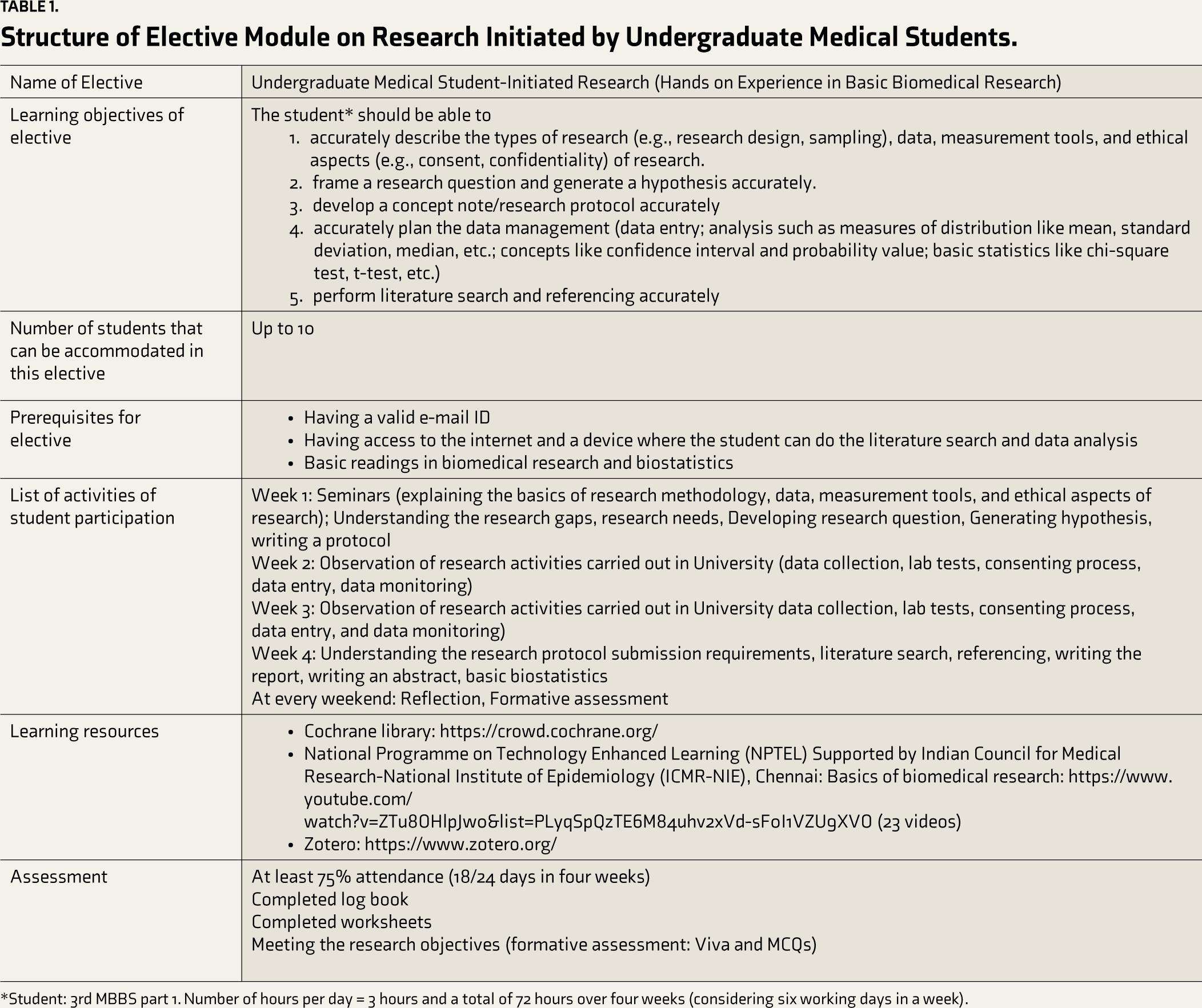
*Student: 3rd MBBS part 1. Number of hours per day = 3 hours and a total of 72 hours over four weeks (considering six working days in a week).
Footnotes
Declaration of Conflicting Interests
The authors declared no potential conflicts of interest with respect to the research, authorship, and/or publication of this article.
Funding
The authors received no financial support for the research, authorship, and/or publication of this article.