



Abstract
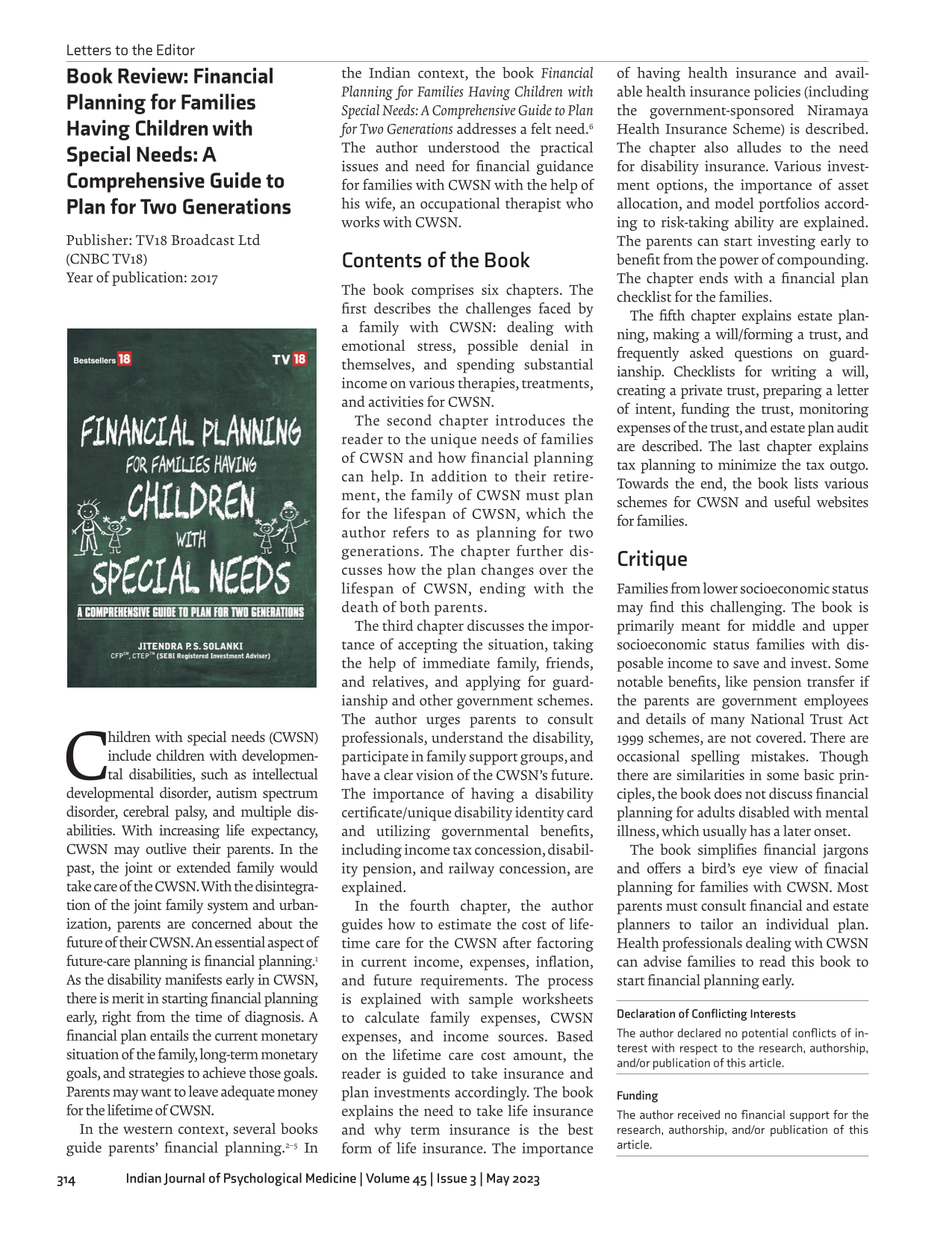
Publisher: TV18 Broadcast Ltd (CNBC TV18)
Year of publication: 2017

Children with special needs (CWSN) include children with developmental disabilities, such as intellectual developmental disorder, autism spectrum disorder, cerebral palsy, and multiple disabilities. With increasing life expectancy, CWSN may outlive their parents. In the past, the joint or extended family would take care of the CWSN. With the disintegration of the joint family system and urbanization, parents are concerned about the future of their CWSN. An essential aspect of future-care planning is financial planning. 1 As the disability manifests early in CWSN, there is merit in starting financial planning early, right from the time of diagnosis. A financial plan entails the current monetary situation of the family, long-term monetary goals, and strategies to achieve those goals. Parents may want to leave adequate money for the lifetime of CWSN.
In the western context, several books guide parents’ financial planning.2–5 In the Indian context, the book Financial Planning for Families Having Children with Special Needs: A Comprehensive Guide to Plan for Two Generations addresses a felt need. 6 The author understood the practical issues and need for financial guidance for families with CWSN with the help of his wife, an occupational therapist who works with CWSN.
Contents of the Book
The book comprises six chapters. The first describes the challenges faced by a family with CWSN: dealing with emotional stress, possible denial in themselves, and spending substantial income on various therapies, treatments, and activities for CWSN.
The second chapter introduces the reader to the unique needs of families of CWSN and how financial planning can help. In addition to their retirement, the family of CWSN must plan for the lifespan of CWSN, which the author refers to as planning for two generations. The chapter further discusses how the plan changes over the lifespan of CWSN, ending with the death of both parents.
The third chapter discusses the importance of accepting the situation, taking the help of immediate family, friends, and relatives, and applying for guardianship and other government schemes. The author urges parents to consult professionals, understand the disability, participate in family support groups, and have a clear vision of the CWSN’s future. The importance of having a disability certificate/unique disability identity card and utilizing governmental benefits, including income tax concession, disability pension, and railway concession, are explained.
In the fourth chapter, the author guides how to estimate the cost of lifetime care for the CWSN after factoring in current income, expenses, inflation, and future requirements. The process is explained with sample worksheets to calculate family expenses, CWSN expenses, and income sources. Based on the lifetime care cost amount, the reader is guided to take insurance and plan investments accordingly. The book explains the need to take life insurance and why term insurance is the best form of life insurance. The importance of having health insurance and available health insurance policies (including the government-sponsored Niramaya Health Insurance Scheme) is described. The chapter also alludes to the need for disability insurance. Various investment options, the importance of asset allocation, and model portfolios according to risk-taking ability are explained. The parents can start investing early to benefit from the power of compounding. The chapter ends with a financial plan checklist for the families.
The fifth chapter explains estate planning, making a will/forming a trust, and frequently asked questions on guardianship. Checklists for writing a will, creating a private trust, preparing a letter of intent, funding the trust, monitoring expenses of the trust, and estate plan audit are described. The last chapter explains tax planning to minimize the tax outgo. Towards the end, the book lists various schemes for CWSN and useful websites for families.
Critique
Families from lower socioeconomic status may find this challenging. The book is primarily meant for middle and upper socioeconomic status families with disposable income to save and invest. Some notable benefits, like pension transfer if the parents are government employees and details of many National Trust Act 1999 schemes, are not covered. There are occasional spelling mistakes. Though there are similarities in some basic principles, the book does not discuss financial planning for adults disabled with mental illness, which usually has a later onset.
The book simplifies financial jargons and offers a bird’s eye view of finacial planning for families with CWSN. Most parents must consult financial and estate planners to tailor an individual plan. Health professionals dealing with CWSN can advise families to read this book to start financial planning early.
Footnotes
Declaration of Conflicting Interests
The author declared no potential conflicts of interest with respect to the research, authorship, and/or publication of this article.
Funding
The author received no financial support for the research, authorship, and/or publication of this article.