




Abstract

Suicide is defined as either an action of commission or omission resulting in the loss of one’s life, and attempted suicide is when the above action is unsuccessful. Suicide attempts result from the interaction between biological, psychological, genetic, sociological, and environmental factors. According to WHO, around 8 lakh people die because of suicide every year, and 25 times more attempt suicide. 1 Until the start of the 19th century, most countries had legislation in place to punish those who attempted suicide. The last 50 years saw a change in the above pattern. A systematic review found that around 25 countries still have legislations in place to punish those who attempt suicide. These include Bangladesh, Pakistan, Ghana, Guyana, Kenya, Malaysia, and Myanmar. 2
The Mental Healthcare Act (MHCA) 2017 has been a milestone event for India in this regard. This article discusses certain key practical challenges concerning the decriminalization of suicide in India, especially in medical settings, and then provide specific suggestions that might help address these challenges. First, we present a brief overview of how suicide has been viewed in the Indian legal systems thus far.
Legal Scenario in India
In cases of attempted/completed suicide, two legal questions arise: (a) Is it suicide or homicide? and (b) Is there an abetment (i.e., instigation, intentional aid, or conspiring) for suicide? Different Indian Penal Code (IPC) sections deal with these issue—IPC 309, IPC 306, IPC 302, and IPC 304. As per the IPC section 309 of 1860, those who attempt suicide shall be punished with a jail term of up to one year. Various rationales have been given for IPC 309, such as the concept of “right to life” and taking away life being considered a crime against the state, to punish those who disturb the public order by threatening to commit suicide, and lastly, the justification was that punishment would act as a deterrent to further attempts of suicide. 3 IPC 306 deals with the abetment of suicide and says that anyone who abets the commission of suicide shall be punished with a jail term of up to ten years. Multiple reports and experts in the past had advocated for completely dropping IPC 309 from the statute book. However, instead, IPC section 309 was amended in 2016 where it is specifically mentioned that “suicide attempt committed in a manner that is likely to cause breakdown to public order” should be dealt under the section.

Section 115 (1) of MHCA 2017 says that “Notwithstanding anything contained in section 309 of the IPC any person who attempts to commit suicide shall be presumed, unless proved otherwise, to have severe stress and shall not be tried and punished under the said Code.” This section clearly states that until severe stress has been ruled out, attempted suicide is considered a byproduct of stress, and such a person shall not be tried and punished in a court of law. The next subsection 115 (2) of MHCA 2017 further mentions that “The appropriate Government shall have a duty to provide care, treatment, and rehabilitation to a person, having severe stress and who attempted to commit suicide, to reduce the risk of recurrence of attempt to commit suicide.” So, it is the duty and responsibility of the concerned government to provide appropriate treatment for those who attempt suicide.
Though none of the above sections mention reporting of attempted suicides (other than those causing disturbance to public order) to the police, the practice of reporting all suicide attempts (irrespective of the risk of causing disturbance to public order) continues, and once police is informed, they conduct an informal interrogation of the person who attempted suicide. Furthermore, a news report mentioned that “awareness among police personnel with respect of Mental Health Care Act—2017 is poor because of which they proceed with filing case under IPC 309, and after consultation with senior officers the charges are dropped.” 4
Psychiatric Perspective
Informing police and registering the patient as Medico-Legal Case (MLC) has its own implications with respect to the mental health of the victim. Even if we consider that IPC 309 was in place to act as a deterrent to those who attempt suicide, there is no supporting evidence for this stand. 3 When police receive an intimation about attempted suicide, they proceed to interview the patient. This might make the patient feel like being interrogated and therefore has the risk of increasing the already risen levels of stress. In the above process, the person may also face treatment delays. 4 Consequently, some people who have attempted suicide might not even approach healthcare providers because of the fear of police interrogation. 5
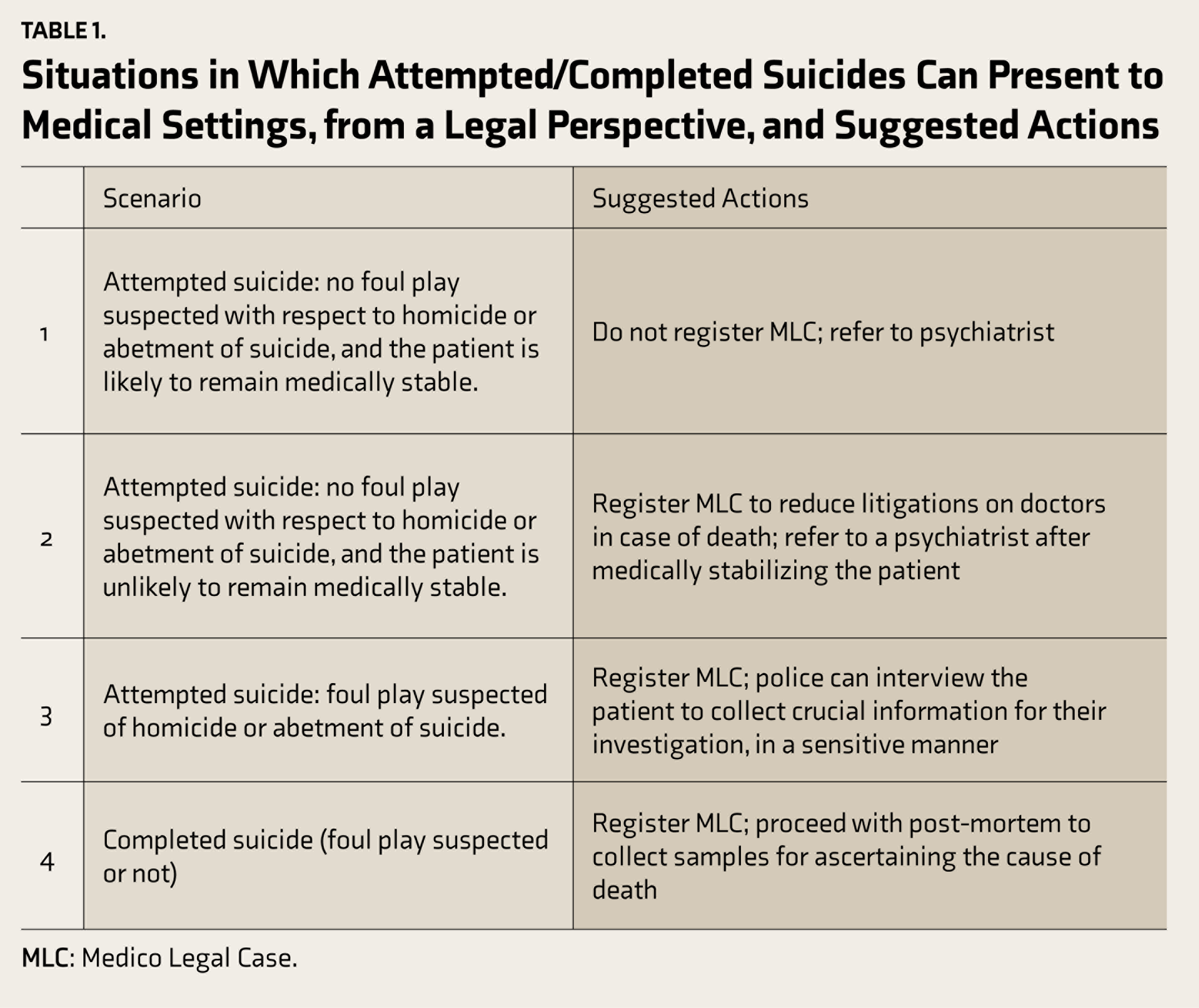
Situations in Which Attempted/Completed Suicides Can Present to Medical Settings, from a Legal Perspective, and Suggested Actions
Medical Perspective
Decriminalizing suicide has been a welcome step to decrease the anguish of the already suffering person who has taken this extreme step under stress. A medical/surgical specialist deals with many types of attempted suicide cases, ranging from drug overdose (OD), organophosphorus poisoning (OPP), attempted hanging, self-harm (cutting wrist arteries or throat artery), burns, etc. Amongst these modes of suicide, in cases of more lethal ones such as drug OD, OPP, or burns, the prognosis is difficult to predict early in the course. The fatality in such cases is influenced by multiple factors. In such cases, registering an MLC and informing the police become essential to gather initial evidence (e.g., toxicology samples) and have proper documentation from all those involved in the care of the patient and the hospital administration. Registering an MLC is an institutional practice backed by documented standard operating procedures (SOPs), made in collaboration with forensic medical experts, physicians, surgeons, and psychiatrists, that direct the treating physician regarding which of the suicides or attempted suicides need to be informed to the police. This also safeguards the treating physicians if any legal suit is filed against them. Intimation to police is a step after the patient’s death, or fatality in case of attempted suicide, which leads the way for other legalities like questioning to collect information or post-mortem as in case of death due to suicide. Intimating police (registering MLC) about each and every case of attempted suicide complicates the situation with unnecessary, mostly unempathetic, questioning of the persons, causing them more stress.
Specific Challenges and Suggestions to Address Them
As already mentioned, the two important questions for the law enforcement agencies to address in cases of attempted suicide are whether it is suicide or homicide and whether there was any abetment to suicide. Based on the above two questions and medically stability of the patient there can be four different scenarios which are listed in Table 1 along with suggested actions on how to proceed in those scenarios.
While situation 4 in Table 1 is straightforward and the suggested practice is already in place, situations 1, 2, and 3 are challenging and require a change in existing practices. The current practice of reporting all the attempted suicides to police needs a serious relook. Importantly, we suggest a classification of the situations involving suicides and attempted suicides as presented in Table 1.
Interviewing the patient and his relatives is an essential first step which helps us in suspecting if there was abetment to suicide and if it was a homicidal attempt. further assistance in making the decision may also be sought from medical social workers who can collect important information from other significant persons such as neighbors, friends and co-workers. The treating physician can then document all the appropriate and relevant interview findings and avoid registering MLC if there is no suspected abetment to suicide, suspicion of a possible homicidal act, and if the patient is unlikely to become medically unstable.
While these suggested actions might be possible in many cases, it may not be easy and straightforward in certain cases. The decision in such cases can be purely subjective, and we suggest that the treating physician should err on the side of registering MLC. In such challenging instances, a new concept of “potential MLC” may be brought in. Here, the treating physician earmarks the case as potential MLC, continues to provide routine medical care, and delays the intimation to police until discharge from the emergency medical setting. At the time of discharge, the opinion of two other independent doctors can be sought regarding the need for intimating the police and a decision can be taken accordingly. By adopting this method, the responsibility of decision is shared, and the treating physician also gets adequate time to decide. If registering MLC is done only for the purpose of collecting the samples considering the possibility of death, we should bring in mechanisms where the police do not interview such patients.
The implementation part of the above concept is sure to come with multiple hurdles. The overburdened casualty medical officer or treating physician might be reluctant to ponder on the suggested actions and instead choose to register MLC for all attempted suicide cases, thereby reducing their workload. Such resistance can be addressed by conducting workshops and awareness programs on suicide and management of attempted suicide cases for such clinicians. There is also a need to collaborate with law enforcement agencies to address this situation effectively. Police personnel should be sensitized towards mental health issues of people who attempt suicide. We should periodically train them in handling persons who have attempted suicide (when abetment to suicide or attempt to homicide is suspected). There is also a need to develop Standard Operating Protocols with which the involvement of police can be restricted to a minimum and absolutely necessary situations. We deem that this article will help develop such SOPs.
Footnotes
Declaration of Conflicting Interests
The authors declared no potential conflicts of interest with respect to the research, authorship, and/or publication of this article.
Funding
The authors received no financial support for the research, authorship, and/or publication of this article.