




Abstract

Using token economy and monetary incentives as reinforcers is an evidence-based practice in psychiatry. It has improved self-care activities, social interaction, behavior, self-esteem, work participation, and productivity.1–3 In India, both the token economy and monetary incentives have been used effectively to motivate and reinforce clients’ work involvement.4,5 The type of reinforcer used and its operationalization vary across mental health rehabilitation centers (hereafter referred to as “centers”). There is a need to understand the pragmatic mechanisms of incentivization evolved by different centers.
Methodology
Our previous publication described the selected centers, the range of income generation programs (IGP) and related practices, and the proforma used for gathering data. 6 This article describes the type and quantum of incentives and strategies used to calculate incentives for clients involved in IGP.
Results
Among the 13 selected centers, the majority (n = 12) provided monetary incentives to clients. One center used the token economy. Most centers (n = 10) gave incentives monthly by cash, while two centers transferred it to the clients’ bank accounts. The monetary incentives ranged from ₹20 to ₹6000 per month (data not available for four centers). Two centers running vocational training centers paid salaries ranging from ₹7500 to ₹15000.
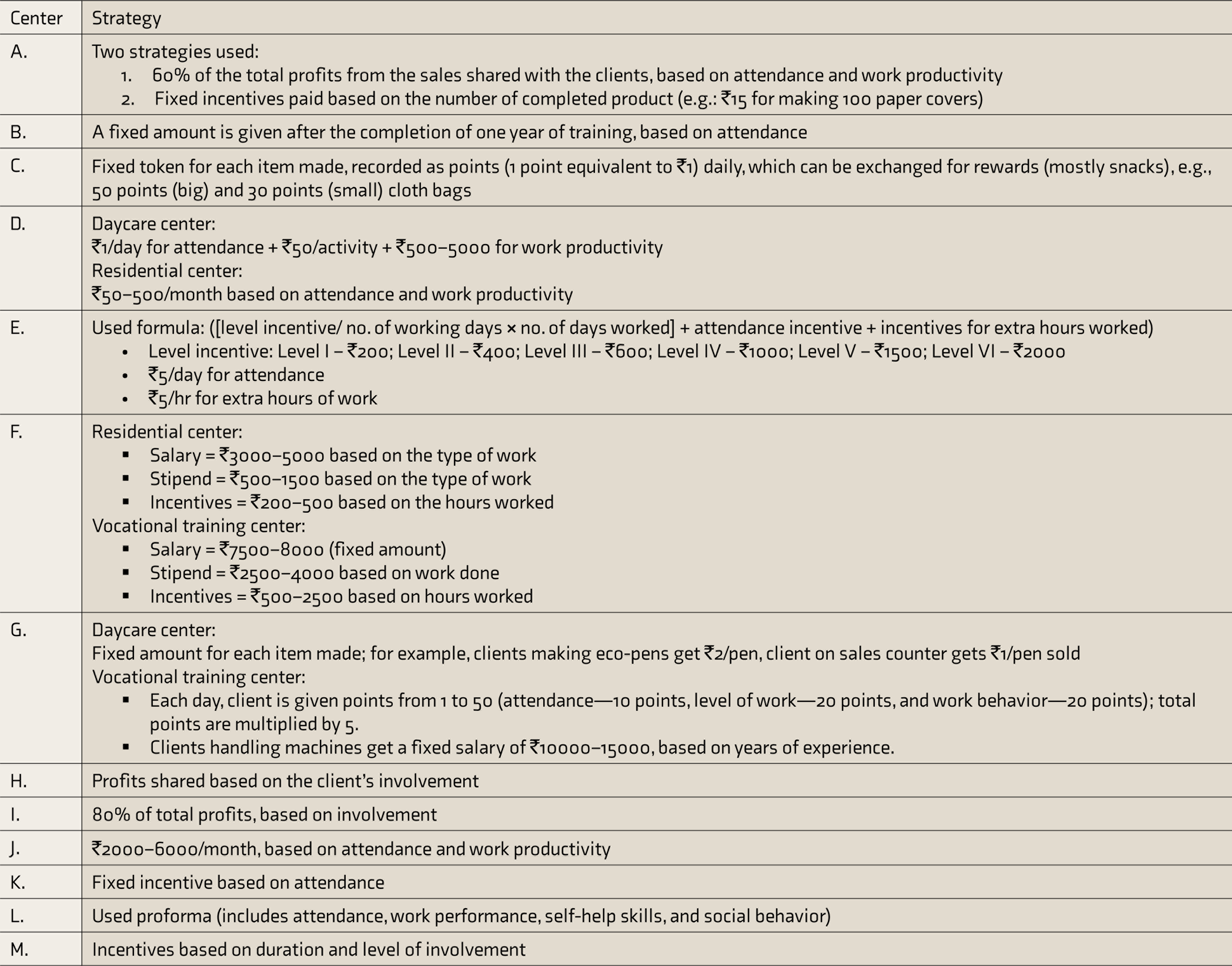
For calculating the incentives, the centers used various indicators, which were either related to the client’s attendance (including days worked and hours worked) or work (including work productivity, work performance, improvement, involvement, and the number of items made) or a combination of both. Eight centers used both attendance and work indicators (Table 1).
Strategies of Incentivizing Used by the Centers
Discussion
All centers used reinforcers for motivating the client’s participation in various IGP. The quantum and frequency of incentives varied substantially across centers. Using incentives for reinforcing work participation improves social and occupational functioning and reduces behavioral problems.5,7 Monetary incentives serve as an income source through work involvement for those who cannot sustain competitive employment. 8 Available literature states that some clients use incentives to buy medications and support their families. 9
Centers used diverse strategies to incentivize clients’ participation in IGP. Using attendance as an indicator appears straightforward, more comfortable, and less time-consuming but fails to consider the client’s productivity. Therefore, this strategy may suit low-functioning clients (persons with severe to profound developmental disabilities or prominent negative symptoms) or where rehabilitation primarily aims at engagement.
Using work indicators can be better suited for moderate- to high-functioning clients, as the strategy reinforces work differentially by assessing various performance-related outcome measures. A few limitations of this approach are (a) lack of standardized tools to measure work performance, (b) likelihood of subjective bias—it is challenging to measure all objective dimensions of performance with equal precision, (c) labor-intensiveness—it involves identifying work indicators, monitoring and measuring those indicators, and calculating the incentives for each client.
Combined approaches can take both attendance and work into account. Thus, it can be the most appropriate strategy for incentivizing clients with different needs and functionality and at different stages in their readiness to participate in various vocational activities. Eight centers had adopted the combined approach, possibly as they cater to a mixed group of clients (mental illness and intellectual developmental disabilities) with varying functionalities.
Limitation
Incentivization was explored at the institutional level and not at the individual level.
Conclusion
Indian centers use monetary incentives and token economy for reinforcing the clients’ participation in IGP, which highlights the practical utility of the approach. Incentives were offered depending on the clients’ attendance, work, or both. Using a combined approach of incentivization that incorporates both attendance and work-related indicators can be an effective method to accommodate the clients’ varying functionality. Further research is needed to understand the impact of using different incentive methods, its long-term implications for desired vocational rehabilitation outcomes, and its utility from the clients’ and caregivers’ perspectives.
Footnotes
Acknowledgements
We thank following centers for permitting to visit and publish findings: Amogh (Bengaluru), Government Medical College and Hospital (Chandigarh), Hombelaku (Manipal), Institute of Mental Health and Neurosciences (Calicut), Manas Rehabilitation Centre (The Society for Mental Health, Kerala)(Calicut), MS Chellamuthu Trust and Research Foundation (Madurai), Richmond Fellowship Society (I), (Bengaluru branch), Richmond Fellowship Society (I) (Lucknow branch), Schizophrenia Research Foundation (Chennai), Seva In Action (Bengaluru), Spastic Society of Karnataka (Bengaluru), The Association for the Mentally Challenged (Bengaluru), The Banyan (Centre for Emergency Care and Recovery) (Chennai).
Declaration of Conflicting Interests
The authors declared no potential conflicts of interest with respect to the research, authorship, and/or publication of this article.
Funding
AR was funded by the Indian Council of Medical Research (ICMR) fellowship, and Psychiatric Rehabilitation Services (NIMHANS) corpus funds.