




Abstract

Dear Sir,
Substance use and substance use related disorders posit a unique challenge in India given a large and growing vulnerable population, socio-economic transitions leading to changes in social dynamics and attributes, and geographical location making it a potential transit route.1,2 Though there are well-established substances that have been in regular use among the Indian population, newer substances have also made inroads, especially in some populations. 3 In this context, club drugs represent a growing potential issue that primarily affects the younger population and may become a public health challenge over time.
Club drugs are psychoactive drugs that are usually used by young adults and adolescents at bars, nightclubs, concerts, and parties, to reduce fatigue and enhance the pleasure of the “clubbing” scene. 4 Club drug use has been associated with serious physical and psychiatric disorders, risky sexual behaviors, HIV infection, violence, and criminality. 5 Since users of club drugs do not generally need to seek treatment at healthcare facilities, the use is often concealed, and the consequences are under the surface. Population surveys generally are not able to reach the users of these substances effectively. Hence, newspaper reports are often the sources of some usable information.
In view of the lack of literature from India, we aimed to synthesize information from the newspaper reports on club drugs. Google News database was used to identify relevant online English language regional or national newspaper reports over a two year period (January 1, 2017 to December 31, 2018). The search keywords included “India” (and “Delhi” OR “Mumbai” OR “Kolkata” OR “Chennai” OR “Hyderabad” OR “Bengaluru” ) AND (“Club drugs” OR “Cocaine” OR “Methamphetamine” OR “Ecstasy” OR gamma-Hydroxybutyric acid (“GHB”) OR “Ketamine” OR “Rohypnol” OR “Mephedrone”). Newspaper reports were included if they clearly identified reporting from India, were published in a newspaper, and reported about club drugs. Other substances were also included in this analysis if they were reported as a club drug. In the case of multiple reports of the same event, the chronologically first report was selected. Information about the type of club drug, type of news, and club drug seizure details was obtained from these reports by one of the investigators.
A total of 74 newspaper reports were included in this analysis. The news originated most commonly from Mumbai (n = 30), Delhi (n =15), Goa (n = 5), Hyderabad, Ahmedabad and Kolkata (n = 3 each), and Kochi (n = 1) (places other than the six largest cities turned up with keyword of “India”). The place was not mentioned in four reports. The drugs that were reported included cocaine in 40 reports, lysergic acid diethylamide (LSD) in 26, mephedrone in 15, 3,4-Methyl-enedioxy-methamphetamine (MDMA)/Ecstasy in 14, methamphetamine in 9, ketamine in 6, methaqualone in 5, amphetamine in 4, GHB in 3, and ephedrine in 3 reports. The type of news could be classified into police action (n = 61, 81.3%) or seizure of drugs (n = 59, 79.7%) in a majority. Representational or actual photos were presented in 70 articles (94.6%). Information about seeking help for substance use problems was present in only four articles (5.4%). A separate analysis was conducted of the seizure reports (n = 59, Table 1). It was seen that seizure was done largely by the police (n = 33, 55.9%), followed by Narcotics Control Bureau of India (n = 18, 30.5%), and Customs (n = 6, 10.2%). Airport (n = 12, 20.3%) and streets (n = 7, 11.9%) were the common venues of the seizure. The dark web was the source of procurement in about a sixth of the reports, and the substance was supposed to be transited to some other country in about a tenth of the reports.
Analysis of Seizure Reports (n = 59)
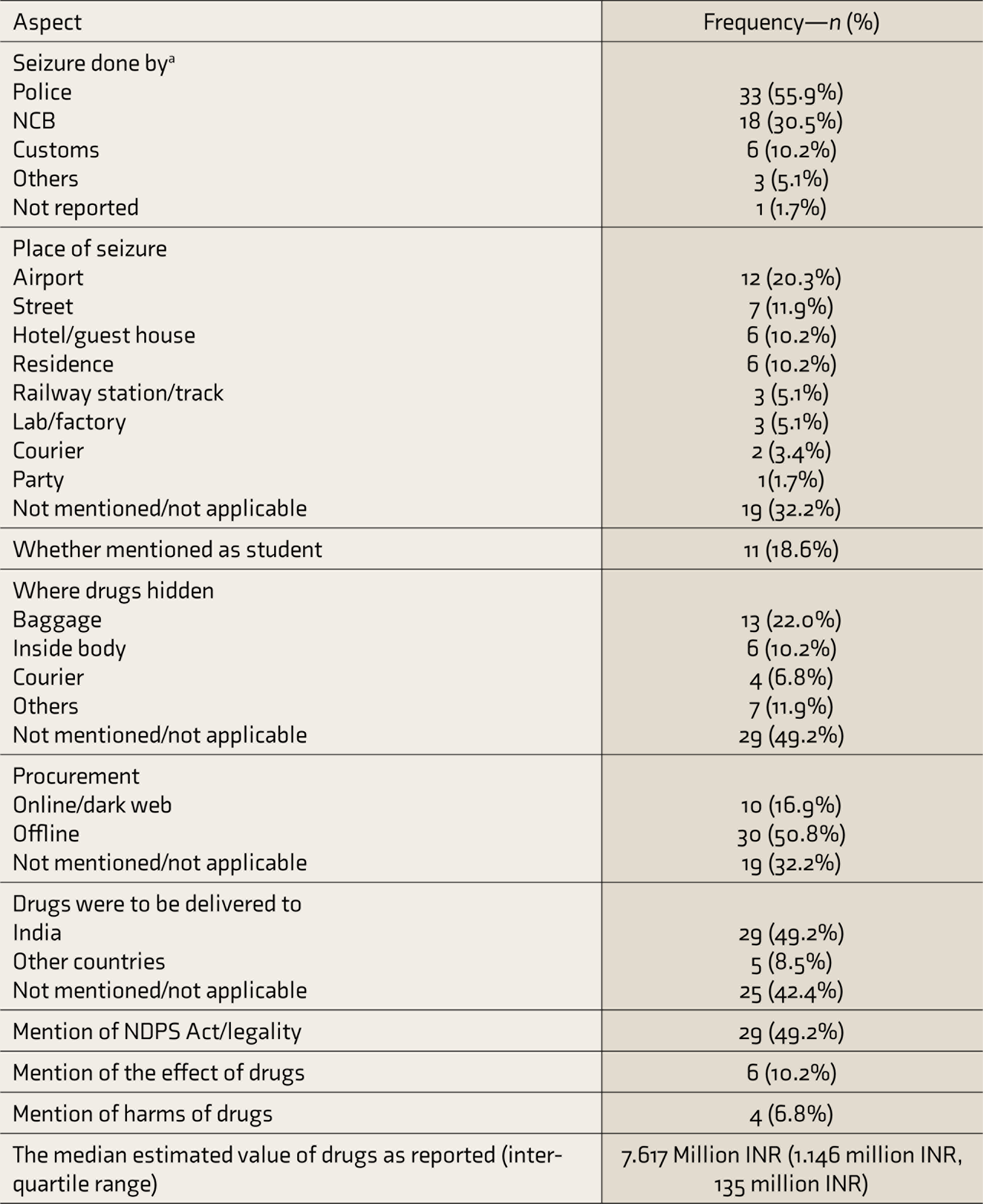
a Two seizures were done by two agencies simultaneously. INR: Indian Rupees, NCB: Narcotics Control Bureau of India, NDPS: Narcotic Drugs and Psychotropic Substances (Act of 1985).
The present synthesis of newspaper reports should be interpreted in terms of only web search of newspaper reports, limiting to only two years, not looking at trends of reporting, and relatively unconstrained definition of a “club drug.” The findings suggest that club drugs might become a further health and law enforcement challenge in the times to come. Among the reported substances, cocaine seems to be an important drug that is being seized and reported upon. The previous Drug Abuse Monitoring System (DAMS) data of India, which collects information of patterns of substances from different treatment centers, had reported cocaine infrequently among the treatment seekers. 6 The rates of seizure of cocaine, mephedrone, and methamphetamine would mean that healthcare services need to be cognizant of the potentially increasing use of stimulants. The findings complement the findings in the World Drug Report, which suggests that India may be an emerging origin, transit, or destination for drugs like ecstasy, cocaine, and amphetamines. 7 Law enforcement also should be better sensitized, enabling the officials to take necessary actions for detection and prosecuting wherever necessary. It has been observed that stimulants have gradually become an important substance of abuse and cause of mortality in South East Asia,8,9 but not yet in South Asia. A careful watch is required to prevent it from becoming a greater challenge. It would need attention from mental health professionals and psychiatrists when patients with abuse of these substances seek treatment either for the addictive disorders or comorbid psychiatric disorders.
Footnotes
Declaration of Conflicting Interests
The authors declared no potential conflicts of interest with respect to the research, authorship, and/or publication of this article.
Funding
The authors received no financial support for the research, authorship, and/or publication of this article.