



Abstract
To the Editor,
In India, online education emerged as an effective stopgap for continuing education during COVID-19- induced school closures. However, the transition to online learning might have been challenging for some students for varying reasons. Besides a few scientific publications, such challenges were spotlighted by multiple media reports of student suicides in the context of online education.1,2 The current study aimed to understand the association between student suicides and online education through a thematic analysis of the media reports.
Methods
A Google search was performed separately for each month from June 2020 to January 2021, by customizing the search period using the “tools” option. The search command used was: online classes, suicides, India. For each search, we used an inbuilt filter within the Google search that shows the results after omitting the entries that were similar to those already displayed. By combining the search results from all eight months, we identified 899 nonrepetitive news items. These news items were subjected to the screening of title and content. Our inclusion criteria were as follows: (a) news items reporting incidents of student suicide in the context of online education and (b) news items providing adequate demographic details to establish the uniqueness of the incident, such as details of the victims (name, age, gender, class, etc.) and details of the incidents (date, time, place, area of the police station, etc.), to avoid inclusion of the same incident more than once. For the incidents reported by more than one newspaper, we chose those with more detailed descriptions of the incident.
Results
Forty-two unique news reports were included for the analysis. After a detailed reading of the content, four nonoverlapping themes were identified. These were: (a) being unable to access online education, (b) being unable to cope with online education, (c) being scolded by the parents, and (d) unknown (reason not reported). We organized the demographic details and thematic categories in a Microsoft Excel Sheet and performed a descriptive analysis. Figure S1 explains the search strategy in detail. Table S1 provides the online links to the included news reports. Table 1 shows the information extracted from the news reports that were used in the analysis.
Student Suicides in India in Context of Online Education in India During COVID-19
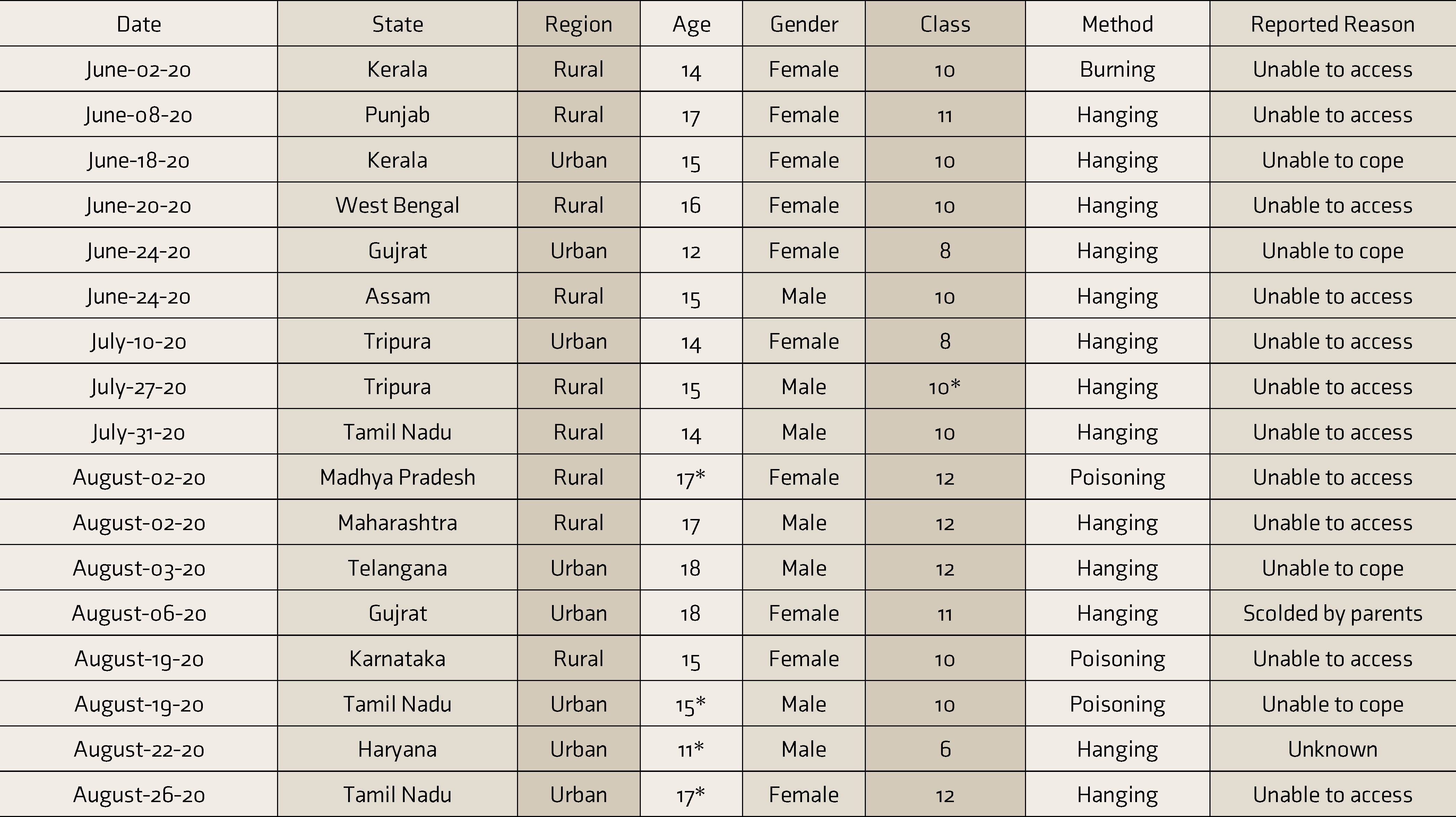
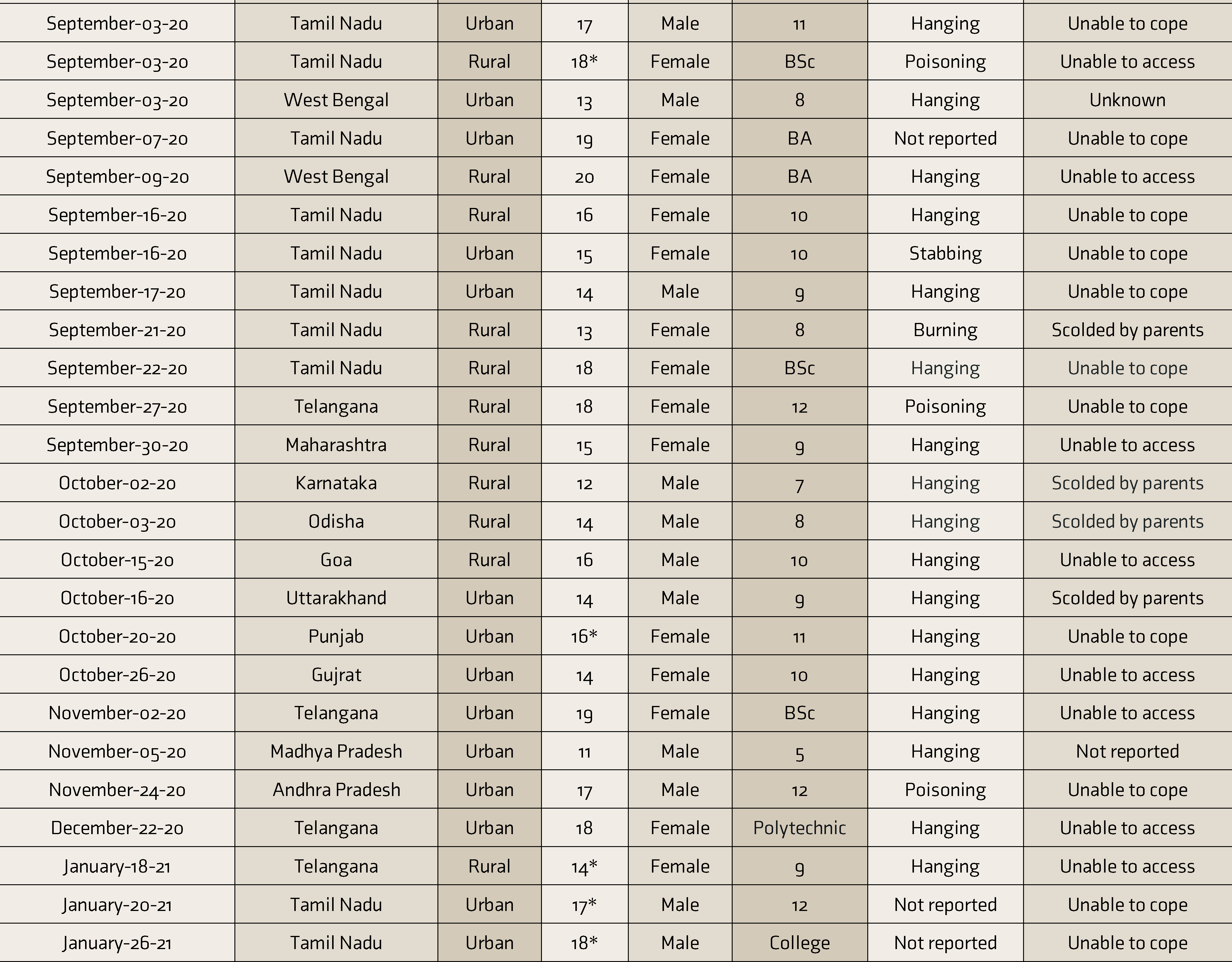
Among the victims, 79% (n = 33) were between 14 years and 18 years of age, 14% (n = 6) between 11 years and 13 years, and 7% (n = 3) between 19 years and 20 years. Overall, 57% (n = 24) of victims were females and 43% (n = 18) were males. The victims were from both urban (52%, n = 22) and rural (48%, n = 20) areas. These cases were reported across 14 states, with the maximum number being from Tamil Nadu (31%, n = 13). The most frequently reported theme (45%, n = 19) was the inability to access online education because of the unavailability of smartphones or internet facilities. The second most frequently reported theme (36%, n = 15) was the inability of the students to cope with online education, wherein they had expressed their difficulty in learning through the online classroom and the stress associated with it. The third most common theme (12%, n = 5) was being scolded by parents for not paying enough attention in the online classroom and getting distracted by online games, videos, or social media sites. In the remaining 7% cases (n = 3), victims were between 11 years and 13 years of age who died by suicide soon after attending the online class, for unknown reasons. The most commonly reported theme in the urban group was the inability to cope with online education (54.5%, n = 12), whereas in the rural group, it was the inability to access online education (70%, n = 14). With regard to gender differences, the most common theme among male students (38.9%, n = 7) was the inability to cope with online education, whereas for female students (58.3%, n = 14), it was the inability to access online education. A large majority (71.4%, n = 30) had used hanging as the method of suicide.
Discussion
Although online education has helped millions of children continue learning during the COVID-19 pandemic, the current study underscores the important challenges experienced in the Indian context. The most frequently reported theme associated with student suicides was the inability to access online education, which indicated unequal learning opportunities created by various socioeconomic disparities. A recent survey by the National Council of Educational Research and Training (NCERT) reported that nearly 27% of the students lack smartphones and laptops to study online. 3 Similarly, the United Nations International Children’s Emergency Fund (UNICEF) reported that only 24% of households in India have internet access. 4 Further, our urban-rural and gender-based comparative analyses showed that higher proportions of rural students and female students had died by suicide because of their inability to access online education than the corresponding comparator groups. More children from rural areas might be at risk of lagging in online education because of the poorer reach of technological advances in villages compared to towns or cities. According to the survey on “Household Social Consumption on Education in India,” less than 15% of households in rural India have internet access, compared to 42% urban households. 5 Additionally, female children belonging to socioeconomically weaker sections of the society, especially in rural areas, have lesser utilization of digital technology that might also be reflected in the access to online education. 6 In our study, the second most frequent theme underlying student suicide was inability to cope with online education. Online learning could be challenging for some students because of the lack of necessary technical knowledge and difficulty in clarifying doubts. Exclusive online education often fails to generate the opportunities and experiences obtained from attending the school, such as peer interactions, academic discussions, extracurricular activities, and finding support. Some of these challenges, including the negative mental health impact of a transition to online education among students, have been highlighted by a few recently published surveys from India and elsewhere.7–9 Additionally, some groups of children could be substantially more vulnerable to the stress related to the studies than others. In our study, more than half of the victims belonged to Class 10 and Class 12, which represents the board examinations in the Indian education system.
Our findings emphasize the need for diverse measures to improve access to online education for children, particularly those belonging to socioeconomically weaker sections and rural regions. Several creative ways might have to be used to enhance the coverage of online education to prevent the widening of the education gap in the country during the COVID-19 pandemic. More proactive initiatives are required to address the gender-based digital divide that creates barriers for girls to access online education. Promoting mental wellbeing among students is necessary to reduce psychological distress associated with difficulty incoping with online education. Teachers should be trained to identify psychological difficulties experienced by vulnerable students, such as those appearing for board examinations, and address their specific needs. Schools should take a flexible stance on the matters of attendance, syllabus completion, and conducting examinations to reduce stress among students.
Limitations and Future Directions
While these media reports provide a glimpse into the ground realities of online education in India, their credibility as scientific evidence may be poor because of several reasons. Further, as psychological autopsies were not performed in the reported incidents, the role that online education plays in student suicides cannot be conclusively established beyond being one of the potential risk factors. So far, only a few sporadic research reports have been published on this topic.1,10 More research is required to systematically explore the factors contributing to suicidal behavior among youth in the context of online education.
Footnotes
Declaration of Conflicting Interests
The authors declared no potential conflicts of interest with respect to the research, authorship, and/or publication of this article.
Funding
The authors received no financial support for the research, authorship, and/or publication of this article.