



Abstract

Respected Editor,
On November 10, 2020, India’s COVID-19 cases crossed 8.6 million, of which approximately 127,500 people succumbed. 1 The burden of multiple stressors, such as scarcity of personal protective equipment (PPE), undue work demands, pessimistic public attitudes, and physical attacks, instigate lasting moral injury on healthcare professionals (HCPs).2,3 Governmental and institutional strategies to address psychosocial well-being and mitigate these negative gestures from society are suboptimal in our country with diverse socio-cultural and regional disparities. We thoroughly searched the literature and official websites to shed light on various problems faced by HCPs during this pandemic and put forward a strategic model to overcome these tussles.
With a huge population of 1.36 billion in the country, every doctor and nurse in India caters to 1457 and 483 people, respectively, with an estimated shortage of 600,000 doctors and 2 million nurses.4,5 In addition to corona virus, HCPs in India are fighting another insidious threat—stigma. Incidents of eviction, ostracism, and mental harassment toward HCPs are repeatedly reported. 6 There have been incidents of mob attack, rape threats, verbal spats, and exhibitionism toward HCPs, due to the fear that they are vectors of coronavirus. 7 The petrifying phenomenon is that HCPs have been perceived as “an impending risk, as opposed to being a solution” to COVID-19.
HCPs are at high risk of having moral injury and mental-health problems while dealing with the challenges of COVID-19. 8 Apart from these challenges, HCPs are vulnerable to burnout, mental trauma, and depression. Hectic working hours, lack of protective gear, and separation from family have emerged as major factors contributing toward disturbed mental health. 8
An overburdened and crumbled healthcare system cannot manage an expanding pandemic if HCPs fall sick or surrender to moral injury. We propose a model to depict threats to HCPs during COVID-19 pandemic and the strategies to deal with it. The model emphasizes a delicate interplay between various factors that determine the efficiency of an HCP in COVID times. The model further depicts the factors threatening the efficiency of HCP (Figure 1, left wheel).
Strategic Model for Healthcare Professionals
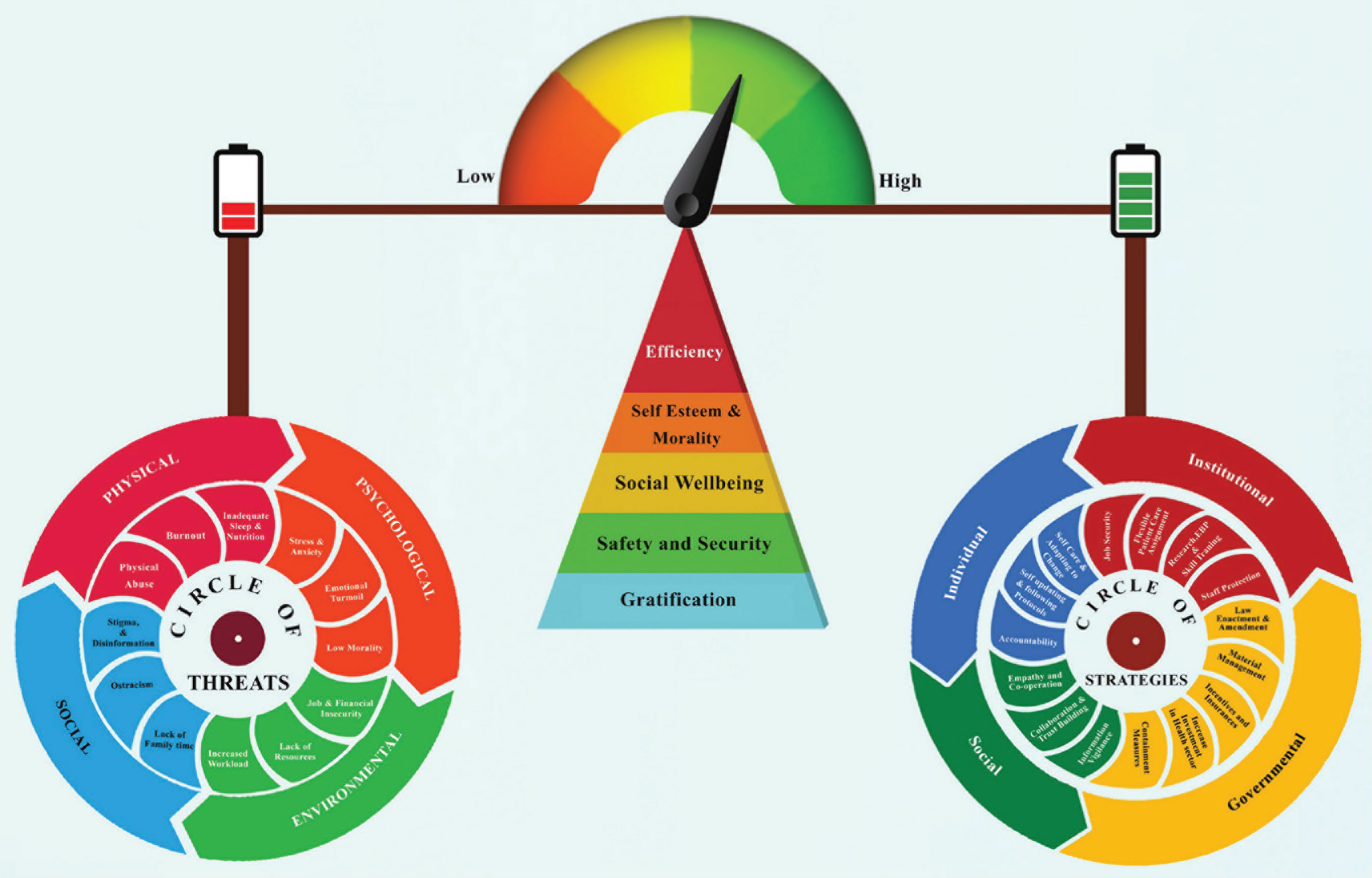
Threats can be broadly grouped as physical, psychological, social, and environmental. Physical stressors, such as excessive physical exertion due to long working hours in PPE, staff constraints, physical attacks, and inadequate rest and sleep, cause bodily damage to the worker. Psychological threats include existing low morale, stress, anxiety induced by sub- optimal working conditions, and the fear of infecting self, family, and community. The arduous task of triaging and ensuring equitable distribution of care to all the deserving patients is very stress inducing, as it may come in direct conflict with ethical, moral, and religious principles of HCPs. Among social factors, stigma exhibited by the very society they chose to serve, evictions, stone pelting, and the mounting number of HCPs infected induce a state of being ostracized. Among the environmental factors, poor working conditions, patient overload, lack of supplies, and unsafe conditions jeopardize an already strained HCP.
Strategically, the approach to compact threats can be four-pronged (Figure 1, right wheel). At the governmental level, the prime focus should be on enacting, implementing, and putting in place a system with zero tolerance on attack against the healthcare workforce. It is in the government’s capacity to ensure a smooth supply of equipment and well-validated protocols to ensure transparency. These can be done by increasing investments in the healthcare sector and contingency funding. Incentivizing and insuring HCPs can boost morale and zeal in the workforce.
Society has a pivotal role to play by being responsible and empathetic to the HCPs. There should be mutual trust and confidence-building measures to enhance cooperation and respect. Institutions have impactful roles in providing job security and staff protection by ensuring optimal working conditions and making the working environment as flexible as possible by diverting priority attention and resources to COVID care, without compromising attention to other emergency cases. Proper staff training, open communication, and ensuring adequate supplies and facilities can make staff in an institution feel part of the system.
Testing times like these call for a lot of effort at a personal level from the HCPs. These may include stress adaptation and change management strategies, openness to learn and contribute, and a high state of accountability and responsibility. This would also require moving out of routines and comfort zones and moving into an unknown, uncertain realm.
In summary, humankind is capable of amazing resilience, and healthcare is not an exception to it, albeit with support from the governmental, institutional, and societal systems. None of the strategies can exist in isolation; each one must turn to be the “Cape of Good Hope” through collaboration by giving priority to society.
Footnotes
The authors declared no potential conflicts of interest with respect to the research, authorship, and/or publication of this article.
Funding
The authors received no financial support for the research, authorship, and/or publication of this article.