




Abstract
The Government of India has issued guidelines for assessment and certification of disability according to Rights of Persons with Disabilities Act 2016. 1 Disability due to mental illness is measured and quantified by Indian Disability Evaluation and Assessment Scale (IDEAS). While the assessment for certification of neurological disability “is usually done six months after the onset of disease,” no minimum duration is specified for mental illness. 1 The Rehabilitation Committee of Indian Psychiatric Society, which drafted IDEAS, had recommended that the duration of illness should be a minimum of two years at the time of certification, and the number of months disabled in the last two years is scored. 2 In the gazetted version of IDEAS, the minimum duration of illness is not specified and the domain “the number of months disabled in the last two years” was replaced with the duration of illness (a score of 1 for duration < 2 years and 4 for duration > 10 years). 1 As per law, disability due to mental illness can be certified even during the first consultation for mental illness.
According to the National Mental Health Survey 2015−2016, the median duration of time taken from the onset of symptoms of mental illness to seeking professional care varies from 2.5 months (for depressive disorder) to 11 months (for bipolar affective disorder). 3 The mean duration of illness before seeking consultation at a tertiary center was around 5.5 years. 4 There is a lack of literature about the duration of illness at the time of disability certification in clinical practice.
Method
The Institute Ethics Committee approved the study. A retrospective chart review of disability certificates issued between January 2017 and December 2018 at National Institute of Mental Health and Neurosciences (NIMHANS), Bengaluru, a tertiary care center, was done. In this period, 931 and 123 disability certificates were issued for mental illness and neurological disorders, respectively. For 516 patients, the duration of illness at the disability certification was available from the case records.
Results
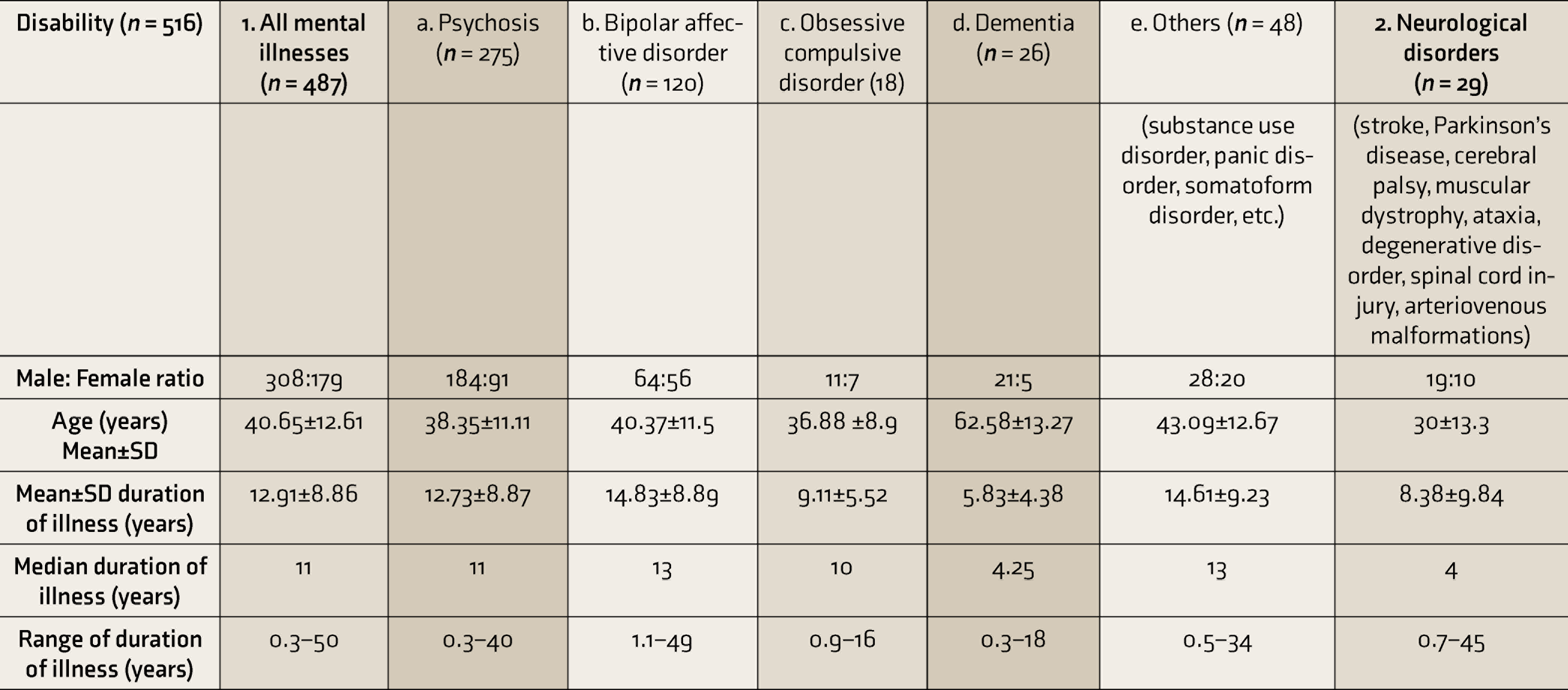
Psychosis (including schizophrenia, schizotypal, and other psychotic disorders) was the most common mental illness to be certified for disability (
Sociodemographic Profile and Duration of Illness at Disability Certification
Discussion
Though research suggests that disability due to schizophrenia plateaus by 5 years,5, 6 the median duration of illness at disability certification for psychosis was 11 years. The possible reasons for the delay in disability certification need to be studied prospectively. One possible reason may be delays in patients seeking tertiary care. Attitudinal barriers among health professionals towards certifying disability for mental illness or specific conditions like substance use disorder may also delay disability certification.
The present study suggests that a disability certificate is issued earlier for patients diagnosed with conditions where improvement with treatment is limited (including intellectual disability, autism spectrum disorder, dementia, and chronic neurological conditions). As treatment for mental illness results in a considerable reduction in disability, 7 health professionals treat the symptoms before certifying disability.
The government guideline is silent about treatment status at the time of certifying disability due to mental illness. 1 As per current guidelines, disability certification is possible for an untreated patient. An untreated patient with schizophrenia with a benchmark disability due to mental illness may not be disabled after the treatment is initiated. There is a discrepancy across states on this issue. Some states, like Uttar Pradesh, mandate treatment before certifying disability due to mental illness. 8 An expert committee constituted by the Indian Psychiatric Society had suggested three months of treatment before disability certification for mental illness. 9 This timeframe is arbitrary, and a proportion of patients may not respond to the first medication trial.
The timeframe for administering IDEAS needs to be clarified. For example, a patient may have a high IDEAS score at the time of hospitalization as compared to discharge. The draft IDEAS proposed by the Rehabilitation Committee of Indian Psychiatric society had recommended scoring the number of months disabled in the last two years. 2 The World Health Organization-disability assessment schedule assesses disability over the previous 30 days. 10
As this was a retrospective file review-based study, we were not able to assess the reasons for the delay in disability certification. We did not collect the details of whether the disability certificates were issued for the first time or renewed. The duration of the treatment trial, medication adherence, and response to treatment were not studied.
Conclusion
Disability certificate is issued earlier for dementia and other neurological disorders than mental illnesses. Government guidelines on disability certification for mental illness should specify the timeframe for administering IDEAS and the relevance of treatment status at the time of certification.
Footnotes
Acknowledgements
The authors acknowledge the institute and hospital administration of NIMHANS for support. The authors acknowledge valuable inputs from Dr Anil Nischal, Professor of Psychiatry, KIng George's Medical Univeristy, Lucknow.
Declaration of Conflicting Interests
The authors declared no potential conflicts of interest with respect to the research, authorship, and/or publication of this article.
Funding
The authors received no financial support for the research, authorship, and/or publication of this article.