




Abstract
Background:
Suicide in armed forces is a matter of concern despite adequate prophylactic measures that have been adopted to reduce it. Military psychiatrists routinely conduct psychological autopsies. It may reveal various biopsychosocial factors leading to suicide and may be helpful in suicide prevention too. A few studies have been done in Indian Armed Forces but all of them involve cases of attempted suicide. Our study is different as it uses the methodology of psychological autopsy to find out various psychosocial factors of suicide in armed forces.
Methods:
The present study was carried out in a large service hospital and included all suicide cases occurring in a particular strategic location from February 2014 to July 2017. A total of 16 suicide cases were investigated, and information was collected through visiting the scene, detailed semistructured interviews, the perusal of mobile call records, social website activities, notes in a social diary, bank statements, service record, and health records.
Results:
The majority (nine of sixteen) of suicide victims were less than 30 years of age. The most common method of suicide (ten of sixteen) was use of firearms. Family history of mental illness/suicide was seen in three of them. Three had a past history of mental illness. Two were abusing substance in the recent past. Behavioral change was noticed in three, and suicide notes were available in three cases. Five had expressed their intent to die.
Conclusions:
Strain of serving in frontiers is not a common stressor associated with suicide as commonly perceived.
Stress and strain of serving in frontier are not prominent cause of suicide in armed forces. Many lives can be saved by sensitising the environment about identifiable psychosocial stressors and early warning signs of suicide.Key Messages:
There were an estimated 793,000 suicide deaths worldwide in 2016. 1 This indicates an annual global age-standardized suicide rate of 10.5 per 100,000 population. 1 Indian incidence of suicide is 10.6/lakh/year. 2
Suicide in armed forces has been taken seriously and various measures have been adopted to prevent it. 3 Often, press reports describe suicide in armed forces in a sensational manner, but these reports fail to report relatively low rates of suicide in the armed forces as compared with a civil population. 3
On the occurrence of a suicide, military psychiatrists are tasked to conduct a psychological autopsy. It is a process of gathering information and reconstruction of events leading to the suicide. 4 It can reveal various biopsychosocial factors leading to suicide and also help in determining cause and mode of death in case of equivocal deaths. 5
There is an absence of data regarding psychological autopsies in Indian Armed Forces. Further, there are no standard format and methodology available. Moreover, the situation is different in military services because of the easy availability of firearms, which have high lethality. So, after the use of firearms, most of the suicides are completed as the death is quick and an intervention is unlikely. Very limited cases could survive after a nearly fatal attempt. In civil, people usually use hanging or poisoning, with more chance to get time for an intervention. So, a need for research was felt in this field.
This study was conducted in a large service hospital and included suicide cases from a particularly strategic location, between February 2016 and July 2017.
Aim
To draw an inference of preventable biopsychosocial and triggering factors leading to suicide in armed forces.
Material and Methods
A total of 16 suicide cases (out of around 100,000 troops posted in highly active frontier regions) were studied.
Study Design
Retrospective, observational study using a convenience sampling technique.
Methodology
The occurrence of suicides was informed to the authors through the service channel, and the authors were authorized to carry out a psychological autopsy. The authors visited the scene personally to gather firsthand information.
Data Collection
The following methodology was adopted for the collection of data:
A perusal of suicide case file held in the unit, mentioning the person’s personal and service details. Detailed interview of unit administrative authorities and colleagues who were in regular interaction with the deceased (as per predetermined semistructured pro forma). Telephonic interview of family members, friends, and neighbors (after a period of bereavement ranging from six to eight weeks) to gather personal details, premorbid personality, past/family history, and the details of domestic stressor if any. A perusal of mobile call records, posts and statuses at social networking websites, personal diaries, belongings, bank statements, etc., to gather detailed information about stated/covert intent of impending suicide and final preparation before suicide. Access to the above records was provided by the initial investigating agencies (civil/military police). A perusal of disciplinary records and health records to know the attitude toward work, health, and life. A perusal of circumstantial and expert evidence such as suicide notes, medicolegal autopsy report, medicolegal findings, and photographs of the scene of death to further confirm the nature of the death and the mode of suicide.
Ethical Issues
Interviews/telephonic interviews were carried out after a period of six to eight weeks from suicide to give fair time to overcome the loss and for resolution of grief. The interview was confidential, and willingness to participate in the interview was respected. None of them was unduly pressurized. None of them denied participating after explaining the aim of the study.
A high standard of confidentiality and ethics were observed during the entire study. Ethical committee approval was taken. Verbal consent was taken from the family members of the deceased.
Results
In the current study, emphasis was given on biopsychosocial and triggering factors and lethality and intent of the attempt. The following facts emerged during the study.
Age and Tenure in the Frontier Area
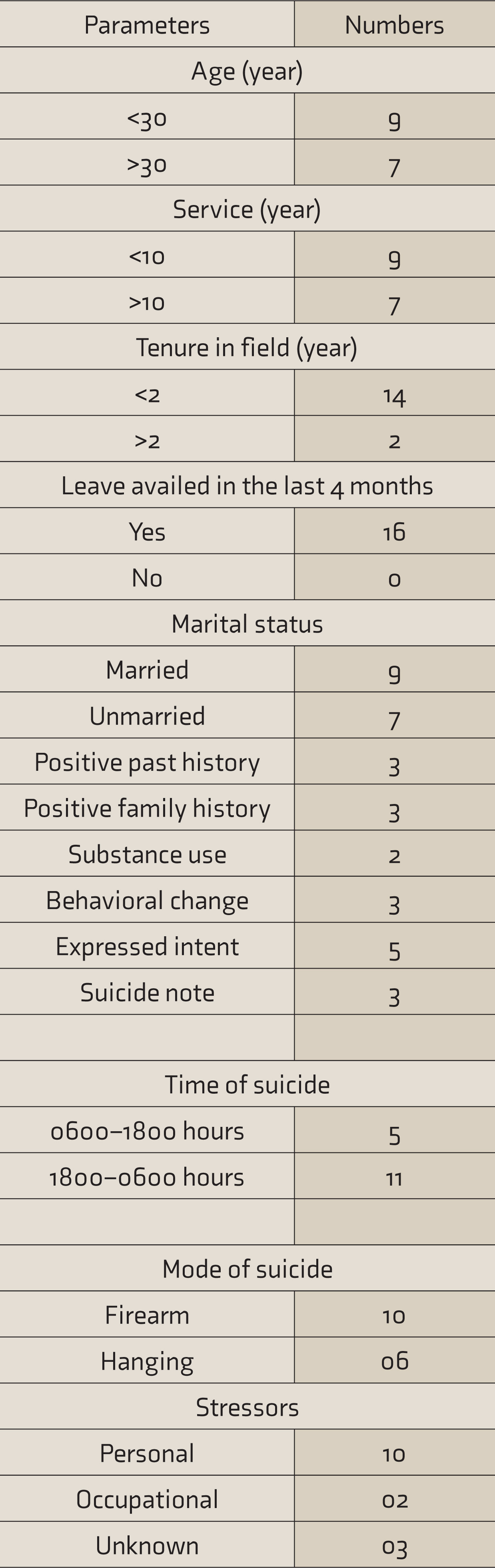
The most frequent age group was <30 years (Table 1). Out of 16 cases, only 2 had spent more than 2 years in the frontier area. All the 16 cases had availed leave during the last 4 months.
Means of Suicide
Suicide by firearms was most common (10 out of 16), followed by hanging (06 out of 16).
Time of Suicide
Eleven subjects chose dark hours (between 6
Marital Status and Service Bracket
In total, 09 out of 16 were married and had less than 10 years of service.
In total, 14 out of 16 had less than 2 years of tenure in the field. All the cases had availed leave during the last four months.
Parameter of Suicide
Family and Past History
Three subjects had a positive family history of suicide/mental illness. Three had a past history of mental illness; one of them had accessed mental health services in the recent past, and the rest two had never visited a psychiatrist.
Substance Abuse
Two of sixteen had indulged in substance abuse in recent past/ before the act.
Noticeable Behavioral Change and Expressed Intent
Three had been noticed by others to have changed behavior such as social withdrawal, reduced interest in the surroundings, gloomy outlook, and significant socio-occupational dysfunction. Five had expressed their intent to others.
Stressors and Triggering Factors
In total, 12 cases were having significant stressors and 10 cases had personal stressors. Failed love affair/conflict with a partner was the commonest stressor (7 cases). Only 02 cases had occupational stressors.
Discussion
Age and Tenure in the Operational Area
Young persons (<30 years of age) committed suicide more frequently. Similar findings have been reported in civil population like Shukla et al. 6 and Ponnudurai et al. 7
All 16 had availed leaves in the recent past, which was apparently because of the liberal leave policy for troops posted in this frontier area, and it is apparent that sending soldiers on leave may not guarantee suicide prevention.
Means of Suicide
Suicide by firearms was the commonest method for suicide in this study. This was apparently due to the easy availability of firearms and the high lethality of this method.
Zalsman et al. noted suicide by firearms to be the most common method for suicide in countries where firearms were easily available, in evidence-based research on suicide, including 1797 articles studied on Cochrane and PubMed between 2005 and 2014. 8 Similar findings were reported by Capt. DS Goel in the year 1975 in Indian Armed Forces. 9 However, various studies have reported that poisioning and hanging are the most common methods in civil population. 6
Marital Status and Service Bracket
The majority of the deceased (9 out of 16) were married. This is similar to the findings of Capt. DS Goel. 9 However, this is contrary to many studies that show that suicide is more common in single subjects. 10 Our subjects were of a particular group, and Indian soldiers get employed and financially independent by the age of 18–20 years; hence, there is a common trend to get married earlier than the average Indian male, which is 24 years. 11 This may be the explanation for a higher number of suicides from married people in the current study.
In total, 09 out of 16 had less than 10 years of service, which is similar to the findings of PK Chakraborty on Indian soldiers who attempted suicide. 12
Family and Past History
Studies have shown that family history of suicide, substance dependence, and other mental illness are independent risk factors for suicide.12,13 However, probably, due to a lack of awareness and poor sensitization of the environment about serious mental illnesses like depression, patients never sought the help of a professional.
Substance Use and Noticeable Behavior Change
Ahmed et al., in a study of 50 suicides in India, found the use of substances before the act of committing suicide in 18%. 13 In our study, two had used a substance before the suicide.
Many of the cases had expressed their intent of suicide to their close ones such as family members, friends, and colleagues. However, they did not take it seriously. Change in behavior such as social withdrawal, reduced interest in activities, and gloominess was not taken seriously, and adequate prophylactic measures were not adopted. There is a need to sensitize the environment about symptoms of depression/impending suicide. Early detection and timely referral of such cases may be key to prevent suicide.
Stressor
Failed love affair emerged as the commonest stressor, and similar results were found by Shukla et al. in an Indian sample 6 and Chaudhury et al. 14 in Indian security forces. Various other studies found that in US soldiers, intimate partner problems are the commonest stressor, followed by military-related stress. Contrary to common belief and media reports that stress and strain of service is a major cause of suicide, only two of our cases had occupational stressor.
Lesson Learnt
Many of the subjects had identifiable psychosocial stressors and behavioral changes that went unidentified by an environment that had poor awareness about symptoms of stress or depression. Early identification and timely referral to mental health professionals could have saved many lives.
Limitation
Due to the limited area under study, the sample size was small. All subjects were male. The majority were migrants from other states and representative of a special professional group with easy access to firearms. There is a need for further studies with a greater sample size before the generalization of these results.
Conclusion
Suicide is a potentially preventable death. Psychological autopsy reveals the interplay of various biopsychosocial factors in completed suicide. Stress and strain of military service is not the common stressor leading to suicide as perceived commonly. With sincere efforts, many lives can be saved by early identification and timely intervention.
Footnotes
Declaration of Conflicting Interests
The authors declared no potential conflicts of interest with respect to the research, authorship, and/or publication of this article.
Funding
The authors received no financial support for the research, authorship, and/or publication of this article.