




Abstract
Asian people are often perceived as a monolith, with the stereotypes of being competent but lacking warmth. This study examines how these racial stereotypes intersect with migration status by comparing perceived societal stereotypes towards Asian international and domestic students. Participants were 195 White students and 135 Asian students at a Canadian university. Results show that Asian students are generally perceived as more competent than warm, but Asian international students are consistently perceived as both less warm and less competent compared to their domestic counterparts. These negative stereotypes towards Asian international students are shared by both outgroup (White students) and ingroup (Asian students) members. Furthermore, among Asian students (but not White students), their endorsement of the model minority myth contributes to the societal double standards towards Asian international students. This study highlights how migration status and race jointly shape societal stereotypes, and that the model minority myth may perpetuate negative stereotypes of Asian international students. An intersectional approach incorporating immigration status offers insight into intergroup and intragroup dynamics.
People often rely on stereotypes — defined as simplified and overgeneralized cognitive shortcuts regarding social groups — to navigate their diverse social environment (Fiske et al., 2007). One characteristic that activates stereotyping is race. Racial stereotypes can have severe interpersonal and systemic consequences for the target groups, impacting their social and educational experiences (Dovidio & Gaertner, 2004; Steele, 1997). Additionally, racial stereotypes can be compounded by other aspects of identity, leading to varying double standards for different marginalized subgroups (Doerer et al., 2017; Lei et al., 2023). The stereotype content model provides a framework for understanding shared societal views towards different groups (Fiske et al., 2018). In North America, societal stereotypes towards minority groups are often ambivalent: positive on one dimension (warmth or competence) but not both (Durante et al., 2017). For example, Asians are often stereotyped as high in competence but lacking warmth.
While Asian students are often inaccurately viewed and treated as a homogeneous group, there are substantial distinctions between Asian international students and their domestic counterparts, including how they are being treated in higher education environments (Zhang et al., 2022). This distinction is consistent with the broader societal attitudes towards migrant and non-migrant groups (Froehlich & Schulte, 2019). Despite recognizing the complexity of Asian international and domestic students’ experiences in North America, the specific role migration status plays in shaping social perceptions of Asian students remains unclear. For example, how does migration status affect societal perceptions of competence and warmth among Asian students? Is there a societal double standard that disadvantages Asian international students compared to their domestic counterparts? To explore these questions, we examine how race and migration status intersect in the construction of societal stereotypes, focusing on differences between Asian international and Asian domestic students, alongside identifying potential systemic factors reinforcing these biased societal perceptions.
Stereotypes of Asians and migrants in North America
The stereotype content model is not designed to capture individuals’ personal opinions but rather to reflect their accessibility of commonly held societal stereotypes through measures of perceived societal stereotypes (e.g., ‘To what extent do you think most Americans view Asian people as [competent, friendly, etc.]?’; Fiske et al., 2018). Examining racial stereotypes as shared cultural knowledge can shed light on the double standards embedded in society, since stereotypes are key mechanisms driving the differential treatment of groups, both historically and in contemporary contexts (Fiske et al., 2007).
The historical treatment of Asian populations in North America illustrates how deeply ingrained racial discrimination is within the region. From early policies that excluded Chinese immigrants to the internment of Japanese Americans during World War II, Asian communities have faced systemic prejudice and discrimination (E. Lee, 2015). These discriminatory practices not only limited immigration but also created and perpetuated a negative societal perception of Asian people as foreigners and untrustworthy (E. Lee, 2015). Historical racial categorizations and injustices continued to shape current patterns of stereotypes and lived experiences, making race a significant factor in migration and inequality in North America today. For example, the model minority myth can be traced back to the 1960s, when Asian immigrants were portrayed as achieving economic success despite systemic discrimination; this stereotype remains prevalent today (Walton & Truong, 2023).
In this study, we focus on the stereotypes of competence and warmth since they are two key dimensions underlying societal stereotypes regarding different racial groups (Fiske et al., 2018). Racial groups who are associated with high competence are seen as intelligent and skillful, while high warmth is associated with approachability and trustworthiness. In North America, these racial stereotypes are rooted in a long history of systemic differential treatment on the basis of race. For instance, both Asian Americans and Asian Canadians are typically portrayed as high in competence but lower in warmth (Froehlich & Schulte, 2019; Lin et al., 2005). The ‘high competence’ stereotype aligns with the pervasive model minority myth, which characterizes Asian people as academically talented and hard workers (Kiang et al., 2017; Padgett et al., 2020; Poon et al., 2016). However, Asians are simultaneously portrayed as lacking approachability and trustworthiness, as reflected in enduring media and societal attitudes (Padgett et al., 2020). This ‘low warmth’ stereotype is often coupled with the ‘perpetual foreigner’ stereotype, where Asian people are viewed as distant and perpetual outsiders in North America (Cheryan & Monin, 2005; Sue et al., 2007). Indeed, findings based on the racial position model suggest that while Asian Americans are perceived as superior to other minority groups, they are regarded as foreigners in America (Zou & Cheryan, 2017).
In addition to racial stereotypes, society perpetuates specific stereotypes against migrants, including international students. Research indicates that migrants are generally perceived as less competent and warm compared to native-born individuals, although this depends on the racial group or socioeconomic status (T. L. Lee & Fiske, 2006). Moreover, media narratives often exacerbate these stereotypes by attributing social issues, such as housing shortages and strain on healthcare systems, to international students (Su et al., 2023). Such portrayals may contribute to the societal perception of international students as a competitive threat, further reinforcing stereotypes of lower warmth (Fiske et al., 2007). These societal biases towards migrants and racial minorities underscore the need for examining stereotypes pertaining to Asian identity and international students simultaneously.
The intersection of race and migration status: is there a double societal standard towards Asian international students?
Are the stereotypes at the intersection of multiple marginalized groups (e.g., being an Asian international student) additive? Given the pervasive view of Asian people as ‘perpetual foreigners,’ regardless of where they were born, one might expect that stereotypes applied to Asian people remain consistent across different migration statuses. Interestingly, research also indicates that certain stereotypes can intersect and influence each other. For example, stereotypes associated with being queer, such as the value of self-expression and freedom, may lessen the perception of foreignness associated with being Asian, leading queer Asian Americans to be seen as more American than their heterosexual counterparts (Semrow et al., 2020).
While previous studies provide insight into the ‘foreigner stereotype’, they have largely overlooked how other dimensions of stereotypes, such as warmth and competence, might be affected by intersectional identity among Asians. This study explores how these stereotypes are shaped when considering both Asian identity and migrant status, contributing to a more nuanced understanding of the stereotype content model (Fiske et al., 2007). Given that Asian people are perceived as high in competence but low in warmth, and migrants are often viewed as low in both competence and warmth, Asian international students may face a compounded stereotype. This dual stereotype may lead to an even greater diminishment of their perceived warmth and competence. In other words, Asian international students may face a double standard – being judged more harshly for both warmth and competence relative to their domestic peers.
Stereotypes are not only imposed by outgroups; they can also be internalized and perpetuated by ingroup members (Van Veelen et al., 2016). This means that if Asian international (vs. domestic) students are perceived as lower in warmth and competence in North American society, Asian students themselves might also be aware of and share these double-standard stereotypes. However, self-reported societal stereotypes may vary depending on the person’s group membership, with outgroups often being perceived more negatively (Cuddy et al., 2009). In other words, while the stereotype content model captures societal beliefs, people may report their own group more favourably within society compared to how others perceive their group. However, previous research has shown that this ingroup favouritism was not found among Asian participants (Cuddy et al., 2009). Nevertheless, by examining stereotyping from both ingroup and outgroup perspectives, we can gain a more comprehensive understanding of the perceptual double societal standards that exist within our society that are shared across different group memberships.
Does the model minority myth connect to the double standard towards Asian international students?
According to the stereotype content model, perceived societal structures predict self-reported societal stereotypes (e.g., Caprariello et al., 2009; Cuddy et al., 2009; Fiske et al., 2018). In other words, individuals’ perceptions of intergroup societal structures — or the legitimization of certain ideologies — shape how they believe society views different groups. For example, perceived intergroup competition (e.g., driven by zero-sum beliefs) predicts stereotypes related to warmth, whereas perceived group status predicts stereotypes of competence. If a group is perceived as a social threat, society tends to view that group more negatively in terms of warmth, which is reflected in individuals’ ratings (see also Gaucher et al., 2018; Grigoryev et al., 2019). In this study, we examined the perceived social status of Asians (aka model minority myth) in relation to societal stereotypes.
The model minority myth portrays Asian individuals as a uniformly successful minority group, contributing to the belief that systemic racial discrimination against Asians is not a significant issue. Central to this myth are the beliefs in achievement orientation (the idea that Asian people prioritize education and have strong work ethics) and unrestricted mobility (the notion that they can overcome inequalities through individual effort because society is fair and just; Parks & Yoo, 2016; Yoo et al., 2010). Such views ignore the diverse experiences and systemic barriers faced by Asian communities and align with broader meritocratic ideologies that promote the false belief that success is solely based on personal effort (J. Lee & Ramakrishnan, 2020). This narrative contributes to false consciousness among minority groups by obscuring the structural factors that perpetuate discrimination, thereby legitimizing social and economic inequalities for minorities who are unfairly judged against this distorted belief (J. Lee & Ramakrishnan, 2020; Walton & Truong, 2023).
When people endorse this model minority myth, they are more inclined to report other unfavourable societal beliefs about Asian people (Parks & Yoo, 2016; Walton & Truong, 2023). They may also use this stereotype to justify systemic racism against Asian people and other marginalized groups (Walton & Truong, 2023). Some Asian individuals may also internalize the model minority myth, given the pervasiveness of social and media influences (Rajagopal & Durkee, 2024; Walton & Truong, 2023). As a result, this structural belief may lead some Asian students to face pressures to succeed, while legitimizing colorblindness ideology (Padgett et al., 2020). Research indicates that Asian individuals who hold stronger beliefs in unrestricted mobility are less likely to support other underserved minority groups (Yi & Todd, 2021). Therefore, it is reasonable to infer that these structural racial beliefs may be linked to the accessibility of the double societal standards towards marginalized groups (e.g., international students). In other words, the model minority myth may underlie the shared negative societal stereotypes towards Asian international students (vs. Asian domestic students).
This study
The Asian population is the fastest-growing racial group in North America, with Canada, for instance, seeing an exponential rise in the number of international students from Asia over the past decade (Kim et al., 2023). Traditional research on stereotypes has primarily focused on domestic ethnic-racial issues, often overlooking the diverse experiences within racial minority groups concerning migration status. This study explores intersecting stereotypes of Asian international students, reported by both the dominant group (White students) and the ingroup (Asian students). By examining societal perceptions across and within groups, this research aims to determine whether these double standards are consistently reflected within our society.
First, we aim to replicate previous research to understand whether Asian students, regardless of migration status, are stereotyped as more competent than warm in Canadian society (RQ1). Second, we explore whether Asian students, based on their migration status, are perceived differently in terms of societal stereotypes of warmth and competence (RQ2). Finally, we examine whether endorsing the model minority myth is associated with the double societal standard applied to Asian international students (vs. Asian domestic students) (RQ3). For RQ3, we control for participants’ ethnic identity because the strength of identity is related to stereotypes and minority myths. 1
Methods
Participants and procedure
The study received ethics approval from a Canadian University. Students (N = 427) were recruited from a Canadian university in 2022, and they were pre-screened based on their self-reported racial identifications (Asian and White). We invited eligible participants from the psychology subject pool to complete an online questionnaire, and they received bonus course credit for their participation. The online questionnaire was administered with the questions of interest being in a fixed order as follows: model minority myth (achievement orientation and unrestricted mobility), ethnic identity and stereotype content model (competence and warmth). The participants who were not eligible (n = 31) or failed the attention checks (n = 66) were removed from the analysis.
In our ethics proposal, we proposed a target sample size of approximately 300 participants for the analysis, which would provide adequate statistical power (.80) to detect a small to medium effect size (d = .32) between the two groups. We achieved a final sample size of 330 participants. However, due to practical constraints, the final sample was not evenly balanced across the two groups.
The final sample consisted of N = 330 participants (Mage = 20.17, SDage = 3.39), divided into two groups. The first group included 195 students who identified as White or European Canadians (81% women, 16% men, 3% non-binary), with the majority being Canadian citizens (89%), followed by permanent residents (4%) and international students (8%). The second group comprised 135 students who identified as Asian (68% East/South-East Asian and 33% South Asian; 70% women, 25% men, 5% non-binary), with most being Canadian citizens (79%), while the rest were either permanent residents (4%) or international students (17%). The measures and preliminary analyses (assumption check, correlations) are available at osf.io/cr63s/.
Material
Stereotype Content Model: competence and warmth
Consistent with the Stereotype Content Model (Cuddy et al., 2009; Fiske et al., 2007, 2018), participants were asked to report not on their personal beliefs but on how they think different groups are viewed by Canadians, on a five-point Likert scale (1 = ‘not at all’ to 5 = ‘extremely’). Participants rated each of the groups on their warmth (e.g., ‘trustworthy’, ‘friendliness’) and competence (‘intelligent’, ‘efficient’). The items were scored by averaging each subscale. As a result, there were six subscales: Asian international students’ competence (α = .76) and warmth (α = .90), Asian domestic students’ competence (α = .80) and warmth (α = .91), and White students’ competence (α = .85) and warmth (α = .91).
Model minority myth: achievement orientation and unrestricted mobility
We adapted the model minority myth measure (Yoo et al., 2010), with two subscales: achievement orientation (α = .91) and unrestricted mobility (α = .72). Participants were asked to read the following sentence: ‘Please read each statement and consider it, then indicate the answer which most accurately reflects how you feel regarding these comparative statements.’ The scale is a seven-point Likert scale (1 = ‘strongly disagree’; 7 = ‘strongly agree’, with 4 representing ‘neither agree nor disagree’). The items were scored by averaging each subscale. A higher score on achievement orientation indicated the belief in greater success of Asian people compared to other racial groups, while a higher score on unrestricted mobility indicated the belief in less perceived racism (Yoo et al., 2010).
Ethnic identity
Participants completed the ethnic group cohesion scale (e.g., ‘I feel a strong attachment towards my own ethnic group’; Maramba & Museus, 2013). Participants were asked to indicate their identity with their ethnic group on a five-point Likert scale (1 = ‘strongly disagree’; 5 = ‘strongly agree’). A higher score indicates a sense of attachment to their own ethnic group (α = .80).
Results
All preliminary and assumption test results are in the supplemental materials. The inspections of the Q-Q plots and assumption tests suggest all assumptions were reasonably met.
RQ1 & RQ2: Are Asian students perceived as more competent than warm, and are the three groups different in their perceived societal stereotypes?
We conducted a 3 (targets as within-subject: Asian international, Asian domestic and White students) × 2 (types of stereotypes as within-subject: competence and warmth ratings) × 2 (participants’ race as between-subject: Asian and White participants) mixed ANOVA (see Figure 1 for visual).
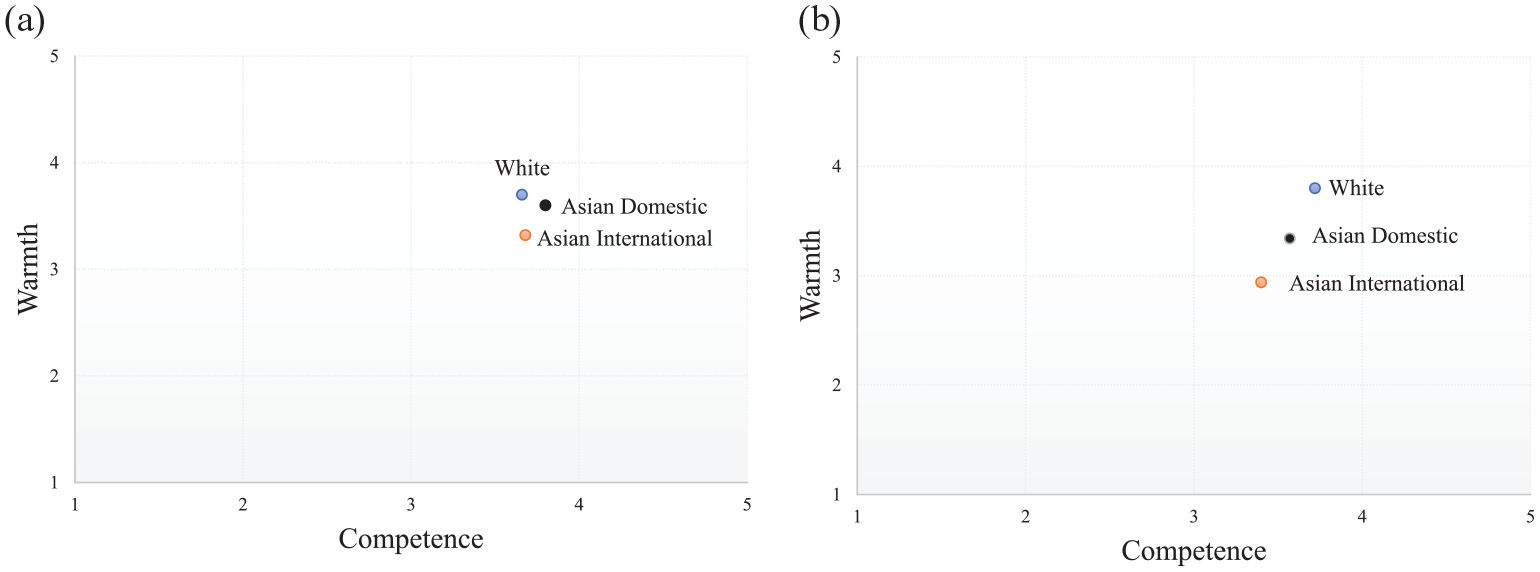
Warmth (y-axis) and competence (x-axis) mean values for White participants’ stereotypes towards different groups (a) and for Asian participants’ stereotypes towards different groups (b).
First, there was a significant within-subject main effect across targets, F = 56.50, p < .001, η p 2 = .15. Specifically, White students (M = 3.72, SE = .03) were significantly higher compared to Asian domestic (M = 3.58, SE = .03, p < .001) and Asian international students (M = 3.33, SE = .03, p < .001), while Asian domestic were significantly higher compared to Asian international students (p < .001). This outcome indicates that Asian international students were perceived as the lowest in overall competence and warmth among the three target groups.
Second, there was a significant two-way interaction between targets and participants, F = 16.73, p < .001, η p 2 = .05. A simple main effect showed that Asian participants reported Asian international student targets (M = 3.17, SE = .05) as significantly lower in warmth and competence compared to Asian domestic student targets (M = 3.46, SE = .05, p < .001) and White student targets (M = 3.76, SE = .03, p < .001). Moreover, Asian participants reported White students as higher in warmth and competence compared to Asian domestic students (p < .001). Similarly, White participants reported that Asian international students (M = 3.50, SE = .04) were significantly lower in warmth and competence compared to Asian domestic (M = 3.70, SE = .04, p < .001) and White students (M = 3.68, SE = .04, p < .001). However, White participants reported Asian domestic students as similar to White students. This outcome indicates that Asian and White participants believe that the average Canadian perceives Asian international students as the lowest on overall competence and warmth compared to the other groups.
Third, the two-way interaction between participants and types of stereotypes was not significant, F = 0.41, p = .521, η p 2 = .00, but there was a significant two-way interaction between targets and types of stereotypes, F = 50.36, p < .001, η p 2 = .13. A simple main effect showed that Asian international and Asian domestic students were perceived to have significantly higher competence (M = 3.54, SE = .04 for international; M = 3.69, SE = .03 for domestic) compared to warmth (M = 3.13, SE = .04 and M = 3.47, SE = .04, ps < .001). In contrast, White students were perceived to have significantly lower competence (M = 3.69, SE = .03) compared to warmth (M = 3.75, SE = .04, p = .025).
Finally, the three-way interaction was not significant, F = 1.29, p = .271, η p 2 = .00, but multiple t-tests and ANOVAs were conducted to provide additional evidence (see supplemental material). In general, the findings support the main analyses, such that both White and Asian participants shared a societal stereotype that Asian students (regardless of status) are more competent than warm. Similarly, both Asian and White students shared a societal stereotype that Asian international students are less warm and less competent compared to Asian domestic students.
RQ3: Does the model minority myth explain the double standards towards Asian international students (vs. Asian domestic students)?
Both groups of participants perceived Asian international students as having lower competence and warmth than Asian domestic students. Therefore, we computed the difference score between the stereotypes of Asian domestic and international students. We then conducted multiple regressions to understand whether the beliefs of the model minority myth predict the mean stereotype gap between Asian domestic and international students (see Table 1). For the White participants, we found that none of the predictors significantly predict the mean differences in warmth and competence between Asian international and domestic students.
Regression results using mean differences between Asian international and domestic students as the criterion.
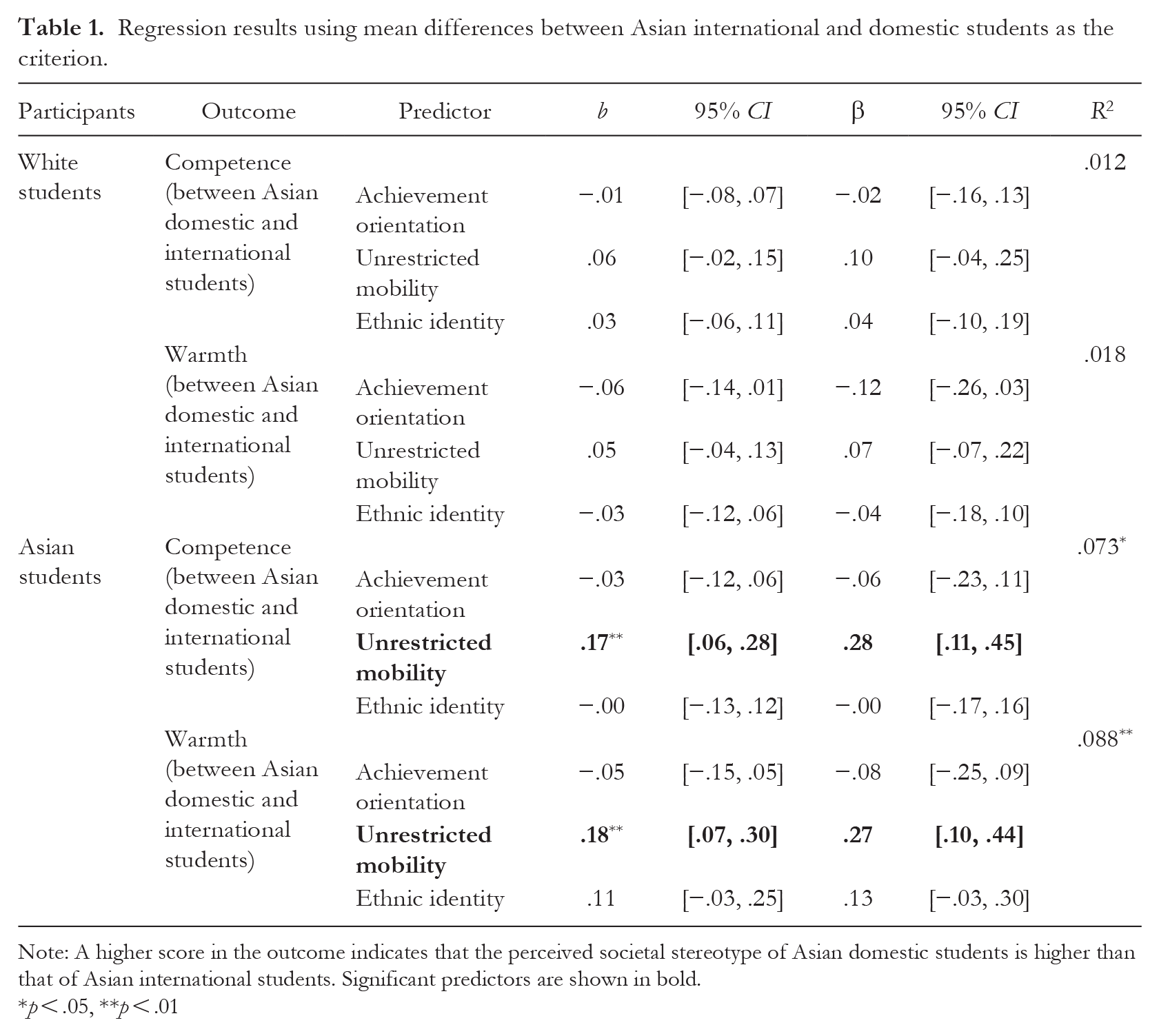
Note: A higher score in the outcome indicates that the perceived societal stereotype of Asian domestic students is higher than that of Asian international students. Significant predictors are shown in bold.
p < .05, **p < .01
For the Asian participants, we found a significant positive association between unrestricted mobility and the stereotypes of competence differences (β = .27, p = .003). All the other predictors were not significant. Similarly, unrestricted mobility was also linked to stereotypes of warmth differences (β = .26, p = .002). Asian participants with higher levels of model minority myth beliefs also reported a stronger societal stereotype that Asian domestic students are higher in warmth and competence than Asian international students.
Discussion
This study explores how perceived societal stereotypes of warmth and competence towards Asian students vary based on whether the targets are domestic or international students, highlighting the importance of intersectional stereotypes involving race and migration status. Our findings replicate previous research showing a consistent societal stereotype that views Asian students, regardless of migration status, as more competent than warm. Additionally, both White and Asian participants perceived a negative stereotype which portrays Asian international students as less competent and warm than their domestic counterparts. Finally, for Asian students (but not White students), their endorsement of the model minority myth that there are no racial barriers among Asian individuals (i.e., unrestricted mobility) contributes to the societal double standards towards Asian international students.
People belong to more than just one social group. This study underscores the importance of considering both racial and migration backgrounds to understand the nuanced stereotypes that reflect different positions in societies, providing implications for contemporary issues in relation to race and migration (e.g., prejudice, social threat, relations among minority groups). While Asian people are stereotyped in North America as aloof and untrustworthy (lower in warmth) but more intelligent (higher in competence) than White people (Walton & Truong, 2023), our results extend this previous understanding by differentiating Asian students based on their migration status. We found that, according to participants’ perceptions of average Canadians, neither Asian nor White participants perceived Asian international students as significantly more competent than White students. Moreover, participants’ reports of societal stereotypes of warmth and competence for Asian immigrants and Asian Canadians were not highly related (rs = .45 to .63; see online supplement). Instead, Asian international students are predominantly subjected to more negative stereotypes, characterized by lower warmth without higher competence. These nuanced findings challenge previous research, suggesting that stereotypes based on Asian domestic students may not extend universally to Asian international students.
The perceptions of broader societal stereotypes found in this study reflect the double societal standards towards Asian international students. These double standards highlight how shared ethnic or racial backgrounds do not necessarily translate to the same social expectations. While both Asian students may face negative stereotypes, negative stereotypes tend to be more strongly applied to Asian international students. For example, Asian international students are often portrayed as less intelligent due to language proficiency issues, while simultaneously viewed as less socially engaged for the same reason (Bu & Borgida, 2021; Houshmand et al., 2014; Lou & Noels, 2023). These negative stereotypes can shape intergroup experiences both inside and outside the educational contexts (Cuddy et al., 2009). Societal stereotypes create cognitive accessibility (mental shortcuts) through automatic associations between groups and characteristics, influencing areas such as academic expectations, social interactions and policy-making (Devine, 2014). These compounded stereotypes can perpetuate harmful media rhetoric, systemic prejudice and discrimination (Melson-Silimon et al., 2024), further marginalizing Asian international students. For instance, societal stereotypes of Asian students as being unfriendly can hinder their leadership prospects and career advancements (Lu, 2022), with potentially even more severe consequences for Asian international students due to their migration status.
These negative societal stereotypes towards Asian international students are not only prevalent among the dominant group but are also broadly perceived by the Asian community itself. Both Asian and White participants shared the societal stereotypes that Asian international students are less warm and less competent compared to their domestic counterparts. We found that within the Asian student sample, the model minority myth of unrestricted mobility contributes to the double standards towards Asian international students. These findings partially support the claim that the structural belief about groups is responsible for societal stereotypes (Caprariello et al., 2009). The belief that Asians have the ability to achieve success without structural barriers may give rise to the negative social expectations and stereotypes directed towards Asian international students. The unrestricted mobility beliefs may lead to the assumption that others (e.g., international students) should also overcome challenges in the same way. The cognitive access to these negative societal stereotypes may then lead to the minimization of the struggles experienced by other Asian and minority groups (Gaucher et al., 2018). Previous research showed that when Asian people endorse a higher level of unrestricted mobility beliefs, they are also more biased towards other underserved minority groups (Yi & Todd, 2021). From an intragroup perspective, it is not uncommon for Asian international students to face rejection from their domestic counterparts; this intragroup rejection may be fuelled by the belief among some Asian individuals that their mobility is unrestricted. Thus, this model minority myth may reinforce negative societal stereotypes about Asian international students and other minorities, undermining solidarity and intergroup dynamics among minority communities.
However, we did not observe that the model minority myth predicts the double standard towards Asian international students among White students. According to the stereotype content model’s claim that perceived societal structures shape stereotypes (Caprariello et al., 2009), other structural beliefs may be influencing White students’ perceptions of double societal standards (see also Grigoryev et al., 2019). The differences in societal stereotypes could stem from various perceived societal structures, such as system justification (Gaucher et al., 2018), xenophobia (Yeo et al., 2019), ethnic homophily (Lu, 2022) or perceived cultural threats posed by foreigners (Zou & Cheryan, 2022). Future research could explore the structural origins of these double standards towards Asian international students in more depth, to better understand and address the root causes of structural inequality.
Future directions
As the field of stereotypes and prejudice evolves to examine social perceptions of multiple interacting groups (e.g., how gender discrimination varies by race), it is important to adopt an intersectional stereotype approach that incorporates migration status. Future studies could build on this approach to further deepen our understanding of intergroup relations involving racial and international migrants across different contexts. First, although both personal attitudes and perceived societal stereotypes are important in understanding personal behaviours, it is important to know whether the current findings based on perceived descriptive norms (shared by Canadians) can be generalized and reflect participants’ personal attitudes. The data were drawn from a single university with a predominantly White and domestic student population. Although this study focused on the impact of the intersectional stereotypes of Asian people and migrants, it is important to recognize that Asian international students are not a monolithic group; their experiences are influenced by intersecting factors such as gender, sexual orientation, country of origin, religion and socioeconomic status (Goh et al., 2023; Mukkamala & Suyemoto, 2018; Okazaki, 2018). Like other ethnic groups, Asian Americans and Canadians encounter gendered racism, which can significantly influence their social interactions and integration into society (Hudson et al., 2024; Mukkamala & Suyemoto, 2018). Since East Asians in North America (unlike in the UK) are often perceived as the prototypical Asian group (Goh & McCue, 2021; J. Lee & Ramakrishnan, 2020), our findings may be limited to the stereotypes towards East Asian students within the Canadian context. Moreover, this study examined only the warmth and competence stereotypes. The biases and experiences of discrimination for Asian international and domestic students are distinct and context-dependent, which may differ using other metrics and types of measures.
Finally, White individuals’ experiences and perceived societal stereotypes may be influenced by factors such as migration status and country of origin. Future research should examine how these intersecting identities shape the stereotypes across different racial and migrant groups. Moreover, we found that model minority beliefs did not predict the double standards towards Asian international students among White participants. Future research should examine whether the model minority myth may interact with other perceived societal structures, such as perceived threat and social dominance orientation (e.g., Bai, 2020; Zou & Cheryan, 2022).
Footnotes
Notes
Supplementary Material
Please find the following supplemental material available below.
For Open Access articles published under a Creative Commons License, all supplemental material carries the same license as the article it is associated with.
For non-Open Access articles published, all supplemental material carries a non-exclusive license, and permission requests for re-use of supplemental material or any part of supplemental material shall be sent directly to the copyright owner as specified in the copyright notice associated with the article.
