



Abstract
Victims’ testimonies have emerged as an interesting tool for generating changes in societies that are seeking to emerge from a violent conflict. However, victims are not a homogeneous group and their stances regarding the perpetrators can different according to whether they accept or reject intergroup forgiveness processes, as was the case of J. Améry, a writer and essayist who survived the Holocaust. In this article, we inquire into the impact of victims’ testimonies on attitudes towards intergroup forgiveness in Spain (N = 274). An experimental study with three conditions was designed using victims’ testimonies that were favourable (Condition 1) and unfavourable (Condition 2) to intergroup forgiveness, along with a condition with statistical data on violence (Condition 0). The results show a differential impact on attitudes based on the victim’s testimony, in addition to emotional activation that is not inherently related to attitudes in favour of forgiveness but instead to the victim’s attitude towards that process.
When a group is faced with the task of overcoming its violent past, it has to grapple with issues like the quest for truth, the construction of memory and the demands for justice and reparations for victims (López-López et al., 2018). In this effort, the direct victims of violence play a crucial role in groups’ decisions, as meeting their needs may affect psychosocial processes like intergroup forgiveness and social reconciliation (Bilbao & Sáez de la Fuente, 2019). However, victims’ positions on these issues are not homogeneous, and their opinions on group processes can have different impacts on the general population. In this study, we aim to analyse the impact of victims’ narratives in favour of and against intergroup forgiveness on the general population’s attitudes towards forgiveness and social reconciliation in two autonomous communities of Spain.
Collective violence has had a major impact on society in Spain, with more than 3,600 terrorist attacks and 858 deaths in the past 50 years. Although the groups involved are no longer active, the narratives of the violent deeds and the way to deal with the future are still present, with a wide variety of stances (Jiménez-Ramos, 2020). One example of this is the Basque Country, one of the regions affected the most by violence, where 44% of the population is in favour of forgetting, while 43% want to promote the victims’ memory (Euskobarómetro, 2017). In this scenario, victims’ initiatives with a diverse range of goals and stances regarding forgiveness and social reconciliation have gained prominence in recent years (Jiménez-Ramos, 2020).
As groups’ moral examples, victims are playing an increasingly core role in transition processes towards peace (Druliolle & Brett, 2018). In this sense, meeting their demands is imperative, and in the needs-based reconciliation model (Nadler & Shnabel, 2015), this includes restoring their sense of agency, telling them the truth about what happened and enabling them to perceive justice. Victims’ voices, that is, their testimonies and opinions, are one way of restoring their social competence, plus they become a powerful instrument for generating changes in societies in conflict (Ibreck, 2018; Shepherd, 2016).
In this regard, the value of testimony and its potential as a mechanism of interpreting the violence has been promoted in Spain in initiatives aimed at memory and non-repetition (Jiménez-Ramos, 2020). In some case, victims’ initiatives that foster intergroup forgiveness have been created (Basabe et al., 2021), and a study conducted with university students in the Basque Country, which was replicated in Colombia (Castro-Abril et al., 2023), found that victims’ testimonies that were favourable to forgiveness affected the attitudes towards intergroup forgiveness and emotionally impacted them. However, few studies have specifically explored the impact of victims (Castro-Abril, 2023), and to our knowledge, no study explores the impact of the heterogeneity of victims in terms of whether or not they forgive the perpetrators and whether or not they want to initiate a reconciliation process.
Even though these two processes are distinct, they have developed considerably in recent years. On the one hand, social reconciliation is a broad concept that encapsulates the activities of building peace cultures aimed at peaceful coexistence and intergroup acceptance (Alzate & Dono, 2017). On the other hand, intergroup forgiveness has been studied for its potential to improve intergroup relations, empathy towards outgroups, setting beside retaliation, which is associated with a lower likelihood of continuing the cycle of violence, and, in general, its role in peace-building (Enright et al., 2020).
Forgiveness has been associated with variables like victimization, spirituality and group identity (Noor, 2016), in addition to psychosocial variables like empathy (Van Tongeren et al., 2014). In Spain, specifically in the Basque Country, the willingness to forgive perpetrators like ETA is positively related to empathy towards the victims and perpetrators (Mullet et al., 2021). However, despite this evidence, how a victim’s decision to forgive may impact ingroup attitudes towards the outgroup is not yet clear.
The meta-analysis of intergroup forgiveness by Van Tongeren et al. (2014) found that emotions are correlates of this process, as they are a fundamental part of social reactions to conflicts. Specifically, the intergroup forgiveness process can be facilitated by lowering negative and activating positive emotions. In this regard, in the Basque Country and Colombia it has been found that with victims’ testimonies that forgive the perpetrators, this emotional journey may be useful in promoting attitudes that are favourable towards forgiveness; however, there is still little evidence and no information on the victims who decide not to forgive (Basabe et al., 2021; Castro-Abril et al., 2023).
In this regard, it is essential to remember that forgiveness can also be seen as a process that insults the victims’ memory (López-López et al., 2018) or that is at least not intrinsically noble. One prominent historical example is J. Améry’s refusal to forgive; he upheld the right to resentment and counter-violence and denied any possibility of forgiving the perpetrators of the Holocaust (Heidelberg-Leonard, 2007). From a position like Améry’s, there is a moral defence of non-forgiveness as a way of resisting forgetting (Brudholm, 2006).
Precisely in Spain, some victims have built restorative spaces of encounter with the perpetrators (Bilbao & Sáez de la Fuente, 2019), while others have increased their demands for punishment and their rejection of the groups that participated in the violence (Varona, 2014; Varona et al., 2016). Even though all victims’ postures should be welcomed when dealing with the history of conflict, it is essential to ascertain the differential impact of these positions in the general population. In this study, we use an experimental model to identify this impact.
This study
We created an experimental design with three conditions in the Basque Country and Navarra. Two conditions were constructed with victims’ testimonies (forgiveness vs non-forgiveness) and one with statistics on violence (Ethics Committee of the UPV/EHU, RefCEID: M10/2016/031). We posited the following hypotheses.
H1: The condition of forgiveness (vs non-forgiveness and statistics) will increase favourable attitudes towards intergroup forgiveness, social reconciliation and empathy towards the perpetrators.
H2: The condition of forgiveness (vs non-forgiveness and statistics) will lower favourable attitudes towards intergroup punishment.
H3: The condition of forgiveness (vs non-forgiveness and statistics) will activate more positive emotions while the condition of non-forgiveness (vs forgiveness and statistics) will activate more negative emotions.
H4: Positive and negative emotions are expected to exercise a mediating effect on intergroup forgiveness and social reconciliation.
Method
Participants
The sample included 274 people from the Basque Country (n = 165) and Navarra (n = 109). The inclusion criteria were having Spanish nationality and living in the Basque Country or Navarra. These two autonomous communities share a border and historical territories, in addition to being the epicentres of the activities of several groups during the period of violence. We sought people between the ages of 30 and 60 due to the fact that the majority of violent actions were experienced in the 1970s to 1990. Finally, direct victims were excluded, given that the experiment’s goal was to analyse the impact of victims’ testimonies on the general population.
Regarding gender, 52.6% were women, the mean age was 41.41 years old (SD = 6.37) and 31.8% of the participants reported having close friends who were the victims of political conflict. No significant differences were found in the variables analysed by autonomous community or by gender, age, victimization, political stance, nationalism or religiosity among the conditions (see Supplementary Tables 1 and 2).
Procedure and materials
Three experimental conditions were created: C0 = statistics condition (n = 89); C1 = forgiveness condition (n = 96); and C2 = non-forgiveness condition (n = 89). The participants were recruited via the company NetQuest and received compensation for their participation. They filled out an online questionnaire on the Qualtrics platform.
First, the participants read the informed consent form and were given instructions on the survey. After that, they were randomly assigned one of the three videos, each belonging to one of the experimental conditions (see Tables 2 and 6 of the Supplementary Materials). The videos included the testimonies of four ETA victims (two women and two men). Three expert judges chose testimonies recorded in audiovisual media by human rights organizations which contained stories associated with being explicitly in favour of or rejecting intergroup forgiveness and each victim’s story of victimization. After watching the video, the participants responded to a questionnaire. Administering the survey took approximately 45 minutes, and at the end the participants received additional information on the goal of the study and the experimental manipulation. All the materials are available in the Supplementary Materials.
Measures
Intergroup forgiveness
Ten items adapted from Wohl and Branscombe (2005) to measure intergroup forgiveness (e.g., ‘It is possible for me to forgive the actions of the group that has caused us harm’). The response scale was from 1 = ‘No way’ to 7 = ‘Totally’ (α = .92).
Social reconciliation
The scale by Arnoso et al. (2015) on aspects needed for reconciliation, with eight required measures on a scale from 1 = ‘Not at all necessary’ to 4 = ‘Totally necessary’ (e.g., ‘The perpetrators engage in real actions of reparation’) (α = .83).
Intergroup punishment
Scale adapted from Falomir et al. (2007) with seven items, in which the participants responded to statements that completed the sentence ‘People responsible for the collective harm caused should. . .’ (e.g., ‘. . . be excluded from participating in the country’s political life’). The scale ranged from 1 = ‘Totally disagree’ to 7 = ‘Totally agree’ (α = .80)
Emotions
A differential emotion scale adapted from Izard (mDES, Fredrickson, 2009), with nine positive emotions like joy, hope and moral inspiration (α = .84), along with 10 negative emotions such as anger and hatred (α = .85). The scale ranged from 0 = ‘No way’ to 4 = ‘Extremely’.
Intergroup empathy
Scale adapted from Noor et al. (2008) with four items that measure empathy towards the perpetrators (e.g., ‘When I think about the perpetrators of violence, I understand that they may have suffered, too’) (α = .84) and towards the victims (e.g., ‘I can imagine the pain and injustice that victims feel, even if I don’t politically identify with them’) (α = .76). The seven-point response scale ranged from 1 = ‘Not at all’ to 7 = ‘A lot’.
Victimization
This was measured via three ad hoc items which asked whether the participants’ family members or close friends had been the victims of violence, and if so, from which group (e.g., ‘During the armed conflict, did anyone close to you [like family members or close friends] suffer from political violence?’). After that, a dichotomous variable was created (0 = ‘Not victim’; 1 = ‘Victim’).
Control variables (check)
The participants were asked to evaluate whether the video was reliable and credible and described true events (1 = ‘Not at all’; 5 = ‘Absolutely’). A credibility variable was created with these three questions.
Sociodemographic variables
Age, gender, political stance (from 1 = ‘Far left’ to 7 = ‘Far right’), Basque nationalism (from 1 = ‘Not at all nationalistic’ to 10 = ‘Very nationalistic’) and importance of religion in their life (from 1 = ‘Not at all important’ to 10 = ‘Very important’).
Data analysis
The data were analysed in SPSS-V26. ANOVA tests were performed for differences between conditions, followed by paired comparisons (d-test as an index of effect size), and then mediation analyses to identify the indirect effects of the experimental conditions on the criterion variables using the PROCESS macro by Hayes (2013) for SPSS (v3.3), model 4. We performed a power analysis with G*Power 3.1 (Faul et al., 2009), which indicated that 64 participants per group were needed in order to obtain an effect size d = .50 when comparing two independent measures with an alpha of .05 and a power of .80.
Results
All the reliability coefficients were acceptable (see Table 5 in the Supplementary Materials). Regarding the experimental manipulation, no significant differences were found regarding the credibility variable in the conditions, F(2, 261) = .15, p = .86 (η2 = .001).
Comparison of measures between experimental conditions
Confirming H1, the participants in the forgiveness condition showed the highest scores on intergroup forgiveness (p = .011, d = .53), with a moderate effect, and on social reconciliation (p = .015, d = .33) and empathy (p = .014, d = .36), with small effects. We should note that in all the conditions the scores exceeded the arithmetic mean. Even though the statistics condition was not distinguishable from the forgiveness condition, it could be distinguished from the non-forgiveness condition in the same variables. On the other hand, no differences were found in empathy towards the victims, which had high scores in all cases (see Table 1).
Comparisons of means between experimental conditions.
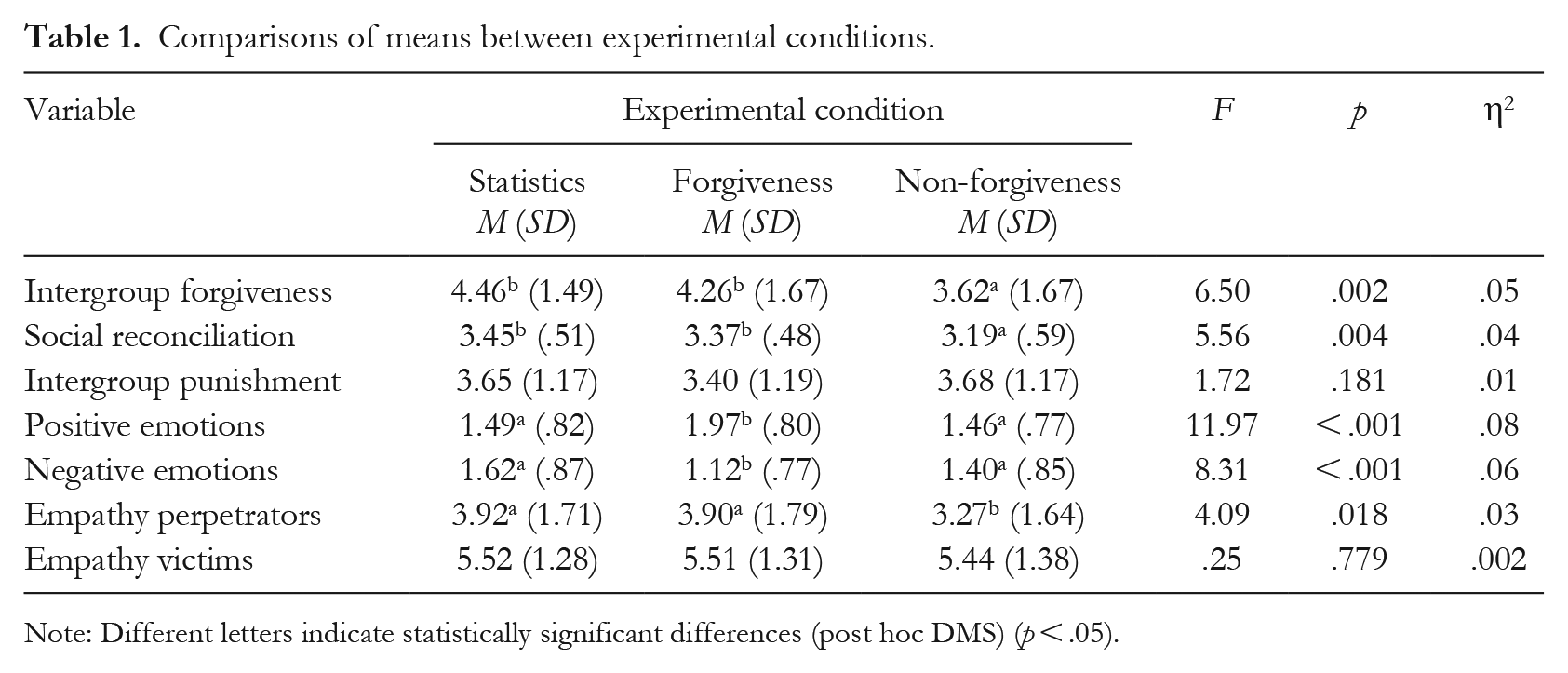
Note: Different letters indicate statistically significant differences (post hoc DMS) (p < .05).
Regarding H2, there were no statistically significant differences in the punishment scale. Regarding H3, positive emotions were activated more in the forgiveness condition than the non-forgiveness condition (p < .001, d = .66) and the statistics condition (p < .001, d = .61), with moderate effect sizes. In parallel, the forgiveness condition showed lower negative emotional activation than the non-forgiveness condition (p < .001, d = .33) and the statistics condition (p < .001, d = .60). Finally, no difference was found in the negative emotional activation of the statistics and non-forgiveness conditions. In no cases did the scores on the positive and negative emotions exceed the arithmetic mean.
Mediation analysis
To check H4, a mediation analysis was conducted with the criterion variables using positive and negative emotions as mediators (see Figure 1). First, the forgiveness condition was significantly associated with positive emotions (b = .41) and negative emotions (b = −.30), while the non-forgiveness condition was only significantly associated with positive emotions (b = −.22) (see Table 2).
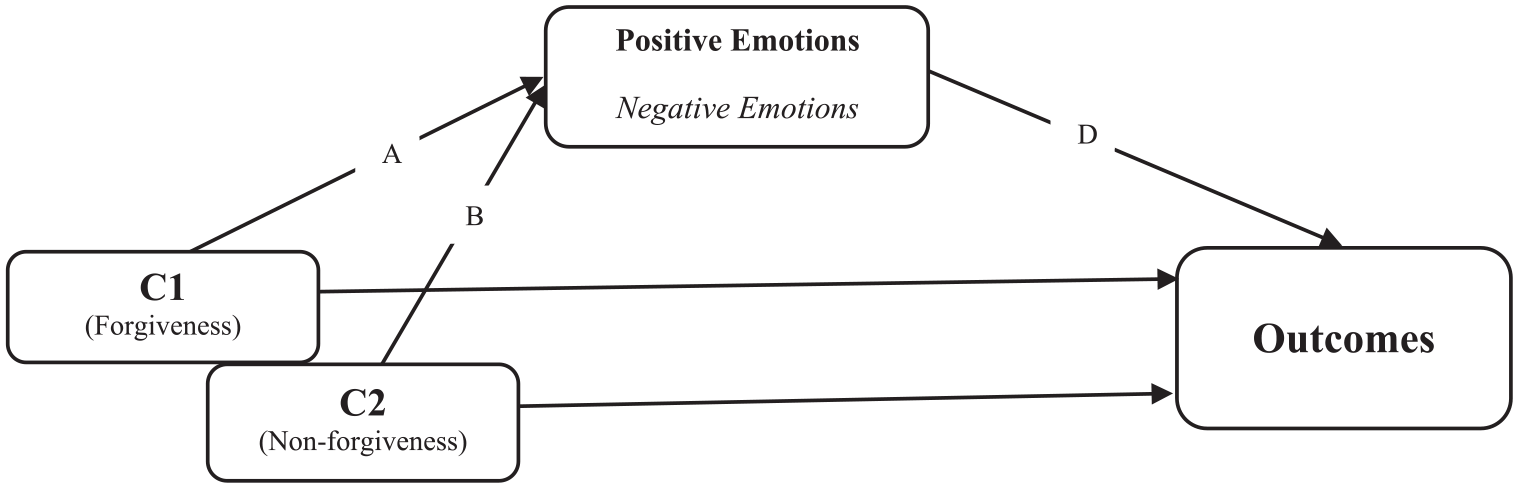
Mediation model.
Analysis of mediation between criterion variables and emotions.
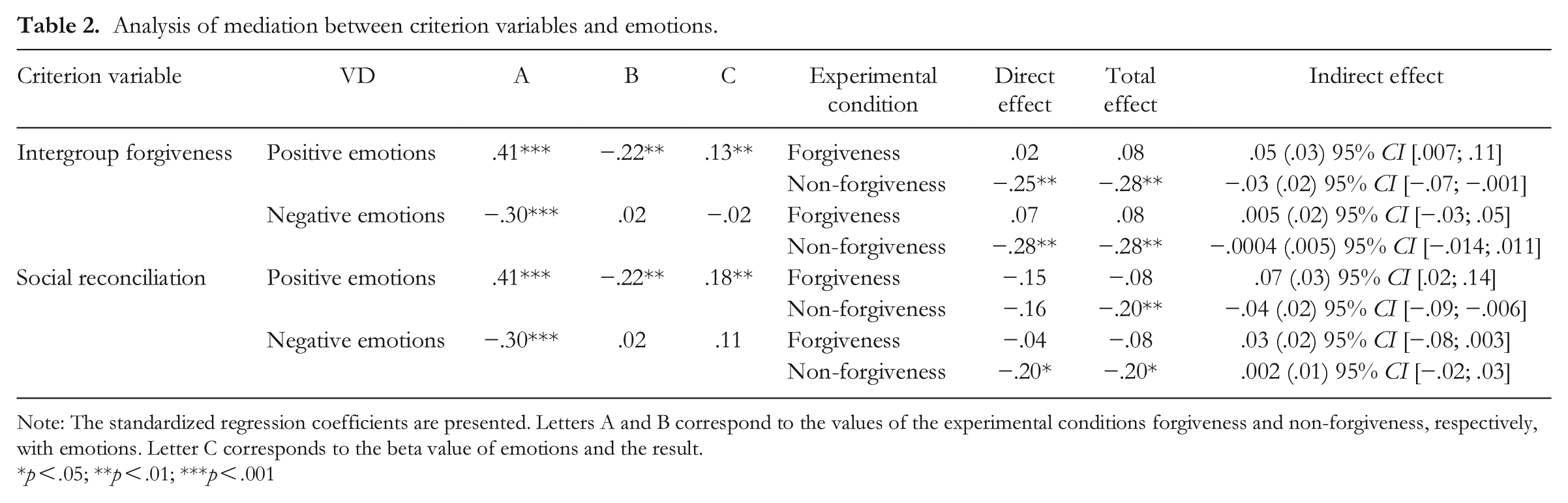
Note: The standardized regression coefficients are presented. Letters A and B correspond to the values of the experimental conditions forgiveness and non-forgiveness, respectively, with emotions. Letter C corresponds to the beta value of emotions and the result.
p < .05; **p < .01; ***p < .001
Regarding the association between the emotions and the variables, the results show that positive emotions were associated with intergroup forgiveness (b = .13) and social reconciliation (b = .18). However, negative emotions were not associated with these variables.
Confirming H4, indirect effects of positive emotions were found in both experimental conditions. For the forgiveness condition, a positive coefficient regarding intergroup forgiveness and reconciliation was obtained, and conversely, in the non-forgiveness condition, these variables were significant with a negative coefficient and significant effects. In other words, the activation of positive emotions has opposite effects on the variables analysed depending on the experimental condition. No indirect effects were found in the case of negative emotions.
Discussion and conclusions
In Spain, victims’ memories are increasingly being used to delegitimize political violence (Jiménez-Ramos, 2020). This study sought to analyse the differential impact of victims’ testimonies that are favourable and unfavourable towards forgiveness on attitudes towards intergroup forgiveness and reconciliation in the general population in the Basque Country and Navarra.
First, our results point to a clear difference between the testimonies that are favourable and unfavourable towards intergroup forgiveness in the variables analysed. Unlike other studies (see Basabe et al., 2021; Castro-Abril et al., 2023), the favourable testimonies cannot be distinguished from the exposure to neutral data (statistics) on the conflict. However, the testimonies that are unfavourable to forgiveness decreased intergroup forgiveness, social reconciliation and empathy towards the perpetrators compared to the other two conditions.
These results suggest that the position of non-forgiveness undermines attitudes towards forgiveness and reconciliation more, which could reinforce a favourable position; they also indicate that the exposure to statistical data on violence may have a positive effect equal or similar to the testimonies in favour of forgiveness. One possible explanation is that testimonies that are unfavourable towards forgiveness (similar to the example of J. Améry) lower empathy towards the perpetrator, given that the victim’s needs are not perceived as having been met, while also boosting the perception of victimization (Van Tongeren & Lindemann, 2020).
On the other hand, it is also possible that the differential results between the forgiveness and statistics conditions vs non-forgiveness are due to the availability heuristic, in which the participants in each experimental condition respond based on the cognitive availability of the information received in the testimonies; consequently, no attitudinal change is created, nor would these results last over time (Sjöberg & Engelberg, 2010). Likewise, the lack of differentiation between the forgiveness and statistics conditions may be due to the fact that the testimonies chosen did not manage to activate the positive emotions the way they were expected to, as they did in other similar experiments (Castro-Abril et al., 2023). However, this would not explain why the statistics condition maintained a favourable position towards intergroup forgiveness.
Regarding the other hypotheses, it is interesting that we did not find significant differences among the conditions regarding intergroup punishment. Even though the non-forgiveness condition undermined attitudes towards intergroup forgiveness, this did not mean that the people exposed to these testimonies were in favour of punishing the perpetrators. In this sense, an Améry-type position does not imply being in favour of violence or revenge; to the contrary, it defends a peaceful way and a moral exigency that rejects forgiveness.
Regarding the role of emotions, our evidence shows that narratives in favour of forgiveness boost positive emotions, and these, in turn, have a positive impact on attitudes towards intergroup forgiveness and reconciliation, as also found in other studies (Basabe et al., 2021; Van Tongeren & Lindemann, 2020). On the other hand, when accompanied by attitudes against forgiveness, the same emotional activation may have the opposite effect.
In other words, the activation of positive emotions plays an opposite role in the experimental conditions. In the forgiveness condition, even though the scores do not exceed the arithmetic mean, positive emotions increase agreement with intergroup forgiveness and reconciliation, while in the non-forgiveness condition, they decrease it. One possible explanation is that as moral examples, the victims guide people’s attitudes through an emotional path, either to increase or decrease agreement with these processes related to the violence experienced.
This study does have a few limitations. The lack of a pre-post measure and thus of the participants’ baseline makes it difficult to ascertain the specific impact of each condition; likewise, there are differences among the stimuli/videos (personal-impersonal, type of information, visual clues) that could affect the results. On the other hand, this study used a sample of adult non-victims, which means that results could be different in younger people or in victims depending on their proximity to the conflict. Future studies should consider obtaining a baseline of the variables and standardizing the experimental stimuli to ensure that the results are not due to other phenomena like the availability heuristic. Furthermore, other populations, regions of the country and sociodemographic characteristics should also be considered, in addition to the testimonies of victims from different groups.
As a whole, this study has important implications. First, it reveals the need for a plural approach that gives all victims visibility, highlighting the position of non-forgiveness and the need to better explore its attributes and correlates. It is essential to conduct more studies to better understand the effects testimonies of non-forgiveness are having on the general population and to further explore the differences between the processes of forgiveness and non-forgiveness, which, as our results suggest, seem to reflect different processes (we have called this differential effect ‘the Améry effect’). On the other hand, this study is also the first to analyse testimonies that are favourable and unfavourable towards intergroup forgiveness together, and in this sense, ascertaining the impact of the testimonies is the foundation for implementing initiatives involving the construction of historical memory and demands for justice and/or social reconciliation. Clarifying the different positions towards forgiveness would help to improve community peacebuilding interventions.
Supplementary Material
Please find the following supplemental material available below.
For Open Access articles published under a Creative Commons License, all supplemental material carries the same license as the article it is associated with.
For non-Open Access articles published, all supplemental material carries a non-exclusive license, and permission requests for re-use of supplemental material or any part of supplemental material shall be sent directly to the copyright owner as specified in the copyright notice associated with the article.
